
A complete issue · 40 pages · 1917
Life — August 30, 1917
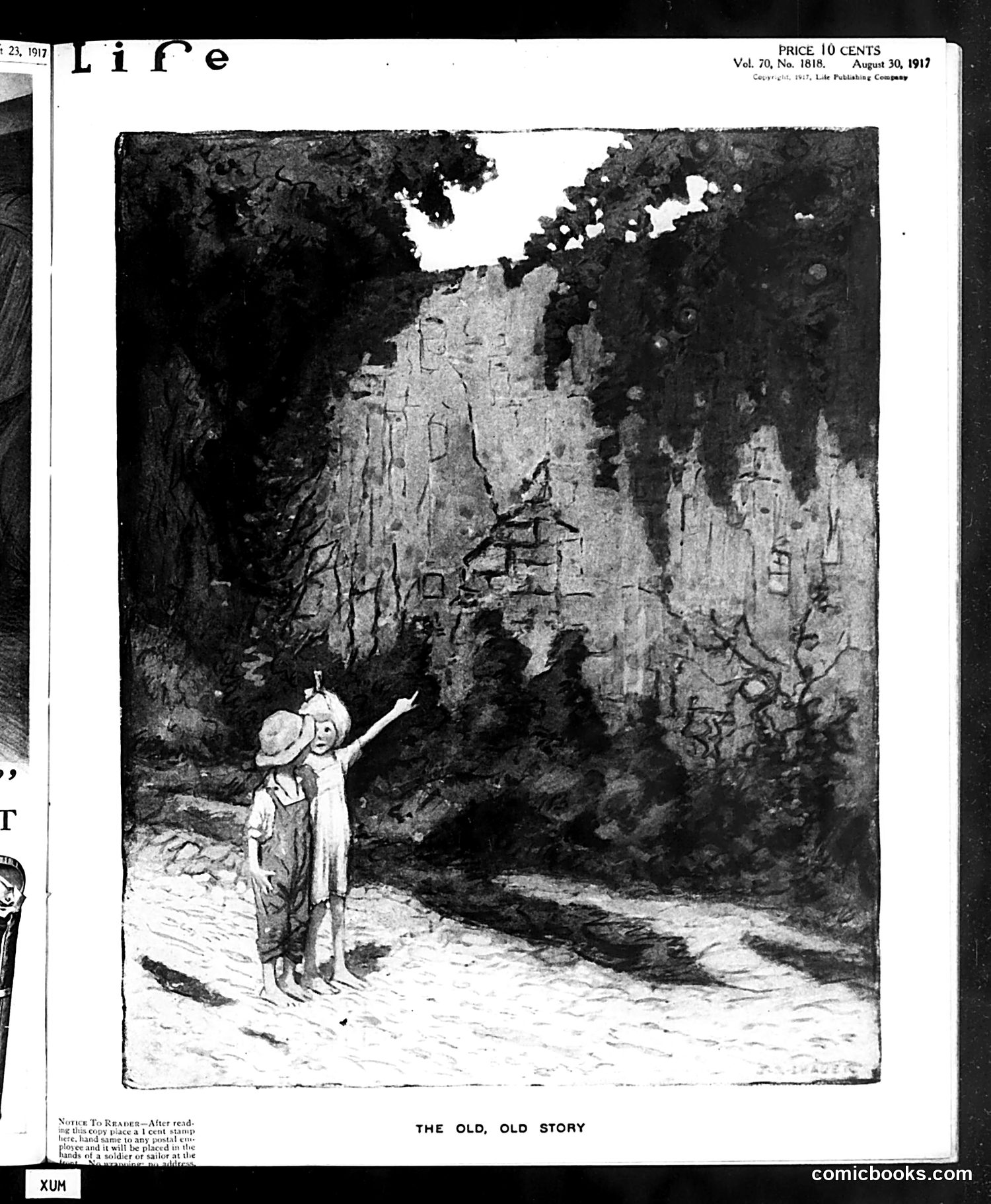
This Life magazine cover from August 30, 1917 depicts a child standing in front of ancient ruins, pointing upward in wonder or supplication. The title "The Old, Old Story" suggests commentary on humanity's cyclical nature—destruction and rebuilding repeating across civilizations. Given the 1917 publication date (during American involvement in World War I), this likely carries anti-war sentiment. The child among ruins represents the consequences of conflict: the destruction of civilization and the burden inherited by younger generations. The pointing gesture may suggest either hope for transcendence or despair at the pattern's repetition. The satire critiques how societies perpetually engage in destructive wars despite knowing history's lessons—hence "the old, old story" that never changes.
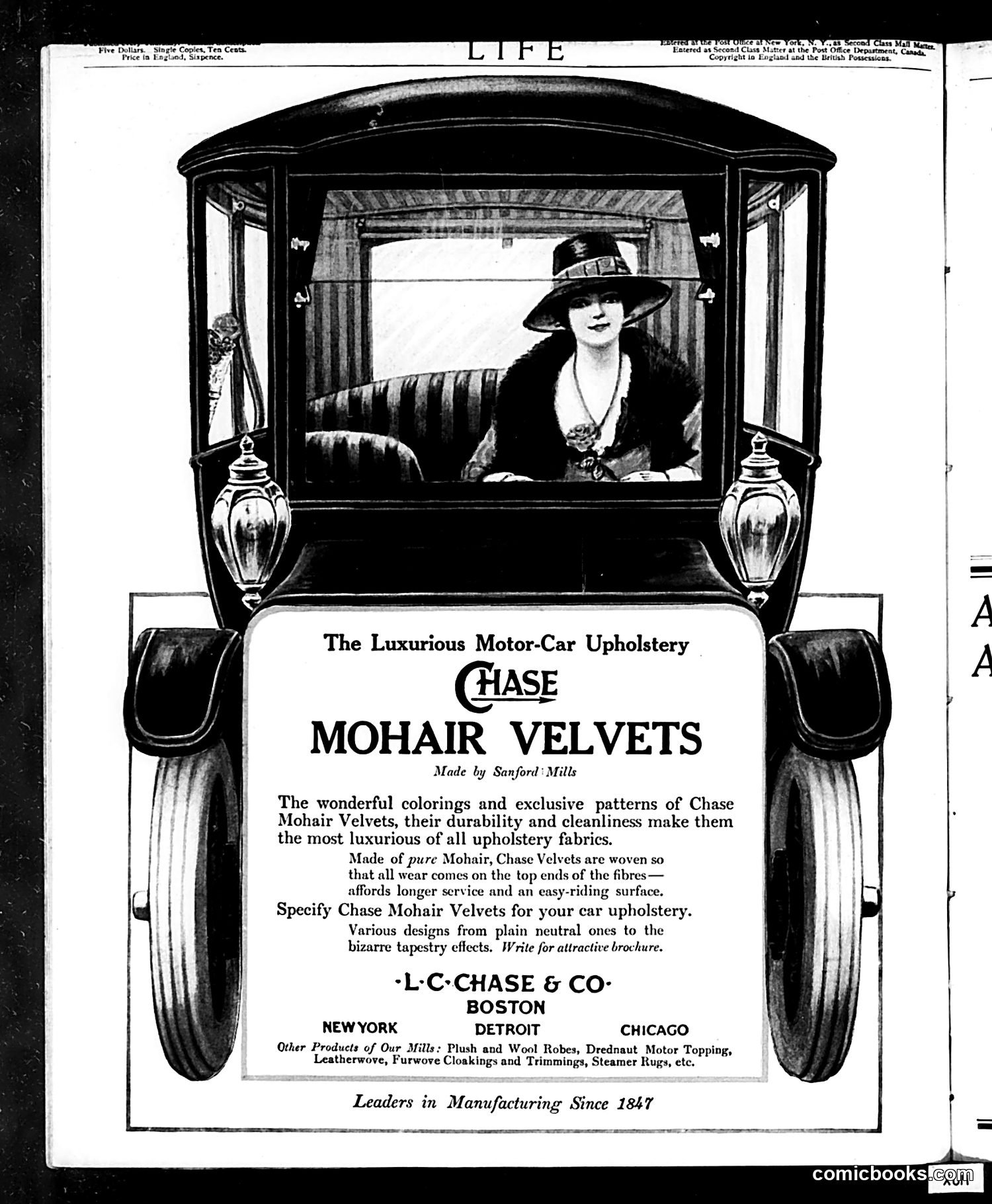
This page is primarily a commercial advertisement, not political satire. It promotes "Chase Mohair Velvets" for luxury automobile upholstery, made by L.C. Chase & Co. (established 1847), with offices in New York, Boston, Detroit, and Chicago. The advertisement features an illustration of an elegantly dressed woman in a wide-brimmed hat seated in the interior of a high-end motor car. The image emphasizes the fabric's exclusivity and durability for car interiors. The text highlights the velvets' "wonderful colorings and exclusive patterns" and their practical advantages: wear-resistance and easy cleaning. This reflects early 20th-century automobile luxury culture, when fine fabrics were a status symbol distinguishing expensive vehicles.
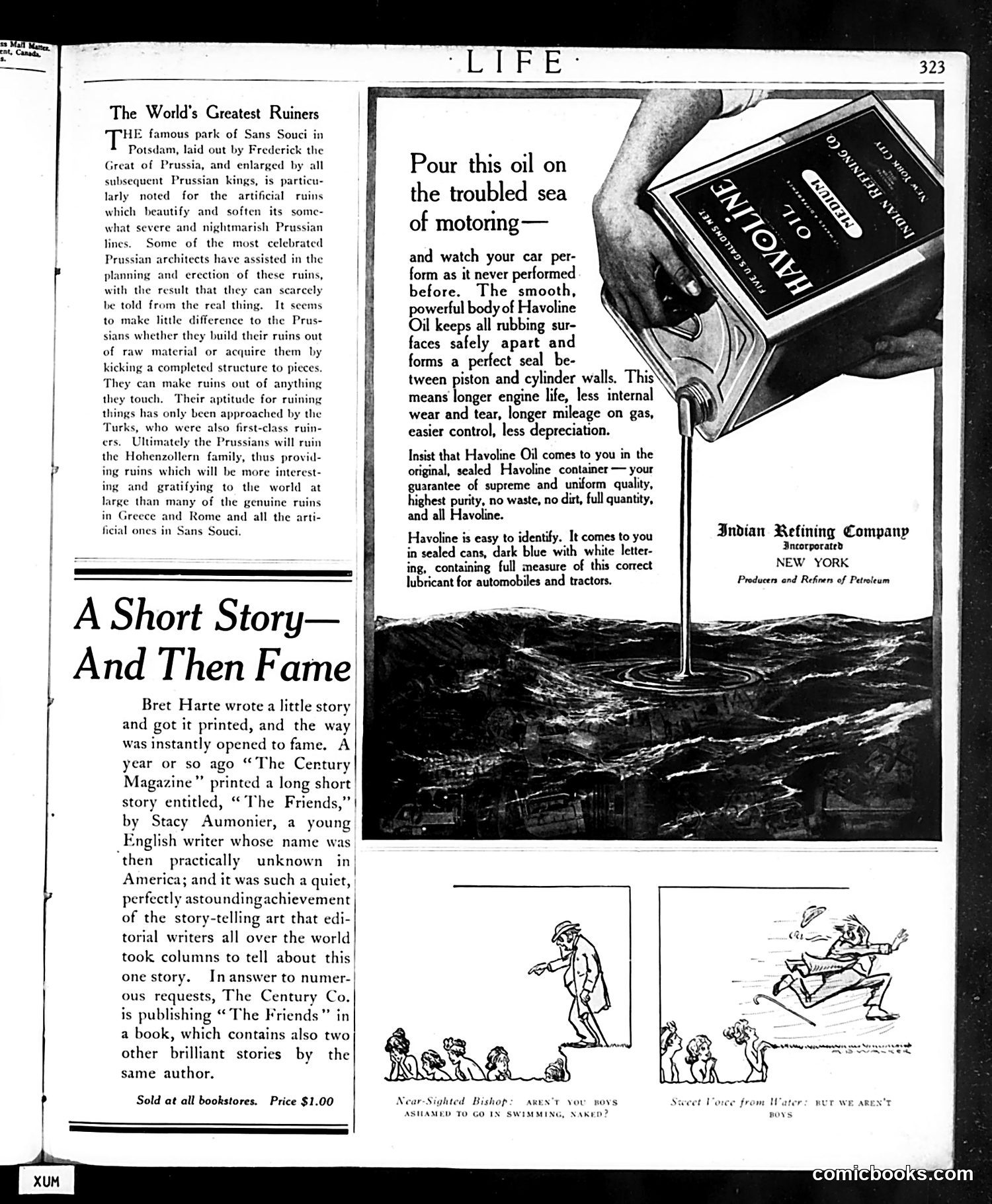
This page is primarily **advertising and book promotion** rather than satire or political commentary. The top half contains a **Havoline Oil advertisement** (Indian Refining Company, New York) using an image of oil being poured onto turbulent water to promote the lubricant's engine-protecting properties. The visual metaphor—calming troubled seas—was common in early automotive advertising. Below is a book promotion for Stacy Aumonnier's short story collection *"The Friends,"* celebrating its recent success after publication in *The Century Magazine*. The text notes the story achieved "quiet, perfectly astounding" literary acclaim. The bottom cartoons appear to be humorous illustrations related to swimming or water activities, with captions referencing bishops and boys, though the specific satirical point is unclear from this reproduction.
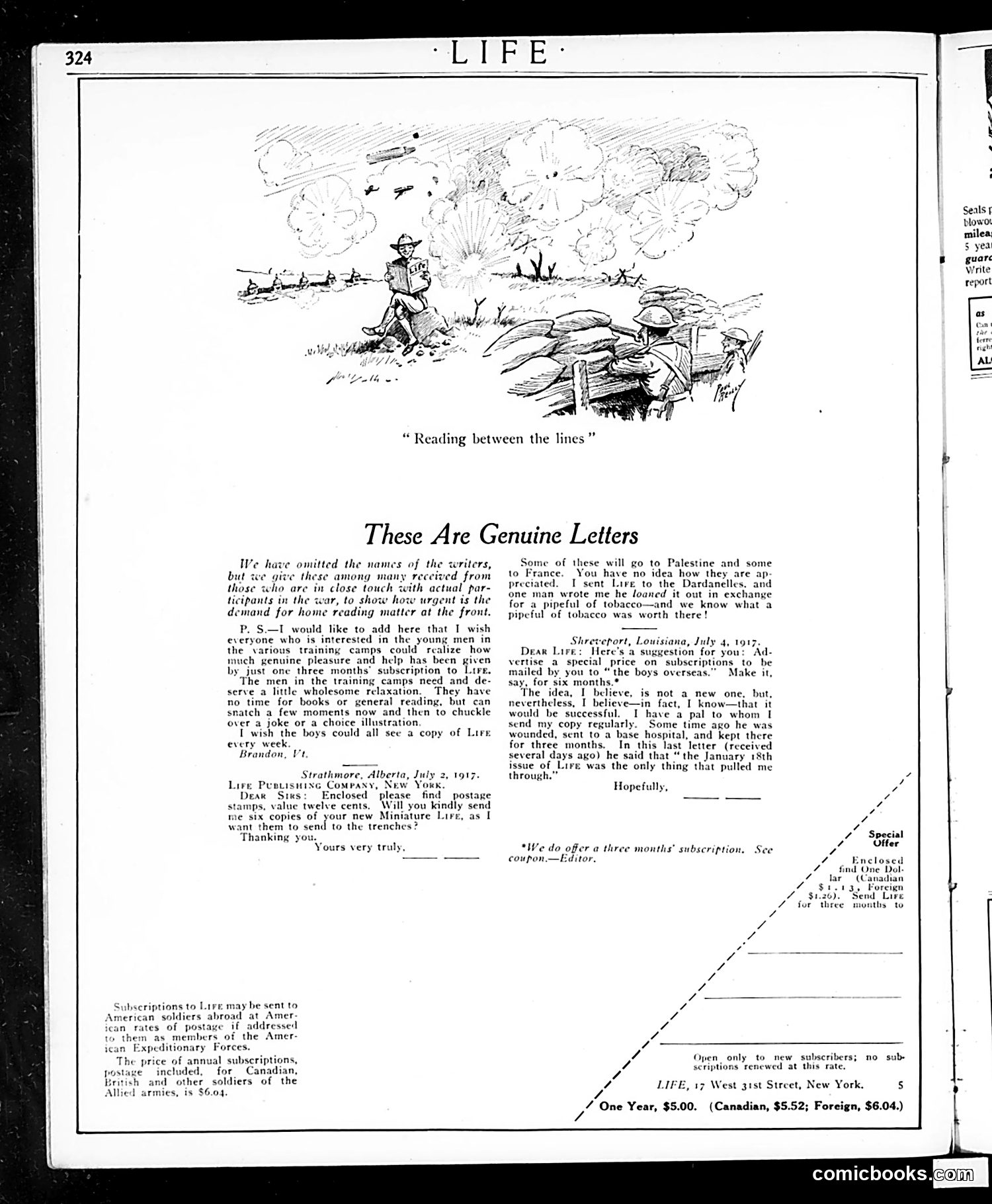
This cartoon satirizes **wartime censorship** during World War I. The sketch shows soldiers in a trench with explosions and military action in the background, while a lone figure (possibly a censor or official) examines documents in the foreground. The title "Reading Between the Lines" is a double entendre: it references both the literal practice of military censors who redacted soldier correspondence, and the figurative meaning—inferring hidden truths from incomplete information. The accompanying letters section titled "These Are Genuine Letters" presents reader correspondence from soldiers and civilians, apparently selected to show authentic voices from the war front. Life magazine is positioning itself as providing unfiltered perspectives that bypass official military censorship, contrasting "real" soldier experiences with official military communications.
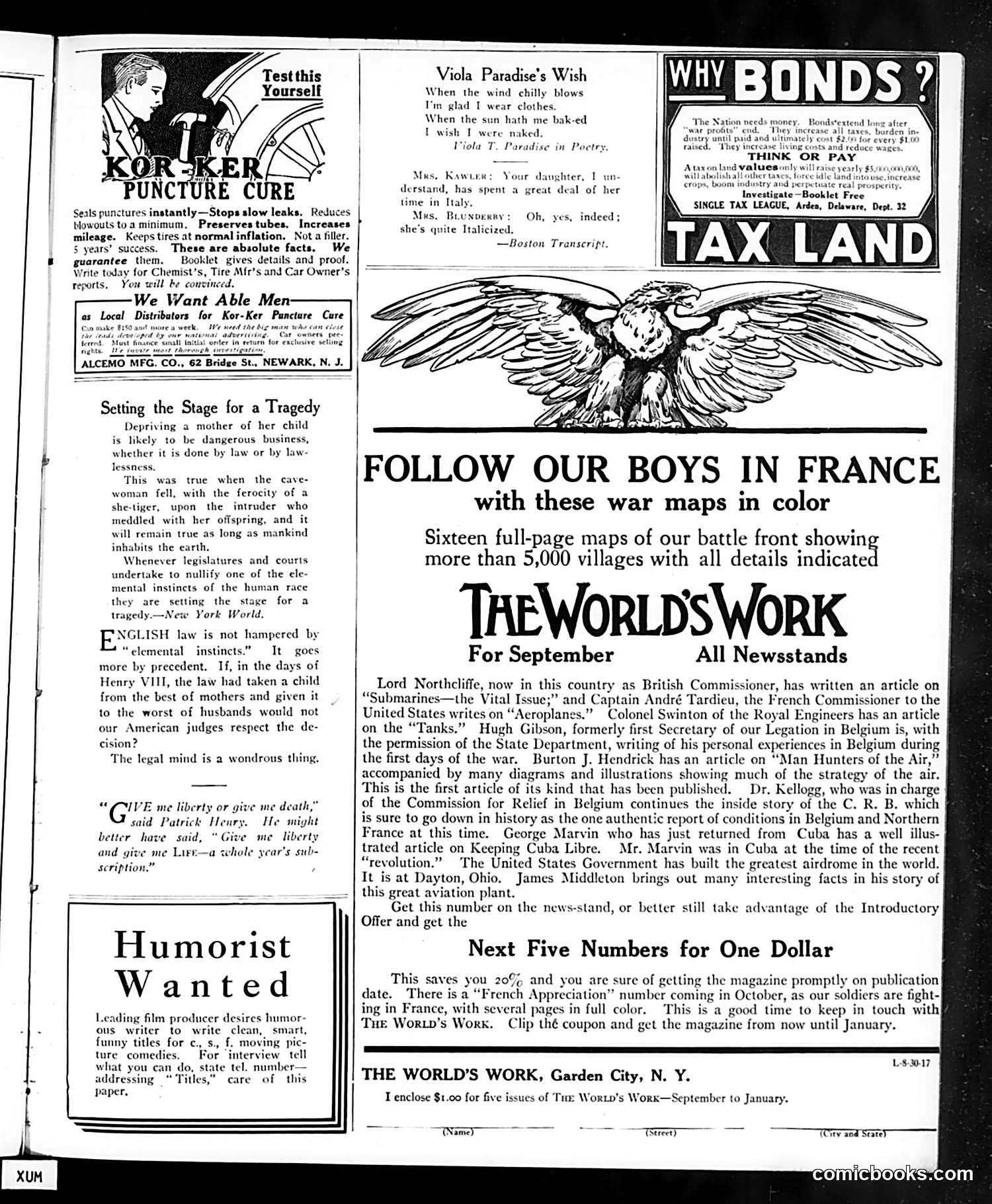
This page is primarily **advertising and editorial content** rather than political satire. The main elements are: 1. **Kor-Ker Puncture Cure ad** (top left): A product advertisement claiming to seal punctures in tires, targeting local distributors. 2. **"Setting the Stage for a Tragedy"** (center left): A brief opinion piece about child custody laws, arguing that English law improperly restricts mothers' rights to protect children from dangerous situations. 3. **The World's Work magazine promotion** (center/right): Advertising colored war maps of France's WWI battlefront, featuring articles by military figures about submarines, tanks, and air combat—clearly targeting readers interested in following the war effort. 4. **"Humorist Wanted"** (bottom left): A job posting from a film producer seeking a comedy writer. The page reflects wartime America (likely 1917-1918), emphasizing war-related content and commercial advertising.
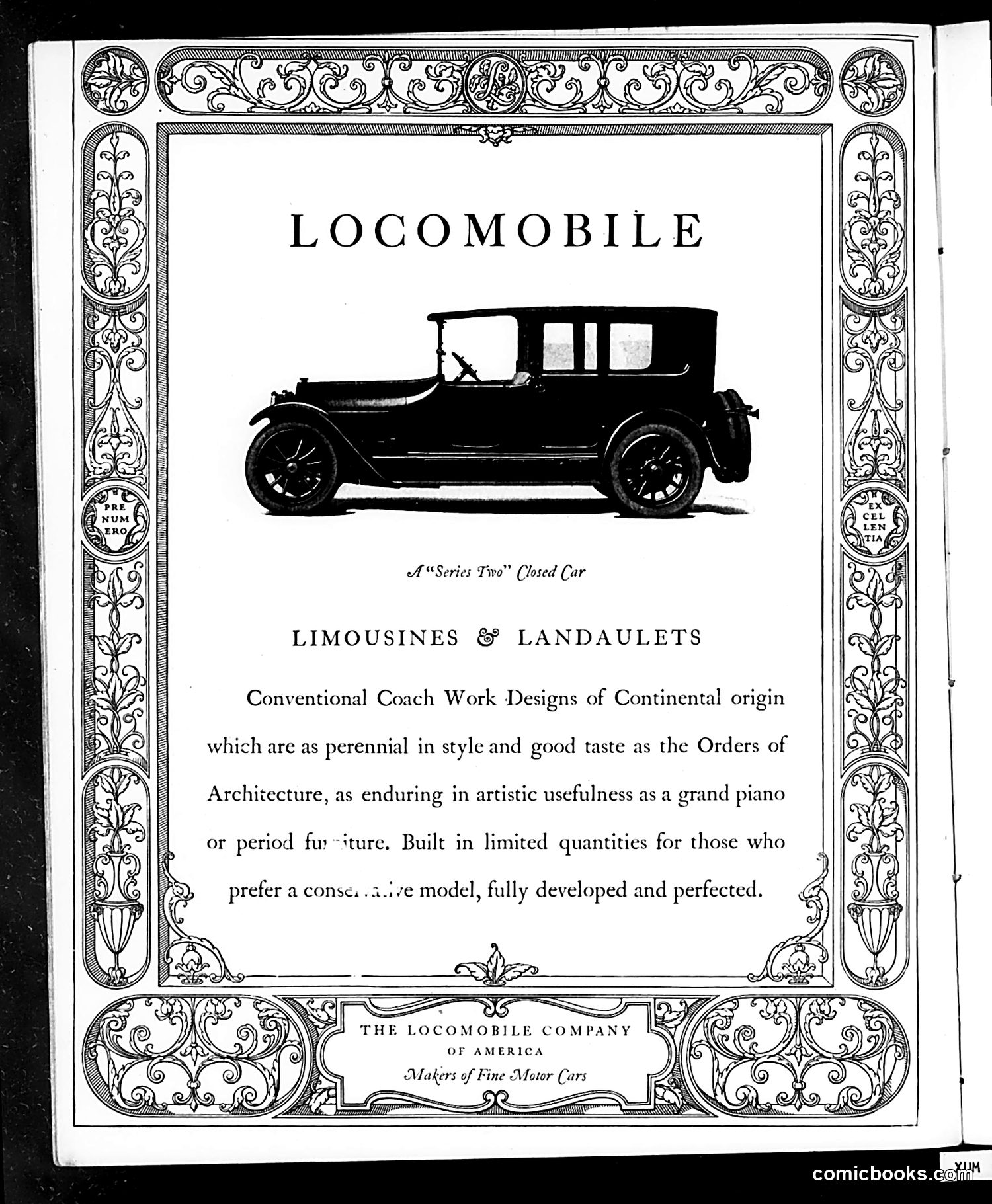
This is not a satirical cartoon, but rather a **luxury automobile advertisement** for the Locomobile Company of America. The page promotes their "Series Two" closed car, specifically limousines and landaulets. The advertisement uses ornate decorative borders typical of early 20th-century print design. The text employs pretentious language, comparing the vehicles to "Orders of Architecture" and "a grand piano or period furniture"—positioning Locomobiles as status symbols for wealthy consumers who "prefer a conservative model, fully developed and perfected." This represents early automotive marketing targeting the affluent, emphasizing craftsmanship, exclusivity, and timeless style rather than innovation or performance. It's a straightforward commercial appeal, not satire.
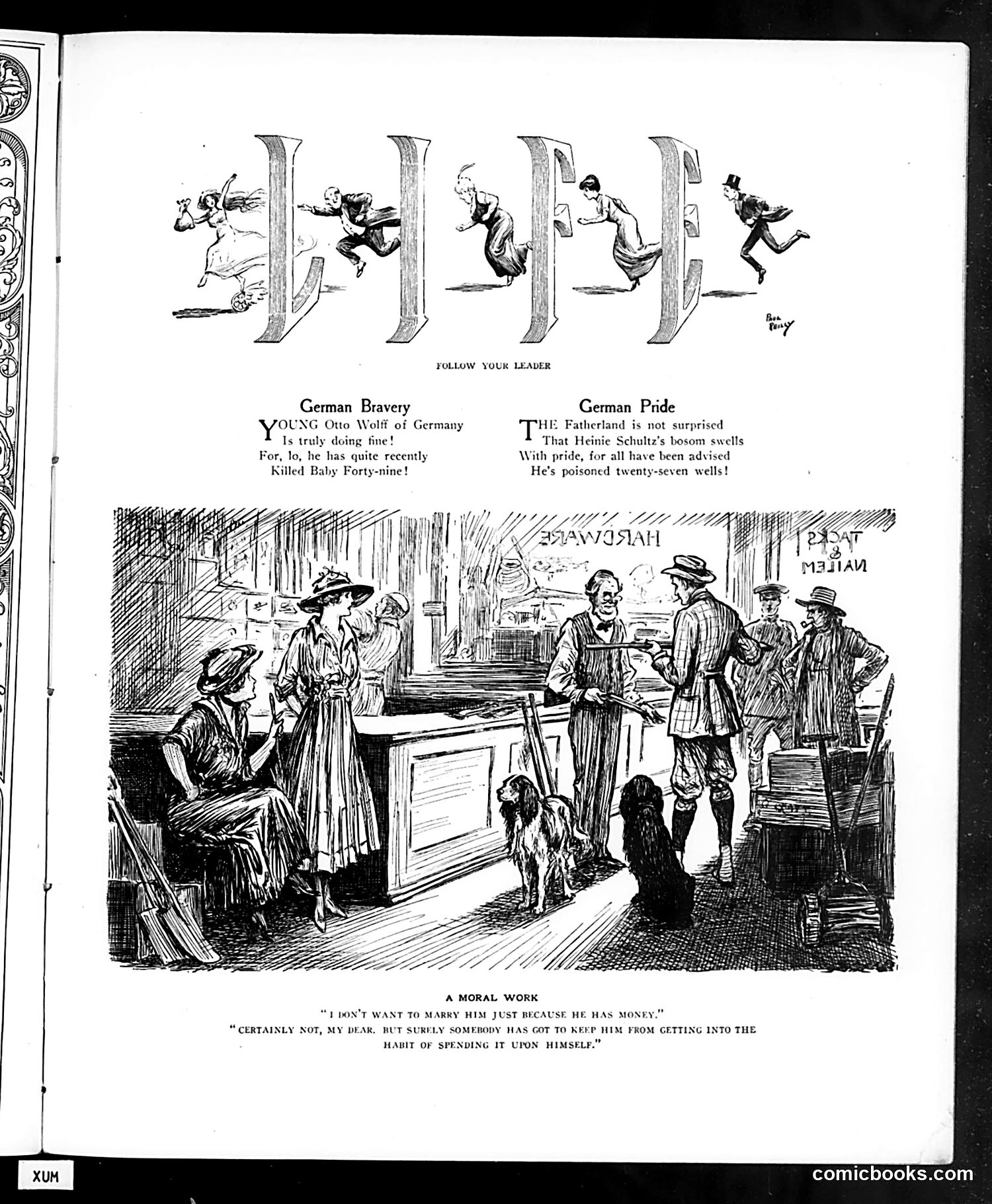
This page contains WWI-era propaganda satire. The top strip "Follow Your Leader" shows figures leaping through large "I"s in a visual pun, mocking blind obedience to authority. Below are two short pieces: "German Bravery" satirizes Otto Wolff of Germany killing "Baby Fortysomething" (likely a satirical reference to a German military figure), while "German Pride" mocks Heinrich Schultz's poisoned wells as a source of national boasting. The bottom cartoon, "A Moral Work," depicts what appears to be a butcher shop or market with German soldiers and civilians. The caption suggests cynicism about money and moral character—a woman refuses to marry a wealthy man unless someone controls his spending habits. The overall tone is anti-German wartime propaganda, using satire to mock German military practices and moral character.
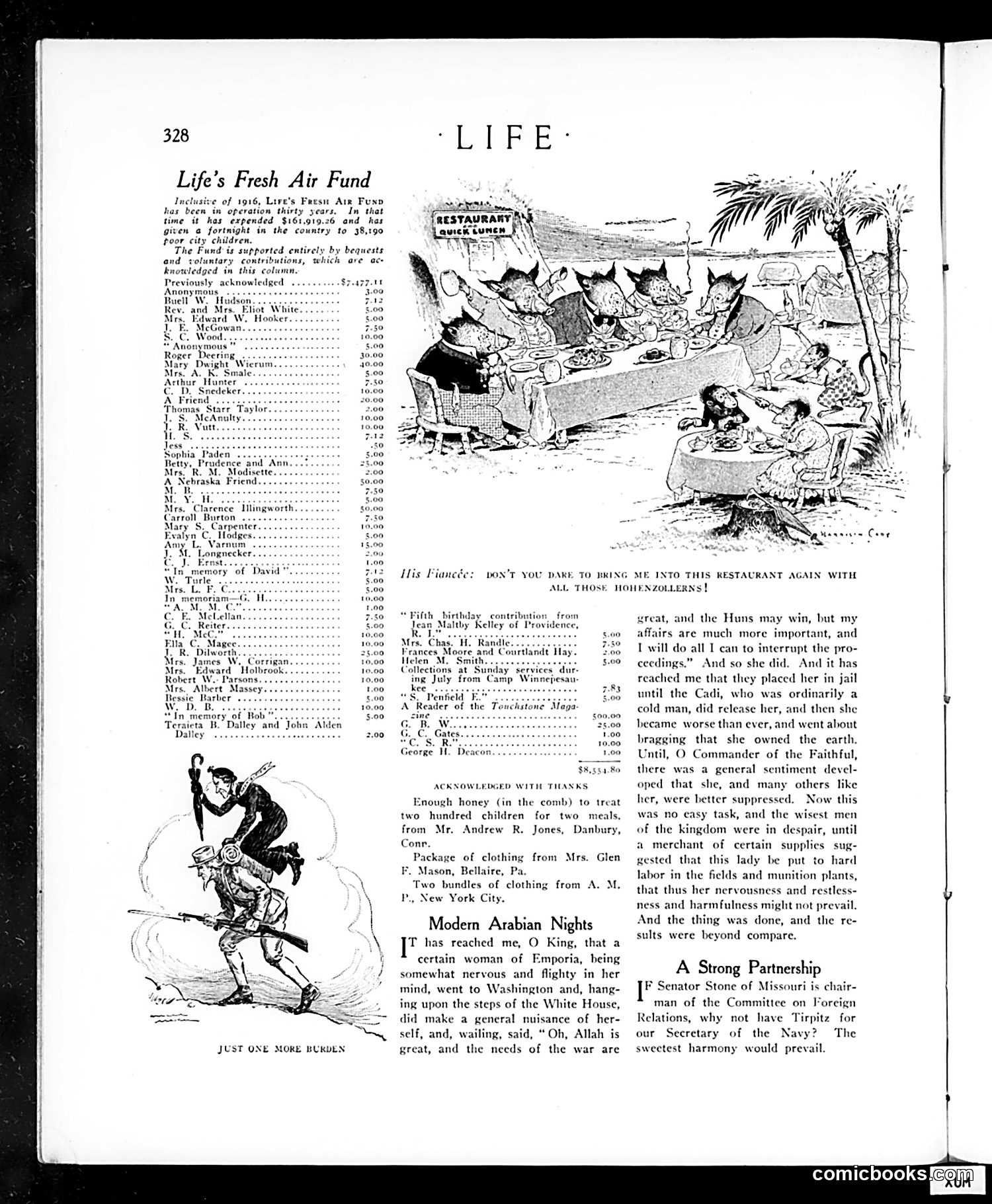
This page documents **Life's Fresh Air Fund**, a charitable initiative providing country vacations for urban children. The left column lists donors and contributions (ranging from $1-$50). The main cartoon titled **"Just One More Huron"** depicts a figure in military/warrior attire—likely satirizing wartime profiteering or military contractors. The exaggerated pose and caption suggest mockery of someone seeking additional contracts or opportunities during wartime. The accompanying article **"Modern Arabian Nights"** tells of a woman from Emporia complaining to Washington officials about wartime conditions, framed as absurd self-centered behavior amid national crisis. The **"Strong Partnership"** section discusses Senator Stone and foreign relations, touching on wartime political matters. The overall page mixes charitable fundraising with satirical commentary on civilian wartime behavior and priorities.
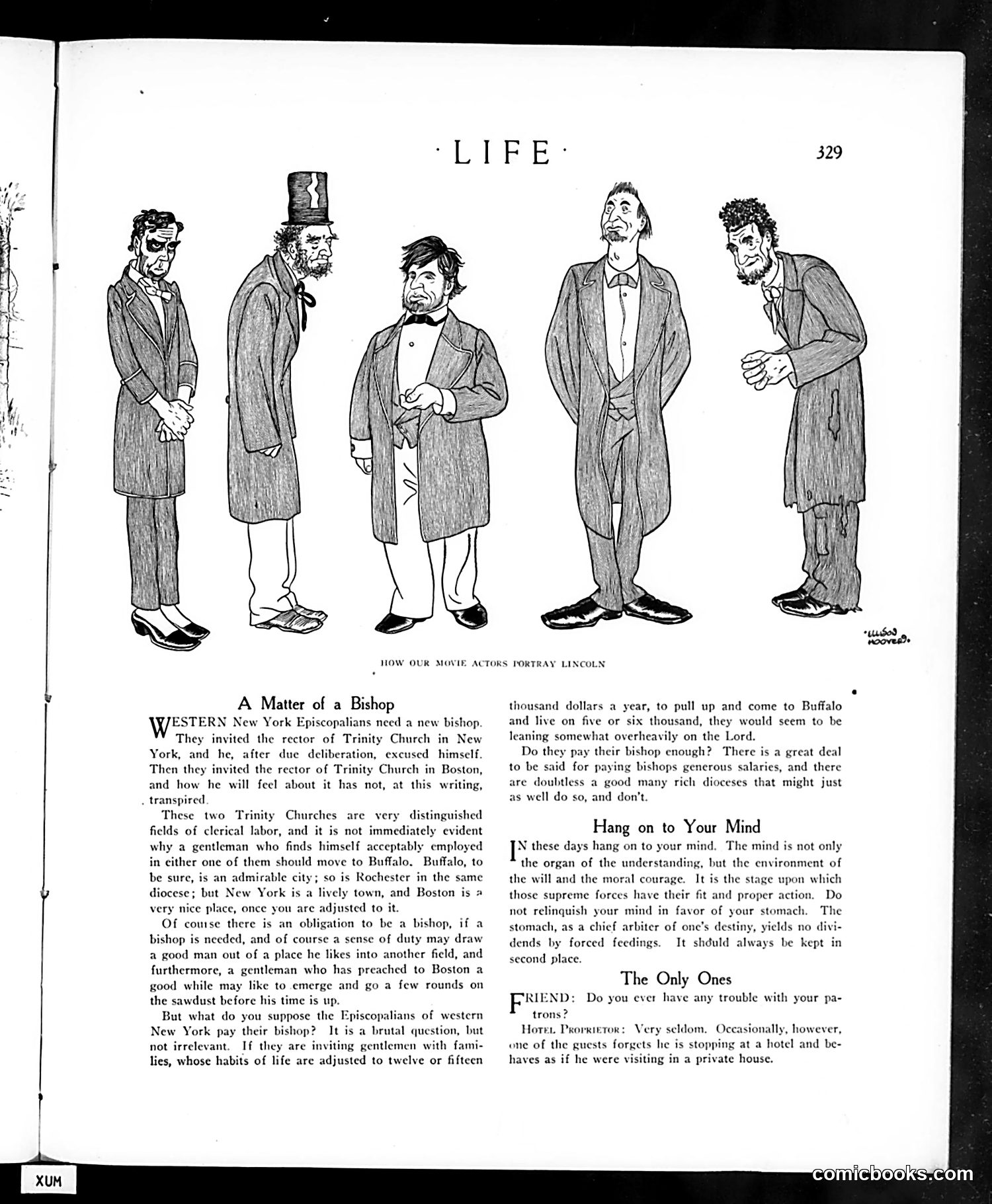
The top illustration titled "How Our Movie Actors Portray Lincoln" shows five caricatured men in formal wear, likely mocking how different actors portrayed Abraham Lincoln in films. The exaggerated facial features suggest satire of theatrical interpretations. The text articles below address unrelated topics: "A Matter of a Bishop" discusses Episcopal church politics and salary disputes between New York and Western dioceses seeking candidates for leadership positions. "Hang on to Your Mind" offers philosophical advice about mental discipline. "The Only Ones" presents a brief humorous dialogue between a friend and hotel proprietor about guest misbehavior. The page appears to be typical Life magazine satirical content mixing entertainment criticism with social commentary and light humor.
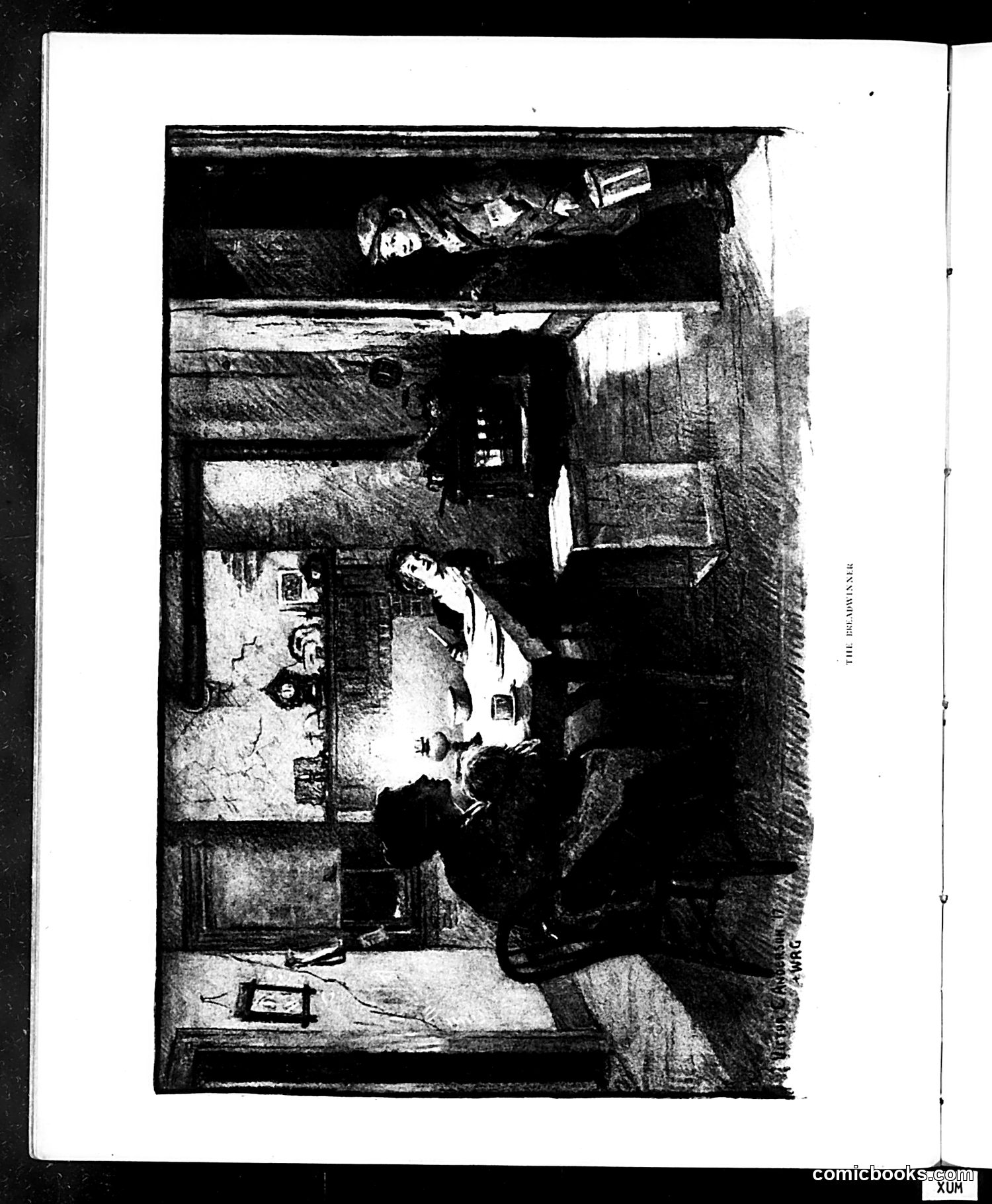
I can see this is a black and white illustration showing what appears to be an interior domestic scene, rotated 90 degrees on the page. The image shows figures in what looks like a modest room or apartment with furniture and household items visible. However, the OCR text provided is blank—no readable text accompanies this image on the page. Without the satirical caption, headline, or explanatory text that would typically accompany a Life magazine cartoon, I cannot definitively identify the specific political or social reference, the figures depicted, or the intended joke or critique. To properly explain this cartoon's meaning to a modern reader, I would need the accompanying text that Life magazine provided. The visual content alone is insufficient to determine its satirical target or historical context.
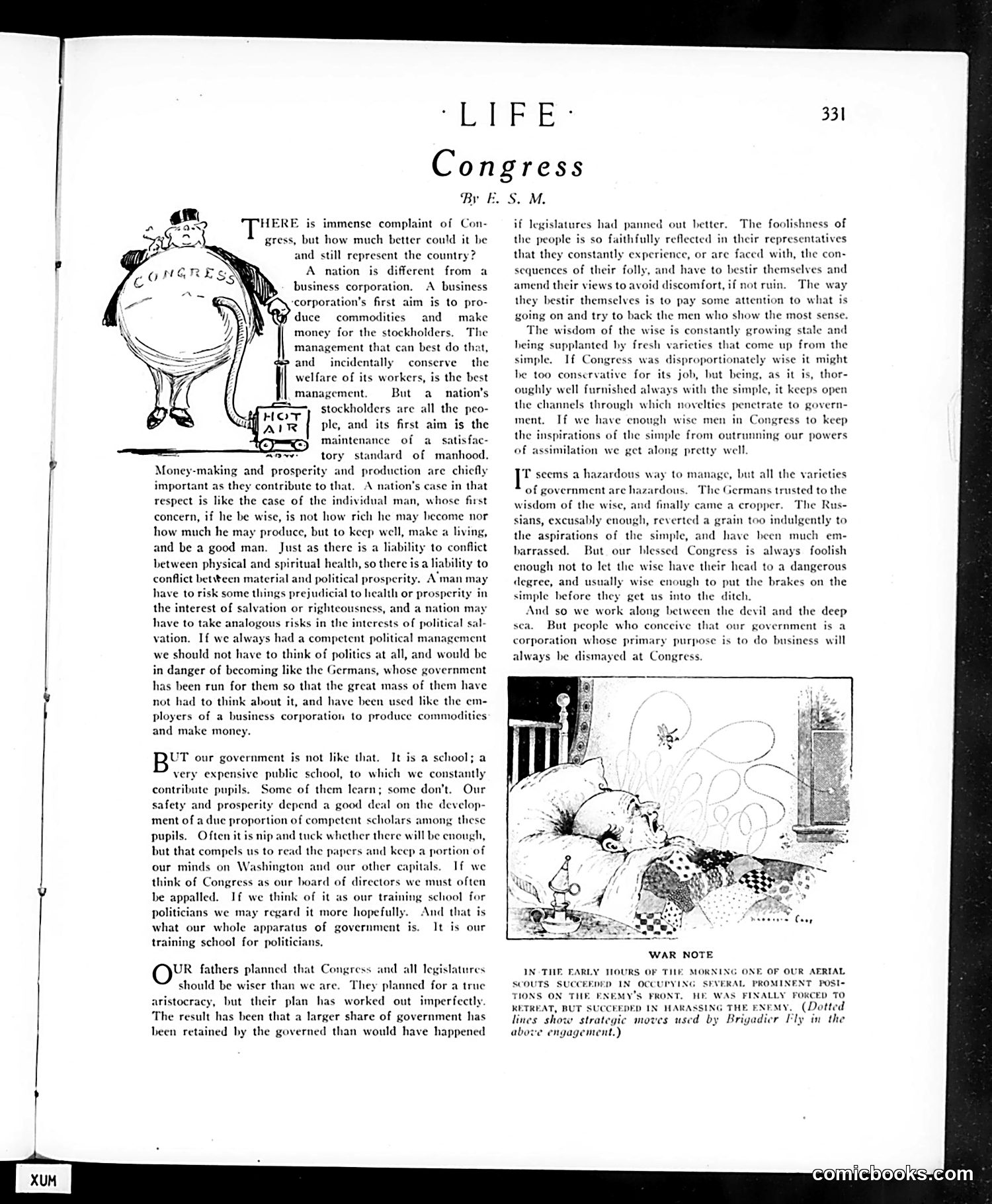
The large caricature on the left depicts **Congress personified as a bloated, rotund figure**, labeled "Congress," stuffed with money and self-interest. This visualizes the essay's central critique: that Congress has become too focused on business and profit rather than serving the public good. The text argues Congress functions like a **"school"** for training politicians rather than as a true governing body. The author critiques legislators for being either too conservative or too foolish, constantly reversing course based on public pressure rather than principle. The **war-time illustration** below shows aerial combat, supporting the essay's broader point about government managing crises poorly. Overall, the satire lambastes Congressional incompetence and corruption during what appears to be **WWI-era America**.
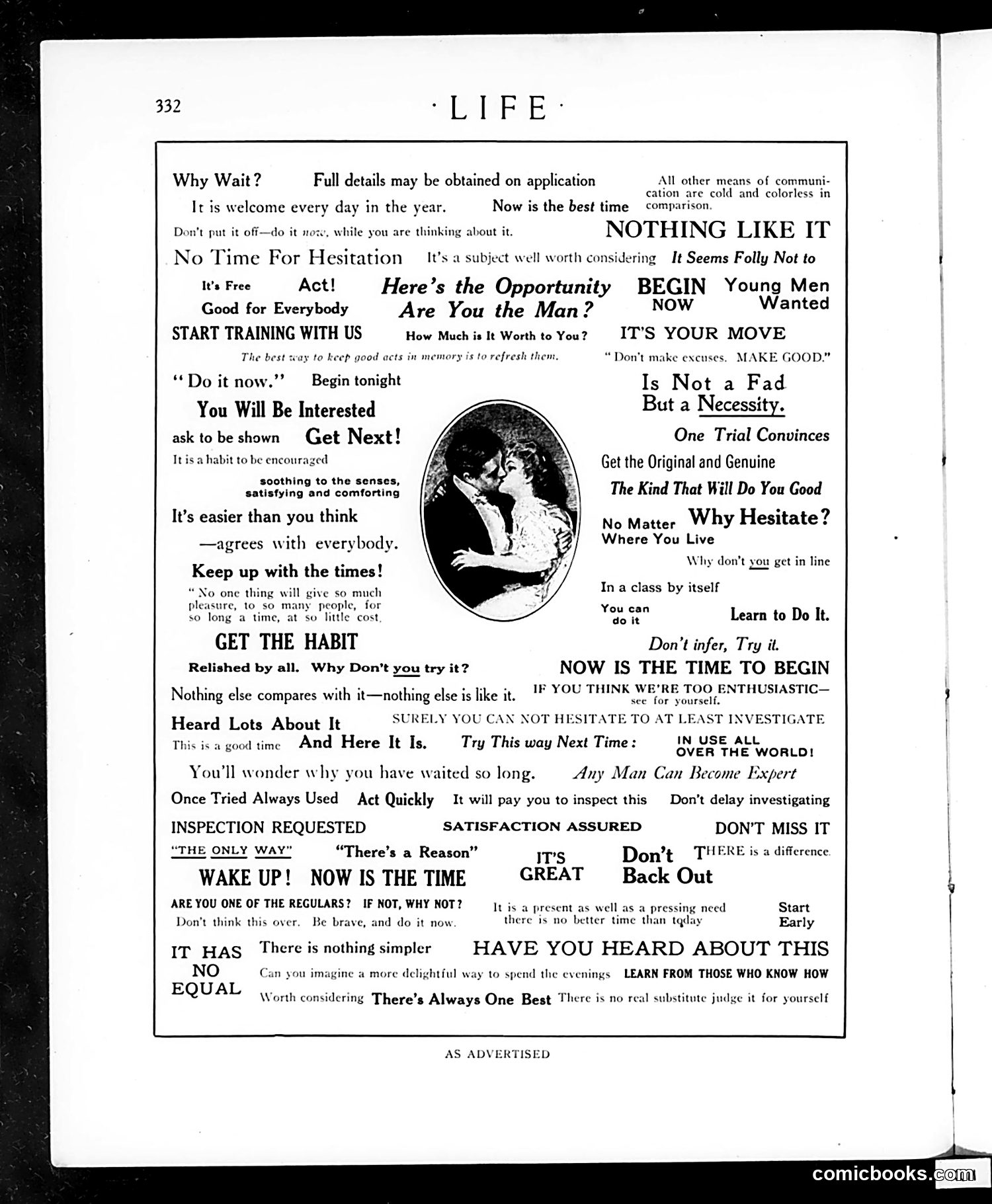
This page is **advertising content**, not editorial satire. It consists of overlapping promotional copy using aggressive sales tactics common to early 20th-century marketing. The central image shows a couple in an intimate embrace—likely advertising a personal hygiene or grooming product, though the specific product isn't clearly identified. The text employs psychological pressure ("Why Wait?", "NOW IS THE TIME", "Don't Back Out") and repetitive urgency to overcome consumer hesitation. Phrases like "It's easier than you think" and "One Trial Convinces" target male readers with appeals to ease, immediacy, and peer pressure. The page reflects historical advertising conventions: gendered marketing (targeting young men), vague product references, and manipulative persuasion techniques now recognized as predatory but standard for the era.
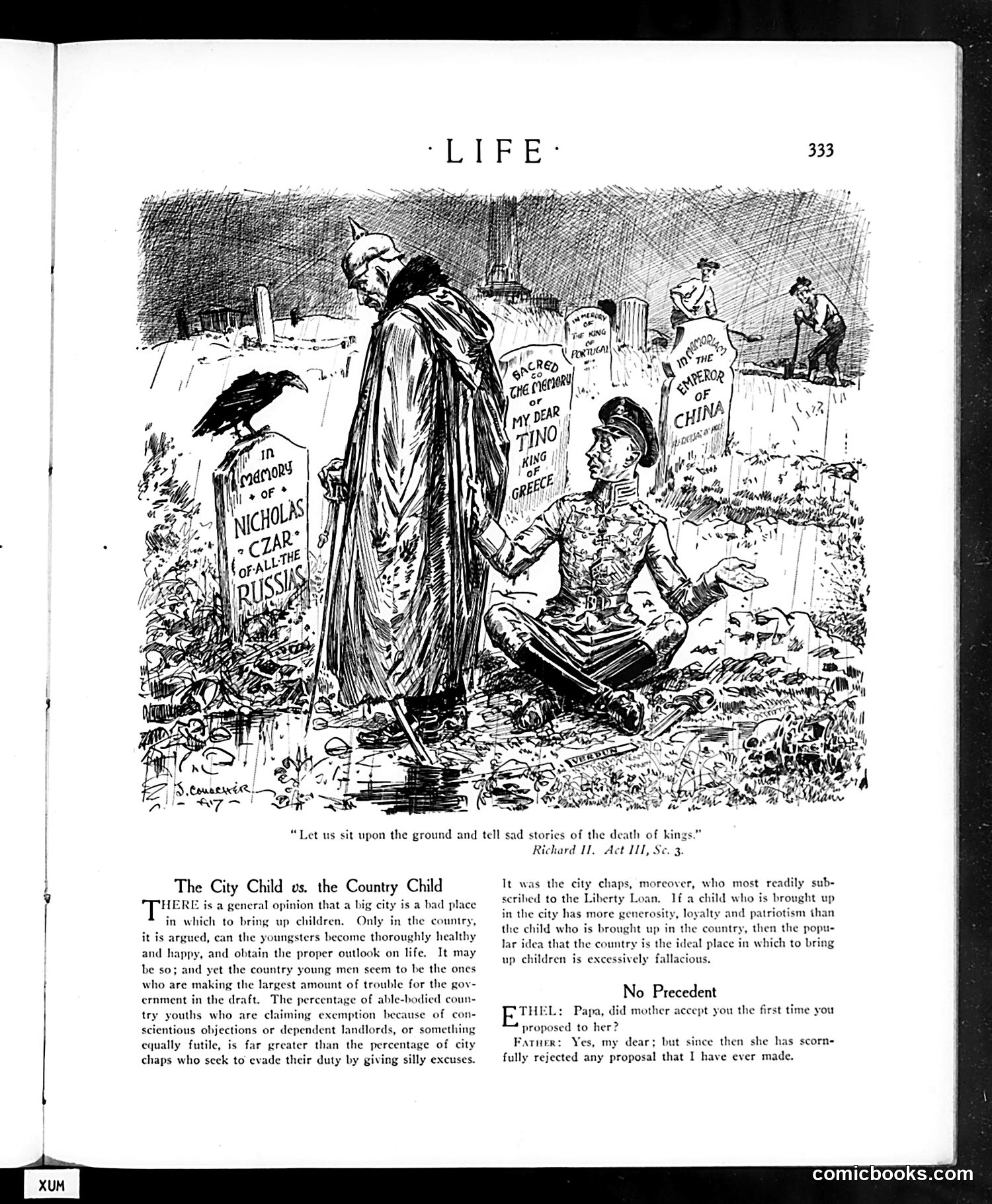
This editorial cartoon depicts **Death as a cloaked skeleton** visiting a military graveyard. The graves visible include rulers labeled "Nicholas Czar of All the Russias," "My Dear Tino" (likely King Constantine of Greece), and "Emperor of China"—references to **monarchies toppled or destabilized during WWI and its aftermath** (1917-1920s). A seated **military officer** gestures toward the graves in apparent despair. The satirical point: European and Asian monarchies are collapsing, their power crumbling. The Shakespeare epigraph reinforces themes of fallen rulers and historical decline. The cartoon critiques how war has dismantled centuries-old imperial systems, presenting Death as the ultimate victor over crowns and kingdoms.
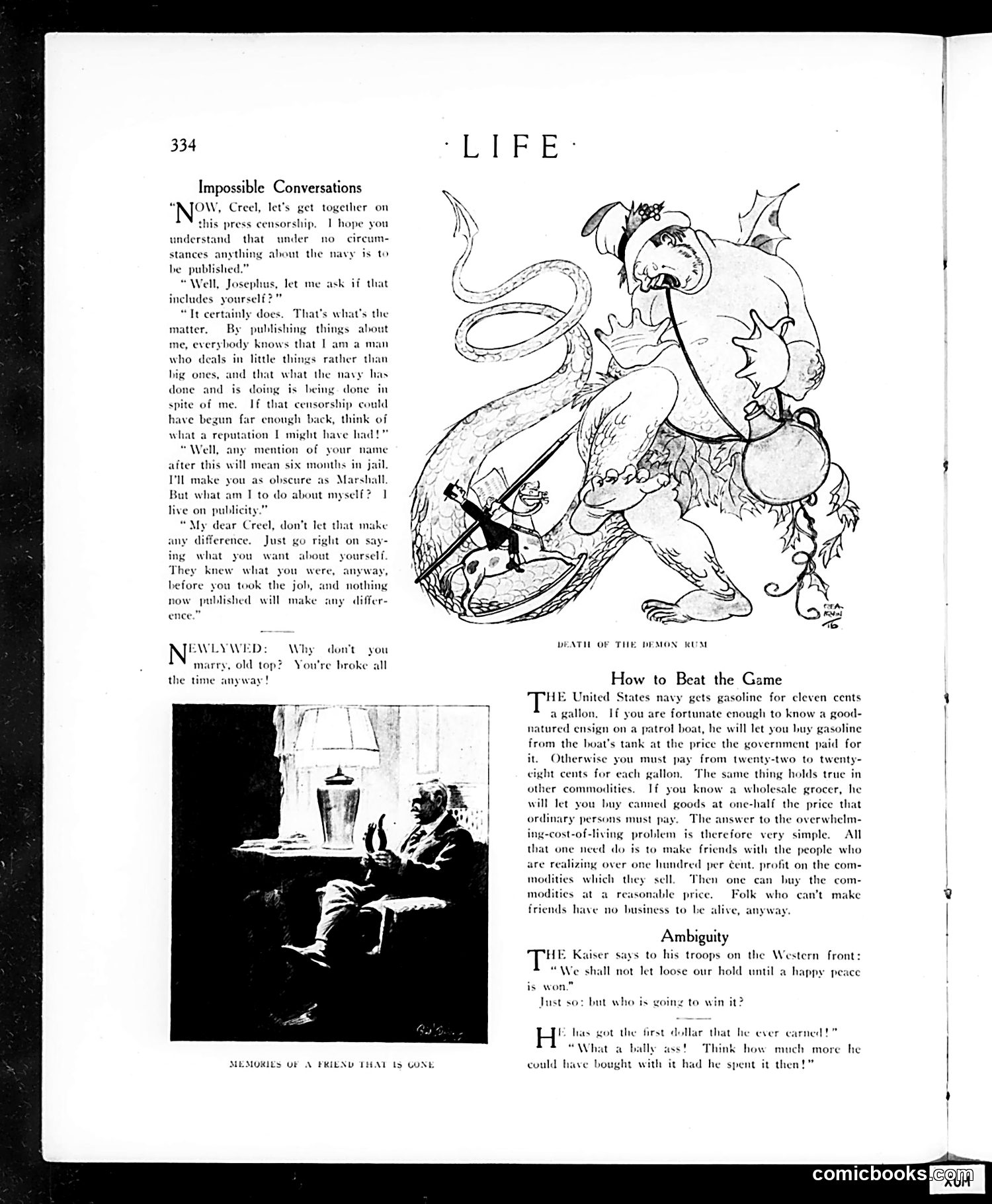
This page contains three satirical pieces: **"Impossible Conversations"** depicts an exchange between two figures (Creel and Josephus) about press censorship during what appears to be WWI. The dialogue mocks the contradiction between claims of no naval censorship while actual censorship is clearly in place. **"Death of the Demon Rum"** is a grotesque illustration showing the personified death of alcohol—likely related to Prohibition efforts gaining momentum in early 20th-century America. **"How to Beat the Game"** satirizes wartime price controls and profiteering, suggesting the only way to afford goods at inflated prices is through personal connections and black-market dealings. **"Ambiguity"** presents a sardonic quote about WWI, questioning who will actually "win" the peace. The overall theme critiques government hypocrisy and wartime economic disruption.
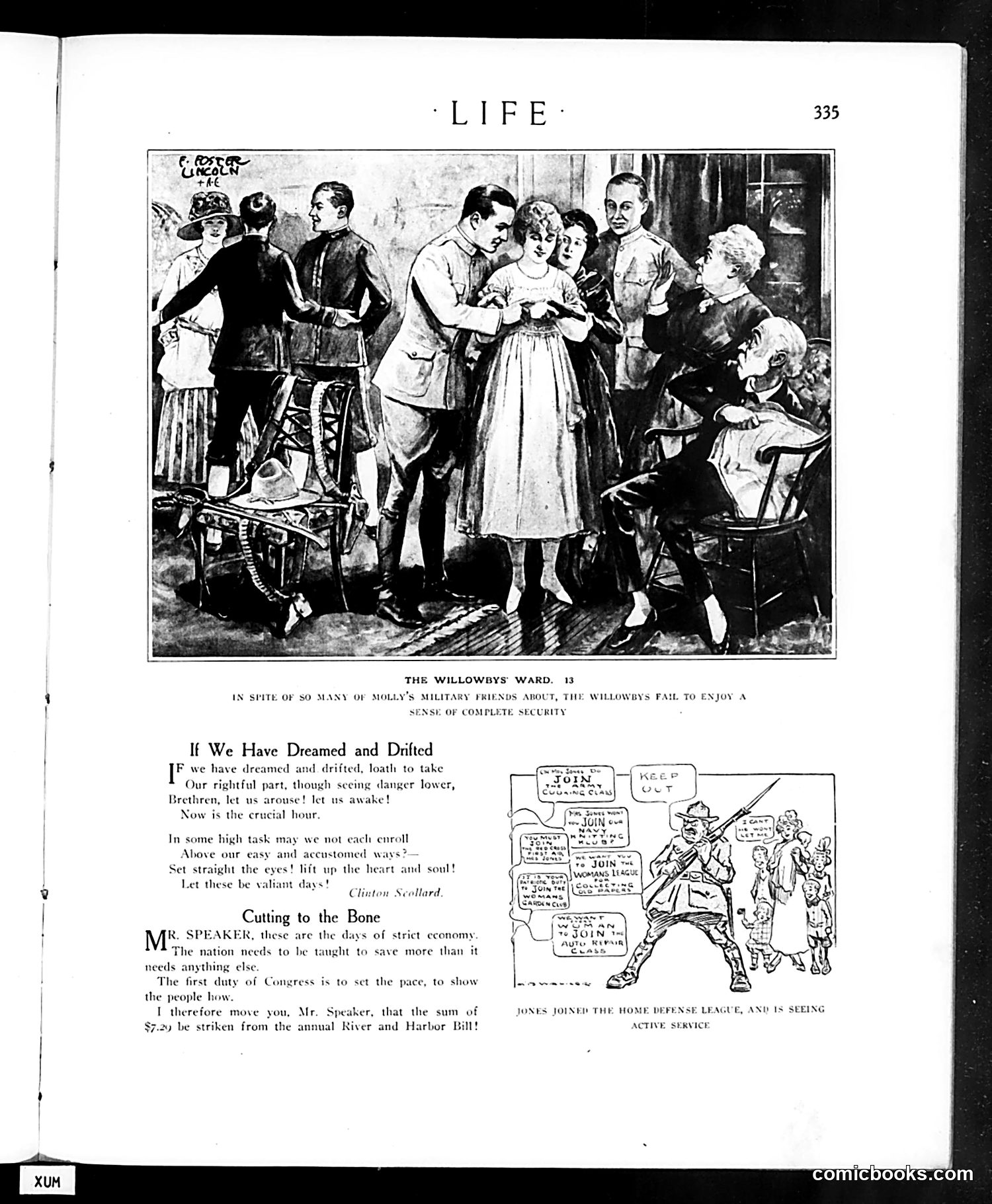
**Top Image ("The Willowbys' Ward"):** A domestic scene showing a young woman surrounded by military men and civilians, suggesting she lacks security despite being protected by "so many of Molly's military friends." The caption indicates these companions fail to provide "complete security," likely satirizing inadequate wartime protection measures or the false sense of safety from having military presence. **Bottom Section:** A poem "If We Have Dreamed and Drifted" (attributed to Clinton Scollard) discusses national duty and sacrifice. Below, a political piece titled "Cutting to the Bone" features Mr. Speaker advocating for economic measures, proposing to strike $7.29 from a "River and Harbor Bill" to teach national frugality during wartime. A cartoon shows someone joining the Home Defense League, satirizing wartime civilian participation and patriotic fervor.
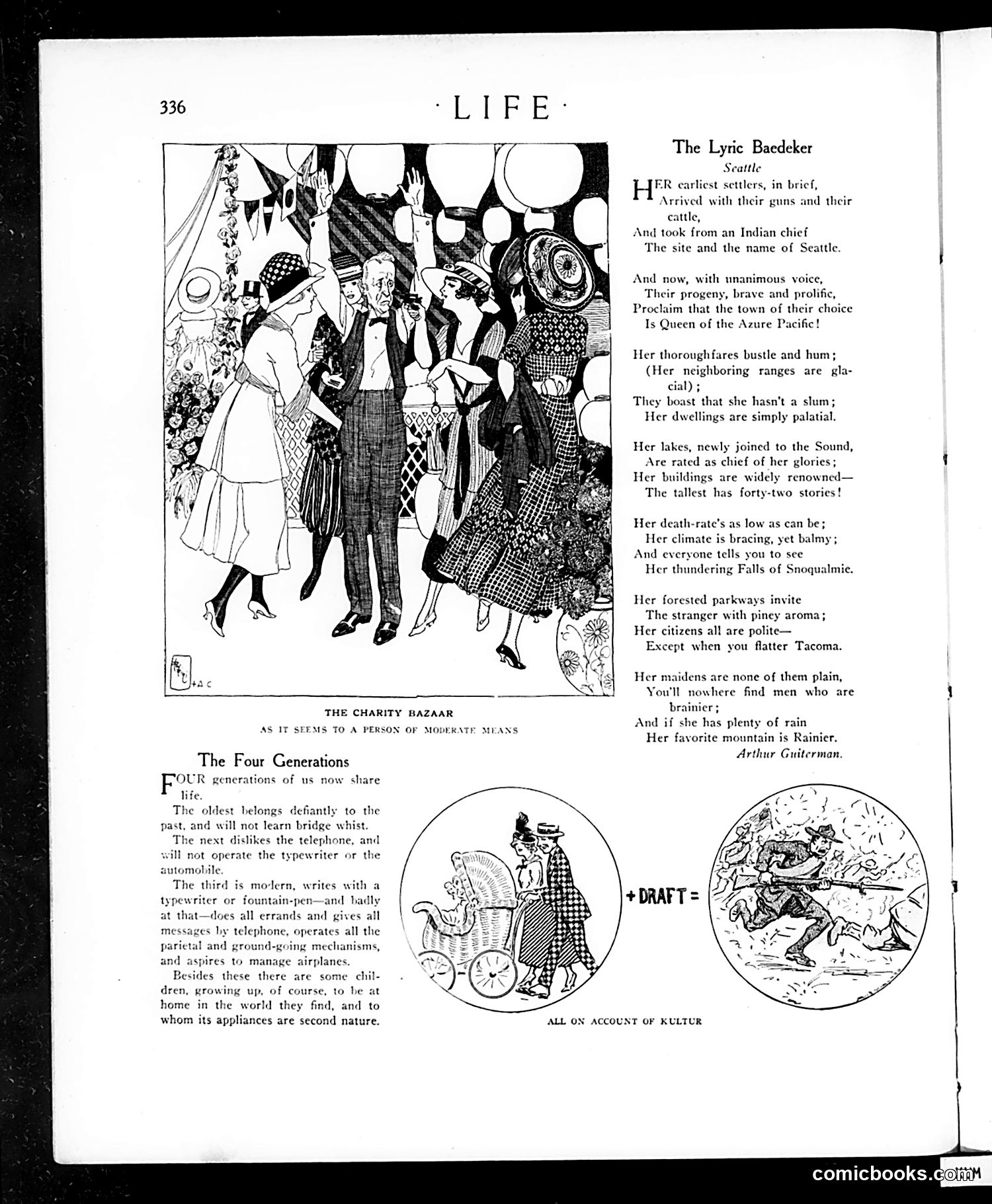
**"The Charity Bazaar" cartoon** satirizes wealthy socialites at a fundraising event. The illustration shows well-dressed attendees in an ornate setting, mocking how the affluent view charity galas—suggesting the event is more about social display than genuine philanthropy for those of "moderate means" (the title's ironic reference to wealthy people). **"The Four Generations"** is a social commentary on technological generational divides: the eldest rejects modern games; the next generation won't use phones or cars; the third type-writes poorly; only the youngest naturally adapt to new technology. This reflects early-20th-century anxieties about rapid technological change fragmenting society across age groups. **"The Lyric Baedecker: Seattle"** by Arthur Guiterman humorously catalogs Seattle's boasts—its growth, beauty, low death-rate, landmarks like Snoqualmie Falls and Mount Rainier. The satire lies in the excessive civic pride and one revealing line: citizens are polite "except when you flatter Tacoma"—mocking Seattle's rivalry with its neighboring city.
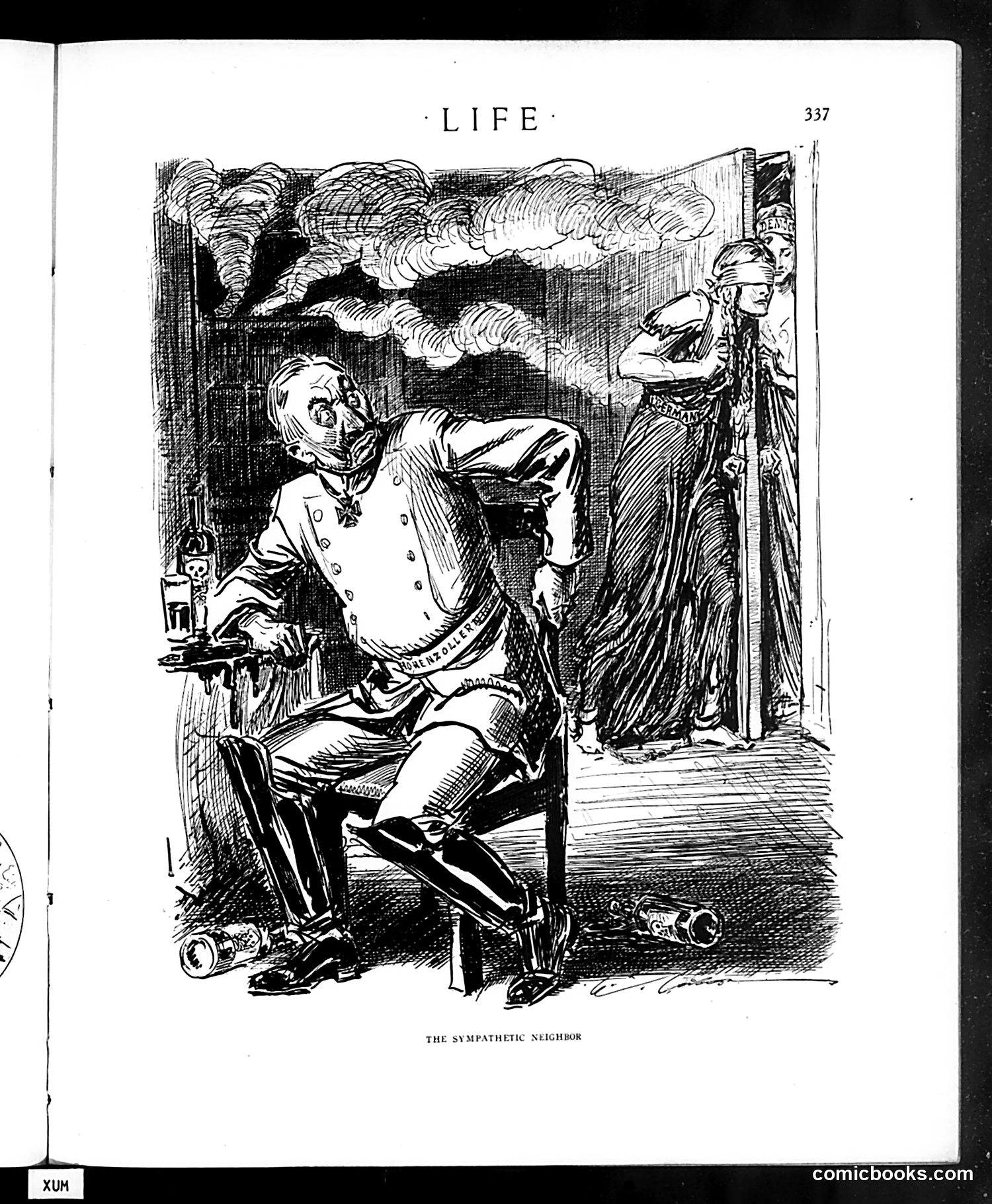
This cartoon depicts a military officer in formal uniform, seated and appearing distressed or troubled, while a woman in elaborate dress stands nearby in a doorway. The title "The Sympathetic Neighbor" suggests the woman is offering comfort or concern to the officer. The satirical point likely concerns the relationship between military authority and civilian sympathy during wartime (the uniform and formal military setting suggest this). The "sympathetic neighbor" may represent either genuine civilian support for military personnel, or—more likely, given Life's satirical nature—ironic commentary on superficial or performative concern from those uninvolved in actual combat. Without additional context about the specific date or historical moment, the exact political target remains unclear, though the contrast between the troubled officer and the well-dressed woman invites critique of class or gender dynamics surrounding military service.
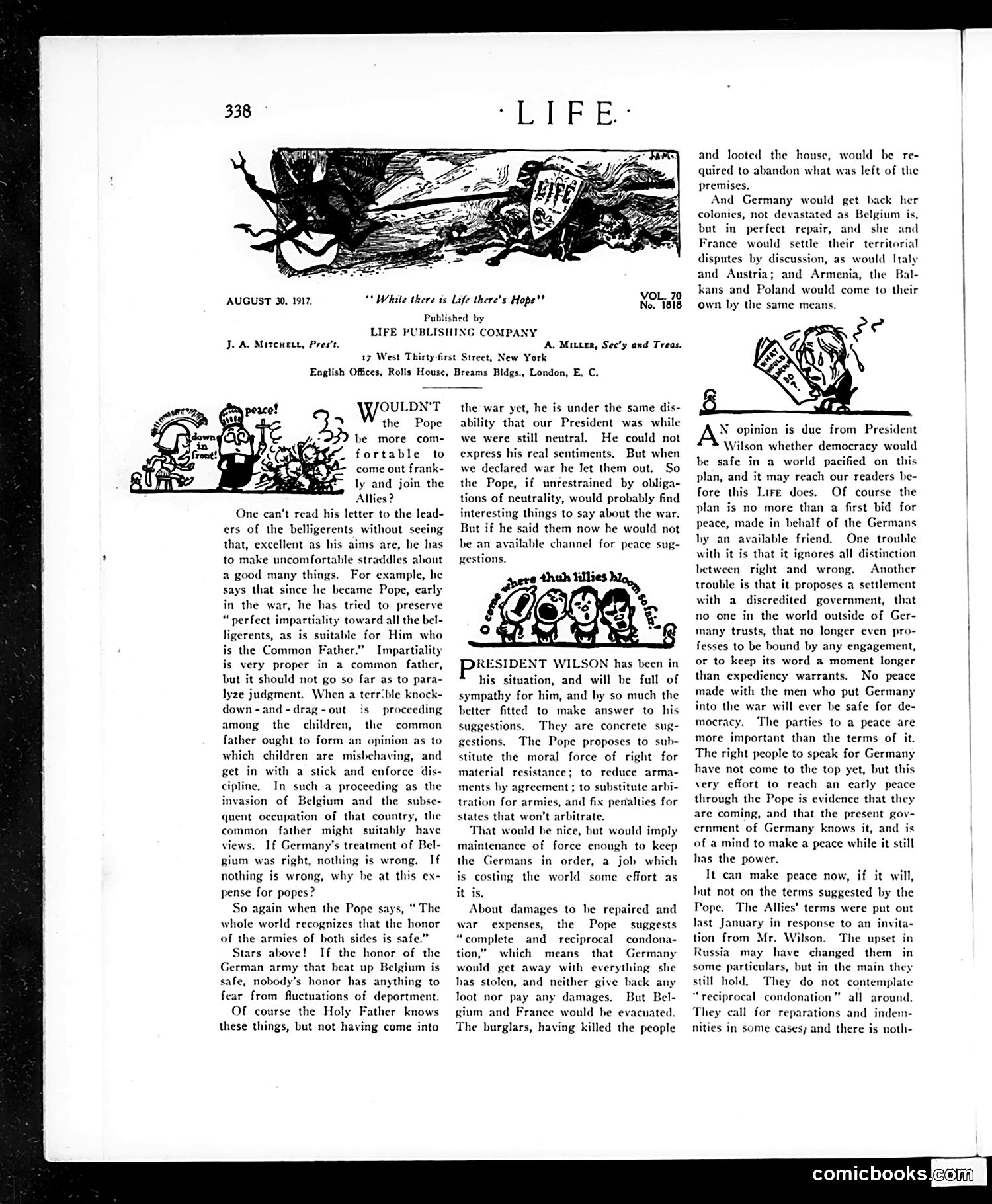
This page critiques Pope Benedict XV's letter proposing peace terms to World War I belligerents. The cartoons and text sarcastically attack the Pope's attempt to remain neutral while offering peace suggestions. The left cartoon shows the Pope awkwardly straddling a fence—visualizing his uncomfortable "impartiality" between the Allies and Central Powers. The article argues that neutrality is inappropriate when one side (Germany) has committed atrocities like invading Belgium. The author compares the Pope to a father who should discipline misbehaving children, not remain passive. The right cartoon appears to show Wilson, referenced in the text as someone who similarly couldn't openly take sides while America was neutral. The piece ridicules the Pope's proposed peace terms as absurdly favorable to Germany—they'd keep stolen colonies and loot while Belgium and France would be evacuated. Life's satire: the Pope's "neutral" mediation actually serves German interests.
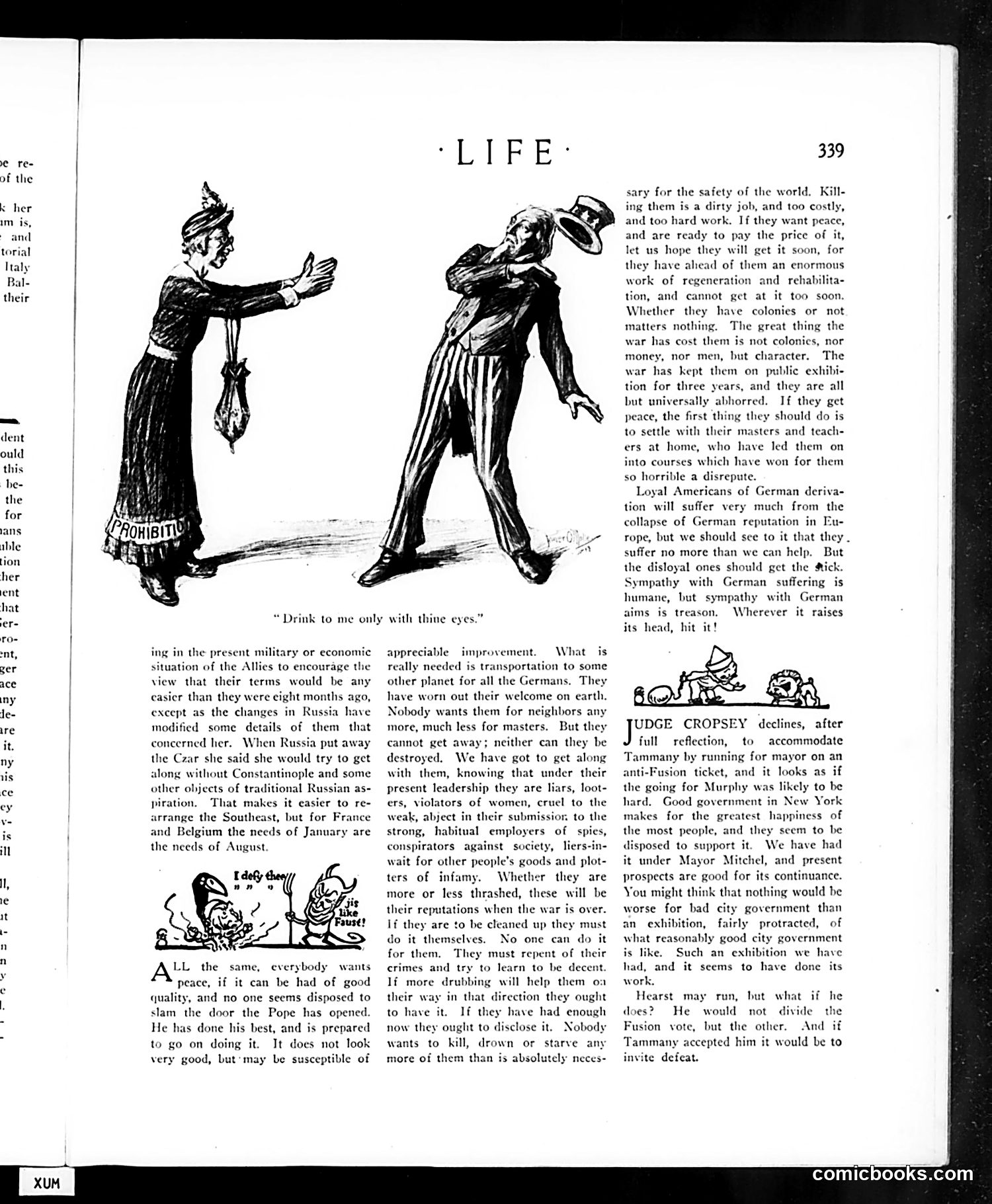
This Life magazine page (page 339) contains two distinct political commentaries: **Top Cartoon:** "Drink to me only with thine eyes" depicts a woman labeled "PROHIBITION" offering a drink to a man who rejects it, illustrating the contemporary debate over alcohol prohibition in America during World War I. **Main Text:** A lengthy editorial discussing post-WWI peace negotiations and Germany's future. The author argues Germans cannot be "transported to another planet" but must undergo moral regeneration themselves. The piece distinguishes between German-Americans (who deserve sympathy if loyal) and those with pro-German sympathies (labeled "disloyal," worthy of harsh treatment). This reflects wartime suspicion of German-American communities. **Bottom Item:** A brief note about Judge Cropsey declining to run for New York mayor on a Tammany Hall ticket, supporting "good government" reform candidate Mitchel instead—referencing local political corruption concerns. The overall tone reflects 1918 American wartime anxiety about both international peace terms and domestic loyalty.
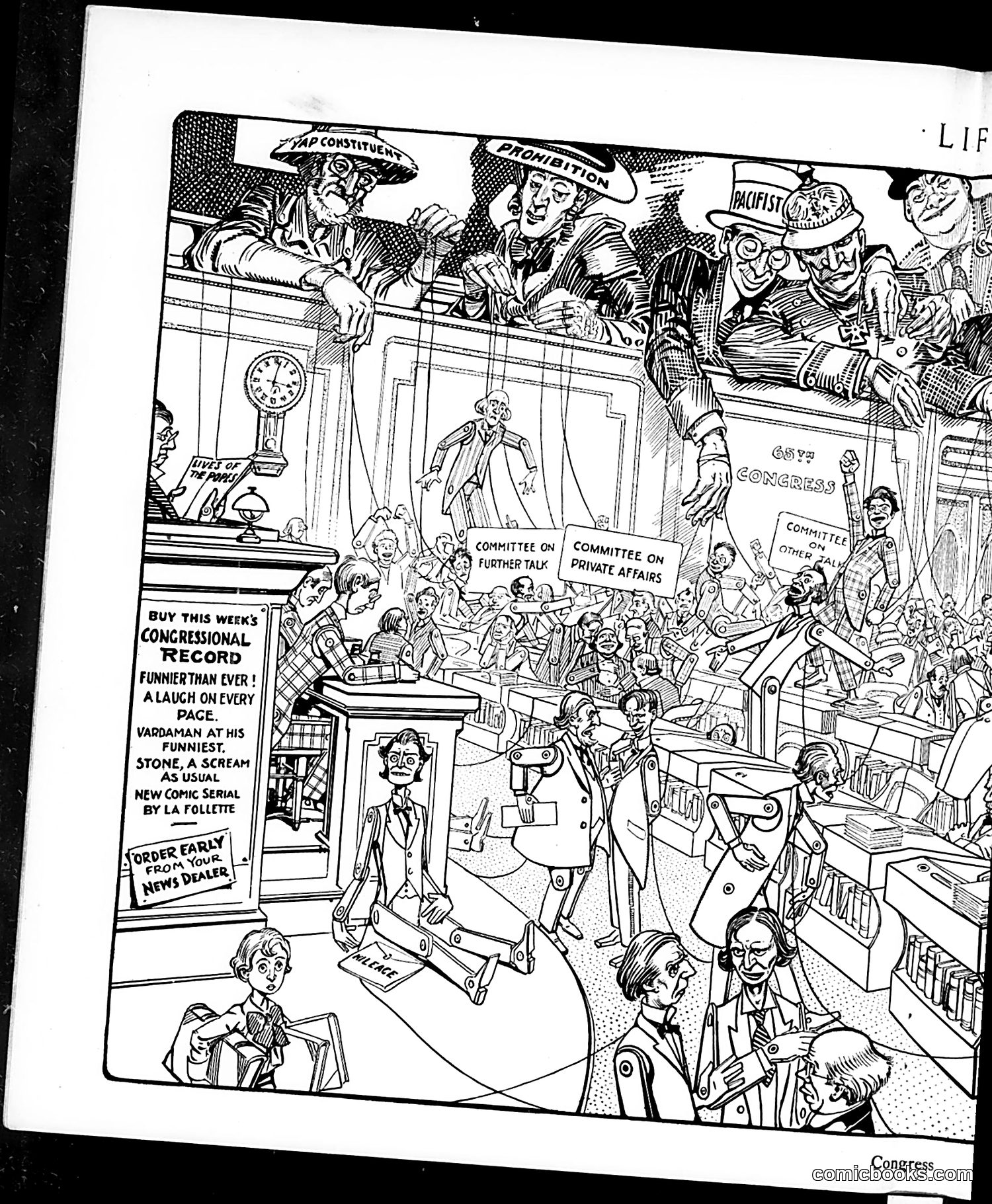
This Life magazine cartoon satirizes Congressional incompetence and endless debate. The central scene depicts Congress in chaos—mechanical robot-like figures populate the chamber, suggesting lawmakers operate without genuine thought or purpose. The advertisement in the left margin mocks this dysfunction by promoting the Congressional Record as entertainment, claiming it's "funnier than ever" and specifically naming politicians: **Vardaman** (likely James K. Vardaman, Mississippi Senator), **Stone** (likely William J. Stone, Missouri Senator), and **La Follette** (Robert M. La Follette, Wisconsin Progressive Senator). The visible committee signs—"Committee on Further Talk" and "Committee on Private Affairs"—suggest Congress accomplishes nothing but endless discussion. The overall message critiques these lawmakers as automatons who produce merely comic relief rather than substantive legislation, mocking the futility of political process during this era (likely 1910s-1920s, given the politicians named).
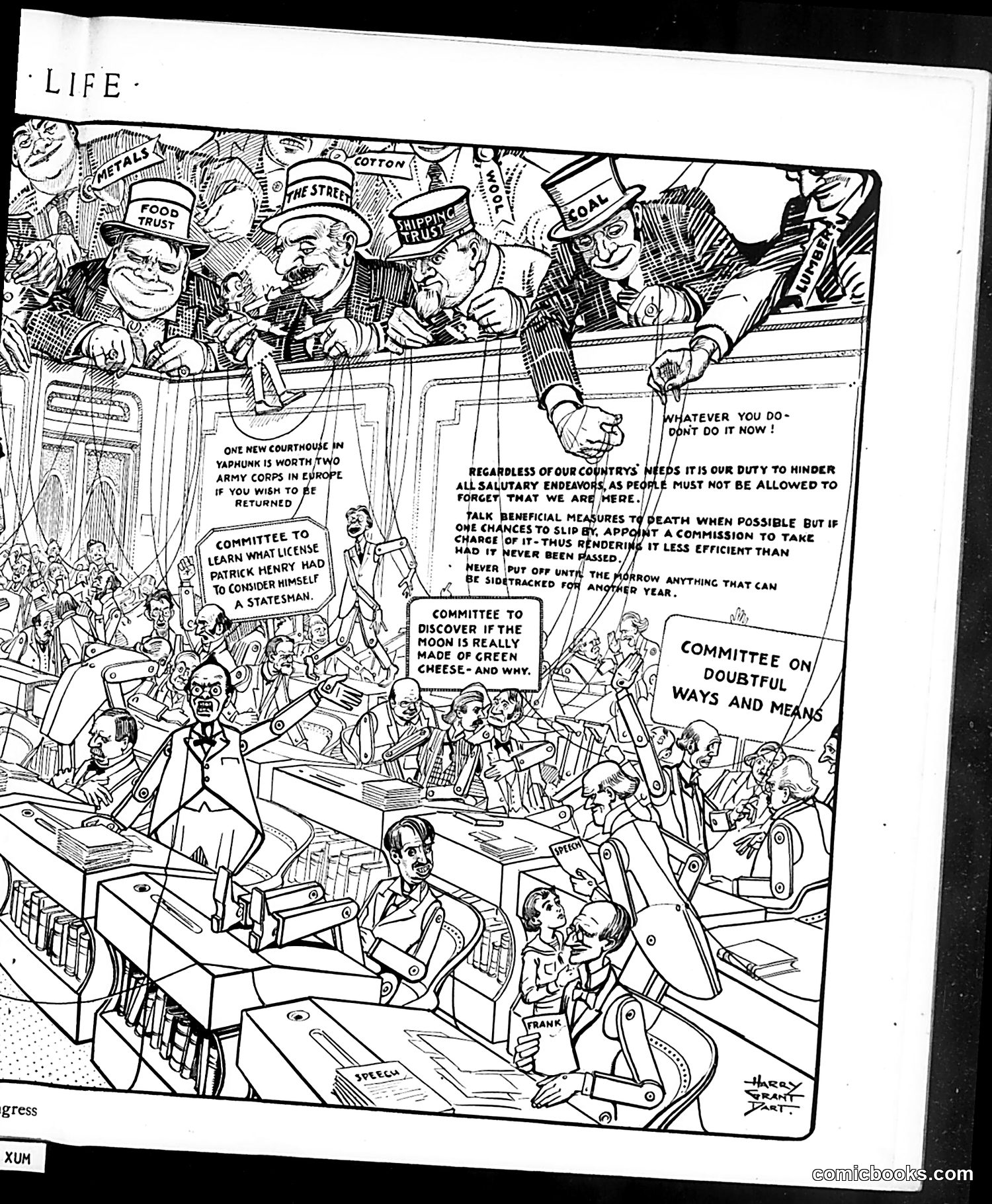
This Life magazine cartoon satirizes **Congressional ineffectiveness and bureaucratic obstruction**. The scene depicts a chaotic legislature where various industry trusts (Food Trust, Coal Trust, Cotton Trust, etc.) wear hats labeled with their monopolies, lounging above while committees proliferate below. The satire targets the **Progressive Era's failed regulatory efforts**. Politicians propose endless investigations—committees on "Doubtful Ways and Means," whether the moon is made of green cheese—as comic absurdities that mask inaction on genuine problems. The caption "Whatever You Do—Don't Do It Now!" explicitly mocks legislative paralysis and delay tactics. The caricatured figures likely represent **industrial monopolists and their Congressional allies** who use procedural obstruction to prevent meaningful reform. The cartoon critiques how trusts escape regulation through committees and studies rather than decisive legislative action—a major Progressive-era complaint about Congressional gridlock.
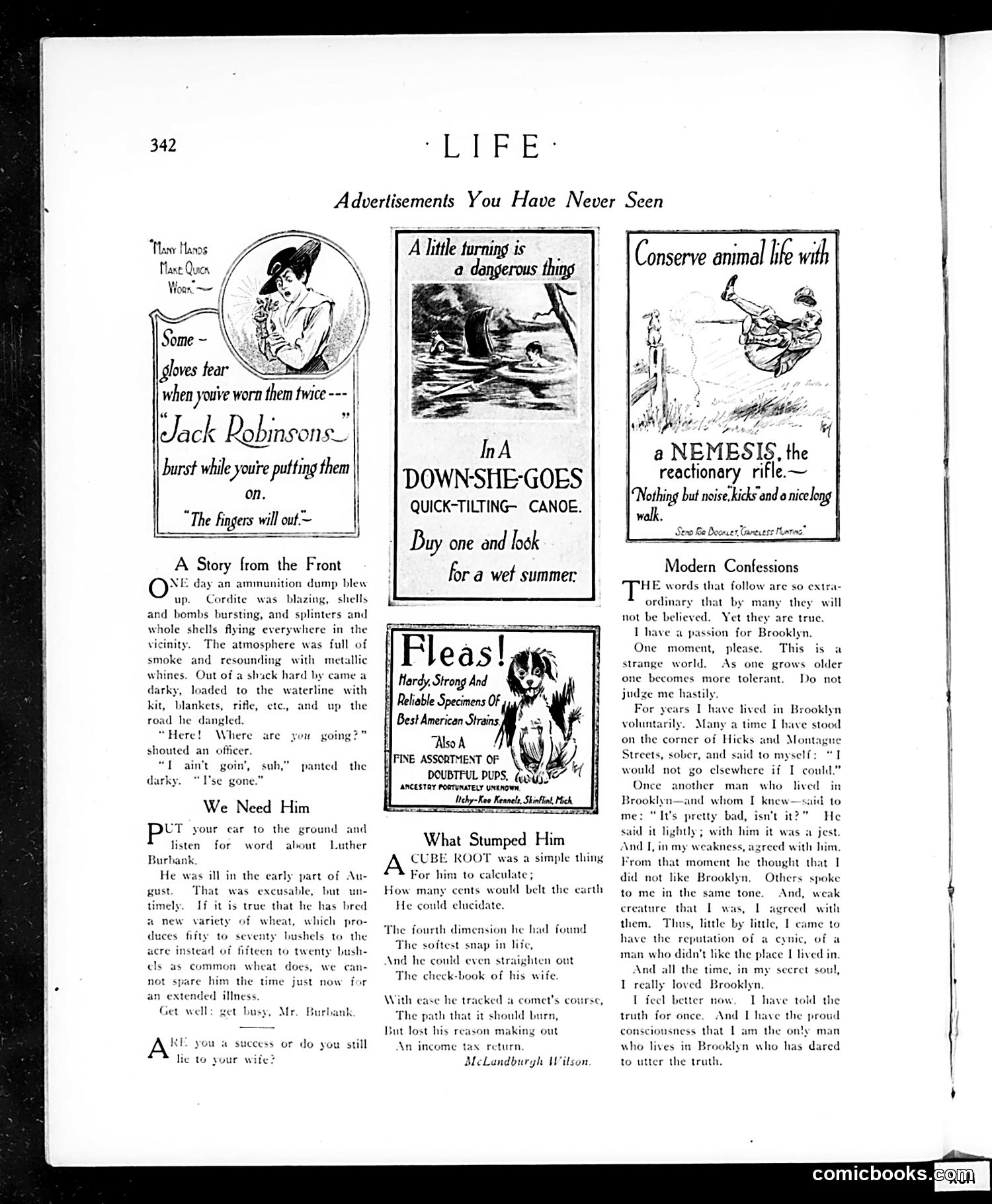
This page contains satirical commentary and advertisements typical of Life's early 20th-century format. **Main Content:** - **"We Need Him"**: Urges Luther Burbank, the famous horticulturist, to recover quickly from illness. It references his breeding of a high-yield wheat variety (fifty to seventy bushels per acre vs. fifteen to twenty), presenting him as essential to wartime food production. The context suggests WWI-era concerns about agricultural output. - **"What Stumped Him"**: A humorous poem about a mathematician who can solve complex problems—cube roots, celestial mechanics, even straighten his wife's checkbook—but cannot figure out income tax returns. This satirizes the Byzantine complexity of early American tax codes. - **"Modern Confessions"**: A confession piece where the narrator admits loving Brooklyn despite adopting a cynical pose around others, ultimately declaring himself Brooklyn's only honest resident. **Advertisements** include Jack Robinson gloves, a canoe product, hunting dogs, and a rifle. The tone reflects Life's characteristic blend of patriotic concern, mathematical humor, and metropolitan social observation.
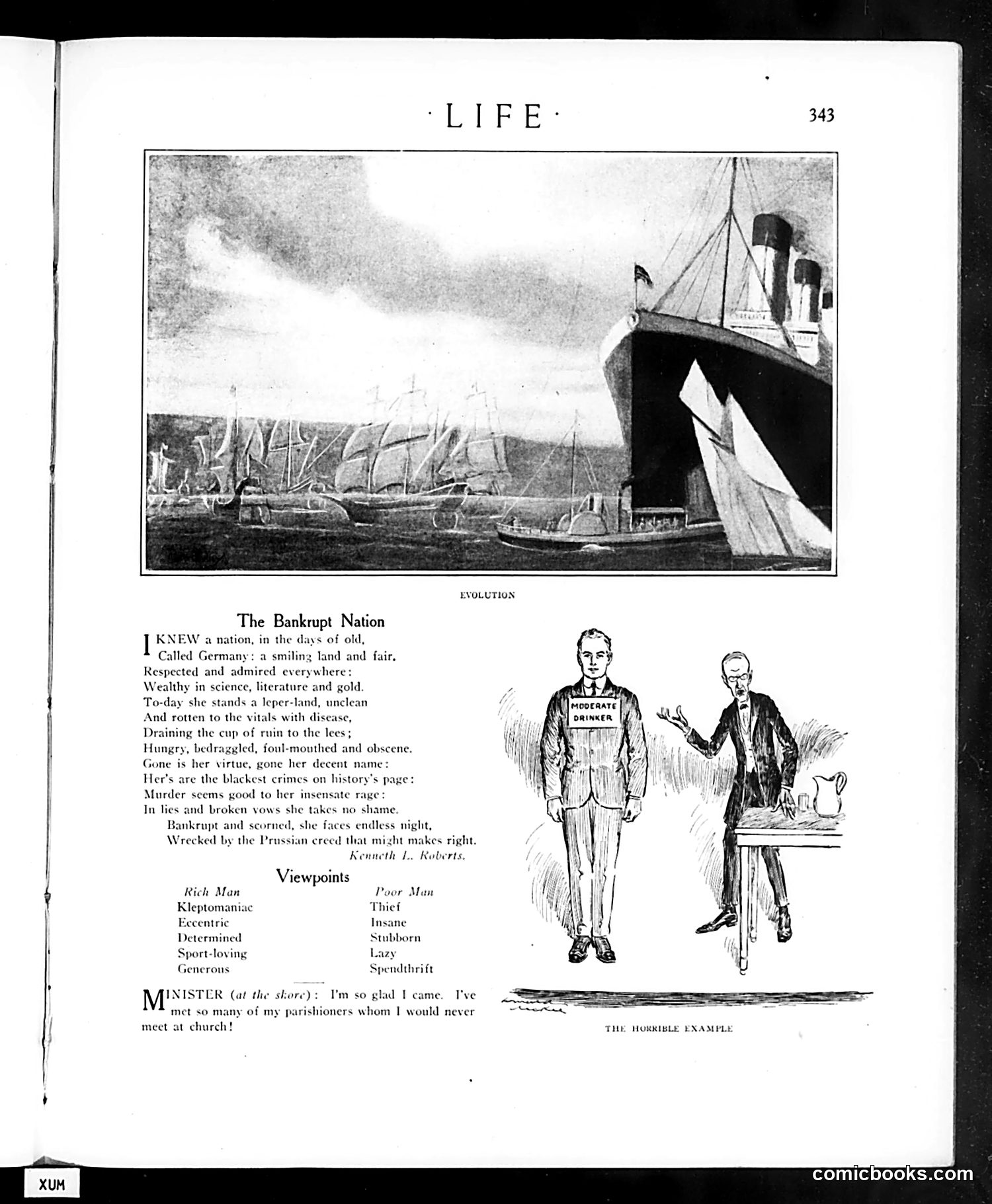
**"The Bankrupt Nation"** is a post-WWI poem attacking Germany's moral collapse. The text traces Germany's fall from a respected, wealthy nation to a "leper-land" morally destroyed by Prussian militarism and its doctrine that "might makes right." This reflects American anti-German sentiment following World War I and Germany's defeat. **"The Horrible Example"** cartoon contrasts two figures labeled "Moderate Drinker" and an older man at a table. The satire appears to illustrate hypocrisy: the "moderate drinker" (likely representing temperance advocates or moral reformers) judges others' behavior while the cartoon implies such judgment rings hollow. This likely relates to Prohibition-era debates about alcohol and moral authority. The "Viewpoints" section uses word pairs (Rich Man/Poor Man, Kleptomaniac/Thief) to satirize how the wealthy escape moral judgment for behavior condemned in the poor—a critique of class double-standards.
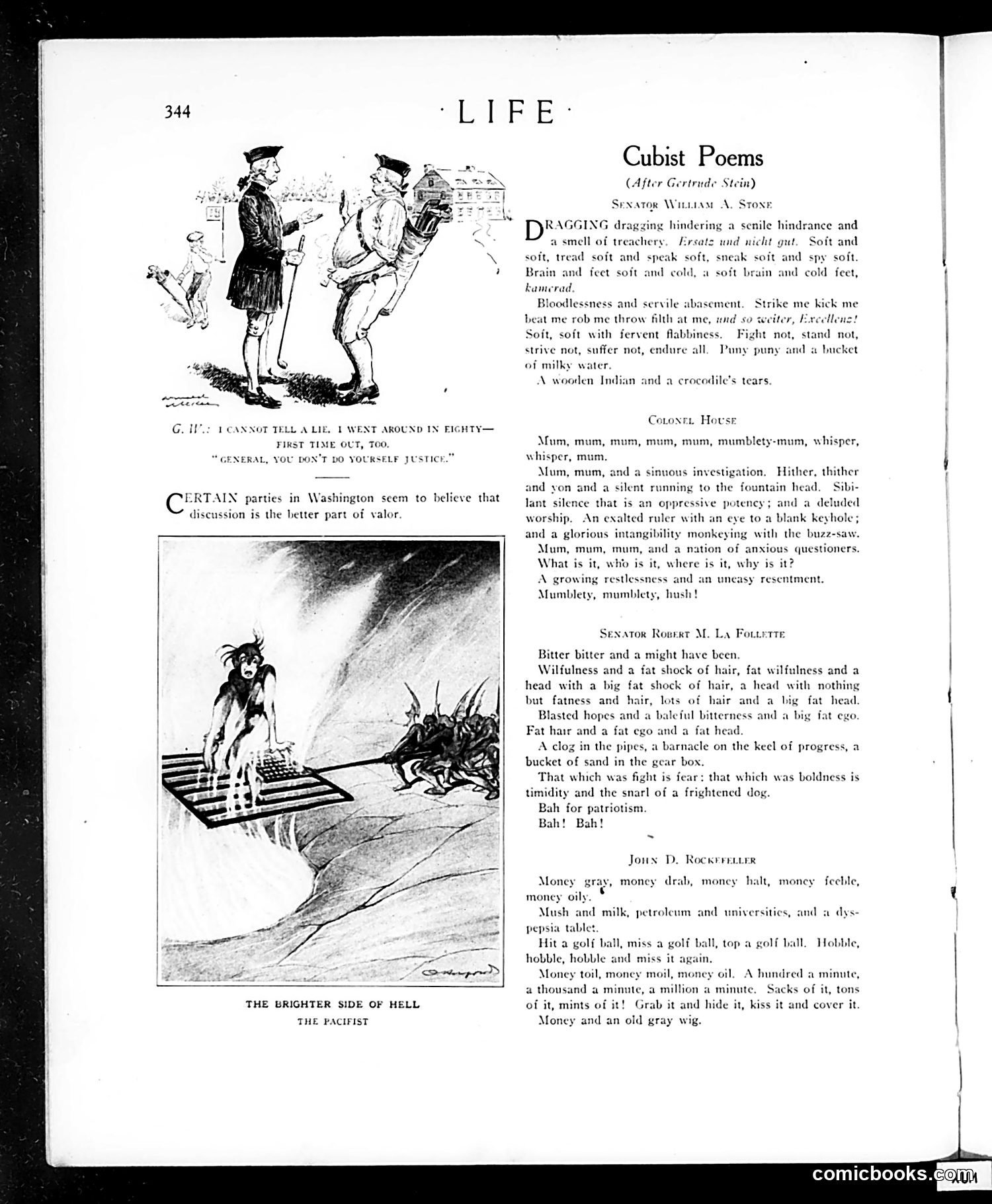
This page satirizes prominent American political figures through avant-garde "Cubist" poetry parodies (attributed to Gertrude Stein's modernist style). The cartoons mock pacifists and isolationists during what appears to be WWI-era debate. **Top cartoon**: References General George Washington's cherry tree legend, mocking a general's excuse-making about military conduct—likely critiquing reluctance to wage war effectively. **Bottom cartoon** ("The Brighter Side of Hell: The Pacifist"): Shows a pacifist cowering before aggressive figures, suggesting pacifism is cowardly appeasement. **Poems mock specific senators:** - Stone and La Follette: Criticized for softness, evasiveness, and obstruction ("clog in the pipes, barnacle on the keel of progress") - Rockefeller reference: Mocks wealth obsession ("Money and an old gray wig") The satire attacks these politicians as ineffectual, self-interested, or dangerously opposed to military action—using intentionally difficult modernist verse to mock both the subjects and contemporary avant-garde literary trends.
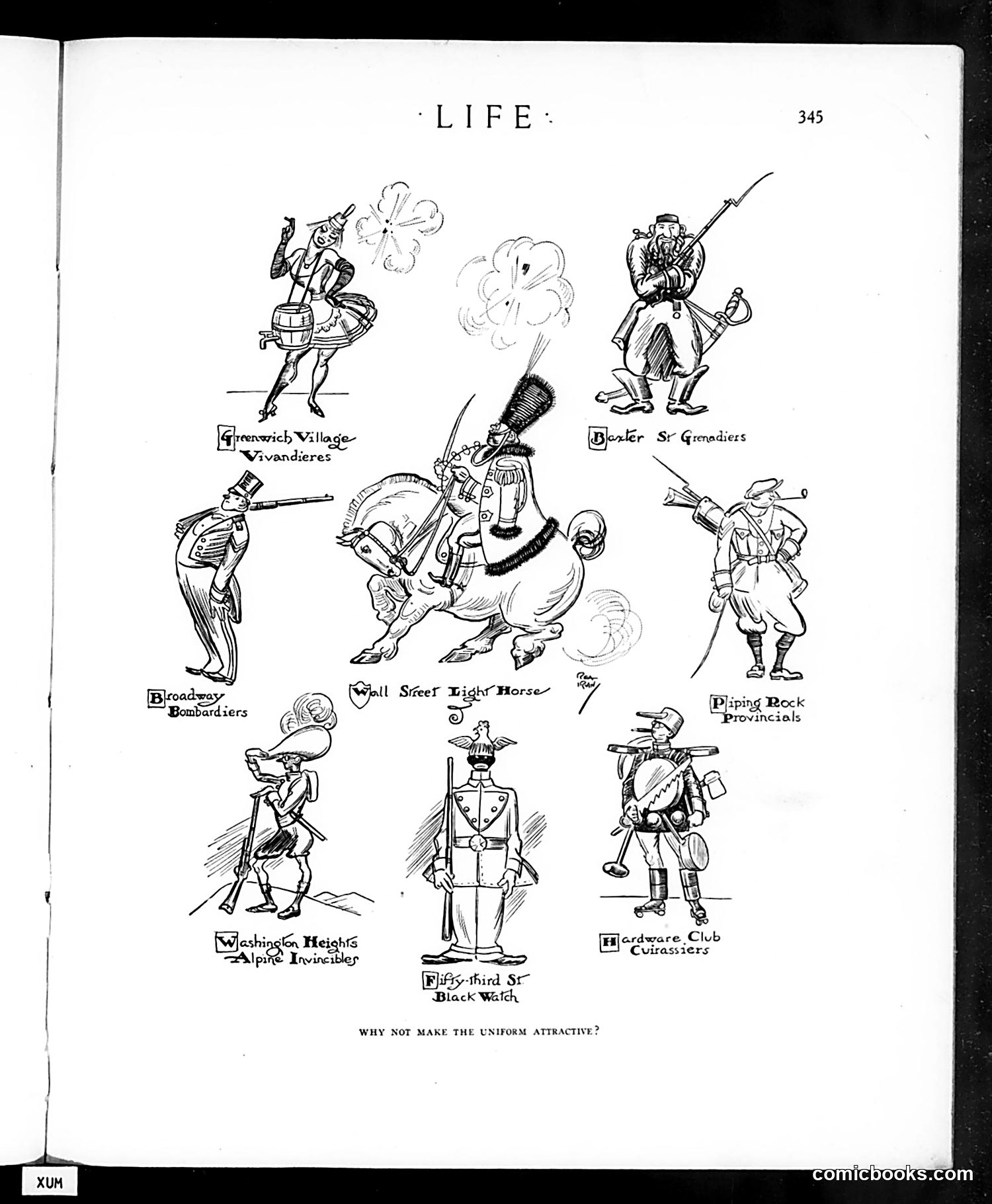
This satirical page mocks various military units and social groups through caricatured figures in exaggerated uniforms. The caption "WHY NOT MAKE THE UNIFORM ATTRACTIVE?" suggests ironic criticism of unattractive or ridiculous military dress. The labeled units appear to reference actual regiments (Black Watch, Grenadiers, Bombardiers) alongside what seem to be society groups or clubs (Piping Rock Provincials, Hardware Club Cuirassiers). The absurdly drawn figures—some skeletal, some portly, some awkwardly posed—satirize the pretension of military uniforms and formal dress. The overall message appears to criticize either military aesthetics, the vanity of uniform design, or possibly the quality of soldiers themselves. Without specific historical context, the exact targets remain unclear, but the humor derives from reducing dignified military tradition to ridiculous visual spectacle.
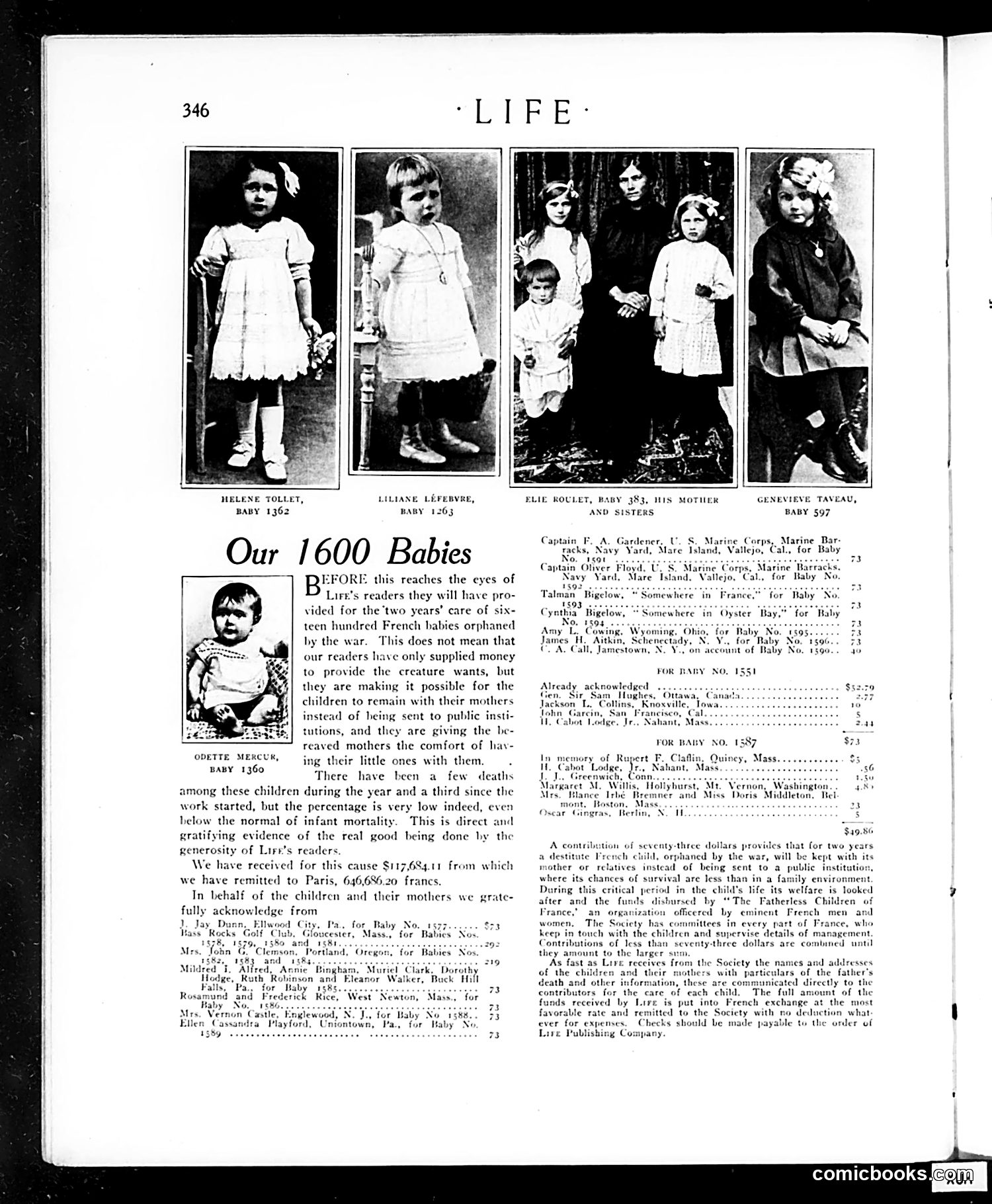
This is not satire or political commentary, but rather a **charitable fundraising appeal** in Life magazine. The page documents the magazine's campaign to support French children orphaned by World War I. The photographs show actual orphans being aided—identified by name and "baby number"—kept with their mothers rather than sent to institutions. The text explains that Life readers have contributed over $117,000 to provide two years of care for 1,600 French orphans. The bulk of the page lists donor names and contributions (ranging from small to substantial amounts), crediting those who funded individual children's support through "The Fatherless Children of France," a French-run relief organization. This reflects early 20th-century philanthropic practice: using a magazine's platform to publicize both the humanitarian need and the donors' generosity. There is no joke or satirical intent—it's earnest advocacy for war relief.
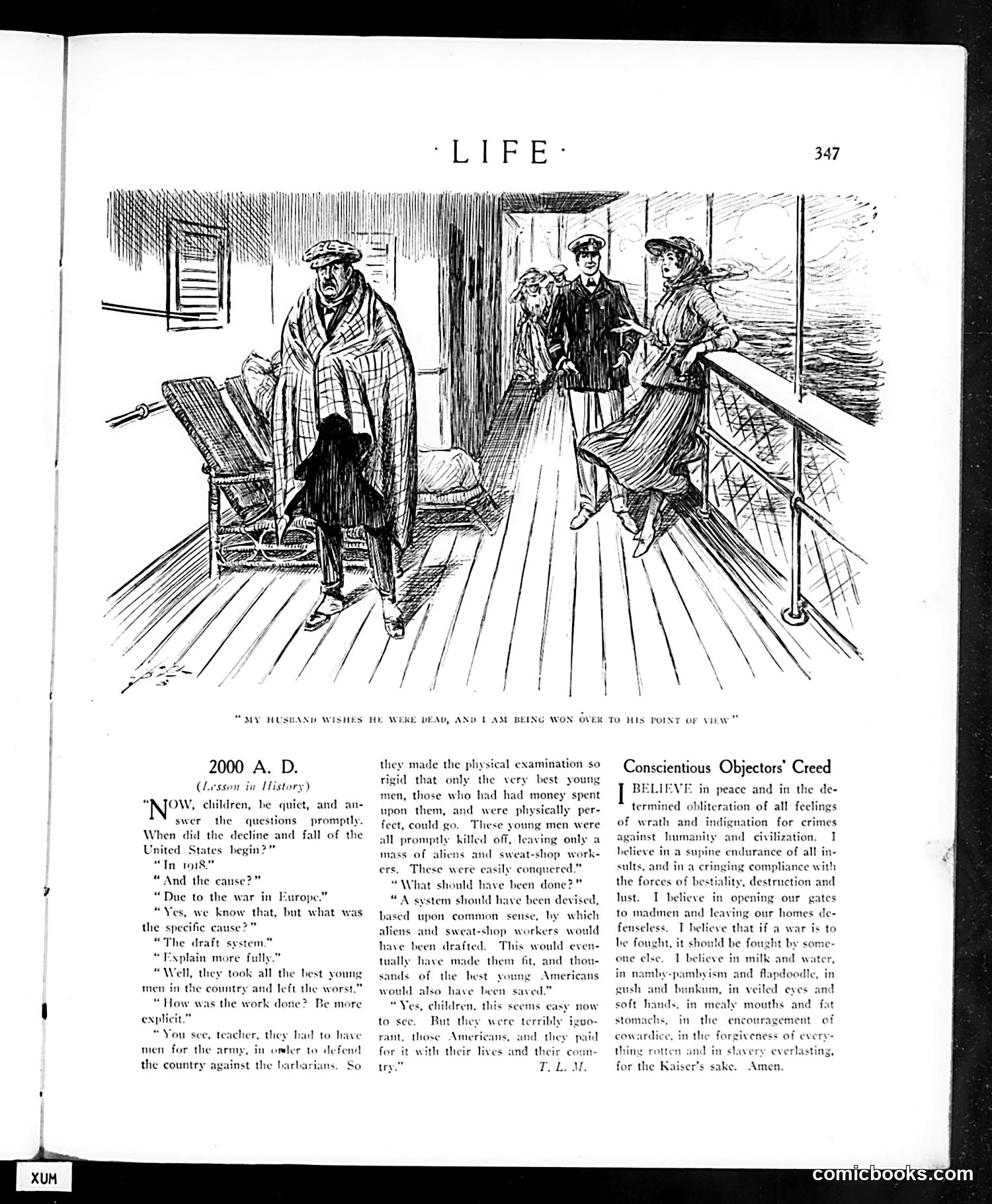
This page contains two distinct satirical pieces critical of American policy during World War I. **Top cartoon**: A classroom scene depicting a future historian teaching children that America's decline began around 1900, caused by the draft system. The satire argues that selective service—which kept wealthy, educated men (those who could afford exemptions) safe while conscripting working-class and immigrant men—depleted the nation's best young talent, leaving only "aliens and sweat-shop workers" to defend the country. **Bottom section**: "Conscientious Objectors' Creed" sarcastically attacks pacifists and war resisters. It mocks their peace advocacy as weak sentiment ("milk and water," "flapdoodle") that enables wartime atrocities. The final line, "for the Kaiser's sake," directly attacks objectors as effectively aiding Germany. These pieces represent *opposing* viewpoints on WWI policy—the cartoon criticizes conscription practices, while the creed attacks those opposing war itself. Together they illustrate the intense debate surrounding American military involvement during this period.
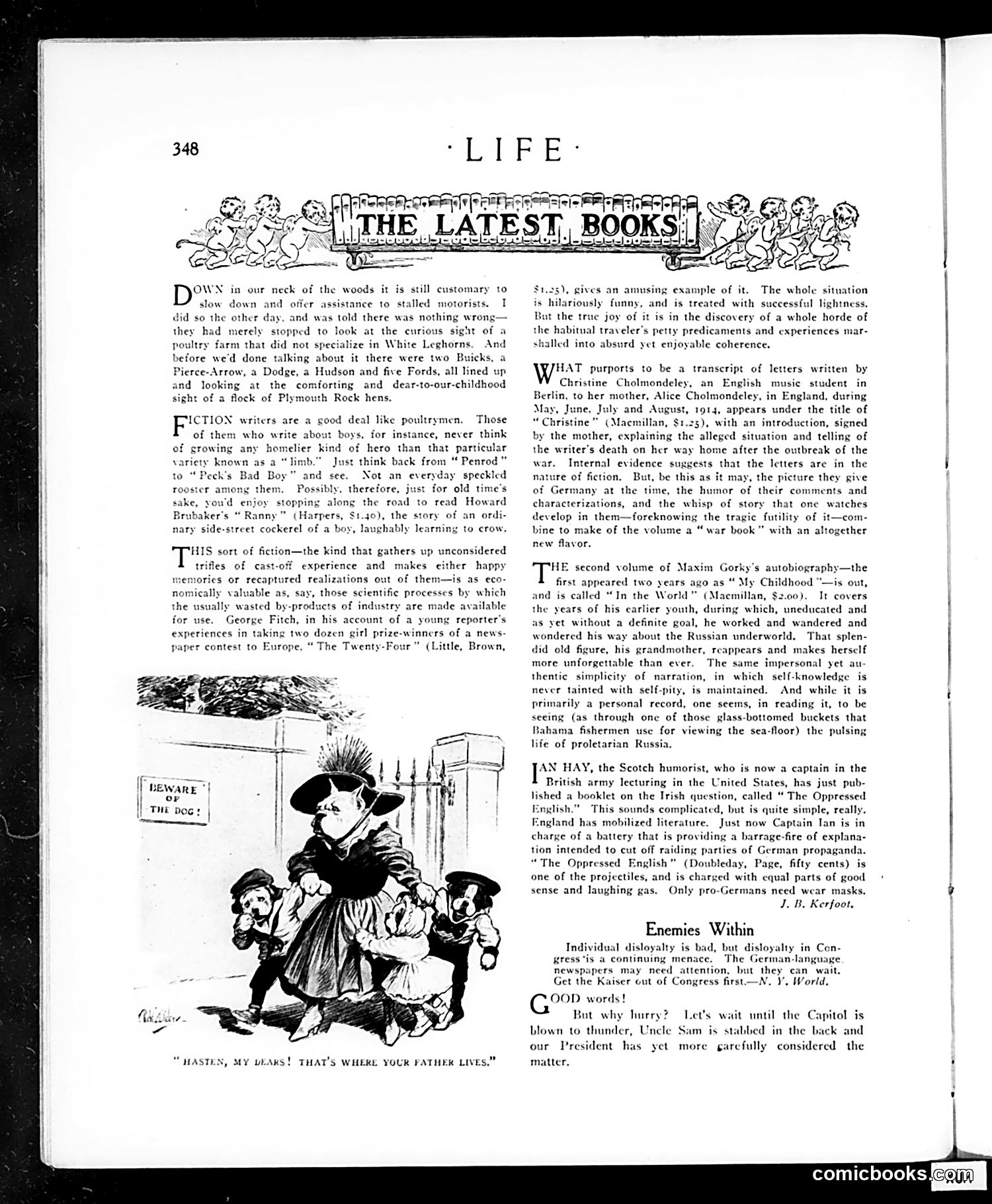
The main cartoon depicts a woman with two small children, with a "Beware the Dog" sign visible. The caption reads: "Hasten, my dears! That's where your father lives." This is wartime satire—the father is away fighting in WWI (the page references 1914), so the children barely know him. The joke darkly suggests the family dog is more present/familiar than the absent soldier-father. The cartoon uses domestic irony to comment on war's displacement of families. The page is primarily a "Latest Books" review section. It discusses fiction about ordinary subjects (a farm boy named "Ranny"), Maxim Gorky's autobiography, and notably a book called "Christine"—letters supposedly written by an English music student in Berlin during May-August 1914, the outbreak of WWI. The reviewer notes the letters' authenticity is ambiguous but praises how they capture German life at war's beginning. The overall theme: how literature documents ordinary human experience amid extraordinary historical events.
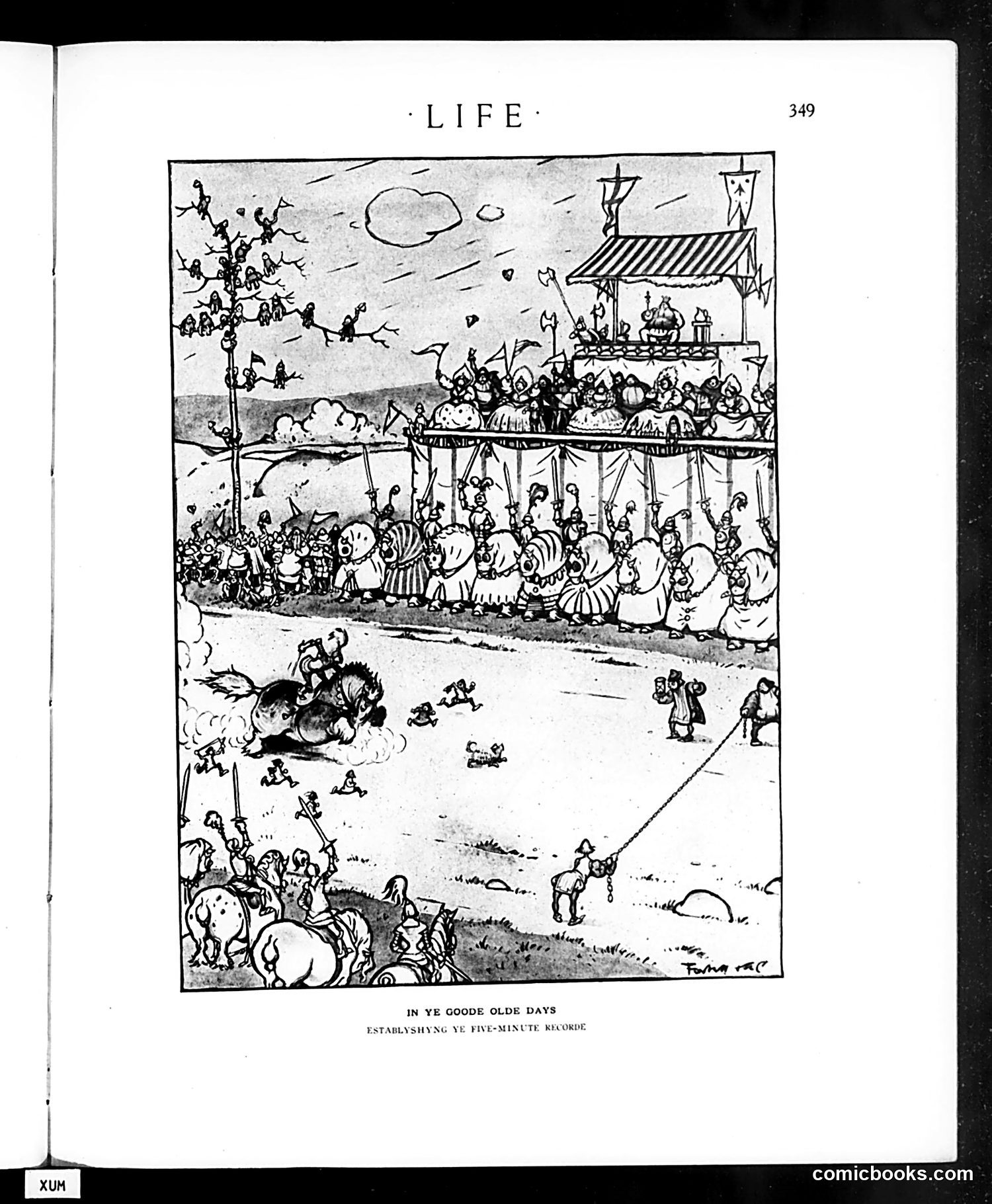
This is a satirical cartoon depicting a medieval or Renaissance-era spectacle. The image shows a fairground or tournament scene with distinct layers: nobility and clergy observe from an elevated pavilion at top; common people crowd a viewing stand below; soldiers on horseback occupy the lower left; and various performers or combatants occupy the central arena. The caption "Establishing Ye Five-Minute Record" suggests satire about modern speed and efficiency obsession—applying contemporary concerns about rapid achievement to a historical setting. The archaic spelling ("Ye Goode Olde Days," "Establyshyng") ironically contrasts old-world pageantry with modern competitive impulses. The cartoon likely mocks either the era's brutal entertainments or contemporary culture's obsession with beating records, though without additional context, the specific target remains unclear.
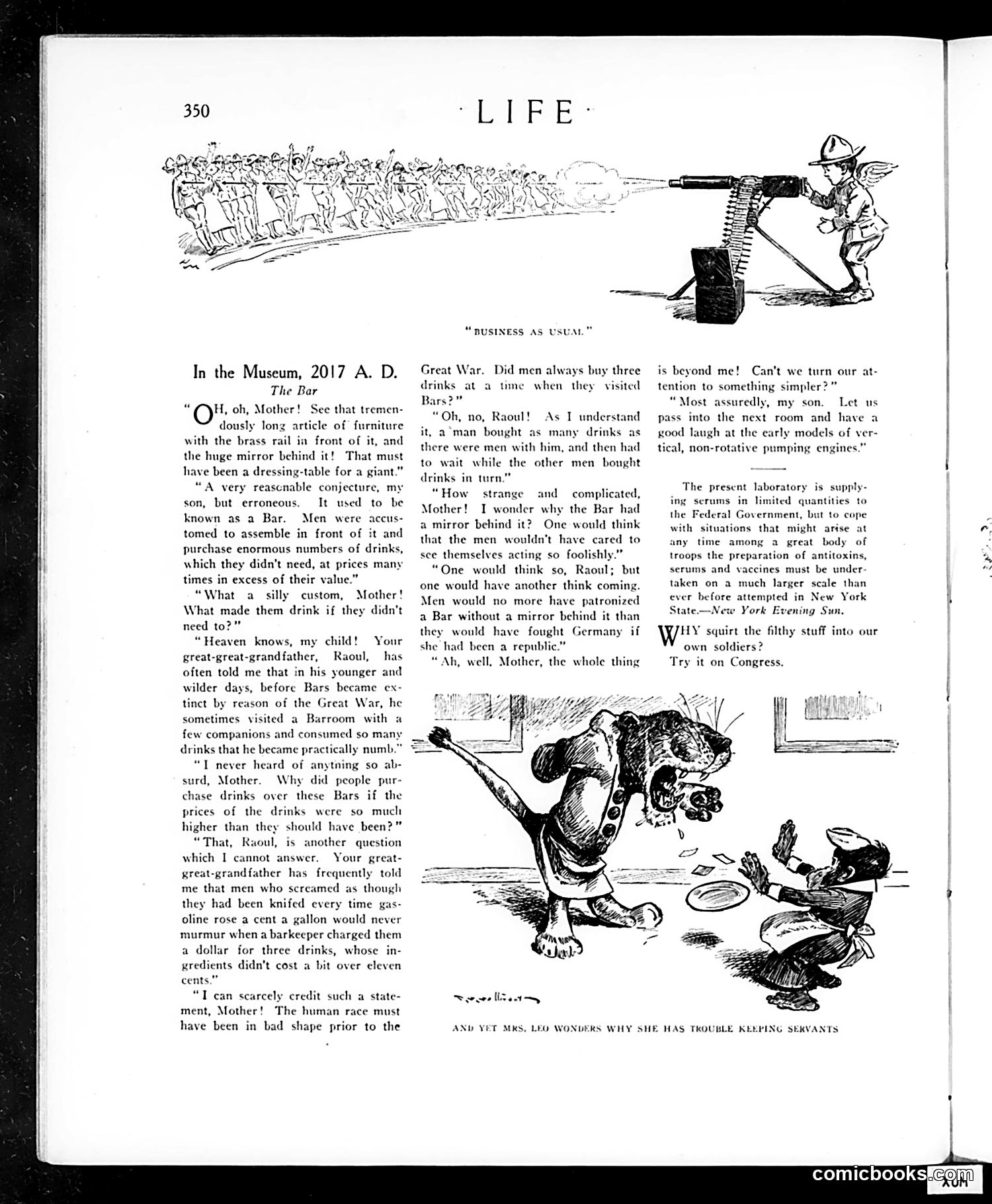
This page from *Life* magazine satirizes the American bar culture and anticipates Prohibition. The top cartoon shows a soldier firing a machine gun at a crowd labeled "Business as Usual"—commentary on wartime profiteering and civilian indifference. The main text presents a fictional museum dialogue set in 2017 A.D., where a mother explains bars to her son as historical curiosities. The satire mocks the illogic of bar culture: men paid inflated prices for drinks they didn't need, bought rounds for companions out of social obligation, and consulted mirrors to admire themselves while drunk. The mother notes men complained endlessly about gas prices but never about outrageous bar markups. The joke hinges on treating bars as extinct relics—reflecting the magazine's perspective during or anticipating Prohibition (alcohol ban, 1920-1933). The bottom cartoon about servants relates to wartime labor shortages. The satire criticizes both consumer irrationality and the social rituals surrounding alcohol consumption.
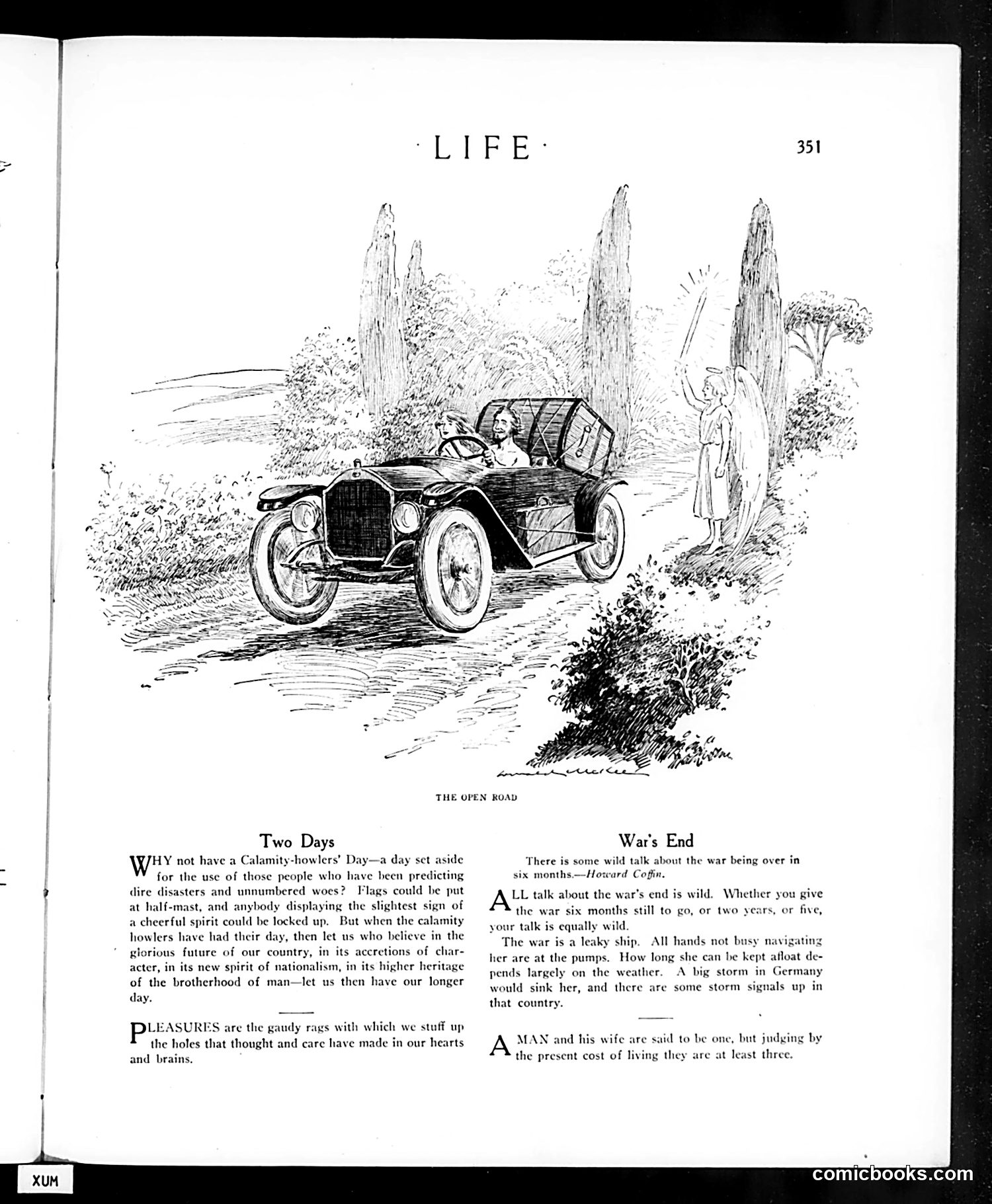
This page from *Life* magazine contains three satirical pieces reflecting post-World War I attitudes (approximately 1918-1919): **"The Open Road"** (illustration): Shows an early automobile on a country road—likely celebrating American optimism and progress during peacetime. **"Two Days"**: Mocks "calamity howlers"—pessimists predicting disaster—arguing they've had their say and now optimists deserve their turn to celebrate America's future and national character. This reflects post-war confidence. **"War's End"**: Satirizes wild speculation about when WWI would conclude. Using a ship metaphor, it suggests the war's duration remains uncertain regardless of predictions. The piece credits Howard Coffin (likely a public figure making such claims). **"A Man and His Wife"**: A brief joke about inflation—sarcastically claiming a married couple must actually be three people because living costs have tripled, suggesting severe postwar economic hardship for households. The overall tone juxtaposes national optimism with economic reality.
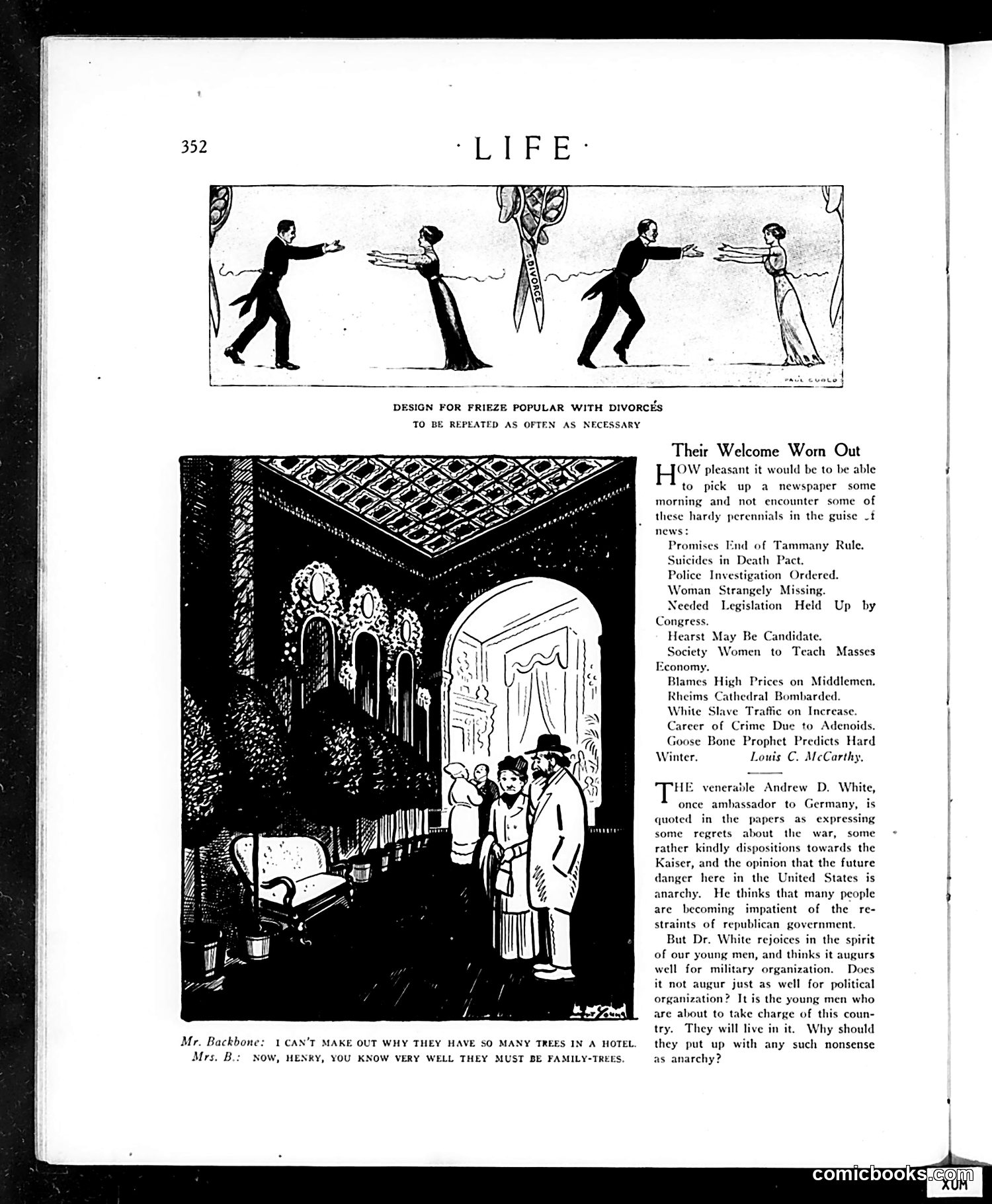
The page contains two satirical pieces mocking contemporary American concerns: **Top cartoon**: A visual pun on "family trees" in hotels. Mr. and Mrs. Backbone joke that hotels must display actual trees because divorce is so common—the "family trees" are literally just trees, since families no longer stay together. The frieze above shows couples repeatedly divorcing and remarrying, satirizing the prevalence of divorce in society. **Lower section**: Commentary on repetitive newspaper headlines. The author (Louis C. McCarthy) laments that papers constantly recycle the same sensational stories—political corruption, suicides, missing persons, crime—without real resolution. **Andrew D. White passage**: A response to the ambassador's fears about American anarchy. The writer argues that if young men's rebellious energy can fuel military organization, why not political reform? It's a pointed critique: anarchic impulses aren't inherently dangerous if properly channeled into civic participation. Together, these pieces satirize American social instability, media sensationalism, and generational anxiety in what appears to be the early 20th century.
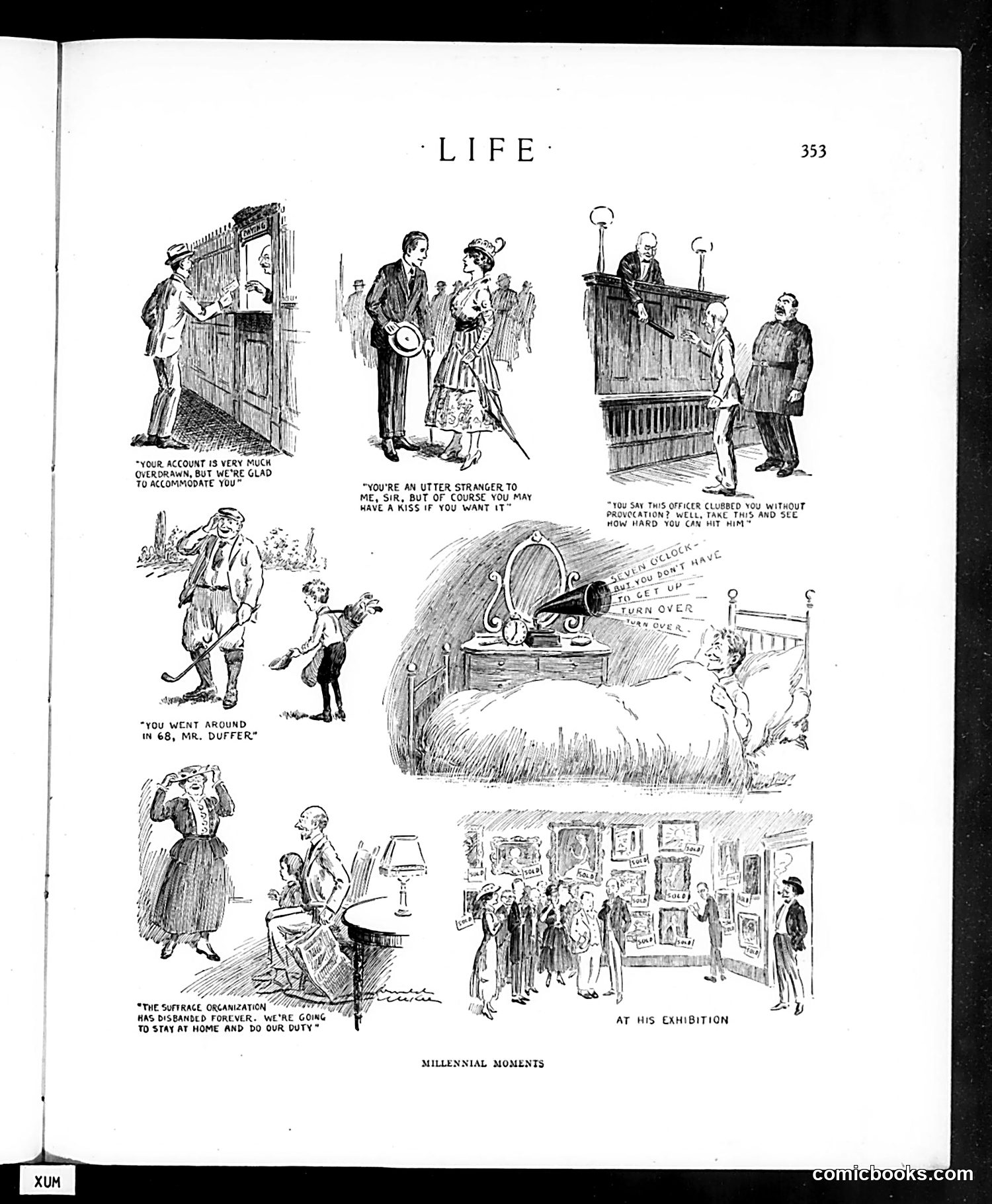
This page satirizes early 20th-century social behaviors and attitudes labeled "millennial" (here meaning young people of that era, not modern millennials). The sketches mock various types: a banker indulging an overdrawn account; a man boasting of his 1868 exploits; a woman offering casual kisses to strangers; a police officer inviting a brutality victim to retaliate; a wife announcing her suffrage organization disbanded so she can stay home; and couples viewing an art exhibition. The humor targets perceived hypocrisy and moral looseness—young people claiming modernity while pursuing frivolous, undignified, or socially questionable behavior. The suffrage reference suggests contemporary debate about women's roles. Overall, the cartoon presents "millennial" youth as shallow, morally suspect, and ultimately unserious about social progress.
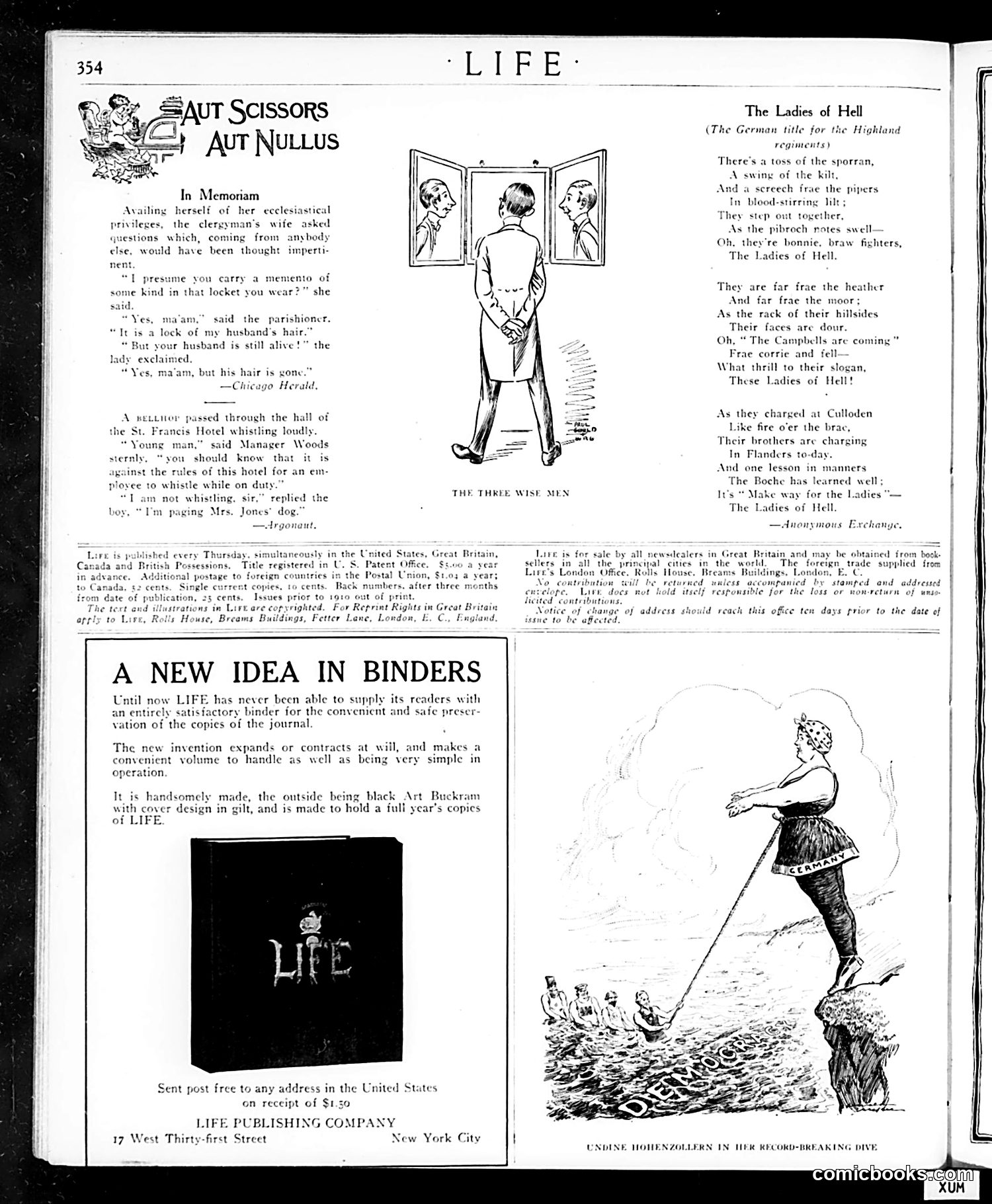
This page contains three distinct elements: **"The Three Wise Men"** (center cartoon): A man examines his reflection in a three-panel mirror, likely satirizing vanity or self-deception about appearance. **"The Ladies of Hell"** (right): A patriotic poem about Scottish Highland regiments (identified by their kilts and bagpipes). The title references the German nickname for these fierce fighters. The poem celebrates their bravery, mentioning their current service "In Flanders" (World War I), and warns the "Boche" (derogatory term for Germans) to yield to them. This is wartime propaganda verse glorifying Scottish soldiers. **"A New Idea in Binders"** (left): An advertisement offering a expandable binder to hold a year's worth of *Life* magazine issues, priced at $1.50 and shipped free. The page mixes humor, wartime morale-boosting poetry, and commercial advertising—typical of early 20th-century *Life* magazine content.
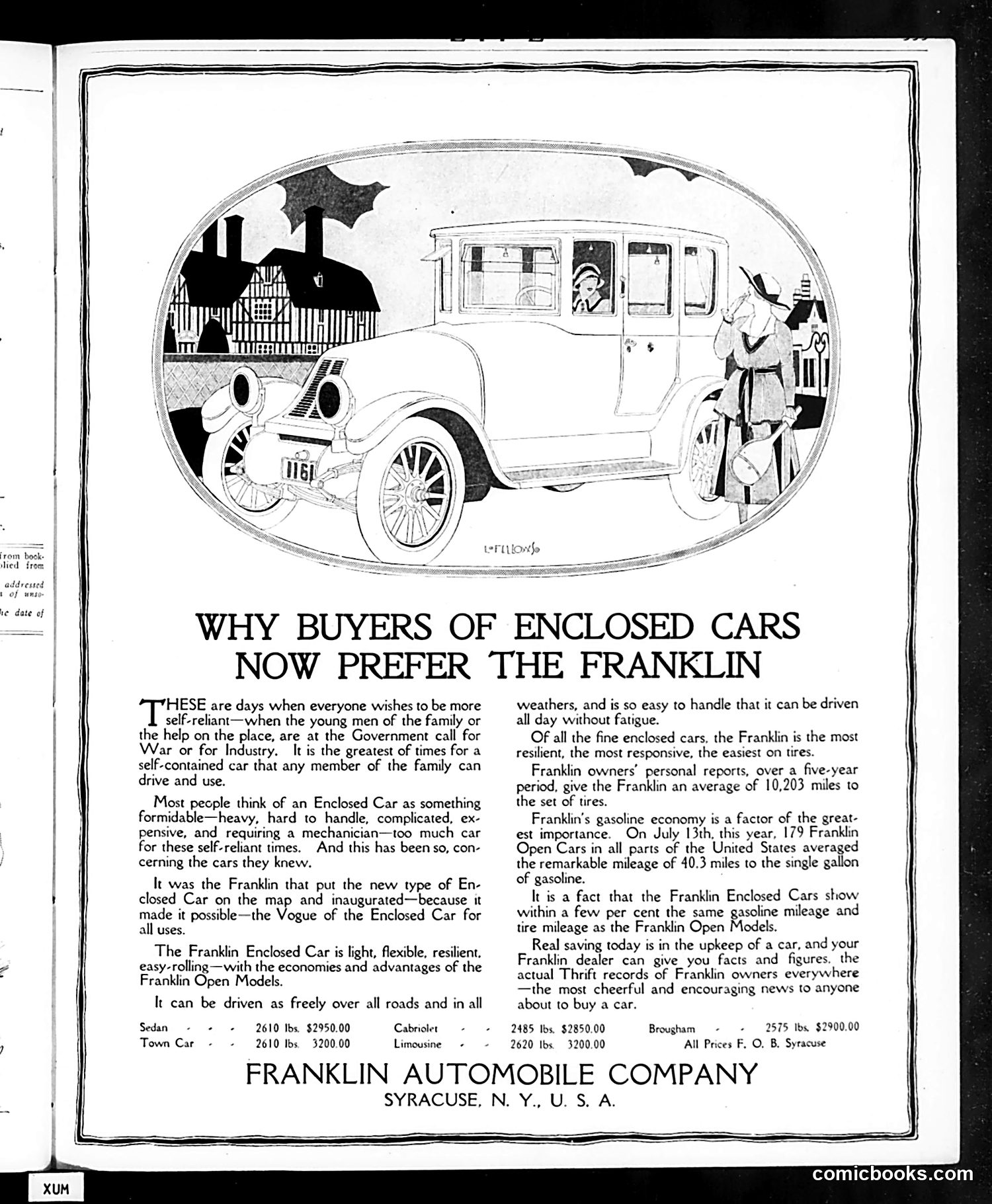
This is primarily a Franklin automobile advertisement, not satire or political commentary. The page promotes enclosed cars (sedans with roofs) as practical vehicles for wartime America, when able-bodied men were away serving in WWI or war industries. The illustration shows a Franklin sedan in use by civilians—a woman and children—emphasizing that enclosed cars are easy enough for non-expert drivers to operate safely. The text argues that Franklins are superior enclosed cars because they're light, fuel-efficient, and reliable, contrasting them with competitors that were supposedly heavy and complicated. The "why buyers prefer" framing addresses wartime concerns: with men unavailable, families needed dependable, manageable vehicles. The ad highlights fuel economy (40.3 miles per gallon) and tire durability as practical selling points for economical-minded consumers during resource scarcity. This is commercial advertising strategy, not editorial commentary or satire.
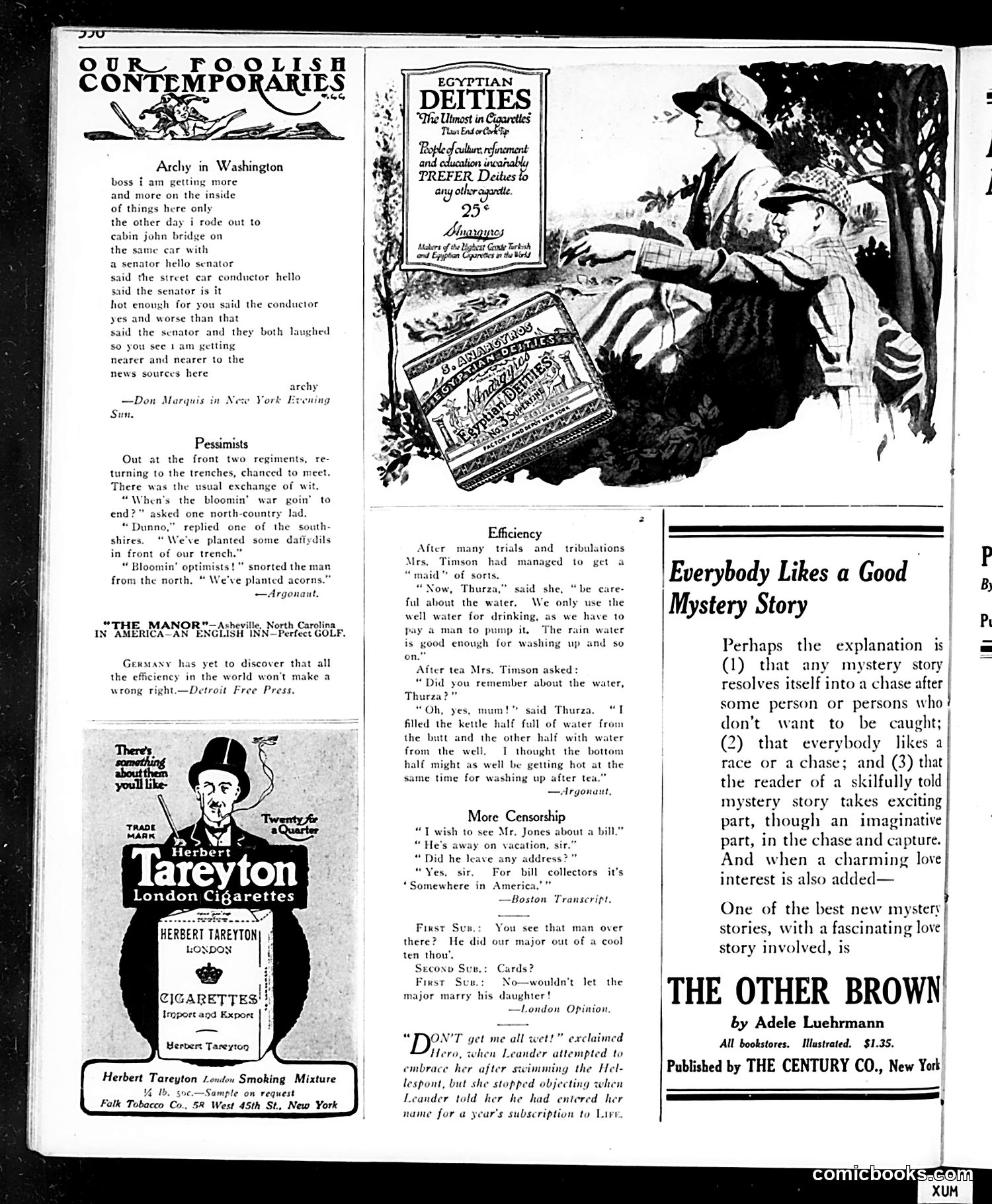
This page contains several satirical pieces and advertisements typical of *Life* magazine's humor circa 1920s. **"Archy in Washington"** (by Don Marquis): A satirical comment on political access. The joke is that a streetcar conductor thinks he's gaining "insider" knowledge by exchanging pleasantries with a senator—the satire mocks how ordinary people inflate minor social encounters into evidence of political influence. **"Pessimists"**: A WWI-era joke contrasting soldiers' outlooks. Northern troops planted acorns (suggesting long-term occupation), while southern troops planted daffodils (suggesting the war would end soon). The humor relies on the absurdity of soldiers planning landscaping during wartime. **"Efficiency"** and **"More Censorship"**: Brief comedic anecdotes poking fun at bureaucratic logic and wartime restrictions. **Advertisements**: Herbert Tareyton cigarettes and Egyptian Deities cigarettes occupy significant space—typical period advertising with minimal regulation. **Book advertisement** (bottom right): Promotes *The Other Brown* mystery novel, emphasizing why readers enjoy mysteries: resolution, excitement, and romance. The page is primarily humorous commentary with commercial content, not political cartooning in the modern sense.
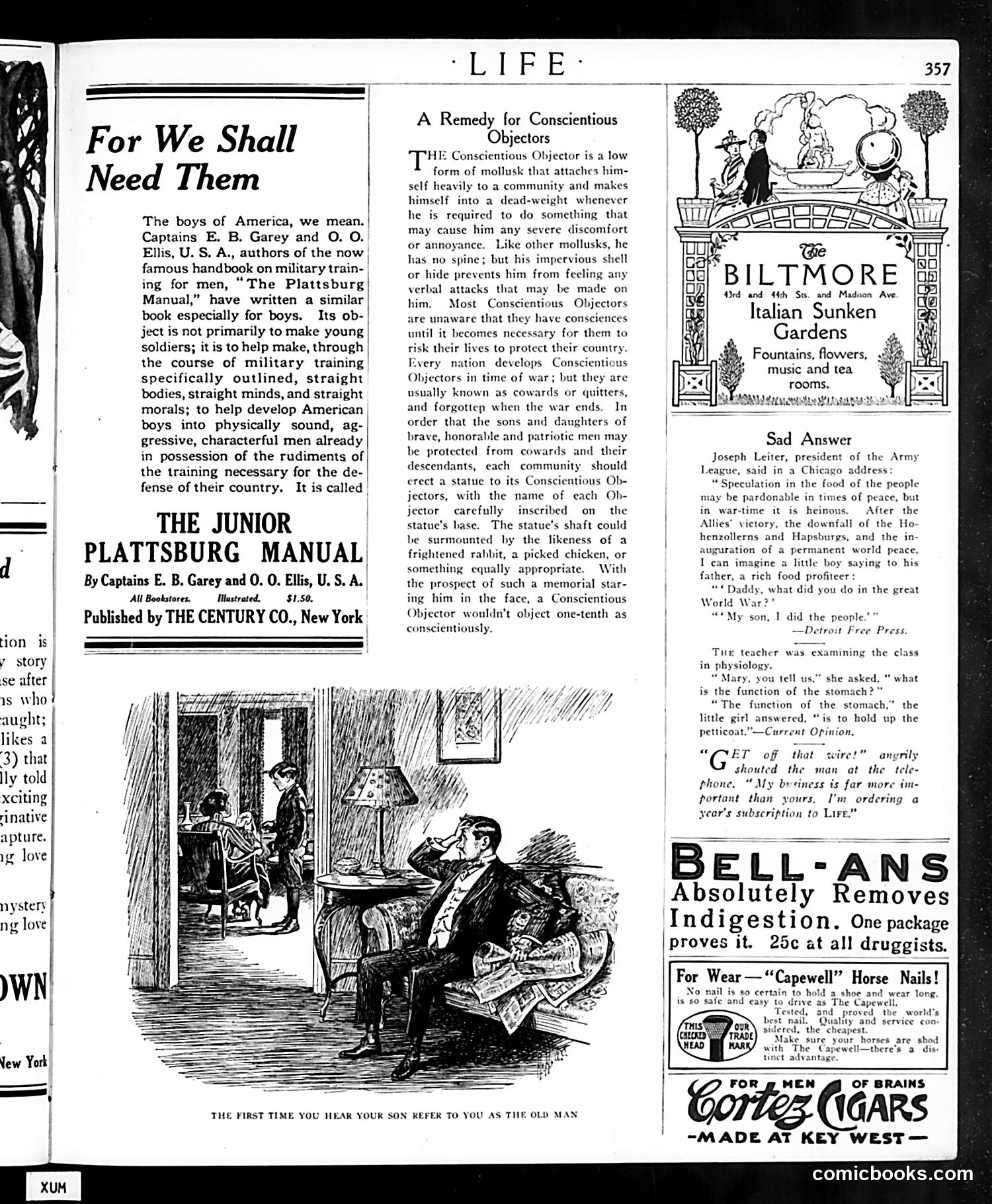
This page satirizes American attitudes toward military preparedness and patriotism during World War I. The main cartoon (bottom) depicts a father and son, with the caption "The First Time You Hear Your Son Refer to You as the Old Man"—a humorous observation about generational change. The featured article promotes *The Junior Plattsburg Manual*, a military training book for boys, positioning youth militarization as character-building. Most sharply, "A Remedy for Conscientious Objectors" viciously mocks draft resisters, dehumanizing them as low mollusks without spines. The article sarcastically proposes erecting monuments to objectors—topped with frightened rabbits or chickens—to shame them into compliance. This represents mainstream wartime hostility toward pacifists. The "Sad Answer" anecdote satirizes war profiteers: a food speculator tells his son he "did the people" during WWI—a dark pun on wartime corruption. Together, these pieces reflect 1918 America's intolerant stance toward dissent and its embrace of aggressive patriotism and youth militarization.
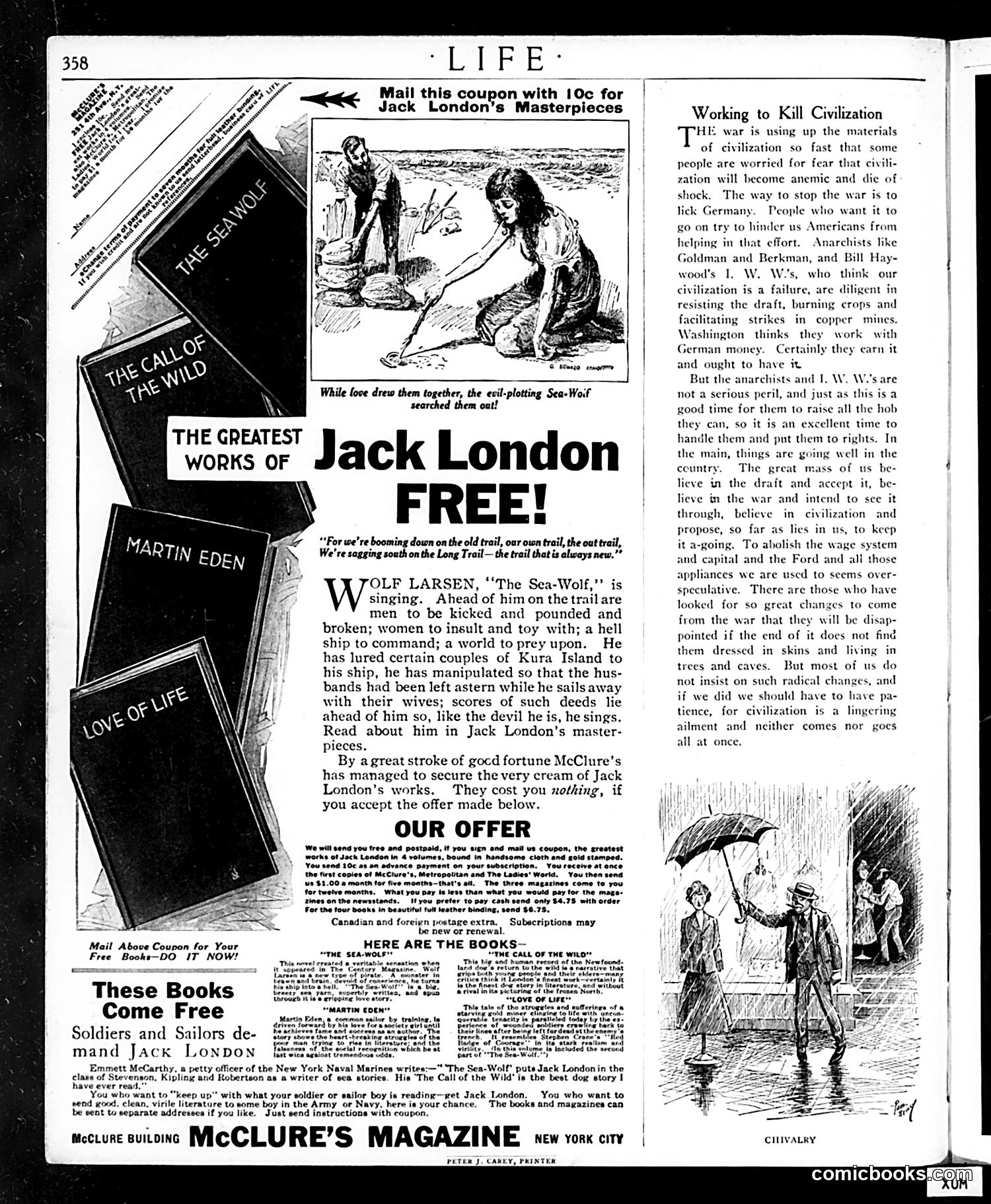
This page combines a Jack London book advertisement with contemporary WWI-era political commentary. The upper right article, "Working to Kill Civilization," attacks American anarchists and labor activists—specifically naming Emma Goldman, Alexander Berkman, and the Industrial Workers of the World (IWW)—for opposing the draft and organizing strikes in copper mines during World War I. The article argues these groups hinder American war effort against Germany and suspects German funding. However, it dismisses them as minor threats compared to widespread public support for the draft and war. The advertisement promotes Jack London's "The Sea-Wolf," whose protagonist is presented as a ruthless villain—apparently meant to contrast with the moral clarity the author claims characterizes the war itself. The free-book offer targets soldiers and sailors, positioning London as patriotic reading material for troops. The page reflects 1917-1918 American anxieties about domestic dissent during wartime.
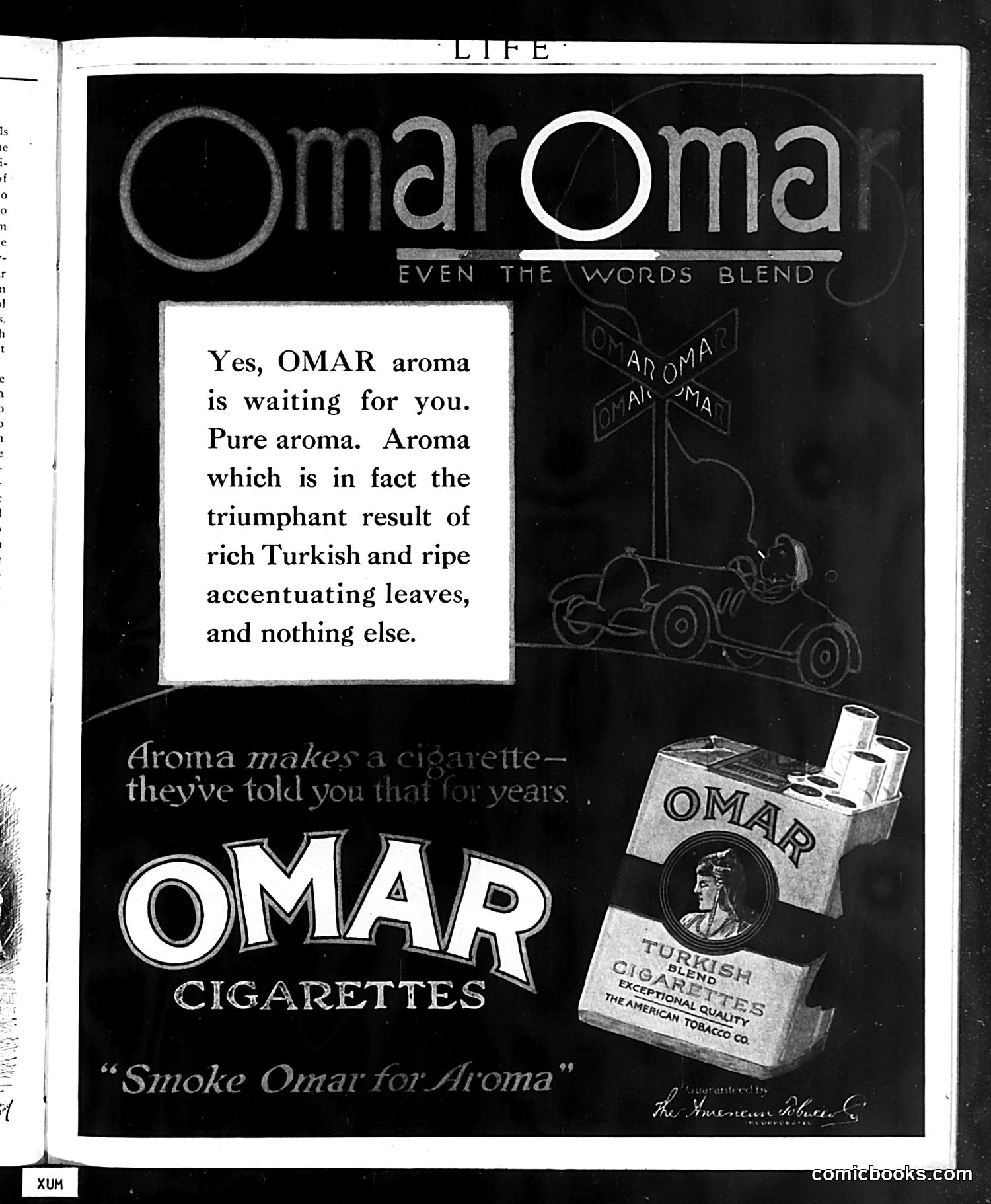
This is a cigarette advertisement for Omar brand, not political satire. The ad promotes Turkish tobacco cigarettes by emphasizing their "pure aroma" derived from "rich Turkish and ripe accentuating leaves, and nothing else." The tagline "Smoke Omar for Aroma" is the central marketing pitch. The text notes that aroma "makes a cigarette—they've told you that for years," suggesting this was a common advertising claim of the era. The ad includes product packaging imagery and appears designed to appeal to consumers seeking quality tobacco flavor. There is no apparent political commentary or satirical intent—this is straightforward vintage advertising typical of early 20th-century cigarette marketing in American magazines.
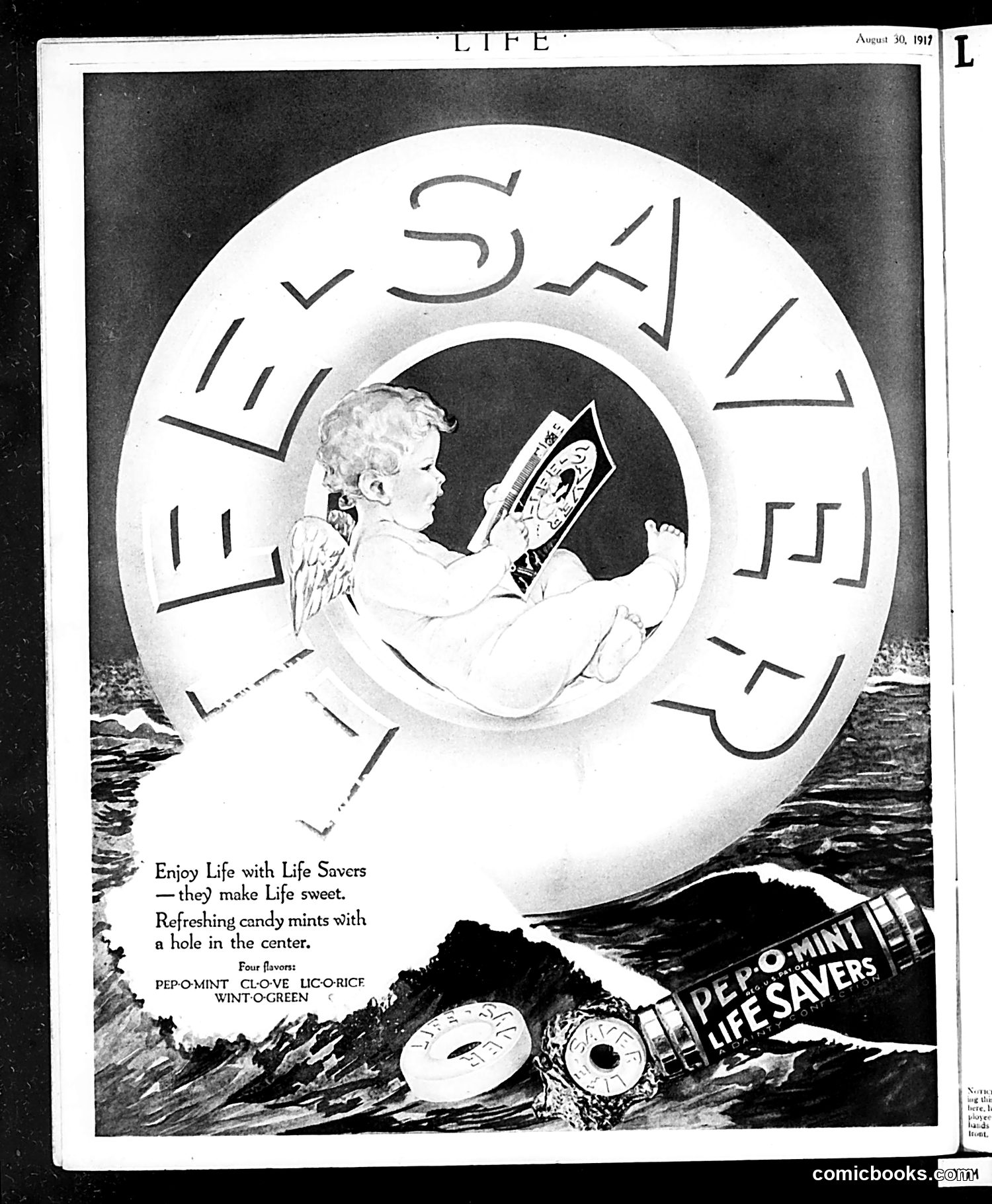
This is a Life Savers candy advertisement from August 30, 1917. The image depicts a cherub or baby angel sitting inside an oversized Life Savers mint candy, reading what appears to be a comic book or similar publication. The candy ring's hole is prominently featured in the center. The ad uses a whimsical, allegorical approach: the angel figure represents innocence and joy, while the "life saver" candy symbolizes pleasure and sweetness in everyday life. The tagline "Enjoy Life with Life Savers—they make Life sweet" plays on the product's name and positioning as a refreshing treat. Four flavors are listed: peppermint, clove, licorice, and wintergreen. This appears to be straightforward product advertising rather than political or social satire—typical of early twentieth-century commercial promotion using playful imagery and wordplay to market confectionery products.