
Life, 1917-08-30 · page 28 of 40
Life — August 30, 1917 — page 28: what you’re looking at
What you’re looking at
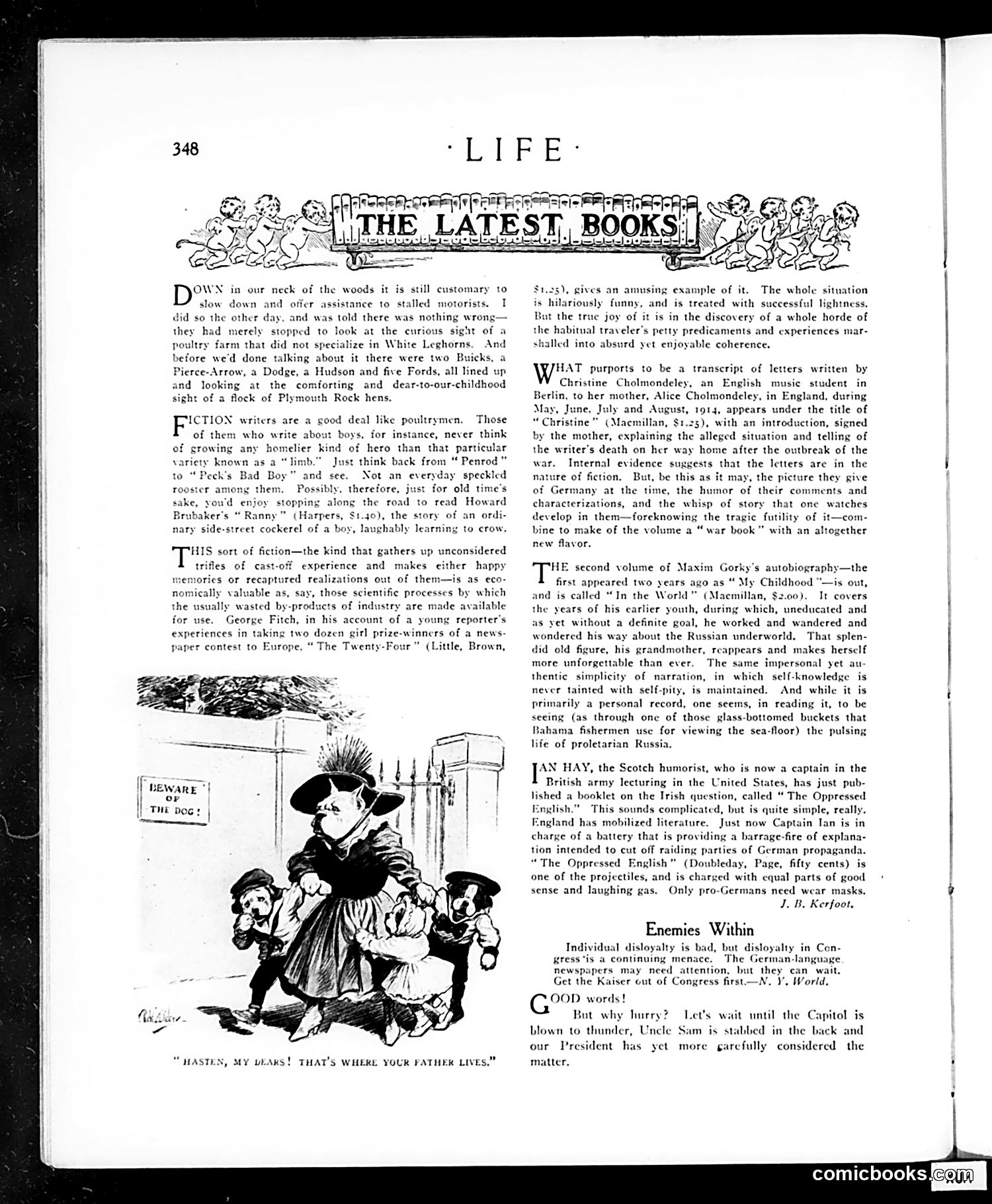
The main cartoon depicts a woman with two small children, with a "Beware the Dog" sign visible. The caption reads: "Hasten, my dears! That's where your father lives." This is wartime satire—the father is away fighting in WWI (the page references 1914), so the children barely know him. The joke darkly suggests the family dog is more present/familiar than the absent soldier-father. The cartoon uses domestic irony to comment on war's displacement of families. The page is primarily a "Latest Books" review section. It discusses fiction about ordinary subjects (a farm boy named "Ranny"), Maxim Gorky's autobiography, and notably a book called "Christine"—letters supposedly written by an English music student in Berlin during May-August 1914, the outbreak of WWI. The reviewer notes the letters' authenticity is ambiguous but praises how they capture German life at war's beginning. The overall theme: how literature documents ordinary human experience amid extraordinary historical events.
📄 Transcribed text from this page (OCR, searchable)
Machine-transcribed from the original scan — historical spelling and the odd misread are preserved.
ir = T neware “| |] THE Doc: | ——— L] AoE FE ee RFT Dos in our neck of the woods it is still customary to tance to stalled motorists. I did so the other day, and was told there was nothing wrong— they had merely stopped to look at the curious sight of a poultry farm that did not specialize in White Leghorns. And before we'd done talking about it there were two Buicks, a Pierce-Arrow, a Dodge, a Hudson and five Fords, all lined up and looking at the comforting and dear-to-our-childhood sight of a flock of Plymouth Rock hens. slow down and offer assi: ICTION writers are a good deal like poultrymen. Those of them who write about boys, for instance, never think of growing any homelier kind of hero than that particular variety known as a “limb.” Just think back from “ Penrod” to “Peck’s Bad Boy” and see. Not an everyday speckled rooster among them. Possibly, therefore, just for old time's sake, you'd en stopping along the road to read Howard Brubaker’s “ Ranny” (Harpers, $1.40), the story of an ordi- nary side-street cockerel of a boy, laughably learning to crow, HIS sort of fiction—the kind that gathers up unconsidered trifles of cast-off experience and makes either happy memories or recaptured realizations out of them—is as eco- nomically valuable as, say, those scientific processes by which the usually wasted by-products of indu are made available for use. George Fitch, in his account of a young reporter's experiences in taking two dozen girl prize-winners of a news- paper contest to Europe, “ The Twenty-Four” (Little, Brown, i eH oF | | | “MASTEN, MY DEAKS! THAT'S WHERE YOUR FATHEK LIVES.” + Rives an amu: example of it. The whole situation is hilariously funny, and is treated with successful lightness. he true joy of it is in the discovery of a whole horde of the habitual traveler's petty predicaments and experiences mar- halled into absurd yet enjoyable coherence. HAT purports to be a transcript of letters written by Christine Cholmondeley, an English music student in Berlin, to her mother, Alice Cholmondeley, in England, during May, June, July and August, 1914, appears under the title of “Christine” (Macmillan, $1.25), with an introduction, signed by the mother, explaining the alleged situation and telling of the writer's death on her way home after the outbreak of the war, Internal evidence suggests that the letters are in the nature of fiction, But, be this as it may, the picture they give of Germany at the time, the humor of their comments and characterizations, and the whisp of story that one watches develop in them—foreknowing the tragic futility of it—com- bine to make of the volume a “war book” with an altogether new flavor. HE second volume of Maxim Gorky’s autobiography—the first appeared two years ago as “ My Childhood "“—is out, and is called “In the World ). It covers the years of his earlier youth, during which, uneducated and as yet without a definite goal, he worked and wandered and wondered his way about the Russian underworld. That splen- did old figure, his grandmother, reappears and makes herself more unforgettable than ever. The same impersonal yet au thentic simplicity of narration, in which self-knowledge is never tainted with self-pity, is maintained. And while it is primarily a personal record, one seems, in reading it, to be seeing (as through one of those glass-bottomed buckets that Bahama fishermen use for viewing the sea-floor) the pulsing life of proletarian Rus: (Macmillan, $. N HAY, the Scotch humorist, who is now a captain in the British army lecturing in the United States, has just pub- lished a booklet on the Irish question, called “ The Oppressed English.” This sounds complicated, but is quite simple, really. ngland has mobilized literature. Just now Captain Tan is in charge of a battery that is providing a barrage-fire of explana tion intended to cut off raiding parties of German propaganda. “The Oppressed English” (Doubleday, Page, fifty cents) is one of the projectiles, and is charged with equal parts of good sense and laughing gas. Only pro-Germans need wear masks. J.B. Kerfoot. Enemies Within Individual disloyalty is bad, but disloyalty in Con- gress ‘is a continuing menace. The German-language newspapers may need attention, but they can wait. Get the Kaiser out of Congress first —N. VY. World, OOD words! But why hurry? Let’s wait until the Capitol is blown to thunder, Uncle Sam is stabbed in the back and our President has yet more garefully considered the matter. comicbooks