
Life, 1917-08-30 · page 11 of 40
Life — August 30, 1917 — page 11: what you’re looking at
What you’re looking at
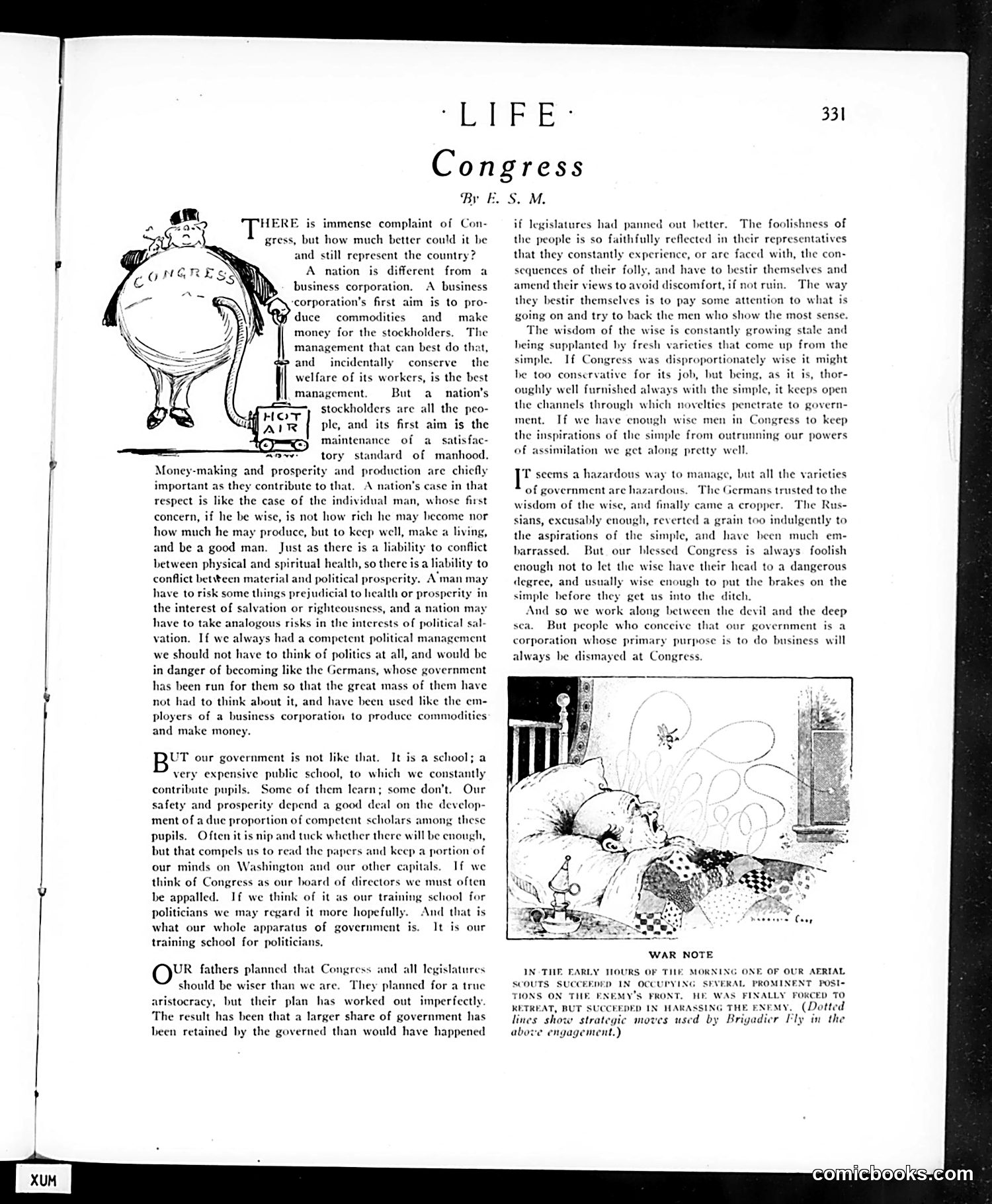
The large caricature on the left depicts **Congress personified as a bloated, rotund figure**, labeled "Congress," stuffed with money and self-interest. This visualizes the essay's central critique: that Congress has become too focused on business and profit rather than serving the public good. The text argues Congress functions like a **"school"** for training politicians rather than as a true governing body. The author critiques legislators for being either too conservative or too foolish, constantly reversing course based on public pressure rather than principle. The **war-time illustration** below shows aerial combat, supporting the essay's broader point about government managing crises poorly. Overall, the satire lambastes Congressional incompetence and corruption during what appears to be **WWI-era America**.
📄 Transcribed text from this page (OCR, searchable)
Machine-transcribed from the original scan — historical spelling and the odd misread are preserved.
— a “LEE * Congress By E “THERE is immense complaint of Con- gress, but how much better could it be and still represent the country? A nation is different from a business corporation. A business corporation's first aim is to pro- duce commodities and = make money for the stockholders. The management that can best do that, and incidentally conserve the welfare of its workers, is the best management. But a_ nation’s stockholders are all the peo- ple, and its first aim is the maintenance of a satisfac tory standard of manhood. Money-making and prosperity and production are chiefly important as they contribute to t A nation’s case in that respect is like the case of the individual man, whose first concern, if he be wise, is not how rich he may become nor how much he may produce, but to keep well, make a living, and be a good man. Just as there is a liability to conflict Letween physical and spiritual health, so there isa liability to conflict bet\teen material and political prosperity. A’man may have to risk some things prejudicial to health or prosperity in the interest of salvation or righteousness, and a nation may have to take analogous risks in the interests of politi vation. If we always had a competent political management we should not have to think of politics at all, and would be in danger of becoming like the Germans, whose government has been run for them so that the great mass of them have not had to think about it, and have been used like the em- ployers of a business corporation to produce commodities and make money. UT our government is not like that. It is a school; a very expensive public school, to which we constantly Some of them Icarn; some don't. Our safety and prosperity depend a good deal on the develop- contribute pupils, ment of a due proportion of competent scholars among these pupils. Often it is nip and tuck whether there will be enough, but that compels us to read the papers and keep a portion of our minds on Washington and our other capitals. If we think of Congress as our board of directors we must often be appalled. If we think of it as our training school for politicians we may regard it more hopefully. And that is what our whole apparatus of government is. It is our training school for politicians, Ov fathers planned that Congress and all legislatures should be wiser than we are. They planned for a truce aristocracy, but their plan has worked out imperfectly. The result has been that a larger share of government has been retained by the governed than would have happened 331 if legislatures had panned out better. The foolishness of the people is so faithfully reflected in their representatives that they constantly experience, or are faced with, the con- sequences of their folly, and have to bestir themselves and The way they bestir themselves is to pay some attention to what is going on and try to back the men who show the most sense. The wisdom of the wise is constantly growing stale and heing supplanted hy fresh varieties that come up from the If Congress was disproportionately wise it might he too conservative for its job, but being, as it is, thor- amend their views to avoid discomfort, if not ruin. simple. oughly well furnished always with the simple, it keeps open the channels through which novelties penctrate to govern- ment. the inspirations of the simple from outrunning our powers If we have enough wise men in Congress to keep of assimilation we get along pretty well. T seems a hazardous way to manage, but all the varieties sermans trusted to the The Rus- of government are hazardous. The wisdom of the wise, and finally came a cropper. sians, excusably enough, reverted a grain too indulgently to the aspirations of the simple, and have heen much em- barrassed. But our enough not to let the wise have their head to a dangerous kes on the Messed Congress is always foolish degree, and usually wise enough to put the bi simple hefore they get us into the ditch. And so we work along between the devil and the deep sca. But people who conceive that our government is a purpose is to do business will corporation whose primary always be dismayed at Congress. WAR NOTE IN THE FARLY HOURS OF TILE MORNING ONE OF OUR AERIAL SCOUTS SUCCEEDED IN OCCUPYING SEVERAL PROMINENT POS TIONS ON THE ENEMY'S FRONT. HE WAS FINALLY FORCED TO KETREAT, BUT SUCCEEDED IN HARASSING THE ENEMY, (Dotted lines show strategic moves used by Brigadier Fly in the above engagement.)