
Life, 1917-08-30 · page 18 of 40
Life — August 30, 1917 — page 18: what you’re looking at
What you’re looking at
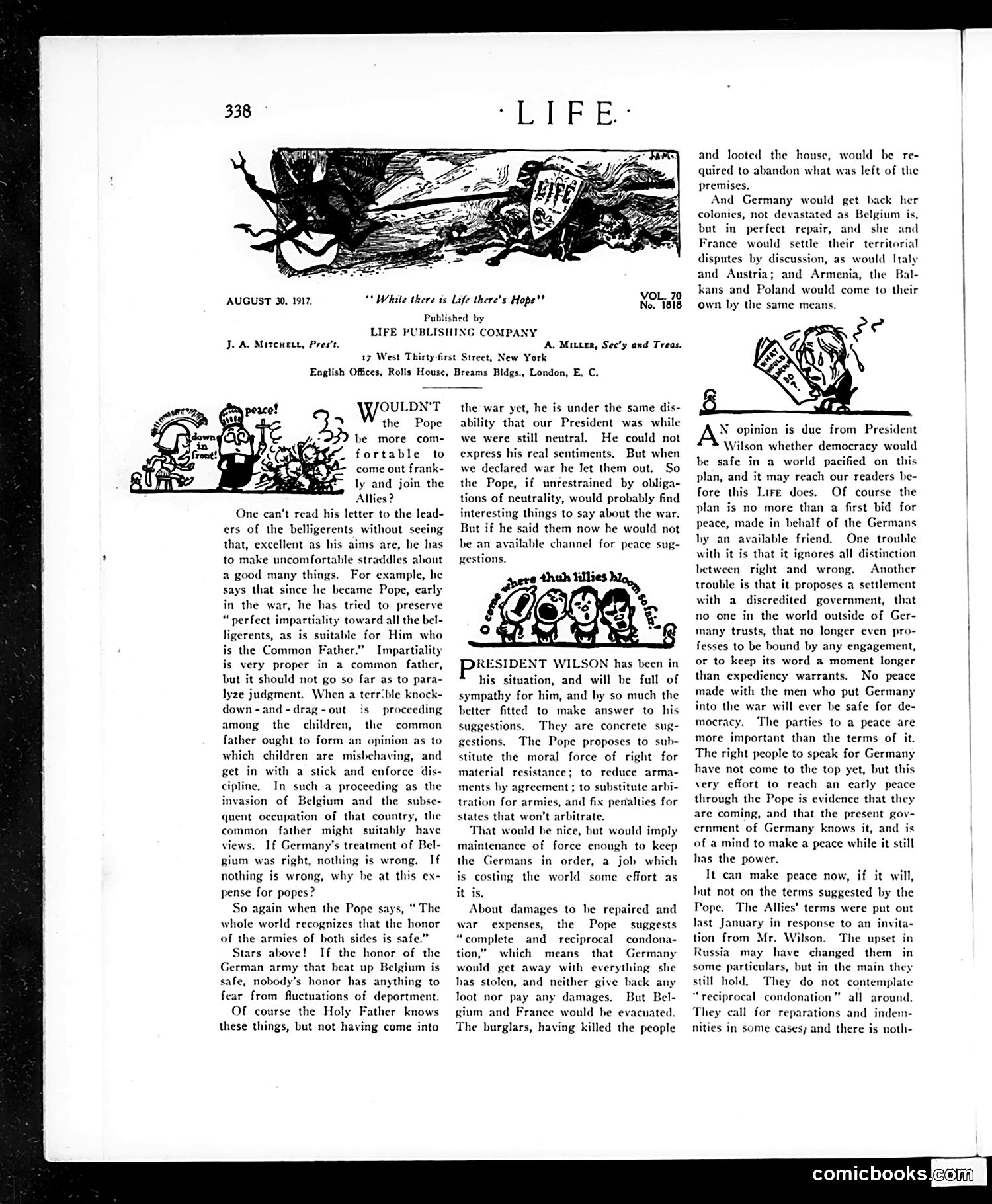
This page critiques Pope Benedict XV's letter proposing peace terms to World War I belligerents. The cartoons and text sarcastically attack the Pope's attempt to remain neutral while offering peace suggestions. The left cartoon shows the Pope awkwardly straddling a fence—visualizing his uncomfortable "impartiality" between the Allies and Central Powers. The article argues that neutrality is inappropriate when one side (Germany) has committed atrocities like invading Belgium. The author compares the Pope to a father who should discipline misbehaving children, not remain passive. The right cartoon appears to show Wilson, referenced in the text as someone who similarly couldn't openly take sides while America was neutral. The piece ridicules the Pope's proposed peace terms as absurdly favorable to Germany—they'd keep stolen colonies and loot while Belgium and France would be evacuated. Life's satire: the Pope's "neutral" mediation actually serves German interests.
📄 Transcribed text from this page (OCR, searchable)
Machine-transcribed from the original scan — historical spelling and the odd misread are preserved.
AUGUST 30, 1917. “While there is Life there's Hope’ VOL. 70 No, 1818 Published by LIFE PUBLISHING COMPANY J. A. Mircnete, Pres’t. A. Mitten, Sec’y and Treas. 17 West Thirty-first Street, New York English Offices, Rolls House, Breams Bldgs., London, E. C. OULDN'T the Pope be more com- fortable to come out frank- ly and join the Allies? One can’t read his letter to the lead- ers of the belligerents without sceing that, excellent as his aims are, he has to make uncomfortable straddles about a good many things. For example, he says that since he became Pope, early in the war, he has tried to preserve “perfect impartiality toward all the bel- ligerents, as is suitable for Him who is the Common Father.” Impartiality is very proper in a common father, but it should not go so far as to para- lyze judgment. When a terr‘ble knock- down -and-drag-out is proceeding among the children, the common father ought to form an opinion as to which children are misbehaving, and get in with a stick and enforce dis- cipline, In such a proceeding as the invasion of Belgium and the subse- quent occupation of that country, the common father might suitably have views. If Germany's treatment of Bel- gium was right, nothing is wrong. If nothing is wrong, why he at this ex- pense for popes? So again when the Pope says, “ The whole world recognizes that the honor of the armies of both sides is safe.” Stars above! If the honor of the German army that beat up Belgium is safe, nobody's honor has anything to fear from fluctuations of deportment. Of course the Holy Father knows these things, but not having come into the war yet, he is under the same dis- ability that our President was while we were still neutral. He could not express his real sentiments, But when we declared war he let them out. So the Pope, if unrestrained by obliga- tions of neutrality, would probably find interesting things to say about the war. But if he said them now he would not be an available channel for peace sug- gestions. SIDENT WILS his situation, and will be full of sympathy for him, and by so much the better fitted to make answer to his suggestions. They are concrete sug- gestions. The Pope proposes to sub- stitute the moral force of right for material resistance; to reduce arma- ments by agreement ; to substitute arbi- tration for armies, and fix penalties for states that won't arbitrate. That would he nice, but would imply maintenance of force enough to keep the Germans in order, a job which costing the world some effort as it is. About damages to he repaired and the Pope suggests “complete and reciprocal condon: ion,” which means that Germany would get away with everything she has stolen, and neither give back y loot nor pay any damages. But Be war expenses, gium and France would be evacuated. The burglars, having killed the people and looted the house, would be re- quired to abandon what was left of the premises. And Germany would get back her colonies, not devastated as Belgium is, but in perfect repair, and she and France would settle their territorial disputes by discussion, as would Italy and Austri and Armenia, the Bal- kans and Poland would come to their own by the same means. N opinion is due from President Wilson whether democracy would be safe in a world pacified on this plan, and it may reach our readers be- fore this Lire does. Of course the plan is no more than a first bid for peace, made in behalf of the Germans hy an available friend, One trouble with it is that it ignores all distinction between right and wrong. Another trouble is that it proposes a settlement with a discredited government, that no one in the world outside of Ger- many trusts, that no longer even pro- fesses to be bound by any engagement, or to keep its word a moment longer than expediency warrants. No peace made with the men who put Germany into the war will ever be safe for de- mocracy, The parties to a peace are more important than the terms of it. The right people to speak for Germany have not come to the top yet, but this. very effort to reach an early peace through the Pope is evidence that they are coming, and that the present gov- ernment of Germany knows it, and is of a mind to make a peace while it still has the power. It can make peace now, if it will, but not on the terms suggested by the Pope. The Allies’ terms were put out last January in response to an invita- tion from Mr. Wilson, The upset in Russia may have changed them in some particulars, but in the main they still hold. They do not contemplate “reciprocal condonation” all around. They call for reparations and indem- nities in some cases; and there is noth- comicbooks