
A complete issue · 42 pages · 1917
Life — August 9, 1917
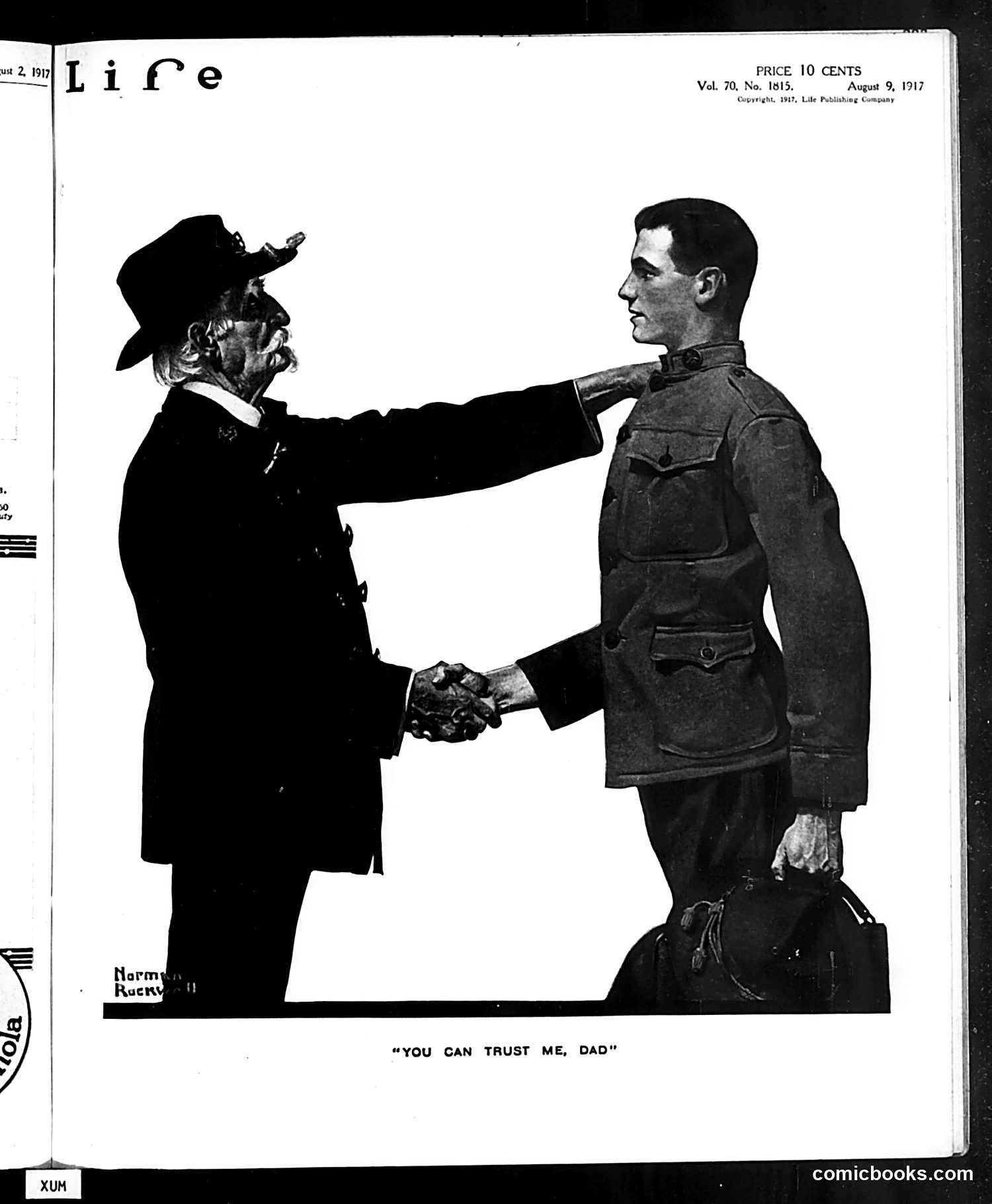
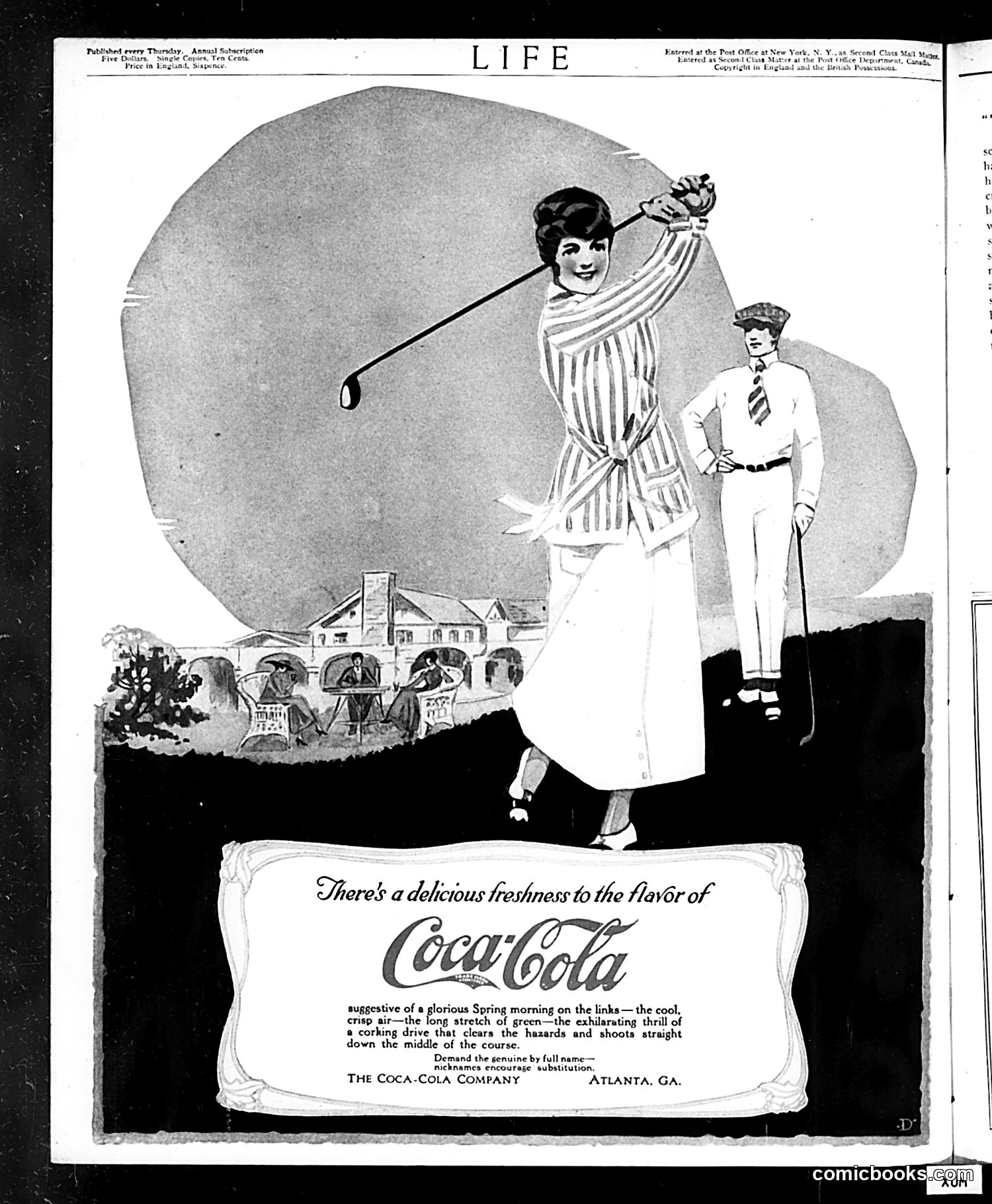
This is primarily a **Coca-Cola advertisement**, not political satire. The image shows a woman in early 1900s golfing attire mid-swing, with a male golfer observing. In the background is a country club setting with spectators. The ad's text associates Coca-Cola with "a glorious Spring morning on the links"—connecting the beverage to the leisurely, upper-class sport of golf. The copy emphasizes "freshness" and the drink's appeal during athletic activity. The satire, if any, is gentle: the ad humorously suggests that Coca-Cola provides refreshment comparable to the ideal golfing experience. This reflects early 20th-century advertising that positioned soft drinks as sophisticated refreshments for the affluent, leisure-class market—a stark contrast to modern perceptions of Coca-Cola as mass-market casual consumption.
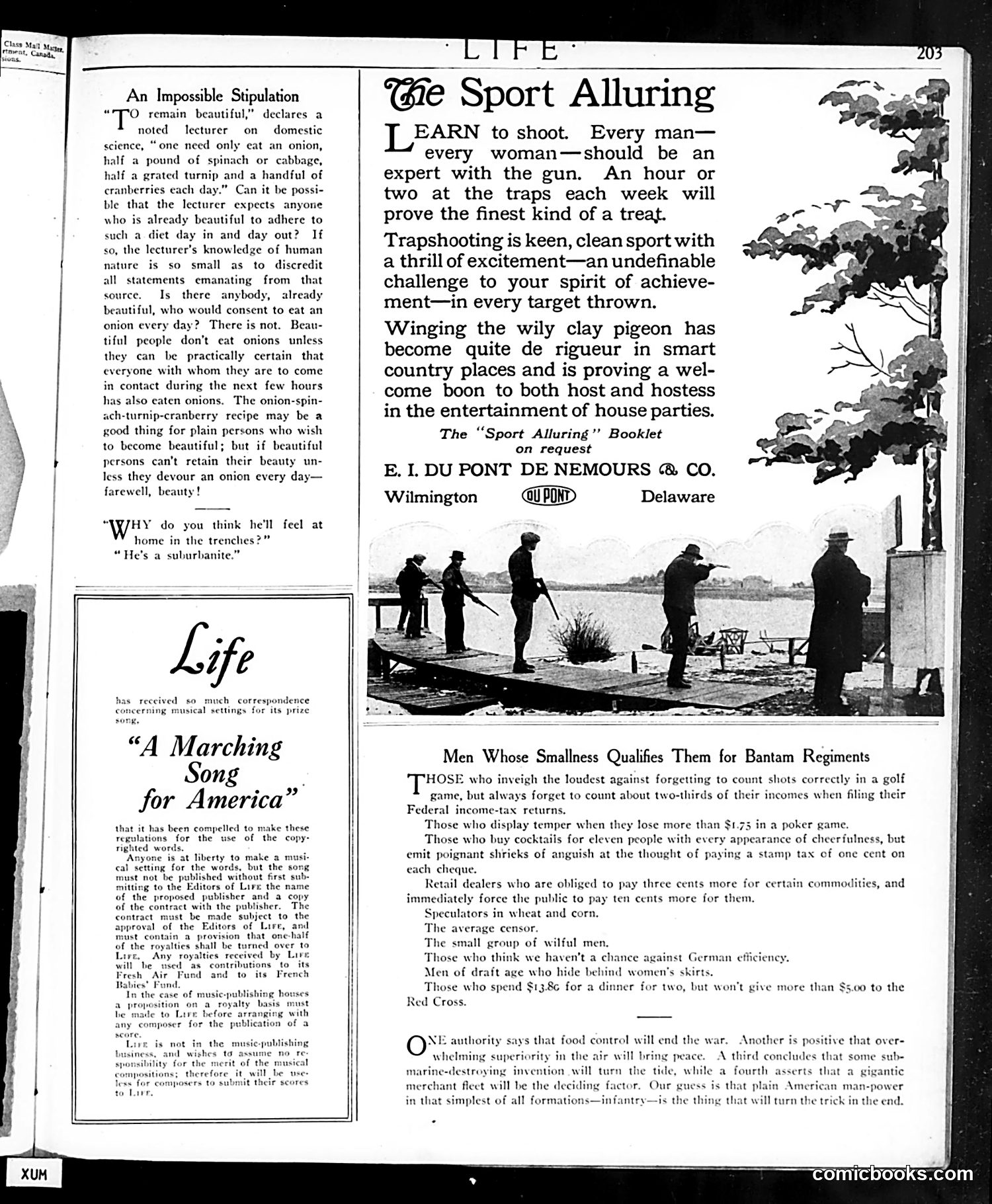
This page primarily contains **advertising and editorial content** rather than political cartoons. The main feature is a DuPont advertisement promoting trapshooting as a leisure sport, with an accompanying photograph of men shooting clay pigeons by water. The ad encourages both men and women to learn shooting, framing it as wholesome recreation and a "keen, clean sport." The left column contains humorous editorial pieces, including a commentary on an impossible dietary stipulation (eating only onions for beauty) and a joke about soldiers in trenches. The bottom section discusses various social critiques regarding small-minded behaviors—tax evasion, gambling, overpricing—presented as satirical observations on American life rather than partisan political commentary. This appears to be a typical interwar-era Life magazine blend of advertising, light humor, and social observation.
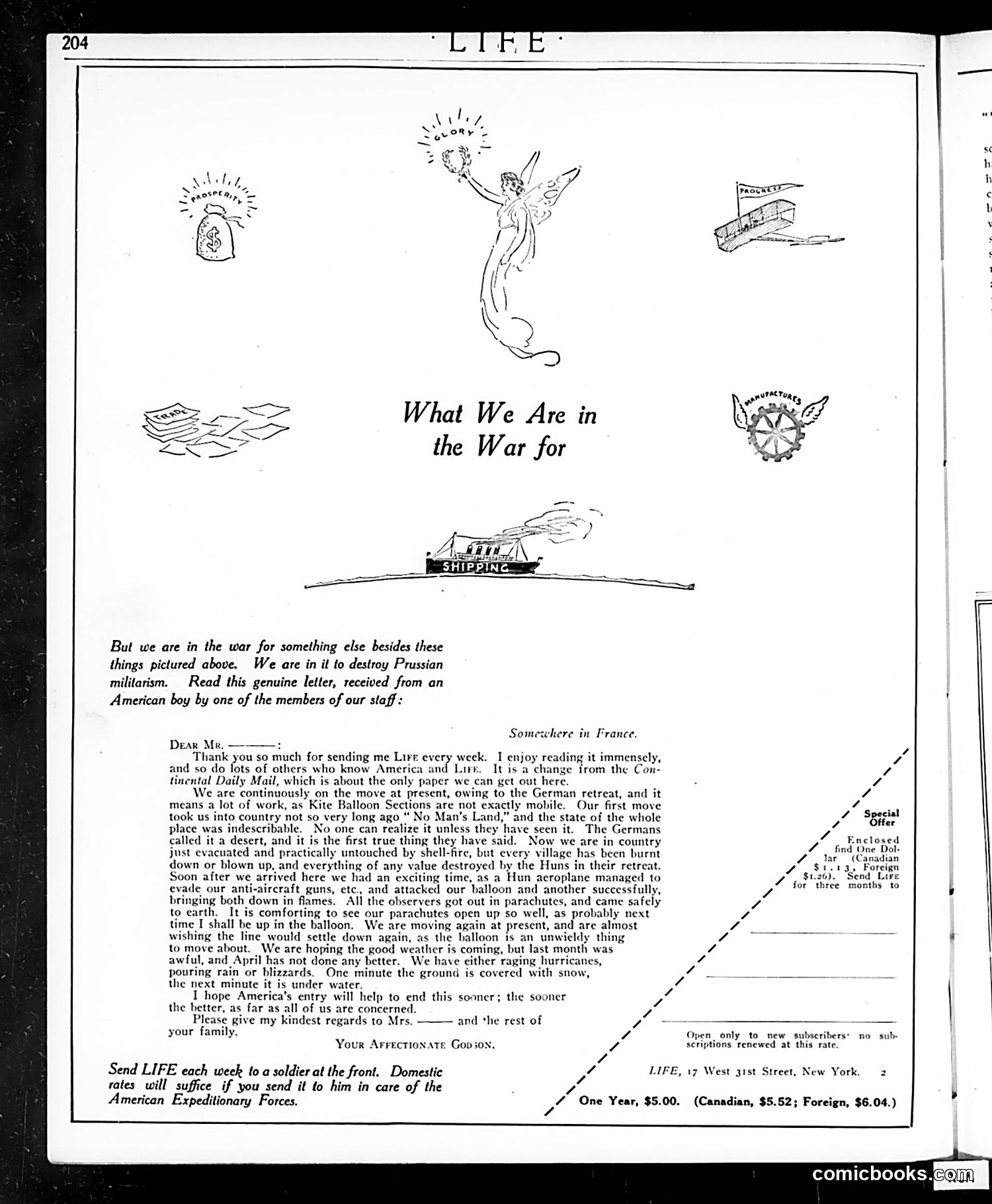
This page presents America's stated war aims during World War I through symbolic illustrations surrounding the headline "What We Are in the War For." The icons represent: - **Money/financial interests** (left) - **Liberty/freedom** (winged figure, center) - **Industrial/manufacturing capacity** (gear symbol, right) - **Shipping/commerce** (vessel at bottom) The accompanying letter from an American soldier in France emphasizes that beyond these material concerns, the war aims to "destroy Prussian militarism." The soldier describes frontline conditions—German retreats, aerial combat, weather hazards—while expressing hope that "America's entry will help to end this sooner." The satire critiques the gap between stated ideological goals and underlying economic motivations driving American involvement in the war.
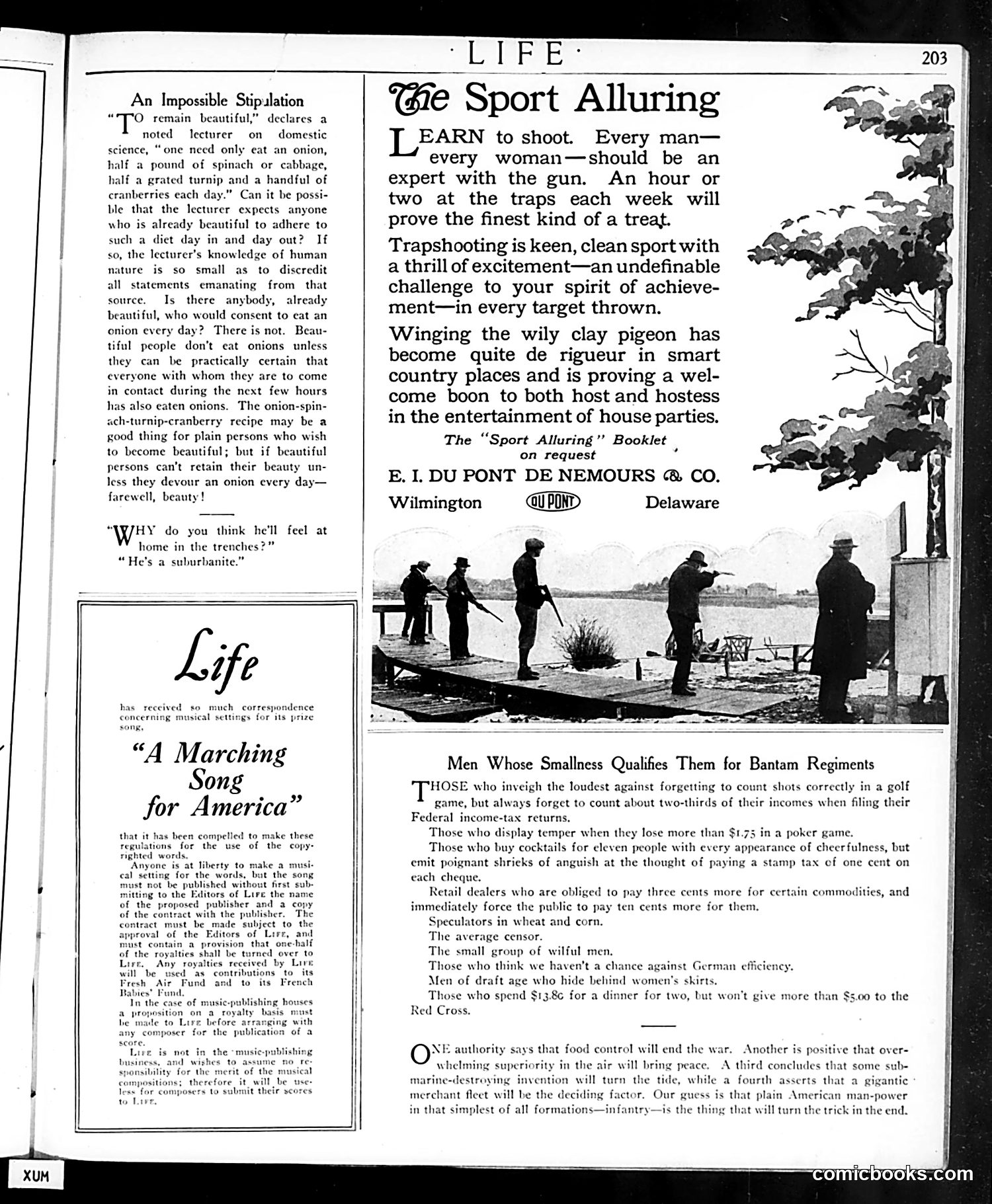
This page is primarily **advertising for Du Pont**, disguised as editorial content about trapshoot sport. The main article promotes clay pigeon shooting as entertainment for both men and women, emphasizing it as a "thrill" and social activity for "house parties." The photograph shows men at what appears to be a shooting range near water, dressed in early 20th-century attire. The satirical section below, titled "Men Whose Smallness Qualifies Them for Bantam Regiments," lists social types worth mocking—cheaters at golf, angry poker players, aggressive drinkers, price-gougers, speculators, and stingy Red Cross donors. This targets American social vices rather than political figures. The page also contains unrelated content about musical copyright disputes.
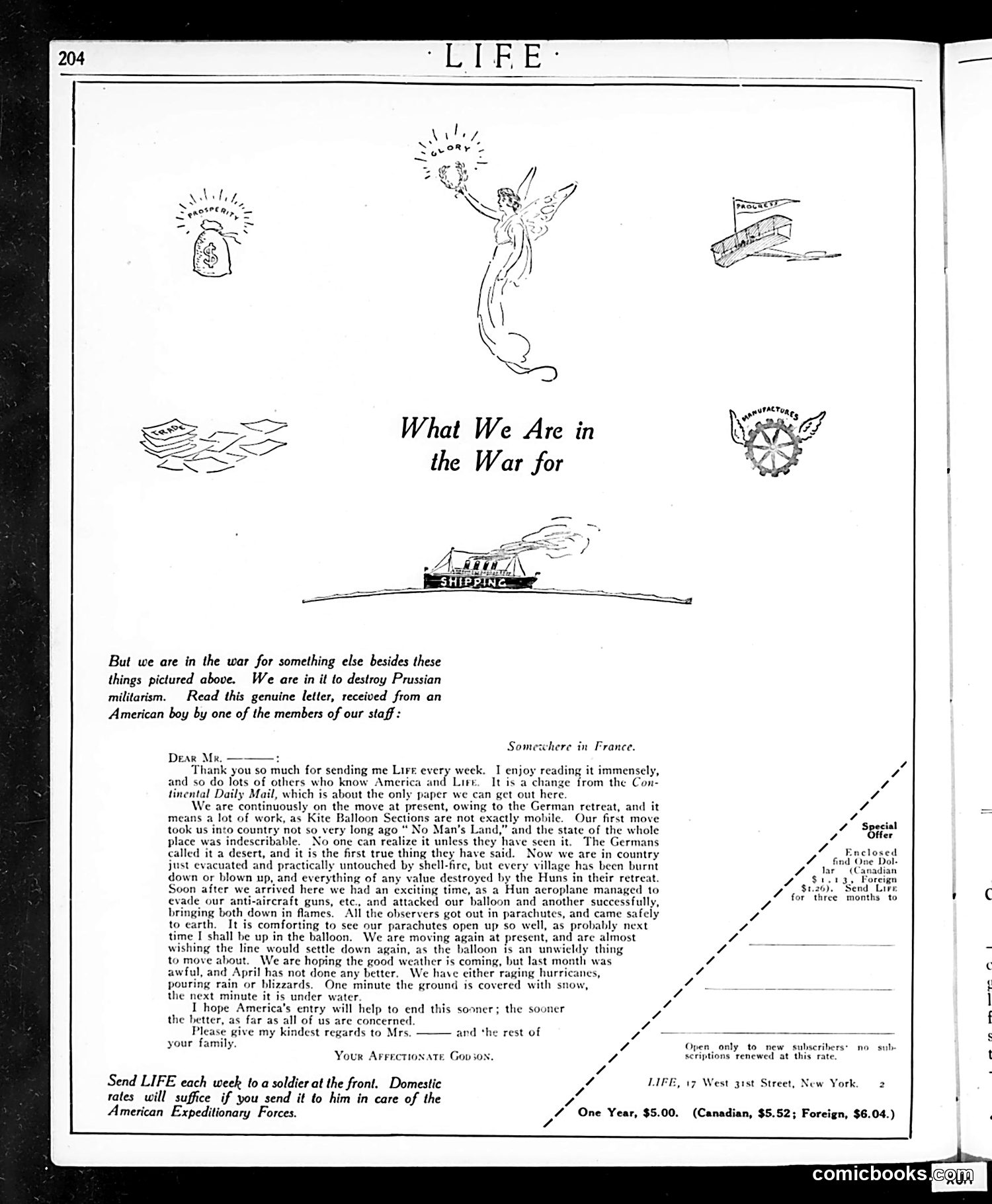
This page presents WWI propaganda content rather than satirical commentary. The central heading "What We Are in the War For" displays symbolic illustrations representing American war aims: prosperity (money bag), glory (angel), patriotism (flag), manufacturing, and shipping. The main text is a letter from an American soldier in France describing military operations against Germans, including kite balloon sections and aircraft combat. The letter emphasizes the destruction wrought by German forces during retreat. The satire is minimal here—this functions primarily as **recruitment and morale-building propaganda** for domestic readers. By publishing authentic soldier correspondence, Life legitimizes the war effort and appeals to readers' patriotic sentiment. The subscription offer at bottom ("Send LIFE each week to a soldier") reinforces this propagandistic purpose.
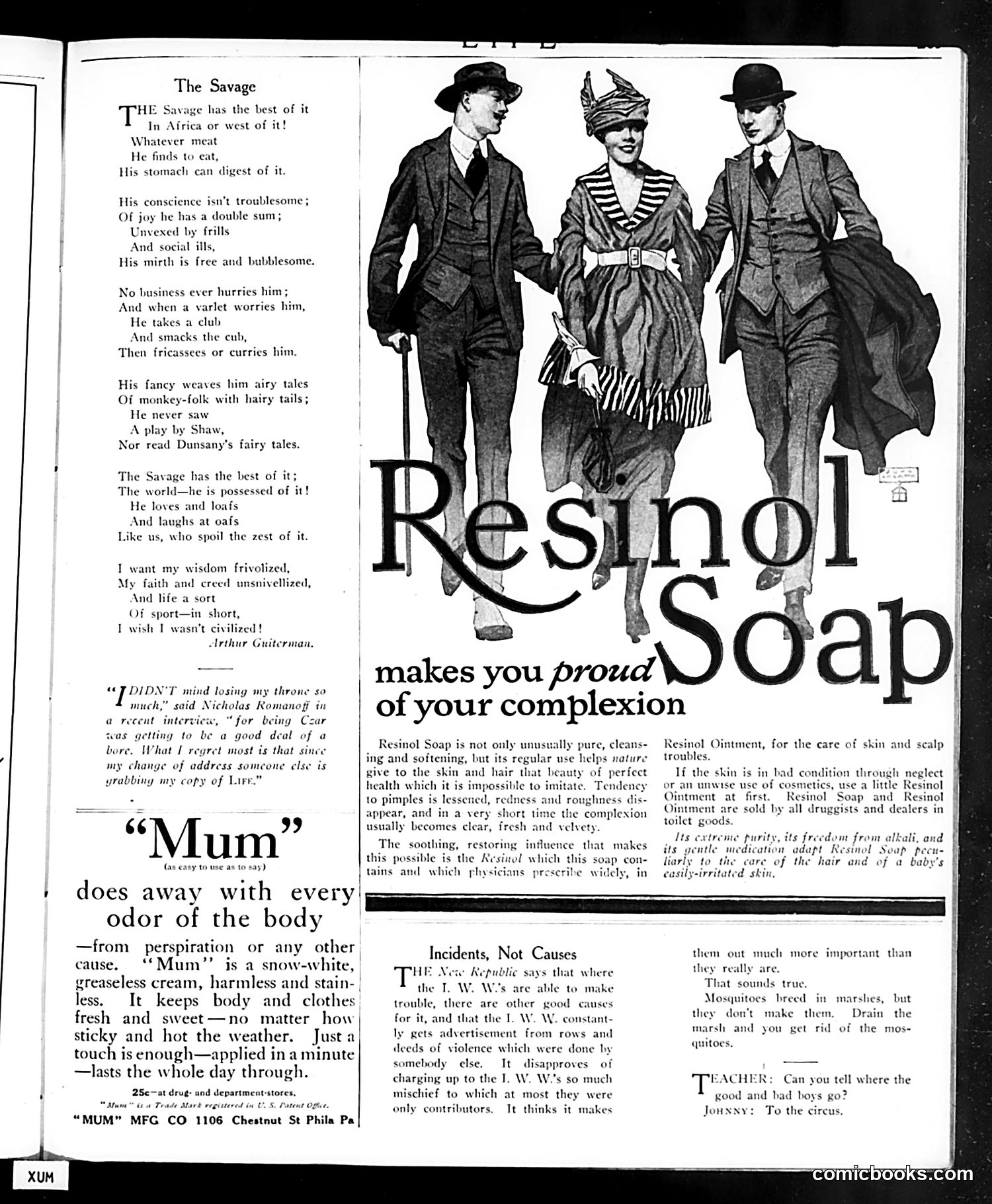
This page combines Arthur Guiterman's poem "The Savage" (left) with a Resinol Soap advertisement (right). **The Poem:** Guiterman celebrates an idealized "savage" who is free from civilization's anxieties—unconcerned with business, vulgarity, or intellectual pursuits (Shaw, Dunsany). The savage simply enjoys food, laughter, and life without the burdens of societal pretense. **The Advertisement:** Three fashionable figures in 1920s attire advertise Resinol Soap as making you "proud of your complexion." The ad promises the soap clears skin conditions and maintains beauty despite "sticky and hot weather." **The Irony:** The juxtaposition is likely intentional satire—while the poem romanticizes freedom from civilization's trappings, the advertisement sells civilization's "necessity" (cosmetics/grooming products) to achieve social acceptability. The contrast highlights consumerism's role in modern anxiety.
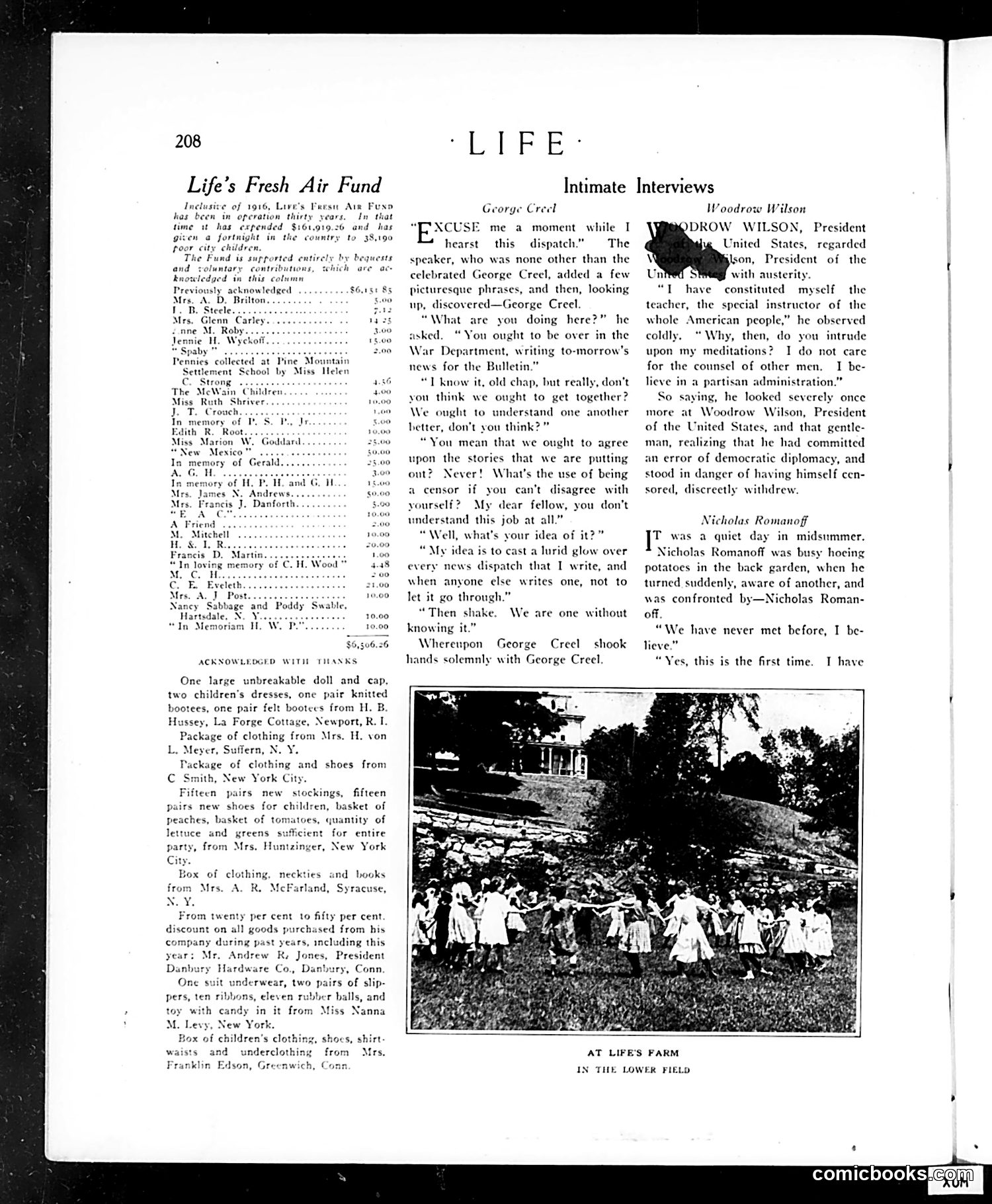
This page documents charitable contributions to Life's Fresh Air Fund, which provided summer relief for underprivileged children. The left column lists donors and monetary contributions totaling $5,526.26. The right side features "Intimate Interviews" with notable figures: George Creel (discussing censorship and news dispatches) and Woodrow Wilson (reflecting on democratic administration). Below is a photograph captioned "AT LIFE'S FARM IN THE LOWER FIELD," showing children at a recreational facility. This appears to be a public-service announcement mixed with celebrity interviews, typical of Life's dual purpose as both satirical magazine and advocate for social causes. The Fresh Air Fund addressed child welfare, a progressive-era concern.
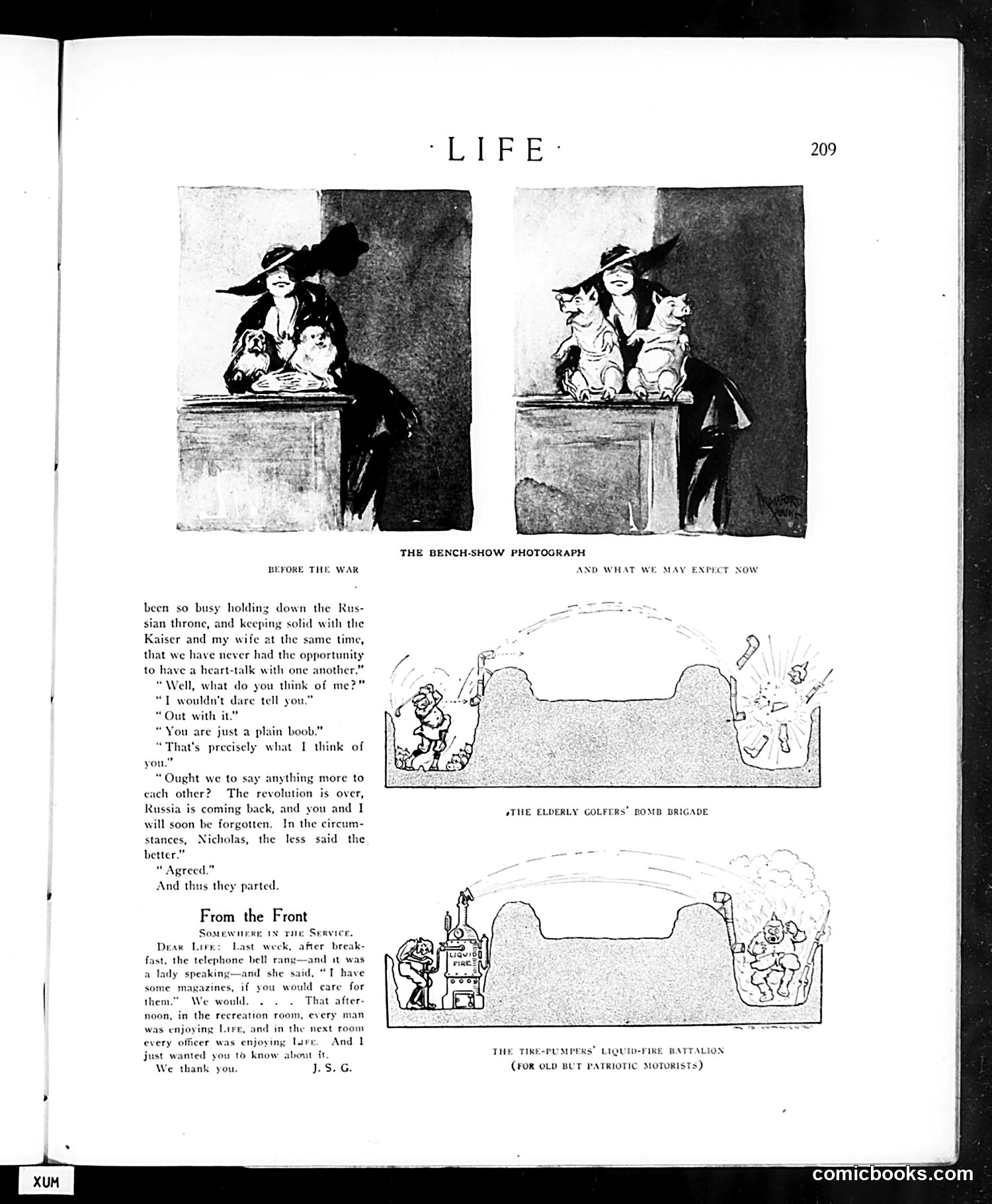
**Top Panel ("The Bench-Show Photograph"):** A before-and-after comparison satirizing post-WWI politics. The "before" shows a man with two small dogs; the "after" shows the same man now appearing alongside two larger, more aggressive-looking figures. This likely represents how Allied leaders (the "dogs") have grown more demanding or troublesome after the war's conclusion. **Lower Cartoons:** Two humorous military sketches—"The Elderly Golfers' Bomb Brigade" and "The Fire-Pumpers' Liquid-Fire Battalion"—mock elderly civilians or veterans being repurposed for wartime duties, with the subtitle noting these are "for old but patriotic motorists." The satire targets the absurdity of conscripting the elderly into combat roles. **Text excerpt** discusses Russian political upheaval and post-war diplomacy, referencing Nicholas II and international relations.
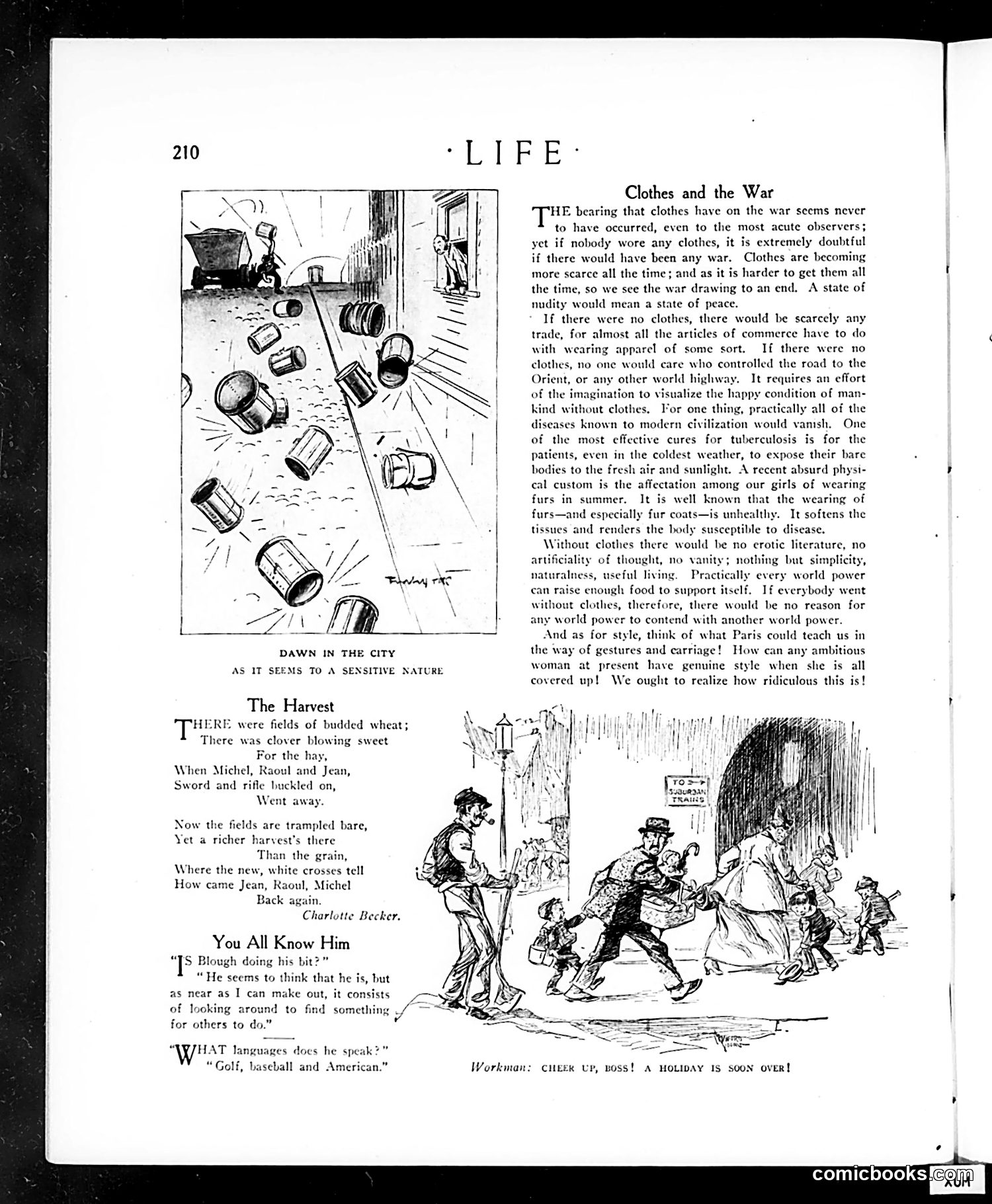
This page contains three distinct pieces: 1. **"Dawn in the City"** (top left): A sketch showing scattered kitchen utensils and household items on a street, apparently depicting urban poverty or homelessness. 2. **"Clothes and the War"** (main essay): An extended prose argument that if clothes disappeared, war would end—because trade and commerce require clothing, and without commercial interests, nations wouldn't fight. The piece sarcastically suggests nudity would eliminate vanity and artificiality, forcing human simplicity. 3. **"The Harvest"** (poem by Charlotte Becker) and **"You Know Him"** (dialogue): These appear to be unrelated short literary pieces about wartime sacrifice and a cryptic character sketch. The overall theme suggests WWI-era social commentary on materialism, warfare, and human nature.
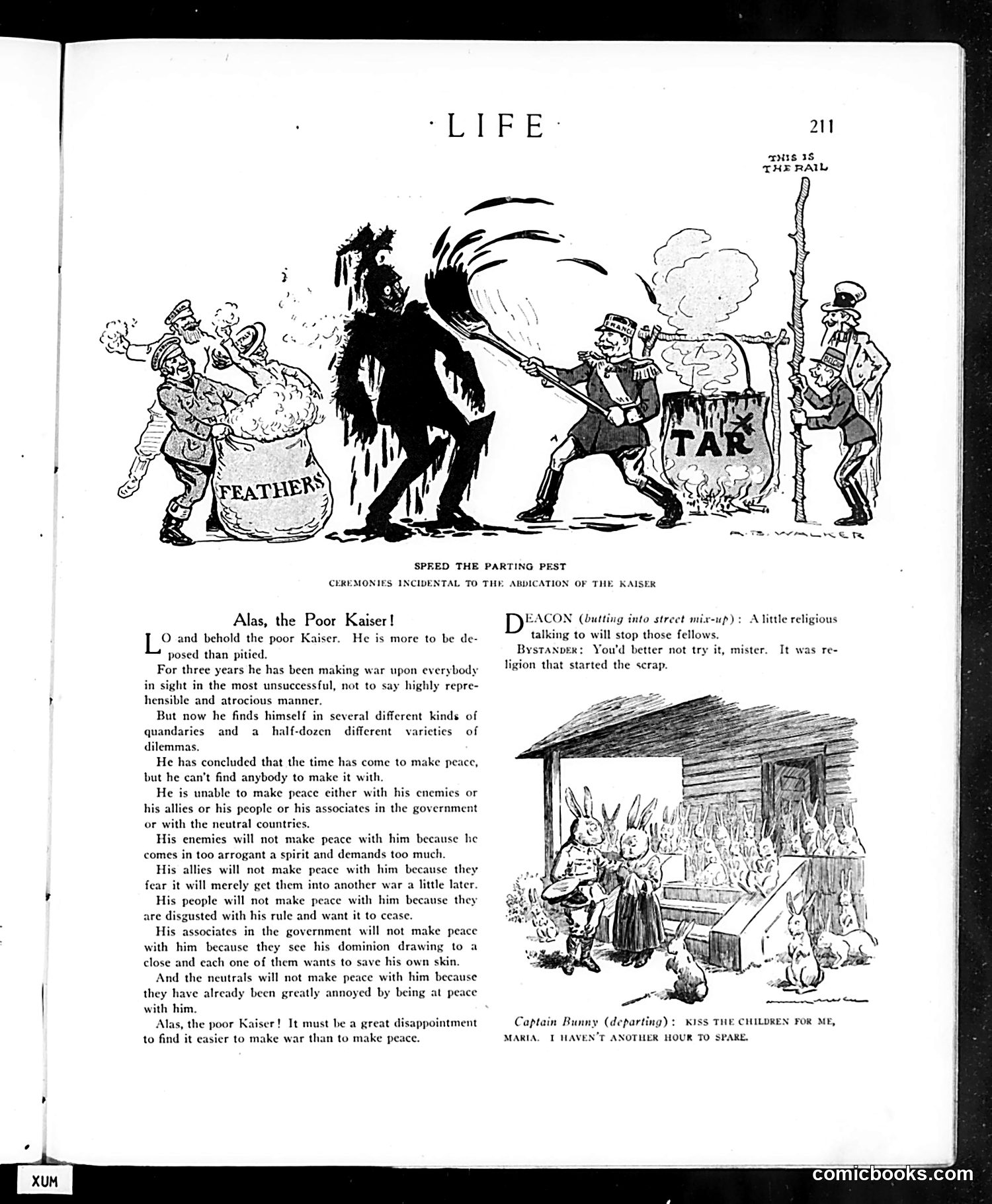
This WWI-era satirical cartoon depicts the abdication of Kaiser Wilhelm II of Germany. The central dark figure (labeled "the Poor Kaiser") is being escorted away by Allied soldiers while various groups—labeled "Feathers," "Tar," and others—actively drive him out, some wielding what appear to be tar and feathers (a humiliation tactic). The accompanying text sarcastically catalogs why the Kaiser cannot make peace: his enemies won't negotiate, his allies fear him, his people despise him, his government wants rid of him, and even neutral countries are sick of him. The joke is that it's easier to wage war than to escape the consequences of three years of unsuccessful warfare. The cartoon celebrates his forced departure as a necessary "pest" removal.
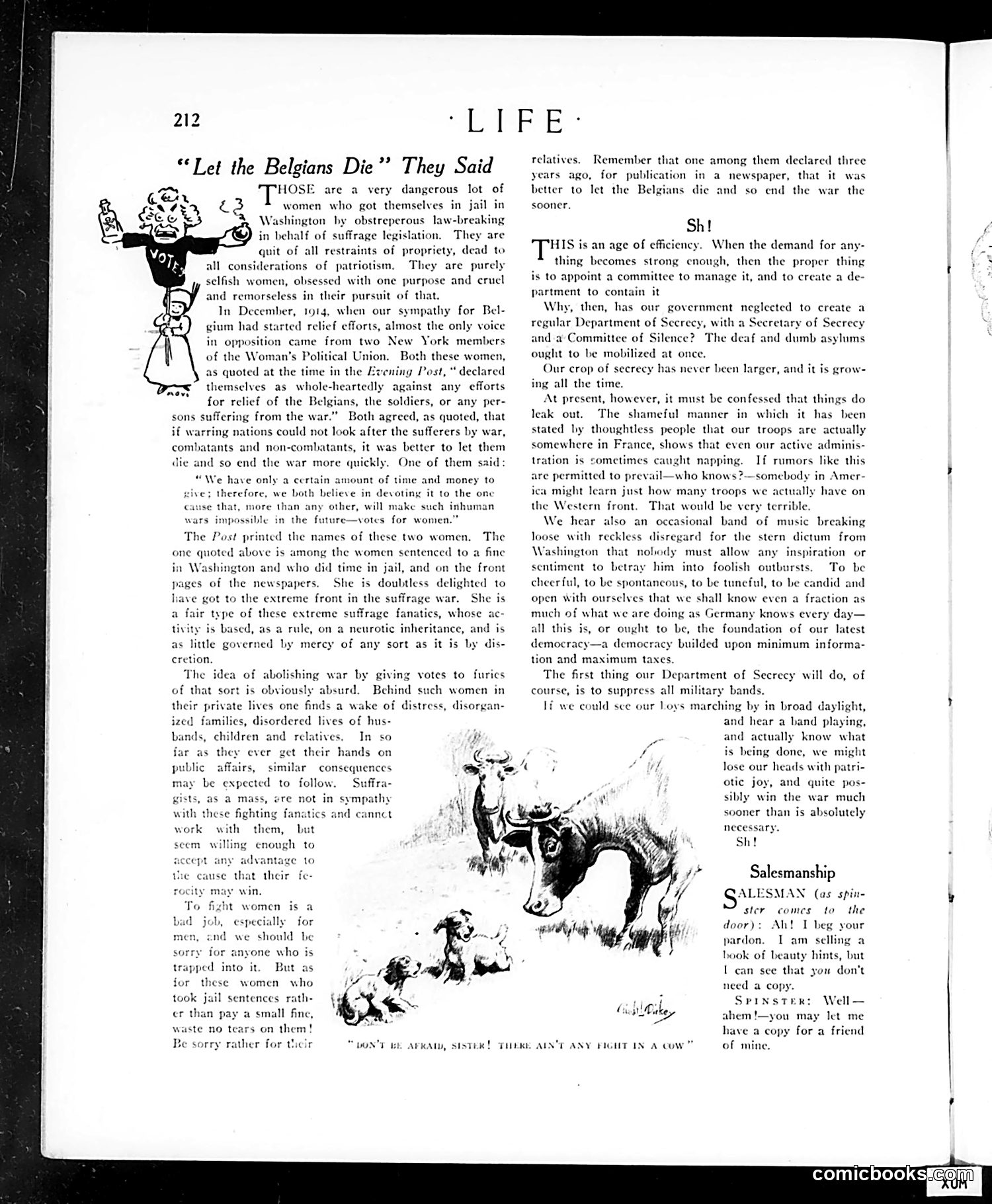
This page from *Life* magazine satirizes American suffragists and anti-war activists during World War I. The left cartoon mocks women suffragists who opposed the war, depicting them as hypocritical—demanding voting rights while simultaneously undermining military efforts. The text criticizes their "reckless disregard for stern dictum from Washington," suggesting they betray troops by spreading pacifist sentiment. The right illustration shows a cow unafraid, captioned "Don't be afraid, sister! There ain't any fight in a cow"—apparently mocking pacifists as cowardly. The overall message attacks women activists as foolish obstructionists whose anti-war activism endangers soldiers, reflecting contemporary American opposition to pacifism during WWI.
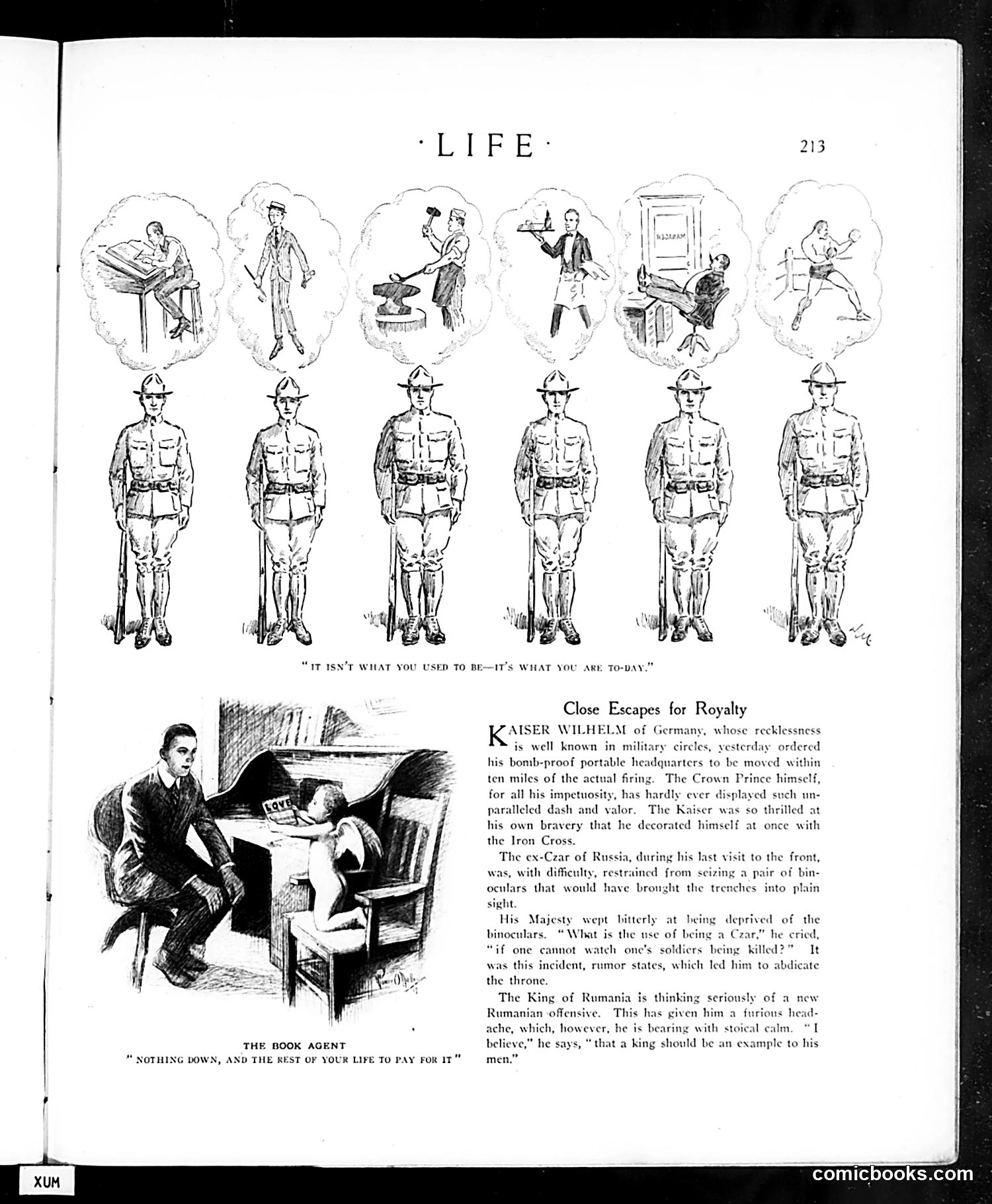
**Top Cartoon:** Six soldiers in identical military uniforms stand below, each imagining a different peaceful civilian profession (musician, businessman, blacksmith, waiter, office worker, fencer). The caption reads: "IT ISN'T WHAT YOU USED TO BE—IT'S WHAT YOU ARE TO-DAY." This satirizes WWI-era conscription, mocking how soldiers must abandon their peacetime identities and aspirations for military service. **Bottom Section:** "Close Escapes for Royalty" describes incidents involving Kaiser Wilhelm II of Germany, the ex-Czar of Russia, and the King of Romania during WWI. The cartoon shows a book agent pitching to someone, captioned "NOTHING DOWN, AND THE REST OF YOUR LIFE TO PAY FOR IT"—likely satirizing how wartime experiences or memoirs might be monetized by royalty figures facing diminished power post-war.
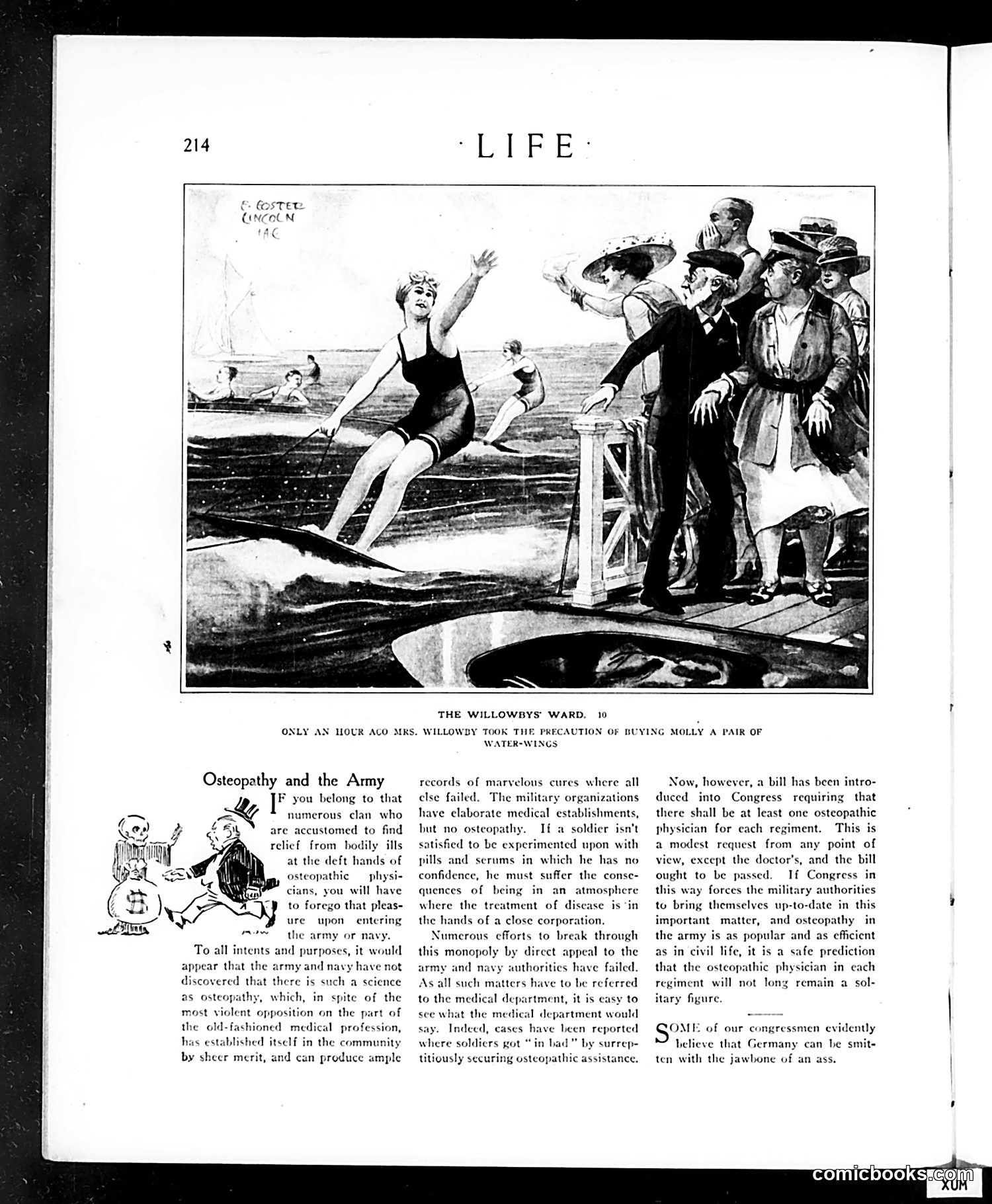
This page from *Life* magazine contains two distinct elements: **The Cartoon Image** ("The Willowby's Ward"): Shows a woman in a bathing suit diving into water while well-dressed onlookers watch from a pier. The caption indicates Mrs. Willowby is buying her companion Molly water-wings—a humorous domestic scene, likely part of a serialized cartoon story. **The Article "Osteopathy and the Army"**: Argues that osteopathy (a medical practice then considered suspect by traditional medicine) should be recognized and legitimized by the U.S. military. The writer contends that osteopathic physicians can treat soldiers effectively and that Congress should require the Army to employ them. The final quip about "Germany can be smitten with the jawbone of an ass" appears to mock skeptics of osteopathy's efficacy. The piece reflects early-20th-century debates over medical legitimacy and military healthcare policy.
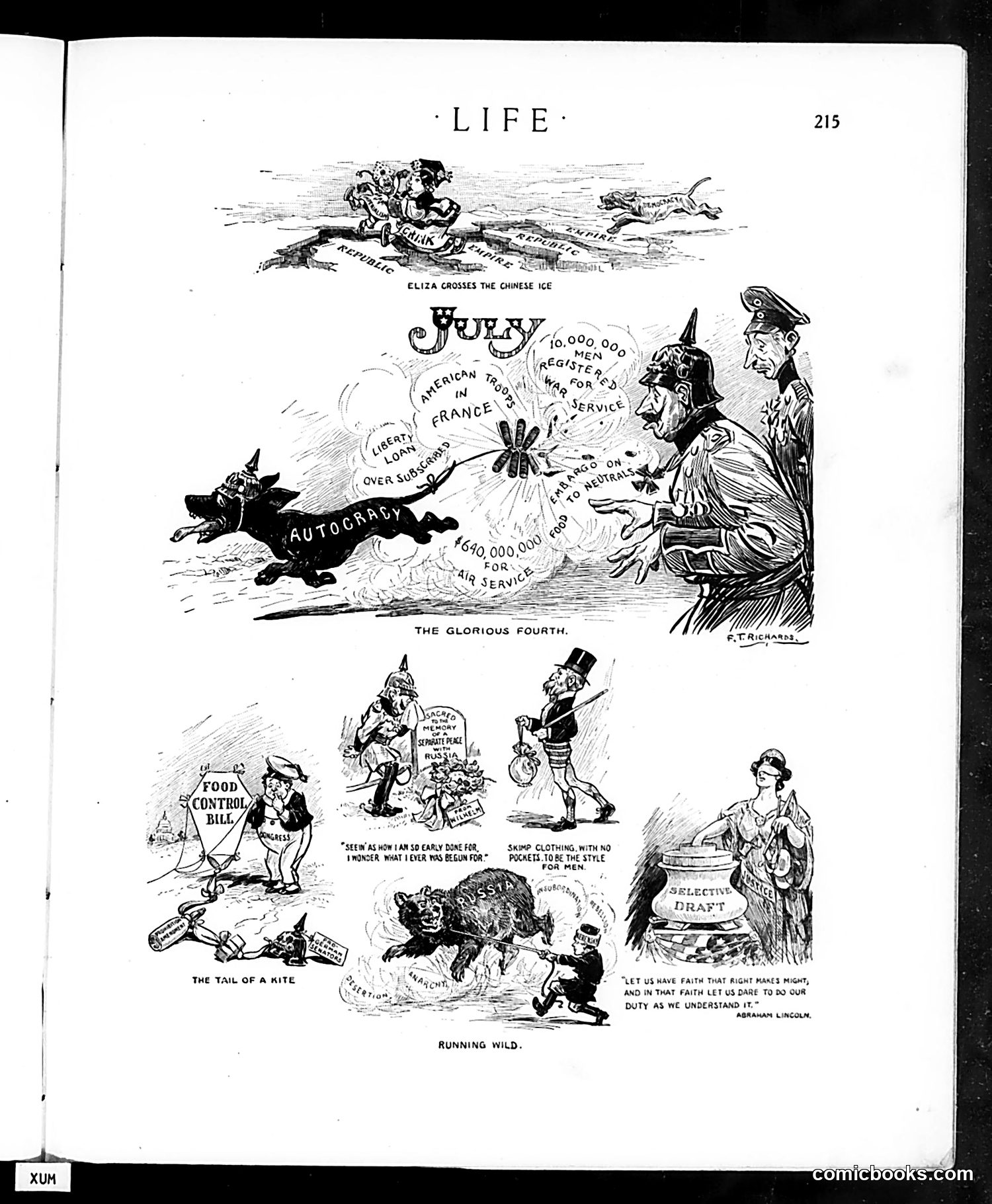
This page contains several WWI-era satirical cartoons: **"The Glorious Fourth"** depicts autocracy (shown as a spiked German-style helmet) being attacked by Allied forces discussing American contributions: Liberty Loans, 10 million men registered for service, and supplies sent to Britain. **"The Tail of a Kite"** shows the Food Control Bill as a troublesome burden. **"Running Wild"** features a beast labeled "Austria" being chased, likely referencing military actions against Austria-Hungary. Other cartoons address the Selective Draft and skimpy clothing fashions for men. An Abraham Lincoln quote about faith and duty appears on the right. The cartoons promote American WWI involvement and domestic war efforts through humor and allegorical imagery typical of 1910s-era propaganda.
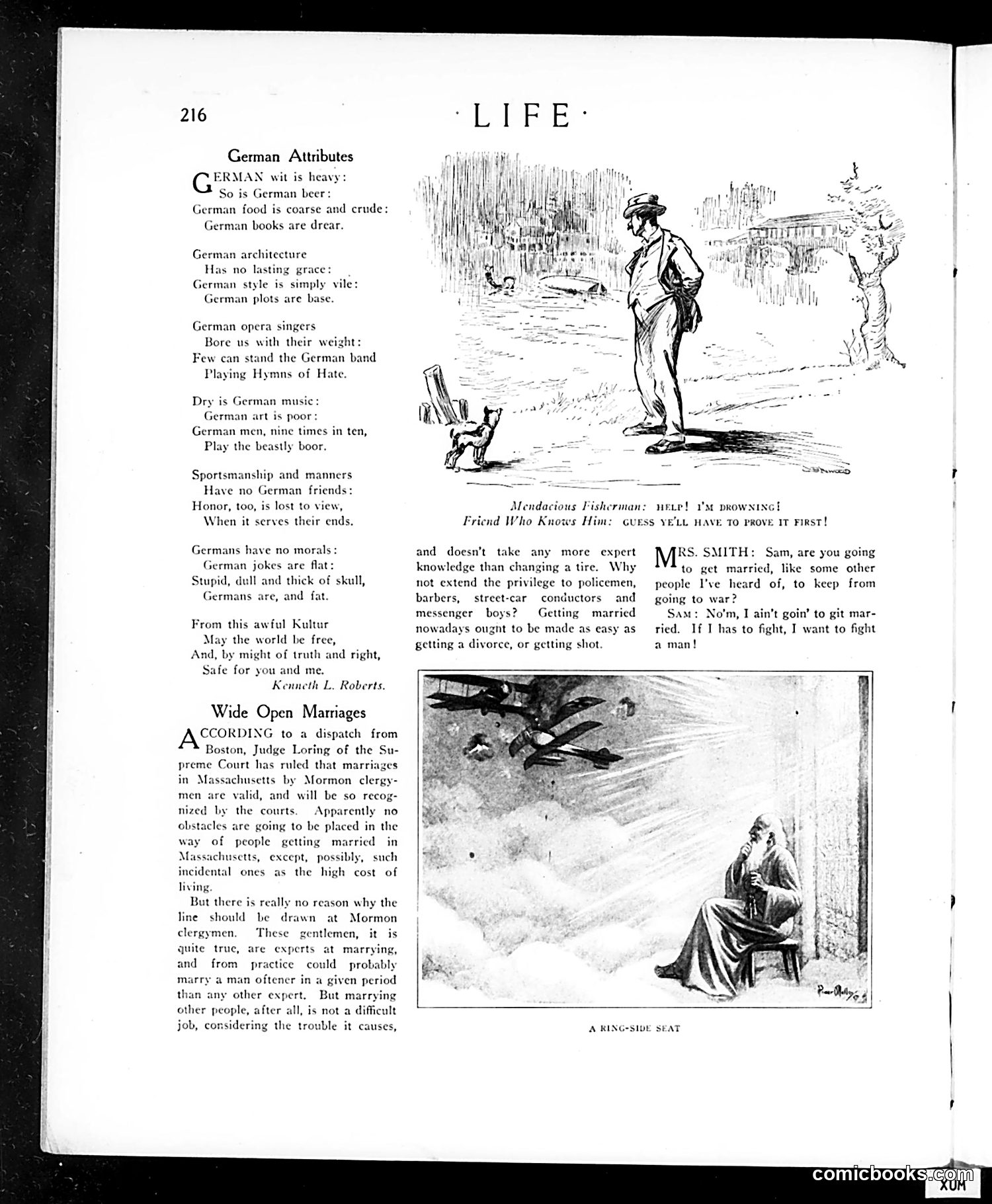
**German Attributes Poem:** Kenneth L. Roberts' satirical verse mocks German culture comprehensively—their wit, beer, food, architecture, art, music, opera singers, sportsmanship, and morals. The poem appears wartime propaganda (likely WWI era), characterizing Germans as crude, humorless, and immoral. It concludes by framing the war as liberation ("May the world be free"). **"Wide Open Marriages" Section:** This satirizes a Massachusetts court ruling recognizing Mormon clergy marriages. The piece argues if Mormon clergy can marry people, why not barbers or street-car conductors? It jokes that marriage should be as easy as divorce—mocking both loosening marriage standards and, implicitly, suggesting marriage is as simple and consequence-free as mundane transactions. **"Mendacious Fisherman" Cartoon:** A fisherman claims to be drowning while his friend skeptically demands proof. The humor plays on fishermen's reputation for exaggeration and tall tales. **"Ring-side Seat" Cartoon:** A woman pressures Sam to marry to avoid military service. Sam refuses, asserting he wants to fight "a man"—implying marriage would be a worse fate than war.
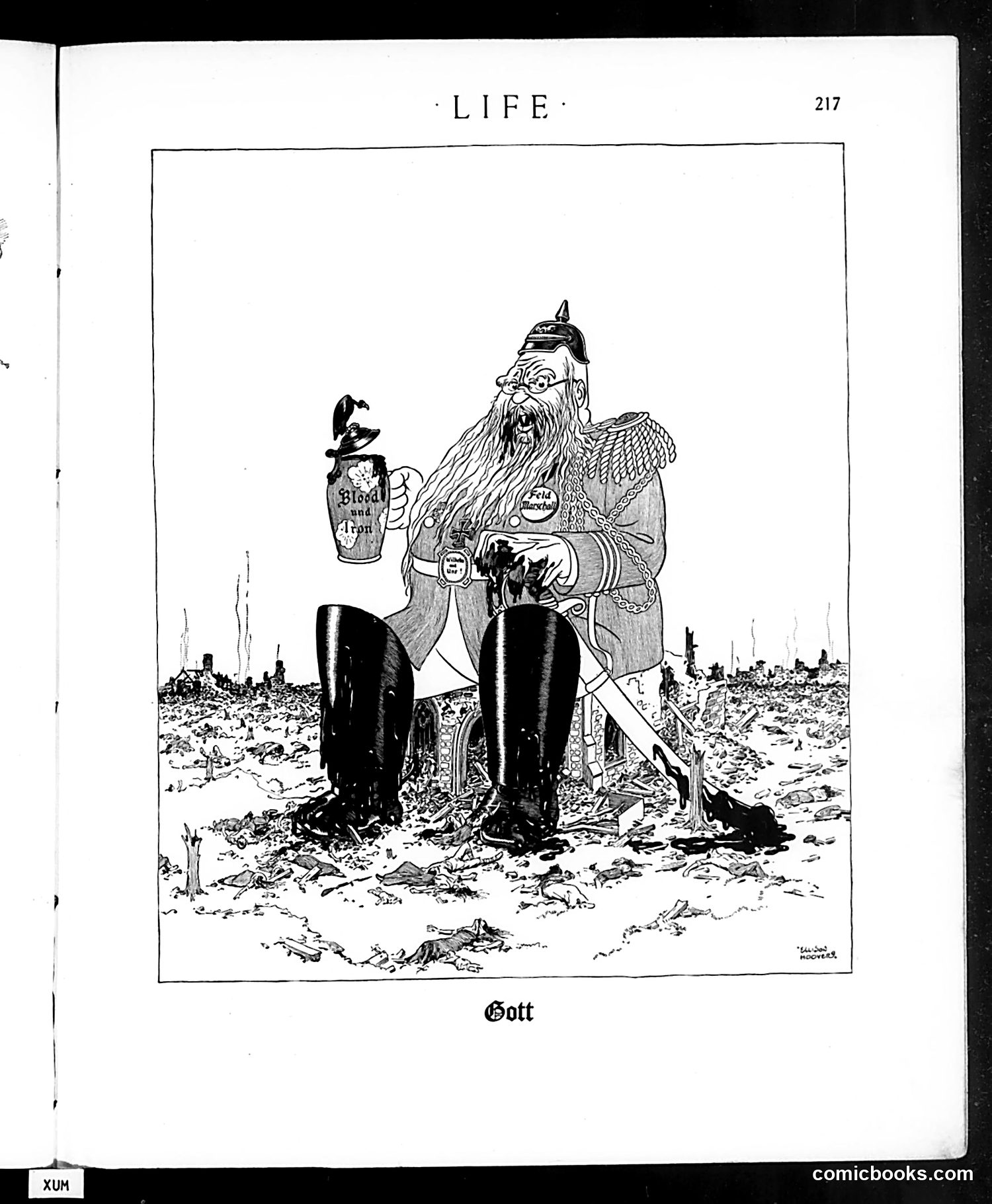
This is a political cartoon titled "Gott" (German for "God"), likely from WWI era based on the visual style and German language reference. The figure depicts a bearded German military leader or Kaiser wearing a spiked Prussian helmet and ornate military uniform, standing amid a devastated battlefield littered with debris and crosses (graves). He holds what appears to be a bottle labeled "Blood and..." (text partially obscured). The satire critiques German militarism and the massive casualties of WWI, suggesting that German leadership invoked divine sanction ("Gott") while presiding over mass death and destruction. The juxtaposition of imperial grandeur with the hellscape of war emphasizes the disconnect between military glory rhetoric and brutal reality. This reflects American anti-German propaganda common during the conflict.
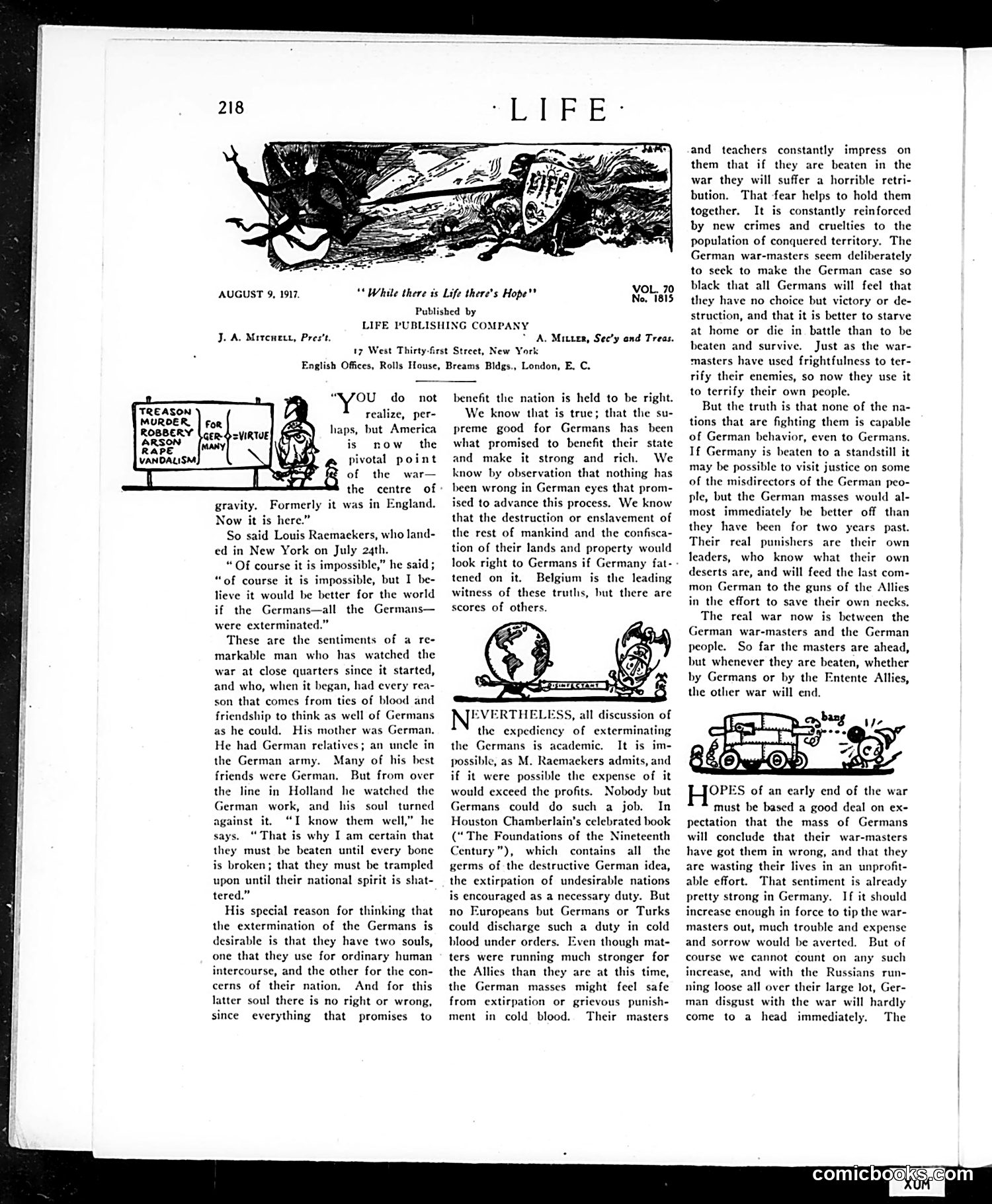
This page features an article about Louis Raemaekers, a Dutch political cartoonist and anti-German propagandist who arrived in New York on July 24, 1917—just months after America entered World War I. The small cartoon (left) shows a figure labeled with German crimes (treason, murder, robbery, arson, rape, vandalism) obscuring "virtue"—visualizing the article's central argument that German national interest has corrupted moral values. The main text quotes Raemaekers arguing that Germans possess a dual moral system: one for ordinary dealings, another for state interests where "nothing is wrong" if it benefits Germany. The article cites Belgium's suffering as evidence. While acknowledging German extermination is impossible and undesirable, the author warns that German leadership deliberately terrifies its own population with threats of horrible retribution to prevent surrender—creating a self-fulfilling cycle of escalating atrocities. This reflects 1917 American wartime propaganda emphasizing German militarism's uniquely amoral nature.
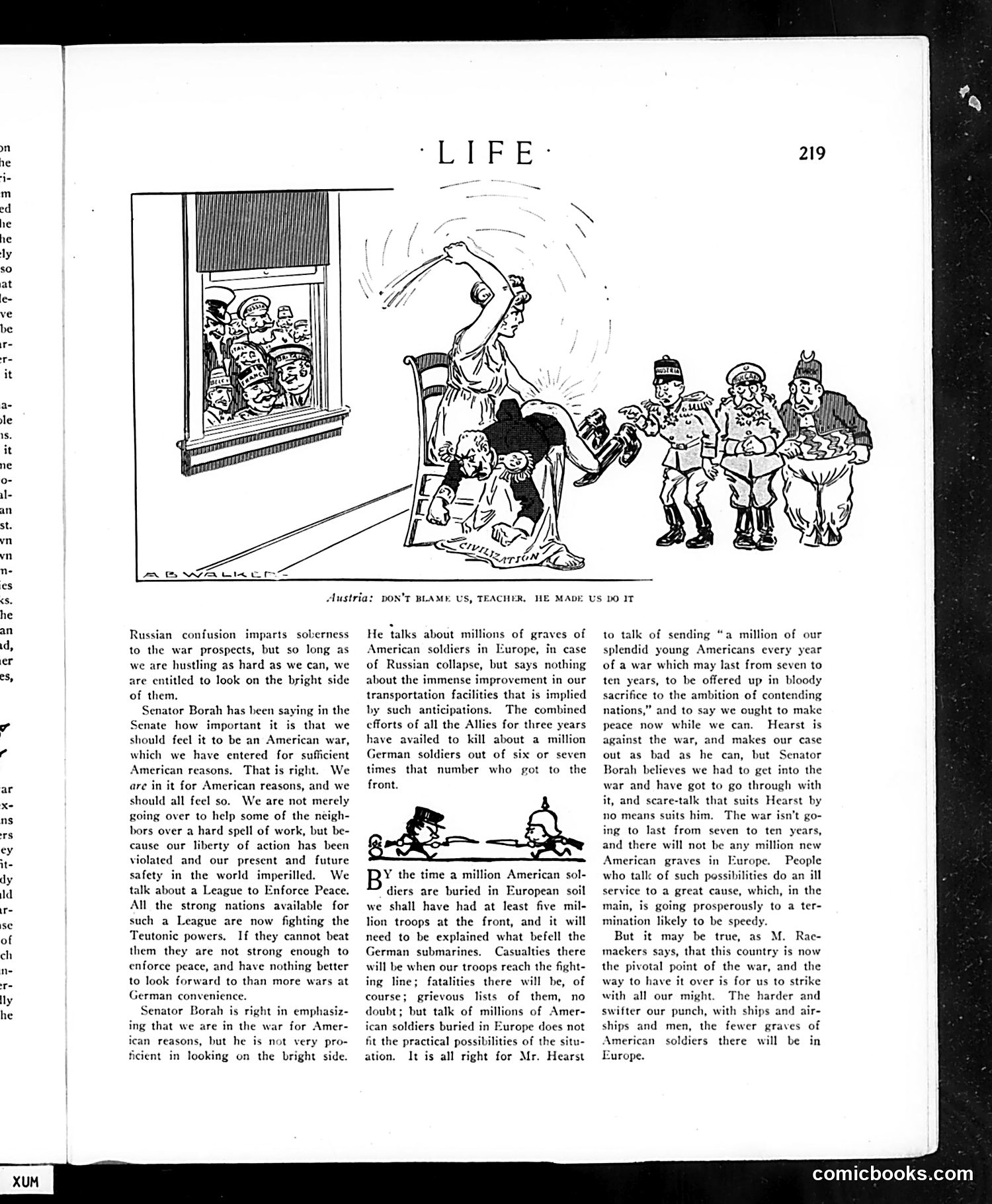
**The Cartoon:** The main illustration depicts a teacher (representing authority/justice) looking out a window at destruction, while a child character labeled "Austria" points accusingly at another figure, claiming shared responsibility for damage. This references Austria-Hungary's role in World War I—specifically, how Austria-Hungary initiated the conflict by attacking Serbia in 1914, triggering the alliance system that pulled in Russia, France, and eventually America. **The Satire:** The cartoon mocks Austria-Hungary's attempt to deflect blame for the war's catastrophic consequences. By portraying it as a child's excuse-making ("he made us do it"), Life ridicules how nations evaded accountability for the war's devastation. **Context:** This page appears from 1917-1918, when America was actively engaged in WWI. The accompanying editorial defends American participation and counters pessimistic war projections (likely from publisher William Randolph Hearst), arguing the conflict will end swiftly with fewer American casualties than feared.
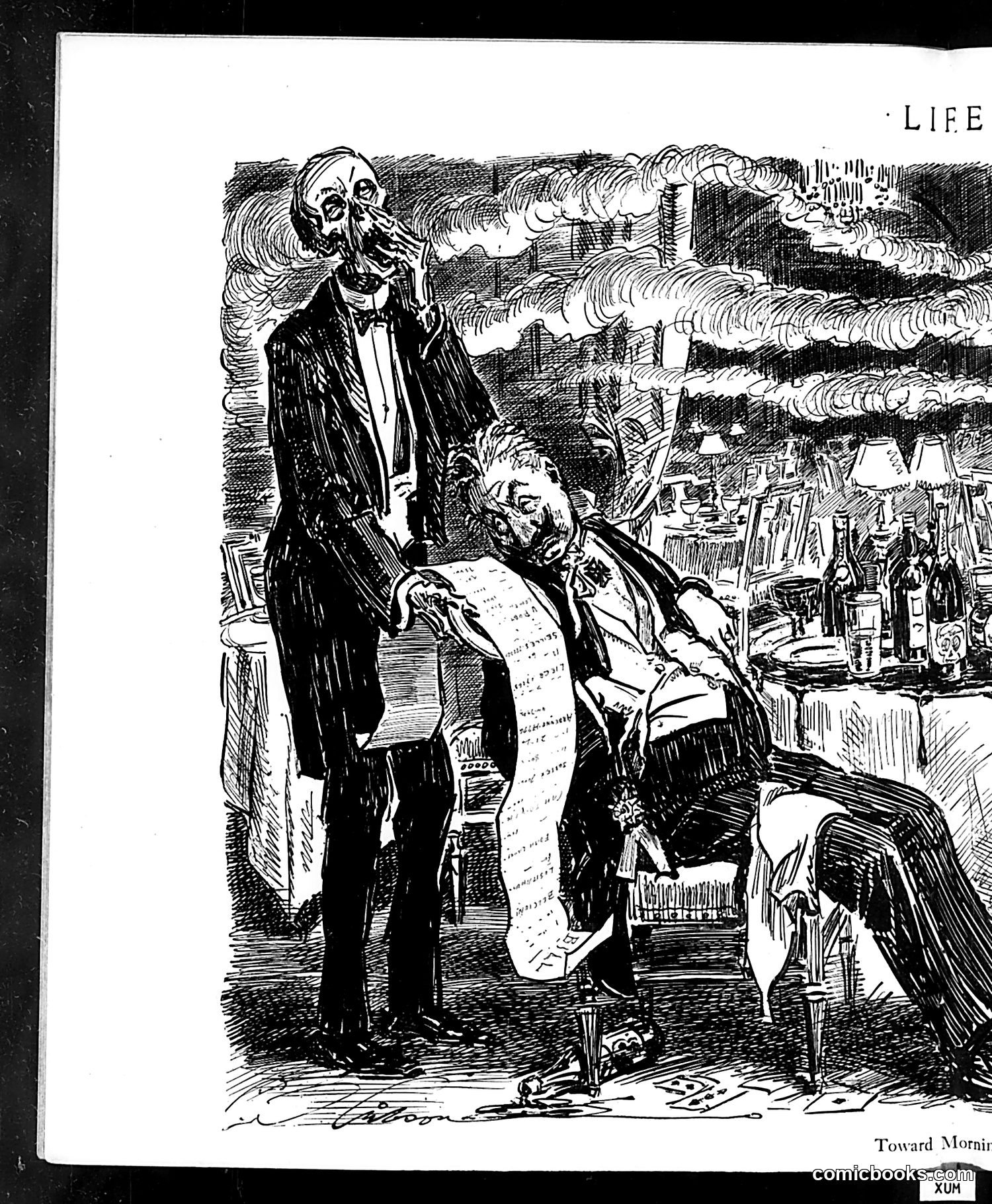
This is a satirical illustration from *Life* magazine showing two elegantly dressed men in what appears to be a formal dinner or social setting. The standing figure, gaunt-faced and formal, observes a seated man writing or reading a document. The cityscape visible in the background suggests an urban, possibly industrial setting with smoke or clouds. The caption reads "Toward Mornin'" (likely "Toward Morning"), suggesting this depicts a late-night scene. The style and formal dress suggest social satire, possibly commentary on business dealings, contracts, or financial negotiations conducted in exclusive circles. The exaggerated facial features and body language imply criticism of the subjects' character or motivations, though without additional context, the specific figures and exact satirical target remain unclear from the image alone.
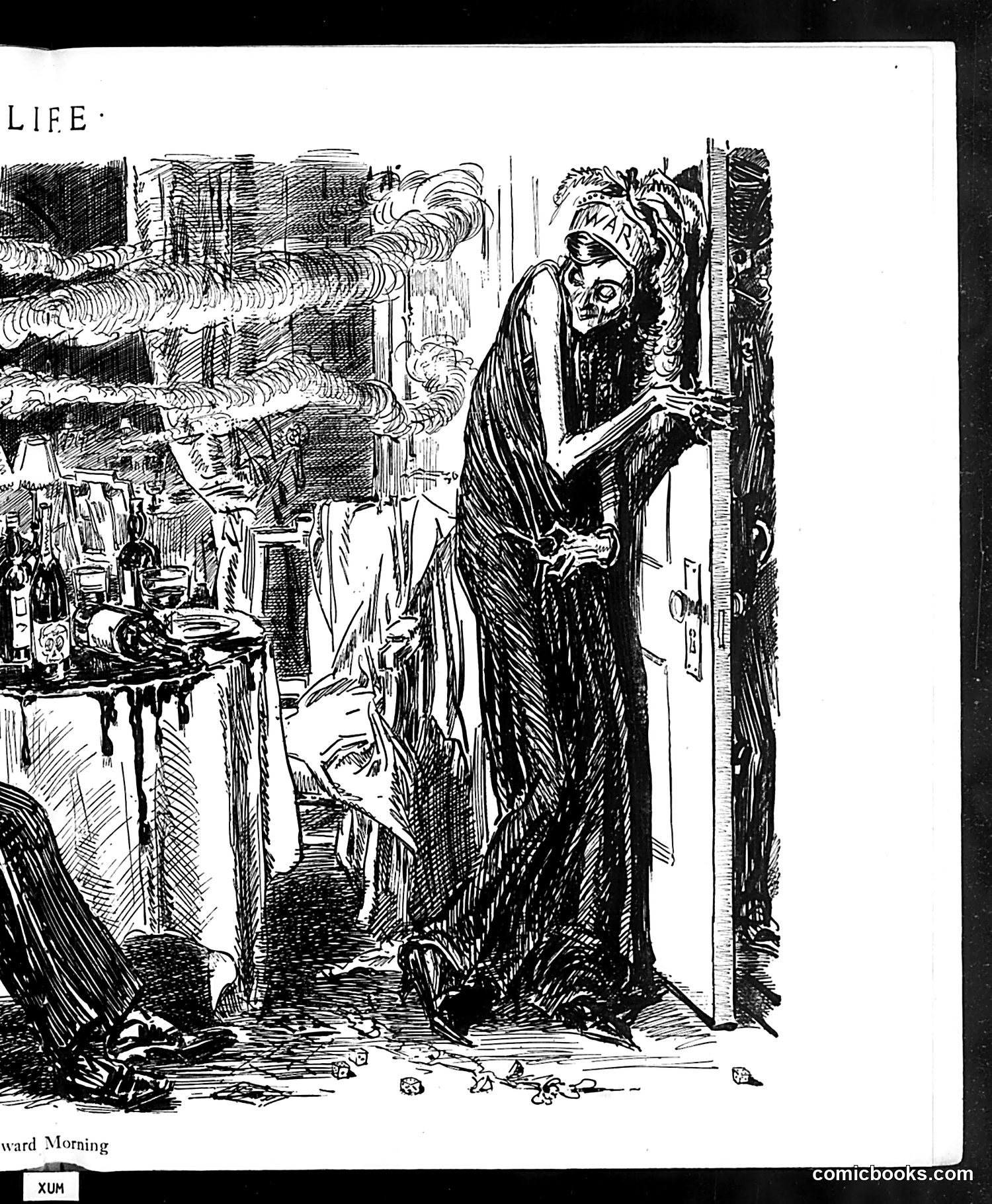
This is a skeletal figure in tattered robes—a personification of Death or Poverty—standing in what appears to be a squalid tenement room. The figure holds something (possibly a document or eviction notice) while examining the doorframe. The cluttered, decrepit interior with minimal furnishings emphasizes urban destitution. The cartoon's title references "ward Morning," likely meaning a hospital ward or poor ward. The satire critiques dangerous living conditions in tenements or slums. The skeletal Death figure suggests these impoverished spaces are literally fatal—that poverty kills residents through disease, malnutrition, or unsafe housing. This reflects early 20th-century American social commentary on urban housing reform and workers' living conditions, common themes in *Life* magazine's satirical content.
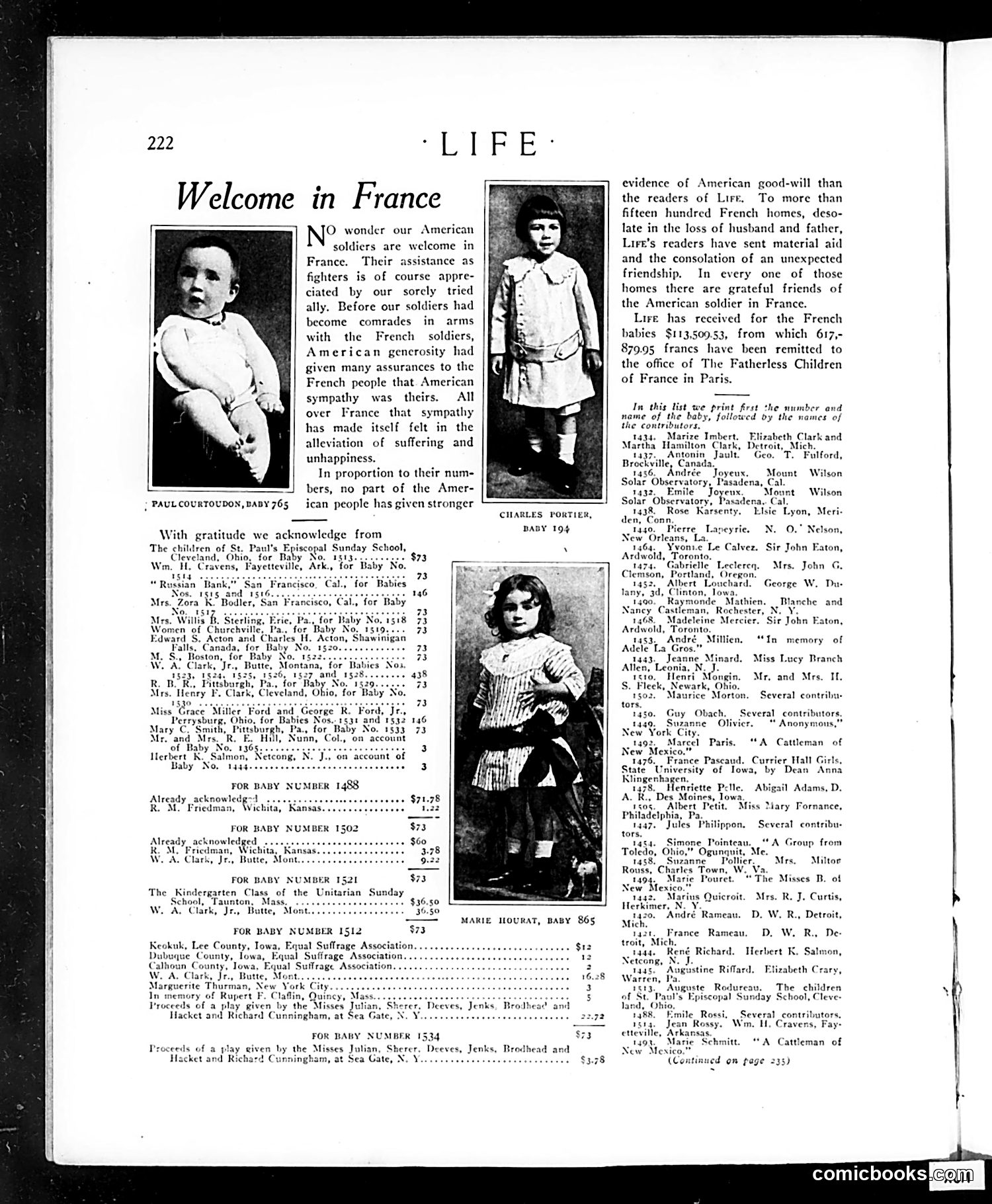
This page documents Life magazine's charitable campaign to aid French war orphans during World War I. The article praises American soldiers' welcome in France and credits American generosity—particularly Life's readers—with providing material support to bereaved French families. The two photographs show French babies being aided: "Paul Courtoudon, Baby 765" and "Charles Portier, Baby 194," along with "Marie Hourat, Baby 865." These represent the over 1,500 French children assisted through Life's fundraising efforts, which had collected $113,509.53 and remitted 617,879.95 francs to "The Fatherless Children of France in Paris." The bulk of the page lists contributors' names and baby recipients—documenting American civic participation in wartime relief. The satire lies in celebrating American benevolence as "evidence of good-will," contrasting private charity with official military involvement in the costly conflict.
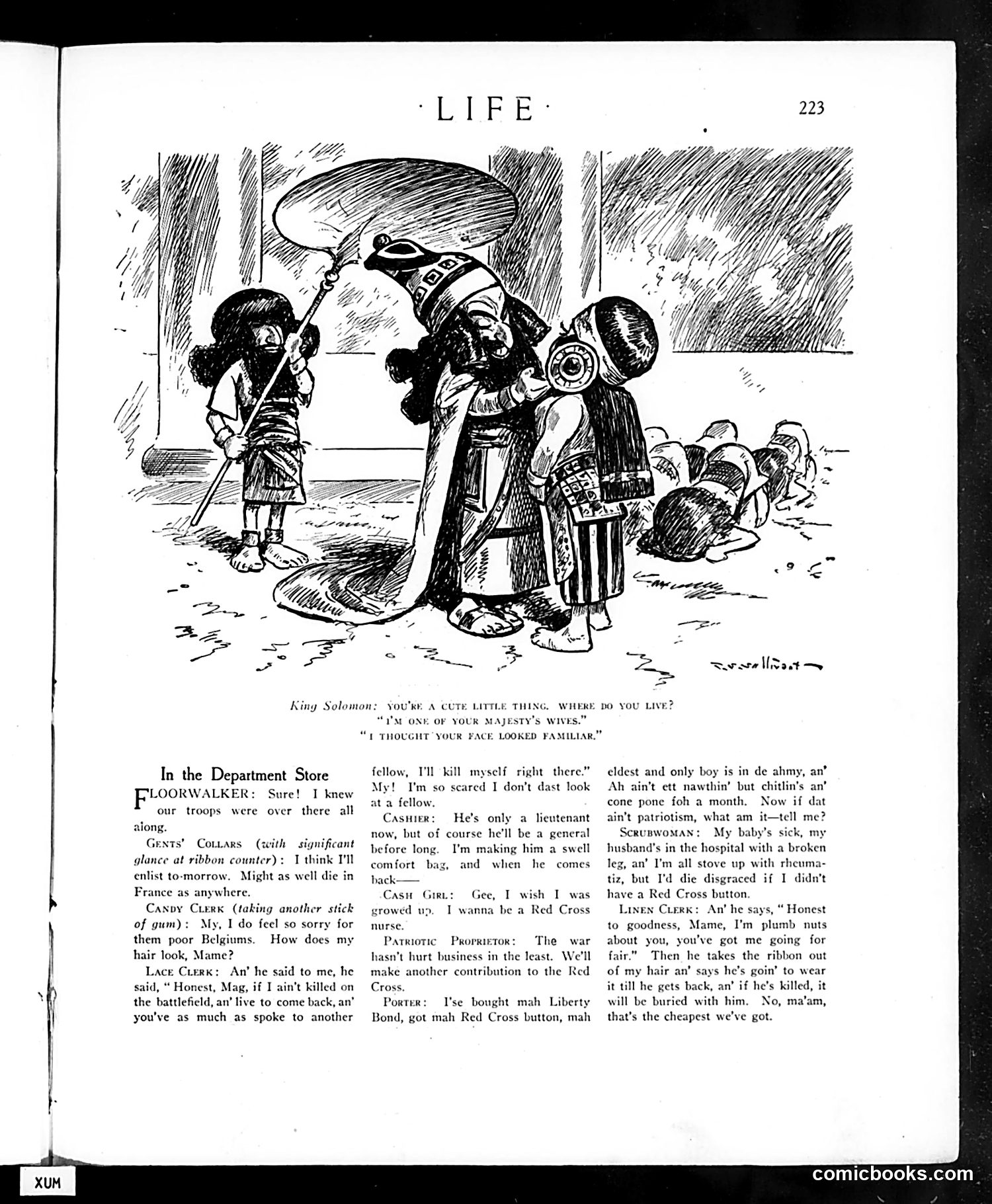
This WWI-era satirical cartoon mocks the disconnect between patriotic sentiment and actual wartime sacrifice. The top cartoon shows King Solomon (representing wisdom/authority) in a department store, where various workers and customers express enthusiasm for the war effort while revealing their shallow motivations or self-interest. The satire targets: **The hypocrisy**: Employees mouth patriotic phrases—enlisting, supporting the Red Cross—while obsessing over appearance, gossip, and business profits. A shop owner celebrates the war hasn't hurt sales. **False patriotism vs. real sacrifice**: Contrasted against these self-serving attitudes are brief monologues from those genuinely suffering—a poor woman eating only scraps, another with a sick child and hospitalized husband, all struggling to afford Red Cross buttons to appear patriotic. **The joke**: Department store culture—commerce, vanity, romantic drama—collides absurdly with genuine wartime hardship. The wealthy and comfortable perform patriotism while the truly sacrificing masses bear actual costs. The cartoon critiques how wartime nationalism became commodified, allowing people to feel patriotic through tokens (buttons, donations) while remaining fundamentally self-absorbed.
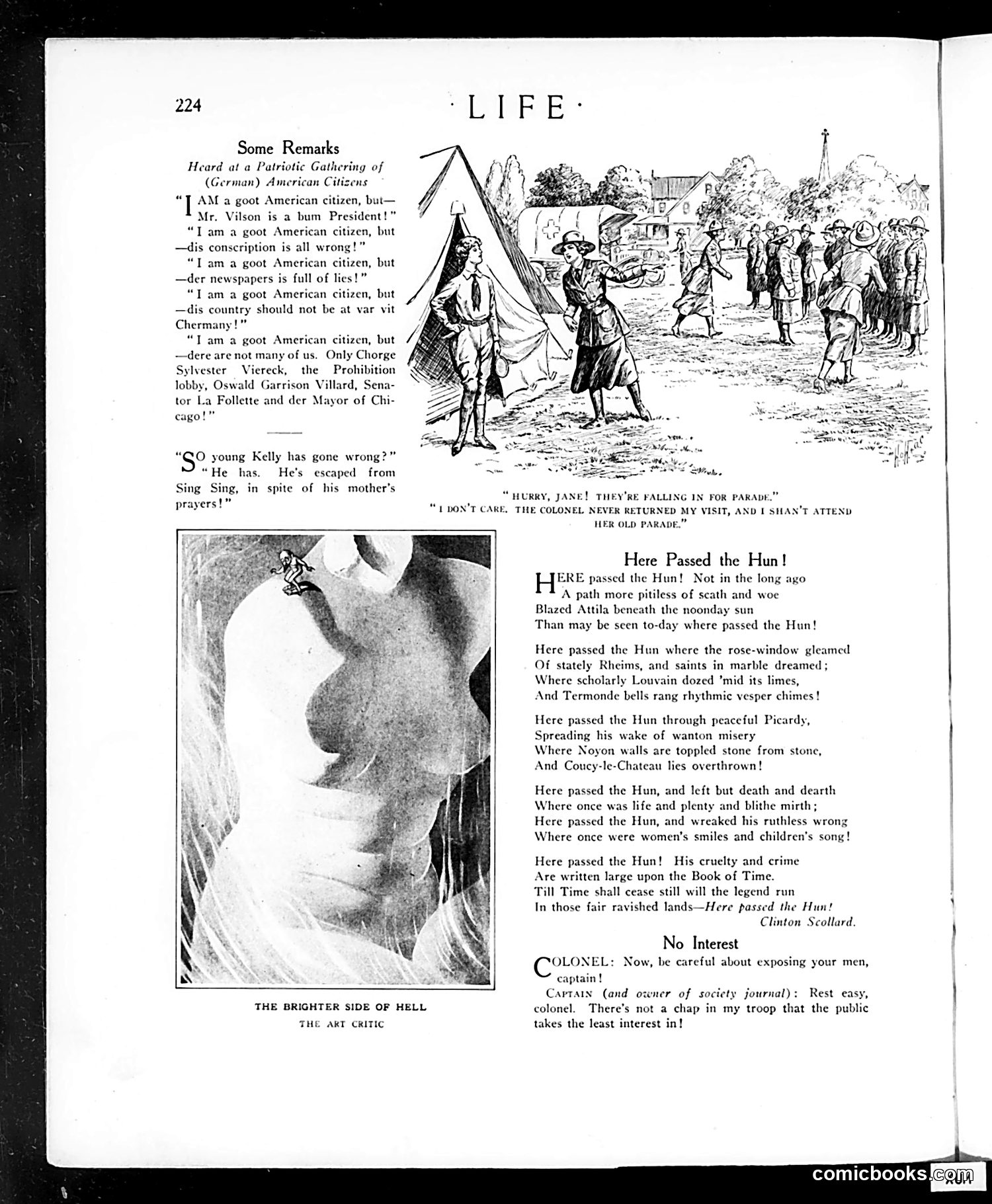
This page contains **anti-German propaganda** from World War I era (likely 1917-1918). **Top Section:** Satirizes German-Americans claiming patriotism while opposing U.S. war efforts. The speaker mocks those who say "I am a good American citizen, but—" before criticizing President Wilson, conscription, newspapers, or the war against Germany. It names real anti-war figures: George Sylvester Viereck (German-American propagandist), Senator La Follette (peace advocate), and others, suggesting only they and a few others opposed the war. **Middle:** A poem titled "Here Passed the Hun!" compares German military destruction in France to Attila's invasions, referencing actual WWI destruction of French cities (Rheims, Louvain, Picardy, Noyon). **Bottom:** A cartoon jokes about a Society Journal owner (captain) unconcerned about exposing his troops because "the public takes the least interest in" them—satirizing society pages' triviality during wartime. The page promotes American patriotism and mocks both German-American dissent and civilian indifference to war.
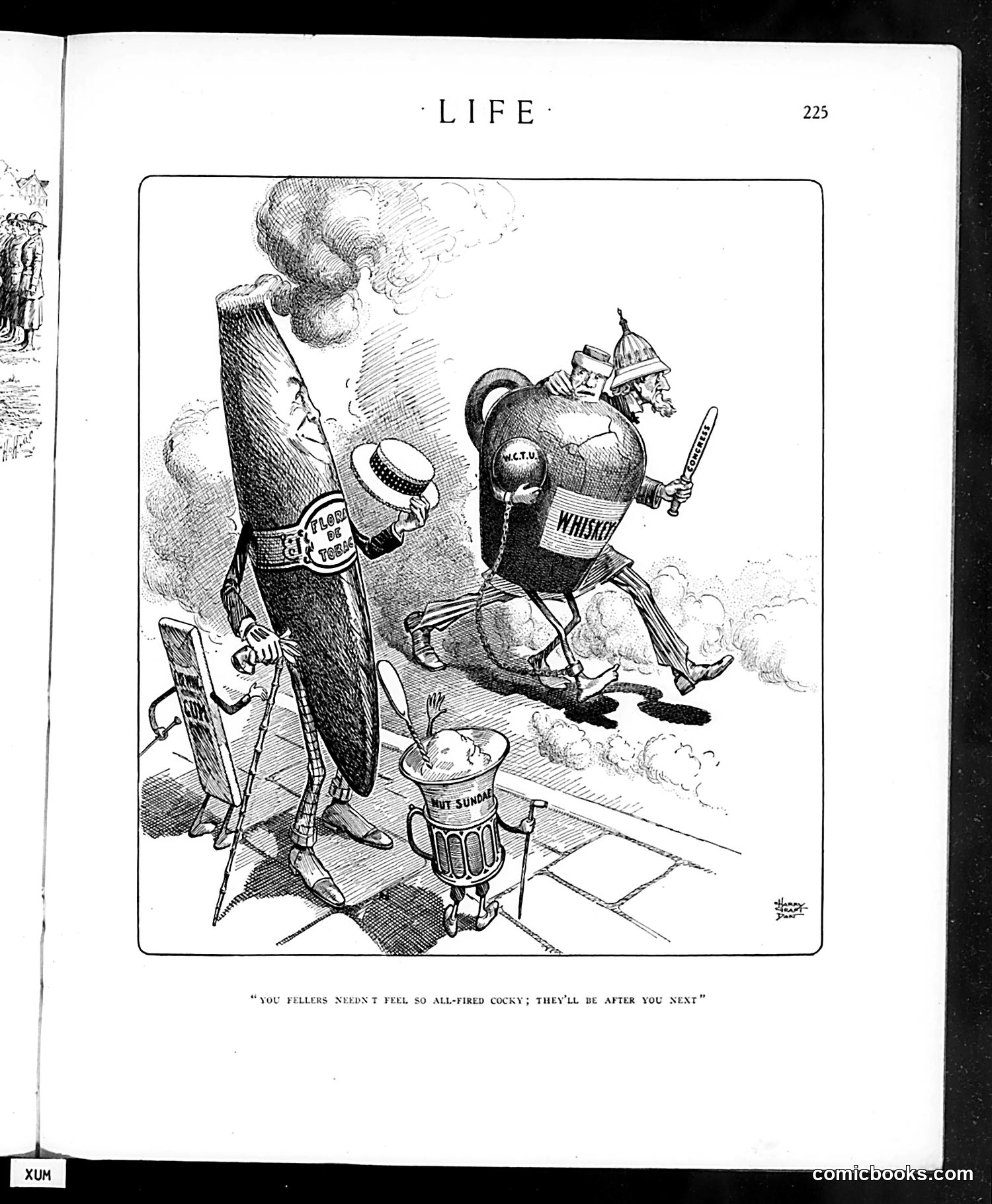
This Life magazine cartoon depicts a military or imperial figure (wearing a spiked helmet, likely German or Prussian in style) threatening two figures labeled "WHISKEY" and what appears to be "ALL FOR" or similar prohibition-related labels. A beer mug labeled "SUNDAY" sits nearby. The caption warns the alcohol industry: "You fellers needn't feel so all-fired cocky; they'll be after you next." **Meaning**: This appears to reference the temperance/prohibition movement in early 20th-century America. The cartoon suggests that while militarism or foreign aggression is being confronted, prohibitionists will subsequently target the alcohol industry. The satire mocks both the perceived threat of militarism and the inevitable push for alcohol prohibition as sequential social crusades. The exact historical moment is unclear without a visible date, though it likely references pre-WWI American anxieties.
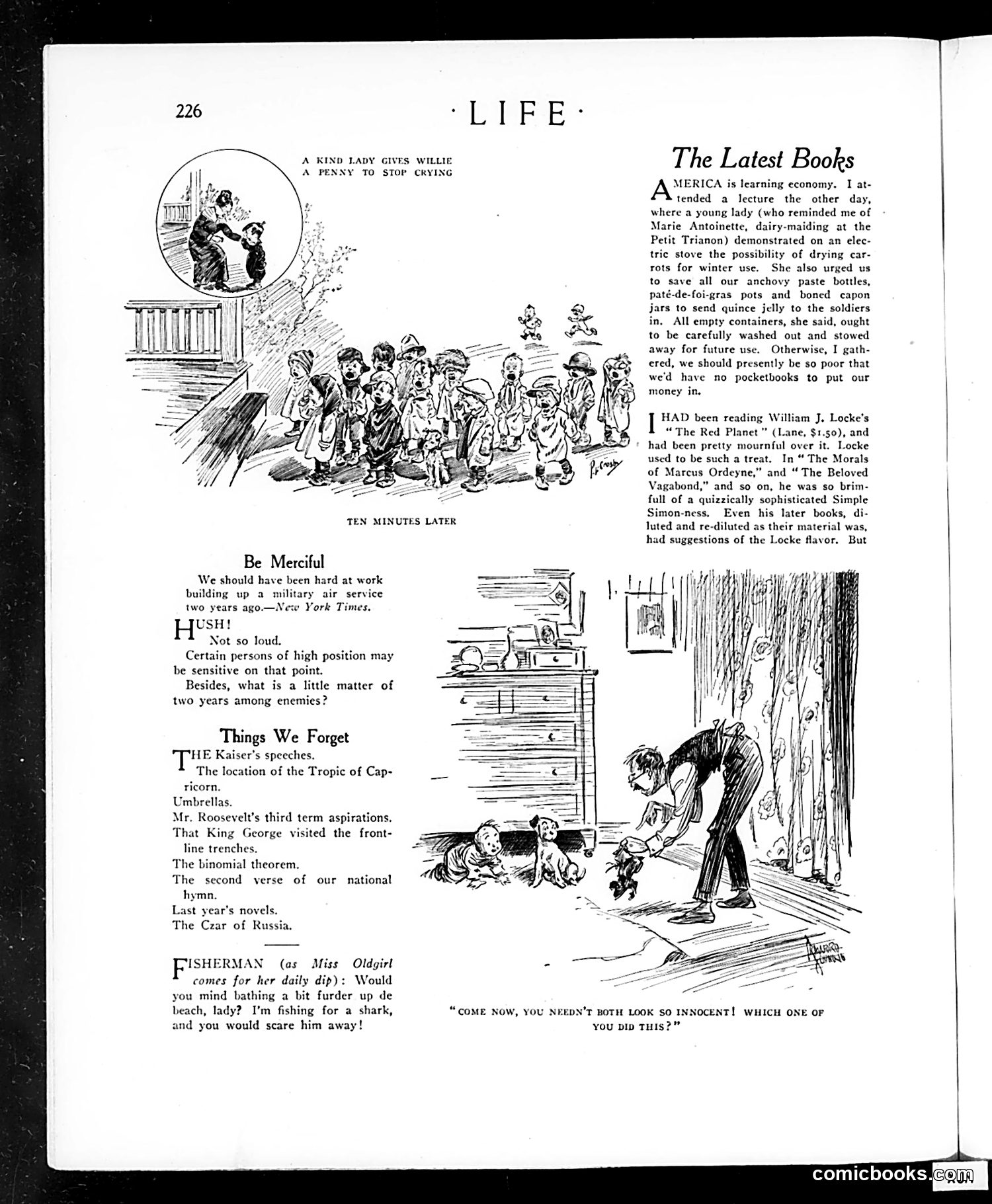
This page contains WWI-era American satire, circa 1917-1918. **Top cartoon**: "A Kind Lady Gives Willie a Penny to Stop Crying" depicts poor children receiving charity while soldiers fight—satirizing American unpreparedness. The caption "Ten Minutes Later" shows the same crowd, mocking delayed military mobilization. **"Be Merciful" section**: Criticizes U.S. delay in building an air service, noting "two years ago" would have been better. The joke: those responsible are "sensitive," so critics stay quiet—satire on political cowardice regarding military readiness. **"Things We Forget" list**: Mocks public amnesia about serious matters (Kaiser's speeches, Czar of Russia) while remembering trivia, reflecting wartime anxieties. **Right-side cartoon**: A fisherman asks a woman to move so he can catch a shark—she might scare it away. The humor involves the woman's innocence versus the man's double meaning. **"Latest Books" section**: Reviews William J. Locke's novel while satirizing wartime economy lectures about saving anchovy jars—mocking wealthy people being asked to practice thrift.
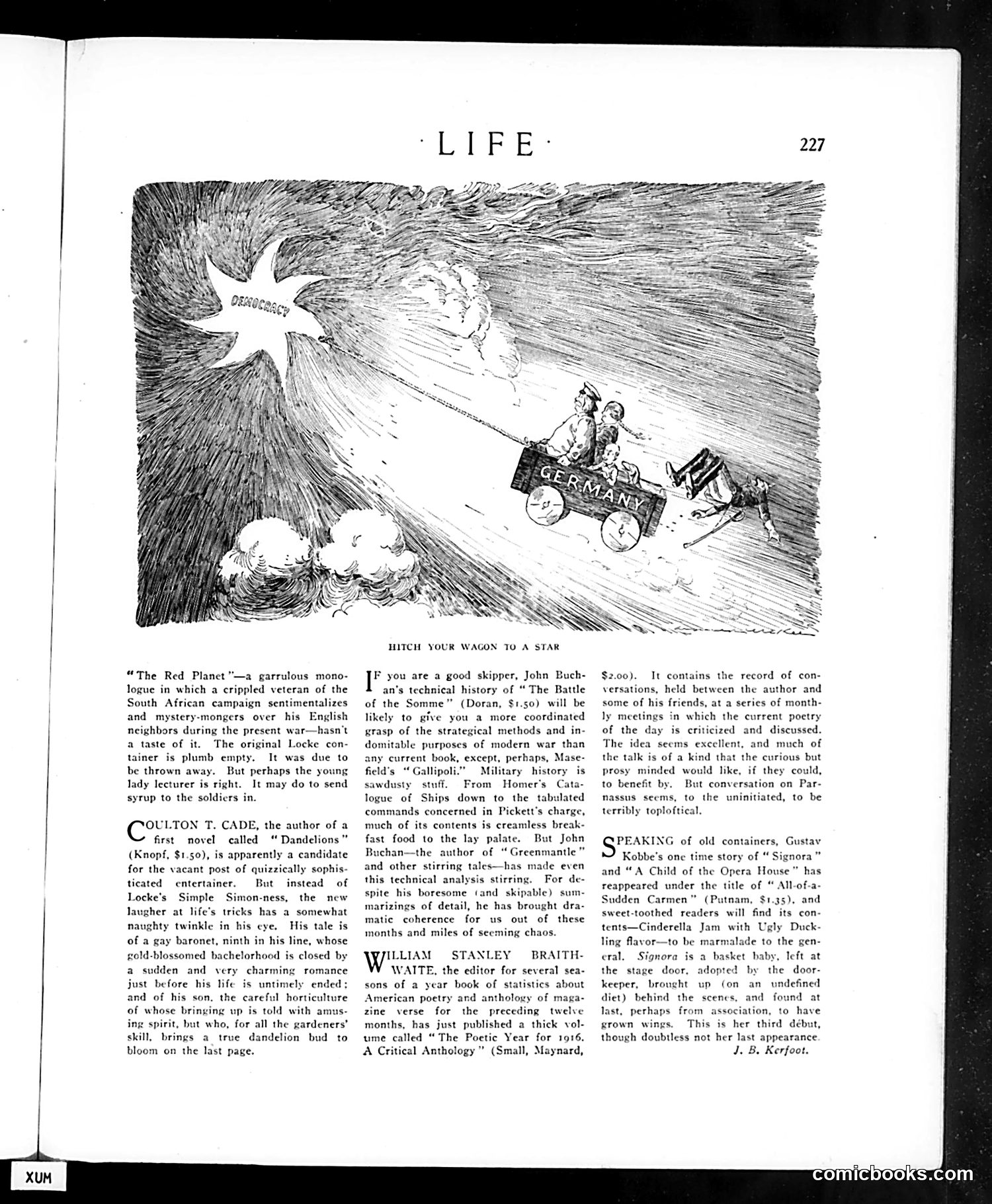
This page features book reviews and a political cartoon titled "Hitch Your Wagon to a Star." The cartoon depicts Germany (labeled on a wagon) being pulled toward a star by what appears to be a figure representing fate or destiny, while an angel or divine force shines light from above—likely satirizing German ambitions during World War I. The reviews discuss contemporary literature, including John Buchan's technical history of the Battle of the Somme, which the critic praises for making military history engaging despite its inherently dry subject matter. Other reviews cover novels and poetry collections from 1916. The cartoon's point appears to be ironic commentary on Germany's war ambitions—suggesting their aspirations are being guided by forces beyond their control, or mocking their belief in inevitable victory. The "star" imagery evokes both aspiration and the phrase "hitch your wagon to a star" (meaning pursue lofty goals), making the satire work on multiple levels during WWI's final years.
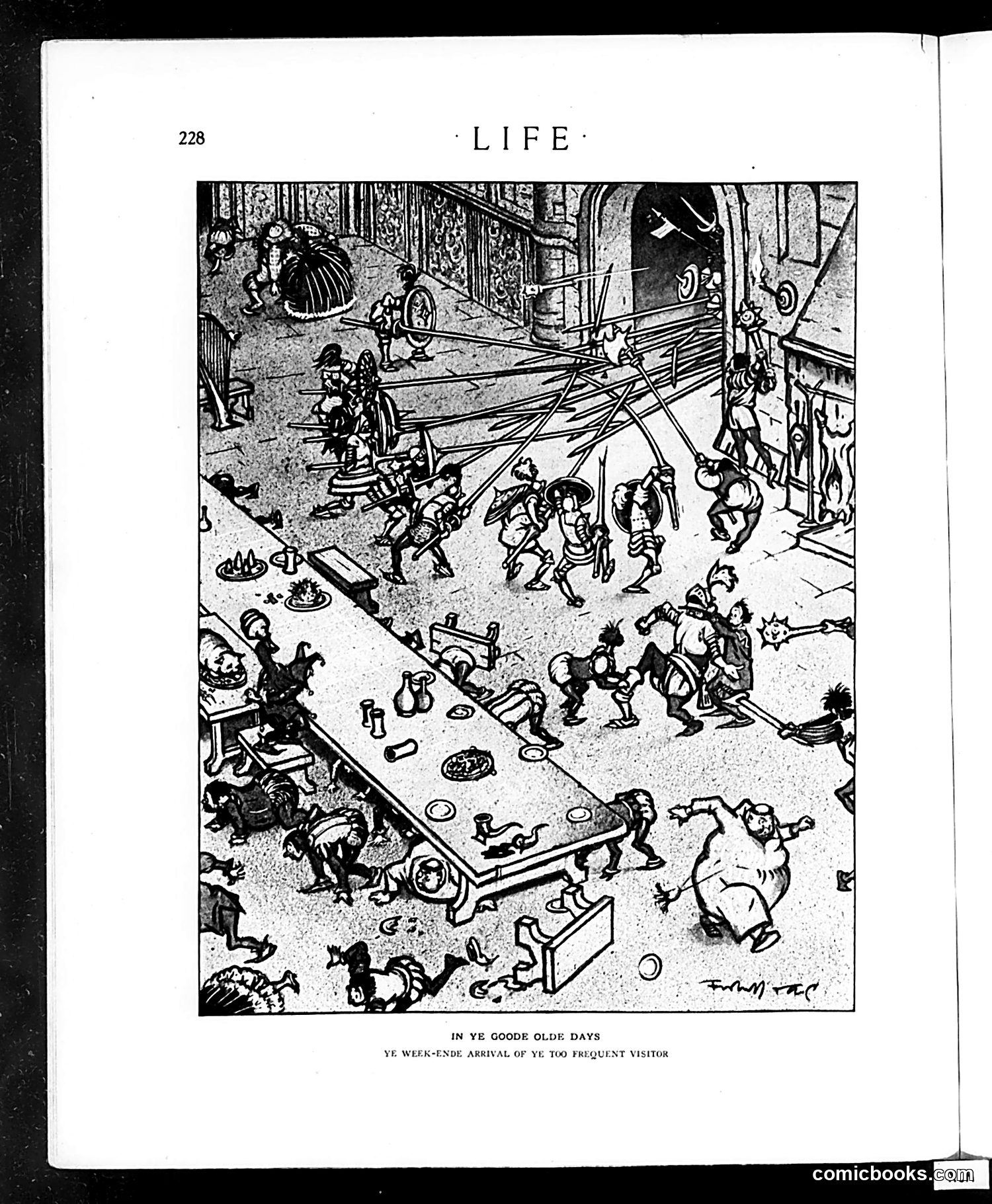
This cartoon satirizes the chaos of weekend social gatherings, depicting a chaotic medieval or fantastical feast scene. The title suggests nostalgia for "good old days," but the image humorously contradicts this by showing complete pandemonium—figures sprawling, fighting, eating messily, with food and objects scattered everywhere. The satire likely mocks: 1. The romantic idealization of the past 2. Contemporary weekend entertaining and houseguest behavior—the subtitle references "ye too frequent visitor," suggesting unwelcome or overstaying guests who create disorder The elaborate costumes and medieval setting make the contemporary complaint about social obligations and houseguests seem absurdly exaggerated, poking fun at both hosts dealing with disruptive visitors and the visitors themselves.
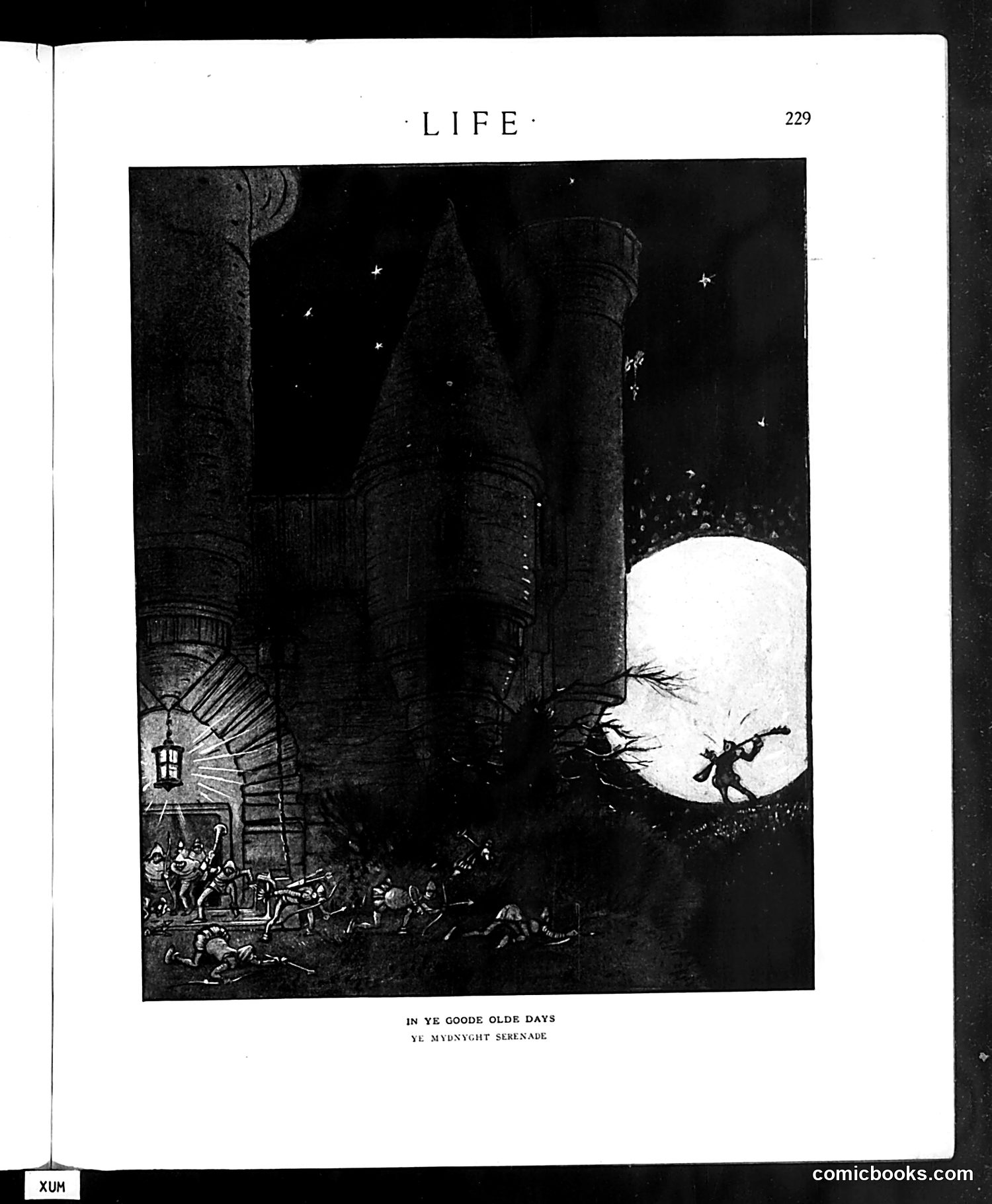
This satirical illustration depicts a romantic medieval or fantasy scene titled "In Ye Goode Olde Days: Ye Midnight Serenade." The image shows a figure with a musical instrument (likely a lute or similar stringed instrument) performing beneath a large moon, positioned against towering castle structures. Small figures can be seen gathered below, apparently an audience to this nighttime performance. The satire appears to mock nostalgic romanticization of the past—specifically the idealized notion of chivalrous serenades in "the good old days." The exaggerated gothic architecture and theatrical staging suggest Life magazine is gently ridiculing how popular culture sentimentalizes medieval romance and courtship customs. The page number indicates this is from Life's satirical content section.
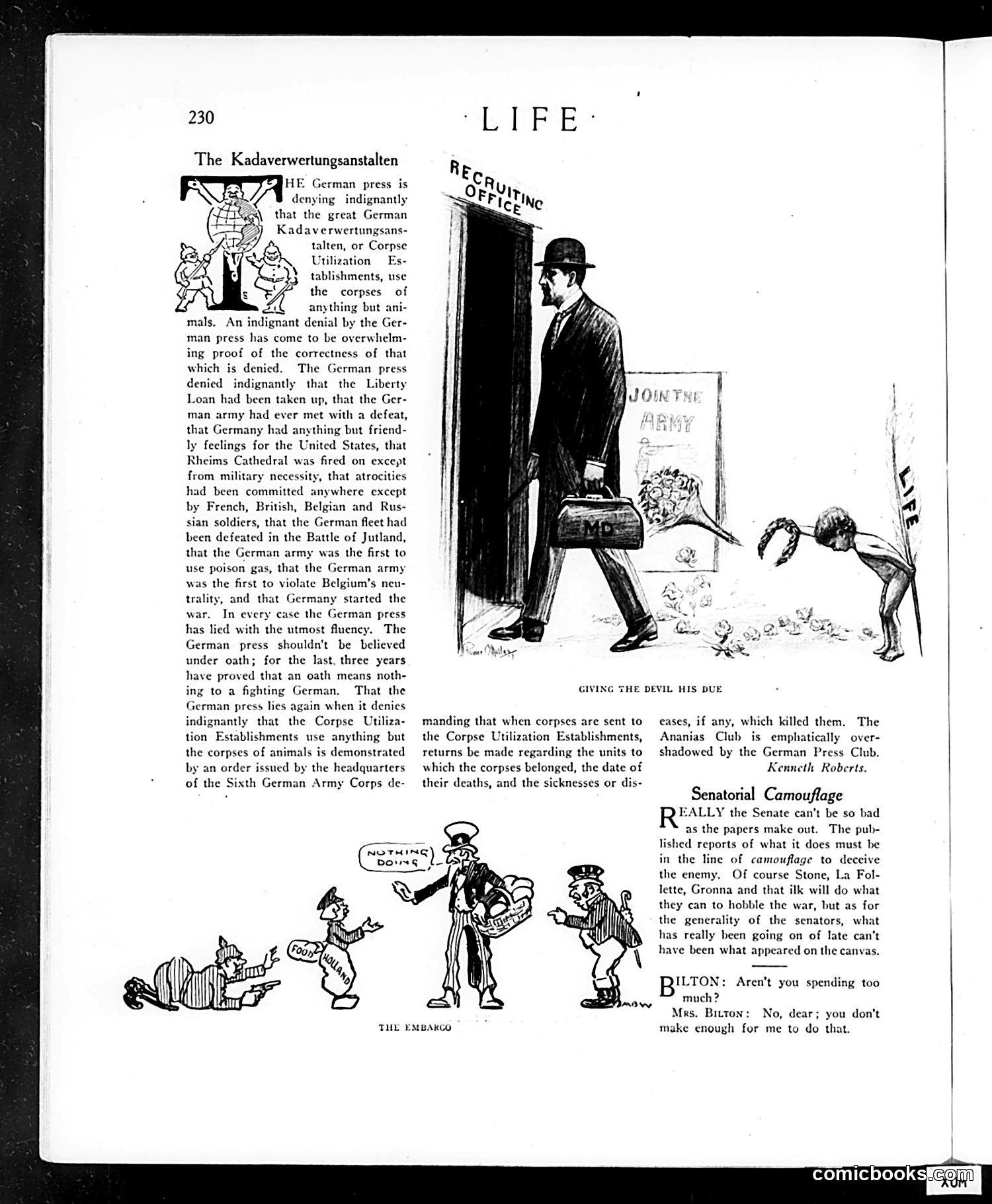
This page contains WWI-era American political satire attacking German credibility and institutions. **"The Kadaverwertungsanstalten" article** (left): Denounces alleged German "Corpse Utilization Establishments"—facilities supposedly using human remains. The text catalogs German press lies (Liberty Loan denials, atrocities, poison gas use, Belgium's neutrality violation), arguing the German military's documented order to track corpses sent to these establishments proves their indignant denials are false. The "Ananias Club" reference invokes a biblical symbol of dishonesty. This reflects real WWI propaganda about German body-processing facilities. **"Giving the Devil His Due" cartoon** (top right): A man in a hat places a suitcase before a devil figure at a "Recruiting Office" and "Join the Army" sign, while the devil greedily reaches for it—suggesting military recruitment cynically exploits patriotic young men. **"Senatorial Camouflage"** (lower right): Satirizes senators as deliberately misleading the public through false reporting to deceive the enemy—implying wartime secrecy masks actual governmental incompetence or scandal. The final dialogue jokes about domestic financial strain.
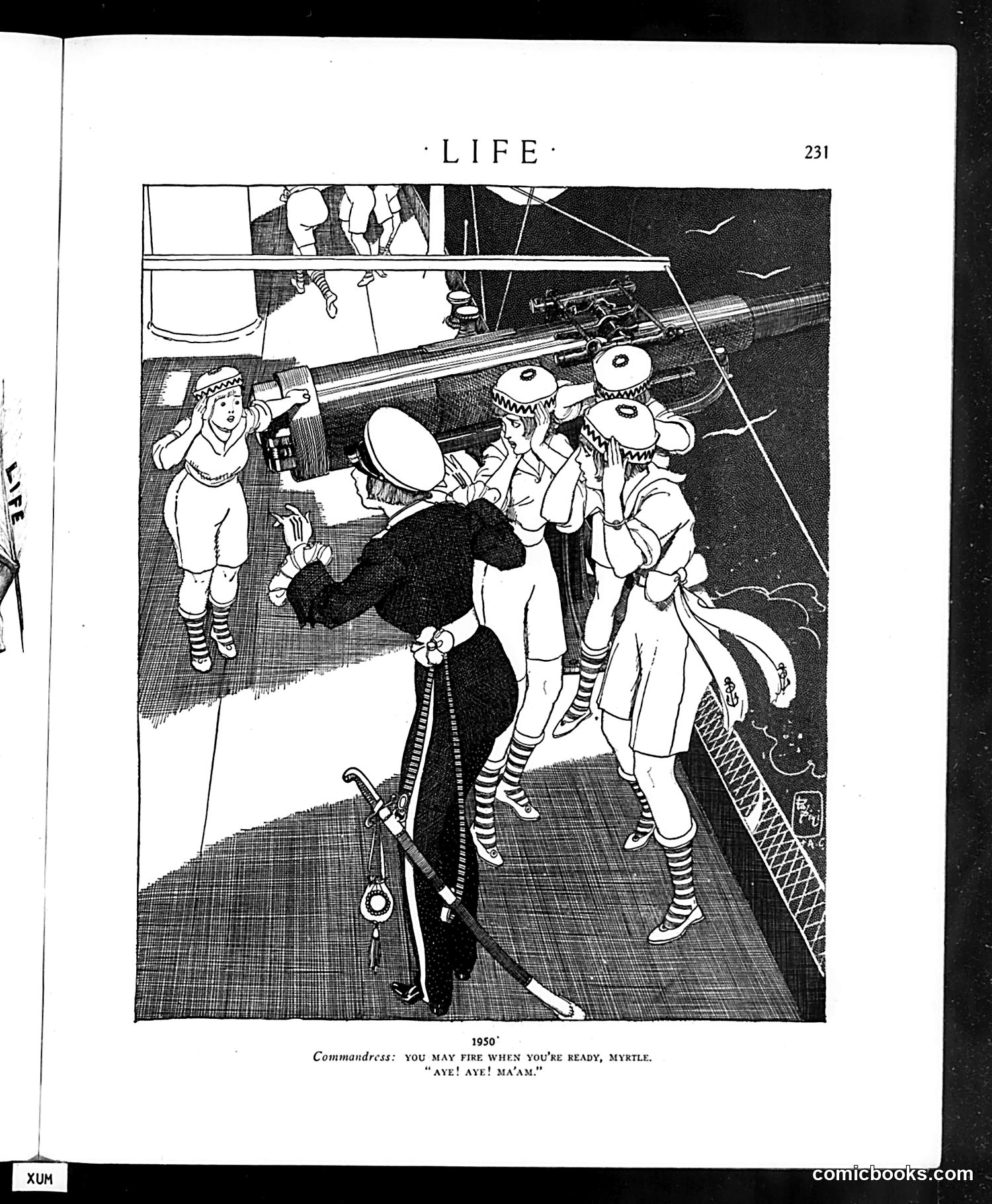
This 1950 *Life* magazine cartoon satirizes women's military roles in the post-WWII era. The scene depicts a female commanding officer ("Commandress") ordering a subordinate named Myrtle to fire what appears to be a ship's cannon or large naval weapon. The satire targets anxieties about women in combat and leadership positions. The exaggerated feminine styling (striped stockings, elaborately dressed figures) combined with serious military responsibility creates comedic incongruity—the visual suggests these aren't "serious" soldiers but rather women playing at warfare. The nautical setting and formal military dialogue underscore this tension between traditional gender roles and emerging female military participation. The joke reflects 1950s anxieties about women's expanding post-war roles and questions their legitimacy in male-dominated military hierarchies.
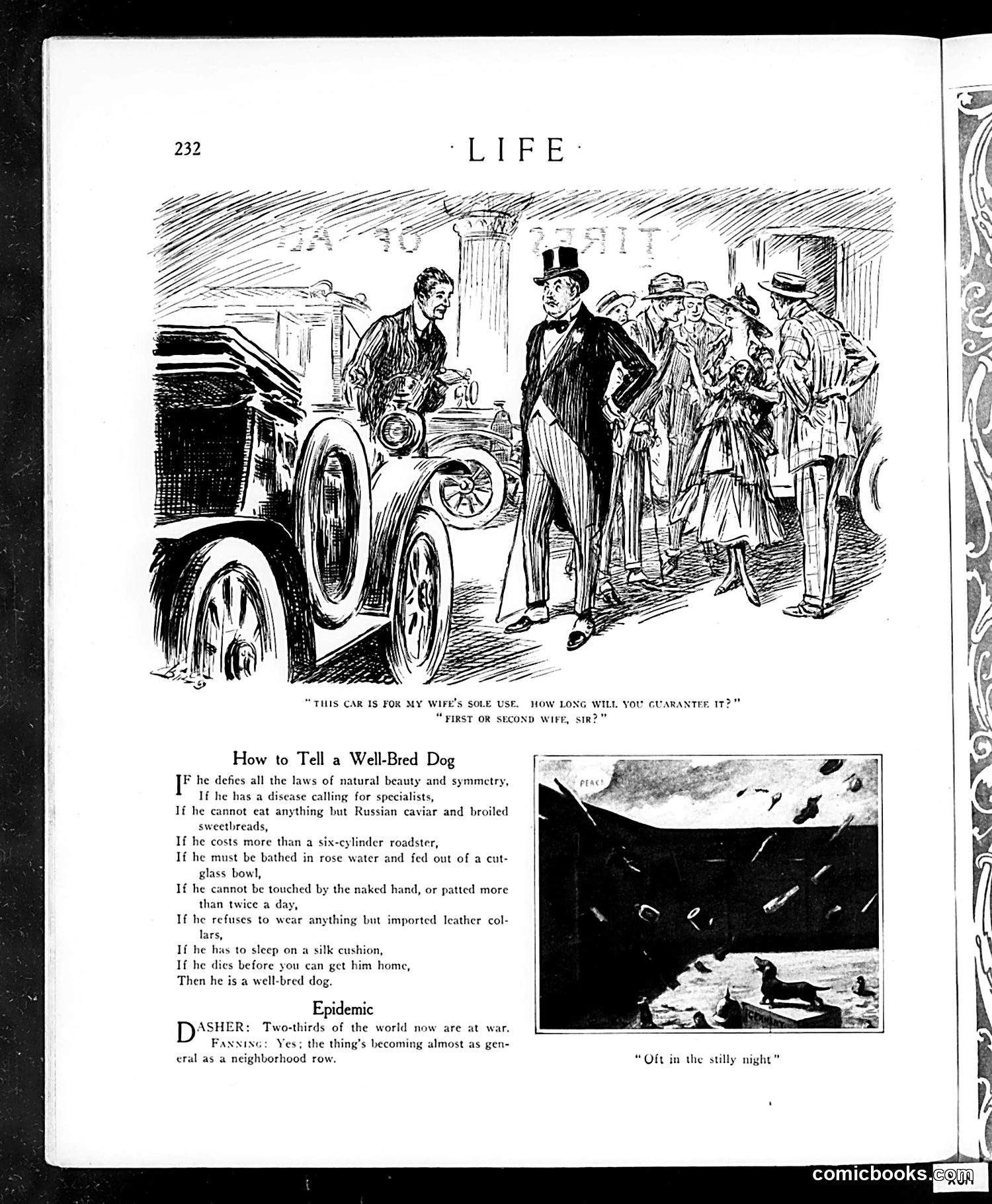
**Top Cartoon:** A man purchasing an expensive automobile claims it's "for my wife's sole use." A salesman sarcastically asks "First or second wife, sir?"—satirizing the era's high divorce rates among the wealthy. The joke mocks both marital instability and the extravagance of buying such a costly vehicle for a spouse. **"How to Tell a Well-Bred Dog":** This humorous essay satirizes the affectations of the ultra-wealthy by describing a "well-bred" dog with absurdly high-maintenance and delicate requirements: eating only caviar, requiring rose-water baths, being untouchable, sleeping on silk. The punchline—"If he dies before you can get him home"—mocks the impracticality of such extreme pampering. **"Epidemic" Dialogue:** Two characters discuss world war becoming "almost as general as a neighborhood row," trivializing global conflict by comparing it to commonplace domestic disputes—satirizing the casual acceptance of warfare's prevalence. All three items target wealthy society's excesses, marital instability, and social complacency during the World War I era.
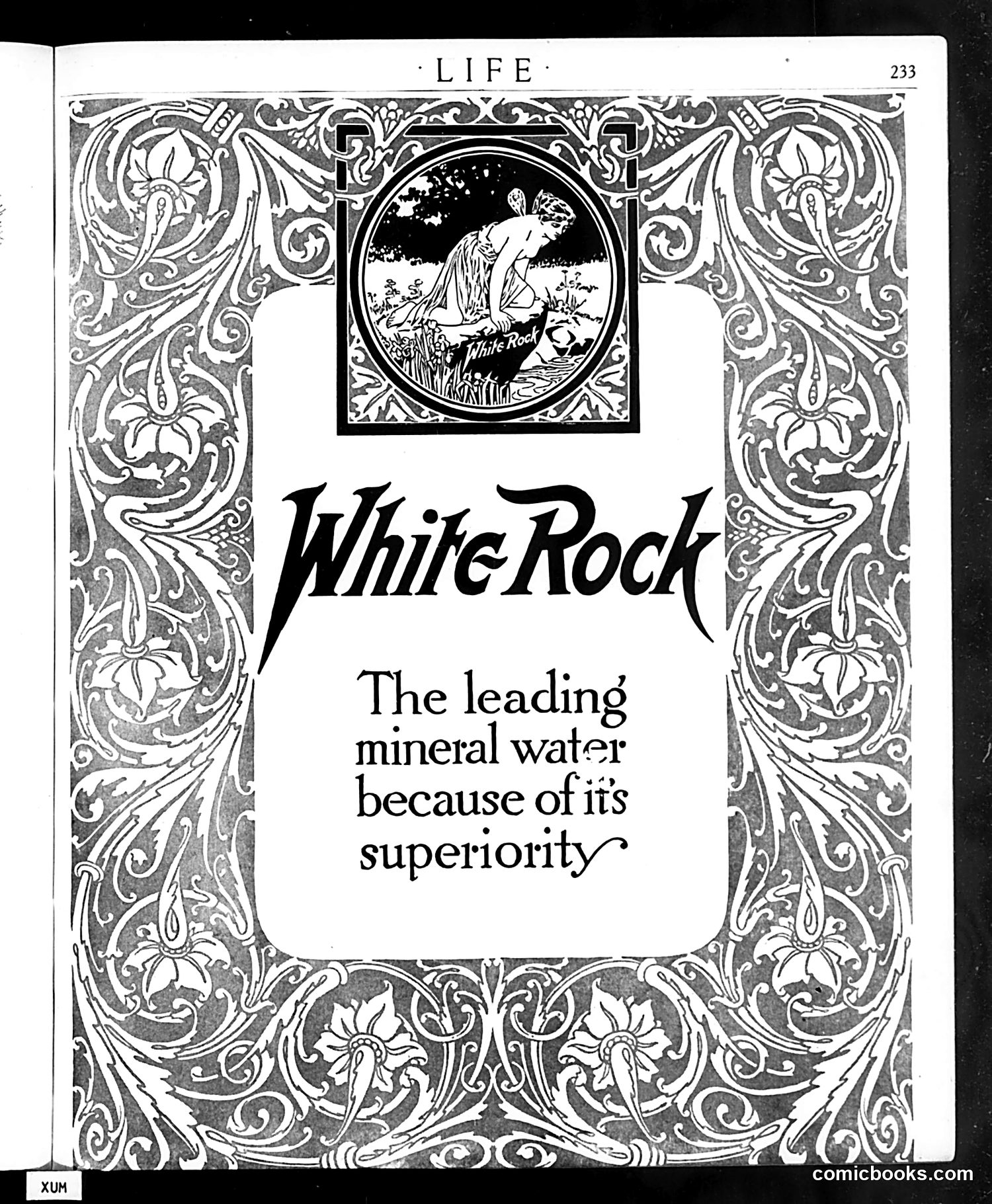
This is a full-page advertisement for White Rock mineral water, not political commentary or satire. The ad features ornate decorative border work in an Art Nouveau style surrounding the brand name and slogan. At the top is a circular vignette showing a classical female figure (a nymph or similar allegorical character) perched on a rock formation, presumably "White Rock." The accompanying text claims it is "The leading mineral water because of its superiority." The elaborate, elegant design was typical of early 20th-century luxury product advertising, positioning White Rock as a premium, refined beverage choice through classical imagery and sophisticated typography.
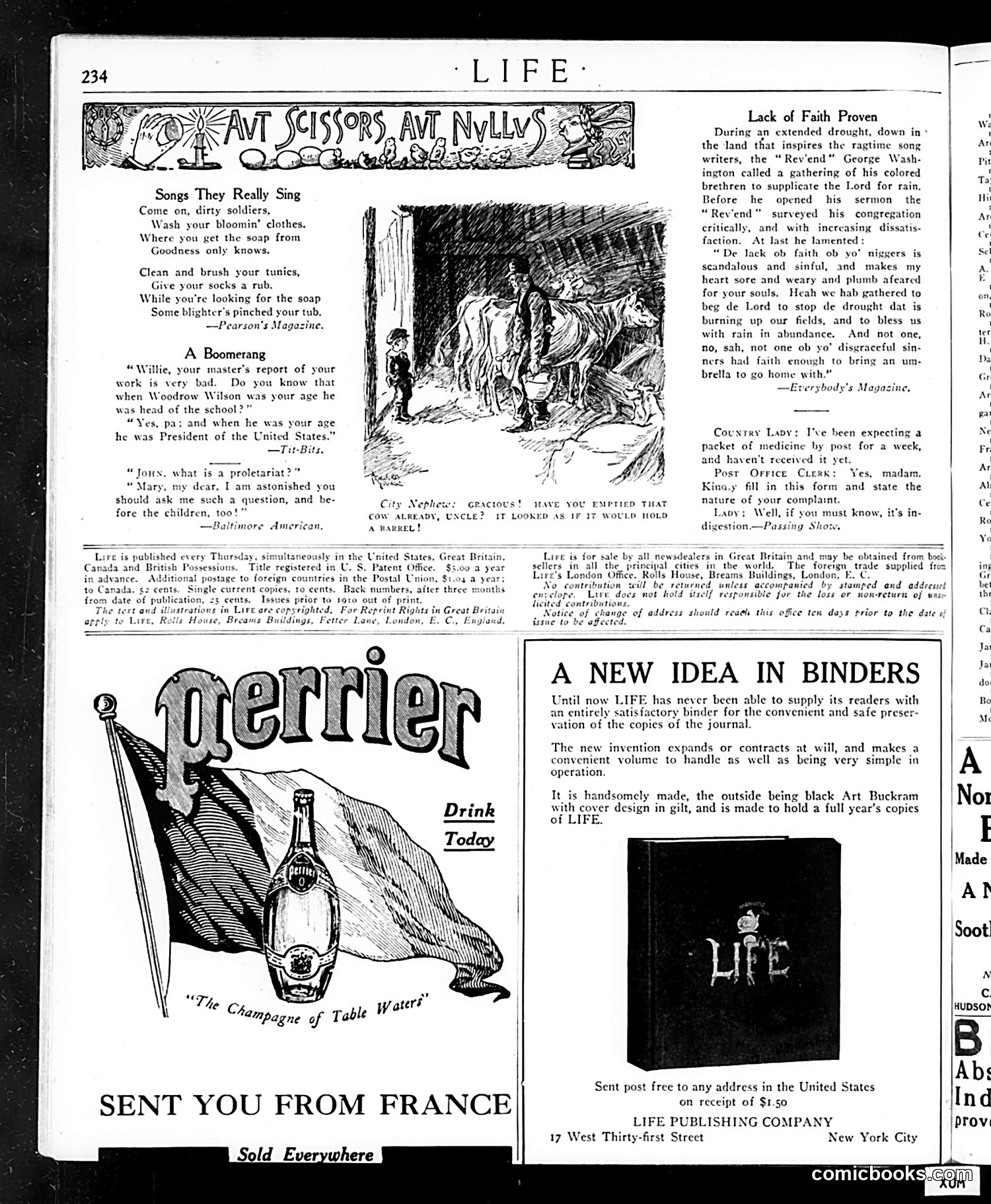
This page contains several short humorous pieces typical of early 20th-century Life magazine: **"A Boomerang"** satirizes parental discipline: a father scolds his son "Willie" by comparing him unfavorably to young Woodrow Wilson. The boy's clever retort—that Wilson became President—undermines the father's authority and suggests Wilson's early promise didn't guarantee adult success. **"City Nephews"** appears to be a visual gag (the image shows what appears to be a rural scene) about a cow, though context is unclear. **"Lack of Faith Proven"** uses dialect humor (common then, now offensive) to mock African American religiosity: a preacher criticizes his congregation's lack of faith during a drought—yet none brought umbrellas, suggesting they didn't actually believe rain would come. **"Country Lady"** is a brief exchange about a lost medicine package. The page also advertises **Perrier water** and **Life's new binder** for collecting issues—a subscription service innovation. The humor relies on wordplay, situational irony, and period-specific cultural references readers would recognize.
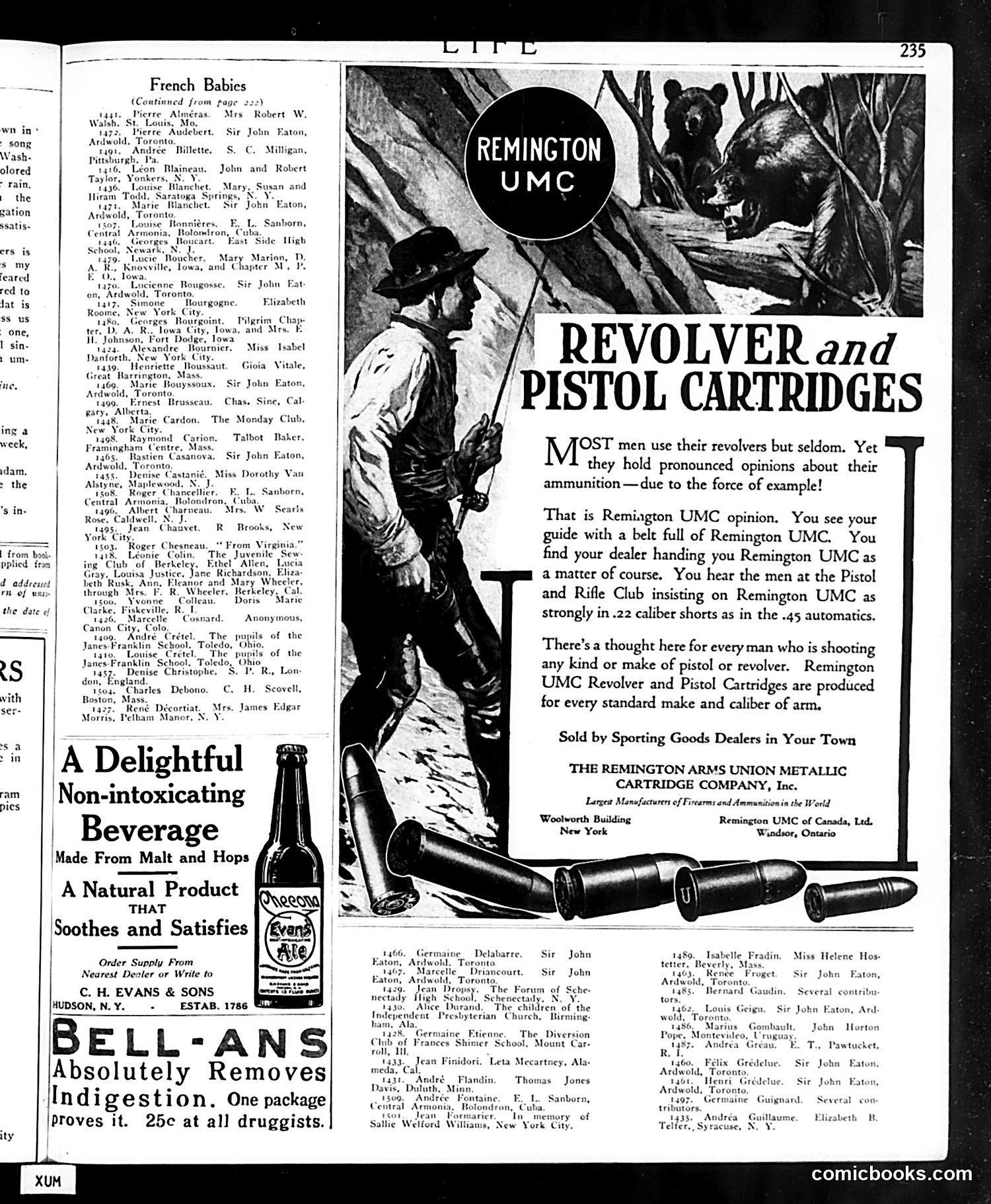
This page is primarily **advertising and donor listings**, not satire or political commentary. The main content consists of: 1. **"French Babies" continuation** — A list of donors who contributed to what appears to be a charitable effort supporting French infants, likely during or after World War I (given the French names and the "life" theme of charitable giving). 2. **Remington UMC advertisement** — The dominant visual features a dramatic illustration of a man with a revolver, promoting ammunition. The ad claims that gun owners hold strong opinions about ammunition "due to the force of example," and positions Remington UMC cartridges as the trusted choice endorsed by hunting and shooting clubs. 3. **Smaller ads** — For Evans beverage (non-intoxicating malt drink) and Bell-Ans indigestion remedy. There is **no political cartoon or satire** on this page. It functions as a typical early 20th-century magazine page mixing charitable donor recognition with commercial advertising.
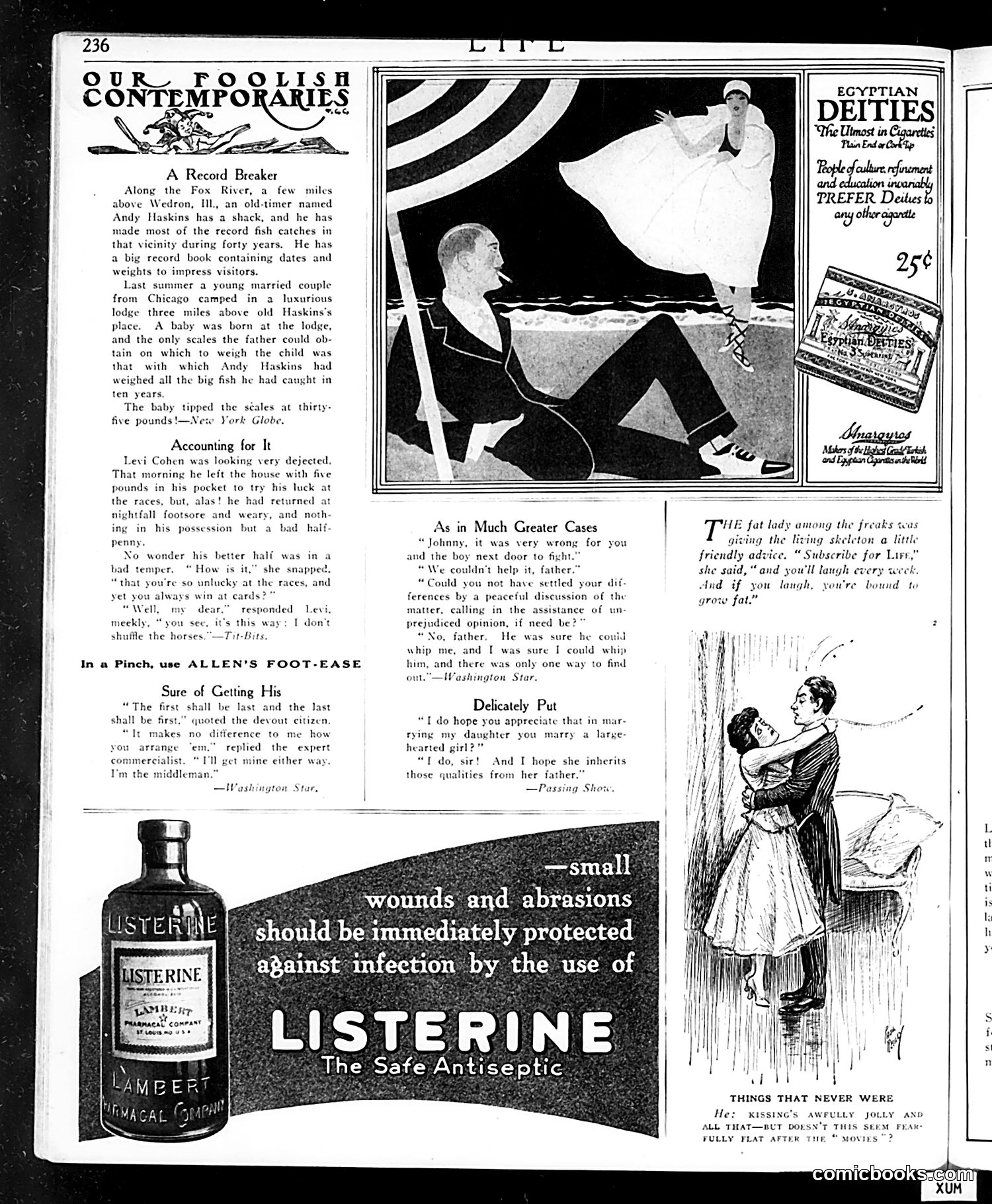
This page from *Life* magazine contains several brief humorous anecdotes and advertisements typical of early 20th-century satirical journalism. **"A Record Breaker"** jokes about a baby weighed on fishing scales, implying the newborn is unusually heavy—a gentle humor about new parenthood. **"Accounting for It"** presents a Jewish character (Levi Cohen) whose wife questions why he loses at horse racing but wins at cards, suggesting he's either unlucky or dishonest depending on the activity. **"As in Much Greater Cases"** depicts a father and son discussing a fight, with the father advocating reason while admitting he'd still resort to violence—satirizing adult hypocrisy about conflict resolution. **"Delicately Put"** shows a suitor reassuring a father-in-law that he appreciates the daughter's good qualities, with the father hoping she inherited them from him—gentle irony about family vanity. The page is primarily **advertising-heavy**, featuring Listerine antiseptic and Allen's Foot-Ease prominently. The humor is mild, domestic, and non-partisan—typical of *Life*'s family-oriented satirical content from this era.
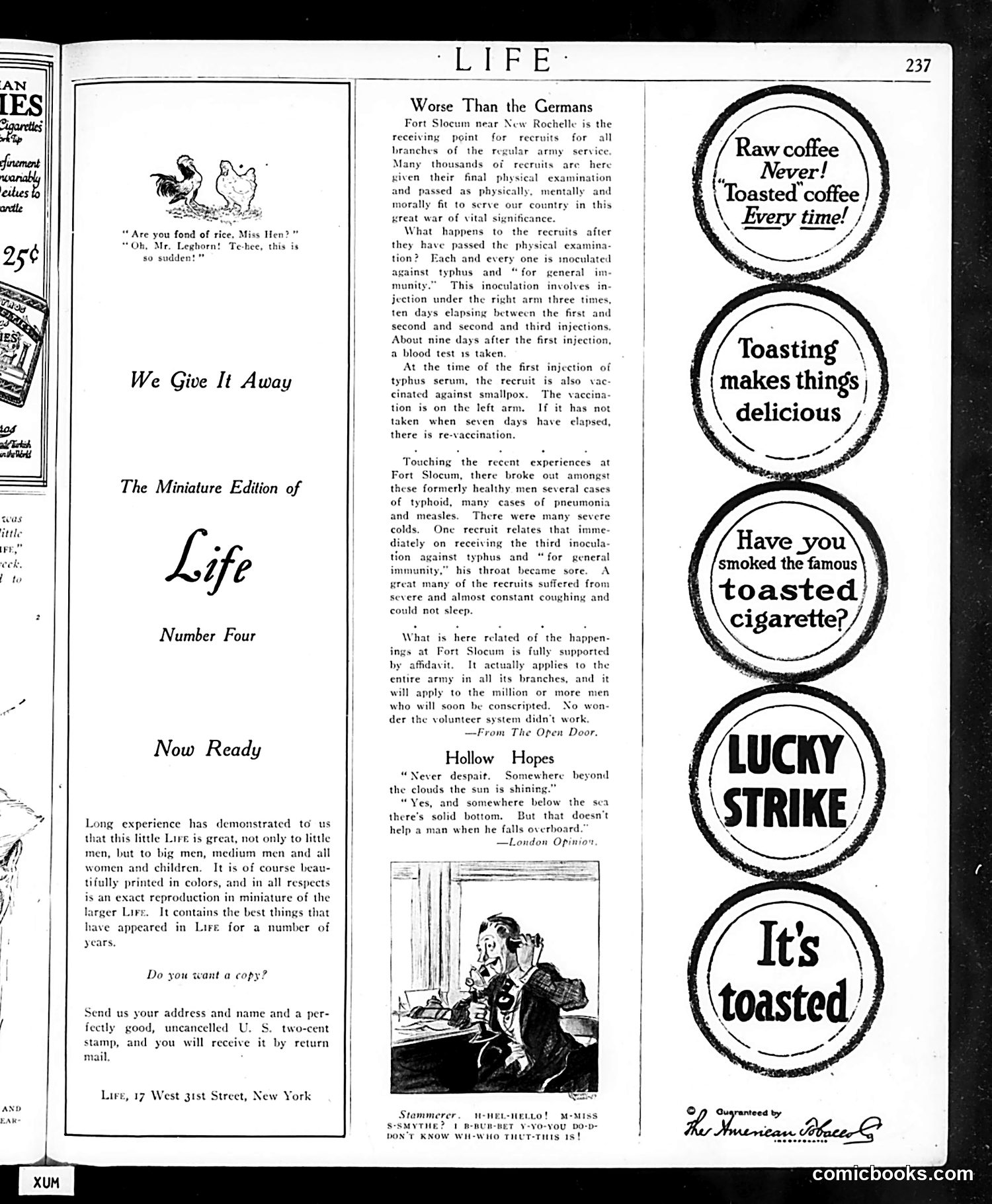
This page contains multiple satirical elements from WWI-era America: **"Worse Than the Germans"** article criticizes medical protocols at Fort Slocum (a military induction center near New York). It details mandatory inoculations against typhus and vaccinations against smallpox given to recruits, documenting resulting illnesses—typhoid, pneumonia, measles, severe colds, and persistent coughing. The title's irony suggests these medical procedures are causing harm comparable to enemy warfare. The piece, sourced from "The Open Door," appears to be anti-militarization commentary questioning whether mandatory military medical procedures actually protect soldiers or endanger them. **Top left:** A cartoon with barnyard fowl making a marriage proposal—light domestic humor unrelated to the heavier content. **Right side:** Advertisement circles for Lucky Strike cigarettes ("It's toasted") and coffee, emphasizing "toasting" as a desirable process—ironic juxtaposition with the article's account of soldiers suffering after medical injections. **Bottom cartoon:** A stammering character, comedic filler content. The page juxtaposes serious wartime health critiques against frivolous advertising and humor.
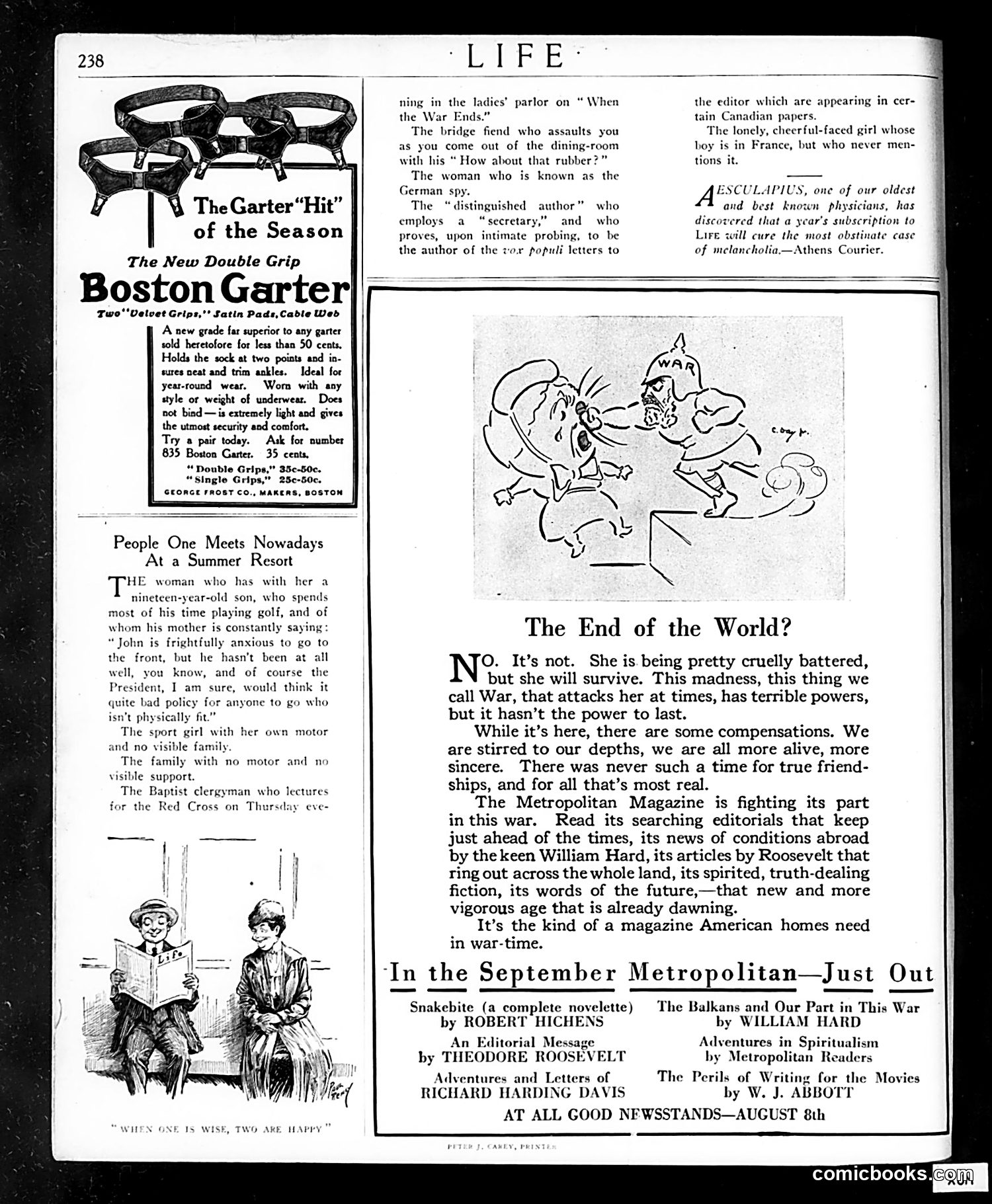
This page from Life magazine (likely 1916-1917, given WWI references) combines social satire with advertising and editorial content. **The Main Cartoon** ("The End of the World?") depicts a woman being attacked, likely representing Europe or civilization during WWI. The accompanying text reassures readers that despite war's brutality, civilization will survive and that conflict has created unexpected social benefits—deeper friendships and moral clarity. **The Social Satire Section** ("People One Meets Nowadays") mocks common wartime types: mothers using their sons' health to excuse them from military service, the self-important "German spy," the fake intellectual "author" anonymously writing letters to editors, and notably, the stoic girl whose boyfriend is fighting in France but never complains. **Overall Message**: The page reflects American attitudes during WWI—mixing gentle mockery of home-front society with pride in sacrifice and idealism about war's ennobling effects. The ads for Boston Garters represent typical commercial content interrupting editorial material.
I can see this is a page from Life magazine, but the image is almost entirely black or heavily degraded, making it impossible to discern any cartoon, illustration, or legible text content. The OCR text fragments ("cer-", "hose", "comicbooks.com") appear to be corrupted or partial. Without being able to see the actual cartoon, identify figures, read captions, or determine the context, I cannot explain what this page's satire or social commentary refers to. To properly analyze this as a historical political cartoon, a clearer or higher-contrast image would be necessary.

I can see this is a page from Life magazine, but the image is almost entirely black or heavily degraded, making it impossible to discern any cartoon, illustration, text, or satirical content. The only clearly visible element is the "comicbookscom" watermark in the bottom right corner. Without being able to see the actual content of the page, I cannot identify any figures, political references, or explain the intended satire or joke. To provide accurate analysis as requested, I would need a clearer, higher-contrast image where the cartoon(s) and text are legible.
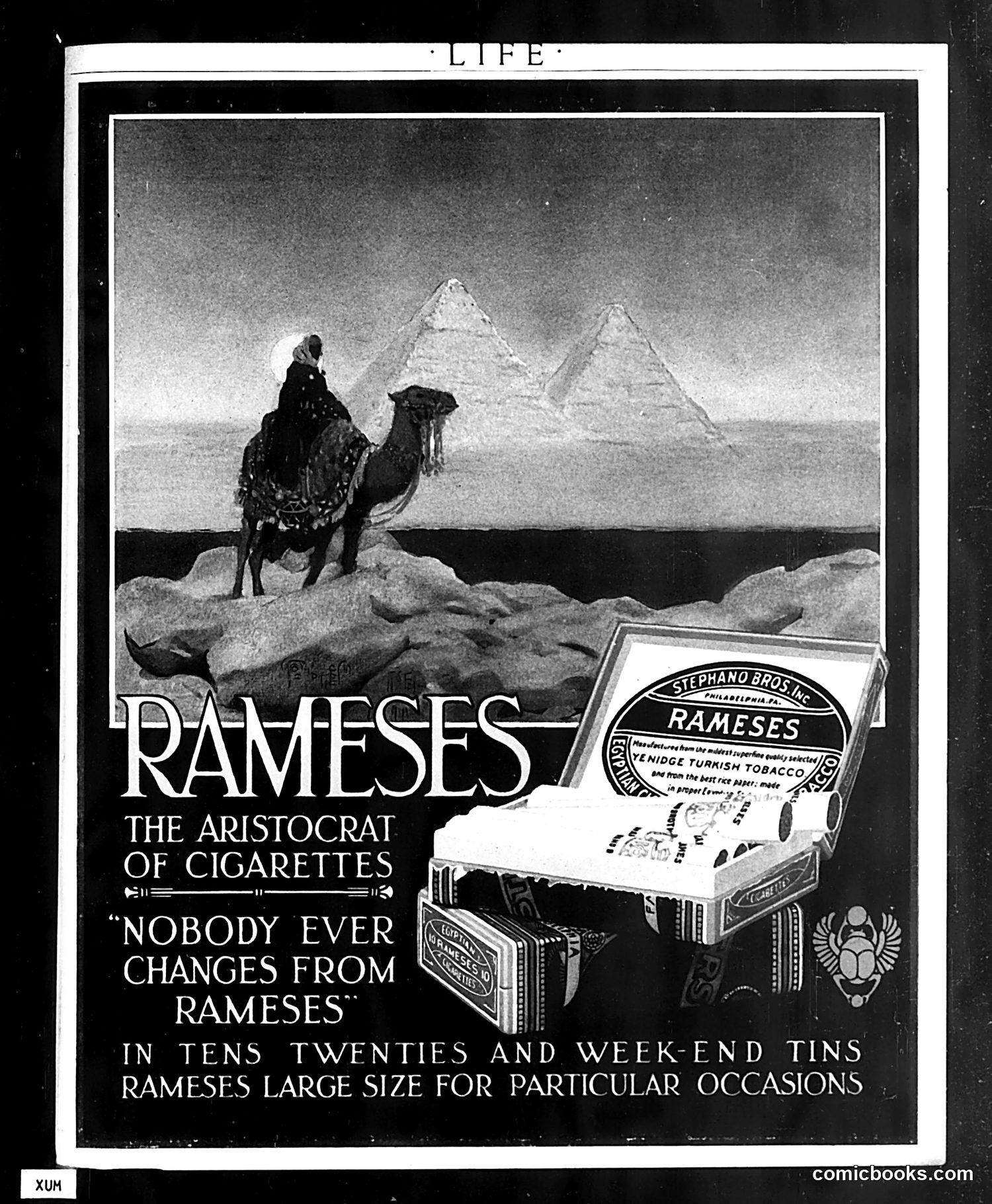
This is a **cigarette advertisement**, not political satire. It promotes Rameses brand cigarettes by Stephano Bros., Inc., a Turkish tobacco product. The image depicts a figure in Middle Eastern dress riding a camel in a desert landscape with pyramids in the background—evoking Egypt and the pharaoh Rameses to suggest exotic sophistication and quality. The advertising copy claims "Nobody ever changes from Rameses," positioning the brand as superior and habit-forming. The ad emphasizes product availability in various sizes: "tens, twenties and week-end tins" for different occasions and budgets. This reflects early 20th-century advertising practices that used colonial/orientalist imagery to market luxury goods, before widespread understanding of tobacco's health dangers.
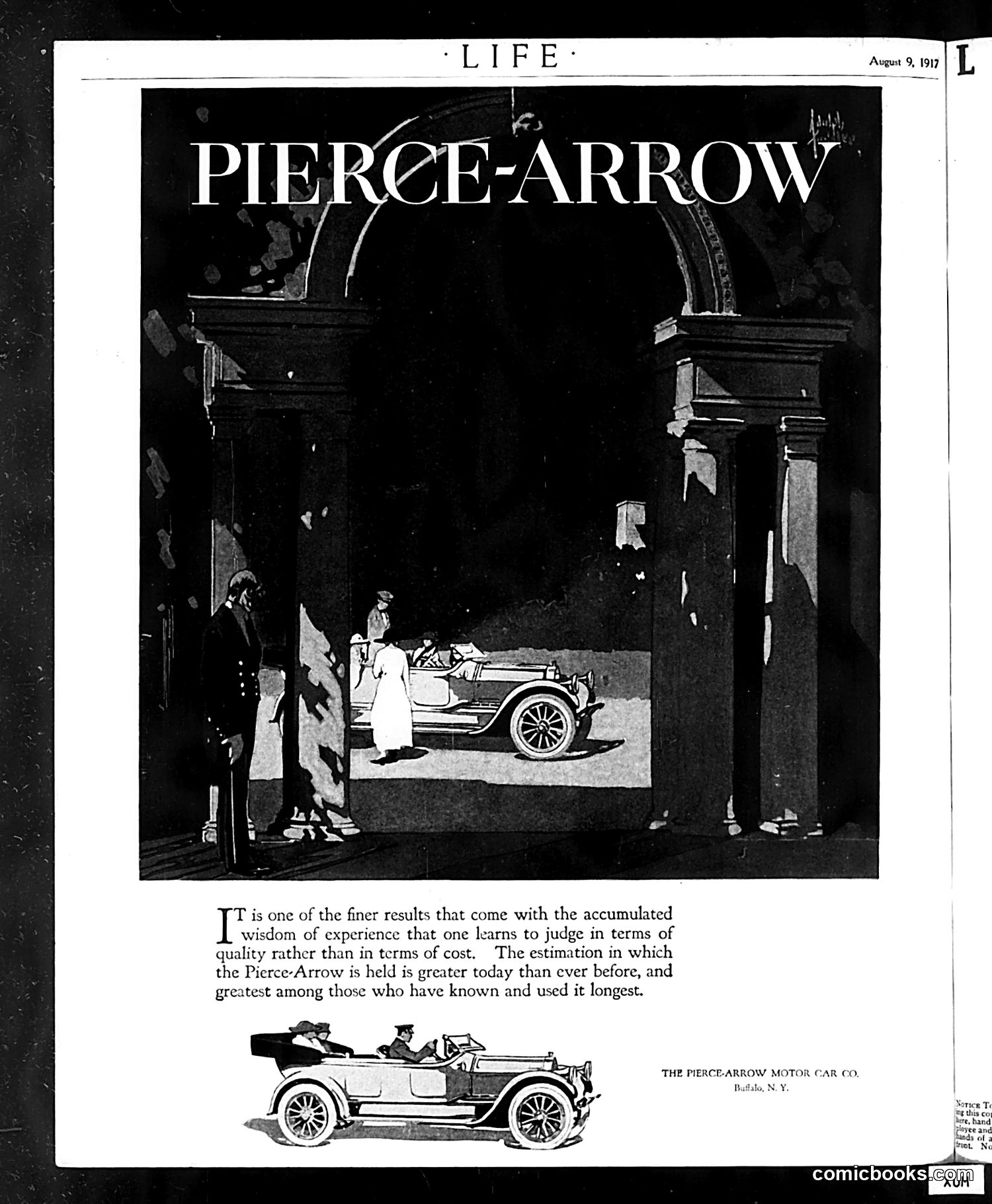
This is a full-page advertisement for Pierce-Arrow automobiles, not political satire. Published in *Life* magazine on August 9, 1917, it promotes the Pierce-Arrow motor car through an atmospheric illustration showing an elegant vehicle framed by classical stone archways, with well-dressed figures admiring it. The ad's text argues that experienced consumers judge cars by quality rather than cost, claiming Pierce-Arrow's reputation has grown among long-time users. The romantic imagery—the grand architectural setting, the refined figures—aims to associate the vehicle with sophistication and enduring value. There is no cartoon or satirical content here; this is straightforward luxury automobile marketing positioned in a magazine known for humor, suggesting the advertiser sought *Life's* upscale readership during the World War I era.