
Life, 1917-08-09 · page 18 of 42
Life — August 9, 1917 — page 18: what you’re looking at
What you’re looking at
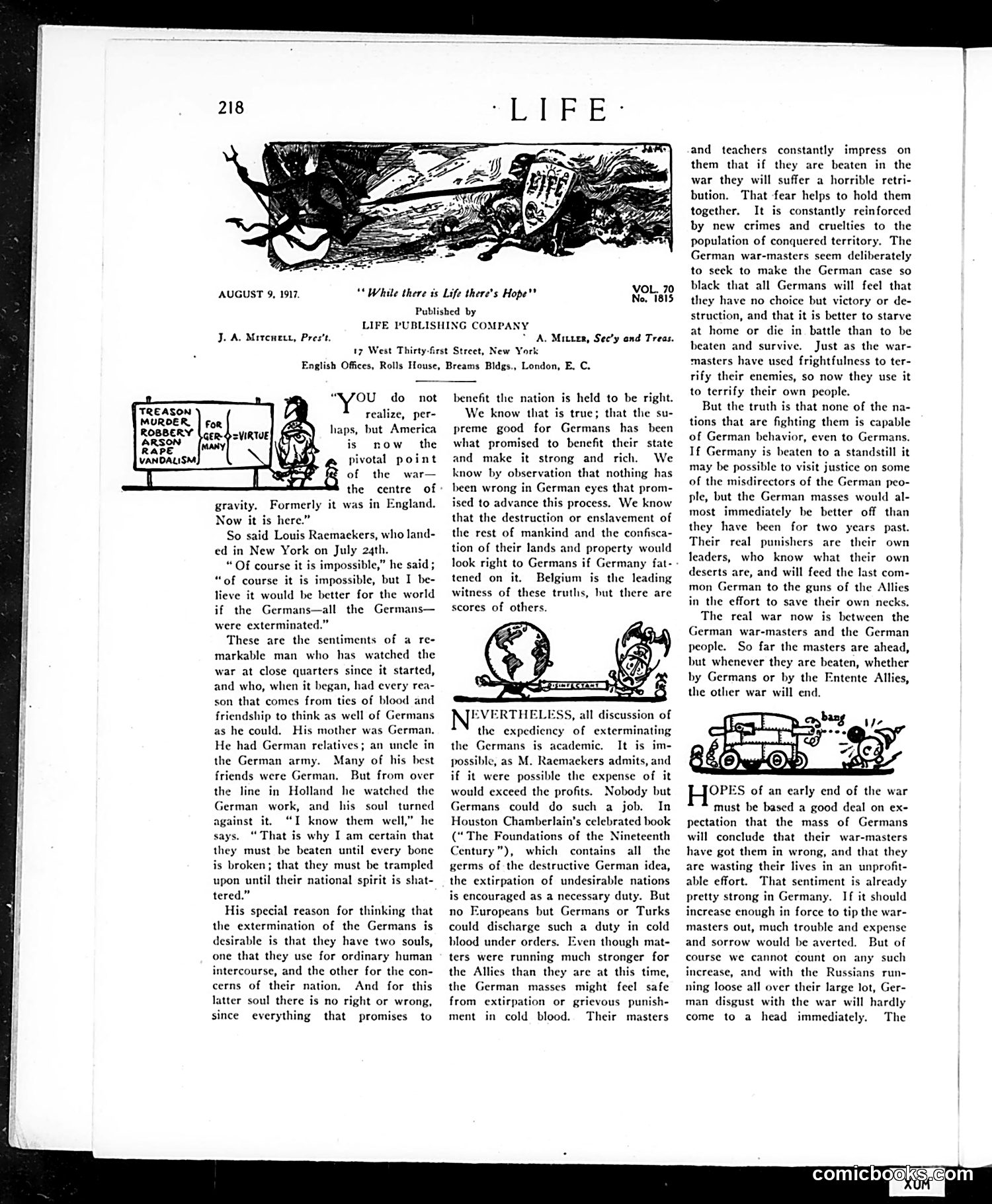
This page features an article about Louis Raemaekers, a Dutch political cartoonist and anti-German propagandist who arrived in New York on July 24, 1917—just months after America entered World War I. The small cartoon (left) shows a figure labeled with German crimes (treason, murder, robbery, arson, rape, vandalism) obscuring "virtue"—visualizing the article's central argument that German national interest has corrupted moral values. The main text quotes Raemaekers arguing that Germans possess a dual moral system: one for ordinary dealings, another for state interests where "nothing is wrong" if it benefits Germany. The article cites Belgium's suffering as evidence. While acknowledging German extermination is impossible and undesirable, the author warns that German leadership deliberately terrifies its own population with threats of horrible retribution to prevent surrender—creating a self-fulfilling cycle of escalating atrocities. This reflects 1917 American wartime propaganda emphasizing German militarism's uniquely amoral nature.
📄 Transcribed text from this page (OCR, searchable)
Machine-transcribed from the original scan — historical spelling and the odd misread are preserved.
AUGUST 9, 1917. “* While there is Life there's Hope"" VOL. 70 No, 1815 Published by LIF J. A. Mitcnett, Pres’t, PUBLISHING COMPANY A. Minter, Sec’y and Treas. t7 West Thirty-first Street, New York English Offices, Rolls House, Breams Bldgs., London, E. C. “YOU do not realize, per- haps, but America is now the pivotal point of the war— the centre of gravity. Formerly it was in England. Now it is here.” So said Louis Raemaekers, who land- ed in New York on July 24th. “Of course it is impossible,” he said; “of course it is impossible, but I be- lieve it would be better for the world if the Germans—all the Germans— were exterminated.” These are the sentiments of a re- markable man who has watched the war at close quarters since it started, and who, when it began, had every rea- son that comes from ties of blood and friendship to think as well of Germans as he could. His mother was German, He had German relatives; an uncle in the German army. Many of his best friends were German, But from over the line in Holland he watched the German work, and his soul turned against it. “I know them well,” he says. “That is why I am certain that they must be beaten until every bone is broken; that they must be trampled upon until their national spirit is shat- tered.” His special reason for thinking that the extermination of the Germans is desirable is that they have two souls, one that they use for ordinary human intercourse, and the other for the con- cerns of their nation. And for this latter soul there is no right or wrong, since everything that promises to TREASON MURDER | Fog ROBBERY \ cen d=ViRTE ARSON MANY RAPE VANDALISM, benefit the nation is held to be right. We know that is true; that the su- preme good for Germans has been what promised to benefit their state and make it strong and rich. We know by observation that nothing has been wrong in German eyes that prom- ised to advance this process. We know that the destruction or enslavement of the rest of mankind and the confisca- tion of their lands and property would look right to Germans if Germany fat- tened on it. Belgium is the leading witness of these truths, but there are scores of others. 5, all discussion of the expediency of exterminating the Germans is academic. It is im- possible, as M. Raemackers admits, and if it were possible the expense of it would exceed the profits. Nobody but Germans could do such a job. In Houston Chamberlain's celebrated book (“The Foundations of the Nineteenth Century”), which contains all the germs of the destructive German idea, the extirpation of undesirable nations is encouraged as a necessary duty. But no Europeans but Germans or Turks could discharge such a duty in cold blood under orders. Even though mat- ters were running much stronger for the Allies than they are at this time, the German masses might feel safe from extirpation or grievous punish- ment in cold blood. Their masters and teachers constantly impress on them that if they are beaten in the war they will suffer a horrible retri- bution. That fear helps to hold them together. It is constantly reinforced by new crimes and cruelties to the population of conquered territory. The German war-masters seem deliberately to seek to make the German case so black that all Germans will feel that they have no choice but victory or de- struction, and that it is better to starve at home or die in battle than to be beaten and survive. Just as the war- masters have used frightfulness to ter- rify their enemies, so now they use it to terrify their own people. But the truth is that none of the na- tions that are fighting them is capable of German behavior, even to Germans, If Germany is beaten to a standstill it may be possible to visit justice on some of the misdirectors of the German peo- ple, but the German masses would al- most immediately be better off than they have been for two years past. Their real punishers are their own leaders, who know what their own deserts are, and will feed the last com- mon German to the guns of the Allies in the effort to save their own necks. The real war now is between the German war-masters and the German people. So far the masters are ahead, but whenever they are beaten, whether by Germans or by the Entente Allies, the other war will end. OPES of an early end of the war must be based a good deal on ex- pectation that the mass of Germans will conclude that their war-masters have got them in wrong, and that they are wasting their lives in an unprofit- able effort. That sentiment is already pretty strong in Germany. If it should increase enough in force to tip the war- masters out, much trouble and expense and sorrow would be averted. But of course we cannot count on any such increase, and with the Russians run- ning loose all over their large lot, Ger- man disgust with the war will hardly come to a head immediately. The comicb % cme m