
Life, 1917-08-09 · page 10 of 42
Life — August 9, 1917 — page 10: what you’re looking at
What you’re looking at
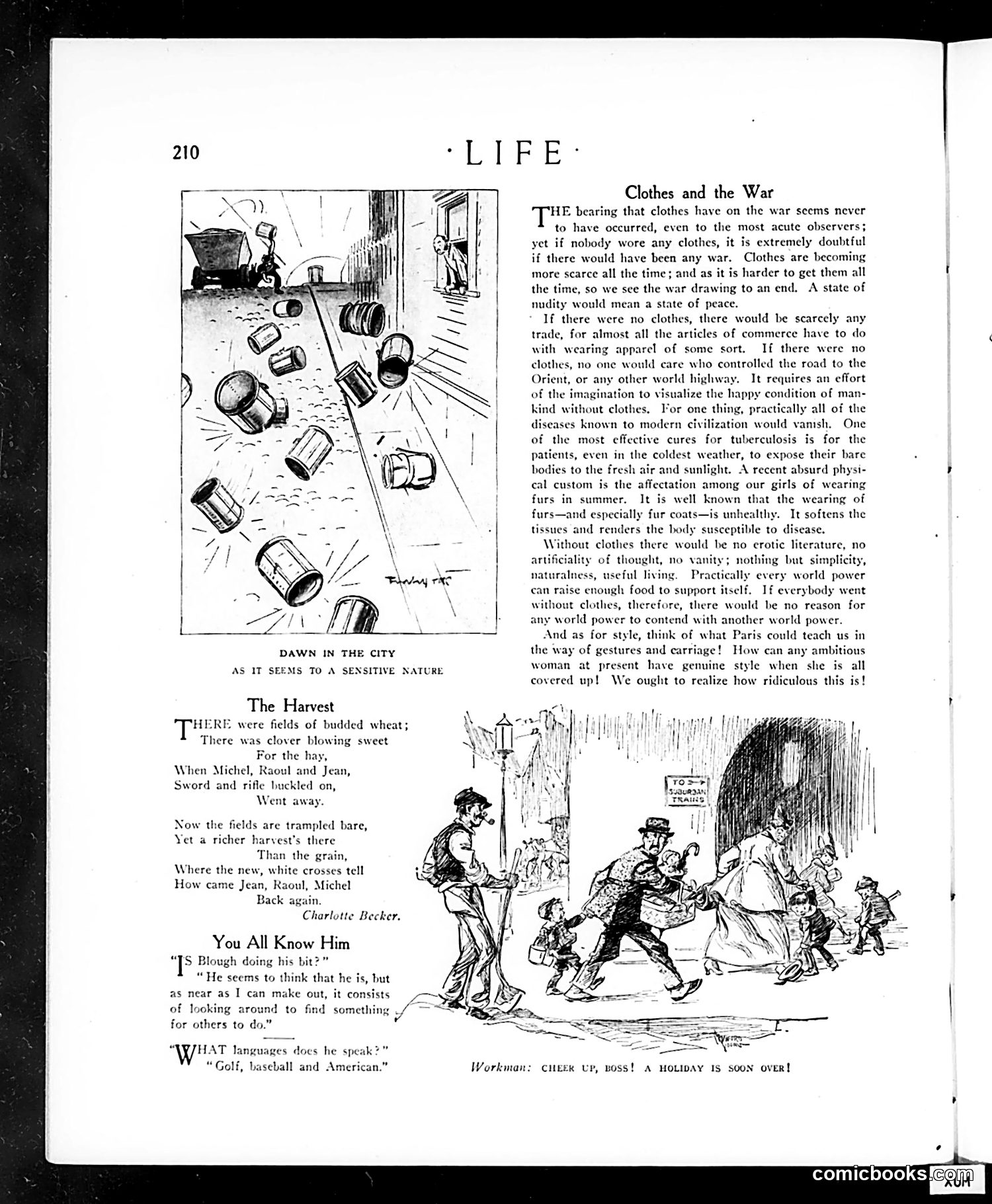
This page contains three distinct pieces: 1. **"Dawn in the City"** (top left): A sketch showing scattered kitchen utensils and household items on a street, apparently depicting urban poverty or homelessness. 2. **"Clothes and the War"** (main essay): An extended prose argument that if clothes disappeared, war would end—because trade and commerce require clothing, and without commercial interests, nations wouldn't fight. The piece sarcastically suggests nudity would eliminate vanity and artificiality, forcing human simplicity. 3. **"The Harvest"** (poem by Charlotte Becker) and **"You Know Him"** (dialogue): These appear to be unrelated short literary pieces about wartime sacrifice and a cryptic character sketch. The overall theme suggests WWI-era social commentary on materialism, warfare, and human nature.
📄 Transcribed text from this page (OCR, searchable)
Machine-transcribed from the original scan — historical spelling and the odd misread are preserved.
DAWN IN THE CITY AS IT SEEMS TO A SENSITIVE NATURE The Harvest HERE were fields of budded wheat; There was clover blowing sweet For the hay, When Michel, Raoul and Jean, Sword and rifle buckled on, Went away Now the fields are trampled bare, Yet a richer harvest’s there Than the grain, Where the new, white crosses tell How came Jean, Raoul, Michel Back again. Charlotte Becker. You All Know Him “TS Blough doing his bit?” “He seems to think that he is, but as near as I can make out, it consists of looking around to find something for others to do.” “NY/HAT languages does he spe “Golf, baseball and American. Clothes and the War THE bearing that clothes have on the war seems never to have occurred, even to the most acute observers; yet if nobody wore any clothes, it is extremely doubtful if there would have been any war. Clothes are becoming more scarce all the time; and as it is harder to get them all the time, so we see the war drawing to an end. A state of nudity would mean a state of peace. If there were no clothes, there would be scarcely any trade, for almost all the articles of commerce have to do with wearing apparel of some sort. If there were no clothes, no one would care who controlled the road to the Orient, or any other world highw: It requires an effort of the imagination to visualize the happy condition of man- kind without clothes, For one thing, practically all of the diseases known to modern civilization would vanish. One of the most effective cures for tuberculosis is for the patients, even in the coldest weather, to expose their bare bodies to the fresh air and sunlight. A recent absurd physi- cal custom is the affectation among our girls of wearing furs in summer. It is well known that the wearing of furs—and especially fur coats—is unhealthy. It softens the tissues and renders the body susceptible to disease. Without clothes there would be no crotic literature, no artificiality of thought, no vanity; nothing but simplicity, naturalness, useful living. Practically every world power can raise enough food to support itself. If everybody went without clothes, therefore, there would be no reason for any world power to contend with another world power. And as for style, think of what Paris could teach us in the way of gestures and carriage! How can any ambitious woman at present have genuine style when she is all covered up! We ought to realize how ridiculous this is! Workman: cuter vr, voss! A HOLIDAY IS SOON oveR! comicbooks Gam