
Life, 1917-08-09 · page 19 of 42
Life — August 9, 1917 — page 19: what you’re looking at
What you’re looking at
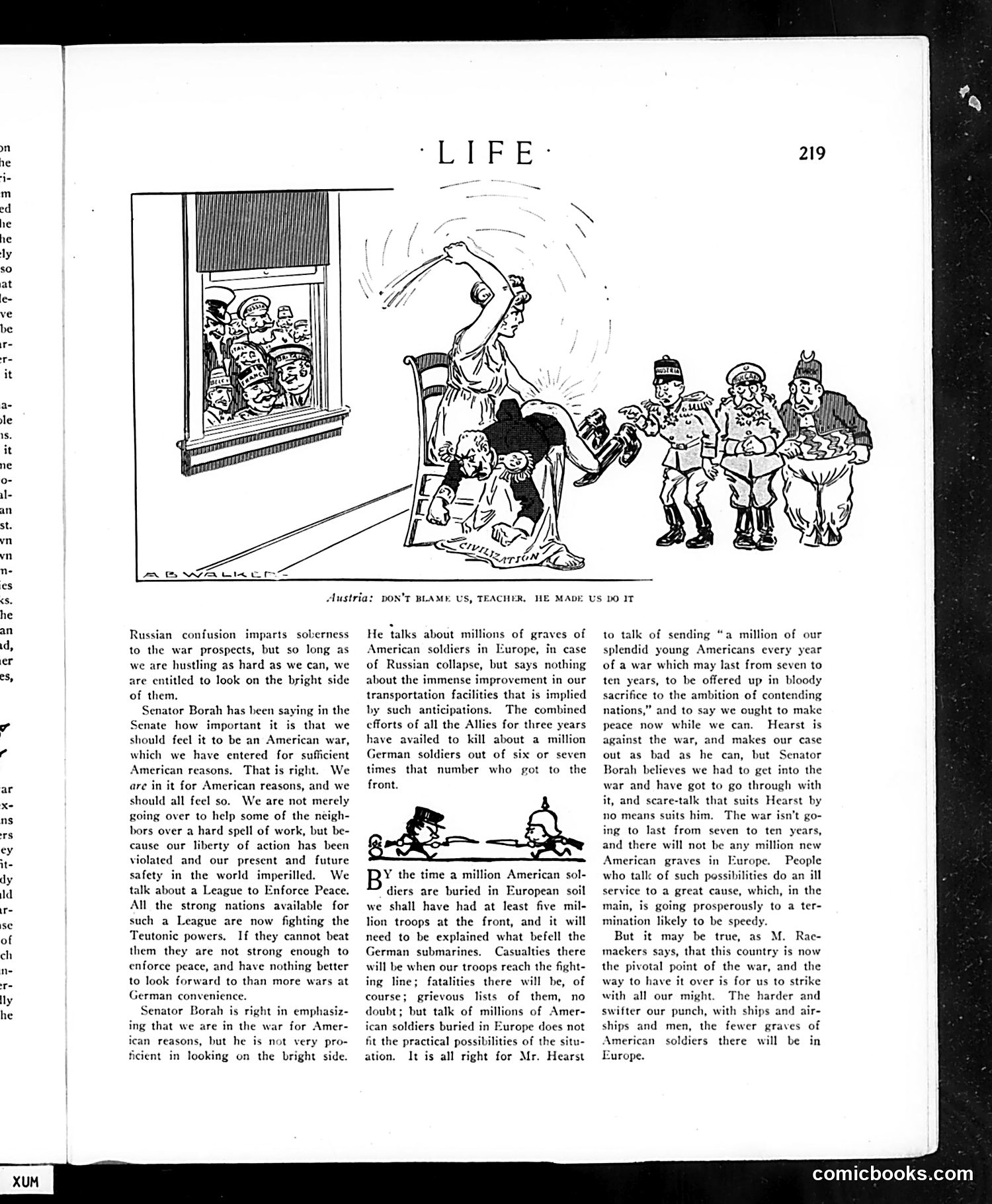
**The Cartoon:** The main illustration depicts a teacher (representing authority/justice) looking out a window at destruction, while a child character labeled "Austria" points accusingly at another figure, claiming shared responsibility for damage. This references Austria-Hungary's role in World War I—specifically, how Austria-Hungary initiated the conflict by attacking Serbia in 1914, triggering the alliance system that pulled in Russia, France, and eventually America. **The Satire:** The cartoon mocks Austria-Hungary's attempt to deflect blame for the war's catastrophic consequences. By portraying it as a child's excuse-making ("he made us do it"), Life ridicules how nations evaded accountability for the war's devastation. **Context:** This page appears from 1917-1918, when America was actively engaged in WWI. The accompanying editorial defends American participation and counters pessimistic war projections (likely from publisher William Randolph Hearst), arguing the conflict will end swiftly with fewer American casualties than feared.
📄 Transcribed text from this page (OCR, searchable)
Machine-transcribed from the original scan — historical spelling and the odd misread are preserved.
ve r= r= it er r= XUM Hh i Hi I | Hh slustria: DON'T BLAME US, TEACHER, HE MADE US DO IT Russian confusion imparts soberness to the war prospects, but so long as we are hustling as hard as we can, we are entitled to look on the bright side of them, Senator Borah has heen saying in the Senate how important it is that we should feel it to be an American war, which we have entered for sufficient American reasons, That is right. We are in it for American reasons, and we should all feel so. We are not merely going over to help some of the neigh- bors over a hard spell of work, but be- cause our liberty of action has been violated and our present and future safety in the world imperilled. We talk about a League to Enforce Peace. All the strong nations available for such a League are now fighting the Teutonic powers. If they cannot beat them they are not strong enough to enforce peace, and have nothing better to look forward to than more wars at German convenience. Senator Borah is right in emphasiz- ing that we are in the war for Amer- ican reasons, but he is not very pro- ficient in looking on the bright side. He talks about millions of graves of American soldiers in Europe, in case of Russian collapse, but says nothing about the immense improvement in our transportation facilities that is implied by such anticipations. The combined efforts of all the Allies for three years have availed to kill about a million German soldiers out of six or seven times that number who got to the front. Y the time a million American sol- diers are buried in European soil we shall have had at least five mil- lion troops at the front, and it will need to be explained what befell the German submarines. Casualties there will be when our troops reach the fight- ing line; fatalities there will be, of course; grievous lists of them, no doubt; but talk of millions of Amer- ican soldiers buried in Europe does not fit the practical possibilities of the situ- ation. It is all right for Mr. Hearst to talk of sending “a million of our splendid young Americans every year of a war which may last from seven to ten years, to be offered up in bloody sacrifice to the ambition of contending nations,” and to say we ought to make peace now while we can. Hearst is against the war, and makes our case out as bad as he can, but Senator Borah believes we had to get into the war and have got to go through with it, and scare-talk that suits Hearst by no means suits him. The war isn't go- ing to last from seven to ten years, and there will not be any million new American graves in Europe. People who tall: of such possibilities do an ill service to a great cause, which, in the main, is going prosperously to a ter- mination likely to be speedy. But it may be true, as M. Rac- mackers says, that this country is now the pivotal point of the war, and the way to have it over is for us to strike with all our might. The harder and swifter our punch, with ships and air- ships and men, the fewer graves of American soldiers there will be in Europe. comicbooks.com