
Life, 1917-08-09 · page 14 of 42
Life — August 9, 1917 — page 14: what you’re looking at
What you’re looking at
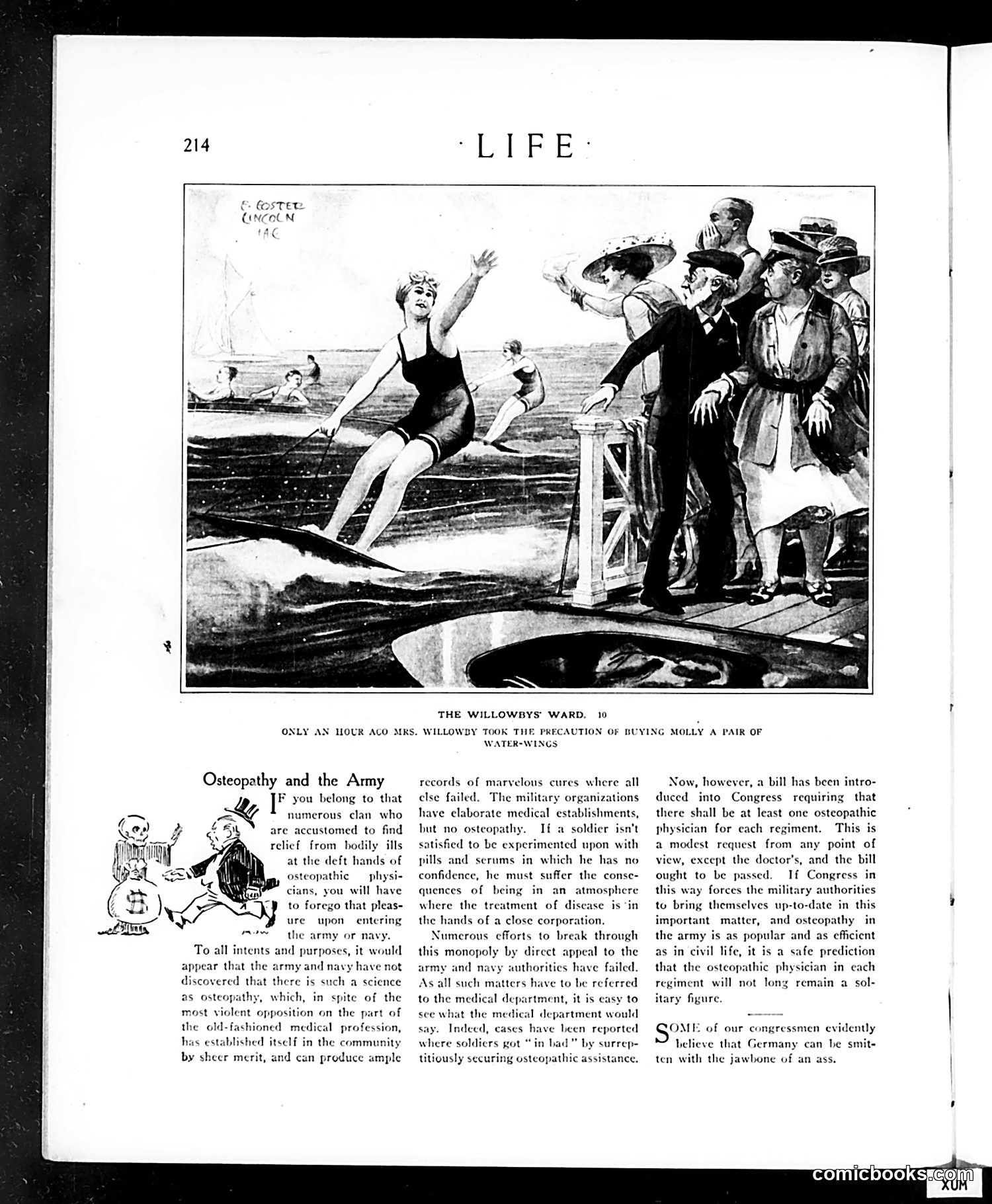
This page from *Life* magazine contains two distinct elements: **The Cartoon Image** ("The Willowby's Ward"): Shows a woman in a bathing suit diving into water while well-dressed onlookers watch from a pier. The caption indicates Mrs. Willowby is buying her companion Molly water-wings—a humorous domestic scene, likely part of a serialized cartoon story. **The Article "Osteopathy and the Army"**: Argues that osteopathy (a medical practice then considered suspect by traditional medicine) should be recognized and legitimized by the U.S. military. The writer contends that osteopathic physicians can treat soldiers effectively and that Congress should require the Army to employ them. The final quip about "Germany can be smitten with the jawbone of an ass" appears to mock skeptics of osteopathy's efficacy. The piece reflects early-20th-century debates over medical legitimacy and military healthcare policy.
📄 Transcribed text from this page (OCR, searchable)
Machine-transcribed from the original scan — historical spelling and the odd misread are preserved.
&: (stew CONCOLN 4 x THE WILLOWBYS' WARD. 10 ONLY AN HOUR ACO MRS. WILLOWBY TOOK THE PRECAUTION OF BUYING MOLLY A PAIR OF Osteopathy and the Army Ik you belong to that & numerous clan who £ sn are accustomed to find relief from bodily ills at the deft hands of osteopathic physi- cians, you will have to forego that pleas- ure upon entering the army or navy. To all intents and purposes, it would appear that the army and navy have not discovered that there is such a science as osteopathy, which, in spite of the most violent opposition on the part of the old-fashioned medica profession, has established itself in the community by sheer merit, and can produce ample WATER-WINCS, records of marvelous cures where all else failed. The military organizations have elaborate medical establishments, but no osteopathy. If a soldier isn’t satisfied to be experimented upon with pills and serums in which he has no confidence, he must suffer the conse- quences of being in an atmosphere where the treatment of disease is ‘in the hands of a close corporation. Numerous efforts to break through ppeal to the ited. tters have to be referred this monopoly by direct army As all such n to the medical department, it is easy to see what the medical department would s have say. Indeed, cases have been reported where soldiers got “in bad" by surrep- titiously securing osteopathic assistance, Now, however, a bill has been intro- duced into Congress requiring that there shall be at least one osteopathic physician for each regiment. This is a modest request from any point of view, except the doctor's, and the bill ought to be passed. If Congress in this way forces the military authorities to bring themselves up-to-date in this important matter, and osteopathy in the army is as popular and as efficient in civil life, it is a safe prediction that the osteopathic physician in cach regiment will not long remain a sol- itary figure. some of our congressmen evidently believe that Germany can be smit- ten with the jawbone of an ass. ne