
Life, 1917-08-09 · page 27 of 42
Life — August 9, 1917 — page 27: what you’re looking at
What you’re looking at
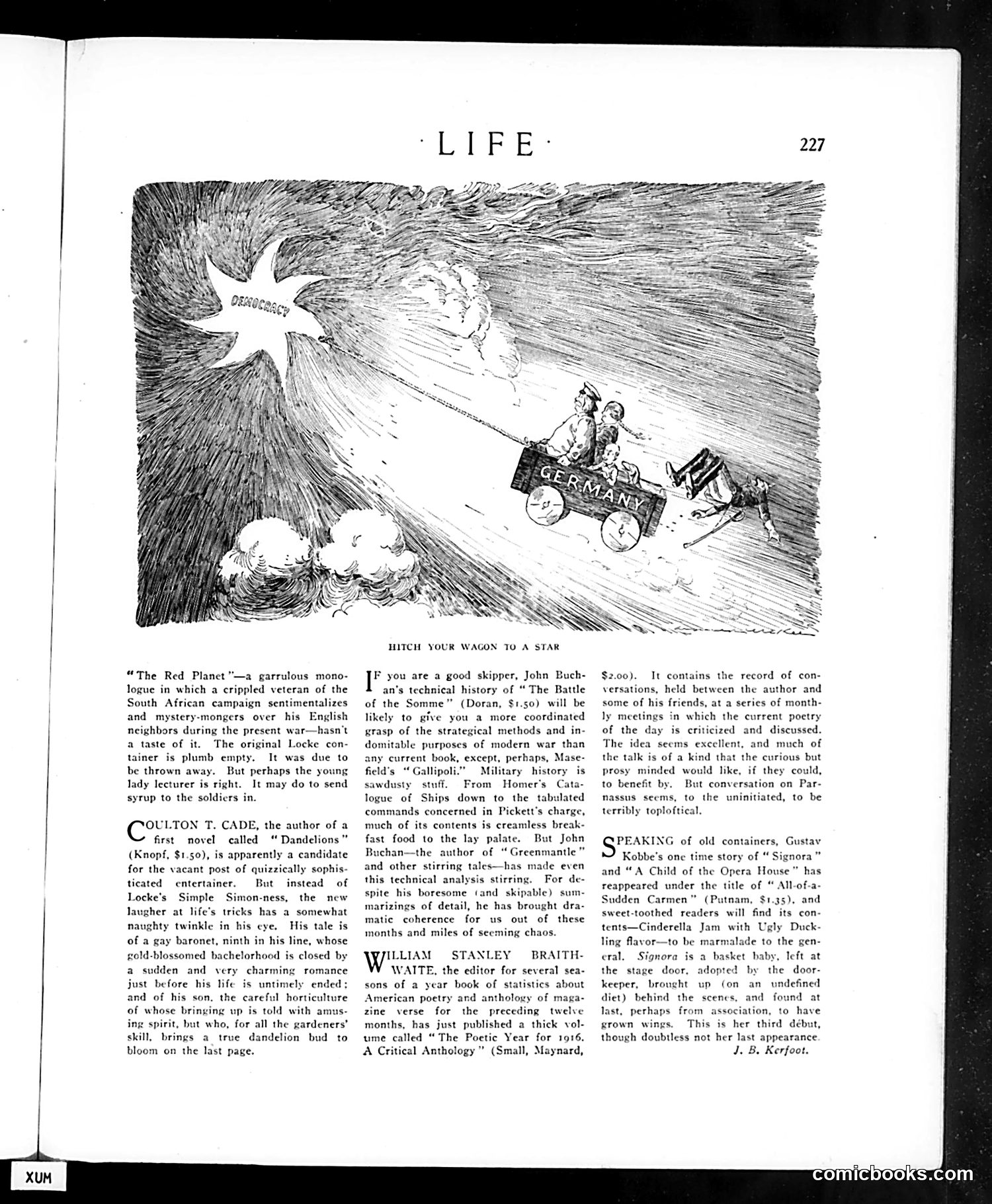
This page features book reviews and a political cartoon titled "Hitch Your Wagon to a Star." The cartoon depicts Germany (labeled on a wagon) being pulled toward a star by what appears to be a figure representing fate or destiny, while an angel or divine force shines light from above—likely satirizing German ambitions during World War I. The reviews discuss contemporary literature, including John Buchan's technical history of the Battle of the Somme, which the critic praises for making military history engaging despite its inherently dry subject matter. Other reviews cover novels and poetry collections from 1916. The cartoon's point appears to be ironic commentary on Germany's war ambitions—suggesting their aspirations are being guided by forces beyond their control, or mocking their belief in inevitable victory. The "star" imagery evokes both aspiration and the phrase "hitch your wagon to a star" (meaning pursue lofty goals), making the satire work on multiple levels during WWI's final years.
📄 Transcribed text from this page (OCR, searchable)
Machine-transcribed from the original scan — historical spelling and the odd misread are preserved.
“The Red Planct—a garrulous mono- logue in which a crippled veteran of the South African campaign sentimentalizes and mystery-mongers over his English neighbors during the present war—hasn't a taste of it. The original Locke con- tainer is plumb empty, It was due to be thrown away. But perhaps the young lady lecturer is right. It may do to send syrup to the soldiers in. OULTON T. CADE, the author of a first novel called “ Dandelions” (Knopf, $1.50), is apparently a candidate for the vacant post of quizzically sophis- ticated entertainer. But instead of Locke's Simple Simon-ness, the new laugher at life’s tricks has a somewhat naughty twinkle in his eye. His tale is of a gay baronet, ninth in his line, whose gold-blossomed bachelorhood is closed by a sudden and very charming romance just before his life is untimely ended; and of his son, the careful horticulture of whose bringing up is told with amus- ing spirit, but who, for all the gardeners’ skill, brings a true dandelion bud to bloom on the last page. HITCH YOUR WAGON To A STAR F you are a good skipper, John Buch- an’s technical history of “ The Battle of the Somme” (Doran, $1.50) will be likely to give you a more coordinated grasp of the strategical methods and in- domitable purposes of modern war than any current book, except, perhaps, Mase- field's “Gallipoli.” Military history is sawdusty stuff. From Homer's Cata- logue of Ships down to the tabulated commands concerned in Pickett’s charge, much of its contents is creamless break- fast food to the lay palate. But John Buchan—the author of “Greenmantle” and other stirring tales—has made even this technical analysis stirring. For de- spite his boresome ‘and skipable) sum- marizings of detail, he has brought dra- matic coherence for us out of these months and miles of seeming chaos. ILLIAM STANLEY BRAITH- WAITE, the editor for several sea- sons of a year book of statistics about American poetry and anthology of maga- zine verse for the preceding twelve months, has just published a thick vol- ume called “The Poetic Year for 1916. A Critical Anthology ” (Small, Maynard, $2.00). It contains the record of con- versations, held between the author and some of his friends, at a series of month- ly meetings in which the current poetry of the day is criticized and discussed. The ide the talk is of a kind that the curious but prosy minded would like, if they could, to benefit by. But conversation on Par- hassus seems, to the uninitiated, to be terribly toploftical. seems excellent, and much of KING of old containers, Gustav P Kobbe’s one time story of “ Signora ” and “A Child of the Opera House” has reappeared under the title of “ All-of-a- Sudden Carmen” (Putnam, $1.35). and sweet-toothed readers will find its con- tents—Cinderella Jam with Ugly Duck- ling flavor—to be marmalade to the gen- eral. Signora is a basket baby, left at the stage door, adopted by the door- keeper, brought up (on an undefined diet) behind the scenes, and found at last, perhaps from association, to have grown wings. This is her third début, though doubtless not her last appearance J. B. Kerfoot.