
A complete issue · 38 pages · 1917
Life — June 21, 1917
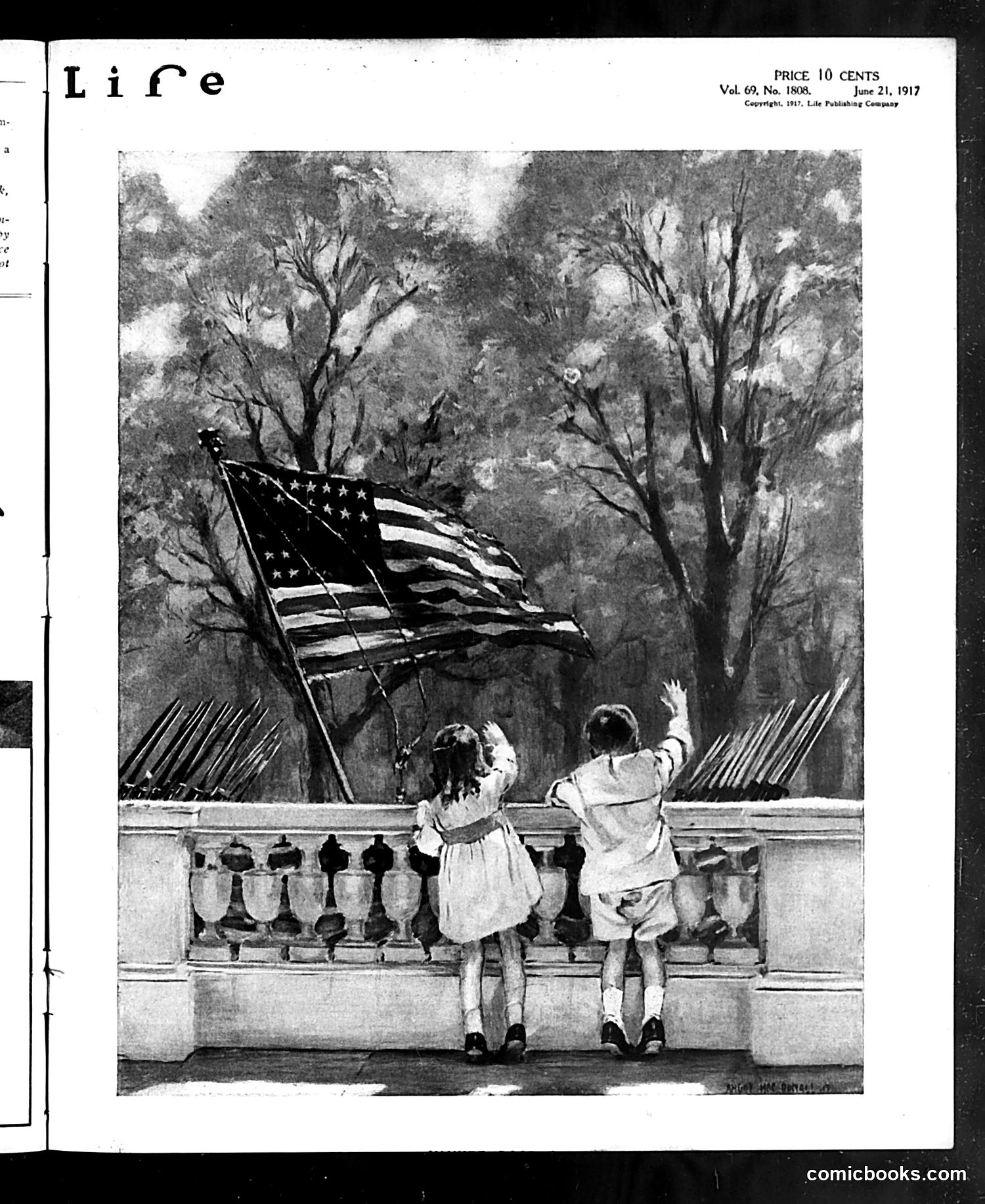
This Life magazine cover from June 21, 1917 shows two children saluting an American flag from a balcony, with bare trees and what appear to be military encampments or fortifications in the background. The image is patriotic propaganda from America's entry into World War I (April 1917). The children represent the next generation pledging allegiance to the nation during wartime. The stark trees and military structures suggest sacrifice and preparedness for conflict. The composition—innocent youth confronting military reality—appears designed to emotionally mobilize Americans for war by emphasizing generational duty and national defense. This reflects how Life magazine used sentimental imagery to support U.S. war efforts during this period.
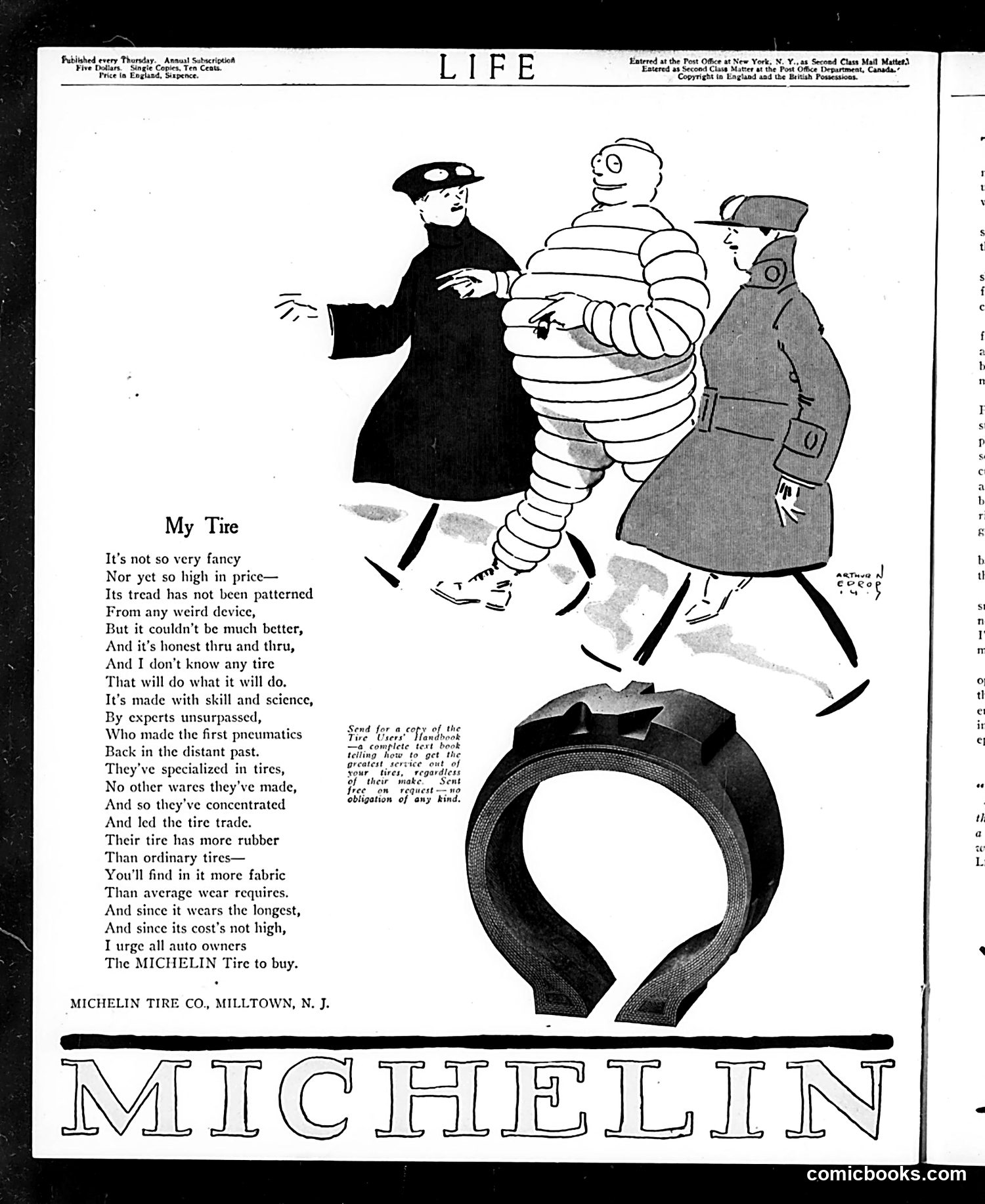
This is primarily a **Michelin tire company advertisement** disguised as editorial content in Life magazine. The cartoon depicts three figures—a thin man in black on the left, the famous **Michelin Man** (the rotund mascot made of tire rings) in the center, and a uniformed officer on the right—appearing to interact or dance together. The accompanying poem "My Tire" is advertising copy promoting Michelin tires' durability and quality. It emphasizes that despite being "not so very fancy," Michelin tires are honest, durable products made with "skill and science" by tire specialists. The humor relies on the Michelin Man's distinctive appearance and the somewhat absurd image of this character participating in everyday life, making the advertisement more engaging than straightforward promotional text.
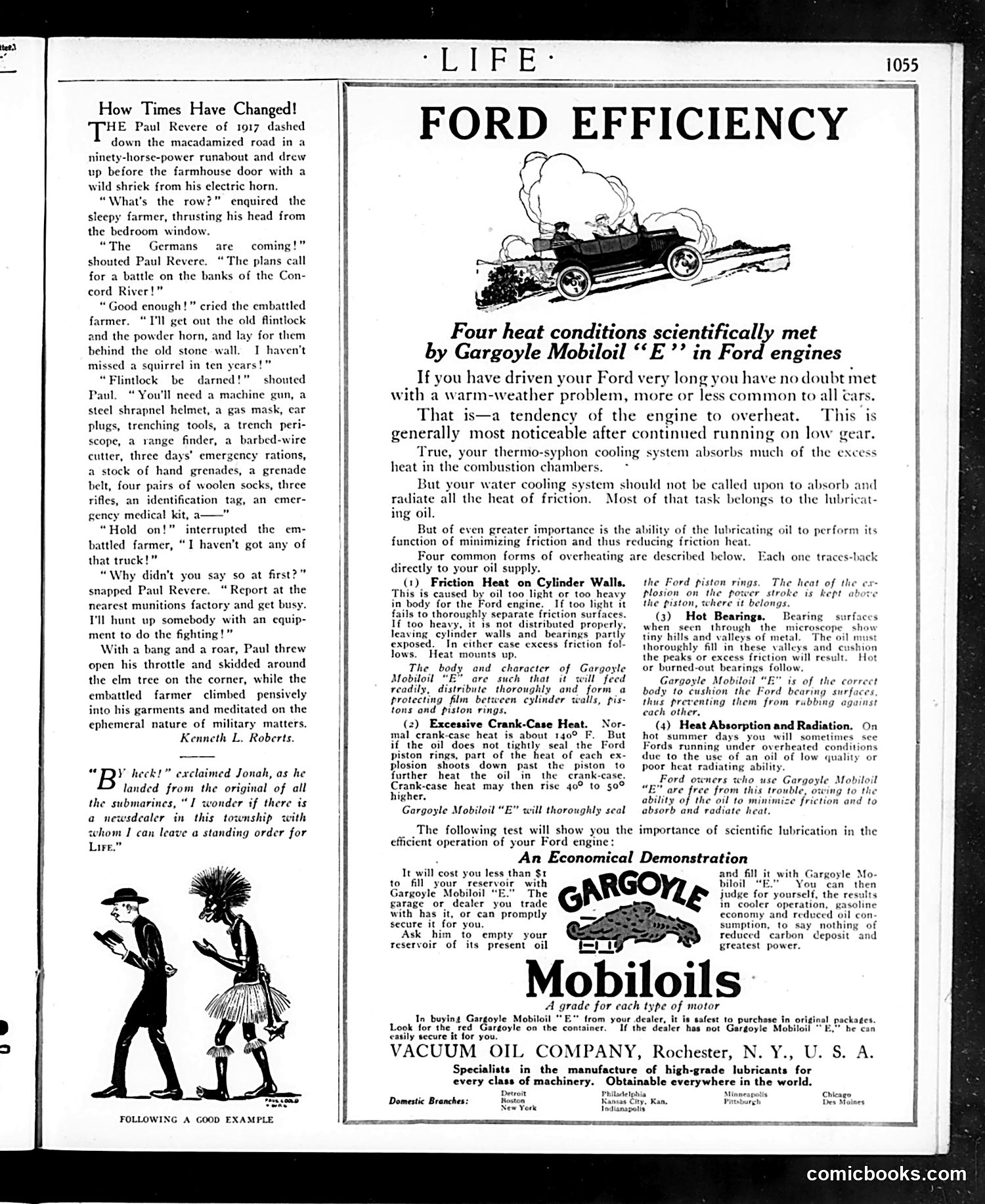
This page contains two distinct elements: **Left side:** A short story titled "How Times Have Changed!" featuring Paul Revere's famous 1917 midnight ride. The narrative humor comes from contrasting Revolutionary War drama with modern (1920s) mechanization—Revere now uses an electric horn instead of shouting, and a farmer complains about missing a squirrel in ten years while obsessing over a truck. The accompanying cartoon shows two figures in period costume, illustrating the satirical contrast between historical and contemporary life. **Right side:** A full-page advertisement for Gargoyle Mobiloils (lubricating oil), disguised as technical automotive advice about Ford engine efficiency. The ad emphasizes scientific cooling systems and proper lubrication, positioning the product as essential for vehicle performance. The juxtaposition humorously illustrates how rapidly American life—and consumer needs—had transformed in the early automotive age.
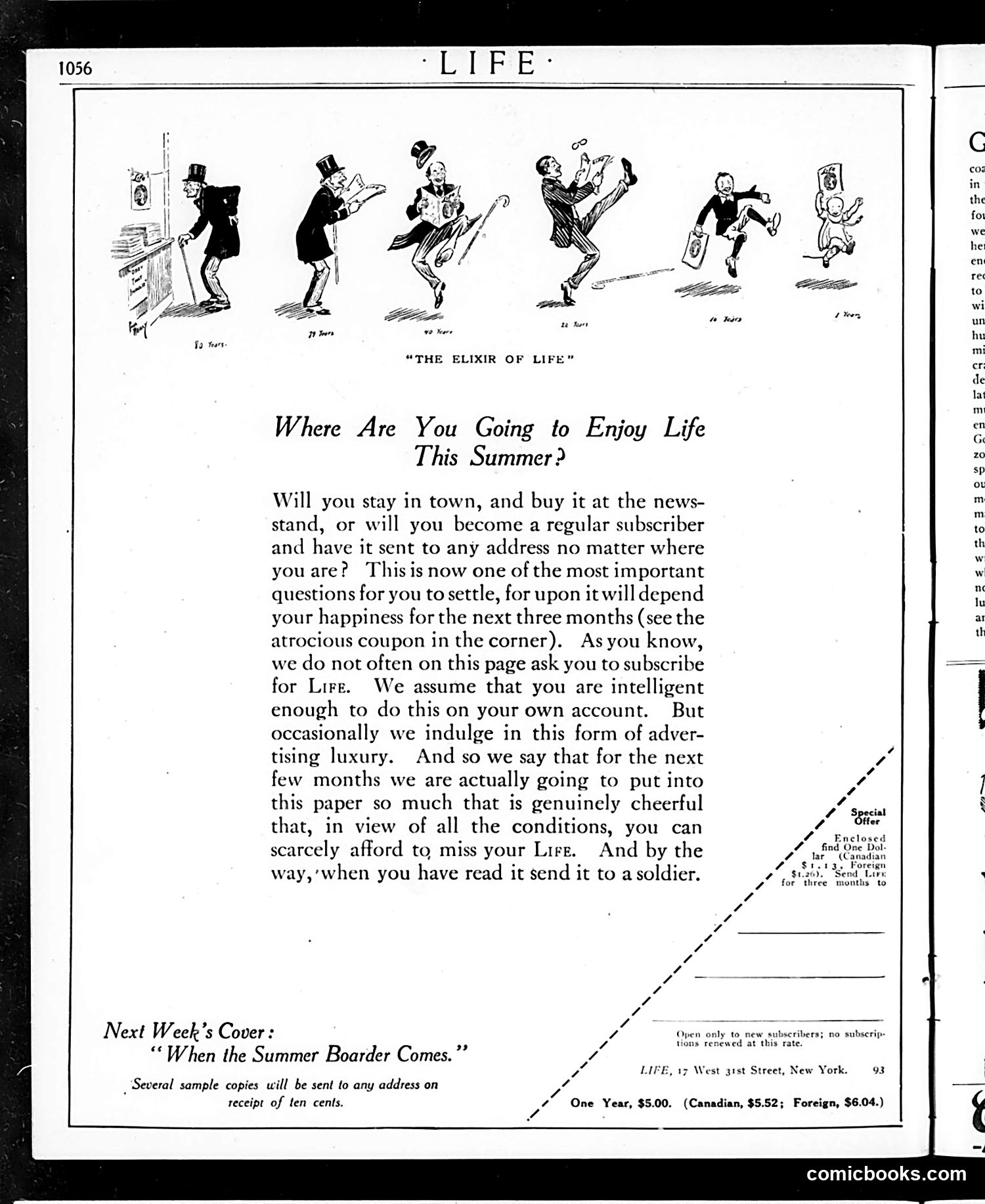
This cartoon satirizes the pursuit of eternal youth and vitality. The six sequential panels show a progression: a man checks his appearance, then increasingly wild and desperate behavior (dancing, contorting, running frantically) as he apparently seeks or consumes some remedy or "elixir of life." The figures become more manic and undignified with each step, suggesting the absurdity of chasing youth. The accompanying text is a subscription pitch for *Life* magazine itself, playfully arguing readers can't afford to miss summer issues. The final note—"when you have read it send it to a soldier"—references WWI, dating this to around 1917-1918, when sending materials to troops was common patriotic practice.
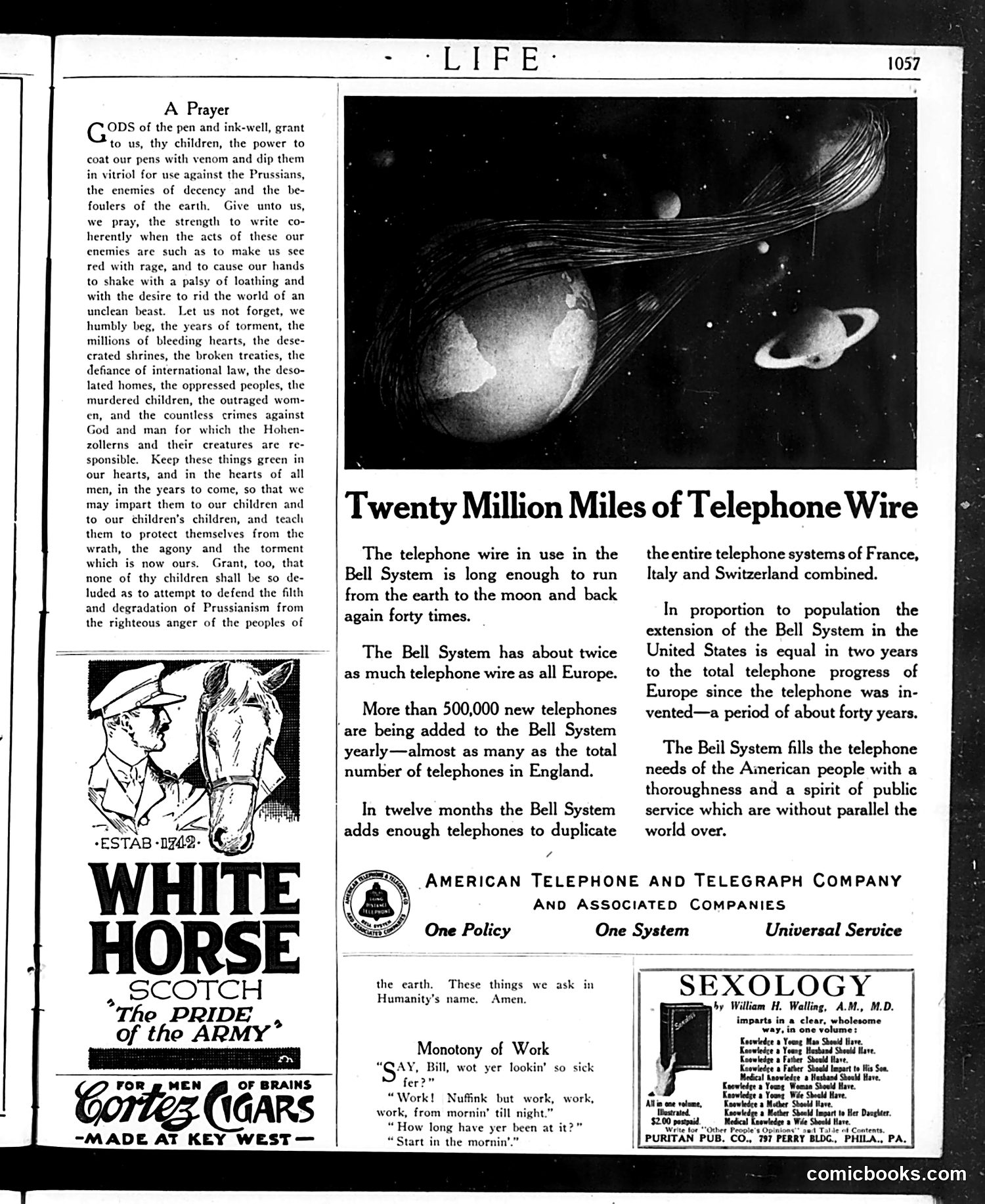
This page is primarily **advertising and corporate content** rather than political satire. The left side features a lengthy prayer criticizing Prussians, enemies of decency, and international lawlessness—likely referencing **World War I** (the references to Prussia and "unclean beasts" suggest anti-German sentiment from that era). Below is a **White Horse Scotch whisky ad** and a **Cortez Cigars advertisement**. The main content is a **Bell System telephone company advertisement** boasting about 20 million miles of telephone wire—positioned as an achievement of American infrastructure and progress. It emphasizes the Bell System's superiority over European telephone networks. Bottom right contains a **Sexology book advertisement**, unrelated to the page's other content. The page reflects early 20th-century American corporate advertising and wartime messaging rather than editorial satire.
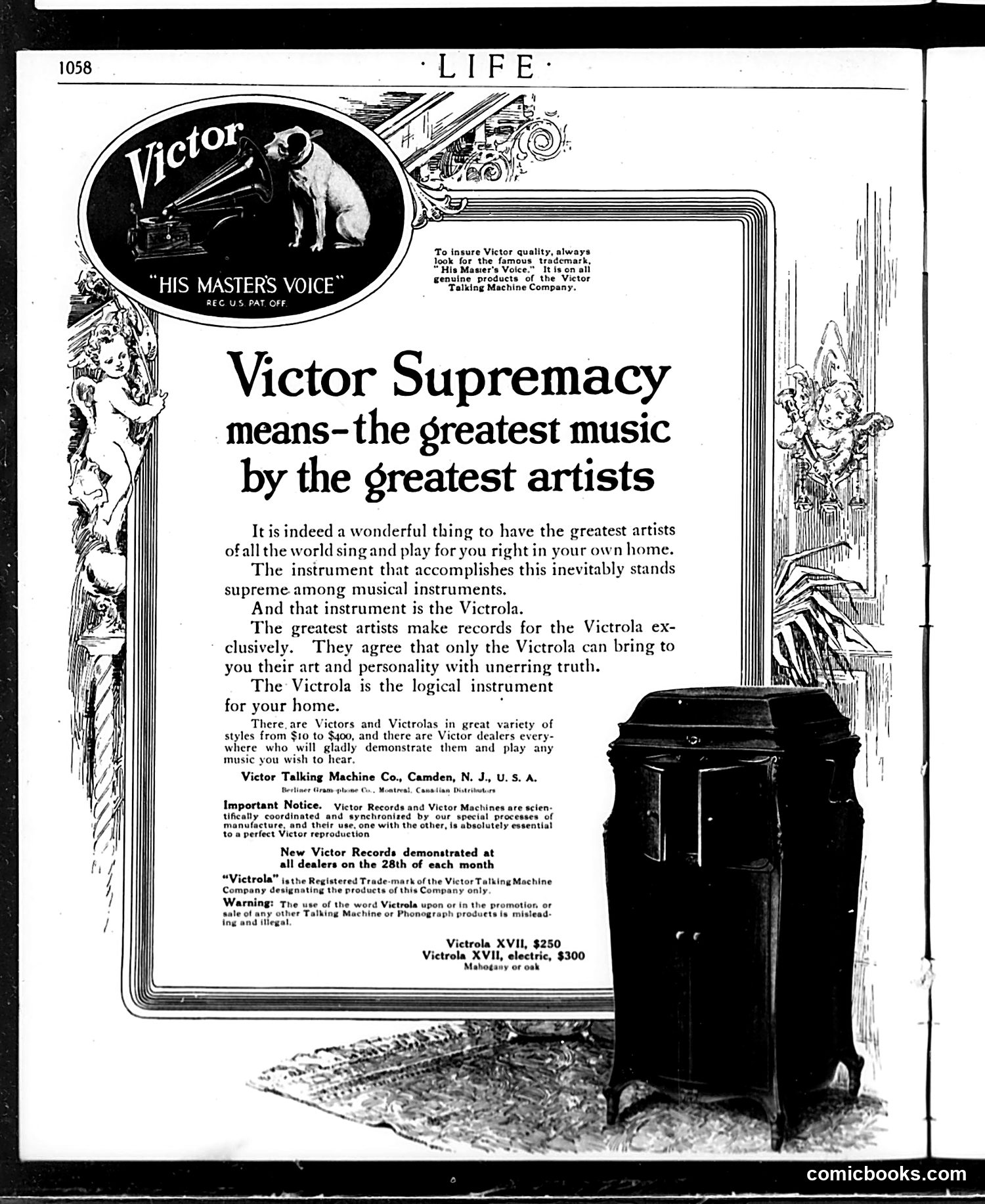
This is primarily a **product advertisement**, not satire or political commentary. The page advertises the Victrola, an early phonograph/record player manufactured by the Victor Talking Machine Company. The famous logo shows a dog listening to the device (the well-known "His Master's Voice" trademark). The ad claims "Victor Supremacy" by asserting that greatest musicians exclusively record for Victor, making it the superior home music device. It emphasizes that owning a Victrola allows ordinary homes to access performances by world-class artists. Two models are advertised: the Victrola XVII at $250 and an electric version at $300 in mahogany or oak finishes. The ornate decorative borders and the prominent product image suggest this was a premium, aspirational product targeting middle to upper-class consumers in the early 20th century.
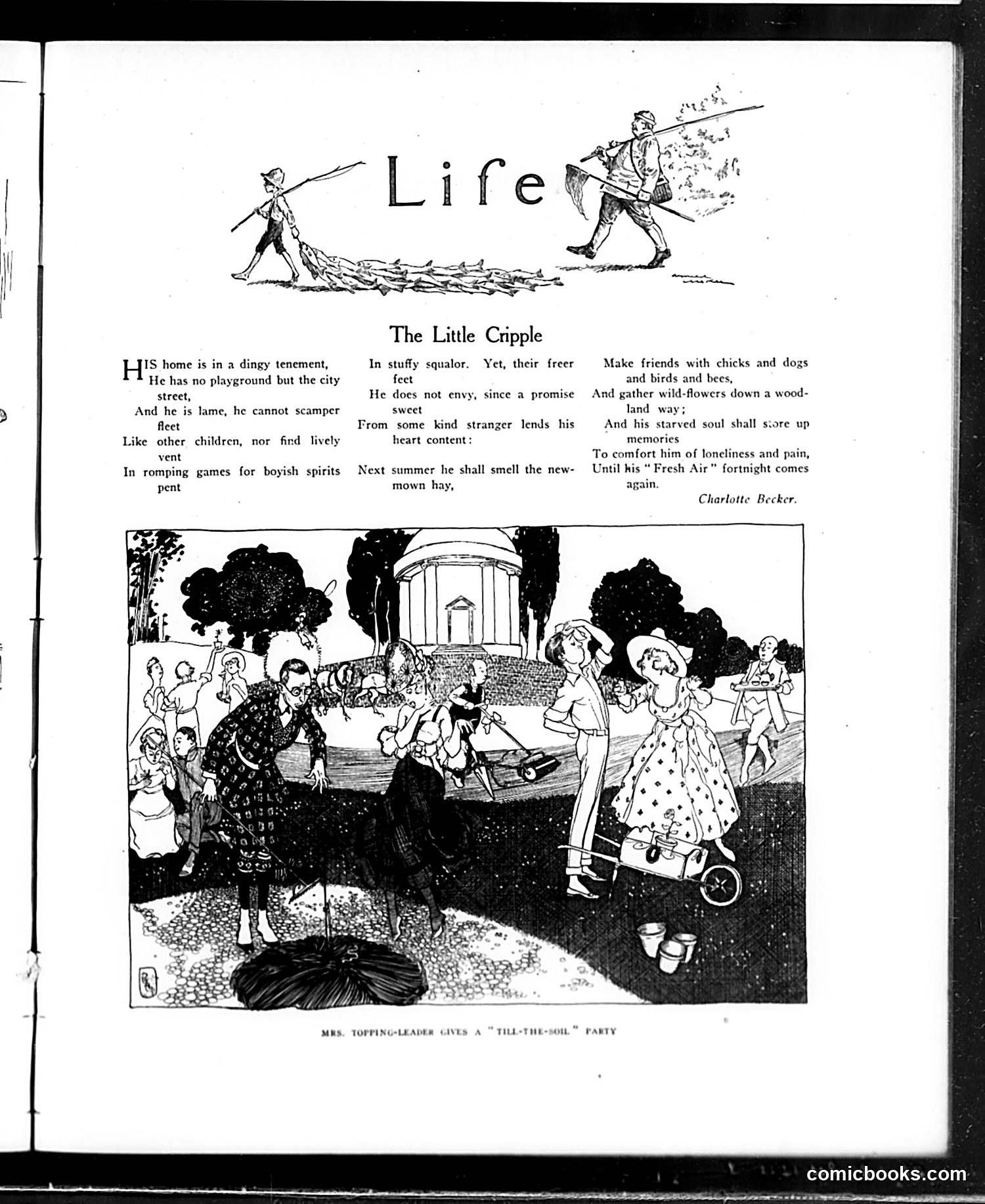
This page presents "The Little Cripple," a sentimental poem by Charlotte Becker about a disabled child confined to a tenement who cannot participate in normal childhood activities. The poem promises future solace through nature and friendship. The illustration below shows an upper-class woman (labeled "Mrs. Topping-Leader") hosting a "tilt-the-soil party"—apparently a wealthy philanthropist's organized charitable event or garden party for children. The satire appears to contrast the poem's message about genuine human kindness with what seems to be performative, fashionable charity by the wealthy elite. The juxtaposition suggests *Life* magazine's critique of how the privileged display benevolence as social entertainment rather than genuine aid to struggling children in tenements.
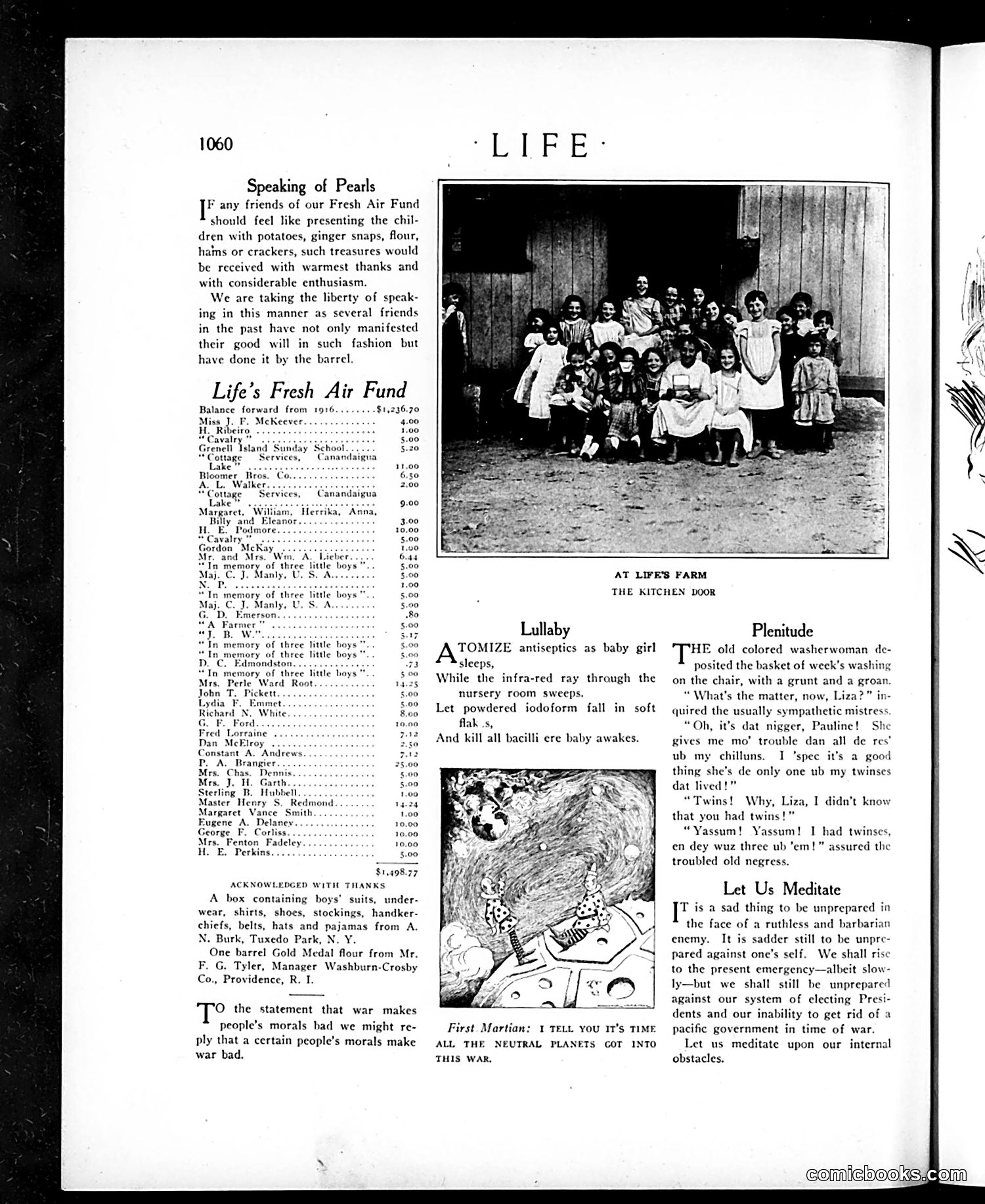
This page contains three distinct sections: **"Speaking of Pearls"** (top left): A charitable fundraising appeal for Life's Fresh Air Fund, listing donations from readers. The opening humorously compares receiving such donations to a child receiving comfort foods—establishing a warm, community-spirited tone. **"At Life's Farm - The Kitchen Door"** (center): A photograph of women and children posed outside a farmhouse kitchen, likely documenting the Fresh Air Fund's charitable work providing respite for urban families. **Three poems** (right): "Lullaby," "Plenitude," and "Let Us Meditate" appear to be satirical or reflective pieces. "Plenitude" humorously depicts a washerwoman and her "twins," while "Let Us Meditate" addresses preparedness against enemies and war—likely referencing contemporary anxieties about international conflict. The cartoon at bottom shows a First Martian character, apparently satirizing wartime rhetoric about neutral nations.
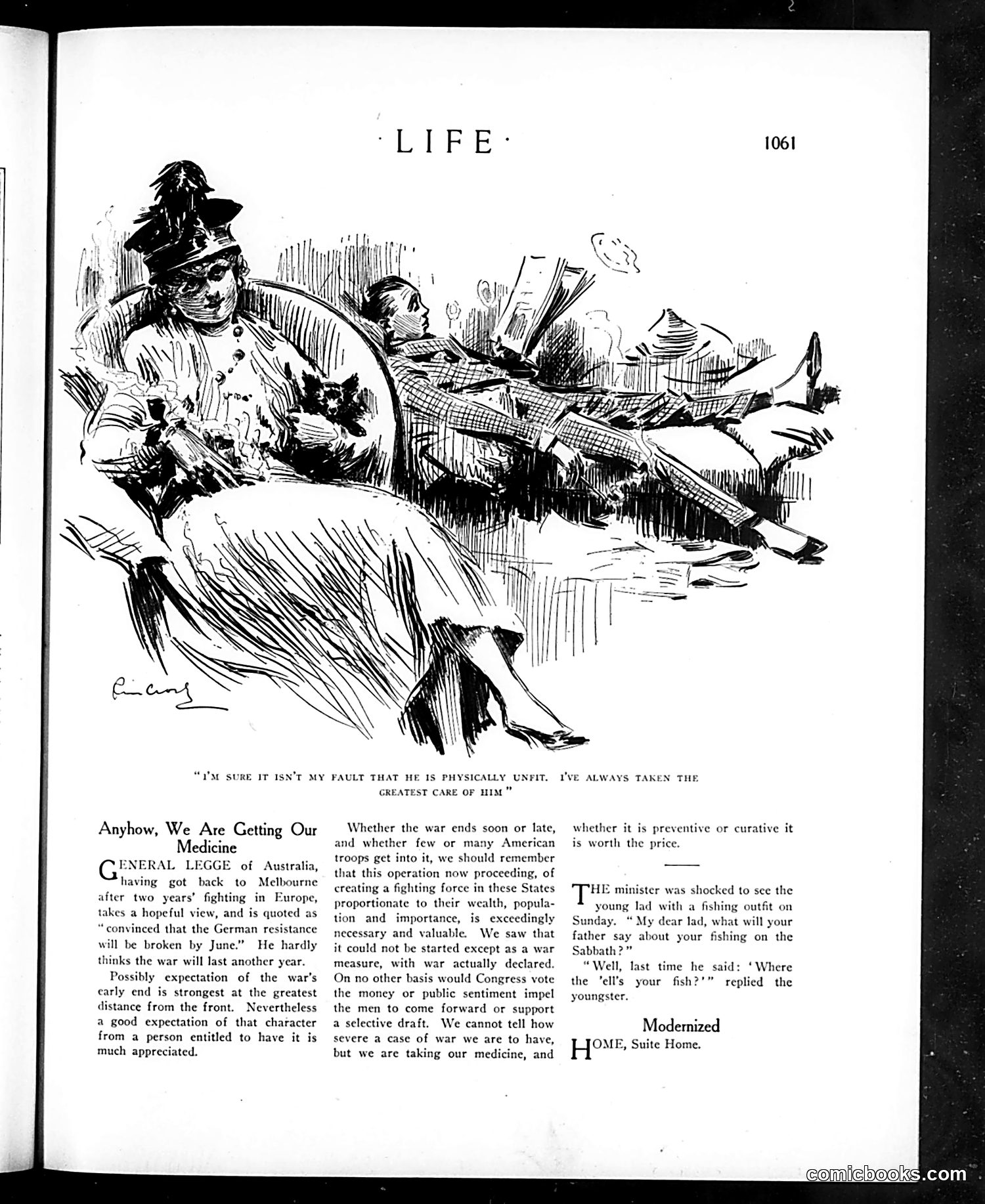
This Life magazine page contains a satirical cartoon about American military preparedness during what appears to be World War I era. The cartoon depicts a rotund military officer (likely a German general based on the spiked helmet) lounging comfortably while a younger soldier sits reading nearby, with papers scattered about. The caption quotes the officer assuring someone that he's taken "greatest care" of a physically unfit person—suggesting ironic commentary on how the military handles unsuitable recruits or soldiers. The accompanying article "Anyhow, We Are Getting Our Medicine" discusses General Legge of Australia's observations about American military mobilization and preparedness, arguing that despite reservations, the effort to create a fighting force is necessary and valuable.
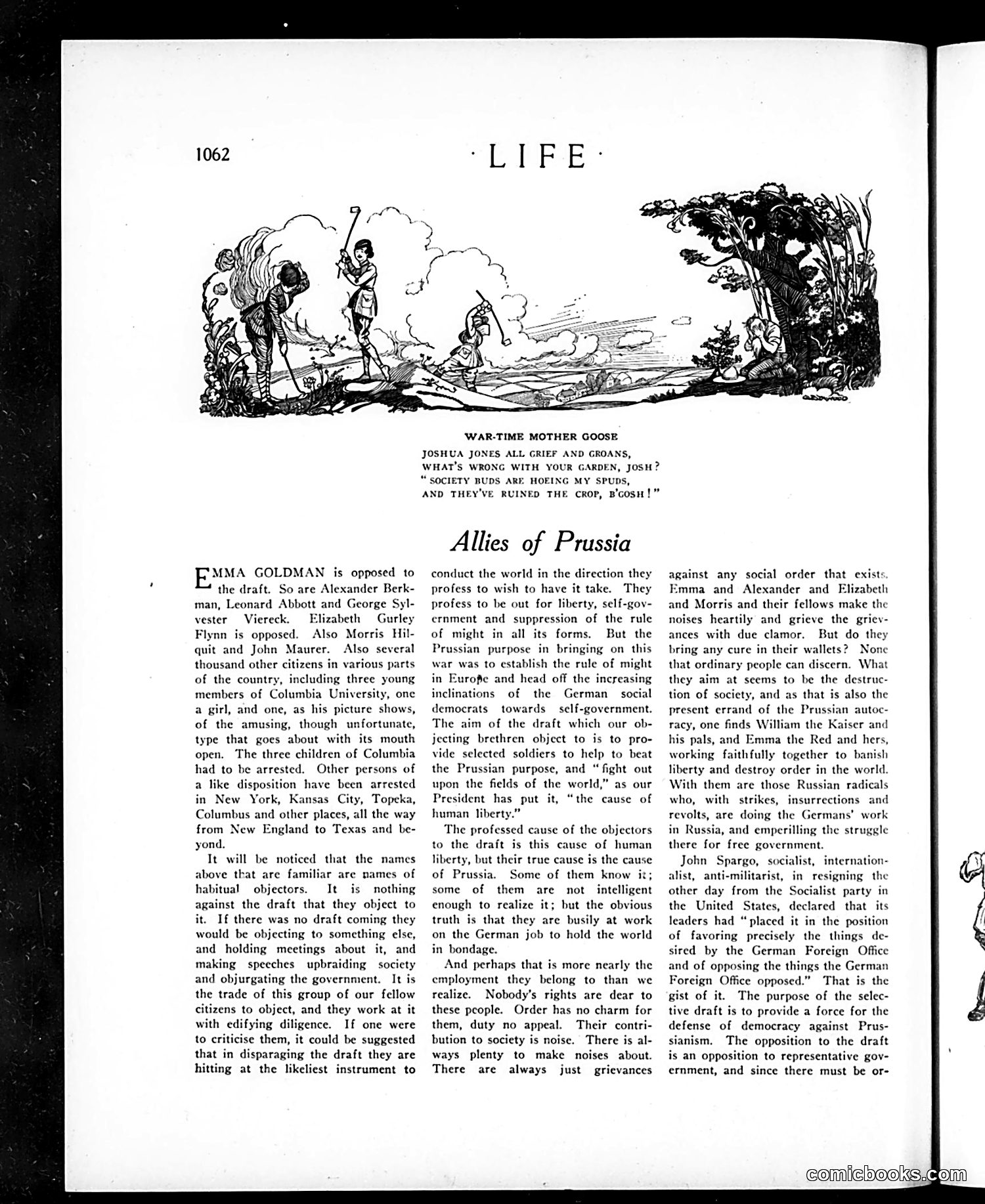
**Top Illustration**: A wartime "Mother Goose" parody shows children engaged in military activities. The verse mocks the nursery rhyme format while addressing wartime hardships: "Joshua Jones all chief and groans, / What's wrong with your garden, Josh? / 'Society buds are hoeing my spuds, / And they've ruined the crop, b'gosh!'" This satirizes how privileged urbanites participating in wartime agricultural efforts were damaging crops. **Article "Allies of Prussia"**: The text attacks prominent anti-draft activists (Emma Goldman, Alexander Berkman, Leonard Abbott, and others named) as effectively serving Prussian interests by opposing U.S. military preparation. The piece argues their pacifism and anti-government rhetoric, while claiming to support liberty, actually advance German military goals. It dismisses their grievances as mere "noise" masking support for autocracy. The satire equates domestic draft opposition with enemy collaboration.
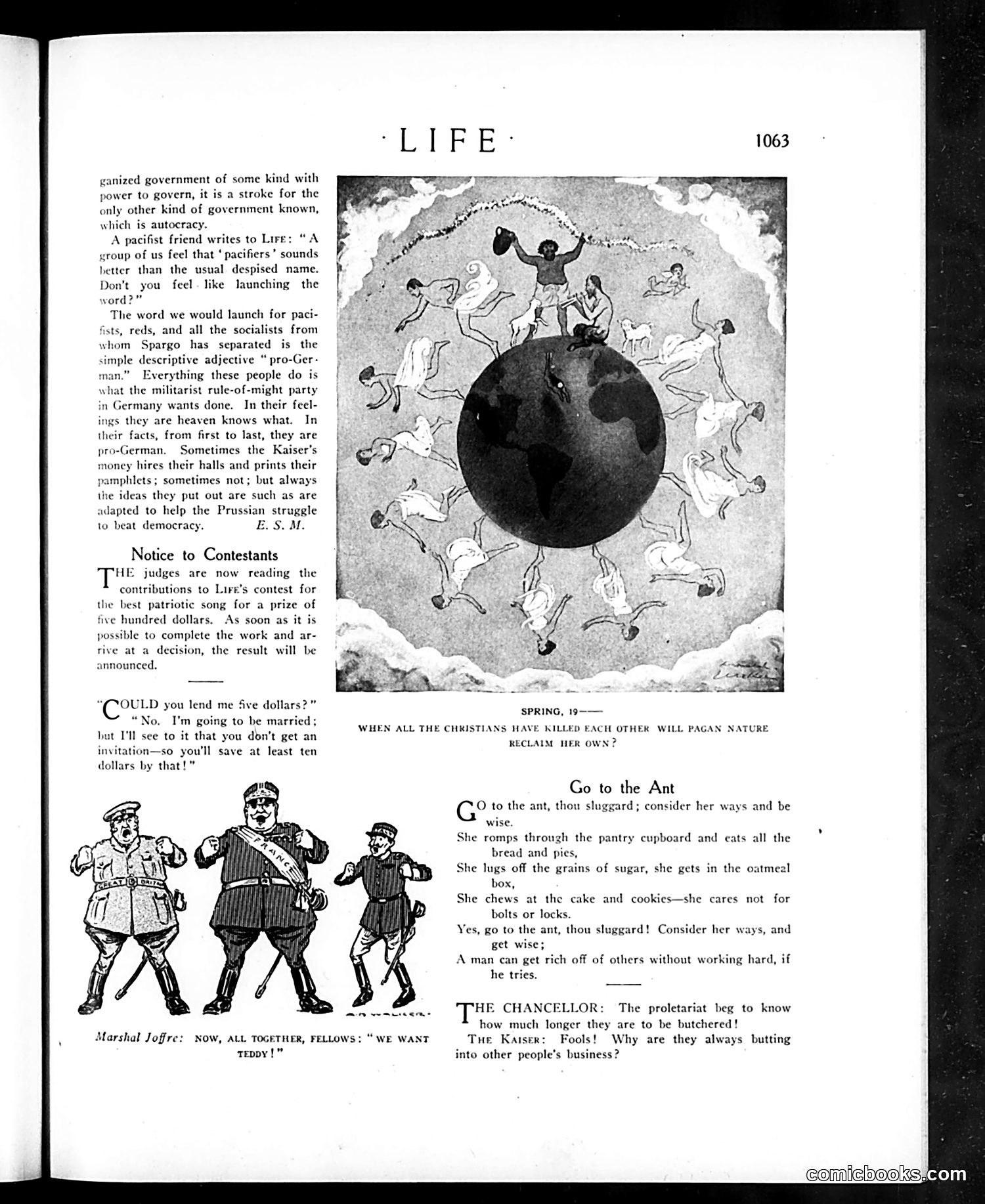
This page contains anti-German propaganda from World War I. The main illustration depicts a large bomb or sphere surrounded by German soldiers, satirizing German militarism. The caption reads: "Spring, 19—When all the Christians have killed each other will pagan nature reclaim her own?"—suggesting Germans represent a pagan threat to Christian civilization. Below, a dialogue mocks German military leadership. Three figures labeled "Marshal Joffre" appear discussing war strategy, with the caption "Now, all together, fellows: 'We want teddy!'"—likely referencing President Theodore Roosevelt's role in international diplomacy. The poem "Go to the Ant" sarcastically advises following ant-like industriousness while critiquing those who "get rich off of others without working hard."
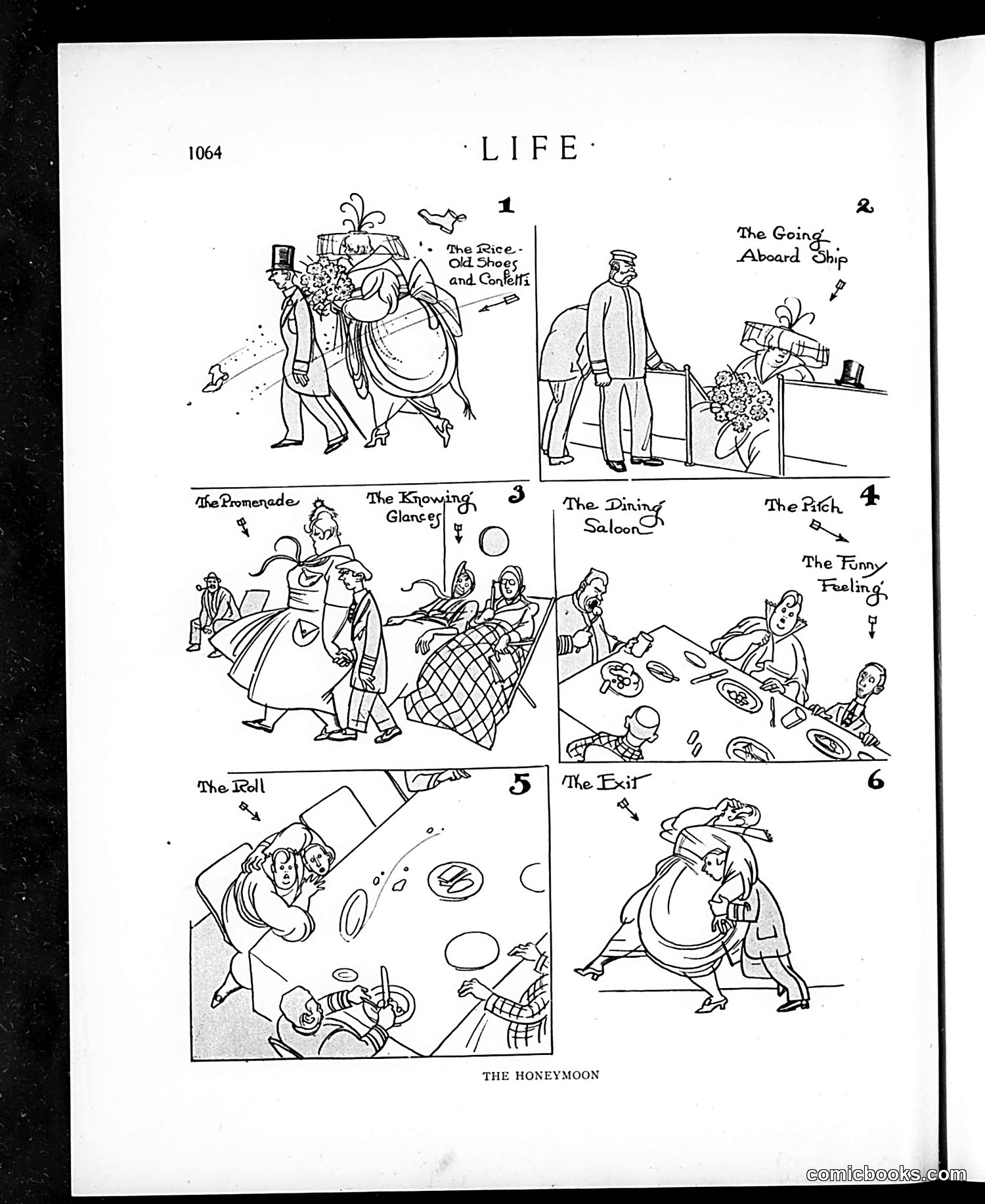
This six-panel satirical comic traces a newlywed couple's honeymoon journey, titled "The Honeymoon." Each panel humorously depicts a stage: 1. **The Promenade** - The couple departs with excessive luggage 2. **Going Aboard Ship** - They board a vessel 3. **The Knowing Glance** - A suggestive moment between them 4. **The Dining Saloon** - They eat together 5. **The Roll** - The ship rocks violently, causing chaos 6. **The Exit** - The wife appears to be fleeing or leaving The satire mocks the romantic ideal of honeymoons by showing how reality—particularly seasickness during ocean travel—disrupts the couple's bliss. The progression from romantic anticipation to the wife's apparent escape critiques both marriage expectations and the practical miseries of early-20th-century sea travel.
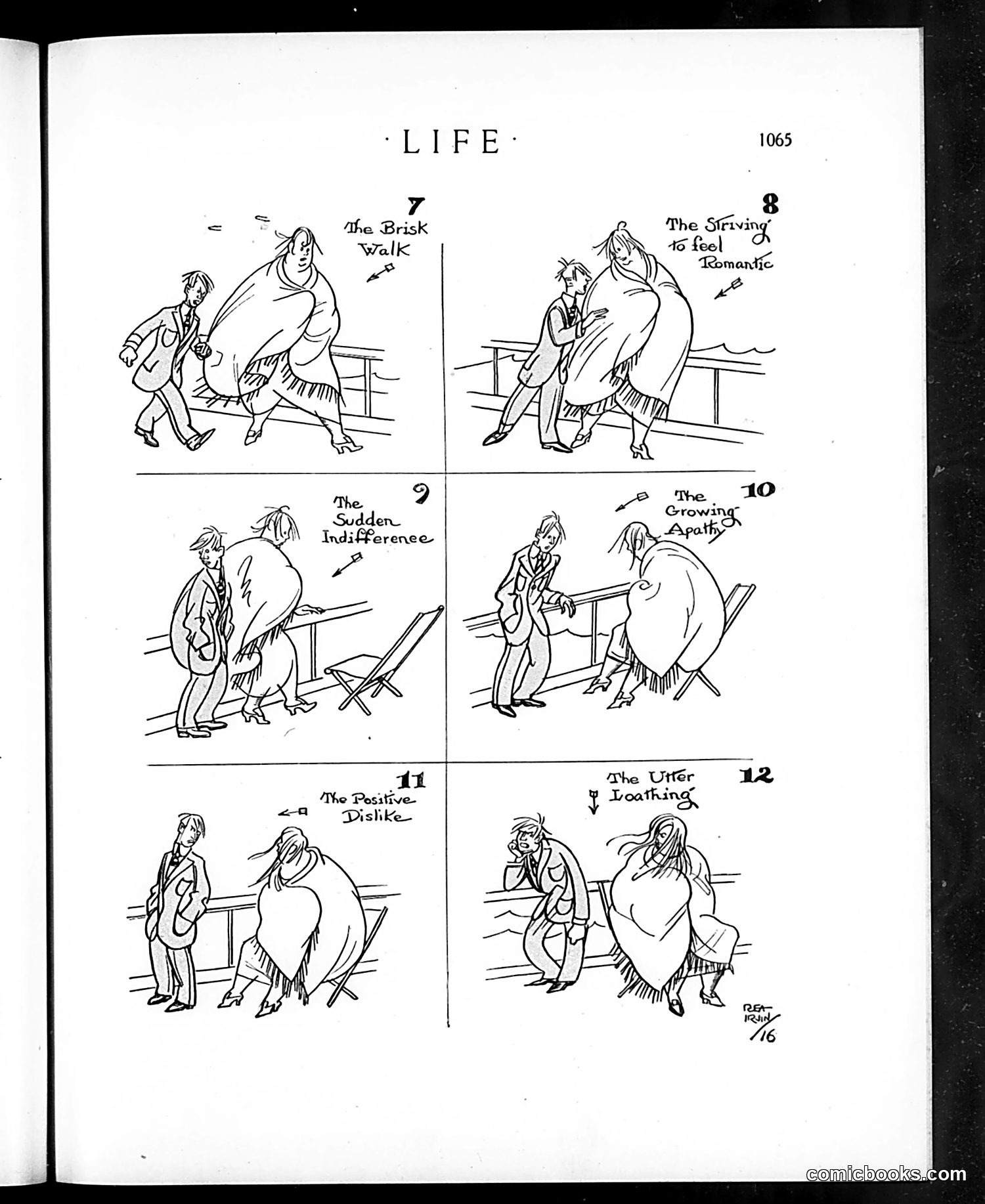
This is a humorous six-panel comic sequence illustrating the progression of a romantic relationship between a man and woman. Each numbered panel shows a labeled stage: 7. "The Brisk Walk" - couple walking energetically 8. "The Striving to Feel Romantic" - forced intimacy 9. "The Sudden Indifference" - emotional distance emerging 10. "The Growing Apart" - physical separation widening 11. "The Positive Dislike" - obvious tension and rejection 12. "The Utter Loathing" - complete estrangement The satirical point targets the common trajectory of romantic relationships, depicting how initial attraction deteriorates into active dislike. The exaggerated body language and facial expressions emphasize the emotional arc, suggesting cynicism about love's durability. This reflects early-to-mid 20th century satirical humor about marriage and relationships.
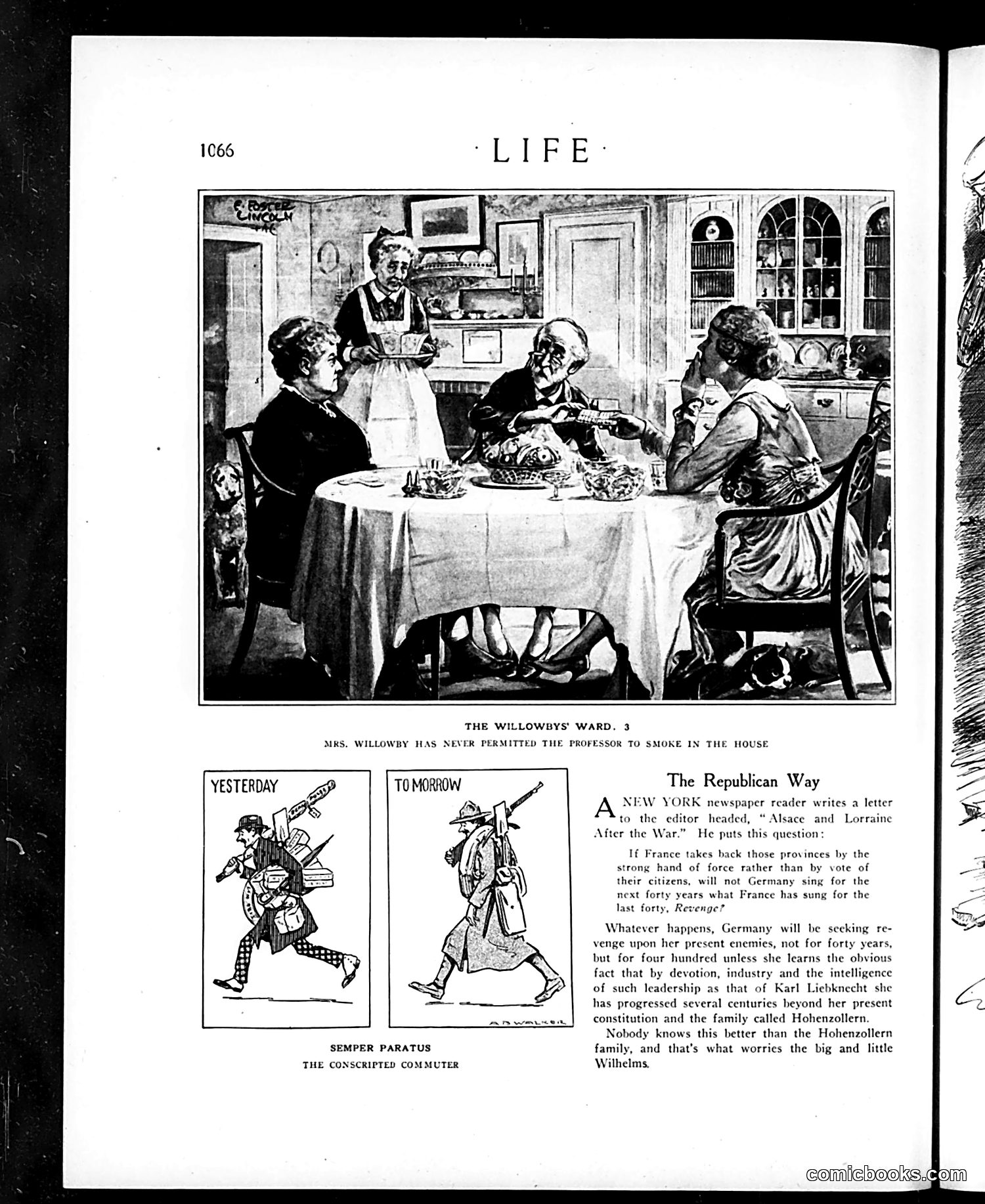
This page contains three distinct elements: **Main illustration** ("The Willowbys' Ward"): A domestic scene showing three men dining while a woman serves. The caption notes Mrs. Willowby "has never permitted the Professor to smoke in the house"—a joke about household authority and gender dynamics in domestic life. **"Semper Paratus" cartoons**: Two panels labeled "Yesterday" and "Tomorrow" showing a conscripted soldier with military gear, referencing military conscription and the contrast between civilian and military life. **"The Republican Way"**: An opinion piece discussing post-WWI politics, specifically whether France should reclaim Alsace-Lorraine through military force or voting. It warns Germany may seek revenge and expresses concern about the Hohenzollern family's political ambitions, reflecting post-WWI tensions and anxieties about future European conflict. The page reflects early 20th-century American concerns: domestic gender relations, military conscription, and international politics following World War I.
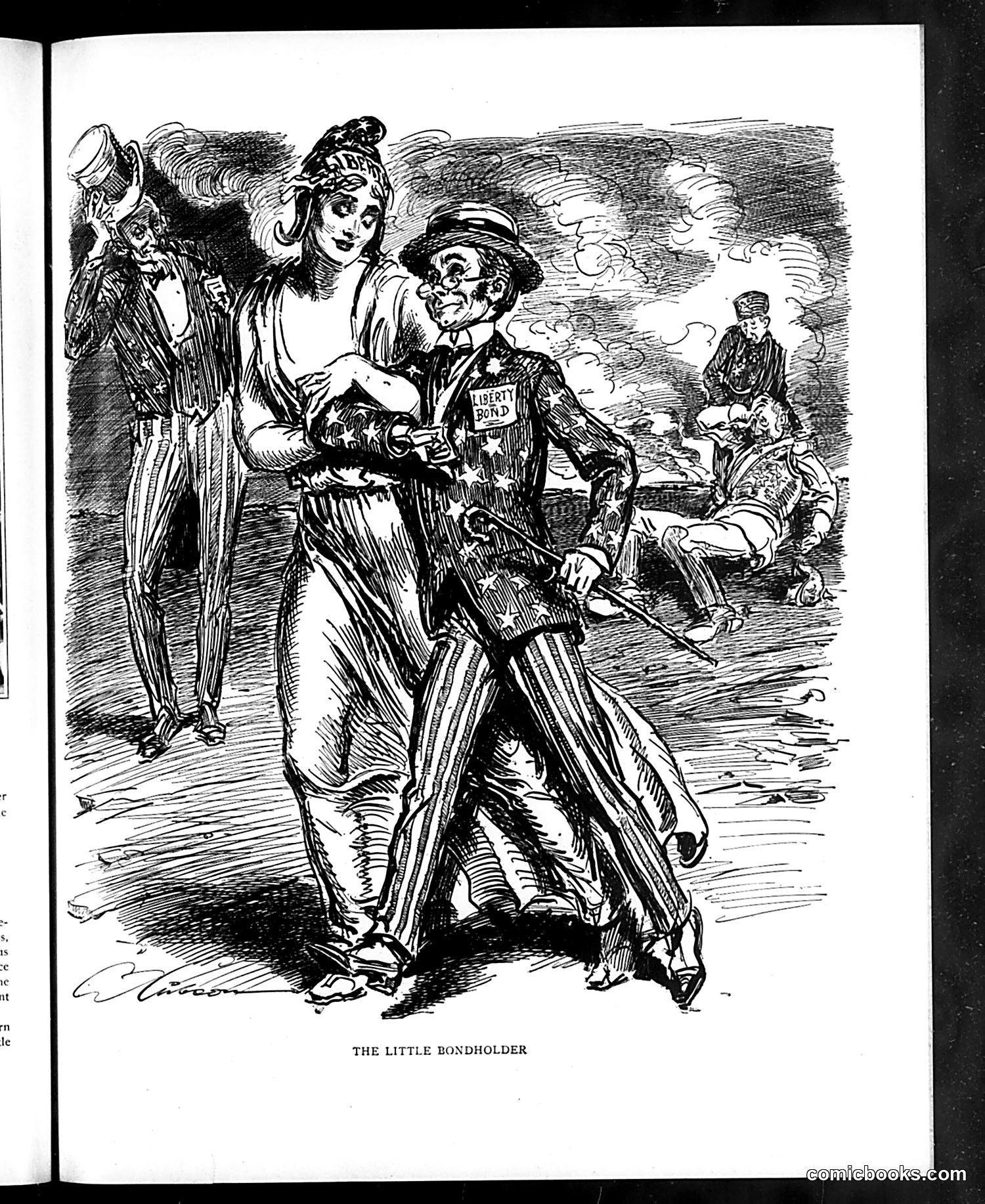
This satirical cartoon depicts a small, impish figure labeled "LIBERTY BOND" being held by a soldier in military uniform, surrounded by other uniformed servicemen. The satire appears to target the disconnect between soldiers fighting in World War I and the financial instruments (Liberty Bonds) that citizens purchased to fund the war effort. The cartoon likely criticizes either: soldiers' resentment toward civilians profiting from war bonds, the burden bonds placed on ordinary people, or the commodification of patriotic duty. The "little bondholder's" impish expression and the soldiers' varied reactions suggest mockery of the bond program or those who benefited from it rather than those actually fighting. The exact political angle remains somewhat unclear without additional context.
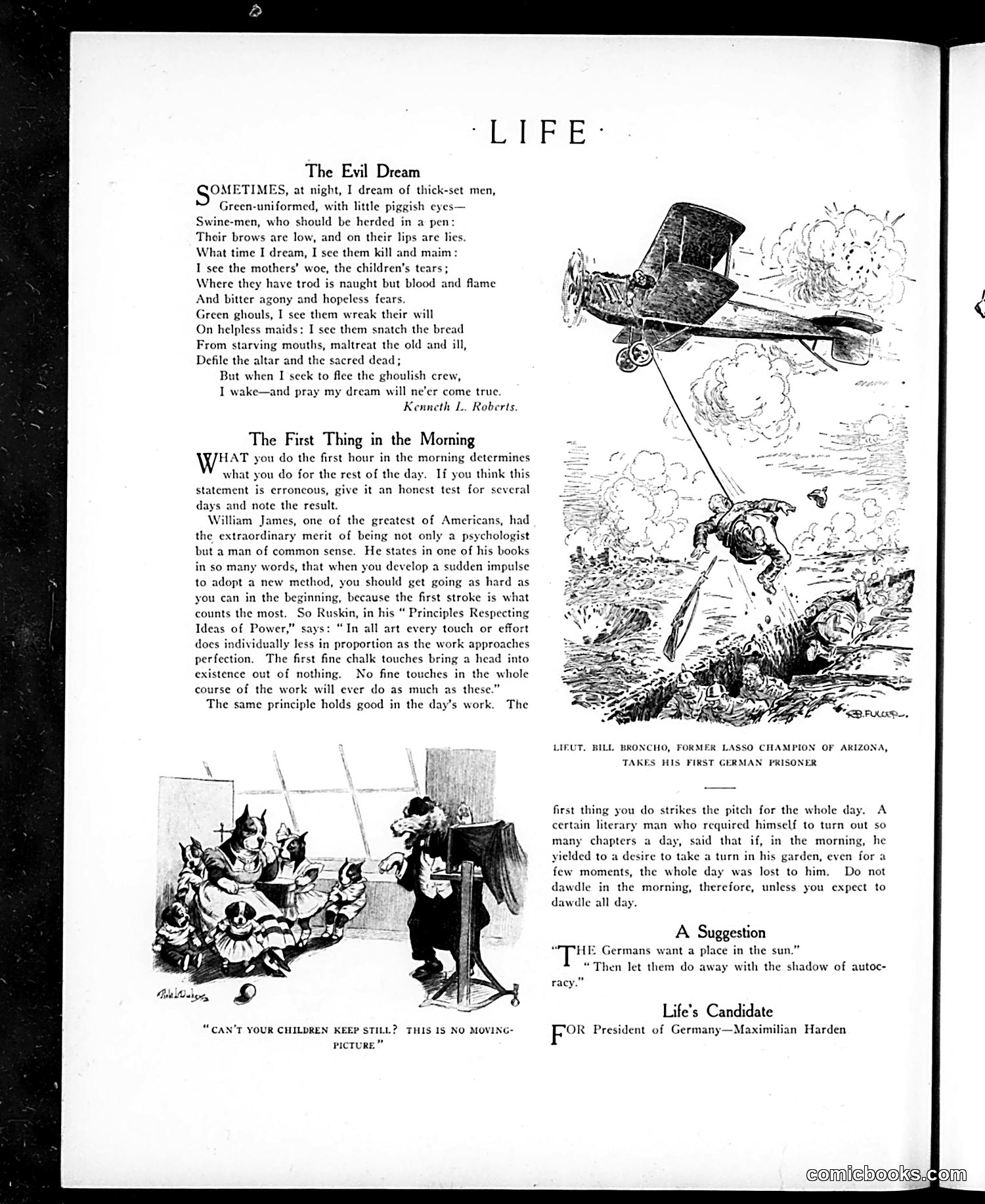
This page contains WWI-era American propaganda against Germany. **"The Evil Dream"** is a poem depicting Germans as subhuman "swine-men" and "green ghouls" committing atrocities—killing civilians, assaulting women, starving the elderly. It reflects American wartime rhetoric portraying Germans as brutal savages. **The cartoon** showing "Lieut. Bill Broncho" (an American cowboy lasso champion) capturing a German prisoner uses the Wild West as metaphor: American frontier toughness defeating German militarism. The caption's humor relies on the incongruity of applying cowboy imagery to modern warfare. **"Life's Candidate"** references Maximilian Harden, a German politician/journalist, as a potential post-war German leader—likely suggesting he'd be preferable to current German leadership, or ironically proposing him as a figure for reform. The bottom cartoon mocks German discipline/rigidity through children unable to sit still during a photograph. All content serves propagandistic purposes: dehumanizing the enemy and promoting American moral superiority during the war.
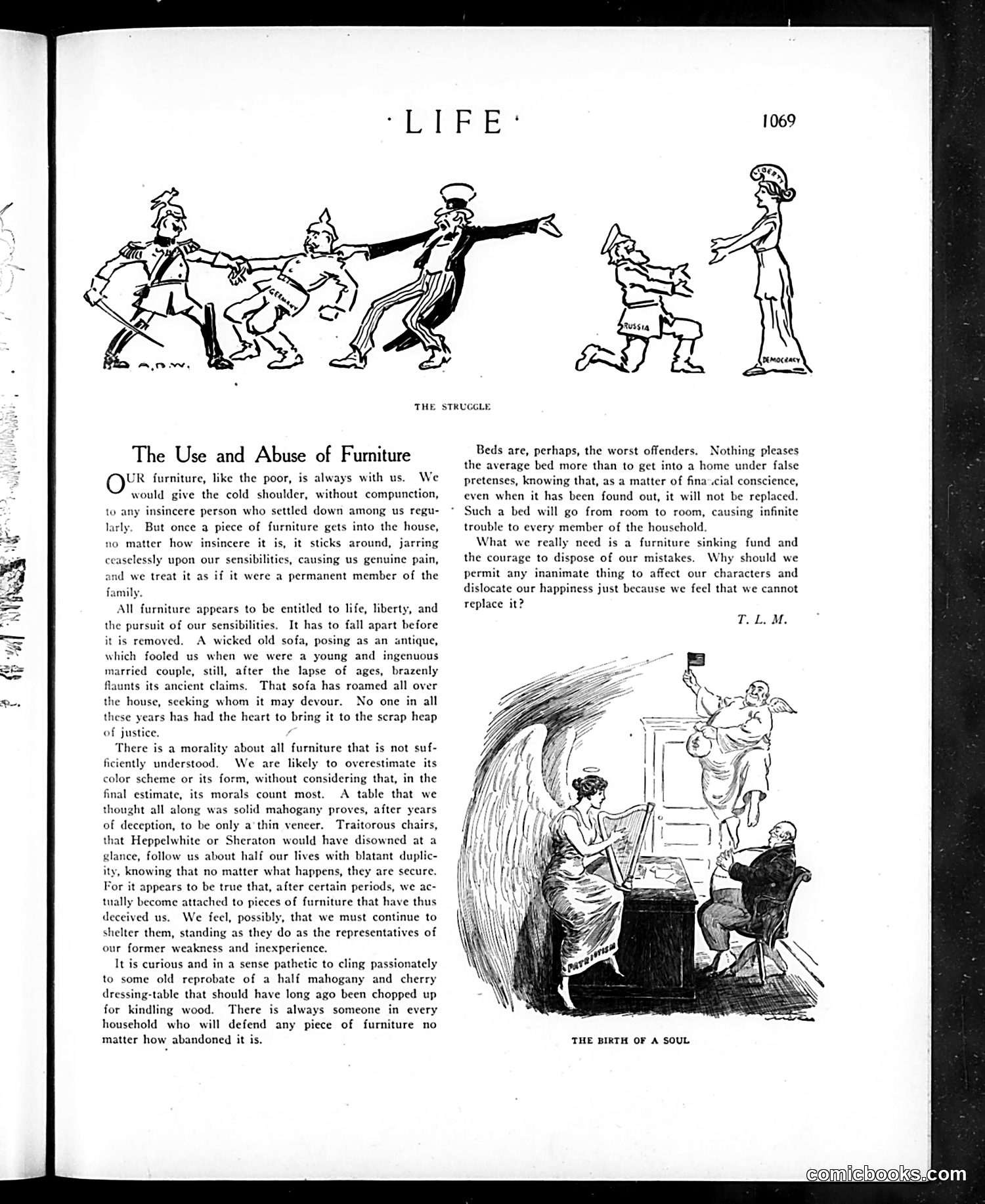
This article satirizes the irrational emotional attachment Americans develop to worn-out household furniture. The author argues that people keep shabby, defective pieces—old sofas, cheap veneer tables, worn chairs—long past usefulness, treating them as permanent family members despite their moral and physical decay. The satire targets middle-class hypocrisy: we'd reject an insincere *person* but tolerate deceptive furniture indefinitely. The piece mocks our reluctance to discard items due to financial guilt or sentimental attachment, suggesting we need a "furniture sinking fund" to break this cycle. The cartoons illustrate the theme: "The Struggle" shows figures fighting over possessions (representing domestic conflict over clutter), while "The Birth of a Soul" depicts what appears to be an angel or cherub emerging—possibly satirizing the quasi-spiritual reverence people accord old household objects. The humor lies in treating furniture with the moral seriousness usually reserved for human relationships.
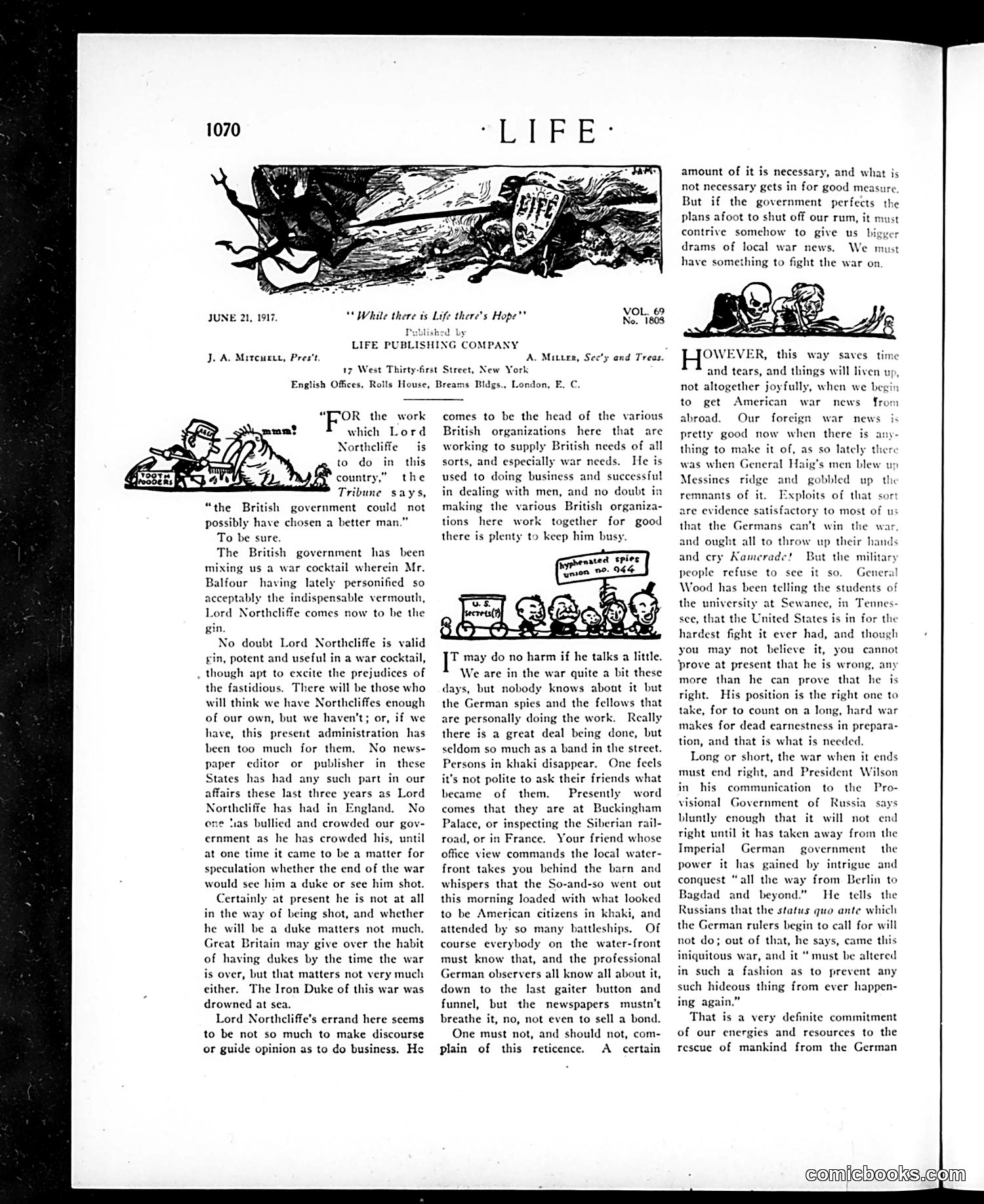
This page satirizes Lord Northcliffe, a powerful British newspaper publisher sent to America in 1917 to coordinate British war supply efforts. The magazine's opening metaphor compares the British government's "war cocktail" to gin—Northcliffe being the potent final ingredient after Balfour (the vermouth). The satire works on multiple levels: Life acknowledges Northcliffe's business competence while mocking his domineering personality. The piece notes he's bullied both British and American governments, and speculates whether he'll become a duke or face execution—though he's safely doing neither. The article's main complaint is about American press censorship: military movements are secret ("persons in khaki disappear"), yet obvious to German spies. Life argues the government should either maintain secrecy *or* provide local war news to sustain public morale—you can't censor everything and expect Americans to "fight the war on" nothing. The cartoons (small illustrations) appear to be decorative but support the gin/cocktail metaphor.
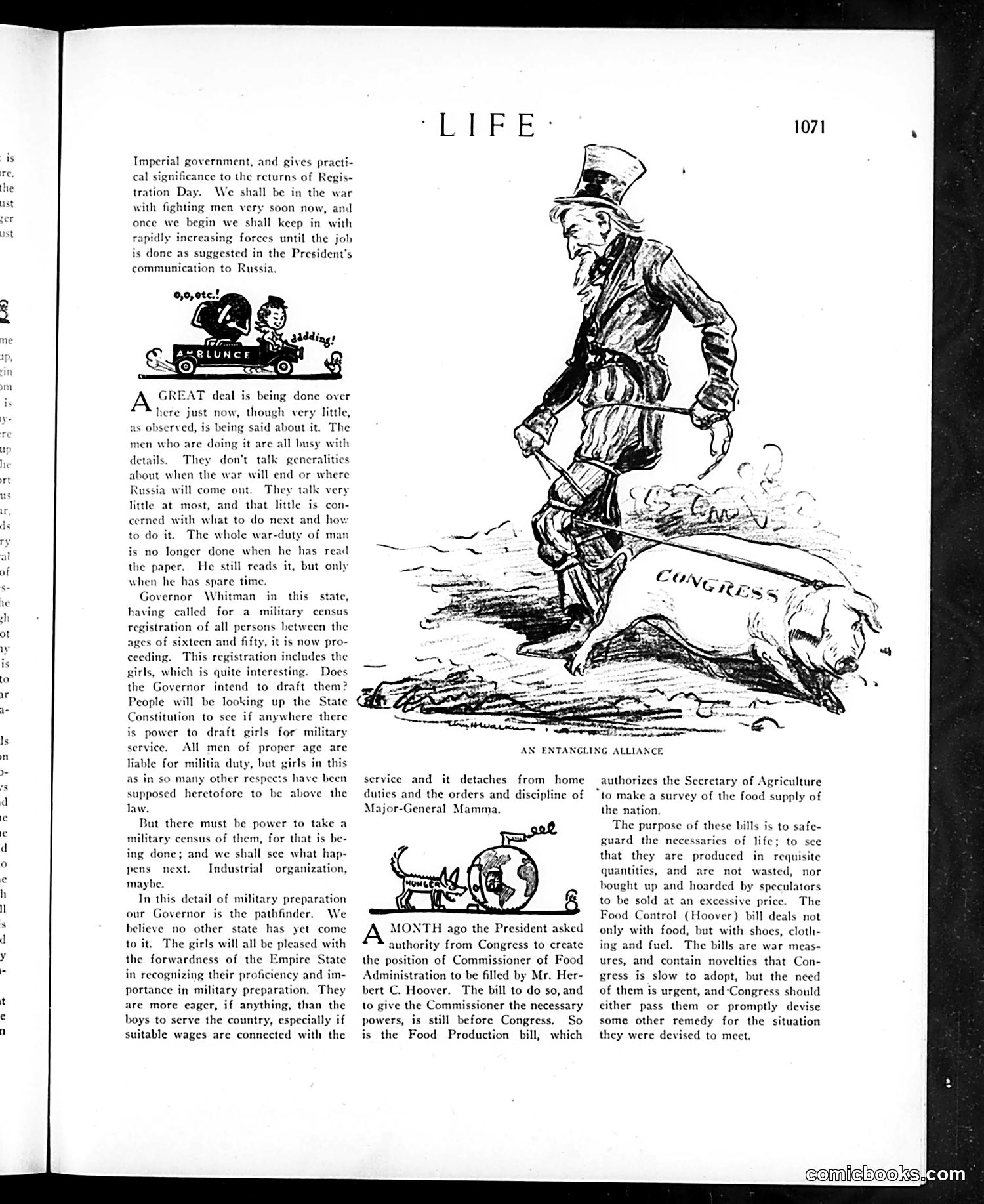
The main cartoon depicts **Uncle Sam** (identifiable by his top hat and characteristic outfit) as a military figure, standing over a prostrate pig labeled "Congress." This satirizes the forced relationship between the executive branch and Congress regarding war powers and resource control. The cartoon critiques the tension between President Wilson's expanding wartime authority and Congressional oversight. The pig represents Congress as weakened, subordinate, or literally "pig-headed"—unable to resist executive demands for emergency powers like Herbert Hoover's Food Administration bill and food production controls. The accompanying text discusses military conscription, including the controversial registration of women aged 16-50 in New York State. The "Entangling Alliance" title likely refers to how wartime necessity forces uncomfortable power-sharing between branches of government and between government and citizens' freedoms. The satire captures public anxiety about unprecedented federal control over food, clothing, and fuel during America's WWI mobilization.
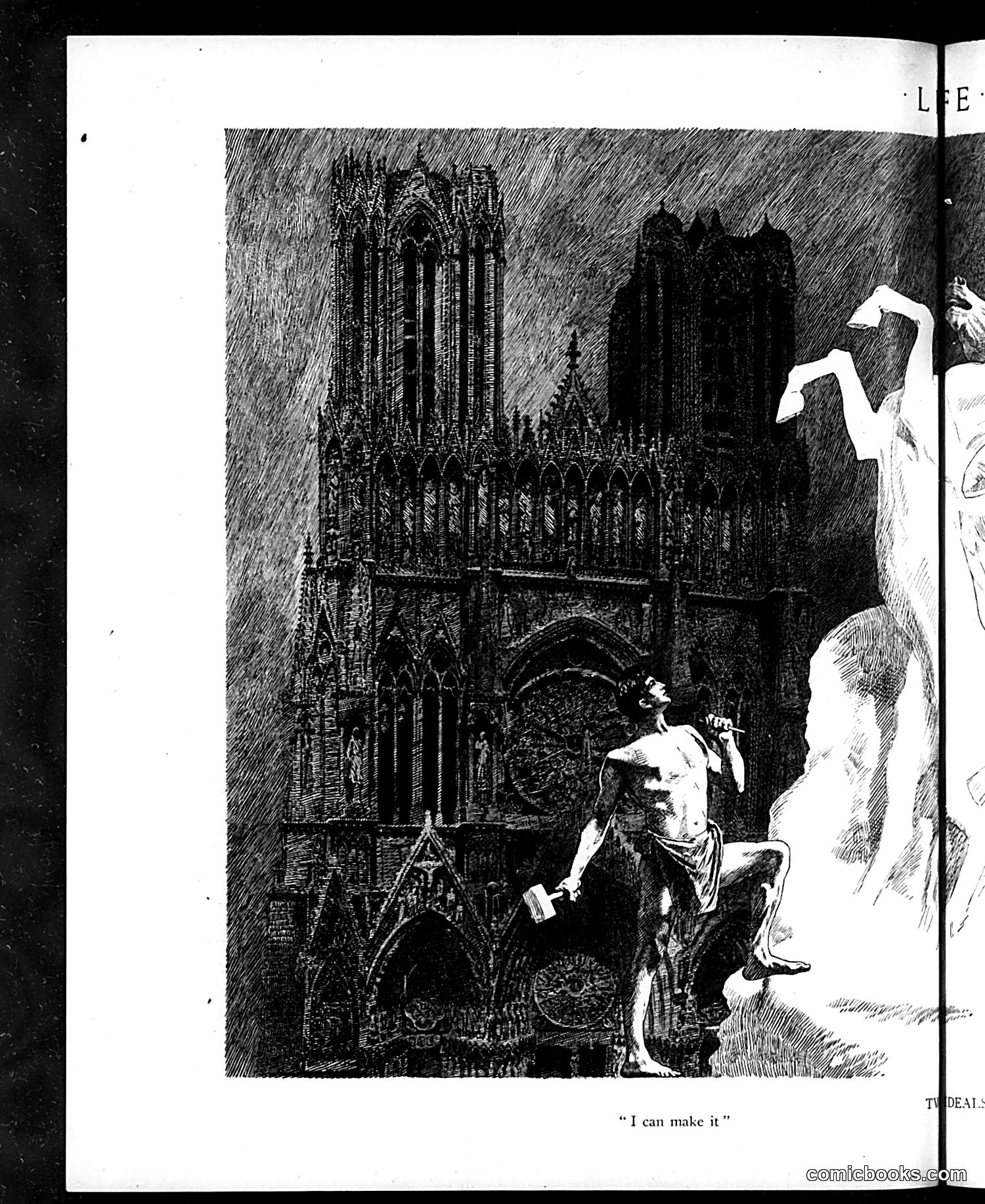
This political cartoon depicts a figure in classical/allegorical dress (possibly representing an artist, builder, or ambitious individual) gazing upward at a Gothic cathedral—likely the famous Reims Cathedral in France, given its distinctive architectural style. The figure appears determined and resolute. The caption "I can make it" suggests themes of aspiration, ambition, or confidence in achieving a difficult goal. Given Life magazine's satirical nature and this appearing to be from the early-to-mid 20th century, the image likely references either: - Artistic or architectural ambition - Post-war reconstruction efforts - European cultural achievement or restoration Without additional context or publication date visible, the precise historical reference remains unclear, though the Gothic cathedral suggests French cultural significance.
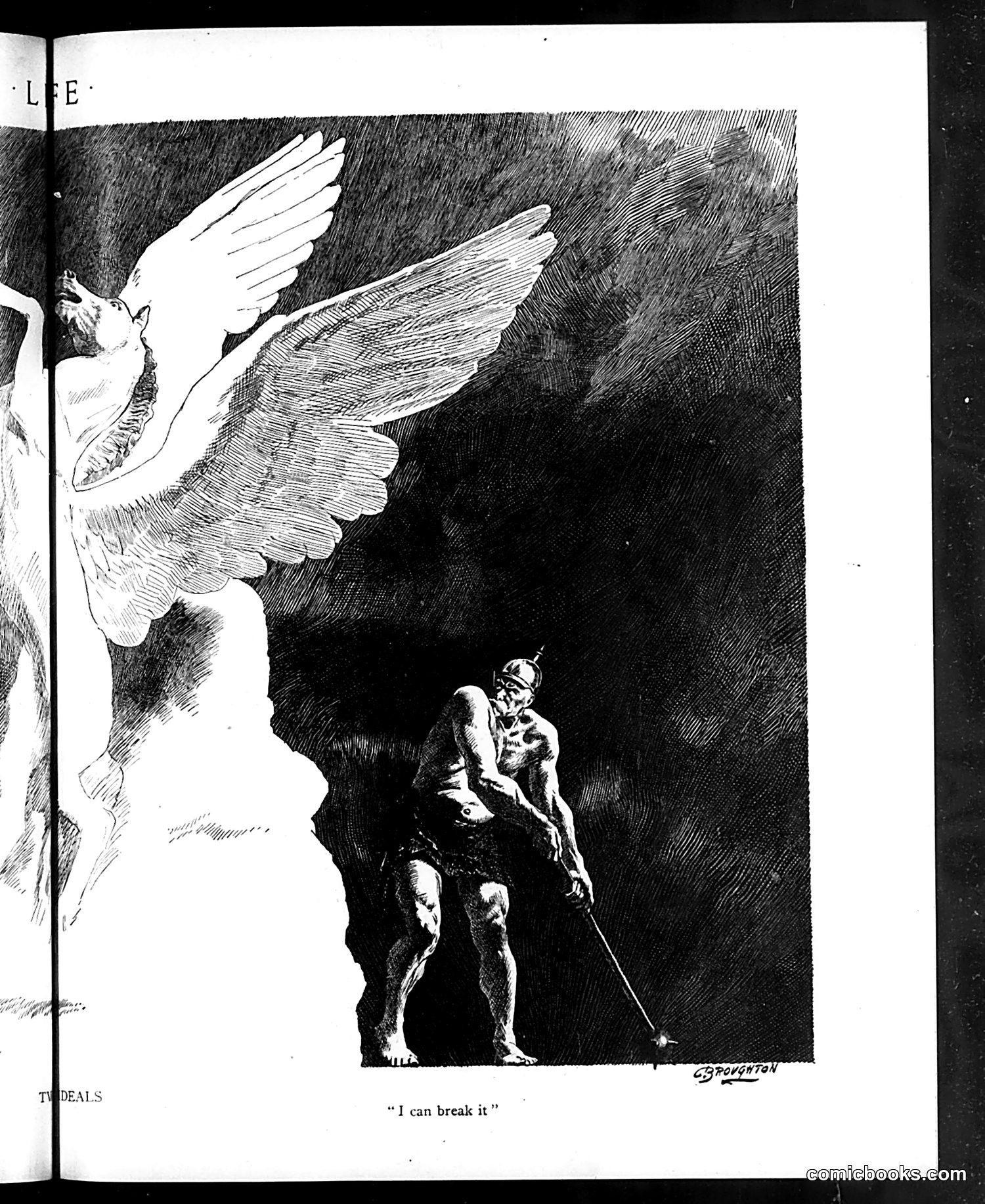
This cartoon depicts a small, helmeted military figure (appearing to be German, based on the spiked "Pickelhaube" helmet) confronting an enormous angelic or divine figure with massive wings. The soldier declares "I can break it," seemingly referring to the winged figure or what it represents. The satire likely critiques German militarism and hubris during World War I, suggesting that military force cannot overcome spiritual, moral, or divine forces. The stark contrast between the tiny soldier and the towering celestial being underscores the cartoon's message: that human warfare is insignificant against larger moral or transcendent powers. The artist, signed "Broughton," uses this religious symbolism to mock German military confidence.
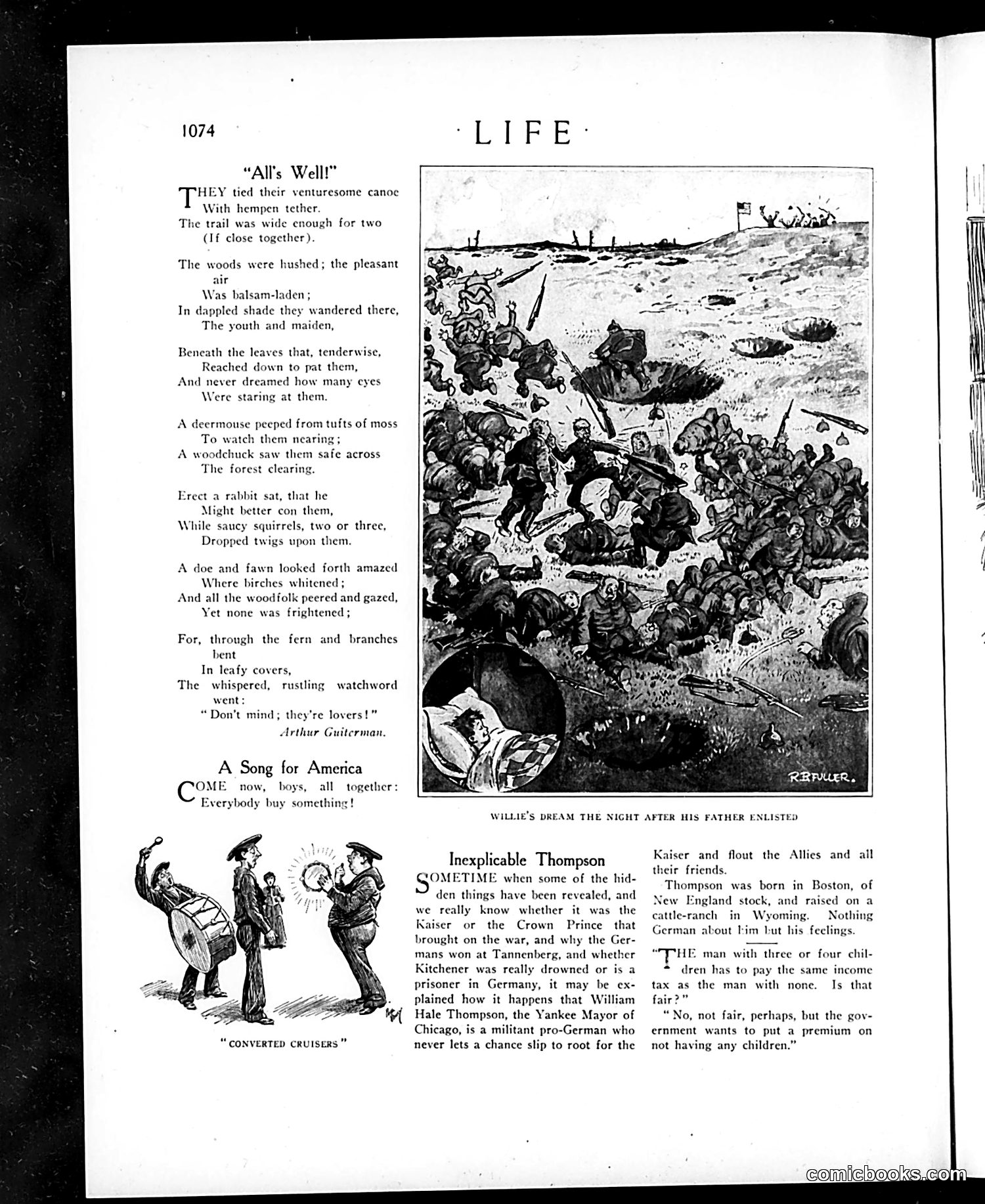
This page contains three distinct satirical pieces from WWI-era America: **"All's Well!"** (top): A romantic poem about a courting couple in the woods, observed by forest animals who recognize them as lovers and leave them undisturbed. This appears to be lighthearted nature verse with no obvious political meaning. **"A Song for America"** and **"Converted Cruisers"** (bottom left): These mock American consumerism during wartime—urging people to "buy something" while showing converted military vessels. The satire targets commercial opportunism during the conflict. **"Inexplicable Thompson"** (right): The main satirical piece targets **William Hale Thompson**, Chicago's mayor, as a pro-German sympathizer despite his New England/Wyoming background. The piece sarcastically questions how an American could so consistently support the Kaiser and undermine the Allies. This reflects wartime suspicion of German-American sympathizers. **"Willie's Dream"** (illustration caption): References a boy's nightmare after his father enlisted, evoking the human cost of war recruitment. The overall tone reflects 1917-1918 American attitudes: patriotic support for the Allies while attacking perceived disloyalty and war profiteering.
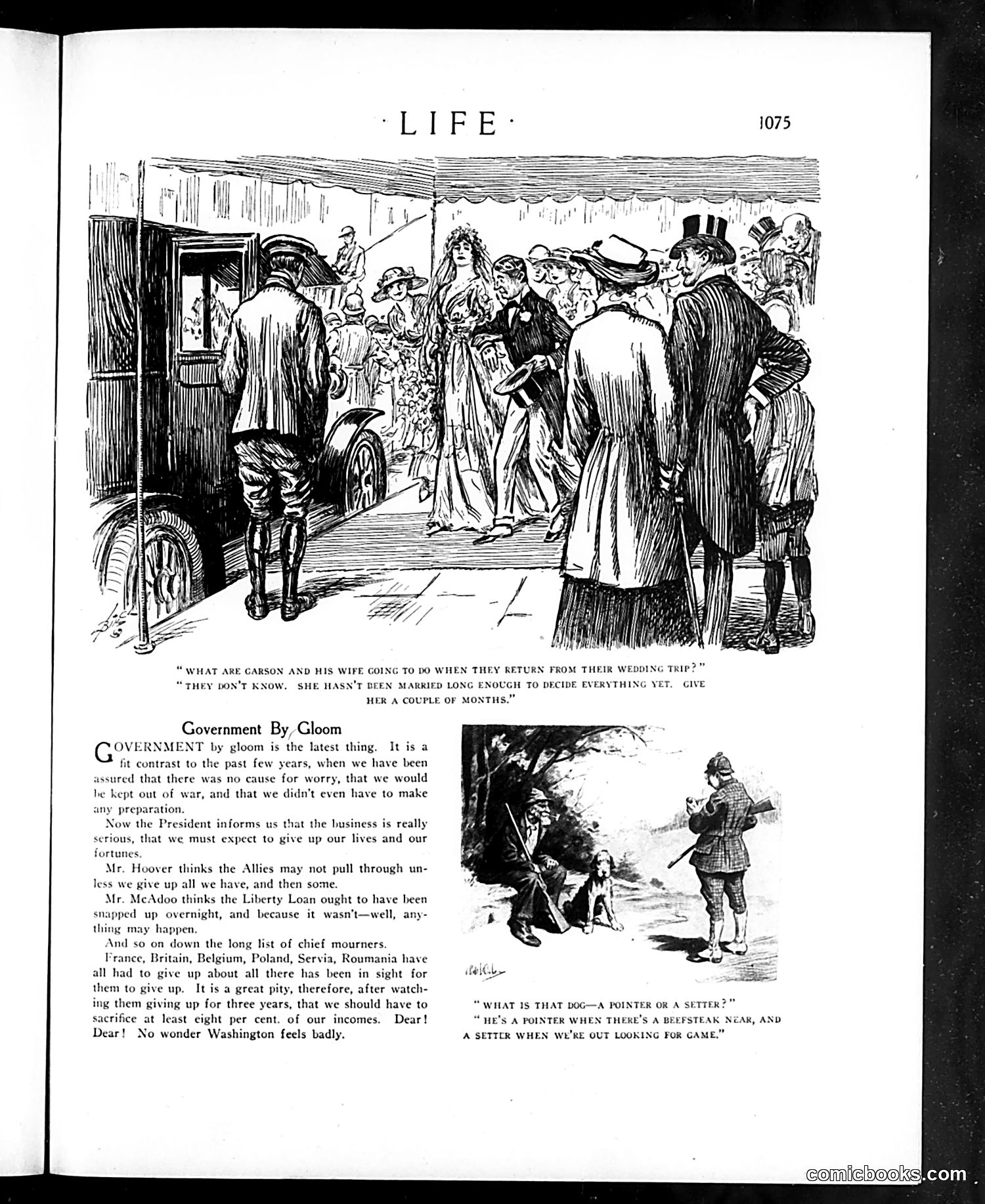
**Top Cartoon:** A social joke about newlyweds named Carson. The humor relies on a woman being too inexperienced in marriage to make life decisions—she needs "a couple of months" to figure out what to do, implying wives defer to husbands' judgment. **"Government By Gloom" Article:** Sharp political satire criticizing the Wilson administration's war messaging. The piece mocks officials (President Wilson, Hoover, McAdoo) for demanding financial sacrifice (the Liberty Loan) after years of promising Americans they wouldn't need to prepare for war. The sarcasm is heavy: calling leaders "chief mourners" and noting it's "a great pity" Americans must sacrifice "at least eight per cent. of our incomes" when European allies already gave everything. **Bottom Cartoon:** A hunting joke about a dog that "points" at game but "sits" (sets) when actually hunting—reversing normal behavior. The humor is observational about animal behavior quirks. The page satirizes wartime government messaging and asks readers to recognize inconsistency between pre-war reassurances and current demands for sacrifice.
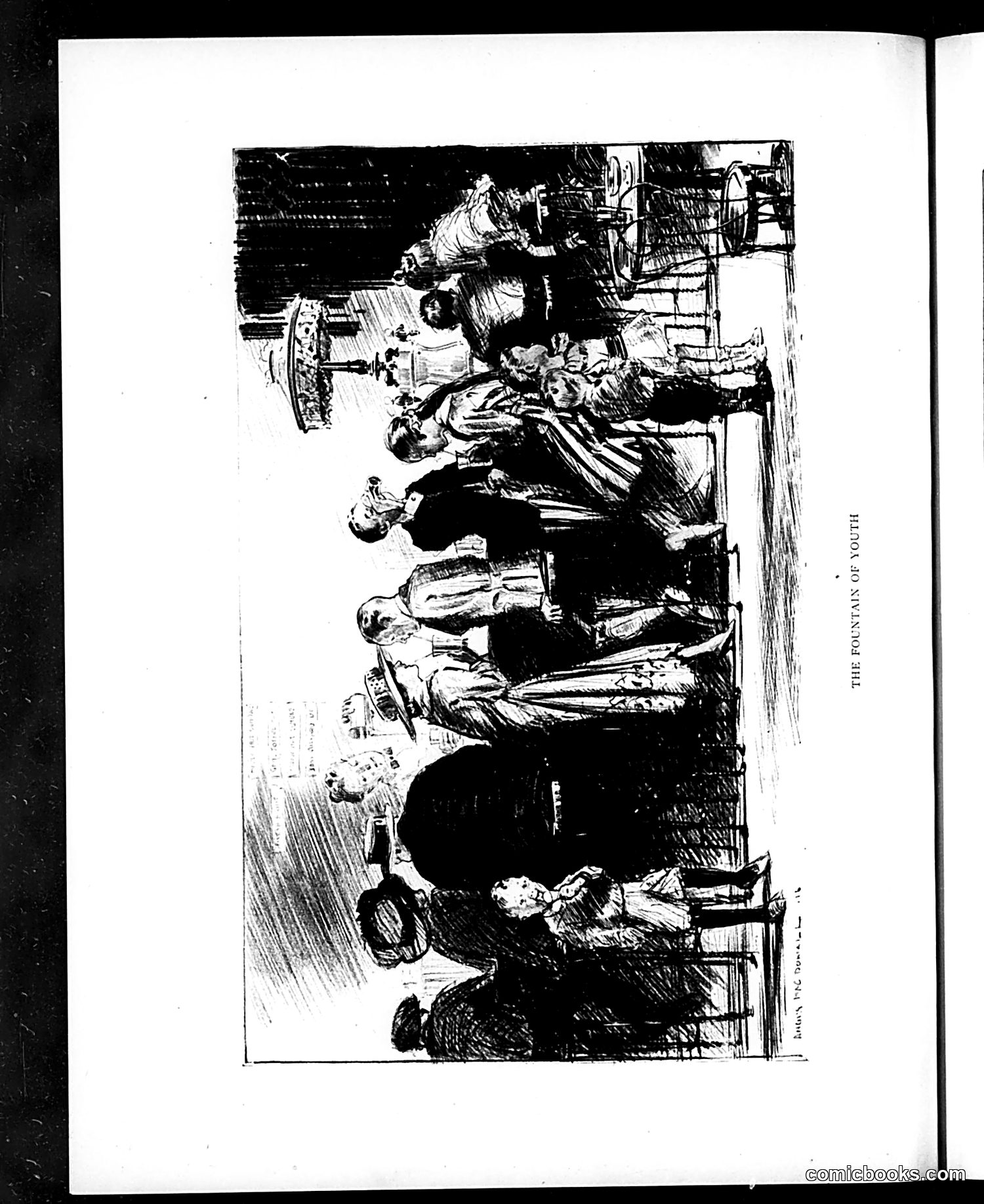
This appears to be a satirical illustration showing multiple figures gathered around what looks like a fountain or water feature. The image is rendered in bold black ink with crosshatching typical of early-to-mid 20th century editorial cartooning. The title "The Fountains of Youth" suggests the cartoon satirizes people seeking rejuvenation or attempting to recapture youth. The composition shows various figures in different poses around the central fountain, likely caricaturing society's obsession with staying young or the commercial exploitation of anti-aging products and treatments. The specific identities of the figures are unclear from the image alone, but the satirical intent appears to mock vanity and the human desire to reverse aging—a timeless theme that Life magazine frequently addressed in its social commentary.
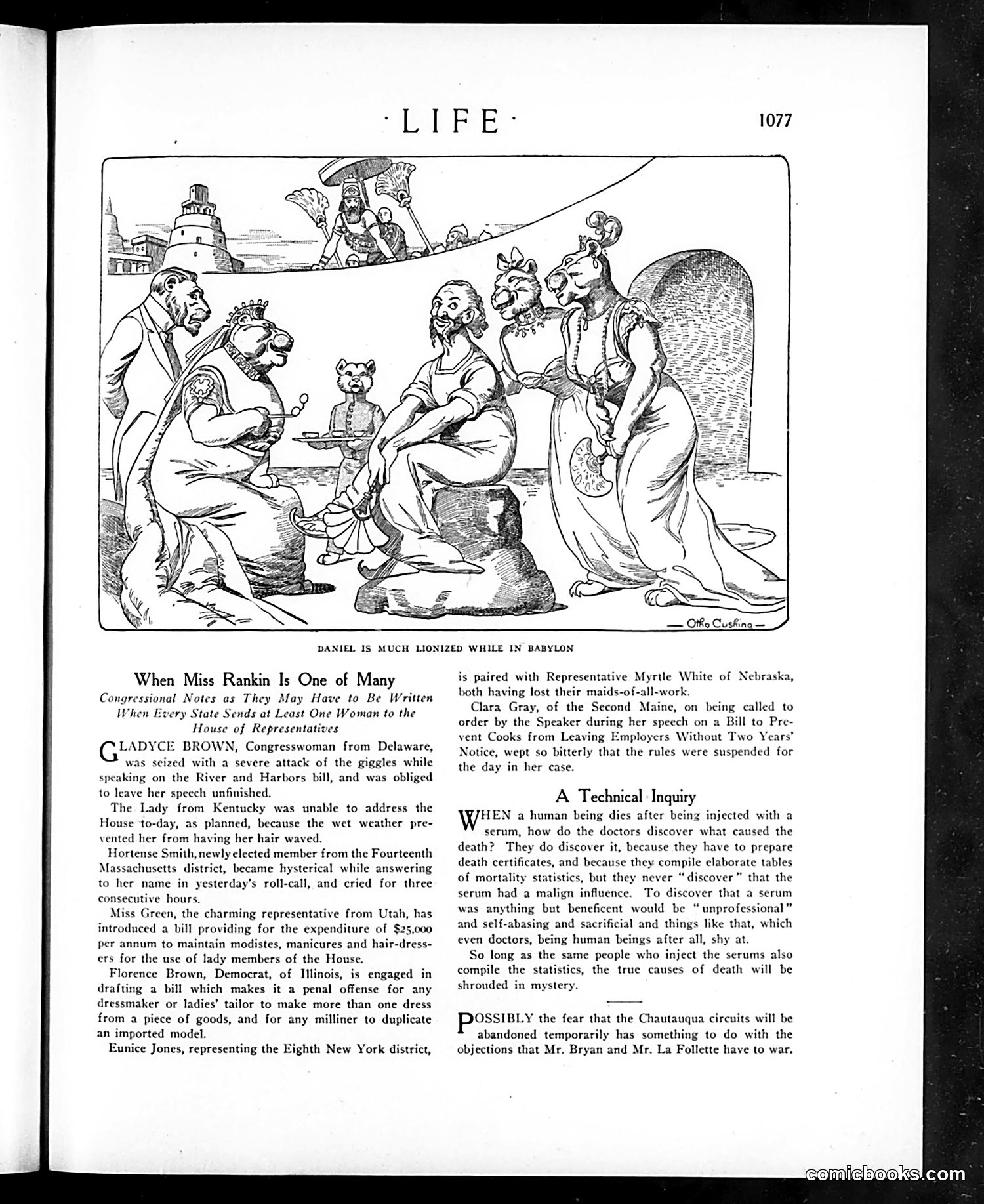
The main cartoon satirizes the hypothetical scenario of women entering Congress en masse. Titled "Daniel Is Much Lionized While in Babylon," it depicts female representatives as frivolous and incompetent—giggling uncontrollably, unable to speak due to hair-waving appointments, becoming hysterical during roll calls, and prioritizing fashion over legislation. The accompanying "Congressional Notes" mock the idea by listing absurd bills women would supposedly introduce: funding for manicures and hairdressers, penalizing dressmakers for duplicate designs, and weeping over domestic help retention. The satire's point is clear: women lack the serious temperament for legislative work and would transform Congress into a trivial, emotion-driven space. This reflects early-20th-century anti-suffrage and anti-woman-politician sentiment. Jeannette Rankin became the first woman elected to Congress in 1916, making this cartoon's timing significant—it mocks the prospect of more female representatives following her precedent, portraying them as stereotypically vain and incompetent rather than capable legislators.
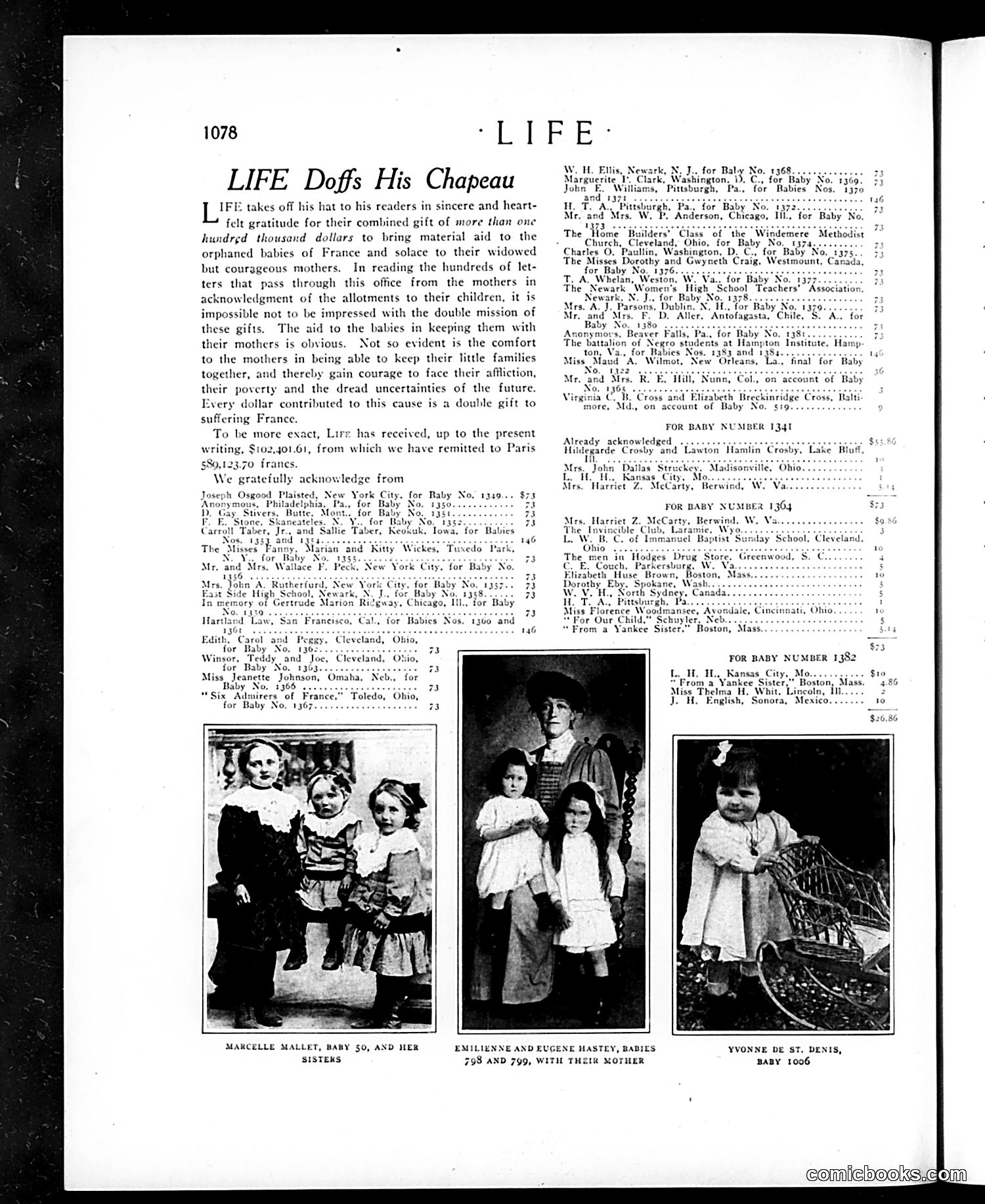
This page documents **Life magazine's fundraising campaign for French war orphans** following World War I. The editorial explains that Life is collecting donations to support orphaned babies in France and their widowed mothers—not just materially, but by enabling mothers to keep their children together rather than lose them to institutions. The page lists hundreds of donors and their contributions, creating a public record of charitable support. Three photographs show actual French children being aided: Marcelle Mallet with her sisters, sisters Emilienne and Eugène Hastey with their mother, and baby Yvonne de St. Denis. The satire is gentle: Life "doffs his hat" (shows respect) to readers for their generosity. The point is to shame wealthy Americans into donating by publicizing others' contributions and showing the human faces of suffering France. This reflects post-WWI American charity work and the magazine's role as both satirist and social advocate.
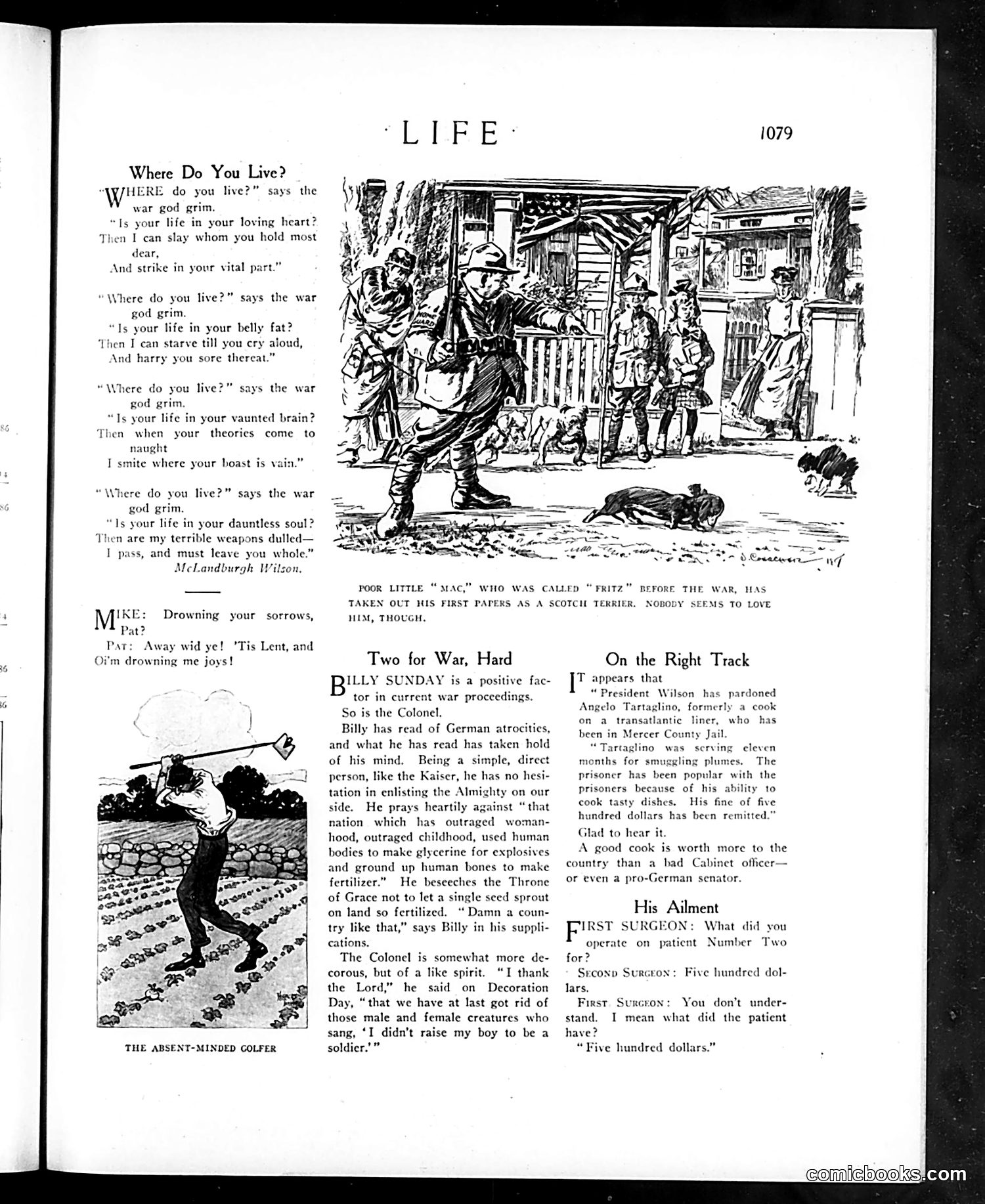
This *Life* magazine page contains WWI-era satirical content with three distinct pieces: **"Where Do You Live?"** (poem): An allegorical warning that war's destructive power cannot touch a person whose life resides in their soul/spirit rather than physical body, heart, intellect, or wealth. It's anti-materialist wartime propaganda. **"Two for War, Hard"**: Satirizes religious figures—"Billy Sunday" (a real evangelist) and unnamed Colonel—who enthusiastically support the war effort and curse Germany, invoking divine punishment. The satire targets their certainty and martial zeal. **"On the Right Track"**: A brief anecdote praising President Wilson's pardon of a cook imprisoned for smuggling feathers, suggesting skilled workers matter more than politicians or German sympathizers. **"The Absent-Minded Golfer"** (cartoon): Shows a distracted golfer in an exaggerated pose, likely criticizing privileged Americans pursuing leisure during wartime. The page reflects American WWI sentiment: mobilization, suspicion of pacifists, religious fervor for the cause, and class-based judgments about who serves the nation.
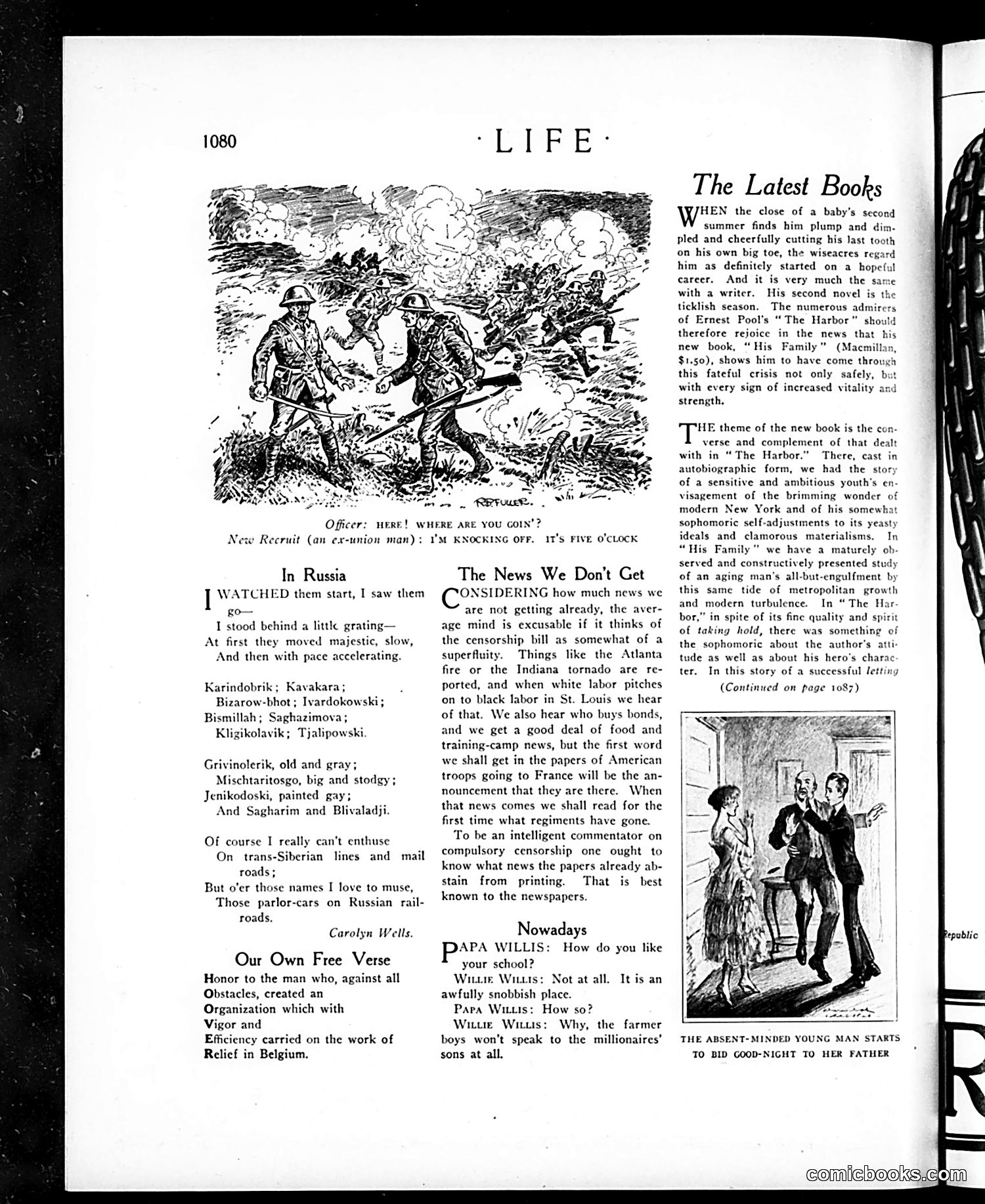
## Main Cartoon The top illustration depicts a military officer dismissing a "New Recruit (an ex-union man)" at 5 o'clock, saying "I'm knocking off." This satirizes labor tensions during wartime—the recruit's former union status suggests friction between military discipline and organized labor's demands. The cartoon likely comments on worker-soldier conflicts during World War I era mobilization. ## Content The page includes: - **"In Russia"** (Carolyn Wells poem): Satirizes the unpronounceable Russian names through exaggerated transliteration, poking fun at American unfamiliarity with Russian culture - **"The News We Don't Get"**: Critiques wartime censorship, noting the government restricts military information while allowing other news - **Book reviews** of Ernest Pool's "His Family" - **"Nowadays"** dialogue: Class satire about rural vs. wealthy boys refusing to socialize at school The overall tone reflects WWI-era American anxieties about labor, censorship, and social divisions.
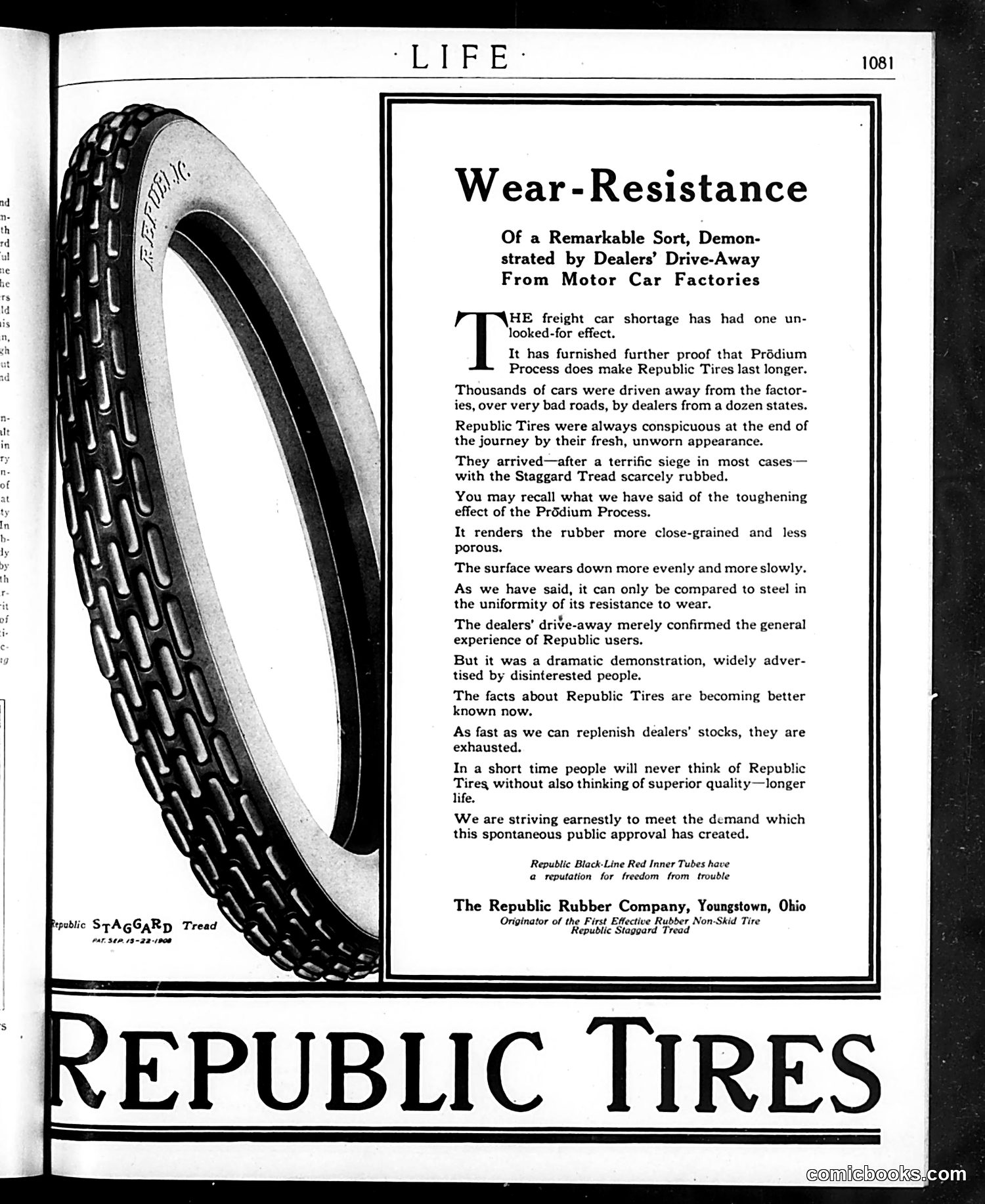
This is **not a cartoon or satire** — it's a straightforward product advertisement for Republic Tires, published in *Life* magazine (page 1081). The ad claims that a freight car shortage created an unintended marketing opportunity: dealers drove cars long distances over poor roads to retrieve vehicles from factories. Republic Tires allegedly arrived with minimal wear, demonstrating superior durability compared to competitors. The advertisement emphasizes the "Prödium Process," which allegedly made rubber "close-grained" and wear-resistant like steel. It frames dealers as "disinterested" witnesses to the tires' quality—suggesting independent validation rather than company claims. **Modern context**: This reflects early 20th-century industrial competition and the emerging importance of automobiles. The ad uses a real logistical problem (freight shortage) as credible real-world testing to build brand reputation—an early form of what we'd now call "authentic marketing."
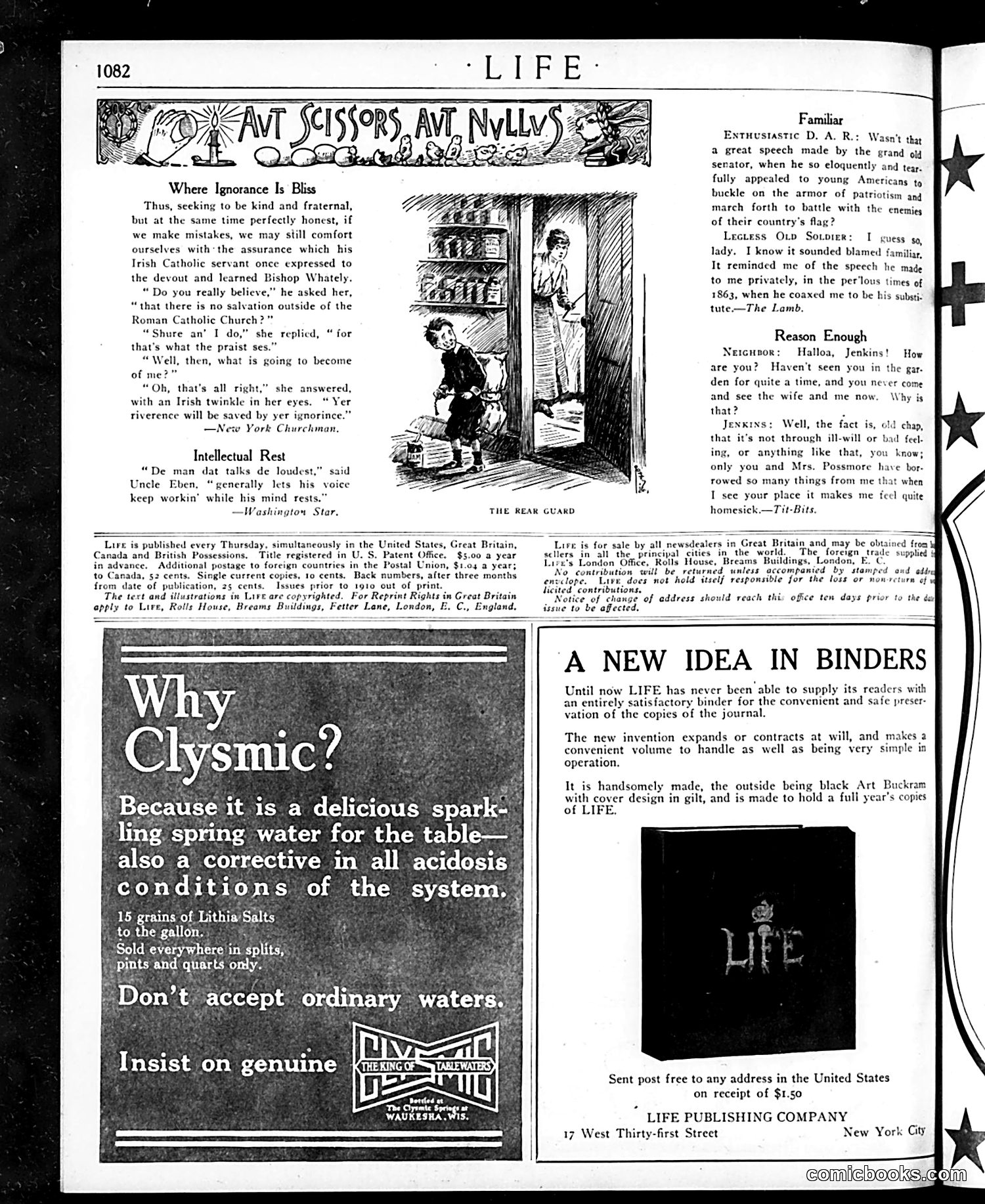
This page contains three separate satirical pieces typical of *Life* magazine's format: **"Where Ignorance Is Bliss"**: A joke about an Irish Catholic servant who assures a Protestant bishop he'll reach heaven through sheer ignorance of theological rules. The satire mocks both religious rigidity and the Irish servant stereotype common in period humor. **"The Rear Guard"** (cartoon): An elderly Civil War veteran complains that a senator's patriotic speech urging young men to enlist sounds familiar—because the same senator paid him to be a substitute soldier in 1863, avoiding service himself. This critiques wealthy men dodging military duty while rhetorically inspiring others to fight. **"Intellectual Rest"**: A brief quip attributing Uncle Eben's (an African American character) observation that loud talkers don't think hard—their mouths work while minds rest. The page also advertises Clysmic sparkling water and a new *Life* magazine binder. These pieces reflect early 20th-century American satirical conventions: ethnic stereotypes, class critique, and commentary on patriotism and hypocrisy.
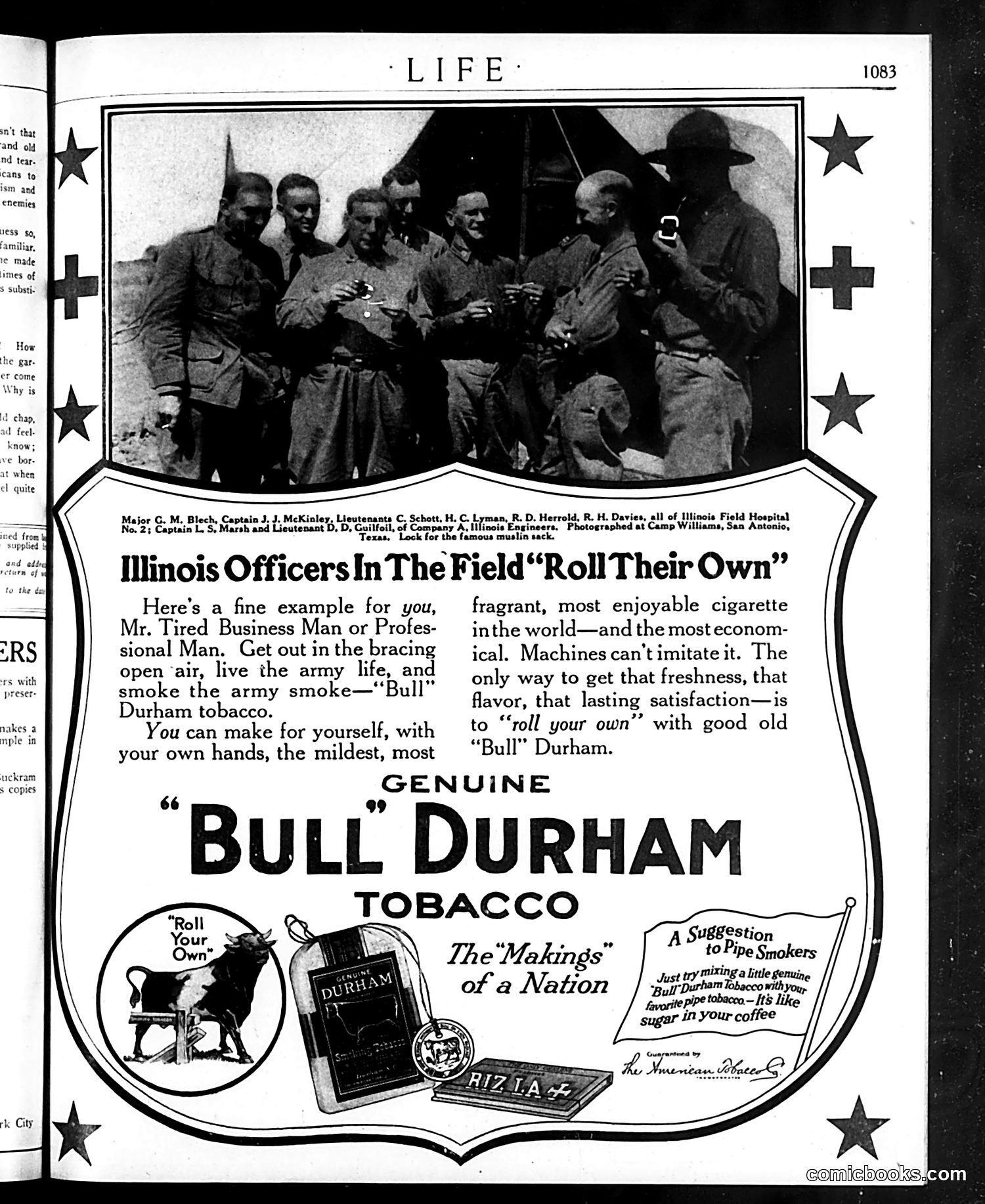
This is **not a cartoon or satire**—it's a **tobacco advertisement** disguised as editorial content in *Life* magazine. The image shows real Illinois Army officers during World War I (identified by name and unit). The ad uses their photograph to market "Bull Durham" rolling tobacco by suggesting that soldiers in the field roll their own cigarettes for economy and quality. The pitch targets "tired business men" with appeals to masculinity, self-reliance ("make for yourself"), and outdoor living. The famous "bull" logo and muslin sack appear at bottom. By 1920s standards, this was normal advertising strategy—using soldiers and patriotic appeals. Modern readers should recognize this as **military-celebrity endorsement marketing** and note the complete absence of health warnings that would be mandatory today.
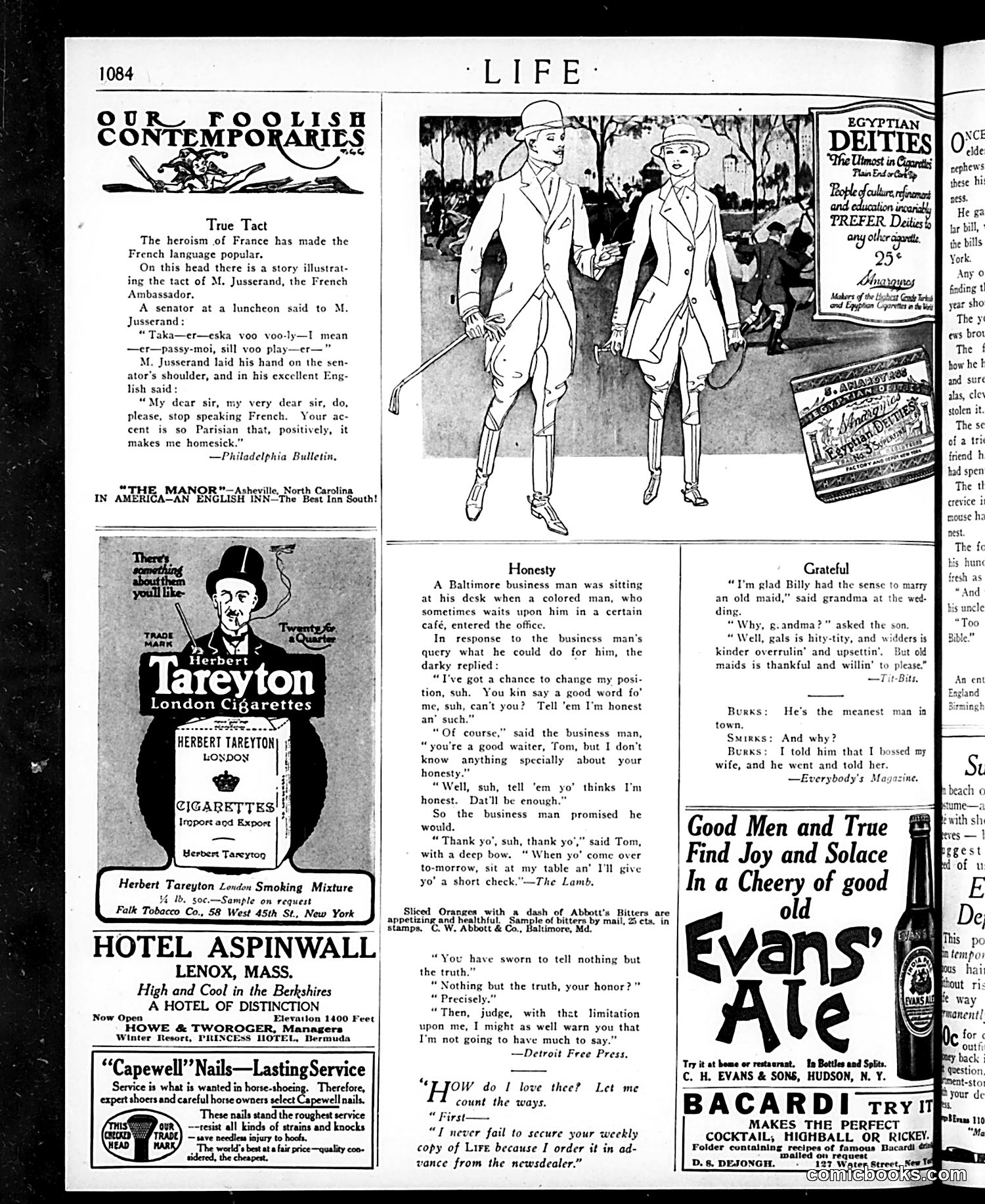
This page mixes humor columns with advertising typical of 1920s Life magazine. The satirical content includes: **"True Tact"**: A anecdote about M. Jusserand, the French Ambassador, making a social joke—a senator attempts French at a luncheon but speaks it so poorly (with bad Parisian accent) that Jusserand, in perfect English, claims the accent makes him homesick. The humor plays on French linguistic pride and diplomatic politeness. **"Honesty"**: A racial stereotype anecdote where a Black waiter seeks a job recommendation; the businessman agrees to vouch for his honesty. The waiter then promises him "a short check" (small bill) the next day—the joke being that his claimed honesty is false. **Court testimony joke**: A defendant warns the judge he won't talk much if restricted to telling only the truth. The page is primarily **advertisements** (Tareyton cigarettes, Hotel Aspinwall, Capewell nails, Evans' ale, Bacardi rum) interspersed with brief humorous columns reflecting period attitudes, including casual racial caricature.
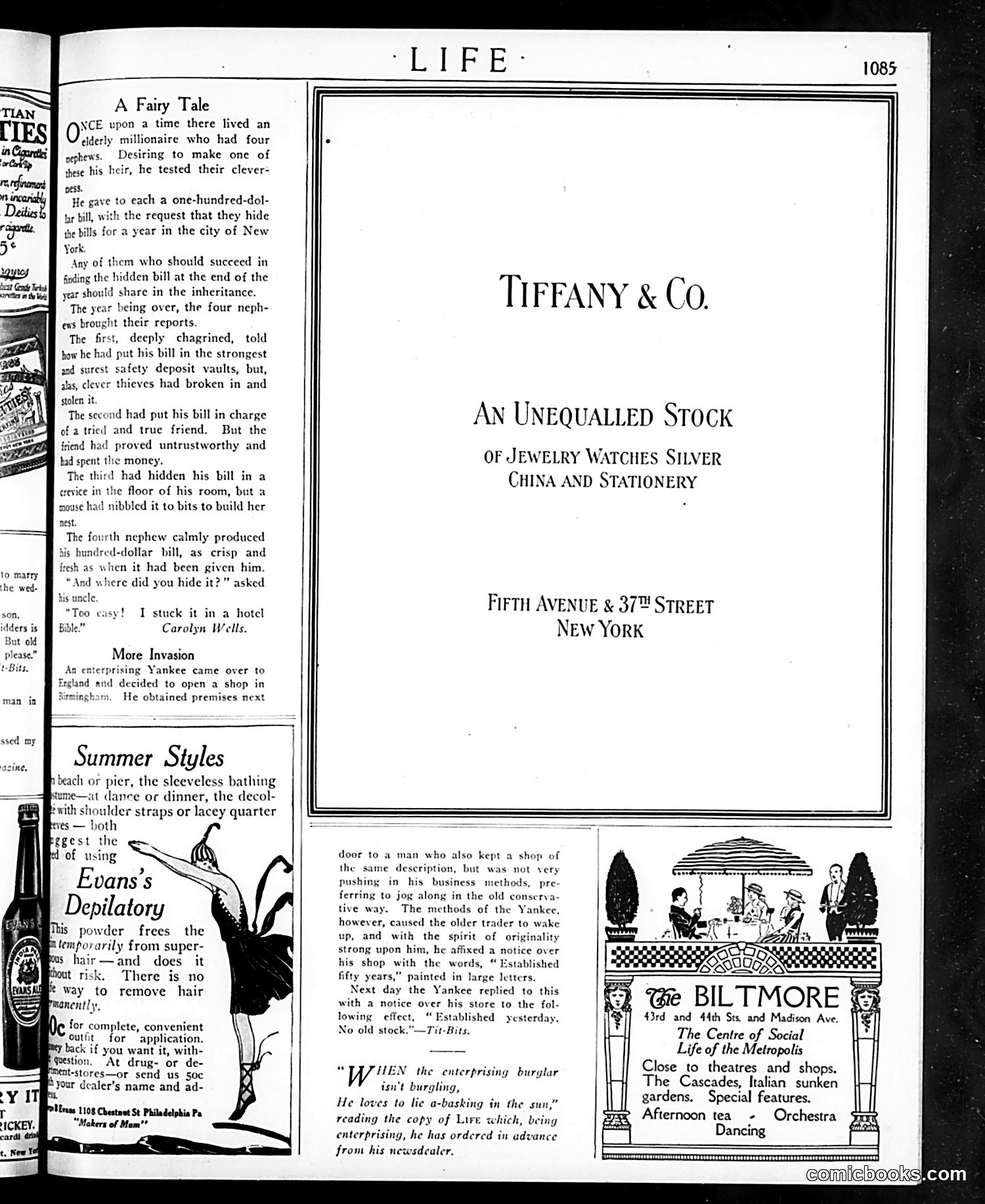
This page contains a short satirical story by Carolyn Wells mocking American attitudes toward money and security. A wealthy uncle tests four nephews by giving each $100 to hide for a year in New York City, with the finder inheriting his fortune. The satire targets contemporary anxieties: the first nephew loses his money to thieves despite using bank vaults; the second is betrayed by an untrustworthy friend; the third's money is destroyed by mice. The fourth nephew—who simply hides his bill in a **hotel Bible**—succeeds perfectly. The joke satirizes both American paranoia about financial security and ironic trust in religion as the safest "vault." It also subtly mocks the era's obsession with clever schemes: sometimes the simplest solution wins. The story exemplifies Life magazine's practice of using brief, witty parables to critique contemporary society.
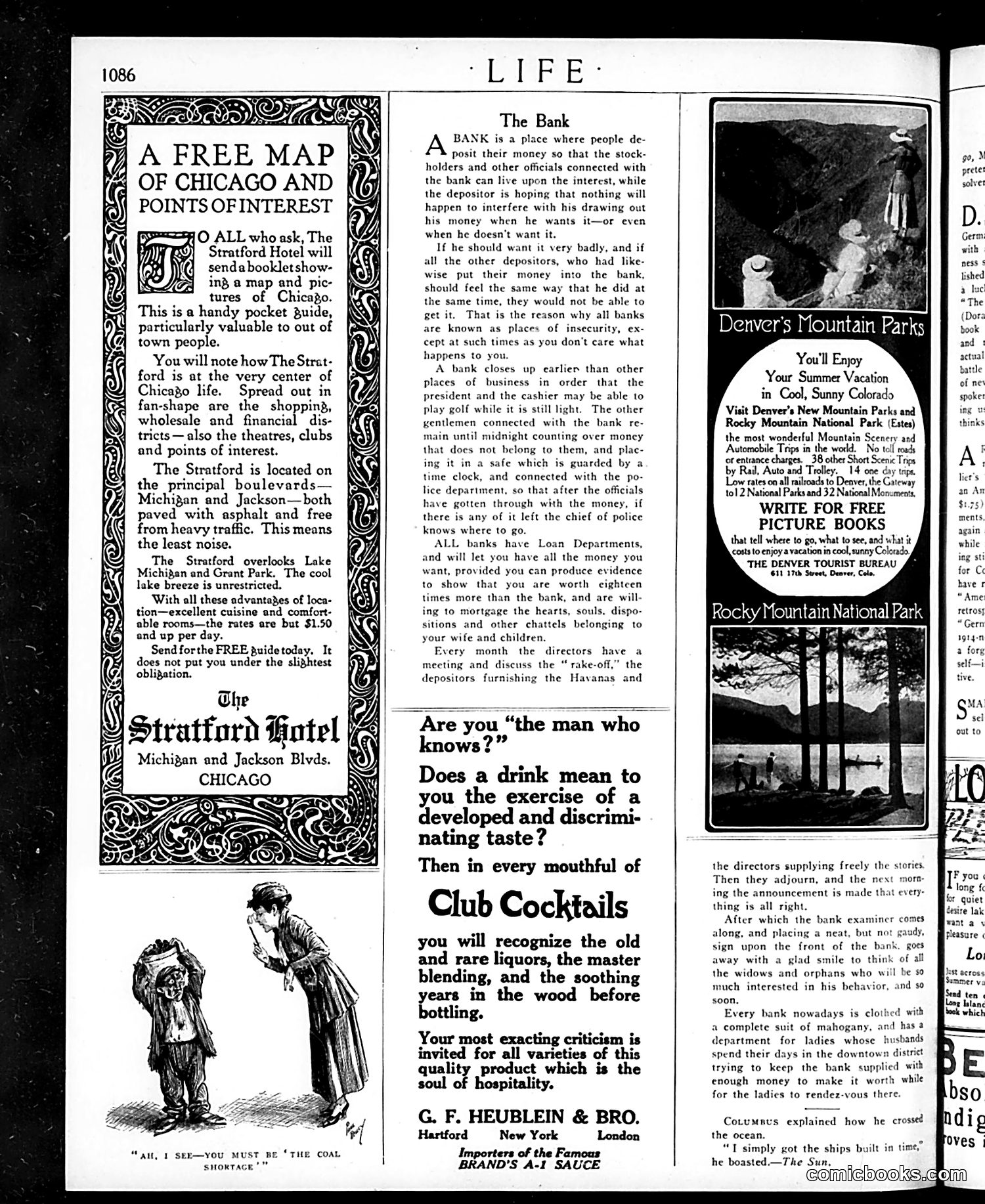
This is primarily an **advertising page**, not political satire. The page features: **Main Content:** - Hotel and tourism ads (Stratford Hotel, Denver tourism) - Liquor advertisement (Club Cocktails by Heublein & Bro.) **Satirical Element:** The only satirical piece is a humorous essay titled "The Bank," which uses deadpan irony to mock banking practices. It sarcastically explains that banks are "places of insecurity" where depositors' money funds executives' leisure (golf), where loan departments require borrowers to be worth "eighteen times more" than the loan amount, and where directors profit through kickbacks ("rake-offs"). **The Cartoon:** A small illustration captioned "All, I see—you must be 'the coal shortage'" depicts two figures in conversation, likely commenting on contemporary economic scarcity, though the specific reference is unclear without additional historical context. The satire reflects early 20th-century cynicism about financial institutions and corporate greed—themes that resonate today.
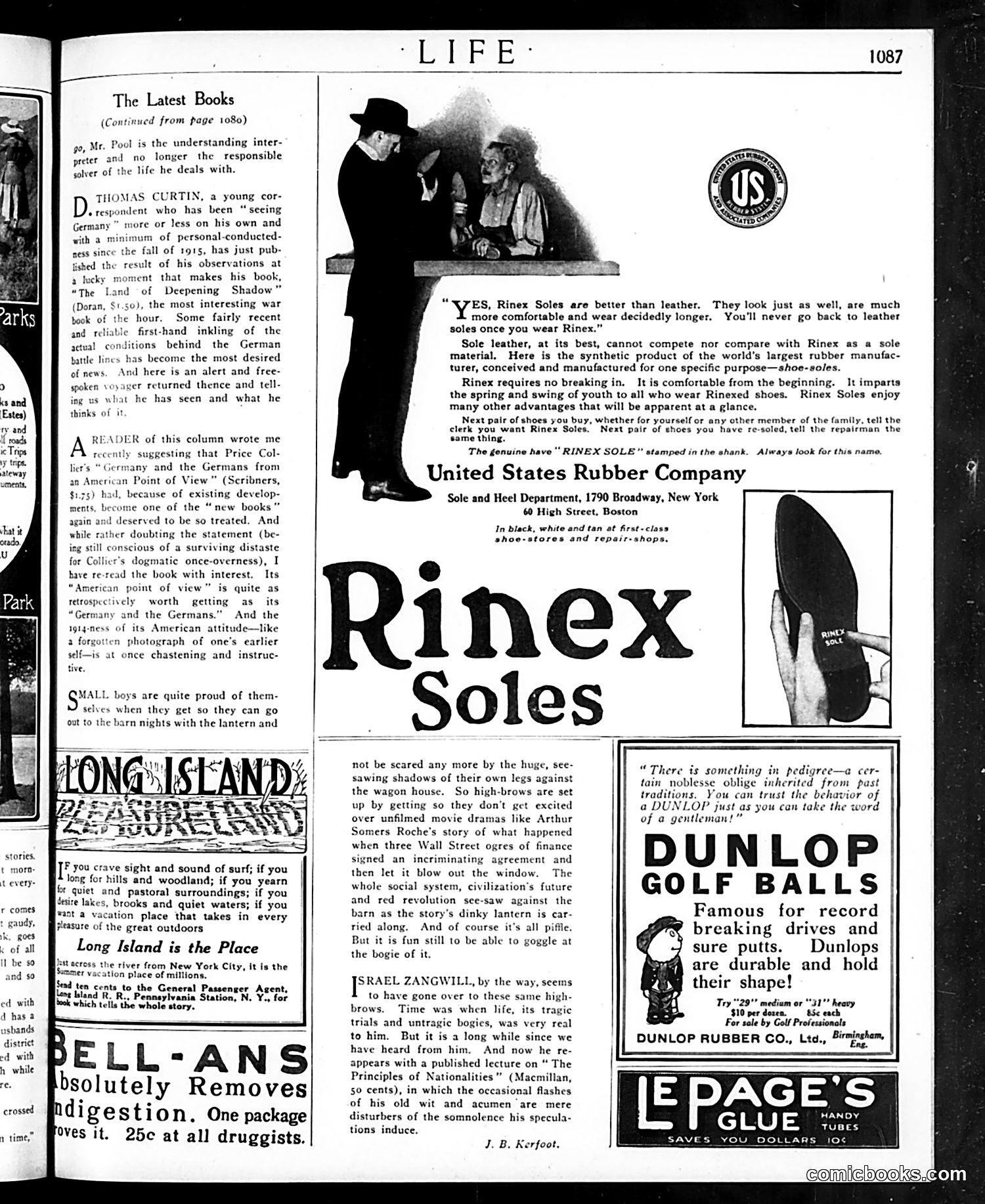
This page is primarily **advertising and book reviews**, not political satire. The main content includes: **Book Reviews**: Thomas Curtin's "The Land of Deepening Shadow" and Price Collier's "Germany and the Germans from an American Point of View" are discussed—both addressing WWI-era German conditions. The reviewer notes these works provide firsthand accounts of actual conditions "behind the German battle lines," indicating this was published during or shortly after World War I. **Advertisements**: The dominant feature is a Rinex Soles shoe advertisement showing a rubber sole material competing with leather. There are also ads for Dunlop golf balls, Bell-Ans indigestion remedy, and LePage's glue. **Minor humor**: A brief editorial note jokes about "small boys" getting excited over farm activities—mild nostalgia humor. The page reflects early 20th-century American interests: WWI developments, consumer products, and gentle social commentary rather than sharp political satire.
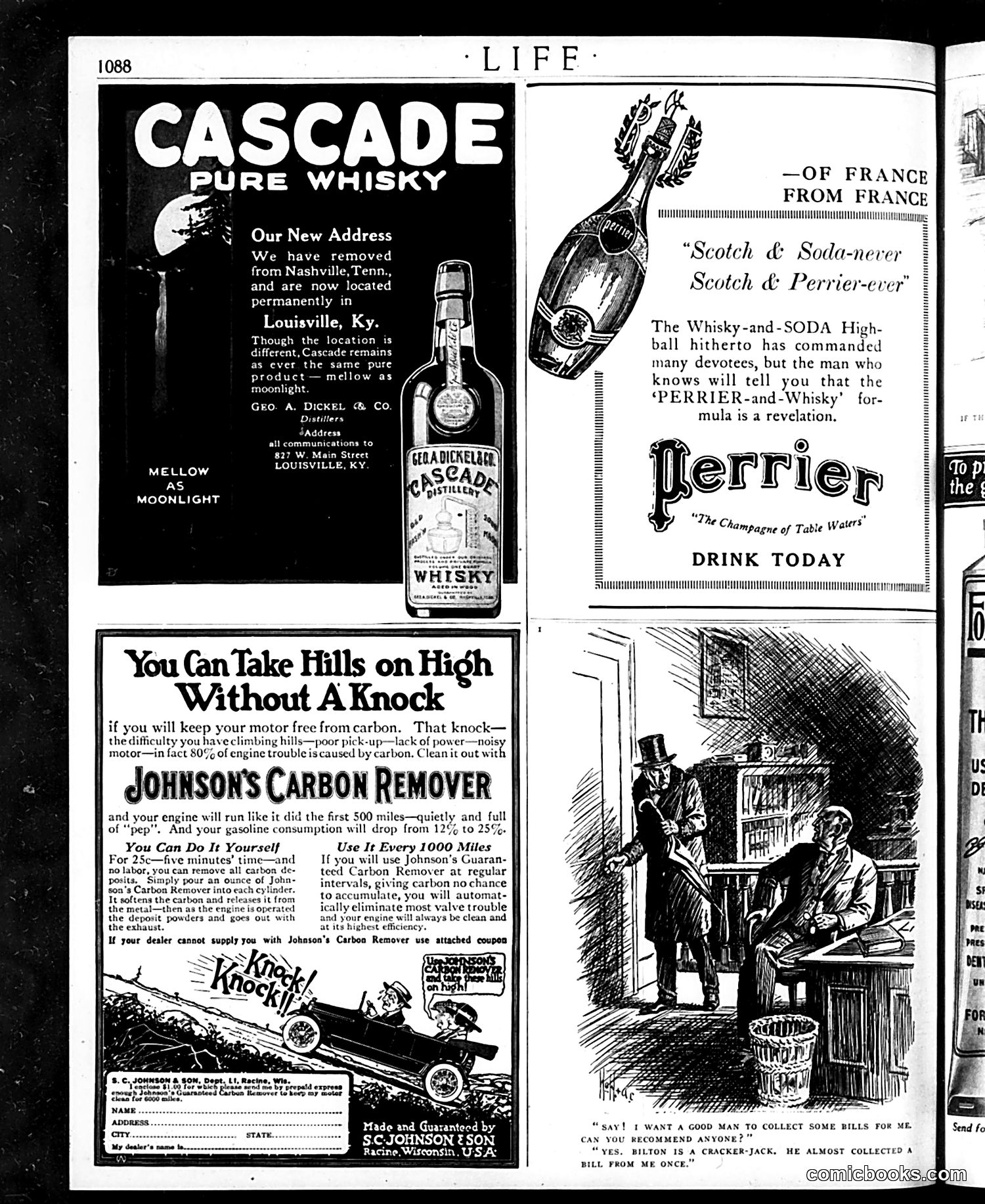
This is primarily an **advertising page** from Life magazine, containing three distinct advertisements with minimal editorial content. The page features: 1. **Cascade Pure Whisky** — announcing relocation from Nashville to Louisville, Kentucky, emphasizing product consistency ("mellow as moonlight") 2. **Johnson's Carbon Remover** — a motorist product claiming to eliminate engine carbon buildup, improve performance, and increase fuel efficiency (12-25% improvement claimed). The ad uses colloquial language ("pep," "knock") to address common driving complaints. 3. **Perrier Water** — a French import marketed as superior to whisky-and-soda mixers, positioned as sophisticated ("Champagne of Table Waters") 4. **A small cartoon** at bottom-right showing two men discussing bill collection, with wordplay on "cracker-jack" (excellent person) collecting bills—likely a pun on debt collection difficulty. The page reflects early 20th-century consumer advertising targeting car owners and middle-class drinkers, with humor used to sell practical automotive and beverage products.
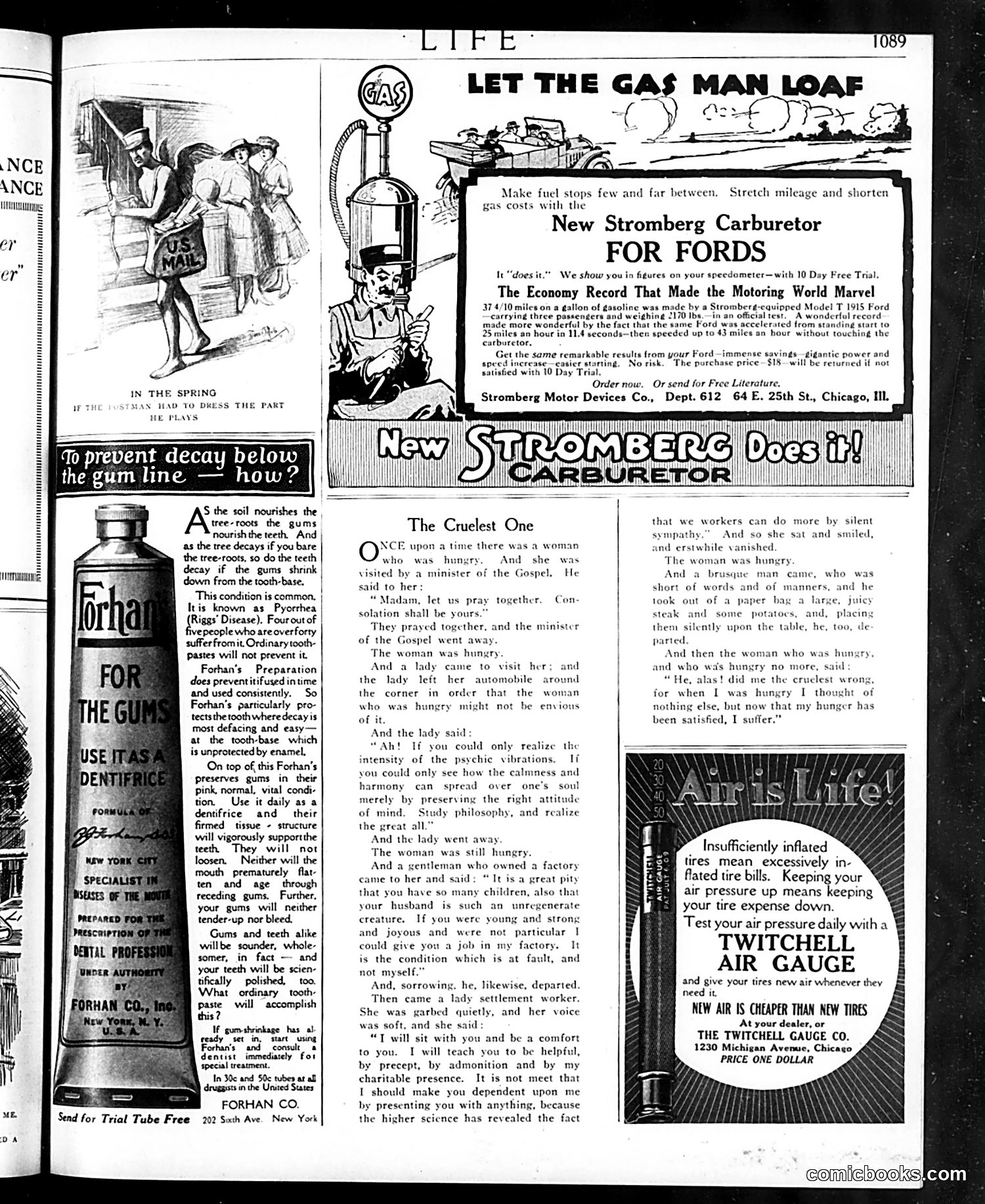
This Life magazine page (1089) mixes satirical content with period advertising, primarily targeting early automotive owners. ## The Cartoon The top-left cartoon, "If the Spring Man Had to Dress the Part He Plays," depicts a mailman dressed as a coiled spring—visual wordplay mocking the absurdity of literal job costumes. The joke relies on the phrase "dress the part." ## The Advertisements Most of the page features ads for Ford accessories and dental/automotive products typical of the 1910s-1920s era: - **Stromberg Carburetor**: Claims remarkable fuel economy (37+ miles per gallon) for Model T Fords - **Forhan's Dentifrice**: Addresses pyorrhea (gum disease), common among older populations - **Twitchell Air Gauge**: Promotes tire pressure maintenance ## "The Cruelest One" The long story contrasts unhelpful responses to a hungry woman—a minister offering prayer, a wealthy lady discussing philosophy, a factory owner making moral judgments, and a settlement worker offering sympathy—none actually providing food. The satire critiques hollow charity and patronizing attitudes toward poverty.
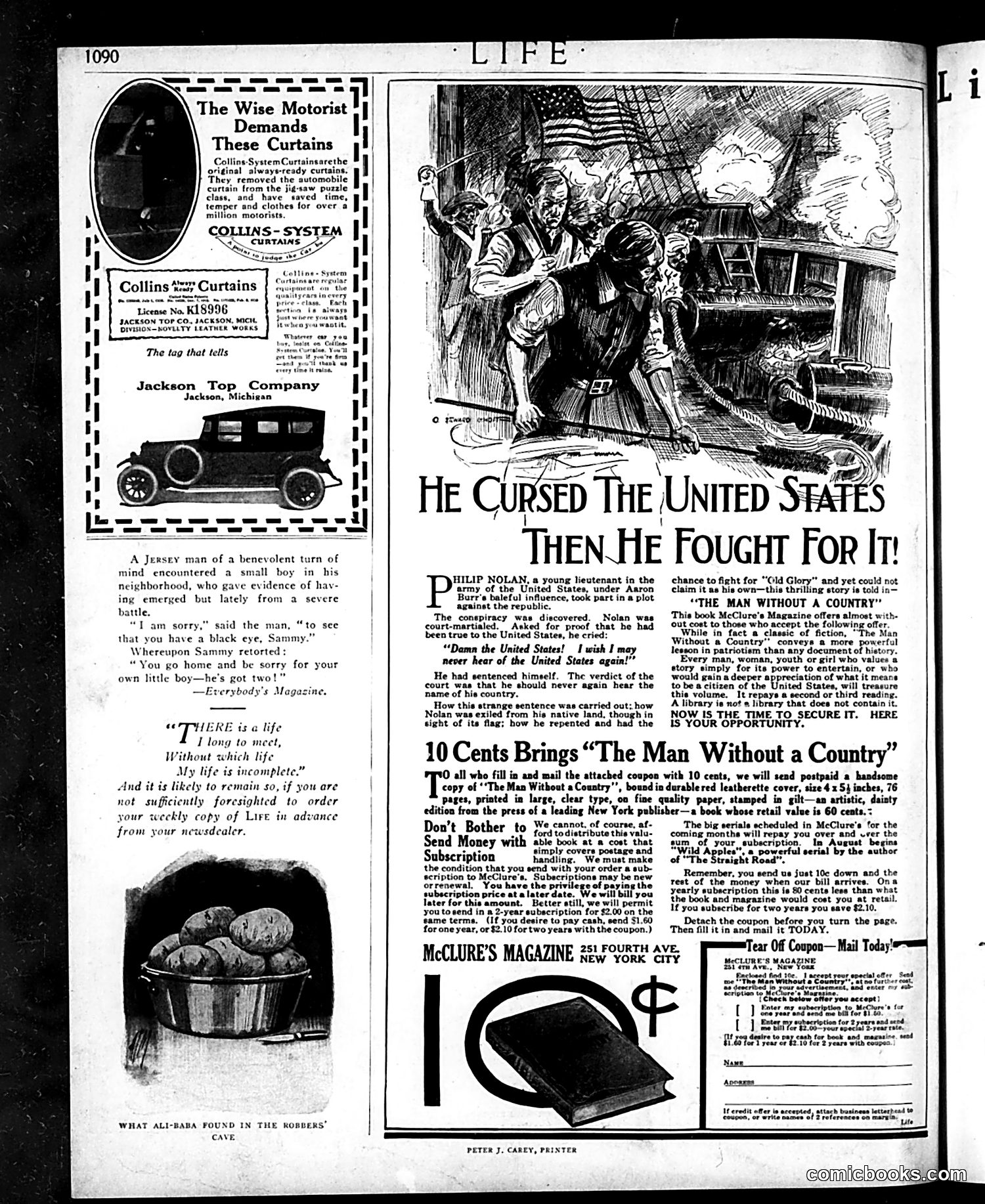
This page contains a story advertisement rather than political satire. The main feature promotes Edward Everett Hale's classic short story **"The Man Without a Country"** (available for 10 cents with magazine subscription). The narrative concerns **Philip Nolan**, a young U.S. Army officer who, under Aaron Burr's influence, participated in a conspiracy against the republic. When court-martialed, Nolan cursed the United States, wishing never to hear its name again. The court granted his wish—sentencing him to lifelong exile from his own country, though in sight of it. The advertisement frames this as patriotic literature, arguing the story teaches deeper lessons about citizenship and national loyalty than "any document of history." For early 20th-century readers, this was inspirational material emphasizing devotion to country. The page also contains unrelated advertisements (car tops, curtains) and a brief joke about children fighting.