
Life, 1917-06-21 · page 17 of 38
Life — June 21, 1917 — page 17: what you’re looking at
What you’re looking at
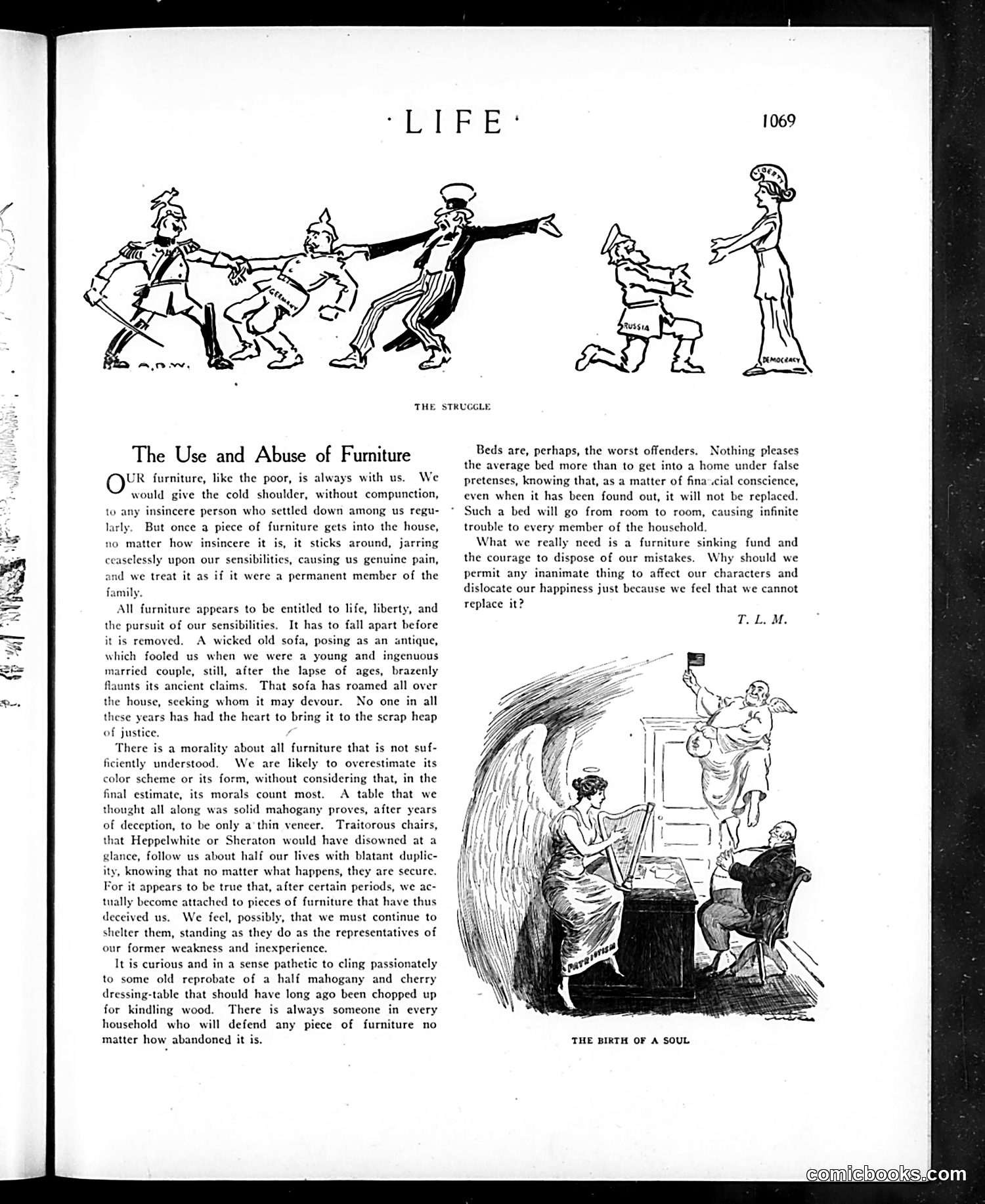
This article satirizes the irrational emotional attachment Americans develop to worn-out household furniture. The author argues that people keep shabby, defective pieces—old sofas, cheap veneer tables, worn chairs—long past usefulness, treating them as permanent family members despite their moral and physical decay. The satire targets middle-class hypocrisy: we'd reject an insincere *person* but tolerate deceptive furniture indefinitely. The piece mocks our reluctance to discard items due to financial guilt or sentimental attachment, suggesting we need a "furniture sinking fund" to break this cycle. The cartoons illustrate the theme: "The Struggle" shows figures fighting over possessions (representing domestic conflict over clutter), while "The Birth of a Soul" depicts what appears to be an angel or cherub emerging—possibly satirizing the quasi-spiritual reverence people accord old household objects. The humor lies in treating furniture with the moral seriousness usually reserved for human relationships.
📄 Transcribed text from this page (OCR, searchable)
Machine-transcribed from the original scan — historical spelling and the odd misread are preserved.
THE STRUGGLE The Use and Abuse of Furniture UR furniture, like the poor, is always with us. We would give the cold shoulder, without compunction, to any insincere person who settled down among us regu- larly. But once a piece of furniture gets into the house, no matter how insincere it is, it sticks around, jarring ceaselessly upon our sensibilities, causing us genuine pain, and we treat it as if it were a permanent member of the family, All furniture appears to be entitled to life, liberty, and the pursuit of our sensibilities. It has to fall apart before it is removed. A wicked old sofa, posing as an antique, which fooled us when we were a young and ingenuous married couple, still, after the lapse of ages, brazenly flaunts its ancient claims. That sofa has roamed all over the house, seeking whom it may devour. No one in all these years has had the heart to bring it to the scrap heap of justice. / There is a morality about all furniture that is not suf- ficiently understood. We are likely to overestimate its color scheme or its form, without considering that, in the final estimate, its morals count most. A table that we thought all along was solid mahogany proves, after years of deception, to be only a'thin veneer. Traitorous chairs, that Heppelwhite or Sheraton would have disowned at a glance, follow us about half our lives with blatant duplic- ity, knowing that no matter what happens, they are secure. For it appears to be true that, after certain periods, we ac- tually become attached to pieces of furniture that have thus deceived us. We feel, possibly, that we must continue to shelter them, standing as they do as the representatives of our former weakness and inexperience. It is curious and in a sense pathetic to cling passionately to some old reprobate of a half mahogany and cherry dressing-table that should have long ago been chopped up for kindling wood. There is always someone in every household who will defend any piece of furniture no matter how abandoned it is. Beds are, perhaps, the worst offenders. Nothing pleases the average bed more than to get into a home under false pretenses, knowing that, as a matter of fina-.cial conscience, even when it has been found out, it will not be replaced. Such a bed will go from room to room, causing infinite trouble to every member of the household. What we really need is a furniture sinking fund and the courage to dispose of our mistakes. Why should we permit any inanimate thing to affect our characters and dislocate our happiness just because we feel that we cannot replace it? T.L. M. THE BIRTH OF A SOUL