
Life, 1917-06-21 · page 16 of 38
Life — June 21, 1917 — page 16: what you’re looking at
What you’re looking at
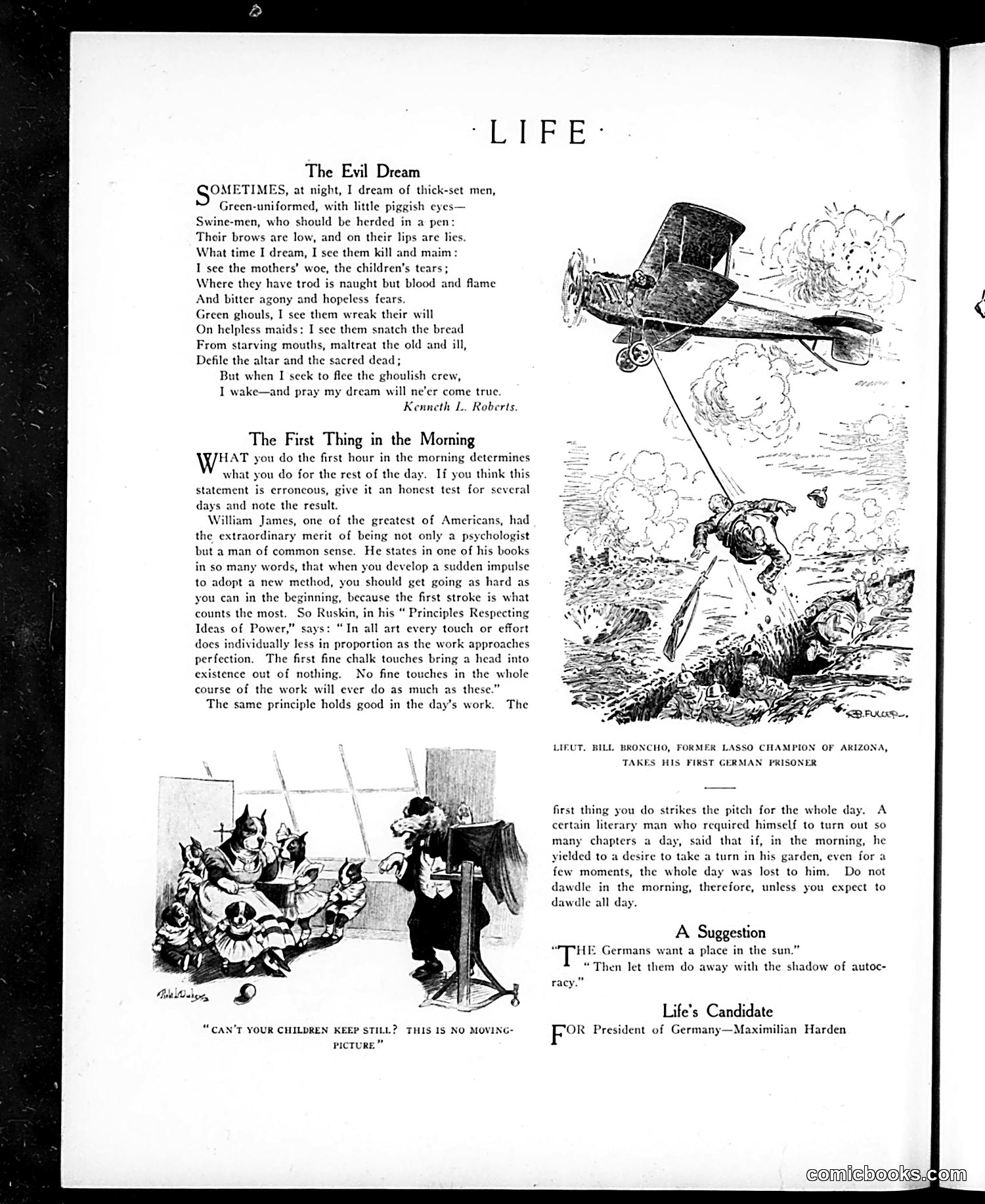
This page contains WWI-era American propaganda against Germany. **"The Evil Dream"** is a poem depicting Germans as subhuman "swine-men" and "green ghouls" committing atrocities—killing civilians, assaulting women, starving the elderly. It reflects American wartime rhetoric portraying Germans as brutal savages. **The cartoon** showing "Lieut. Bill Broncho" (an American cowboy lasso champion) capturing a German prisoner uses the Wild West as metaphor: American frontier toughness defeating German militarism. The caption's humor relies on the incongruity of applying cowboy imagery to modern warfare. **"Life's Candidate"** references Maximilian Harden, a German politician/journalist, as a potential post-war German leader—likely suggesting he'd be preferable to current German leadership, or ironically proposing him as a figure for reform. The bottom cartoon mocks German discipline/rigidity through children unable to sit still during a photograph. All content serves propagandistic purposes: dehumanizing the enemy and promoting American moral superiority during the war.
📄 Transcribed text from this page (OCR, searchable)
Machine-transcribed from the original scan — historical spelling and the odd misread are preserved.
“ase * The Evil Dream OMETIMES, at night, I dream of thick-set men, Green-uniformed, with little piggish eyes— Swine-men, who should be herded in a pen: Their brows are low, and on their lips are lies. What time I dream, I see them kill and maim: I see the mothers’ woe, the children’s tears; Where they have trod is naught but blood and flame And bitter agony and hopeless fears. Green ghouls, I sce them wreak their will On helpless maids: I see them snatch the bread From starving mouths, maltreat the old and ill, Defile the altar and the sacred dead; But when I seek to fice the ghoulish crew, I wake—and pray my dream will ne'er come true. Kenneth L. Roberts. The First Thing in the Morning HAT you do the first hour in the morning determines what you do for the rest of the day. If you think this statement is erroncous, give it an honest test for several days and note the result. William James, one of the greatest of Americans, had the extraordinary merit of being not only a psychologist but a man of common sense. He states in one of his books in so many words, that when you develop a sudden impulse to adopt a new method, you should get going as hard as you can in the beginning, because the first stroke is what counts the most. So Ruskin, in his “ Principles Respecting Ideas of Power,” says: “In all art every touch or effort does individually less in proportion as the work approaches perfection, The first fine chalk touches bring a head into existence out of nothing. No fine touches in the whole course of the work will ever do as much as these.” The same principle holds good in the d LIEUT. BILL BRONCHO, FORMER LASSO CHAMPION OF ARIZONA, TAKES HIS FIRST GERMAN PRISONER first thing you do strikes the pitch for the whole day. A certain literary man who required himself to turn out so many chapters a day, said that if, in the morning, he yielded to a desire to take a turn in his garden, even for a few moments, the whole day was lost to him. Do not dawdle in the morning, therefore, unless you expect to dawdle all day. A Suggestion HE Germans want a place in the sun.” “Then let them do away with the shadow of autoc- Life's Candidate “CAN'T YOUR CHILDREN KEEP STILL? THIS 1S NO MOVING- For President of Germany—Maximilian Harden PICTURE” comichooks.com