
Life, 1917-06-21 · page 28 of 38
Life — June 21, 1917 — page 28: what you’re looking at
What you’re looking at
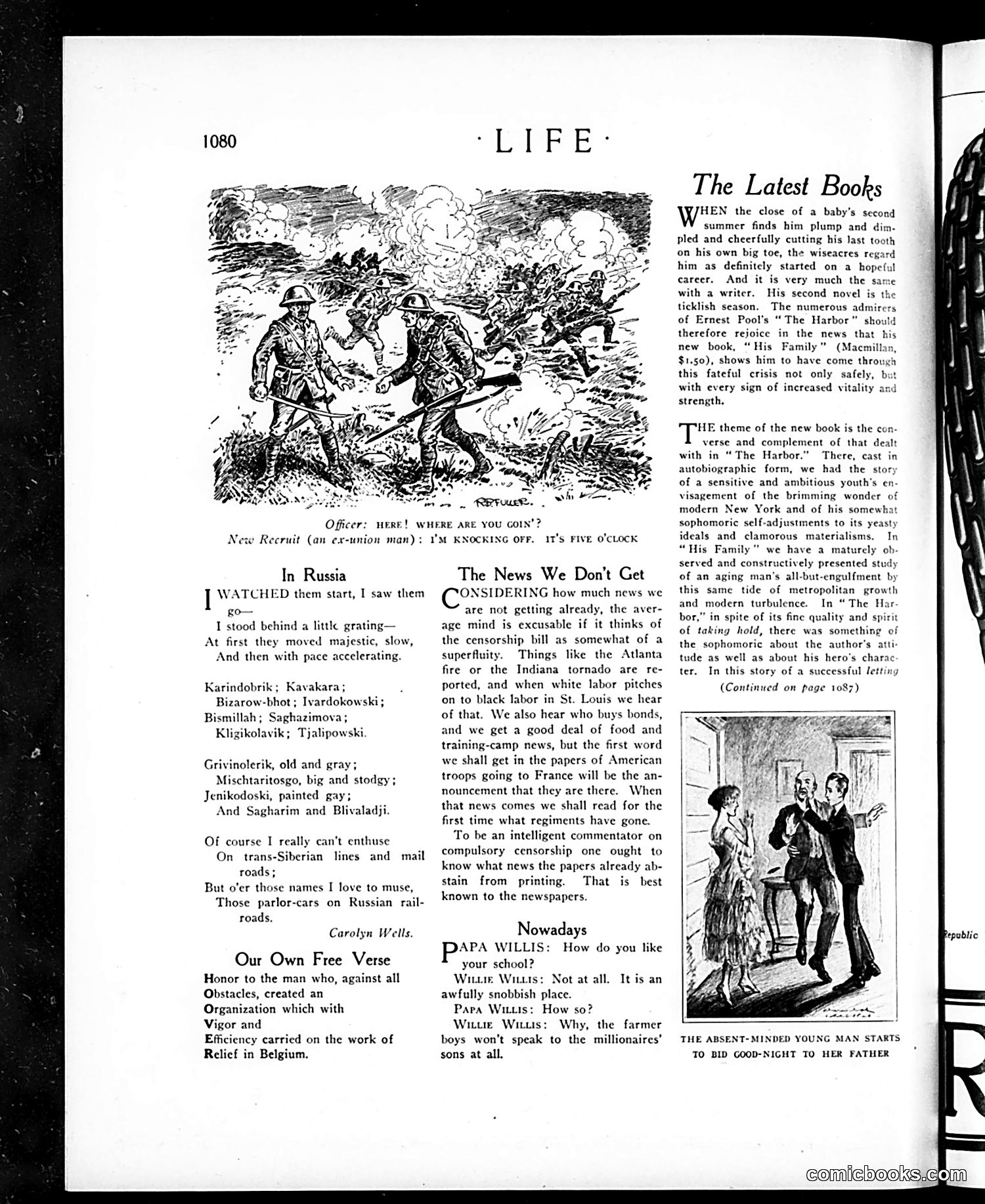
## Main Cartoon The top illustration depicts a military officer dismissing a "New Recruit (an ex-union man)" at 5 o'clock, saying "I'm knocking off." This satirizes labor tensions during wartime—the recruit's former union status suggests friction between military discipline and organized labor's demands. The cartoon likely comments on worker-soldier conflicts during World War I era mobilization. ## Content The page includes: - **"In Russia"** (Carolyn Wells poem): Satirizes the unpronounceable Russian names through exaggerated transliteration, poking fun at American unfamiliarity with Russian culture - **"The News We Don't Get"**: Critiques wartime censorship, noting the government restricts military information while allowing other news - **Book reviews** of Ernest Pool's "His Family" - **"Nowadays"** dialogue: Class satire about rural vs. wealthy boys refusing to socialize at school The overall tone reflects WWI-era American anxieties about labor, censorship, and social divisions.
📄 Transcribed text from this page (OCR, searchable)
Machine-transcribed from the original scan — historical spelling and the odd misread are preserved.
ww Recruit (an ex-union man): I'M KNOCKING OFF. In Russia I WATCHED them start, I saw them go— I stood behind a littl grating— At first they moved majestic, slow, And then with pace accelerating. Karindobrik ; Kavakara; Bizarow-bhot ; Ivardokowski; Bismillah; Saghazimova; Kligikolavik; Tjalipowski. Grivinolerik, old and gray; Mischtaritosgo, big and stodgy; Jenikodoski, painted gay And Sagharim and Blivaladji. Of course I really can't enthuse On trans-Siberian lines and mail road: But o'er those names I love to muse, Those parlor-cars on Russian rail- roads. Carolyn Wells. Our Own Free Verse Honor to the man who, against all Obstacles, created an Organization which with Vigor and Efficiency carried on the work of Relicf in Belgium, 11's FIVE O'CLOCK The News We Don’t Get ONSIDERING how much news we are not getting already, the aver- age mind is excusable if it thinks of the censorship bill as somewhat of a superfluity. Things like the Atlanta fire or the Indiana tornado are re- ported, and when white labor pitches on to black labor in St. Louis we hear of that. We also hear who buys bonds, and we get a good deal of food and training-camp news, but the first word we shall get in the papers of American troops going to France will be the an- nouncement that they are there. When that news comes we shall read for the first time what regiments have gone. To be an intelligent commentator on compulsory censorship one ought to know what news the papers already ab- stain from printing. That is best known to the newspapers. Nowadays APA WILLIS: your school? Wir Witts: Not at all. awfully snobbish place. Para Wits: How so? Witue Witiis: Why, the farmer boys won't speak to the millionaires’ sons at all, How do you like It is an The Latest Books HEN the close of a baby’s second summer finds him plump and dim- pled and cheerfully cutting his Jast tooth on his own big toe, the wiseacres regard him as definitely started on a hopeful career, And it is very much the s: with a writer. His second novel is th ticklish season. The numerous admire: of Ernest Pool's “ The Harbor” should therefore rejoice in the news that his new book, “His Family" (Macmil $1.50), shows him to have come through this fateful crisis not only safely, b with every sign of increased vitality Strength, HE theme of the new book is the con- verse and complement of that dealt with in “The Harbor.” There, cast in autobiographic form, we had the story of a sensitive and ambitious youth's en- visagement of the brimming wonder of modern New York and of his somewh sophomoric self-adjustments to its yeasty ideals and clamorous materialisms. In “His Family” we have a maturely ob- served and constructively presented study of an aging man’s all-but-engulfment by this same tide of metropolitan growth and modern turbulence. In “ The Har bor,” in spite of its fine quality and spirit of taking hold, there was something of the sophomoric about the author's atti- tude as well as about his hero's charac ter. In this story of a successful letting (Continued on page 1087) THE ABSENT- MINDED YOUNG MAN STARTS TO BID GOOD-NIGHT TO HER FATHER comichooks, COMM)