
A complete issue · 42 pages · 1916
Life — October 5, 1916
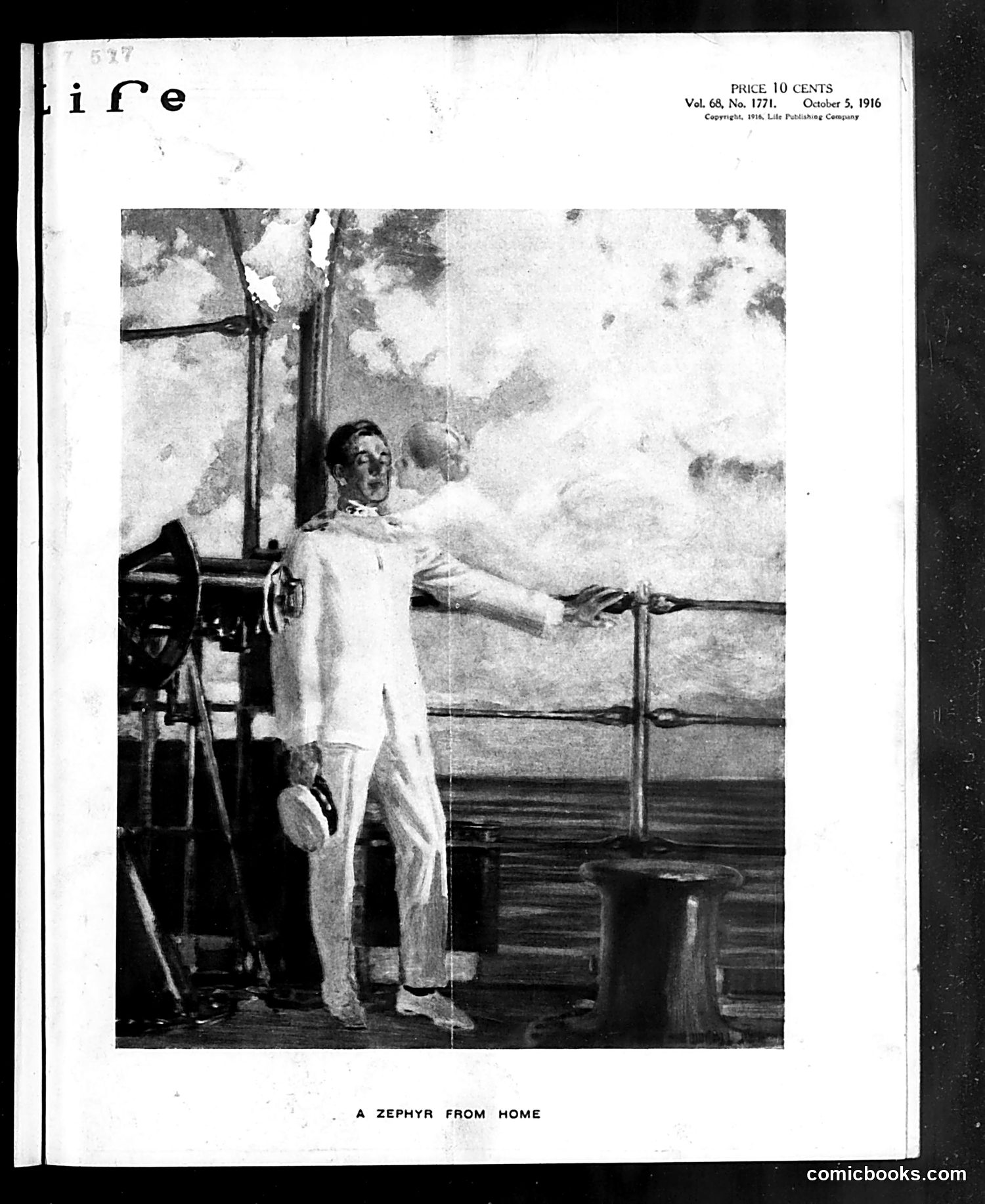
This appears to be a theatrical or promotional photograph rather than a political cartoon. The image shows a person in light clothing at what seems to be a ship's wheel or maritime setting, with cloudy skies in the background. The caption "A Zephyr from Home" (zephyr being a gentle breeze) likely makes a pun or joke connecting the person to the nautical/wind imagery. Without additional context or visible text identifying the subject, it's unclear whether this references a specific theatrical production, a celebrity, or a contemporary public figure from 1916. The photograph's placement in Life suggests it carried satirical or humorous intent for that period's readers, but the specific reference is not apparent from the image alone.
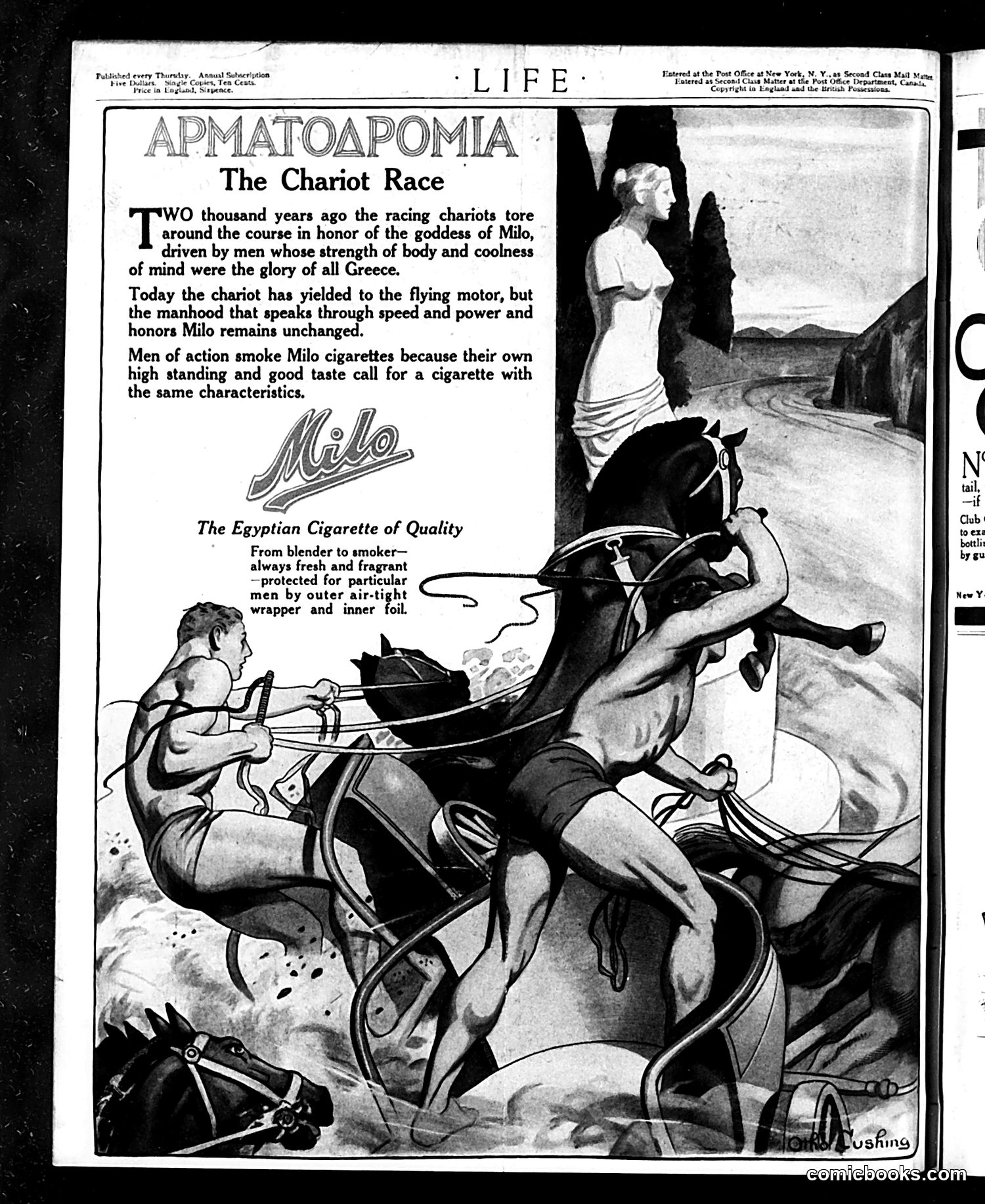
This page is primarily a **Milo cigarette advertisement** disguised as editorial content, a common early-20th-century advertising technique. The ad uses classical mythology as its framing device: it compares ancient Greek chariot racing (honoring the goddess Milo) to modern masculine achievement. The chariot scene illustration depicts classical figures racing with horses, while a statue of Milo appears in the background. The satire is subtle but clear: the ad argues that just as ancient athletes embodied "strength of body and coolness of mind," modern men of "action" and "high standing" should smoke Milo cigarettes. It's essentially claiming that smoking demonstrates masculine virtue and good taste. The comparison between ancient competition and contemporary manhood was a common advertising trope of the era, leveraging classical ideals to market consumer products to aspirational male audiences.
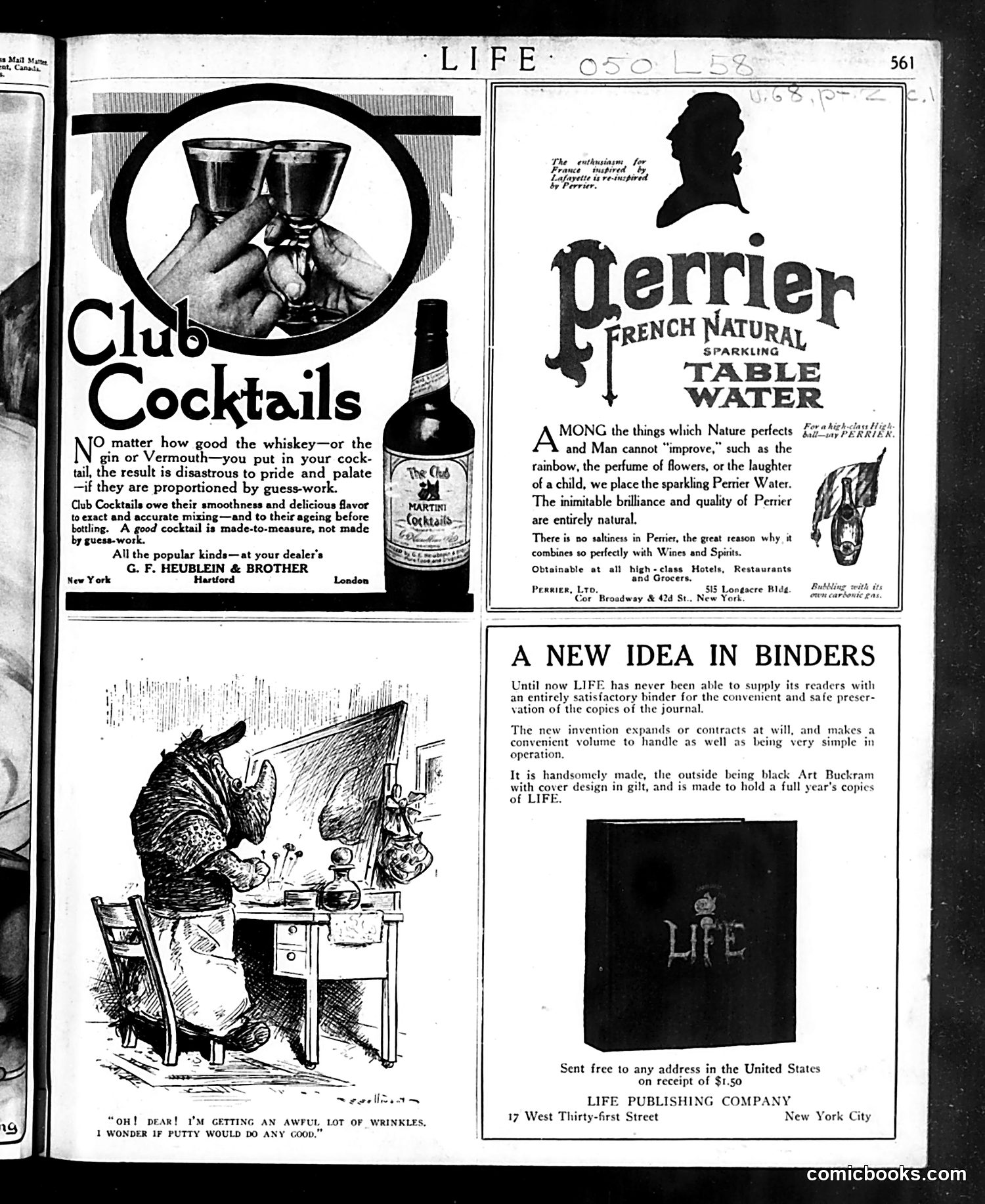
This page consists primarily of **three advertisements** with one cartoon editorial illustration. The main cartoon (bottom left) shows an anthropomorphic animal at a desk surrounded by bottles, captioned "OH! DEAR! I'M GETTING AN AWFUL LOT OF WRINKLES. I WONDER IF PUTTY WOULD DO ANY GOOD." This appears to be **satirizing concerns about aging and cosmetic remedies**, possibly mocking vanity culture or questionable anti-aging products popular in the era. The advertisements promote **Club Cocktails** (G.F. Heublein & Brother), **Perrier sparkling water**, and a **LIFE magazine binder** for preserving annual copies. The cartoon's humor relies on the absurdist image of the animal considering putty as a wrinkle treatment—a comment on both vanity and the sometimes dubious "solutions" marketed to address aging concerns.
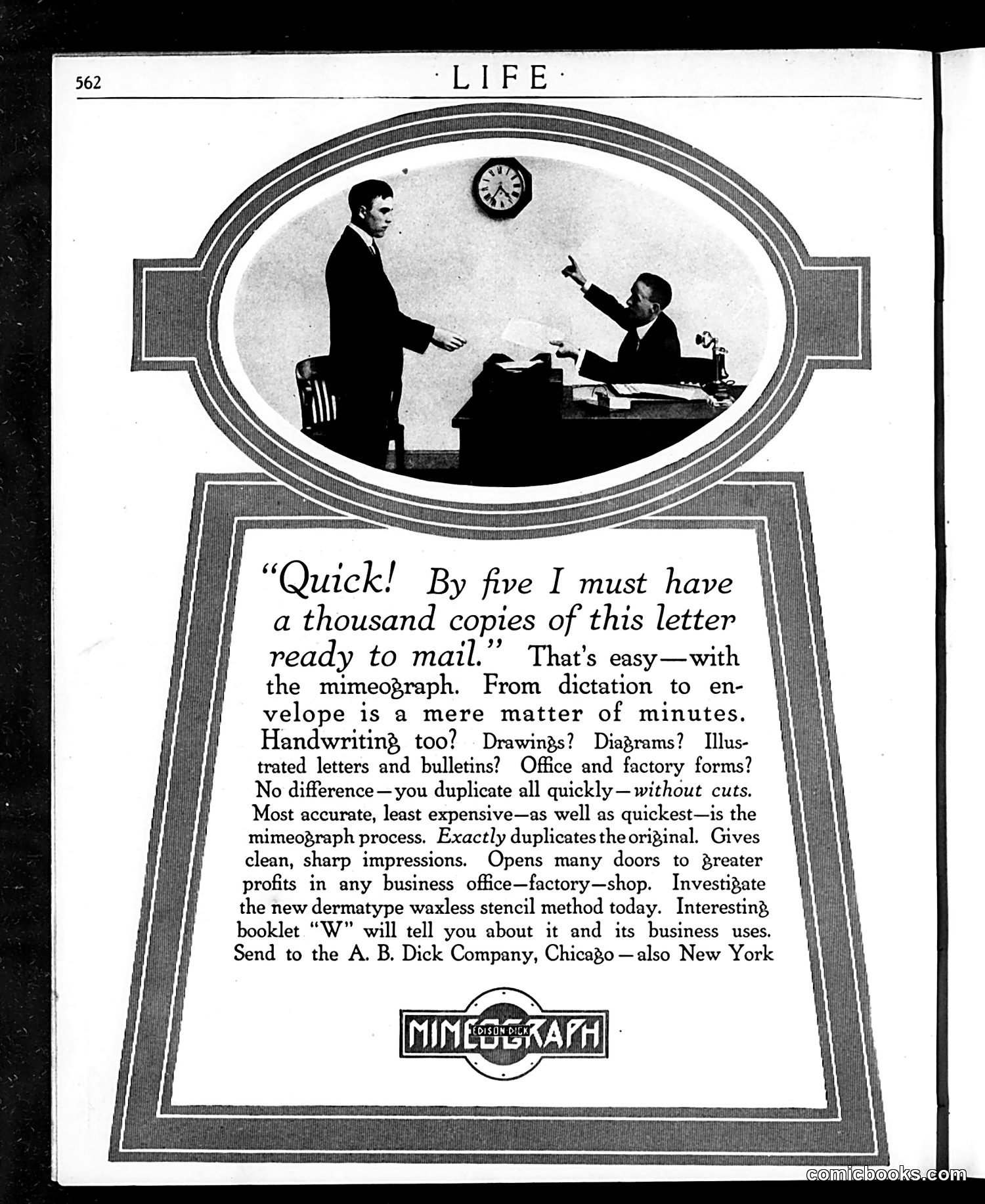
This is primarily a **business advertisement**, not political satire. The page shows an office scene where a businessman urgently requests rapid document duplication—"By five I must have a thousand copies of this letter ready to mail." The ad promotes the **mimeograph machine** (made by A.B. Dick Company), a duplicating technology that was revolutionary for early-20th-century offices. The pitch emphasizes speed and versatility: the mimeograph could reproduce letters, handwriting, drawings, diagrams, forms, and bulletins "without cuts"—meaning without the expense of engraving or printing. This reflects the pre-photocopier era when document reproduction was a significant business challenge. The advertisement targets office managers and factory operators with promises of efficiency and cost savings.
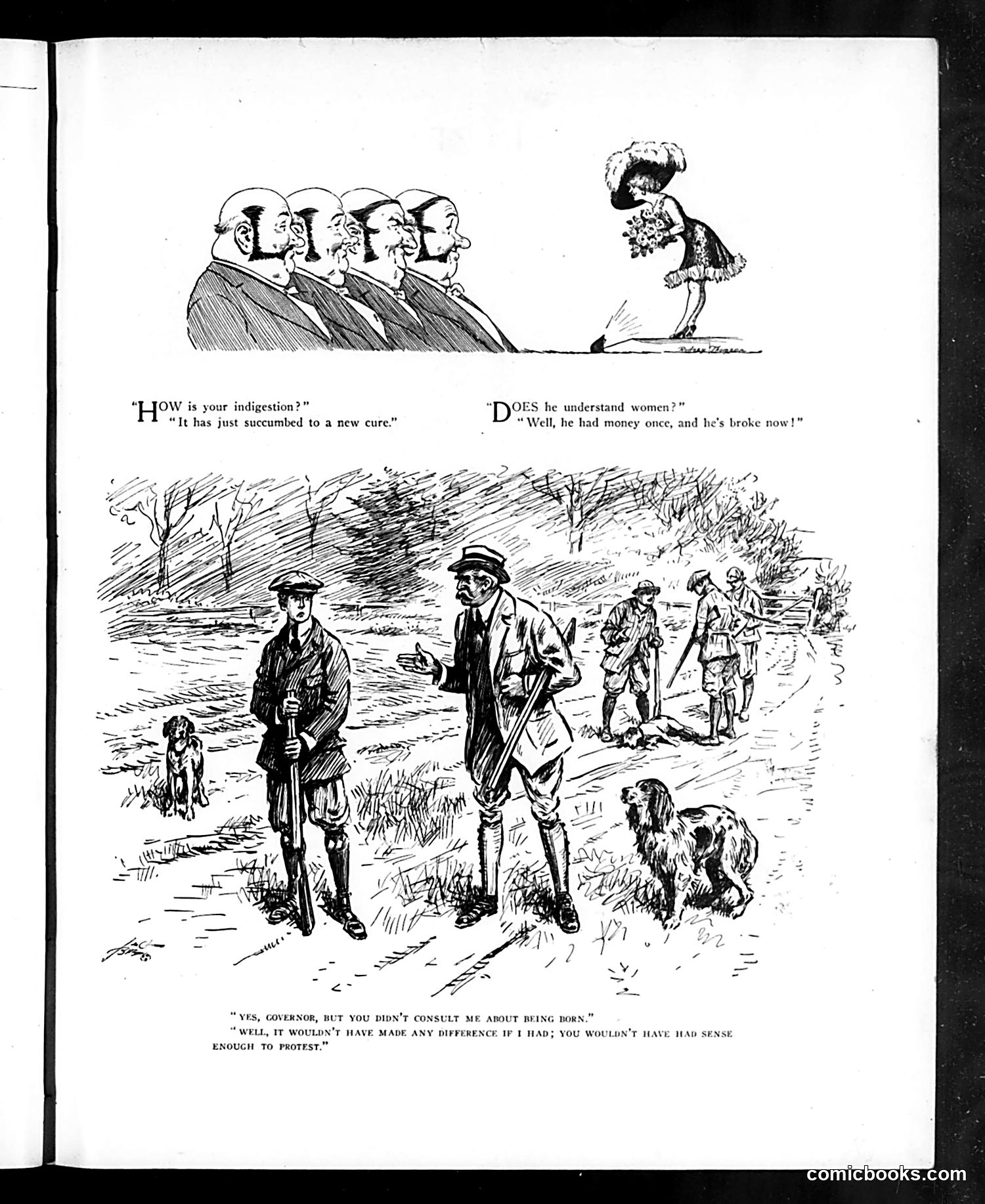
**Top cartoon:** Four identical men (likely politicians or bureaucrats) face a woman displaying her legs. The exchange mocks male hypocrisy: when asked if he "understands women," one man replies "he had money once, and he's broke now"—suggesting women are solely interested in men's finances. **Bottom cartoon:** A hunting scene where a man protests to a "Governor" about being born without consultation, claiming he wouldn't have protested if consulted first. This satirizes complaints about one's circumstances or station in life—mocking those who blame others (or fate/authority) for their existence or conditions rather than accepting responsibility. Both cartoons use humor to critique human nature and social attitudes.
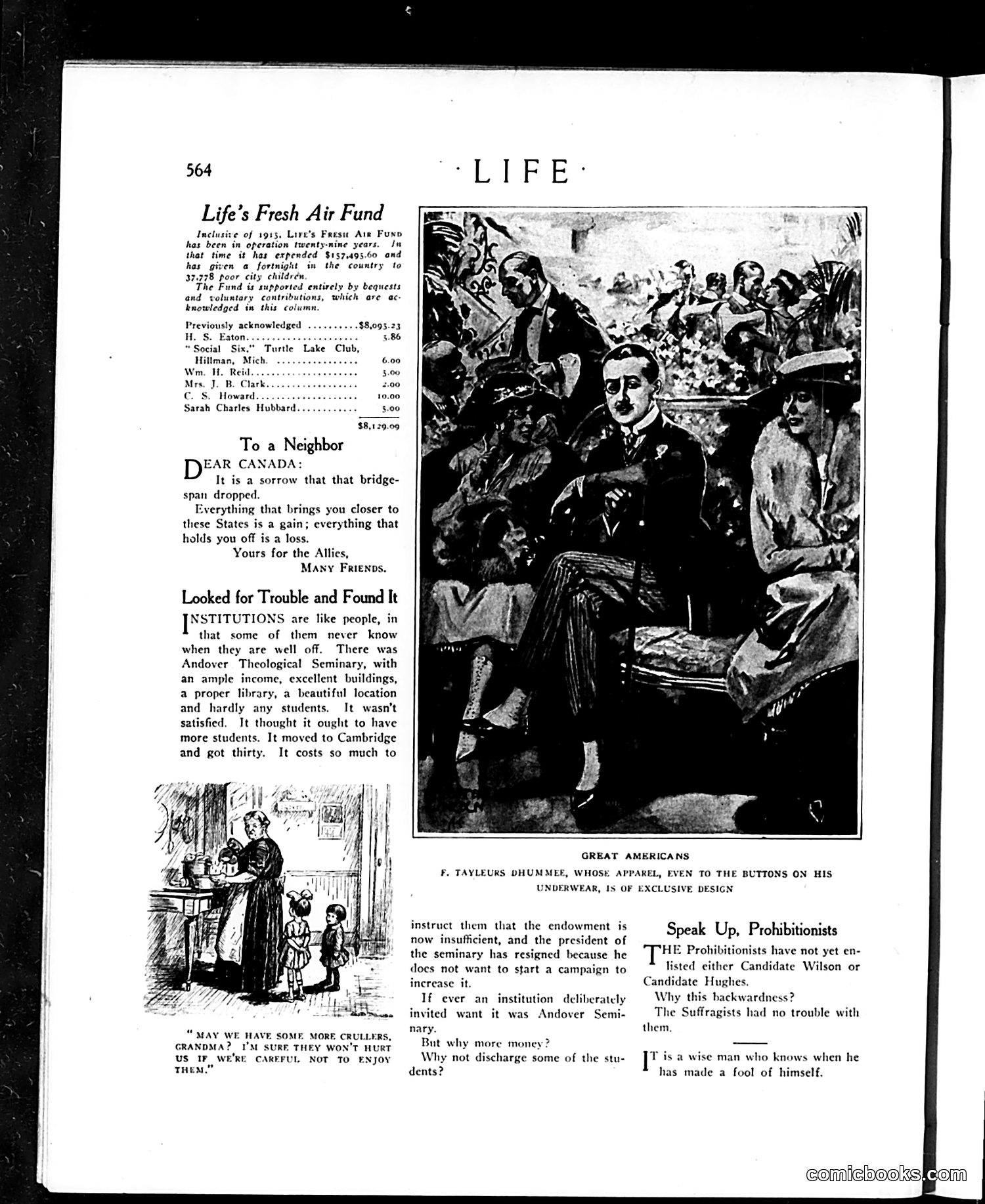
**Main Content:** The large photograph labeled "Great Americans" depicts F. Tayleurs Dhummee, whose "apparel, even to the buttons on his underwear, is of exclusive design." This appears to be satirical commentary on vanity and materialism among the wealthy. **Text Sections:** "*To a Neighbor*" addresses Canada sympathetically regarding a bridge collapse, positioning America as an ally to its northern neighbor during wartime. "*Looked for Trouble and Found It*" criticizes the Andover Theological Seminary for financial mismanagement—the institution had sufficient resources but insufficient students, forcing a costly expansion to Cambridge. "*Speak Up, Prohibitionists*" mocks prohibition advocates for failing to endorse political candidates, questioning their commitment to their cause. The cartoon sketch illustrates domestic life, likely reinforcing themes of everyday concerns.
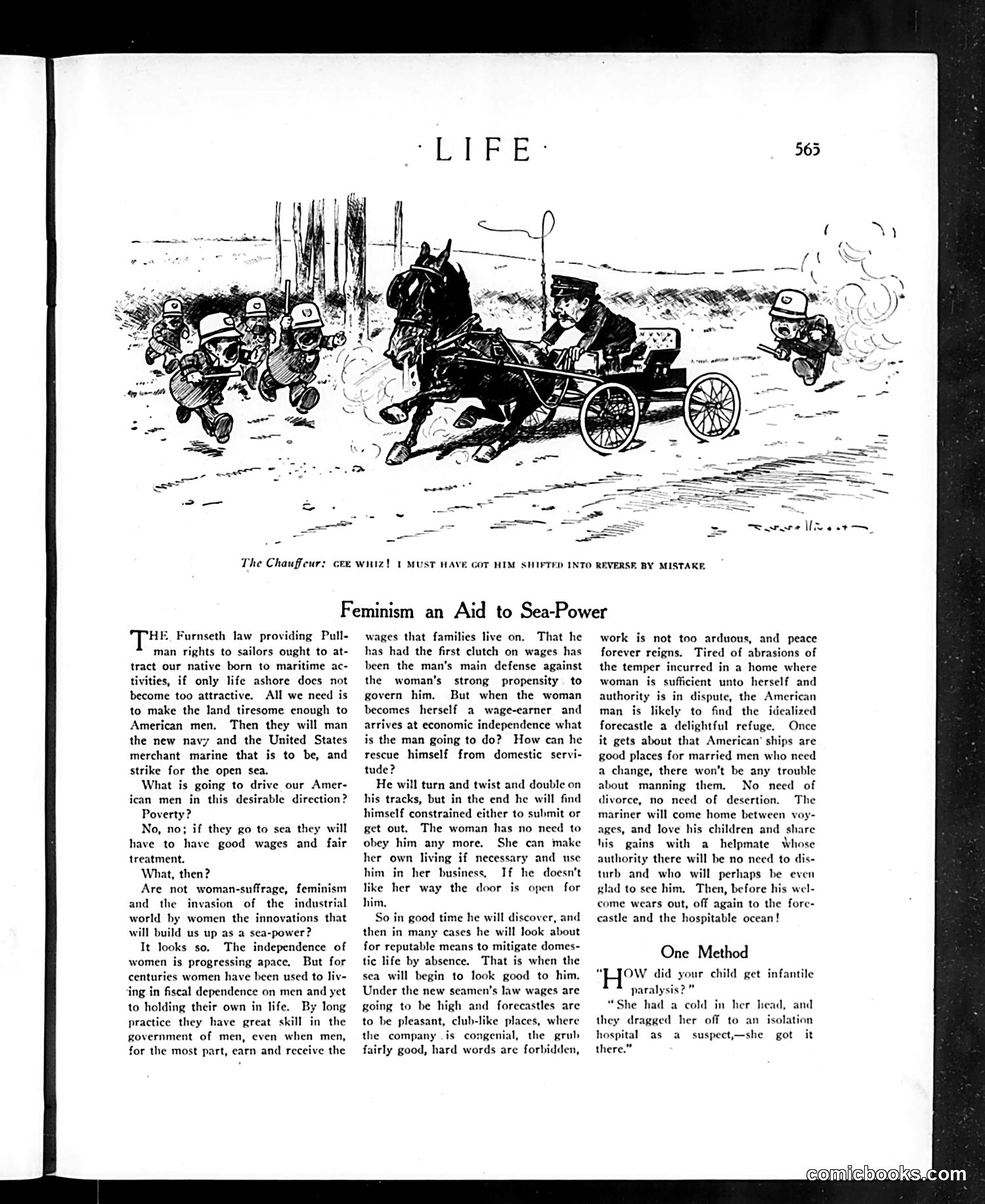
The top cartoon depicts a chauffeur driving a cart pulled by a horse, with small figures (appearing to be sailors or military personnel) running alongside in apparent distress. The caption reads: "GEE WHIZ! I MUST HAVE GOT HIM SHIFTED INTO REVERSE BY MISTAKE." **Meaning:** This is a visual pun. The "chauffeur" (car driver) has accidentally put the vehicle in reverse, causing chaos. The humor likely references contemporary concerns about new automobile technology and human error, satirizing early 20th-century anxieties about mechanical modernization and incompetent operators. The accompanying article, "Feminism an Aid to Sea-Power," discusses women entering the workforce and economic independence, suggesting the cartoon may also comment on social disruption from changing gender roles in the workplace.
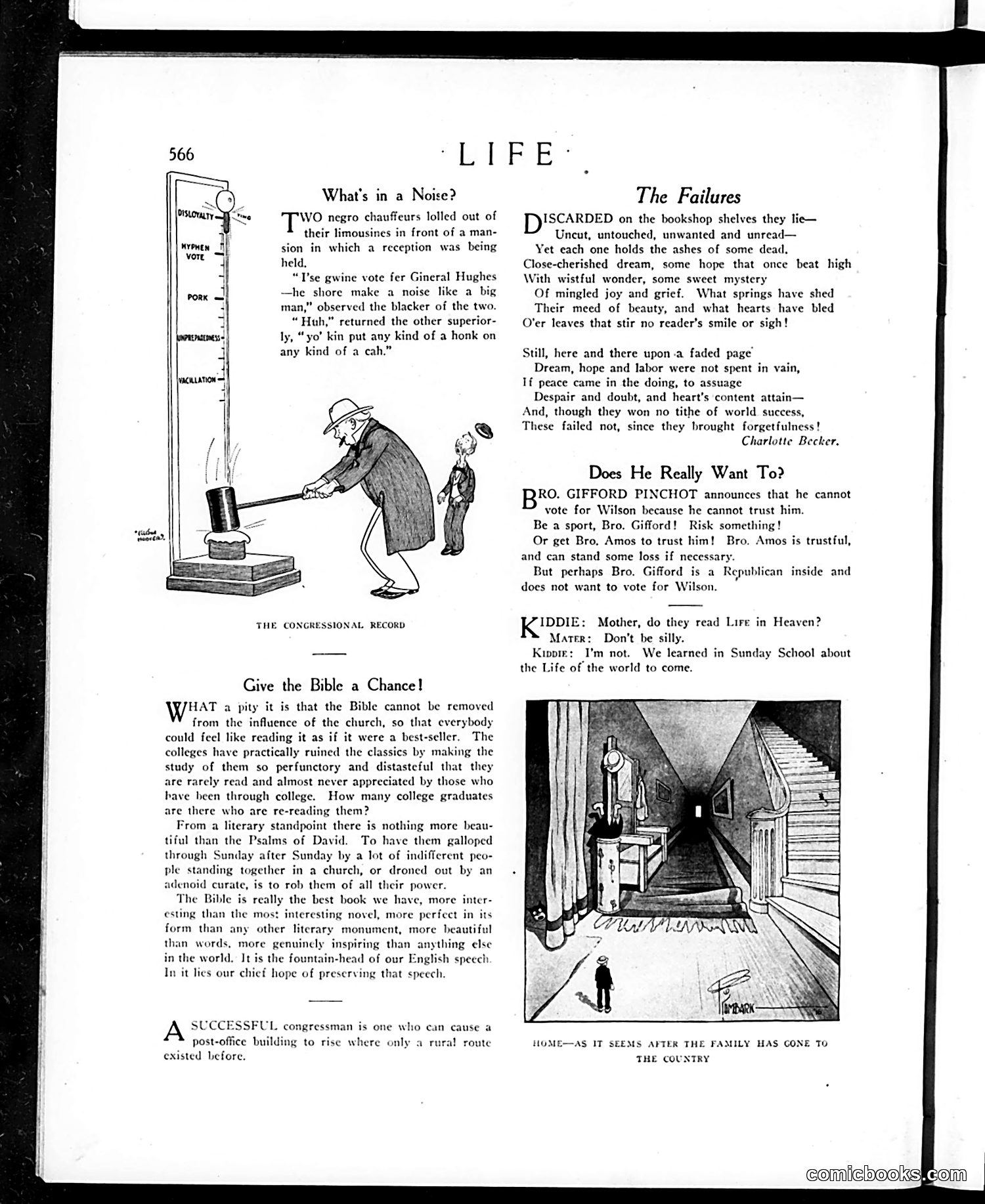
The cartoon satirizes verbose Congressional speeches. It depicts a man operating a large machine labeled "THE CONGRESSIONAL RECORD" with various components (HYPHEN, VOTE, PORK, HYPHENATED, VACILLATION). The machine produces hot air or steam, while a small figure beside it appears overwhelmed or deflated. The satire targets politicians' tendency to fill official records with unnecessary rhetoric, repetition, and contradictory statements ("vacillation"). The "pork" reference suggests wasteful spending proposals. The enormous machine dwarfing the human figure emphasizes how bloated and unwieldy Congressional speech has become—turning what should be substantive legislative discourse into mere mechanical noise-generation. This reflects Progressive Era frustration with political inefficiency and verbosity.
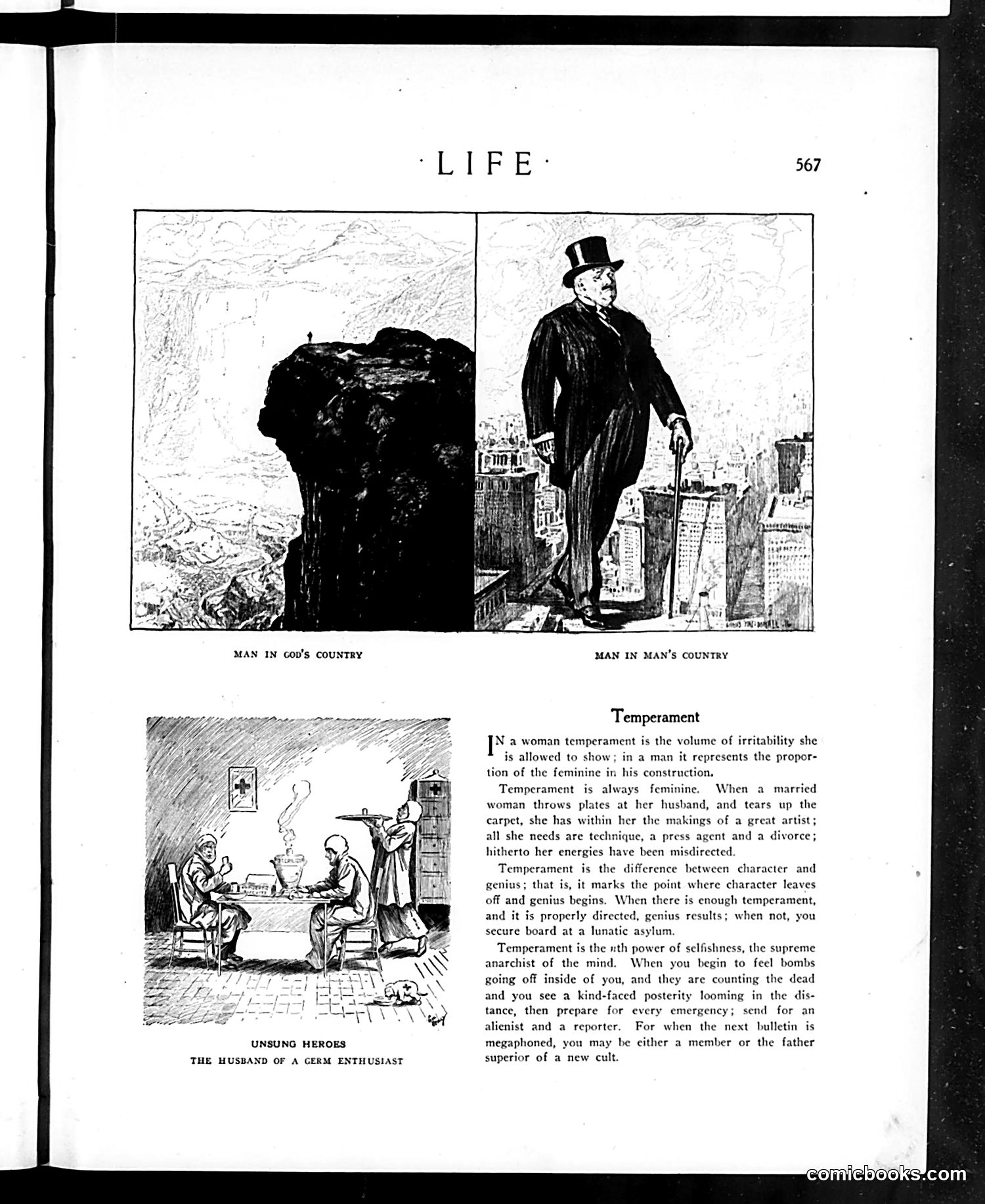
The page presents three cartoons contrasting man's nature across settings. The top pair, "Man in God's Country" and "Man in Man's Country," juxtaposes a figure amid wilderness against a formally dressed gentleman amid urban skyscrapers—suggesting civilization corrupts natural virtue. The bottom cartoon, "Unsung Heroes: The Husband of a Germ Enthusiast," depicts a domestic scene where a woman appears to be conducting some kind of scientific or culinary experiment while her husband sits at table. The satire targets "germ theory" enthusiasm—likely early 20th-century popular anxiety about bacteria—mocking wives who obsessively applied new scientific health theories at home, potentially making domestic life unpleasant for husbands. The accompanying essay on "Temperament" discusses feminine irritability and its distinction from genius.
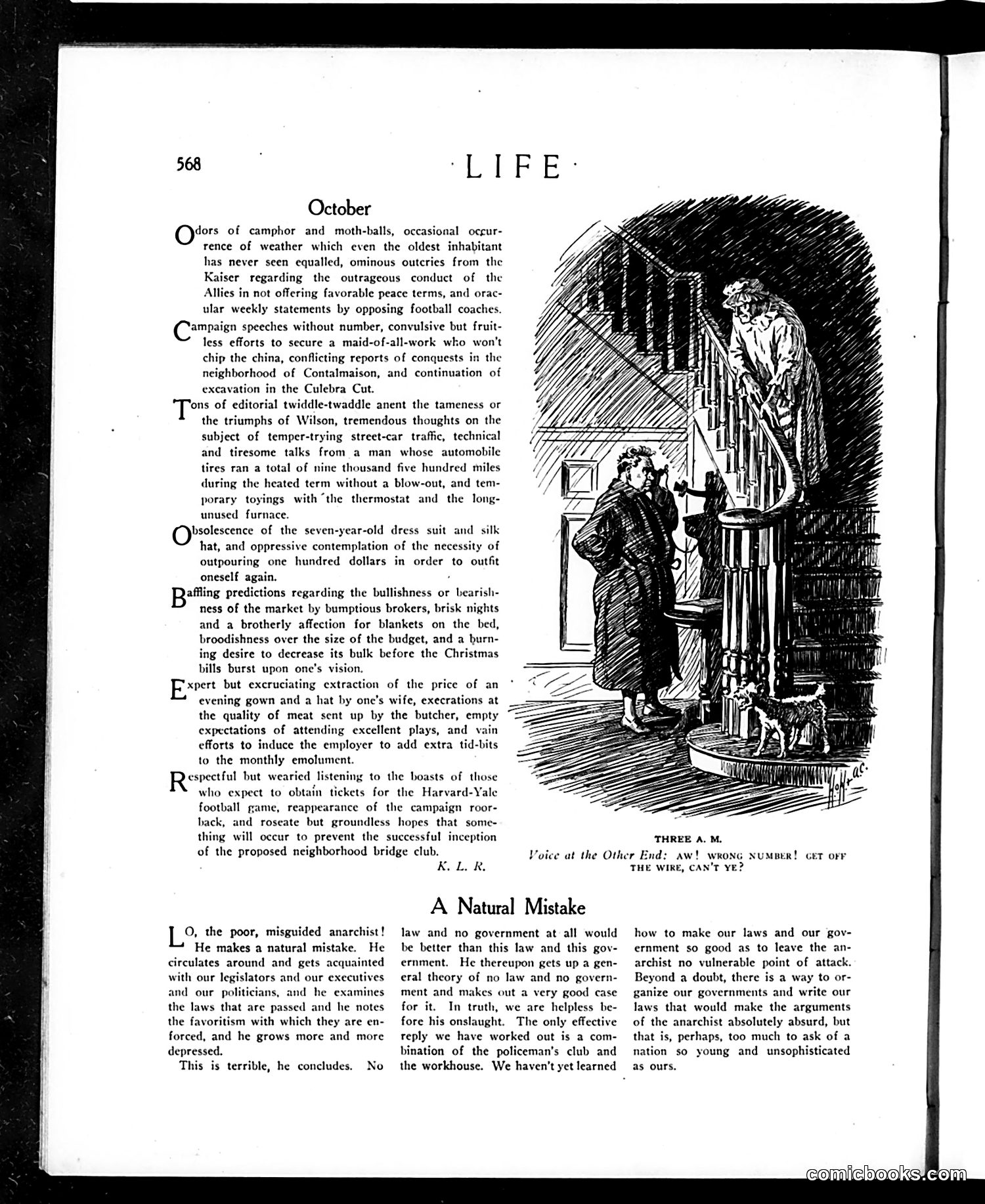
The cartoon illustrates the article below it about an anarchist's misguided logic. The image shows a figure at a doorway being confronted by what appears to be a law enforcement or authority figure. The caption reads: "THREE A.M. 'Voice at the Other End': 'AW! WRONG NUMBER! GET OFF THE WIRE, CAN'T YE?'" The article discusses an anarchist who circulates among legislators and executives, examining laws and concluding government causes oppression. The satire's point: the anarchist's reasoning is flawed—he doesn't recognize that laws and policing, while imperfect, actually prevent chaos. The "natural mistake" is believing no government would be better than imperfect government. The late-night wrong-number intrusion may symbolize the anarchist's disruptive interference in society.
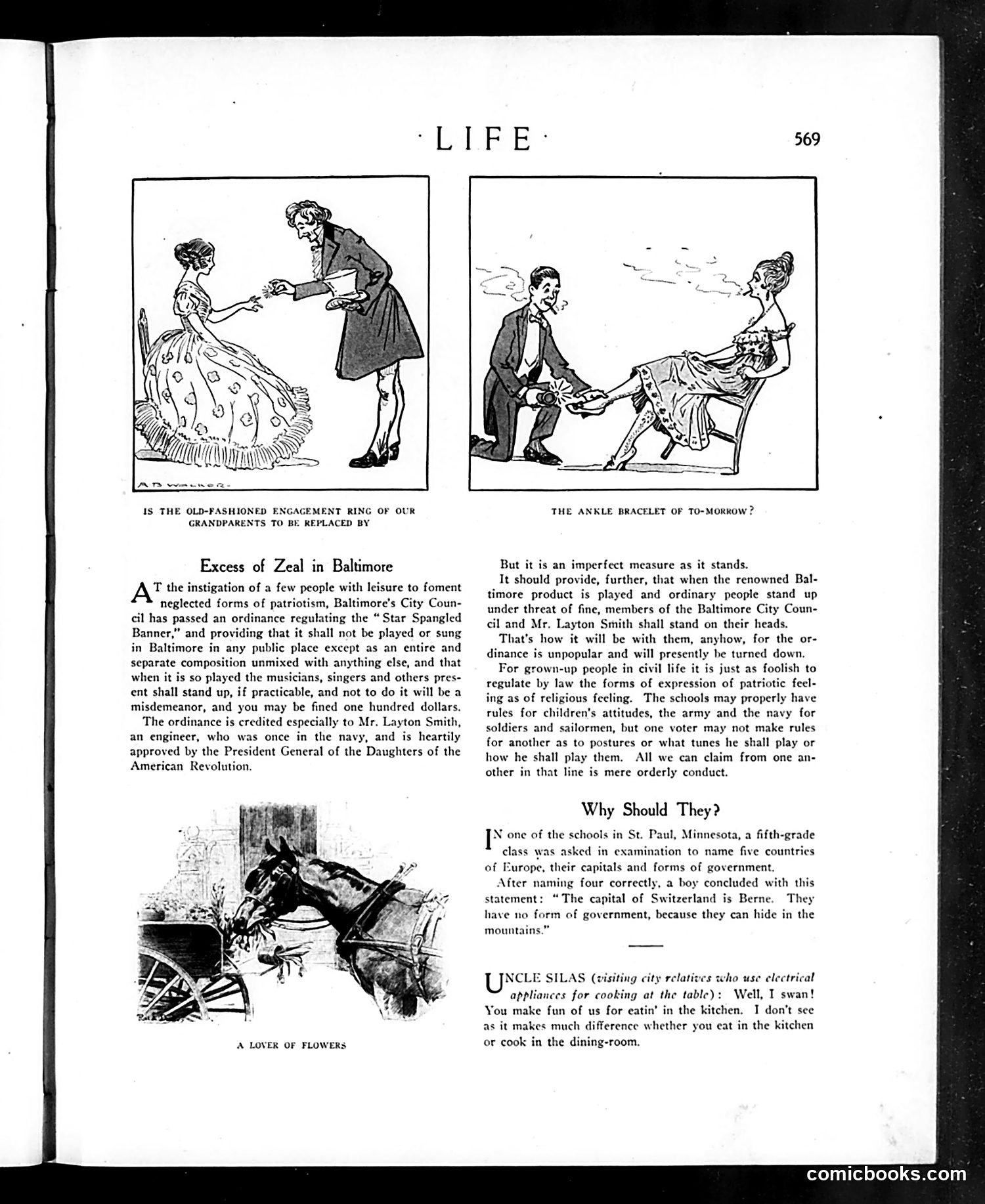
The top two cartoons mock early 20th-century courtship customs. The left panel questions whether old-fashioned engagement rings should be replaced by something else. The right panel suggests "the ankle bracelet of to-morrow" as an alternative—satirizing how engagement traditions might evolve. The main article, "Excess of Zeal in Baltimore," criticizes an overzealous ordinance regulating the "Star Spangled Banner's" performance in public spaces. The author argues this patriotic regulation, credited to engineer Layton Smith, is counterproductive and unpopular, and will soon be repealed. Below, "Why Should They?" presents a humorous school examination answer where a Swiss student incorrectly claims Switzerland has "no form of government, because they can hide in the mountains." The final item features Uncle Silas making a joke about cooking in kitchens versus dining rooms.
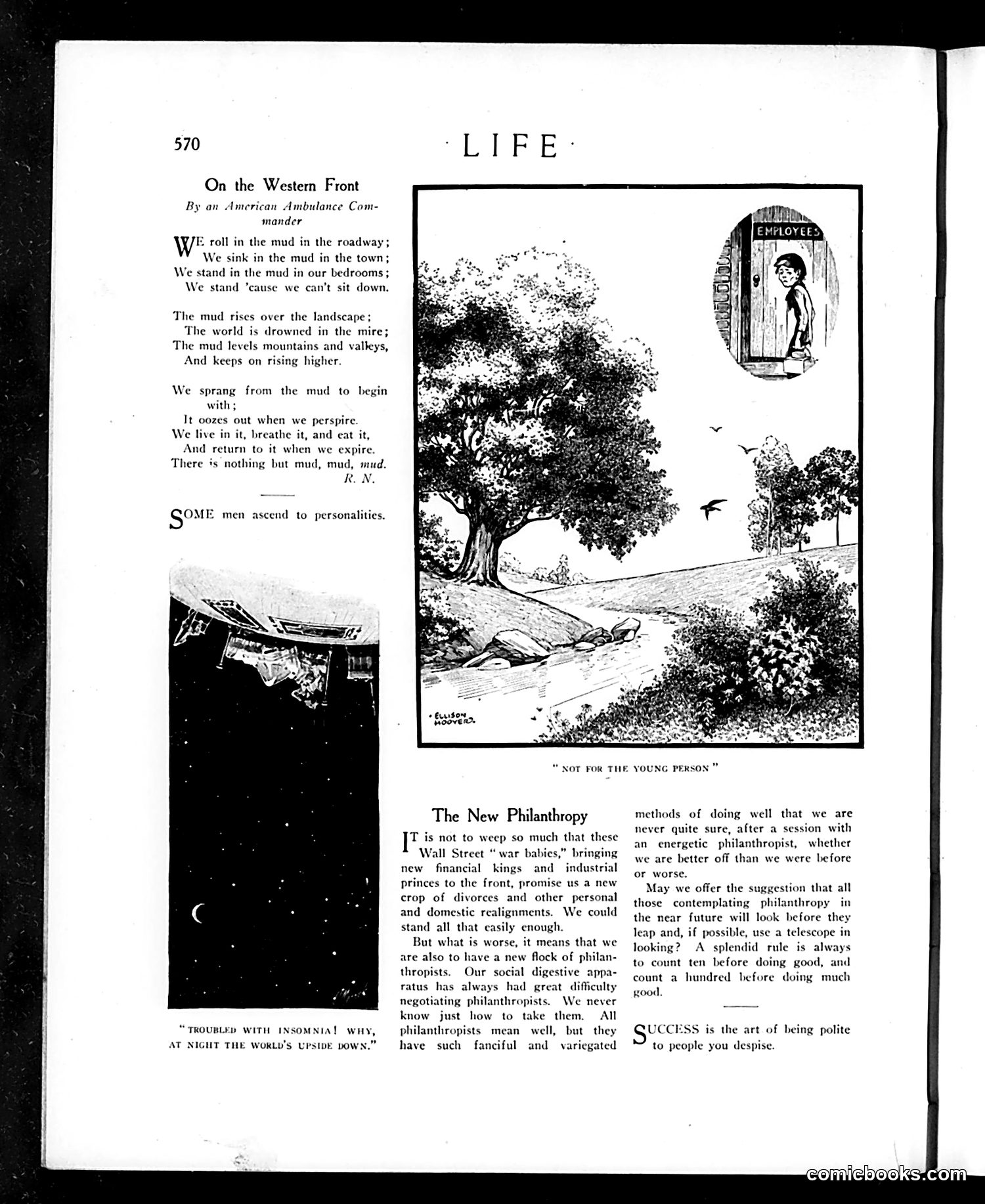
This page contains a poem "On the Western Front" by an American Ambulance Commander, depicting trench warfare's mud and horror. The accompanying illustrations show soldiers in muddy conditions and a nighttime scene labeled "Troubled with Insomnia? Why, at night the world's upside down." The main cartoon, titled "Not for the Young Person," depicts an idyllic pastoral landscape with a tree and stream—a stark visual contrast to the poem's brutal imagery above it. Below, "The New Philanthropy" satirizes post-war financial speculation and philanthropic efforts. The text criticizes wealthy financiers becoming "philanthropists" after profiting from war, suggesting their charitable intentions lack genuine understanding. The closing aphorism mocks insincere social climbers: "Success is the art of being polite to people you despise." The satire targets war profiteers masquerading as philanthropists.
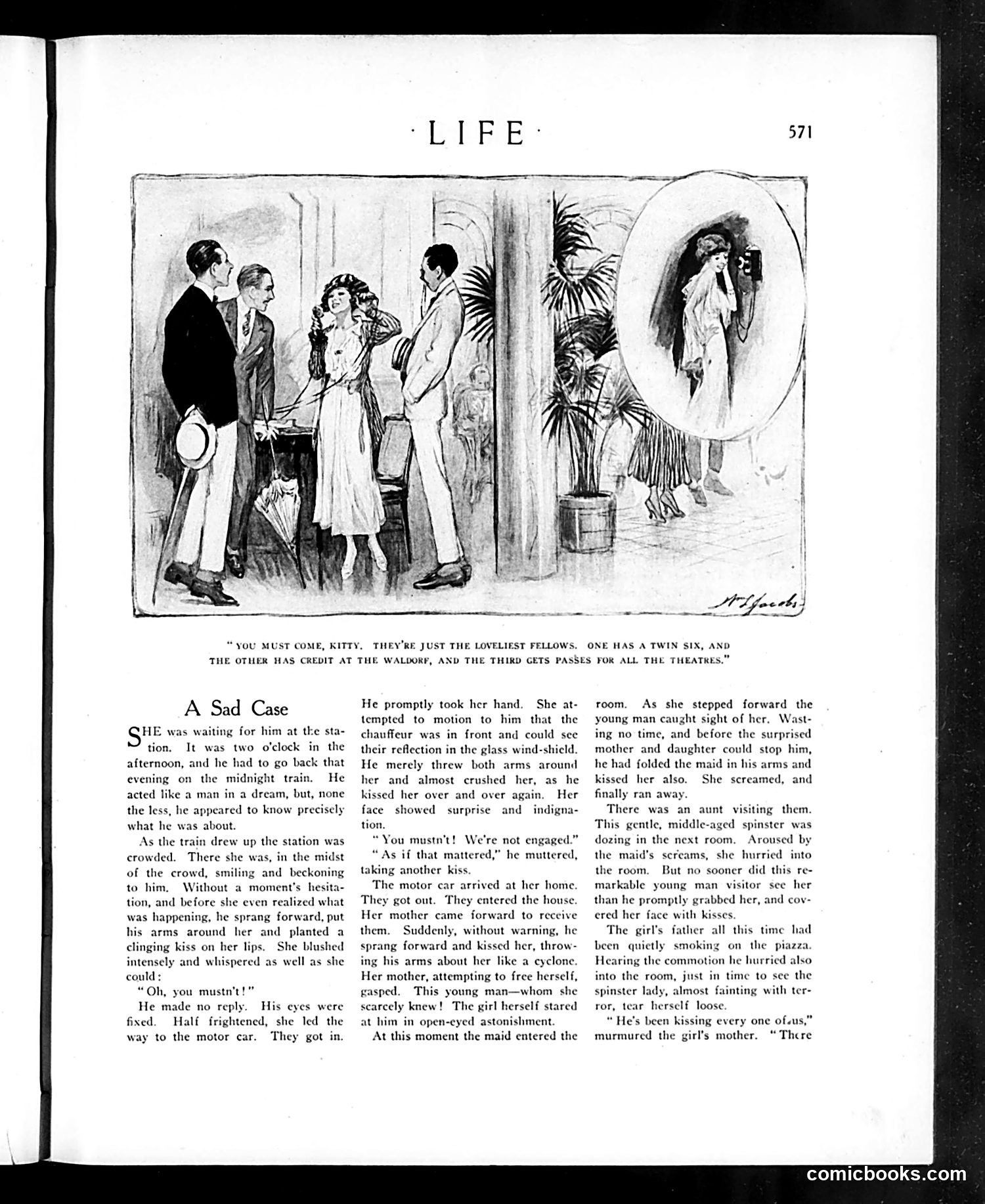
This cartoon illustrates a romantic/social scandal of the early 20th century. The illustration shows a woman being greeted at a train station by a man who embraces her passionately in front of witnesses—an act considered scandalous and improper for unmarked persons in that era. The accompanying story reveals the man is not her fiancé but an imposter who has deceived her. The humor/pathos lies in the social embarrassment: the public display of affection compromises the woman's reputation, and her family's mortification upon discovering the deception. The cartoon satirizes both romantic naiveté and the rigid social conventions of the period, where a woman's respectability depended entirely on propriety and proper courtship rituals.
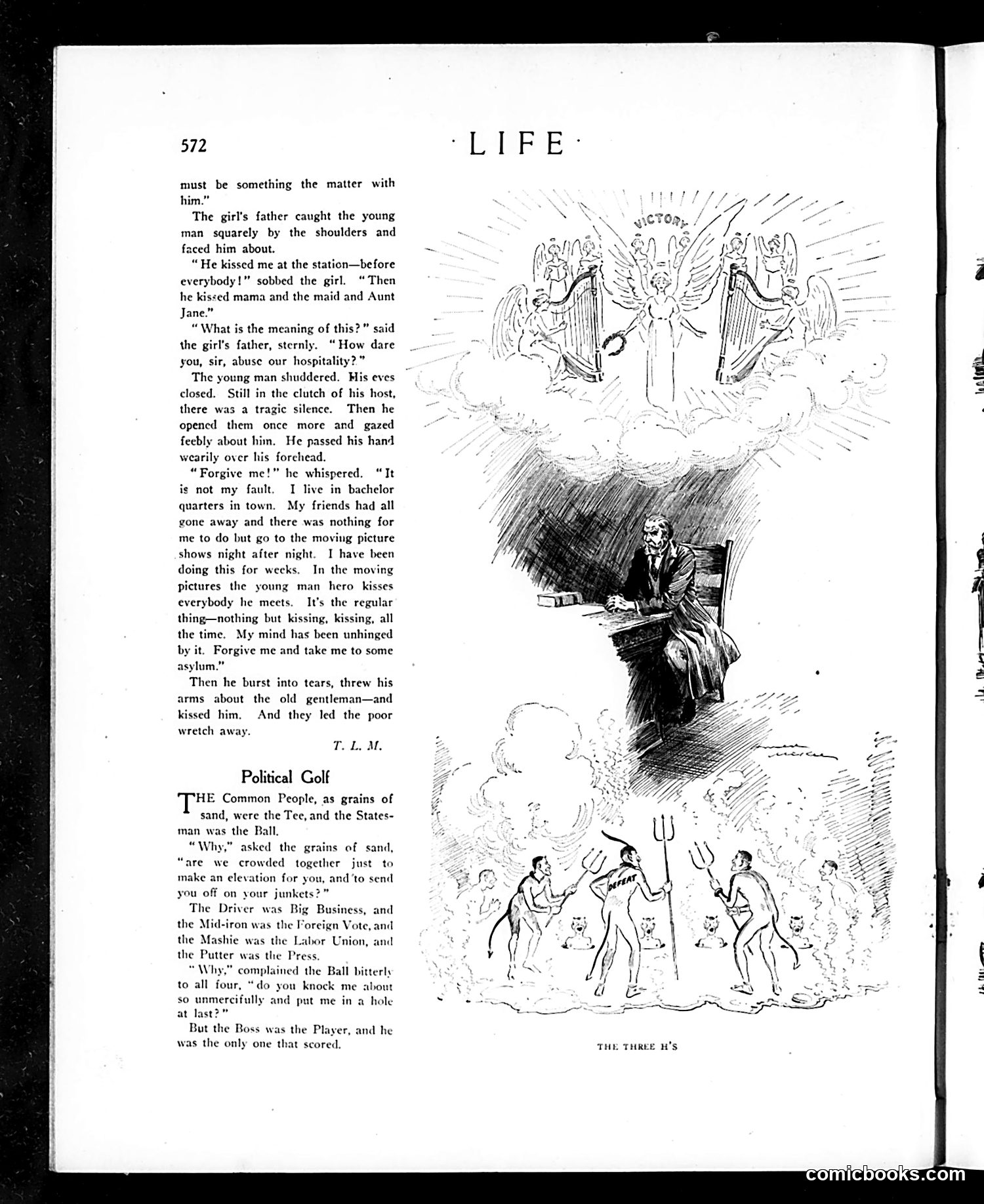
This cartoon uses golf as a metaphor for American politics. The Common People are the "Tee," while the Statesman is the "Player." Various political figures are identified as obstacles: - The Tariff = "Big Business" - Mid-iron = "Foreign Vote" - Mashie = "Labor Union" - Putter = "Press" The joke: these four groups constantly interfere with the statesman's ability to govern effectively. The Ball (labeled "THE THREE H'S") complains of being "knocked about so unmercifully and put me in a hole at last?"—suggesting political problems get passed between competing interests without resolution. The satire critiques how American politics involves constant conflicts among business, foreign voters, labor, and media, preventing effective governance. The date and specific political context remain unclear from the visible text.
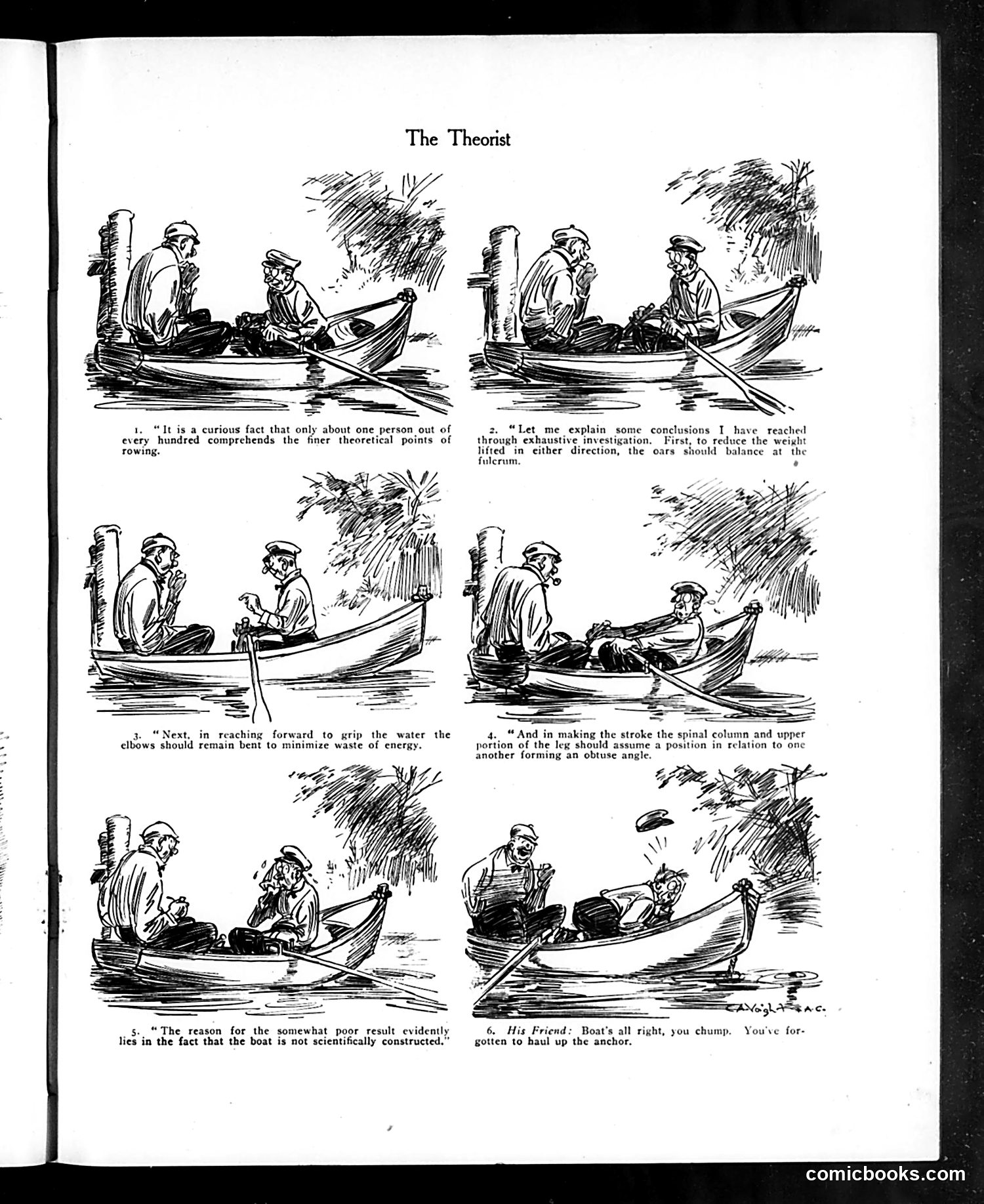
This six-panel comic mocks someone who lectures extensively about rowing theory while demonstrating incompetence in practice. The "theorist" fills his companion's ear with elaborate technical explanations—about balance points, spinal columns, energy conservation, and boat construction—while repeatedly failing at basic rowing tasks. The satire targets the gap between intellectual knowledge and practical skill. Despite confidently explaining *why* things should work (panel 5: "The reason for the somewhat poor result evidently lies in the fact that the boat is not scientifically constructed"), the theorist's boat remains poorly managed. Panel 6's punchline—his friend noting they've "forgotten to haul up the anchor"—suggests the theorist overlooks obvious, simple problems while obsessing over theoretical details.
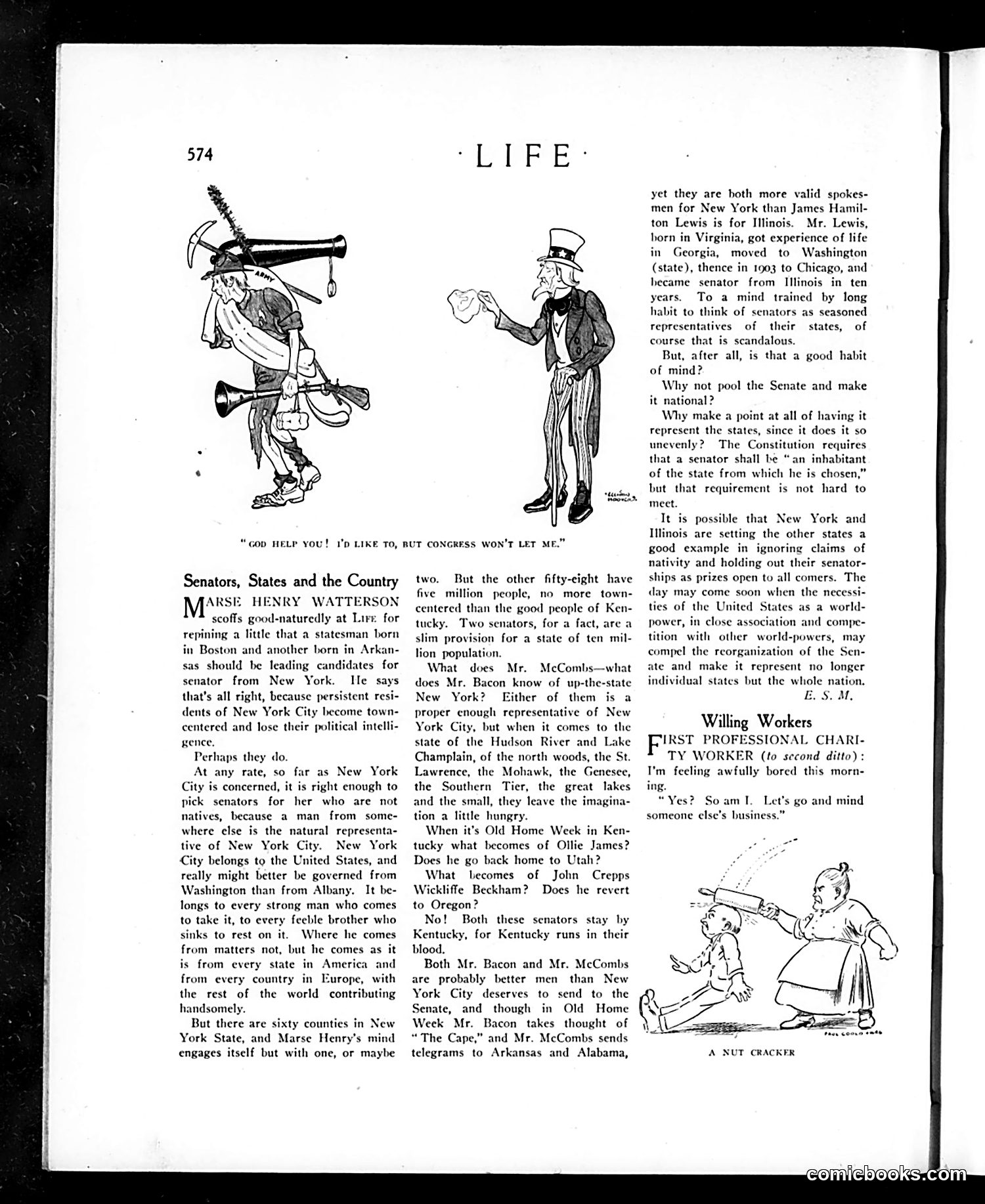
The top cartoon depicts Uncle Sam (identifiable by his characteristic hat and appearance) struggling with various implements of governance while Congress blocks his efforts—illustrating governmental gridlock. The accompanying essay by Marse Henry Watterson criticizes the practice of electing U.S. Senators from New York who lack deep roots in the state. He notes that senators like Mr. Bacon and Mr. McCombs, while qualified, don't truly represent upstate New York's interests—they're Manhattan-focused outsiders. Watterson proposes a radical solution: abandon the state-representation model entirely and create a truly national Senate serving America's emerging world-power status rather than parochial state interests. The bottom cartoon ("A Nut Cracker") appears unrelated social commentary about charity workers. The satire critiques how geographic representation can become meaningless when politicians lack genuine connection to their districts' actual needs and character.
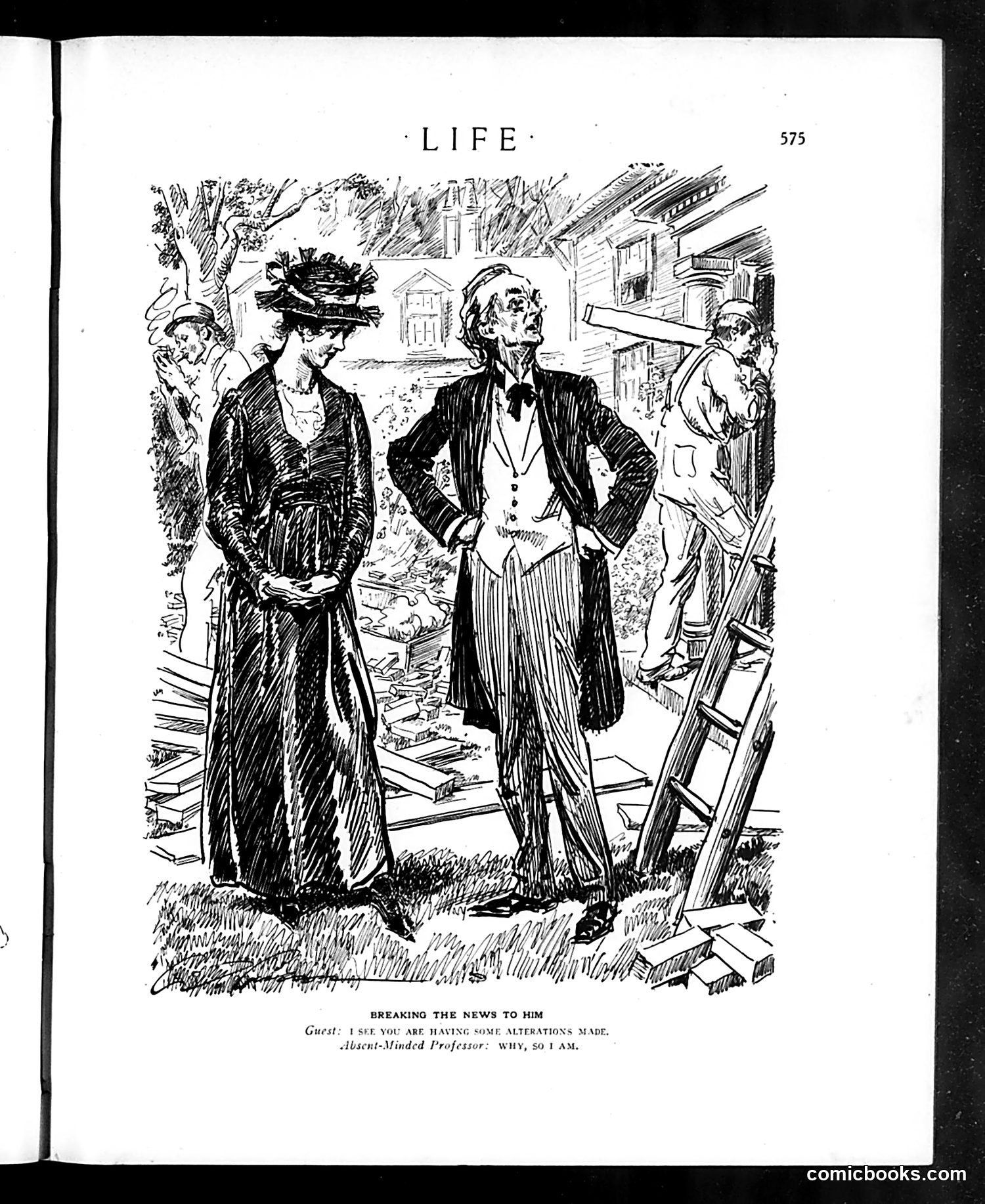
This single-panel cartoon depicts a social comedy about an absent-minded professor. A well-dressed guest observes construction work occurring at the professor's property—visible ladders, building materials, and workers in the background. The guest comments on the "alterations" being made. The professor's response—"Why, so I am"—suggests he's so preoccupied or forgetful that he hasn't noticed the major renovations happening at his own home. The humor relies on the stock character of the impractical academic so lost in thought that he remains oblivious to his immediate surroundings. This was a familiar satirical trope in early 20th-century American humor, poking fun at intellectuals perceived as disconnected from everyday reality.
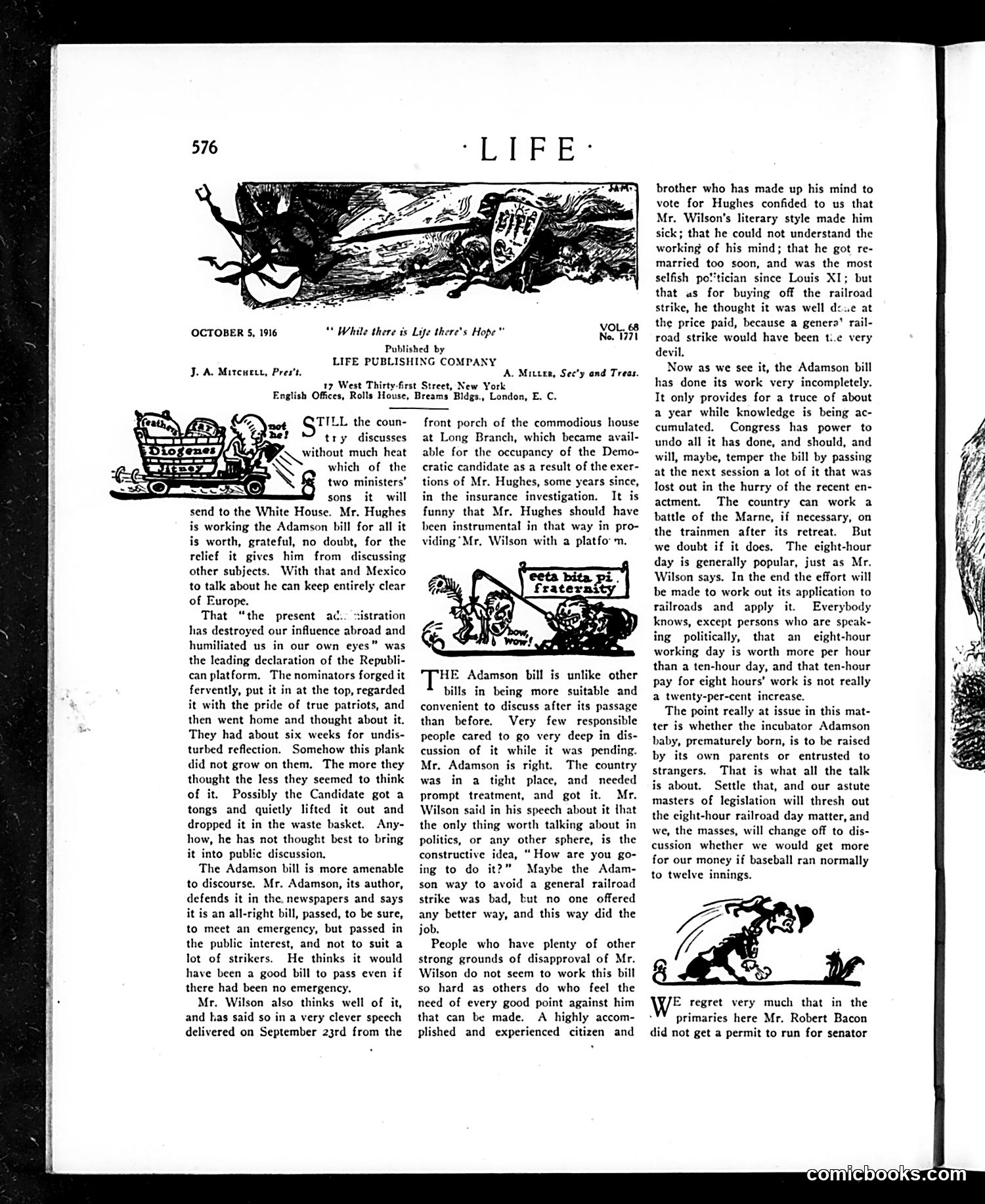
This editorial page discusses the **Adamson bill**—emergency legislation passed to prevent a railroad strike by establishing an eight-hour workday. The 1916 presidential race between **Wilson** (Democrat) and **Hughes** (Republican) frames the debate. The cartoons and text mock Hughes for exploiting the bill politically while avoiding substantive criticism. A key anecdote describes a Hughes supporter who opposes Wilson on literary style, intellect, and personal matters—yet admits Wilson handled the railroad crisis well and cheaply. The satire suggests Republicans lacked genuine policy objections to Wilson, so they seized on minor grievances. The piece argues the Adamson bill, while imperfect and temporary, pragmatically solved an urgent crisis. The real point: Wilson's practical governing success undermined Republican attacks, forcing critics to resort to personality-based complaints rather than substantive policy disagreement.
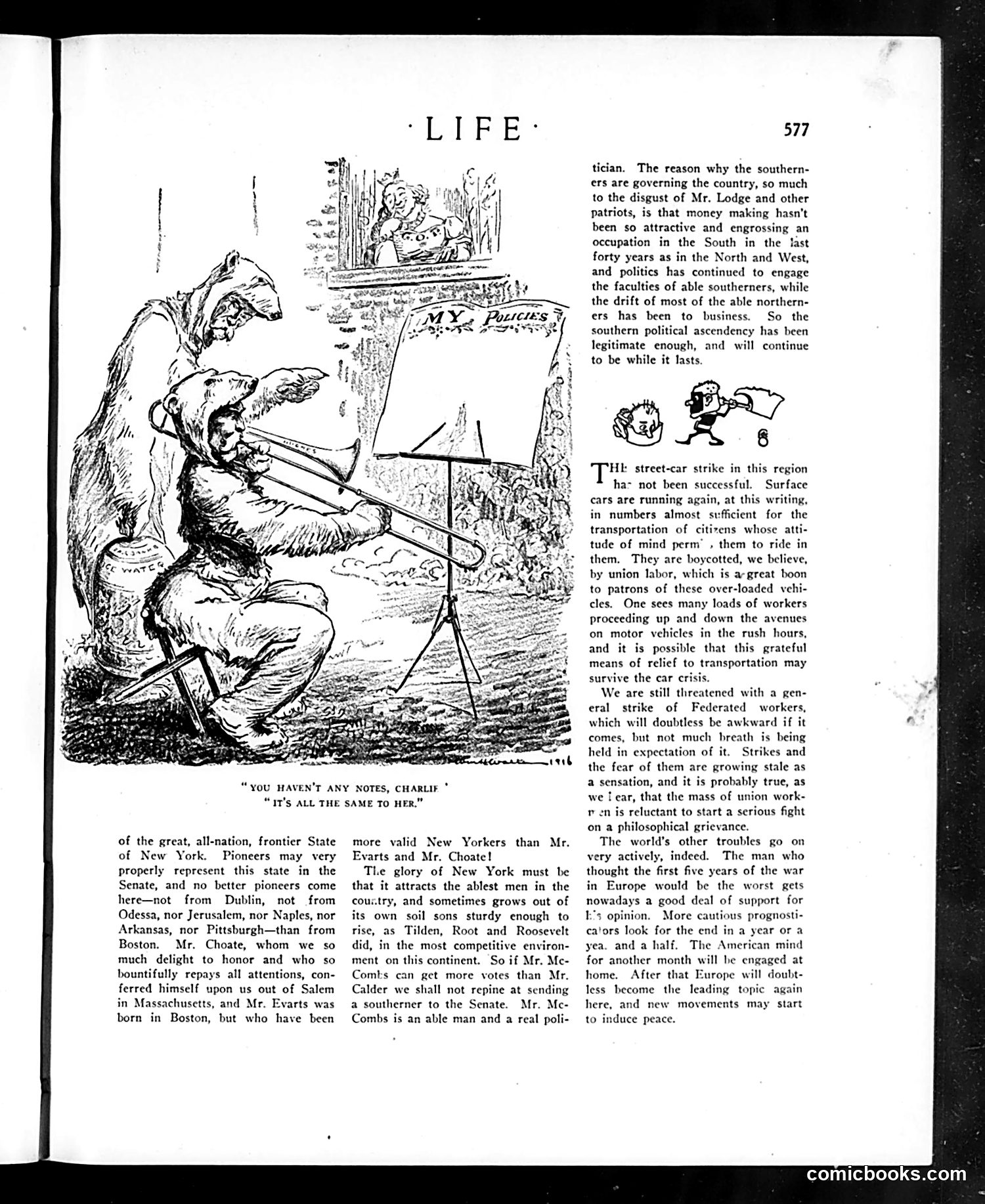
## The Main Cartoon The large illustration shows a disheveled man sitting by a tree, fishing or resting, with a sign reading "MY POLICIES" nearby. The caption reads: "YOU HAVEN'T ANY NOTES, CHARLIE / IT'S ALL THE SAME TO HER." This appears to satirize a political figure (likely "Charlie," possibly referring to a politician of the era) whose policies are nonexistent or indistinguishable—"it's all the same" to the electorate ("her"). The cartoon critiques hollow or meaningless political positioning. ## The Text Context The surrounding article discusses New York Senate candidates, praising southern politicians' engagement in governance versus northern focus on business. It also dismisses the ongoing street-car strike as unsuccessful and largely ineffective, suggesting union labor boycotts are actually benefiting non-striking commuters. The tone is dismissive of labor action as a "stale" sensation. The small illustration at right (lower corner) appears to show children or figures in motion, likely related to the labor dispute discussion.
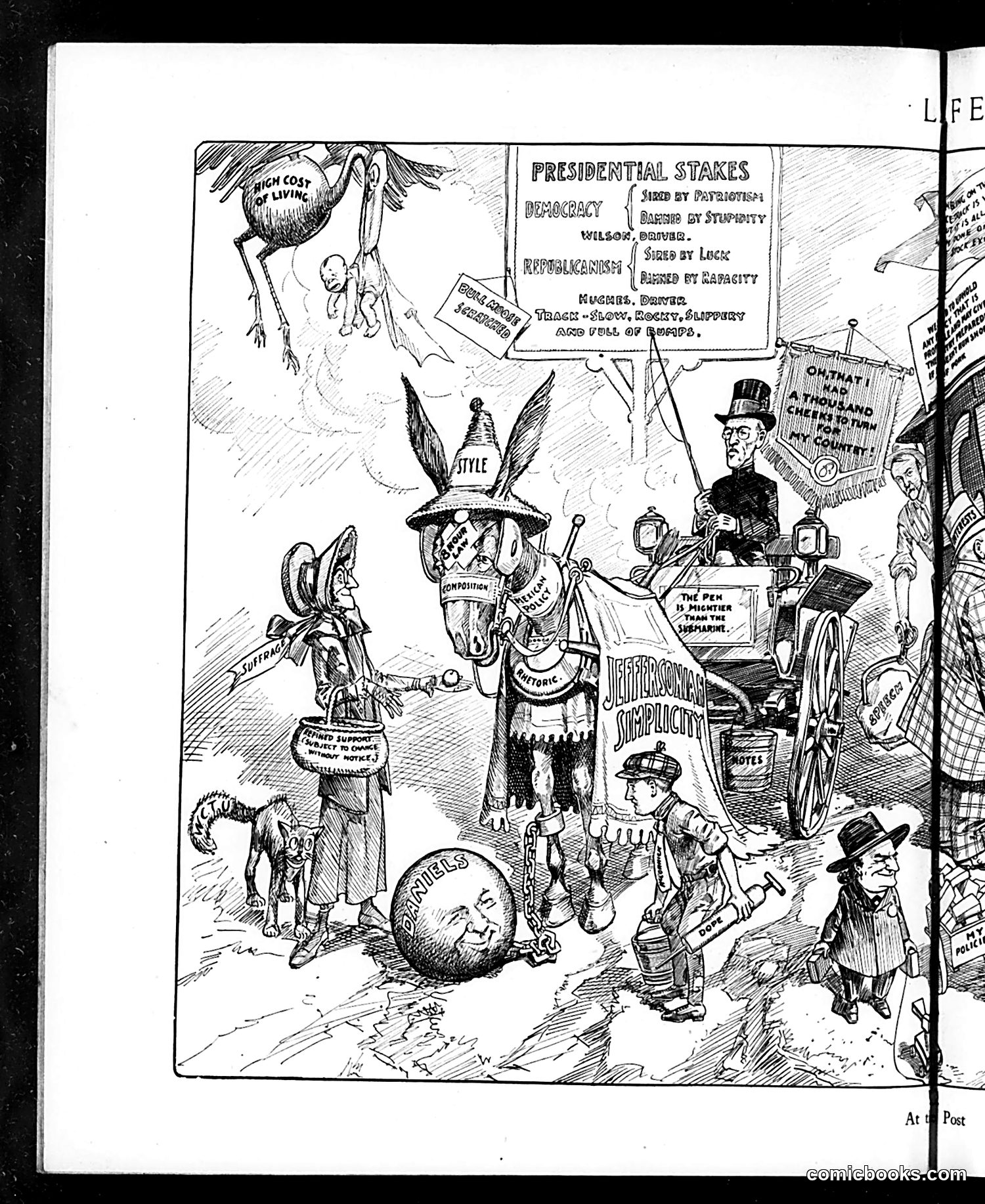
This is a satirical cartoon about the 1912 U.S. presidential election, depicting the race as a carnival or circus spectacle. The central figure is a decorated horse labeled "ROOSEVELT," suggesting Theodore Roosevelt's prominent role in splitting the Republican Party via his Progressive "Bull Moose" Party candidacy. The cartoon mocks the election as theatrical entertainment rather than serious governance. Various figures represent different political factions and their characteristics—labeled with qualities like "Stupidity," "Lucre" (greed), and "Capacity." The carnival imagery (performers, a carriage, circus-like atmosphere) implies the candidates and issues are frivolous spectacle. At top, a spider holds a ball labeled "High Cost of Living," suggesting this genuine concern is merely being manipulated. The sign listing candidate qualities and their "riders" satirizes how each candidate embodies specific flaws or is controlled by particular interests. Overall, the cartoon expresses cynicism about the election's substance and integrity.
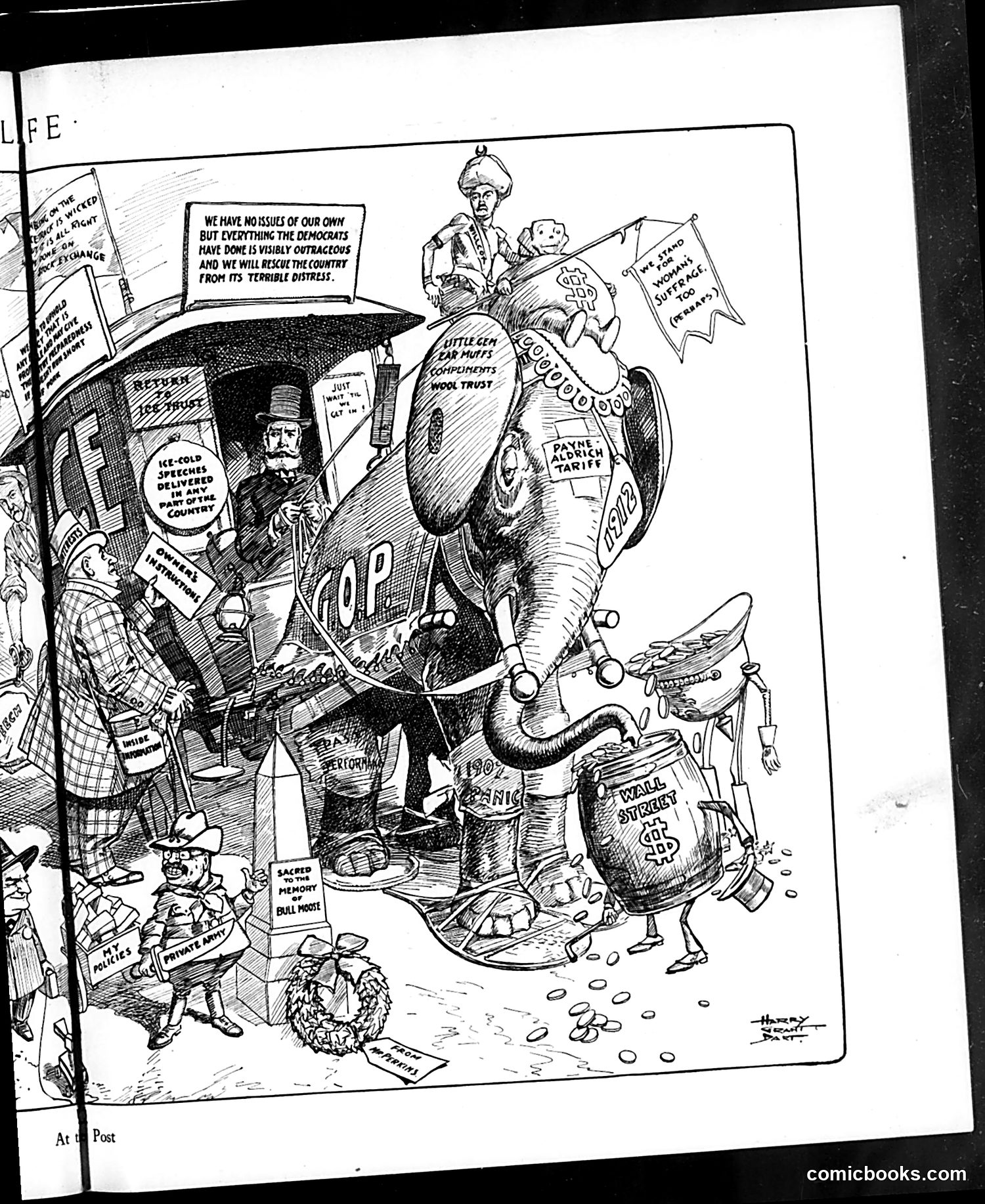
This is a satirical cartoon depicting a large elephant labeled "Republican" being ridden by figures representing Republican leadership, carrying various labels including "Wool Trust," "Little Gem Ear Muffs," and "Aldrich Tariff." The elephant is laden with baggage and followed by smaller figures labeled "Wall Street" and other corporate interests. The cartoon critiques Republican Party alignment with big business monopolies and trusts. The speaker (likely a Republican politician) claims they'll rescue the country from distress, while the visual evidence—the elephant burdened with corporate labels and special interests—suggests Republicans are actually tools of wealthy trusts and monopolies, not saviors. The satire mocks the gap between political rhetoric and actual corporate influence on the party.
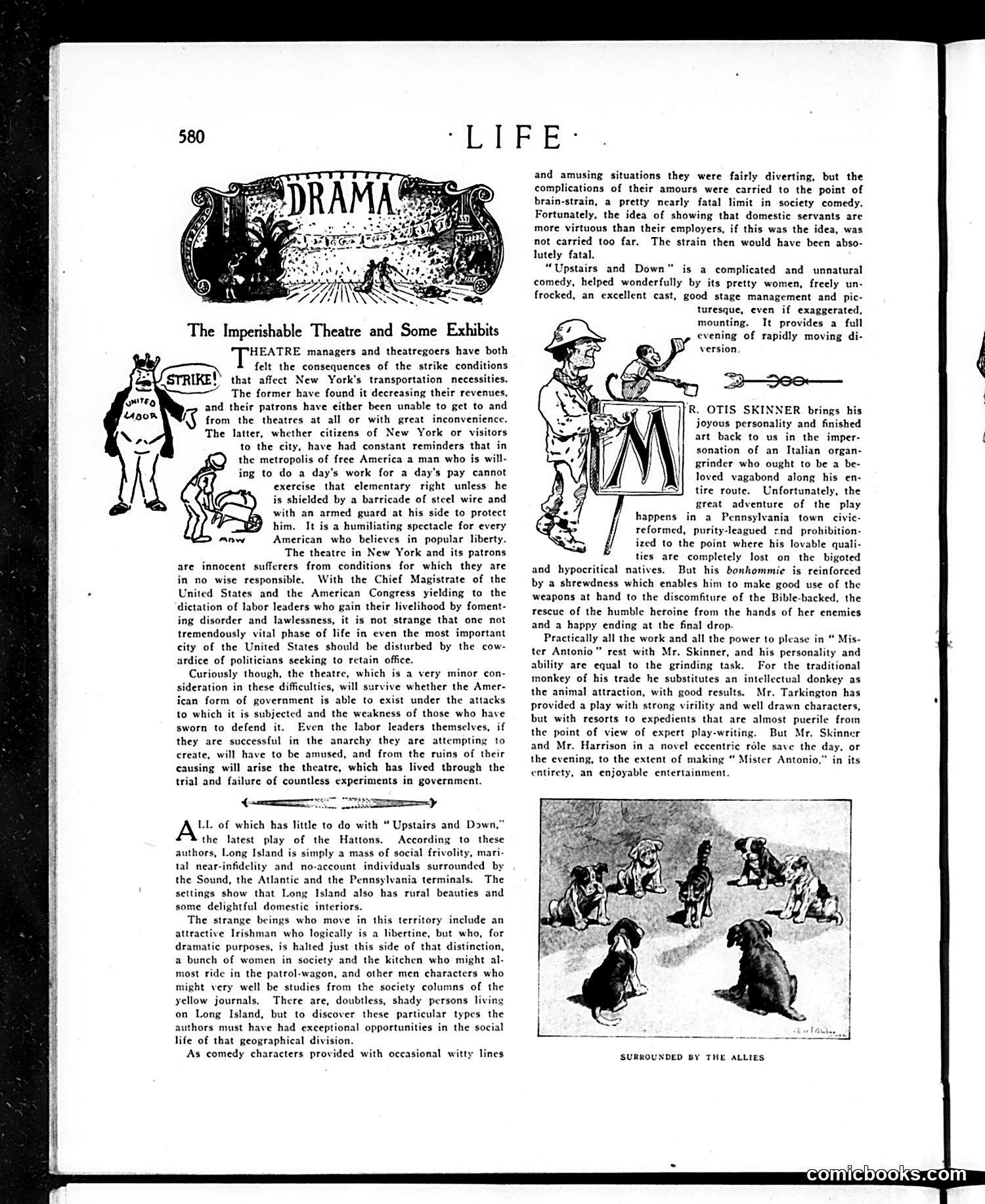
This page critiques New York's labor strike (appearing to reference transportation strikes affecting theater attendance). The left column argues that while theater managers and patrons suffer innocent losses, the real issue is larger: politicians' "cowardice" in yielding to labor leaders, undermining American governance and liberty. The piece argues that even amid government collapse, theater will survive—positioning it as a resilient cultural institution. The cartoon shows a figure labeled "STRIKE" alongside imagery suggesting labor conflict and restrictions on workers' freedom (armed guards, steel wire barriers). The satire targets political weakness in confronting labor unrest. The right column reviews the play "Upstairs and Down," describing Long Island society types—wealthy frivolous characters and servants—with thinly veiled criticism of the wealthy's moral failings. This serves as social satire about class hypocrisy on Long Island during the era.
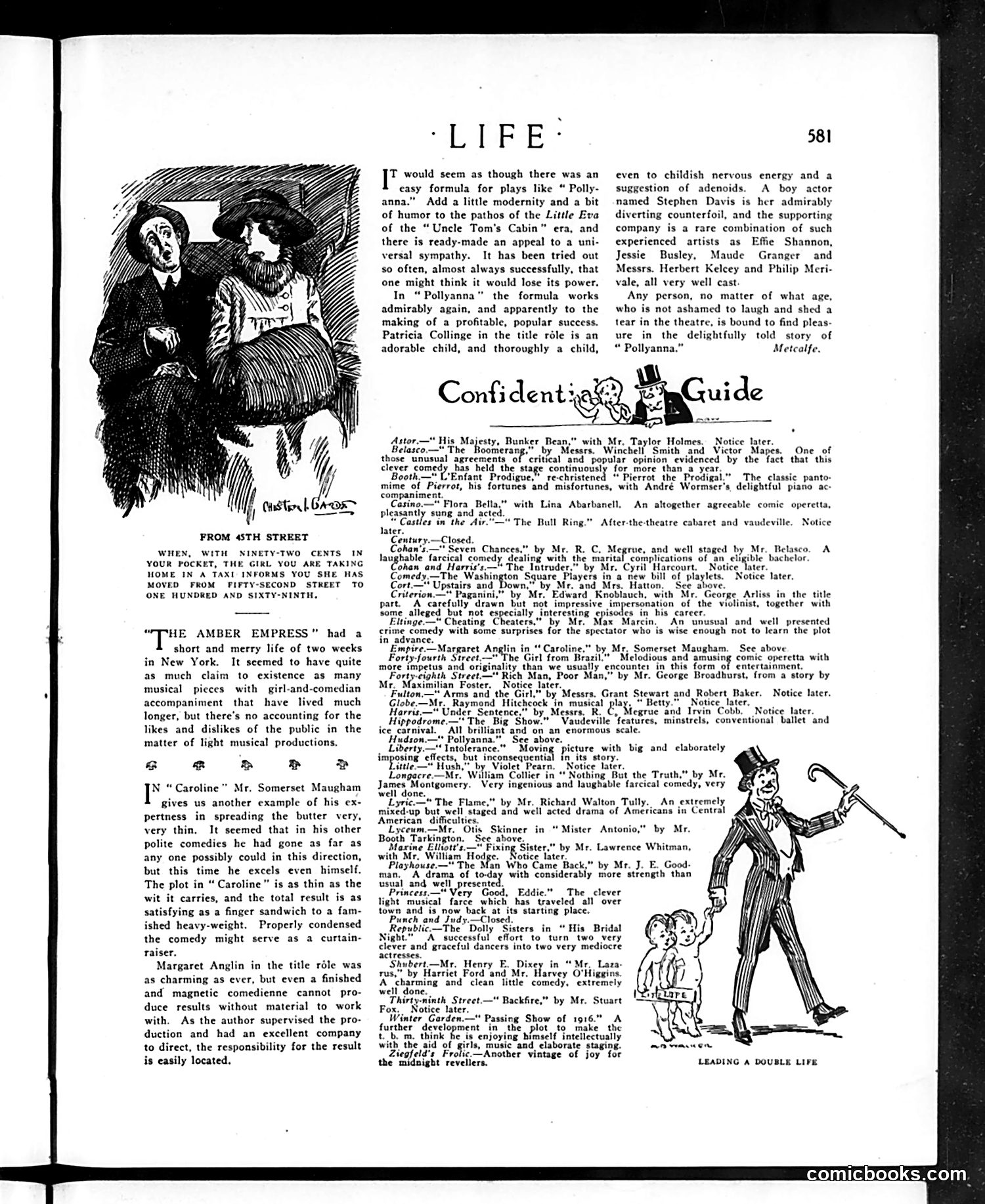
This page combines theater reviews with a cartoon satire about New York courtship costs. The cartoon (bottom right) depicts a young man shocked when his date casually mentions she's moved from 52nd Street to 169th Street—a significant uptown distance. The caption's joke hinges on practical economics: with only 92 cents in his pocket, he's now facing a much longer, more expensive taxi ride home. The humor satirizes the financial strain of dating in 1920s New York, where transportation costs were real expenses and a woman's casual neighborhood change could unexpectedly drain a suitor's meager funds. The title "Leading a Double Life" suggests the pretense required to maintain romantic pursuits despite limited means—a common theme in Life magazine's satirical commentary on urban middle-class life.
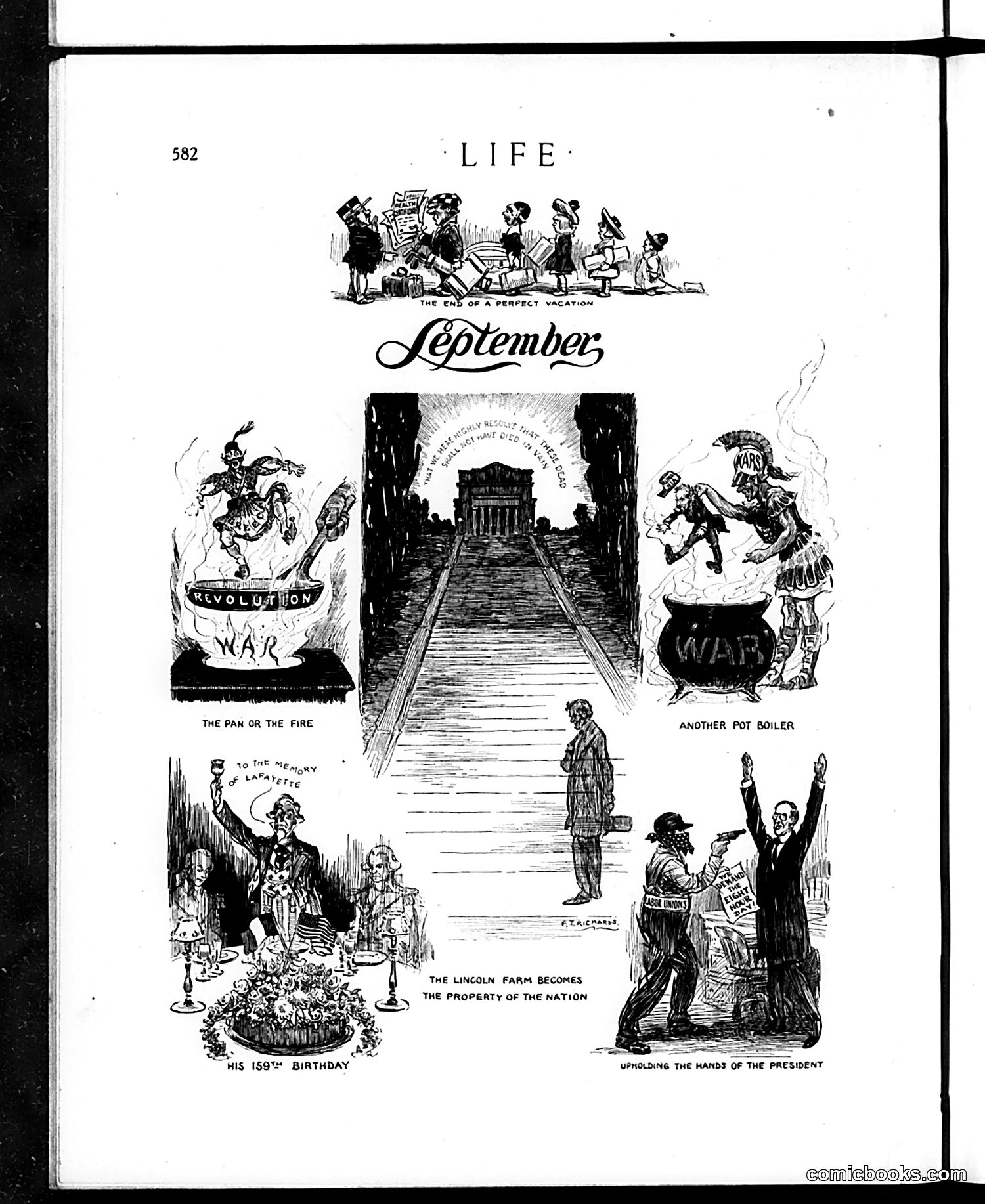
This page features satirical cartoons addressing September 1916 events. The central image shows a path to a classical building, likely representing national patrimony. The cartoons reference: - **"The Pan on the Fire"** and **"Another Pot Boiler"**: These appear to critique political agitation, labeled "Revolution" and "War"—likely referring to domestic unrest or international conflicts. - **"His 159th Birthday"**: Celebrates Lincoln's birthday with patriotic imagery, connecting to the main caption about the Lincoln Farm becoming national property. - **"Upholding the Hands of the President"**: Shows figures supporting the President's position, suggesting political backing during a contentious period. The overall theme celebrates American institutions and presidential authority while satirizing political discord and warmongering rhetoric of the era.
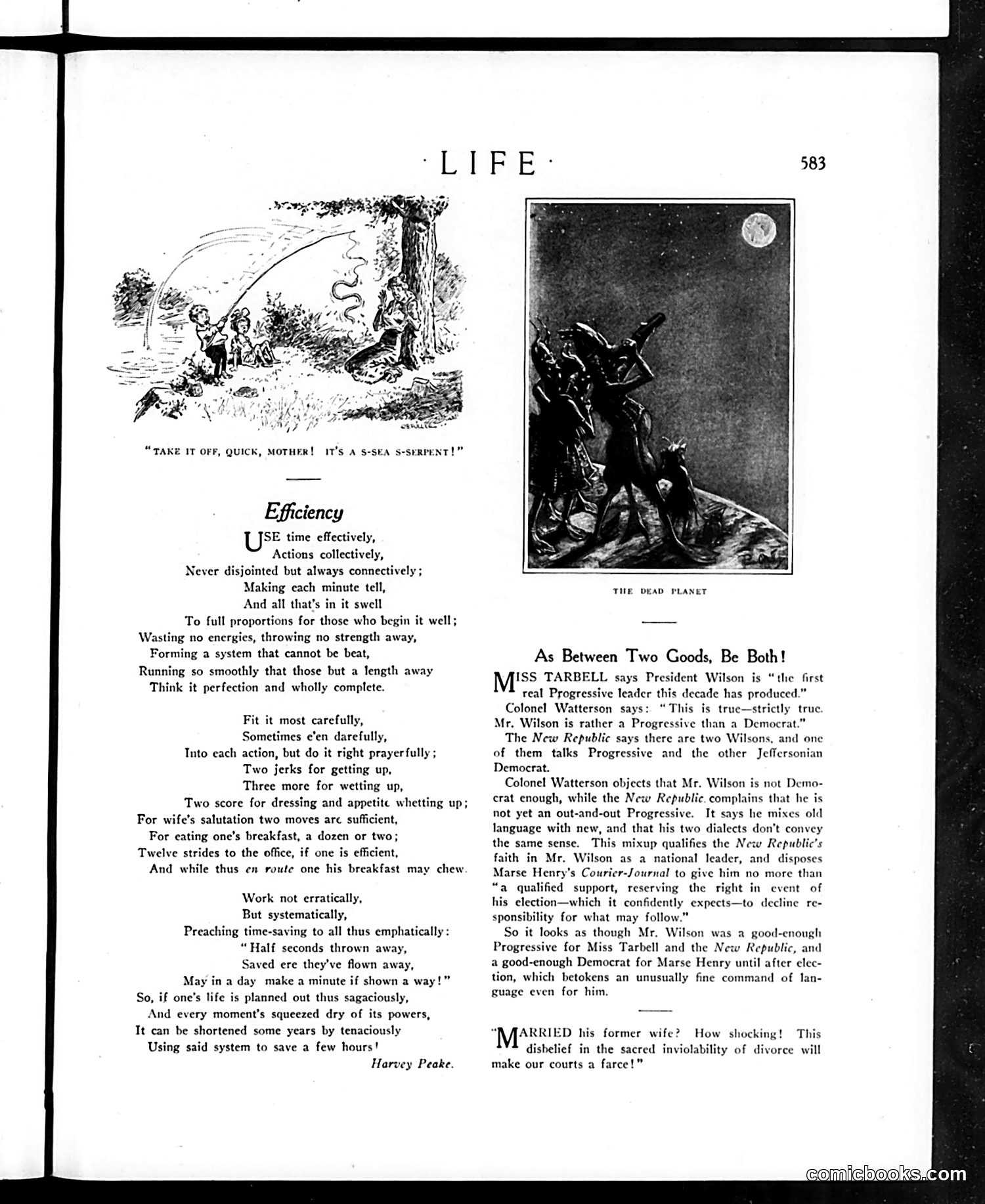
**The Cartoons:** The top sketch depicts a child misidentifying a fishing line as a sea serpent—a simple joke about misperception. "The Dead Planet" (right image) appears to be dark/fantastical artwork, likely unrelated to the political content. **The Political Content:** The main article satirizes President Wilson's ambiguous political positioning. Multiple prominent figures—Ida Tarbell, Colonel Watterson, and *The New Republic* magazine—praise Wilson as Progressive, yet simultaneously complain he's not purely Progressive or Democratic enough. The satire's point: Wilson successfully appeals to *both* camps by speaking their language without fully committing to either ideology. He's "good-enough" for Progressives and Democrats alike, which the piece presents as either admirable political skill or dishonest fence-sitting, depending on one's view. The final snippet mocks contemporary divorce attitudes, suggesting courts face absurdity when remarriage occurs.
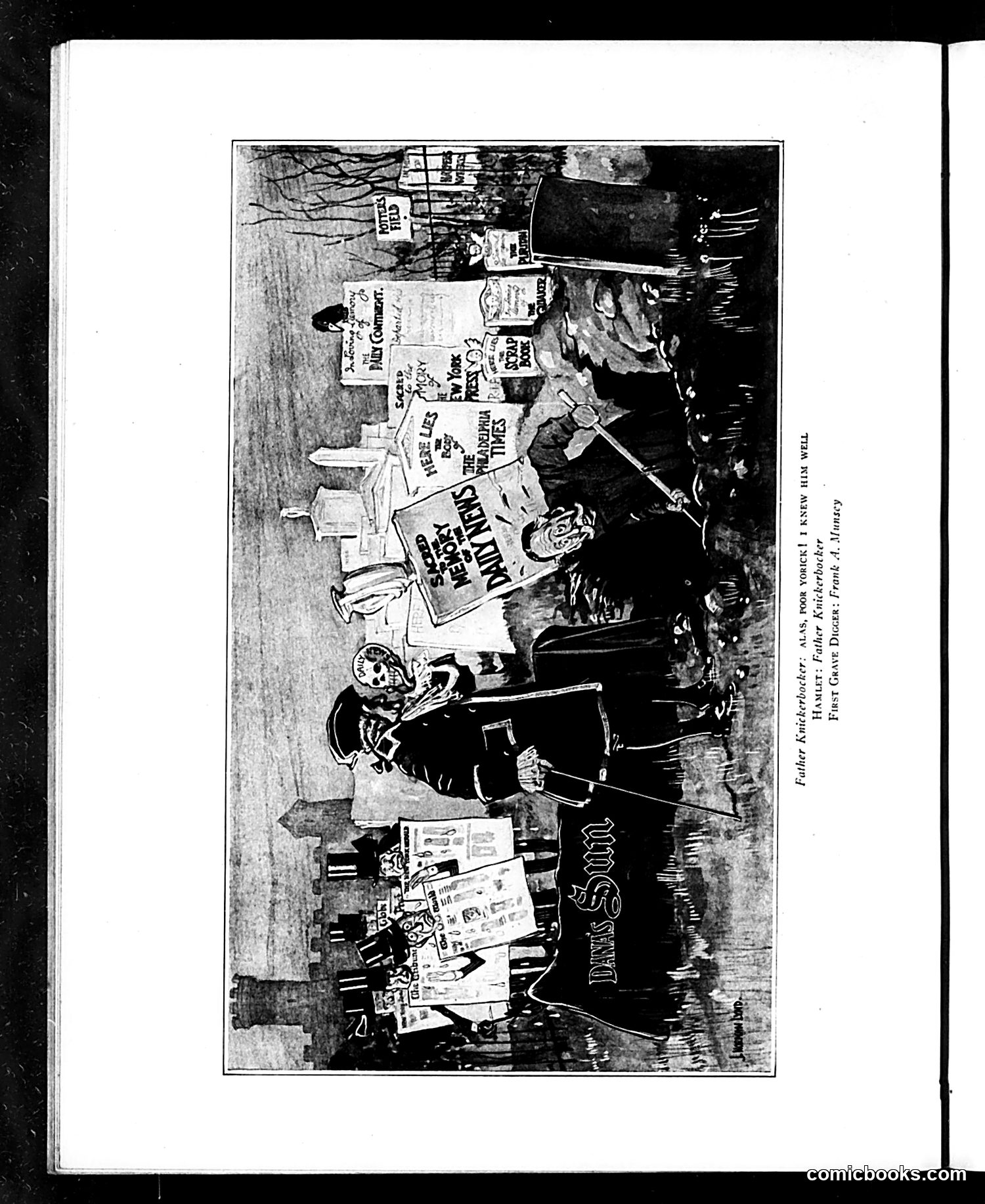
This page appears to be rotated 90 degrees, making it difficult to read clearly. The OCR text is largely illegible garbled characters. From what's visible in the image, this appears to be a satirical illustration showing multiple figures holding protest signs or placards, suggesting commentary on labor activism, strikes, or political demonstrations—common subjects for Life magazine's social satire. However, without legible text identifying the specific figures, historical context, or satirical message, I cannot reliably explain what particular political or social issue is being referenced or which individuals are being caricatured. **To provide accurate analysis, a clearer, properly-oriented version of this page would be needed.**
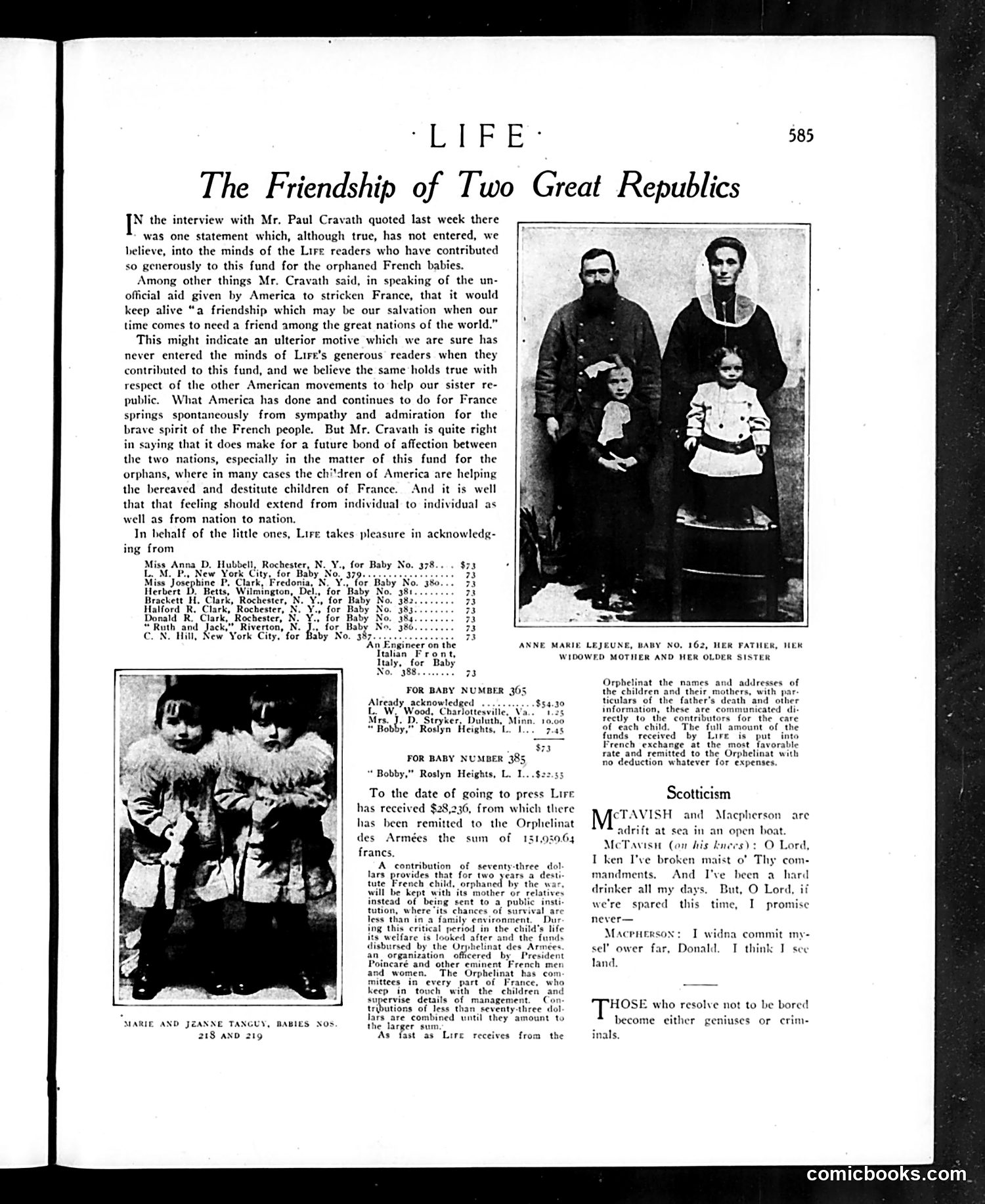
This page documents Life magazine's fundraising campaign for French war orphans during World War I. The main text defends American charitable aid to France against the suggestion it serves ulterior diplomatic motives, insisting contributions spring from "sympathy and admiration" rather than calculated self-interest. The page lists donors supporting individual French children (Babies No. 378-388), with photographs showing beneficiary children and their families. The accompanying article explains that $73 sustains an orphaned child with relatives for two years—preferable to institutional care. A sidebar titled "Scotticism" contains a brief comic dialogue between Scottish characters "McTavish" and "Macpherson" discussing temperance pledges, providing lighthearted relief on an otherwise serious humanitarian page. The overall message frames American assistance as genuine charity strengthening Franco-American bonds through direct individual-to-individual support of war's youngest victims.
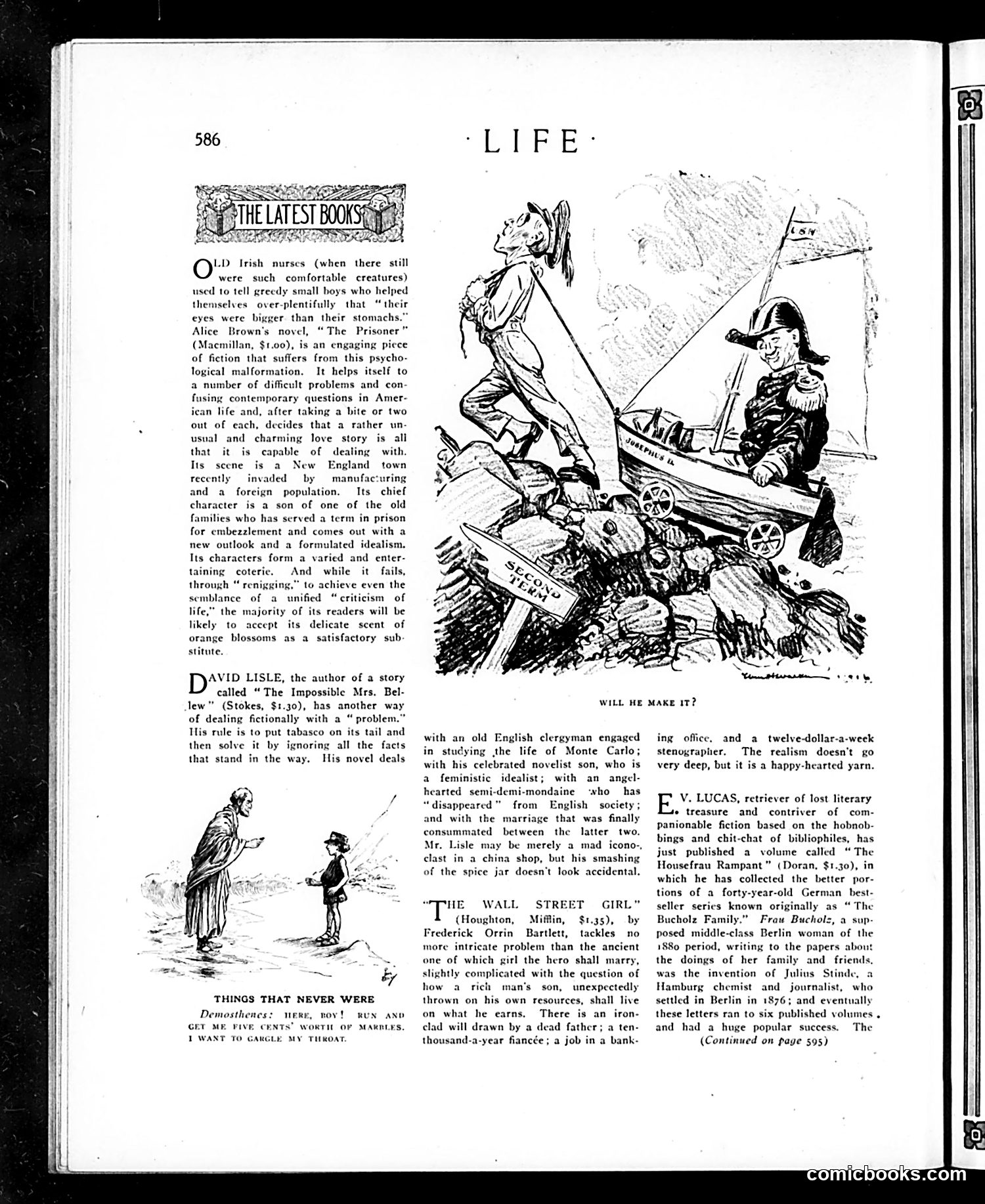
This page contains book reviews and satirical cartoons. The main cartoon, "Will He Make It?," depicts a figure on a tightrope labeled "SUCCESS" attempting to balance while carrying baggage, with onlookers below. This appears to comment on the precarious nature of achieving success in American life. The reviews discuss contemporary fiction dealing with "problems"—a period literary term for socially conscious novels. The critic notes Alice Brown's novel bites off more social issues than it can chew ("eyes bigger than stomach"), while David Lisle's work tackles its subject recklessly ("tabasco on its tail"). The small cartoon "Things That Never Were" mocks an absurd scenario: someone asking for five cents' worth of marbles to gargle their throat—satirizing illogical requests or nonsensical behavior. The reviews suggest early 1900s anxiety about American modernization, industrialization, and changing social values that fiction struggled to address meaningfully.
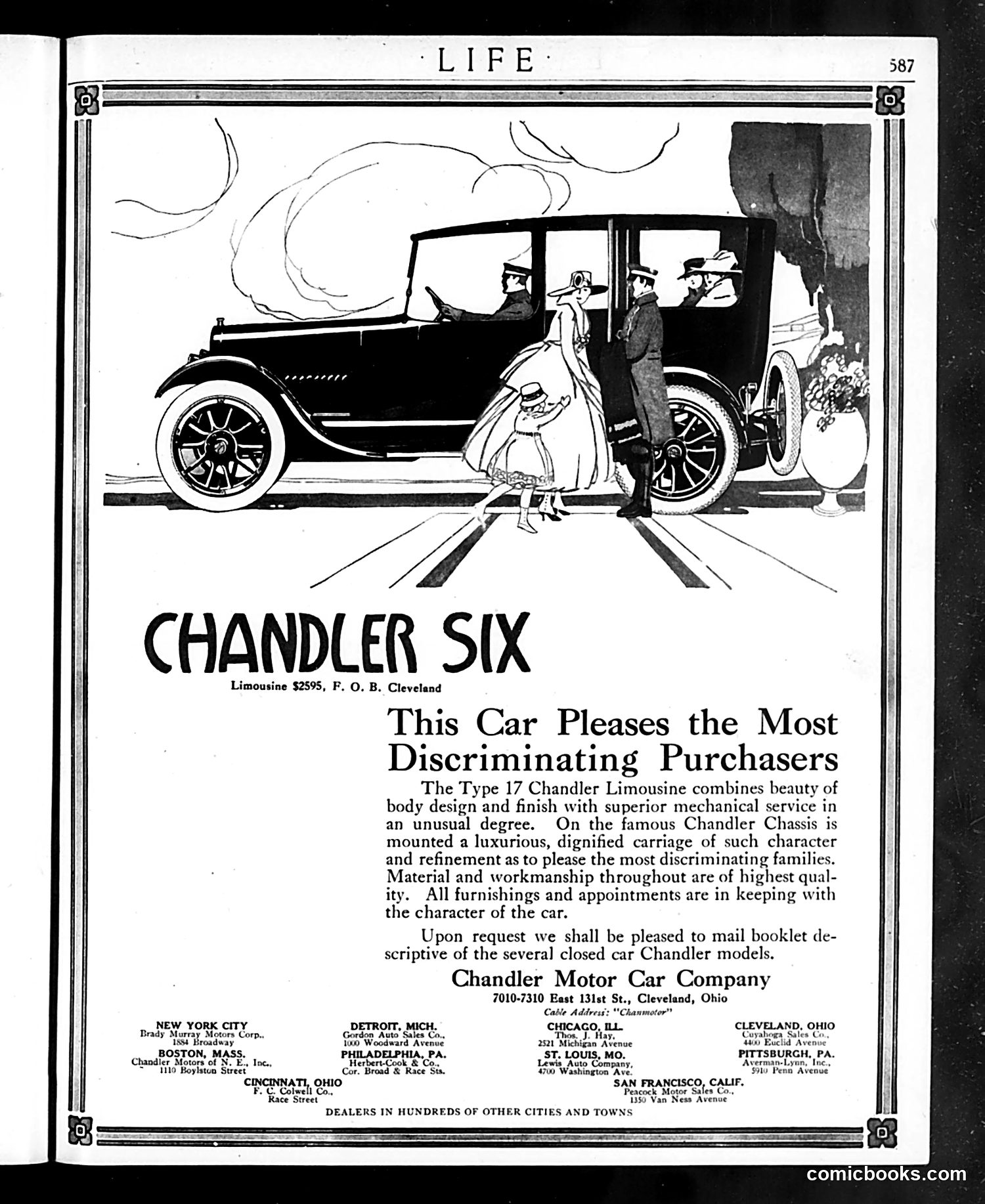
This page is primarily a **luxury automobile advertisement**, not satirical content. It promotes the Chandler Six limousine ($2,595 F.O.B. Cleveland) to wealthy consumers. The illustration depicts an elegant scene: a well-dressed woman in a long coat approaches a Chandler limousine while men in suits and hats stand nearby. The image emphasizes refinement and status—typical advertising imagery of the 1920s era. The advertisement's language targets "the most discriminating purchasers" and "discriminating families," appealing to upper-class buyers concerned with quality and social standing. The extensive dealer network listed suggests Chandler Motor Car Company's significant market presence. There is **no political satire or social commentary** visible here—this is straightforward aspirational marketing from the automobile industry's boom period.
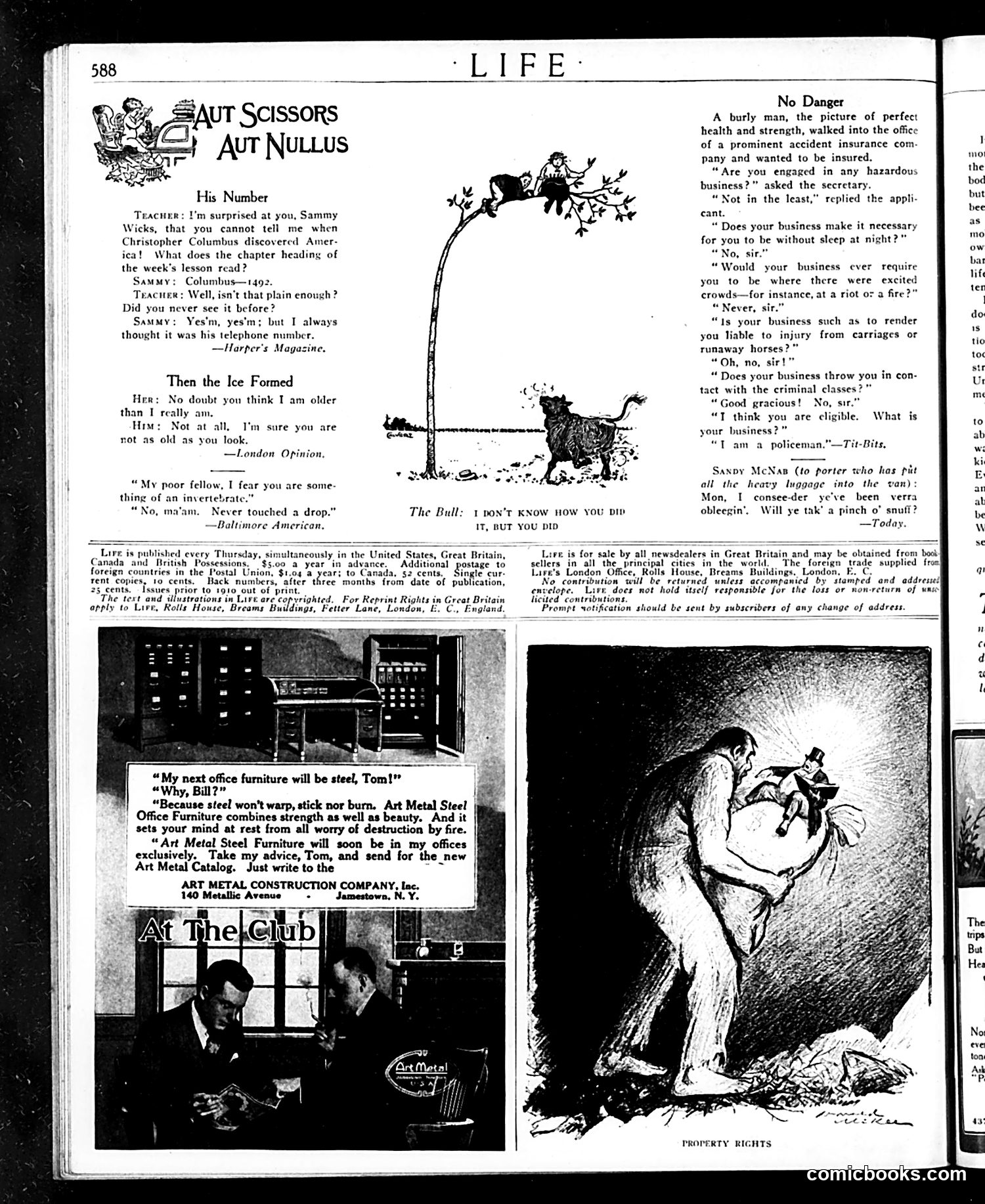
This page contains several short humorous items typical of early 20th-century satirical magazines: **"His Number"**: A schoolroom joke where a student confuses Columbus's discovery date (1492) with a telephone number—humor based on the then-novelty of telephones. **"Then the Ice Formed"**: A flirtation joke where a man insults a woman's appearance, then claims he wasn't implying she looked old. The "ice formed" refers to the relationship cooling. **Insurance Comedy**: An ironic piece about a man seeking accident insurance who claims zero occupational hazards, then reveals he's a policeman—the joke being that police work was genuinely dangerous, yet he denied it. **Advertisements**: Art Metal Steel Furniture (emphasizing fire-safety) and other period products occupy substantial space. **"Property Rights" cartoon** (bottom right): Unclear without caption, but appears to show figures on a large hand or arm, likely commenting on ownership or property disputes. The page exemplifies Life's mix of brief jokes, advertisements, and single-panel cartoons aimed at middle-class readers.
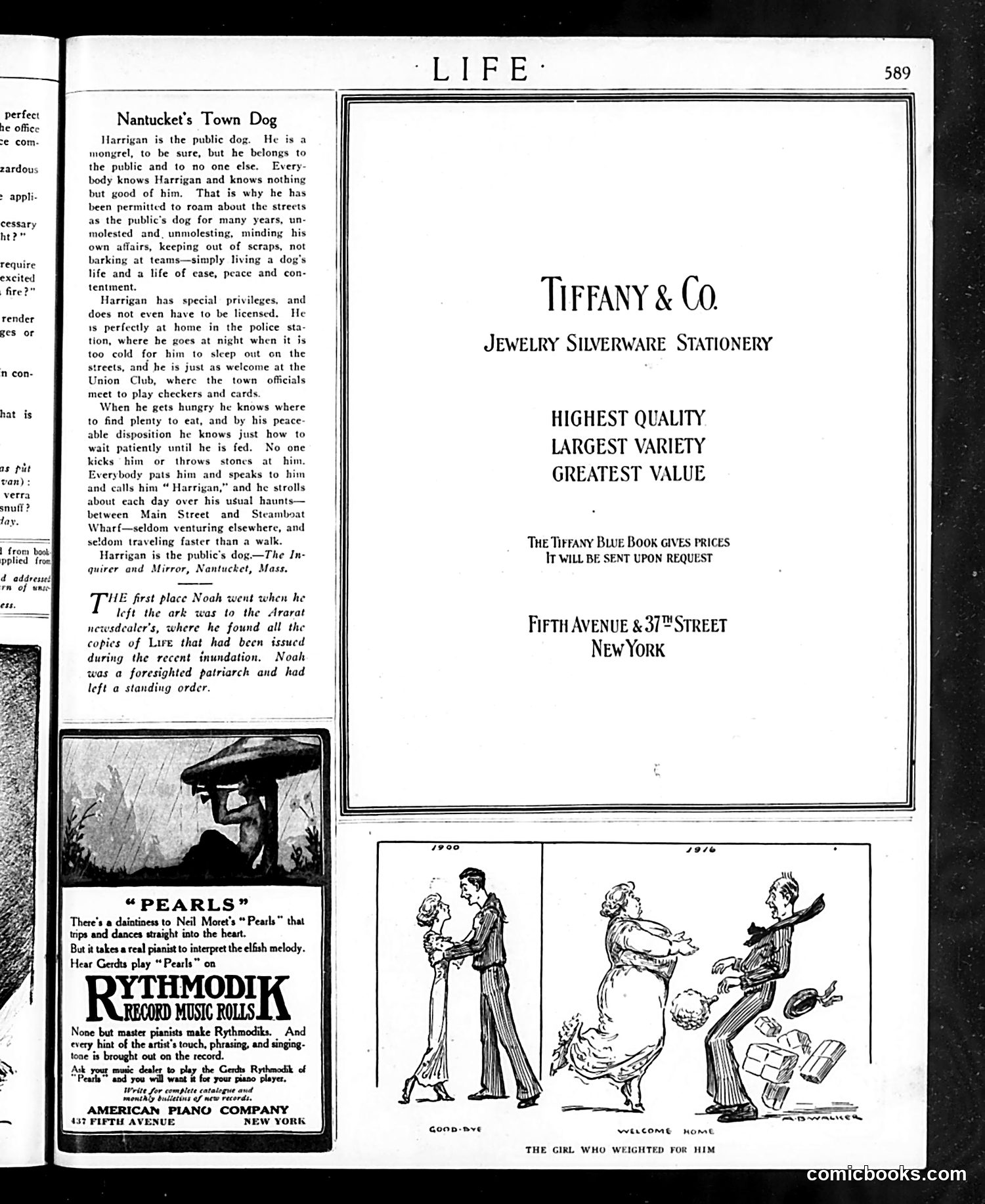
This page mixes editorial content with period advertisements. The main article celebrates "Nantucket's Town Dog" Harrigan—a public mongrel given unusual privileges (no license required, shelter at the police station and Union Club). The piece satirizes small-town civic pride by treating a stray dog as a respected community institution, highlighting how Nantucket's officials indulge this animal as a symbol of their town's character and generosity. Below, a brief anecdote jokes that Noah (from the Biblical flood) immediately sought out a *Life* magazine newsdealer upon leaving the ark, suggesting the publication's essential importance and the newsdealer's foresight in maintaining a "standing order" even during catastrophe. The bottom cartoon, "The Girl Who Weighed for Him," depicts a woman dramatically reacting—apparently having gained weight during her partner's absence. The humor trades on period anxieties about female appearance and male approval, typical of early 20th-century comic sensibilities.
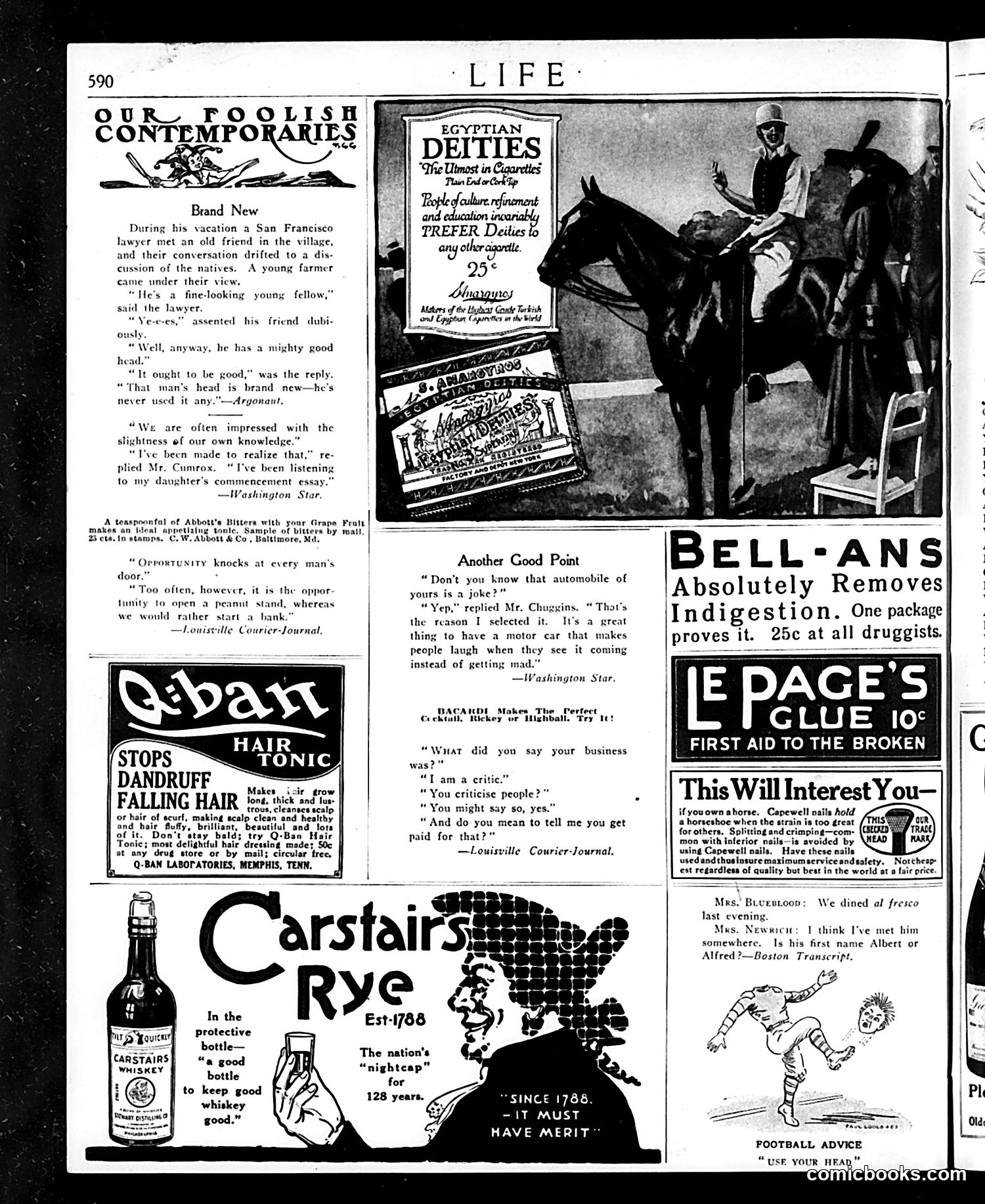
This page is primarily **advertising with framing humor sections**. The main content consists of: **Satirical Jokes** (top left): Brief anecdotes mocking human nature—a lawyer's observation that a young farmer has a "brand new" head because he's "never used it," and comments on people overestimating their own knowledge. **The Automobile Joke**: A running gag where Mr. Chuggins admits his car is a "joke" because it makes people laugh at its appearance rather than fear it. **The Critic Joke**: Dark humor about a self-described "critic" who gets paid to criticize people. **The Social Climbing Reference**: Mrs. Newrich's mention of dining "al fresco" (outdoors), with the joke being confusion over whether someone's name is "Albert" or "Alfred"—poking fun at pretentious nouveau riche behavior and affected speech. **Advertisements**: The page is dominated by product ads (Qban Hair Tonic, Carstairs Rye whiskey, Bell-Ans antacid, Le Page's glue) typical of early 20th-century Life magazine's revenue model. The humor targets American social pretension and human folly.
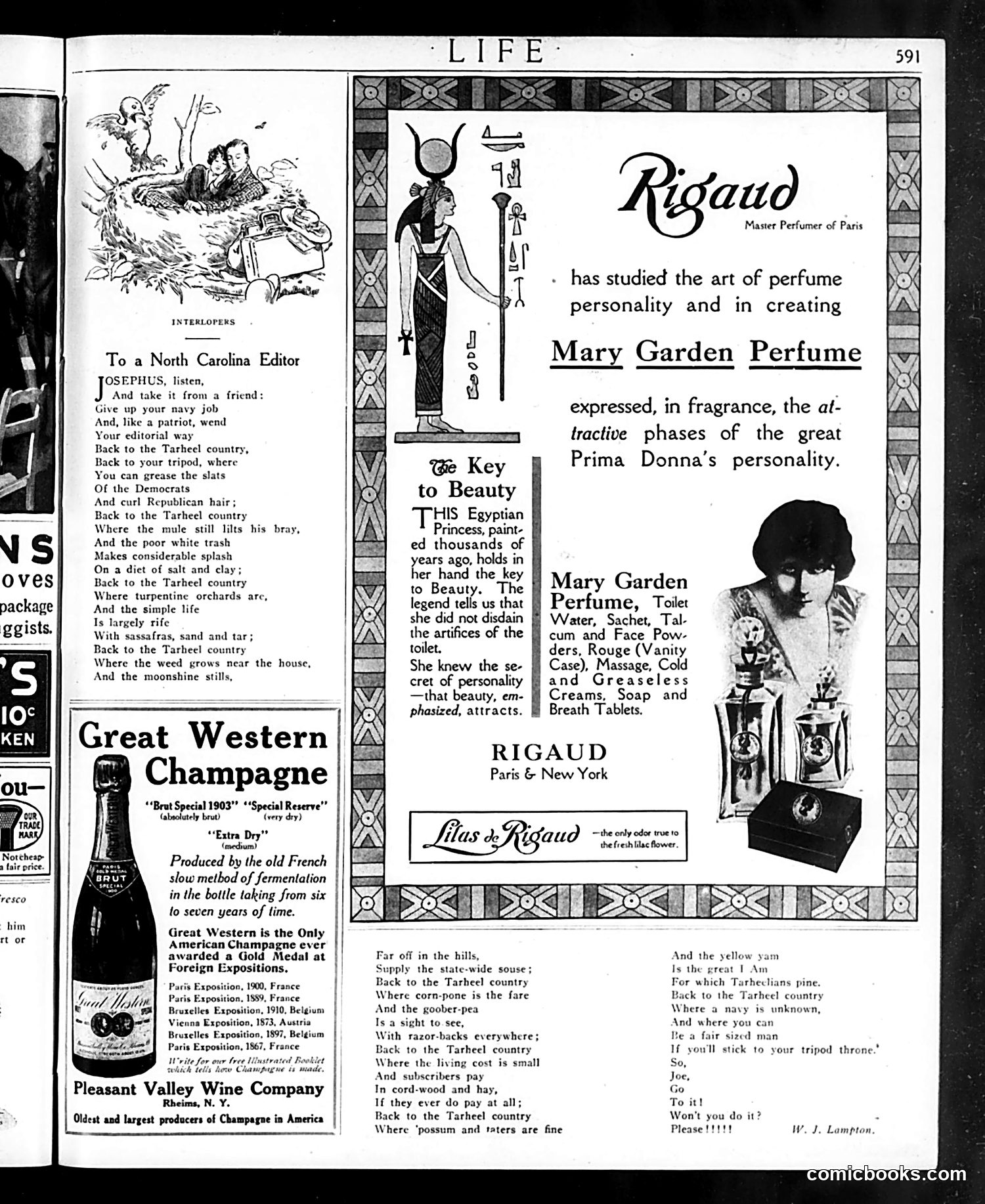
This page combines political satire with period advertising. The main cartoon, "Interlopers," is a poem addressed to "Josephus" (a North Carolina newspaper editor) urging him to abandon his naval job and return to rural North Carolina journalism. The satire mocks both the editor's pretensions and rural Southern life: the poem lists stereotypical lowland Carolina imagery—poor white trash, mules, moonshine stills, corn-pone—while ironically praising these as reasons to return "home." The joke targets someone caught between worlds, suggesting his naval position makes him too grand for his origins. The surrounding advertisements for Rigaud perfume and Great Western champagne (emphasizing Old World French authenticity) provide ironic counterpoint: luxurious imported goods positioned opposite the poem's mockery of rural poverty and backwardness. The cartoon appears designed for Life's educated, urban readership to laugh at both pretentious editors and rural simplicity.
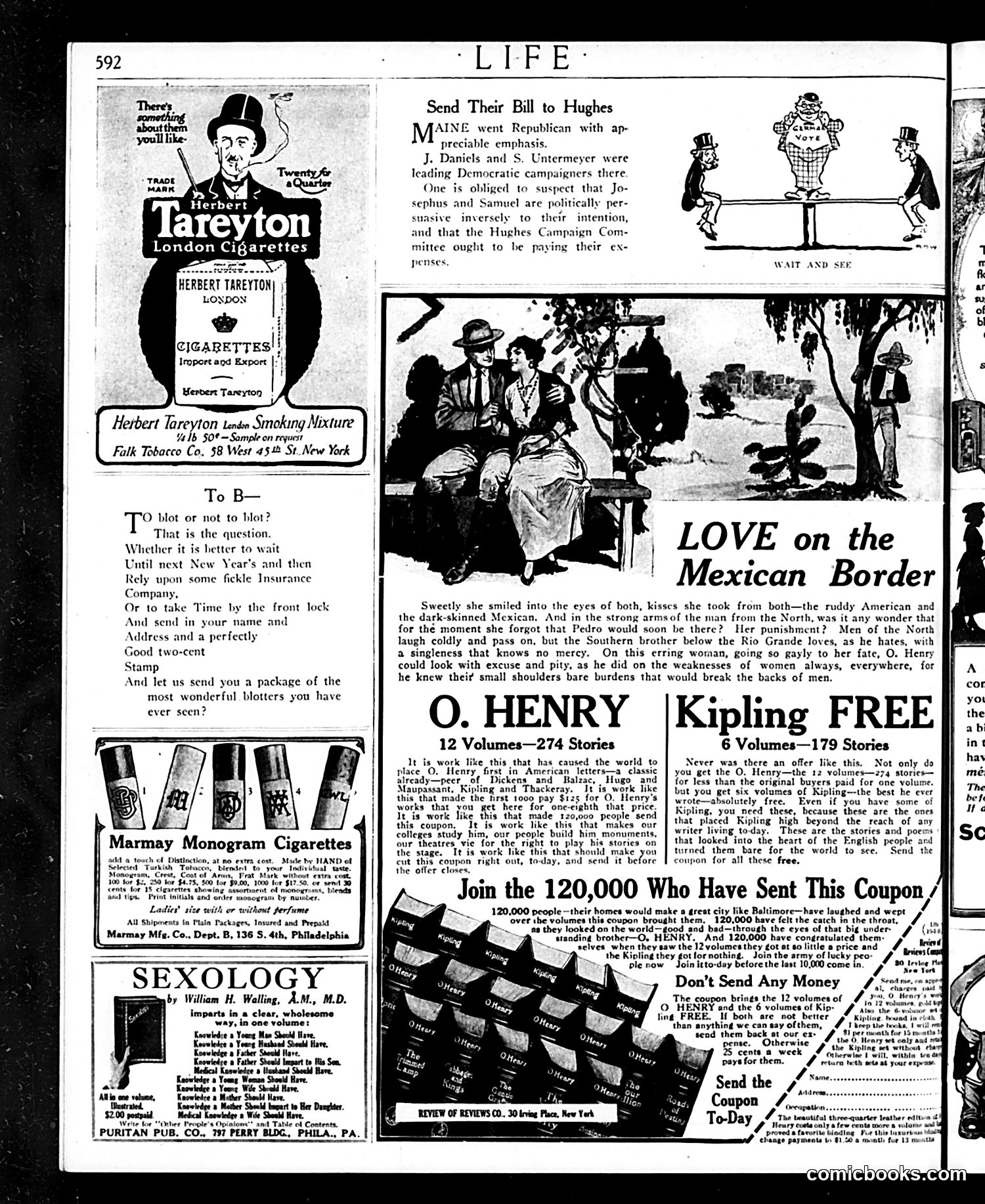
The page's main political content is a brief item titled "Send Their Bill to Hughes," referencing the 1916 presidential election. It mocks Democratic campaigners Joseph Daniels and Samuel Untermeyer for campaigning in Maine on behalf of Charles Evans Hughes (the Republican candidate). The satire suggests these Democrats are so ineffective at persuasion that the Hughes campaign should actually *pay* them, since their efforts seemingly help the Republican cause rather than hurt it. The phrase "Wait and See" sarcastically implies the outcome will prove this theory correct. The accompanying cartoon labeled "Wait and See" (top right) shows two caricatured figures flanking a bust—likely representing Daniels and Untermeyer—visual reinforcement of the written joke. The remainder of the page consists of advertisements for books (O. Henry and Kipling collections), tobacco, cigars, and other products—typical magazine filler of the era.
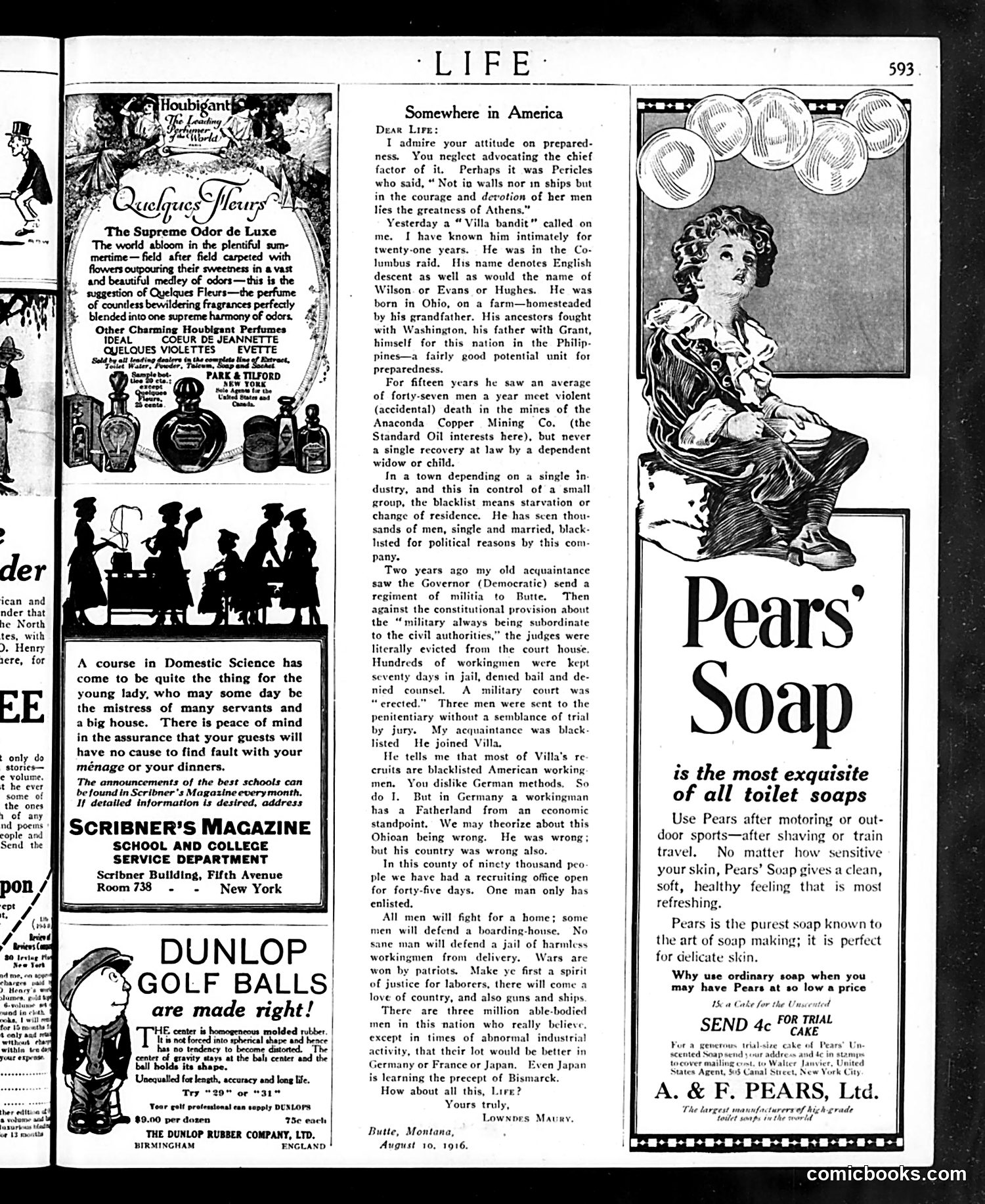
This page combines advertisements with a serious political letter to the editor about American preparedness and labor injustice. The letter describes a man the writer knew—a "Villa bandit" (likely referring to Mexican revolutionary Pancho Villa's forces)—who was born in Ohio to a family with deep American military heritage. However, after witnessing 47 men yearly die without legal recourse in Anaconda Copper mines (Standard Oil interests), and after being blacklisted for political reasons during a 1914 labor dispute in Butte, Montana, he joined Villa's army in Mexico. The writer uses this case to critique American hypocrisy: the government sent militia against striking workers, judges were forcibly removed, and workingmen received no due process. The letter argues that while Germany provides economic security to its workers, America's exploitation drove this patriotic man into exile. It concludes by noting that despite a 45-day recruitment drive, only one man enlisted locally—suggesting preparedness fails when workers have no stake in defending their country. The satire is bitter, not humorous: American injustice creates its own enemies.
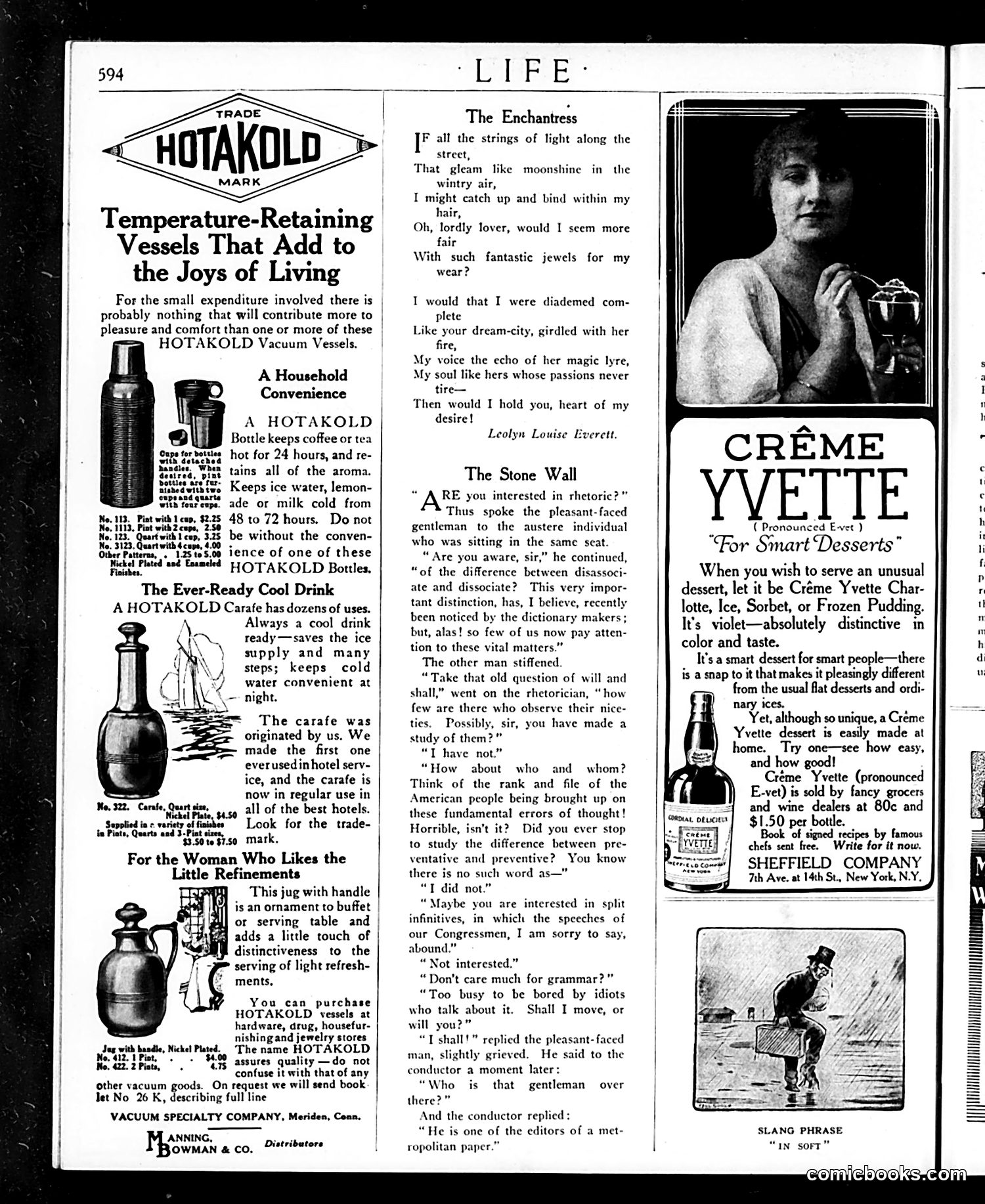
This page is primarily **advertising and light literary content**, not political satire. The left side advertises **Hotakold vacuum bottles/thermoses**—products that keep beverages hot or cold for extended periods. The ads emphasize convenience and home comfort, typical of early 20th-century domestic marketing. The center contains **"The Enchantress,"** a romantic poem by Leolyn Louise Everett about a woman wishing to be adorned like a jeweled city to impress her lover—sentimental verse common to the era. Below that is **"The Stone Wall,"** a humorous short story satirizing pedantic grammar enthusiasts. A bore lectures a stranger on linguistic minutiae (disassociate vs. dissociate, who vs. whom) until the exasperated stranger reveals he's a newspaper editor—the joke being that this "important" grammarian is actually just an annoying person, not an authority. The right side advertises **Crème Yvette liqueur**, marketed as an elegant dessert ingredient for sophisticated home entertaining. No political figures or major social issues are present. This is a typical Life magazine page mixing consumer goods, light literature, and humor.
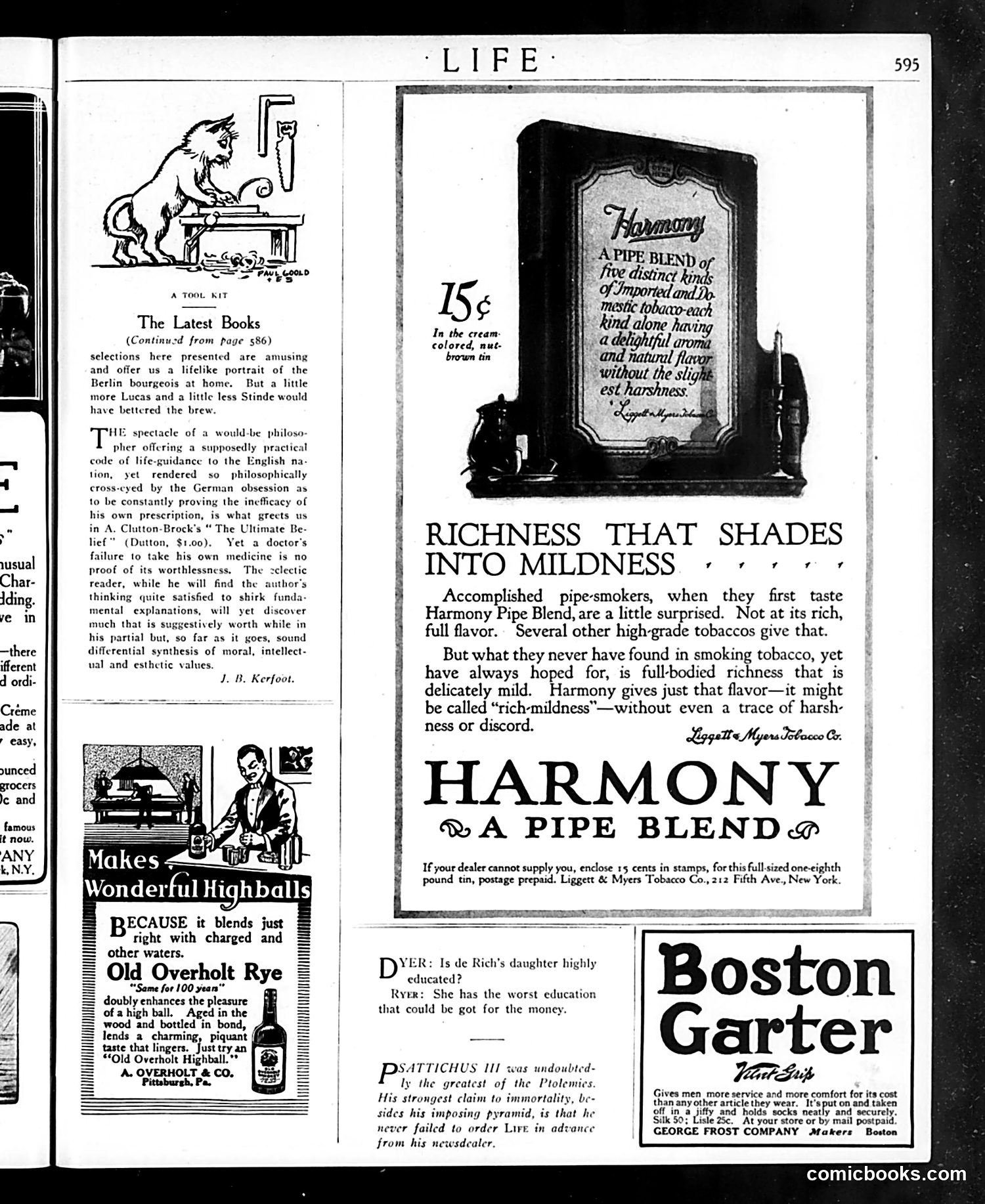
This is primarily an **advertising page** with a small book review section. The main content includes: **Book Review** (upper left): A brief critical assessment of "The Ultimate Belief" by A. Clutton-Brock, discussing a philosopher who preaches practical life guidance while contradicting his own principles—a mild satire on German philosophical pretension. **Advertisements**: The page is dominated by product ads (Harmony Pipe Blend tobacco, Old Overholt Rye whiskey, Boston Garter socks) typical of Life magazine's revenue model. **Humor Snippets**: Small jokes appear, including one mocking wealthy education ("She has the worst education that could be got for the money") and a final quip about Ptolemy III ordering Life magazine in advance—a self-promotional joke by the publication itself. **A Tool Kit cartoon** (far left): A monkey using tools, likely representing "practical ingenuity." The page reflects early 20th-century American magazine culture: serious literary criticism mixed with consumer advertising and light satirical humor.
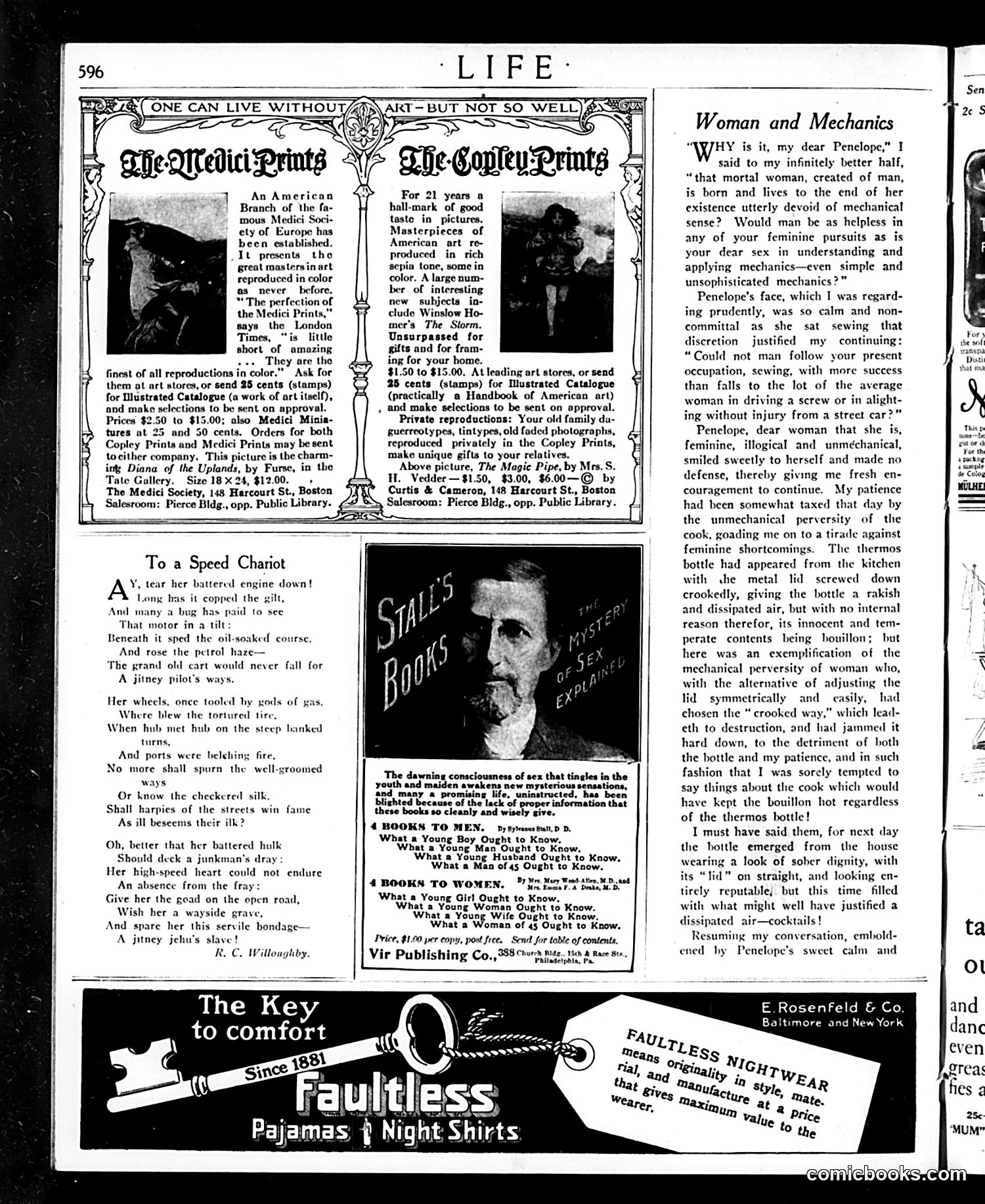
This page contains primarily **advertisements and literary content** rather than political cartoons. **The Medici and Copley Prints ads** promote art reproductions—a cultural enterprise positioning fine art as accessible to American consumers, referencing the prestigious European Medici Society to establish legitimacy. **"To a Speed Chariot"** is a poem by R.C. Willoughby celebrating early automobile racing culture—specifically the nostalgia for racing's pioneering era ("Her wheels, once tooled by gods of gas") against the newer "jitney pilot's ways" (cheap taxi services). **"Woman and Mechanics"** is a satirical essay mocking women's supposed mechanical incompetence. The narrator uses examples like a crooked thermos bottle lid to argue women lack mechanical sense, while implying men would excel at "feminine pursuits" like sewing. The humor relies on period stereotypes about gender and aptitude—presenting women's supposed inability to understand simple mechanical tasks as inherent and inevitable. The piece exemplifies early 20th-century attitudes dismissing women from technical fields.
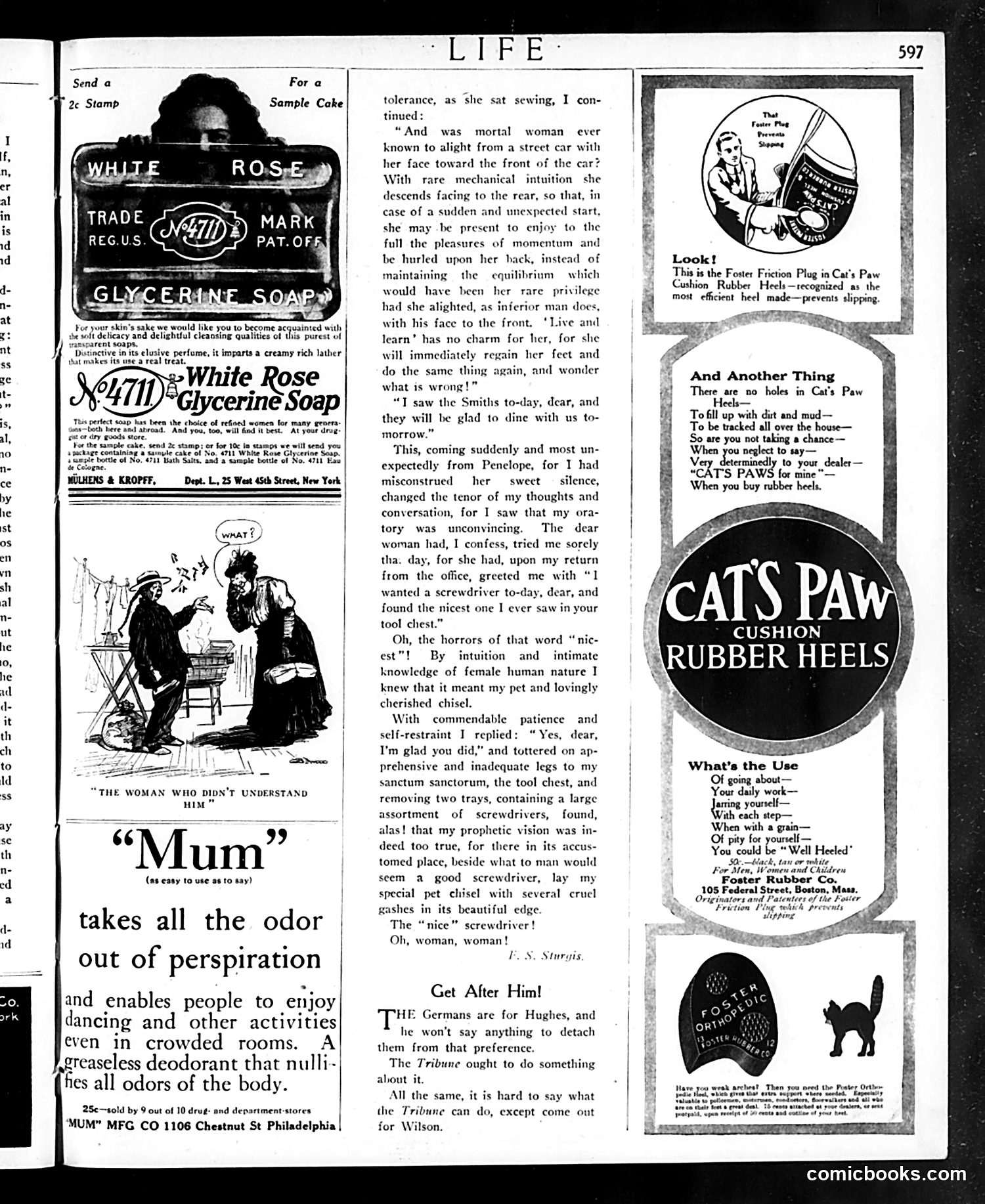
This page contains advertisements and a satirical story column. The main cartoon ("The Woman Who Didn't Understand Him") depicts a husband complaining to his wife about women's behavior—specifically how they face backward exiting streetcars and lose his tools. The wife responds by simply inviting the Smiths to dinner, which silences his complaints. The satire mocks the husband's self-absorbed griping and implies women need not engage with men's tedious grievances. The page also includes period product ads (White Rose soap, "Mum" deodorant, Cat's Paw rubber heels) typical of early-20th-century Life magazine. A brief political note references Germans supporting Hughes (presidential candidate) and suggests the Tribune newspaper should counter by endorsing Wilson—a reference to 1916 election politics. The overall tone is light domestic humor rather than pointed political satire.
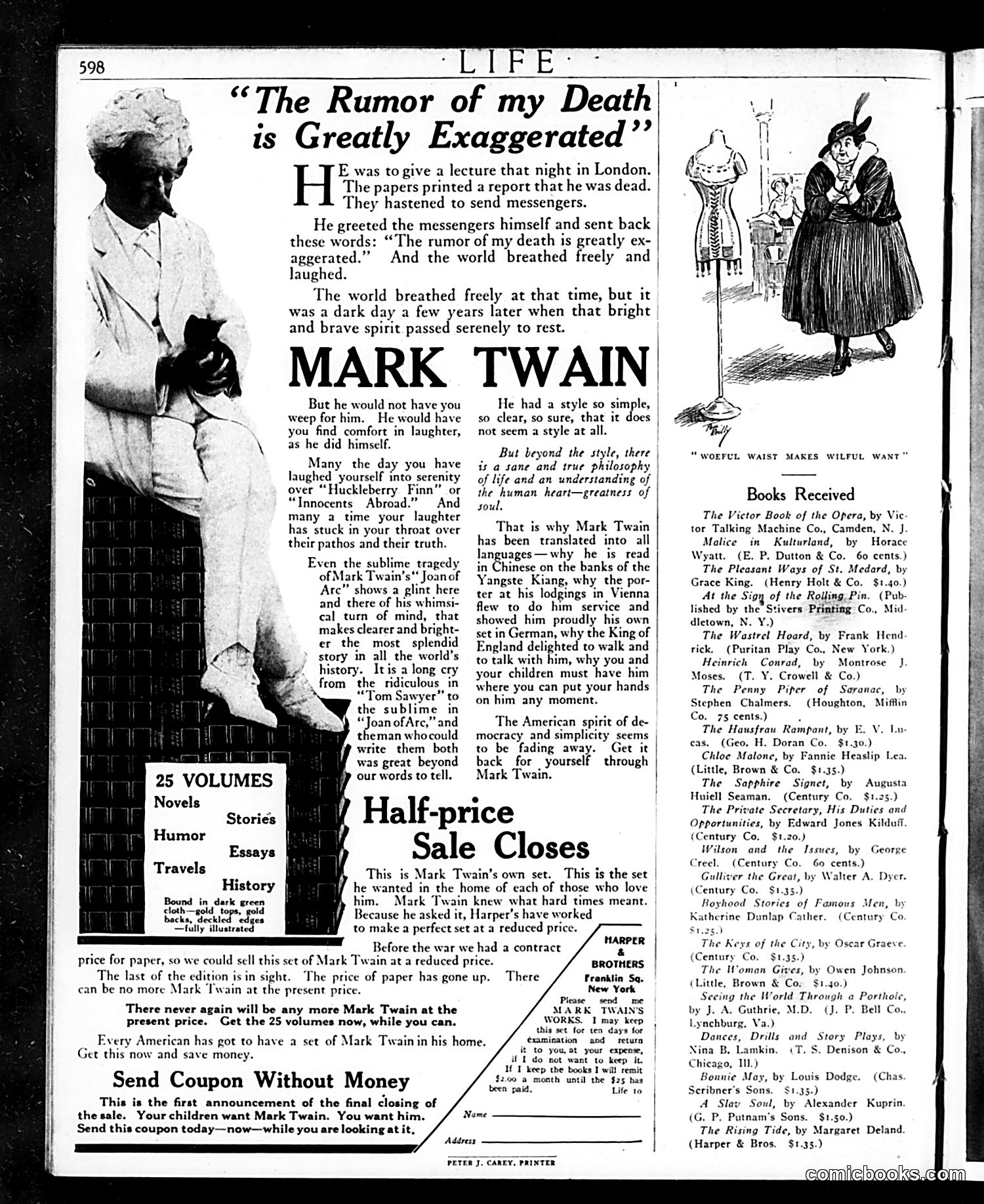
This page commemorates Mark Twain's death, reprinting his famous quip: "The rumor of my death is greatly exaggerated"—a remark he made when newspapers mistakenly reported his death years earlier. The article praises Twain's literary achievements and his universal appeal—his works translated globally, read by everyone from Chinese laborers to European royalty. It emphasizes his simple, clear writing style combined with profound philosophy about human nature. The primary content is advertising for a discounted "Mark Twain Complete Works" set (25 volumes), marketed as the author's own preferred collection. The accompanying illustration shows an elderly Twain with a young child, sentimentalizing his legacy for American families. This is essentially a sales pitch dressed as an obituary tribute, urging readers to purchase the complete set during a closing sale, framed as honoring the recently departed American literary icon.
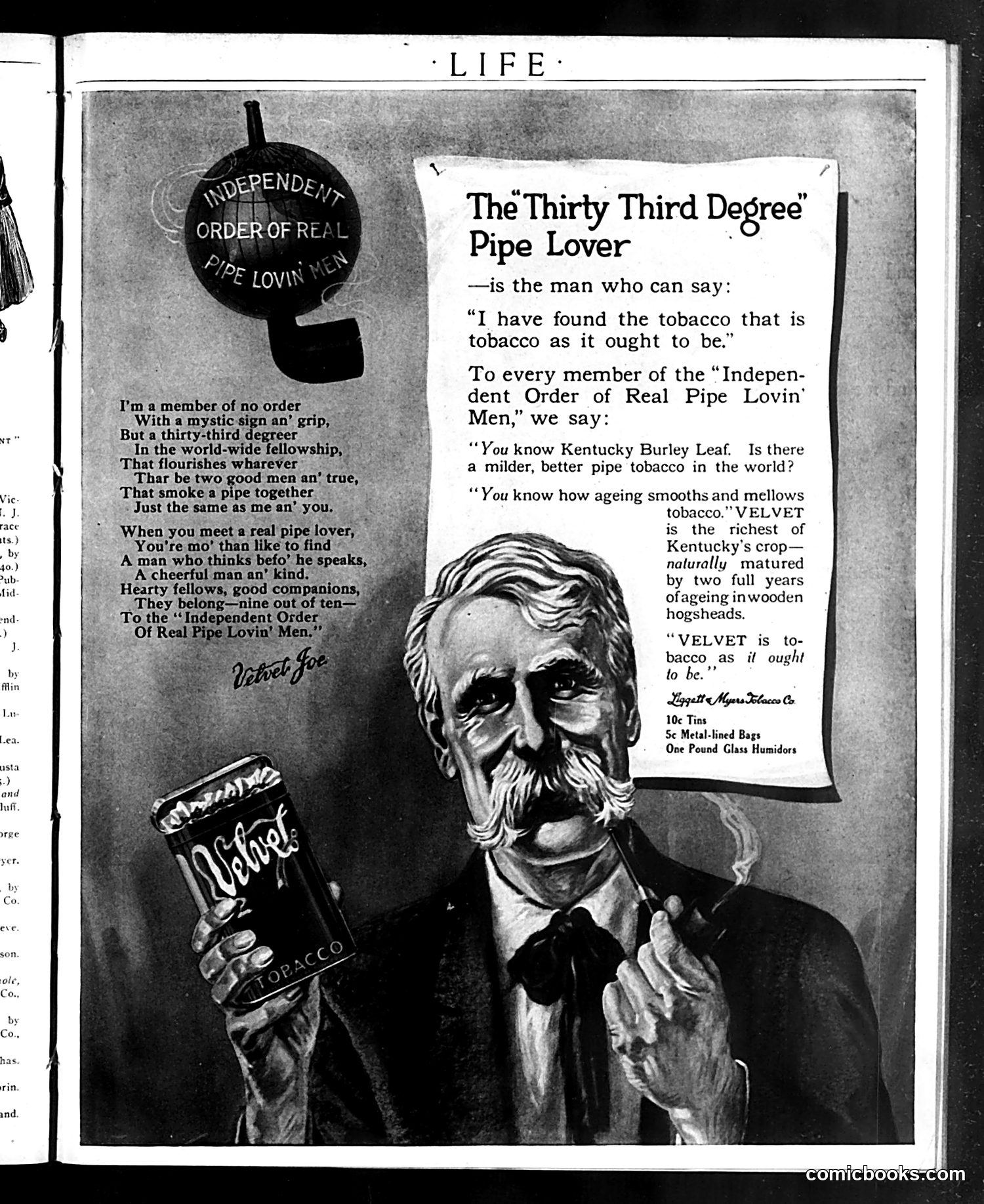
This is a **tobacco advertisement disguised as fraternal satire**. The page mocks fraternal organizations like Freemasonry (referenced by "Thirty Third Degree," their highest rank) by creating a fictional "Independent Order of Real Pipe Lovin' Men"—a joke fraternity devoted entirely to smoking. The bearded man illustration represents an idealized "real pipe lover"—a romantic figure belonging to this exclusive brotherhood. The left panel contains mock-fraternal poetry celebrating the camaraderie of pipe smokers as honorable, trustworthy companions. The advertisement's actual purpose is to pitch **Velvet tobacco** to pipe smokers by flattering them as discerning gentlemen who appreciate quality. The copy emphasizes the tobacco's natural aging process and superiority, suggesting that "real" pipe lovers would recognize Velvet as the authentic choice. This combines early 20th-century advertising's celebration of masculine fraternity with product endorsement—selling tobacco by elevating smoking to an exclusive, noble pursuit.
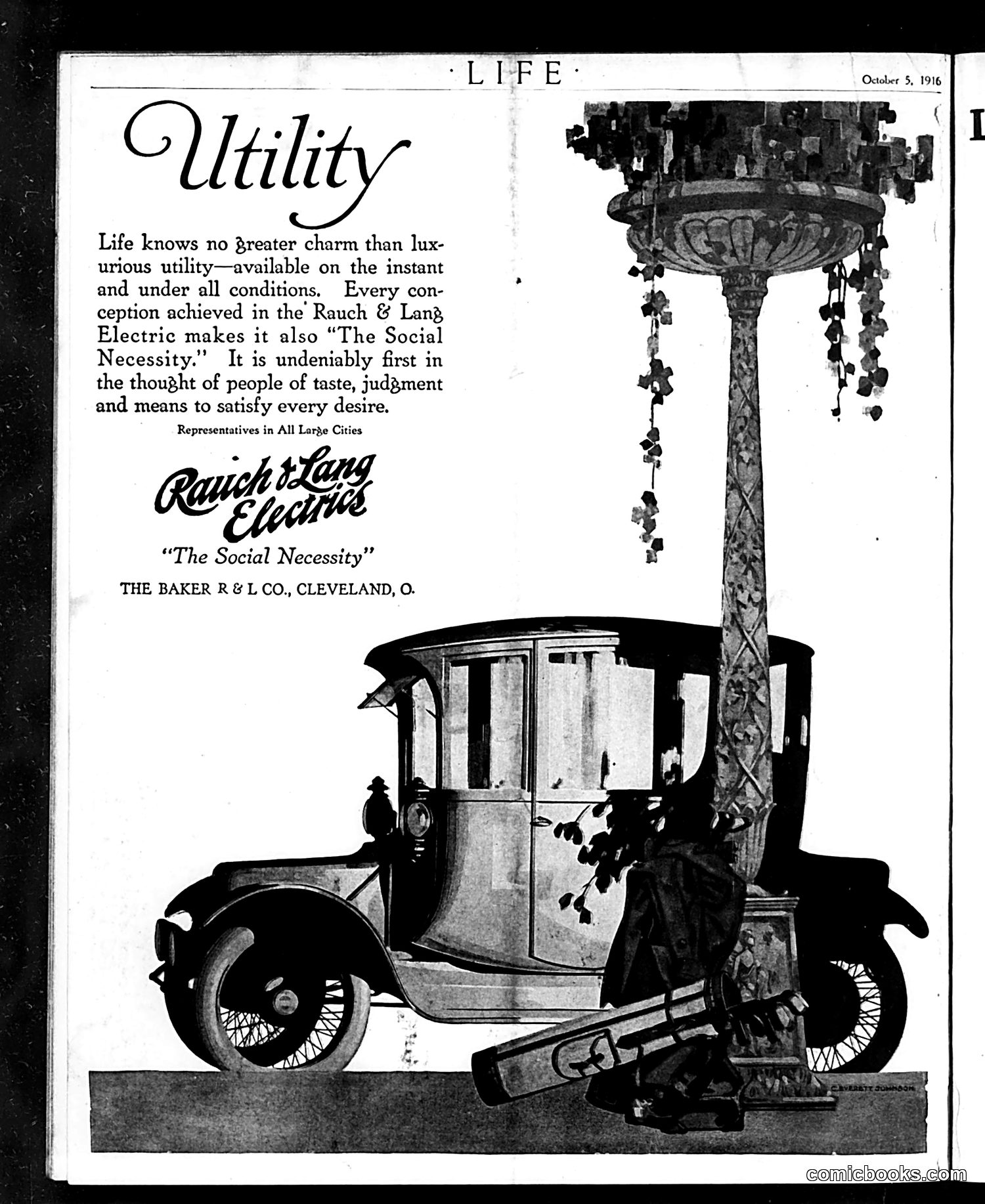
This is an advertisement for the Rauch & Lang Electric automobile, presented as a satirical commentary on consumer culture rather than straightforward promotion. **The Image:** A luxury electric car is positioned beneath an ornate street lamp, with ivy trailing down. The composition sarcastically elevates the automobile to the status of fine art or urban monument. **The Satire:** The headline "Utility" and tagline "The Social Necessity" mock wealthy consumers' self-justifying language. By calling a luxury vehicle a "necessity" and claiming it satisfies "every desire," the ad gently ridicules how the affluent rationalize extravagant purchases as practical needs. **Historical Context:** This 1916 advertisement targets upper-class buyers during the early automobile era. Electric cars were expensive, fashionable alternatives to gasoline vehicles, particularly popular among wealthy urbanites. **The Joke:** Life magazine's satirical voice is evident in treating a status symbol as simultaneously essential and absurdly luxurious—highlighting the contradiction between "utility" and unabashed wealth display.