
Life, 1916-10-05 · page 16 of 42
Life — October 5, 1916 — page 16: what you’re looking at
What you’re looking at
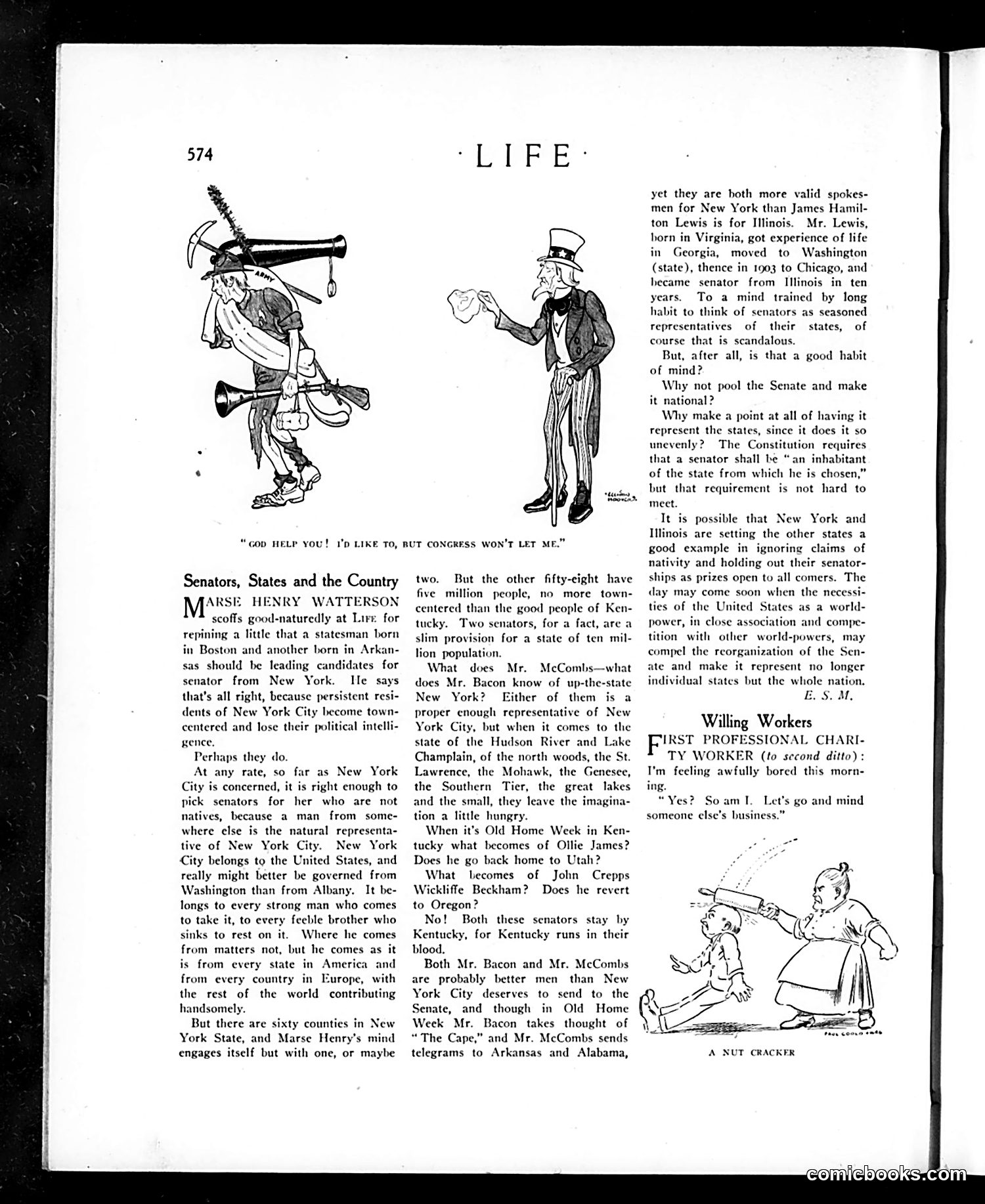
The top cartoon depicts Uncle Sam (identifiable by his characteristic hat and appearance) struggling with various implements of governance while Congress blocks his efforts—illustrating governmental gridlock. The accompanying essay by Marse Henry Watterson criticizes the practice of electing U.S. Senators from New York who lack deep roots in the state. He notes that senators like Mr. Bacon and Mr. McCombs, while qualified, don't truly represent upstate New York's interests—they're Manhattan-focused outsiders. Watterson proposes a radical solution: abandon the state-representation model entirely and create a truly national Senate serving America's emerging world-power status rather than parochial state interests. The bottom cartoon ("A Nut Cracker") appears unrelated social commentary about charity workers. The satire critiques how geographic representation can become meaningless when politicians lack genuine connection to their districts' actual needs and character.
📄 Transcribed text from this page (OCR, searchable)
Machine-transcribed from the original scan — historical spelling and the odd misread are preserved.
“Gov HELP YoU! 1’p LIKE TO, RUT CONGRESS WON'T LET ME.” Senators, States and the Country HENRY WATTERSON M* RSE scoffs good-naturedly at Lire. for repining a little that a statesman born in Boston and another born in Arkan- sas should be leading candidates for senator from New York. Ile says that’s all right, because persistent resi- dents of New York City become town- centered and lose their political intelli- gence, Perhaps they do. At any rate, so far as New York City is concerned, it is right enough to pick senators for her who are not natives, because a man from some- where else is the natural representa- tive of New York City. New York City belongs to the United States, and really might better be governed from Washington than from Albany. It be- longs to every strong man who comes to take it, to every feeble brother who sinks to rest on it. Where he comes from matters not, but he comes as it is from every state in America and from every country in Europe, with the rest of the world contributing handsomely. But there are sixty counties in New York State, and Marse Henry’s mind engages itself but with one, or maybe two. But the other fifty-eight have five million people, no more town- centered than the good people of Ke tucky. Two senators, for a fact, are slim provision for a state of ten mi lion population. What does Mr. McCombs—what does Mr. Bacon know of up-the-state New York? Either of them is a proper enough representative of Ne York City, but when it comes to the state of the Hudson River and Lake Champlain, of the north woods, the Lawrence, the Mohawk, the Genesee, the Southern Tier, the great lakes and the small, they leave the imagina- tion a little hungry. When it’s Old Home Week in Ken- tucky what becomes of Ollie James? Does he go back home to Utah? What Lecomes of John Crepps Wickliffe Beckham? Does he revert to Oregon? No! Both these senators stay by Kentucky, for Kentucky runs in their blood. Both Mr. Bacon and Mr. McCombs are probably better men than New York City deserves to send to the Senate, and though in Old Home Week Mr. Bacon takes thought of “The Cape,” and Mr. McCombs sends telegrams to Arkansas and Alabama, yet they are hoth more valid spokes- men for New York than James Hami ton Lewis is for Illinois. Mr. Lewis, horn in Virginia, got experience of life in Georgia, moved to Washington (state), thence in 1903 to Chicago, and became senator from Illinois in ten years. To a mind trained by long habit to think of senators as seasoned representatives of their states, of course that is scandalous. But, after all, is that a good habit of mind? Why not pool the Senate and make it national? Why make a point at all of having it represent the states, since it does it so unevenly? The Constitution requires that a senator shall be “an inhabitant of the state from which he is chosen,” but that requirement is not hard to meet. It is possible that New York and Illinois are setting the other states a good example in ignoring claims of nativity and holding out their senator- ships as prizes open to all comers. The day may come soon when the necessi- ties of the United States as a world- power, in close association and compe- tition with other world-powers, may compel the reorganization of the Sen- l¢ and make it represent no longer individual states but the whole nation. ELS. M, Willing Workers IRST PROFESSIONAL CHARI- TY WORKER (to second ditto): I'm feeling awfully bored this morn- ing. “Yes? Soam I. Le! someone else's busines go and mind N 0. A NUT CRACKER