
Life, 1916-10-05 · page 7 of 42
Life — October 5, 1916 — page 7: what you’re looking at
What you’re looking at
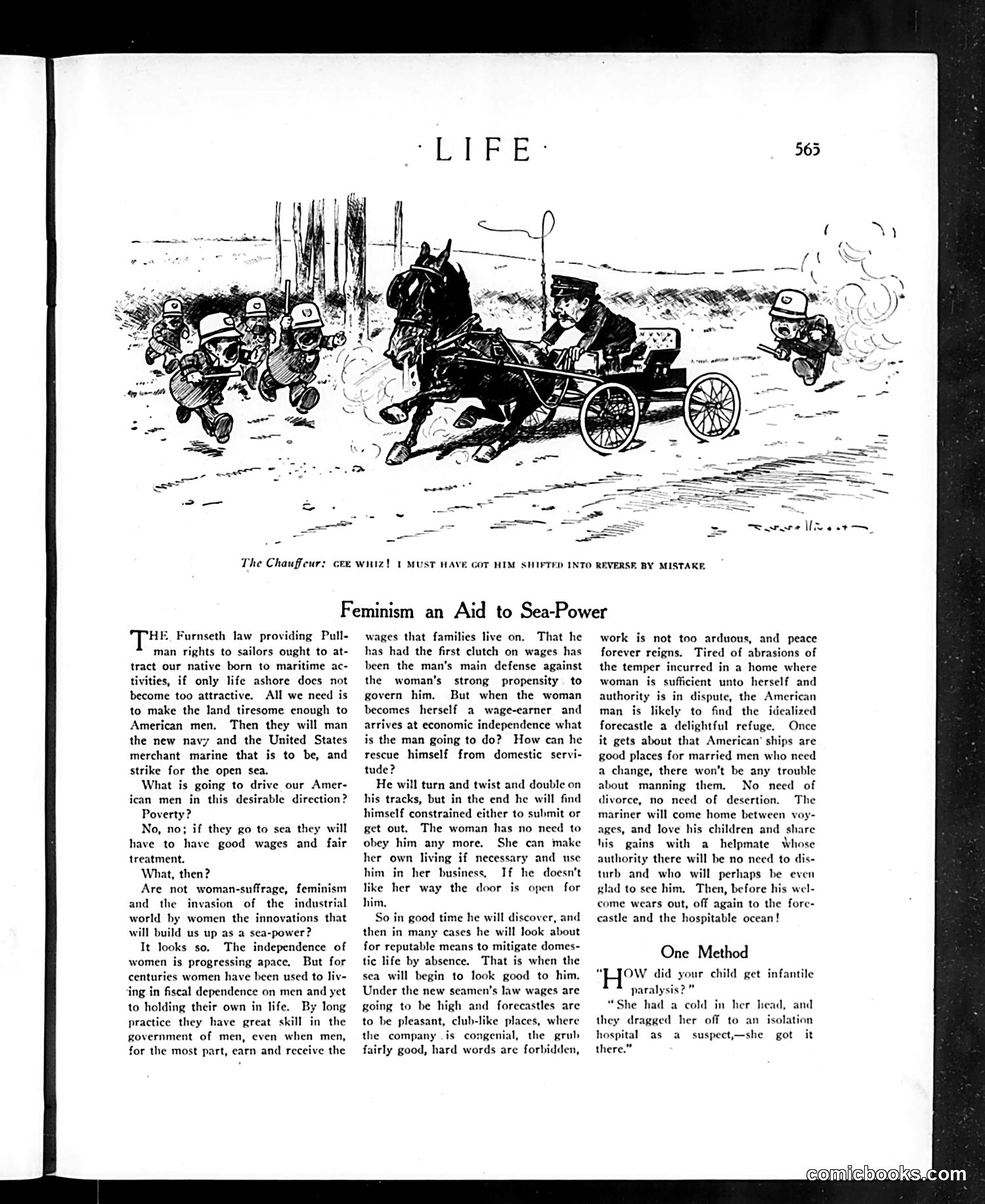
The top cartoon depicts a chauffeur driving a cart pulled by a horse, with small figures (appearing to be sailors or military personnel) running alongside in apparent distress. The caption reads: "GEE WHIZ! I MUST HAVE GOT HIM SHIFTED INTO REVERSE BY MISTAKE." **Meaning:** This is a visual pun. The "chauffeur" (car driver) has accidentally put the vehicle in reverse, causing chaos. The humor likely references contemporary concerns about new automobile technology and human error, satirizing early 20th-century anxieties about mechanical modernization and incompetent operators. The accompanying article, "Feminism an Aid to Sea-Power," discusses women entering the workforce and economic independence, suggesting the cartoon may also comment on social disruption from changing gender roles in the workplace.
📄 Transcribed text from this page (OCR, searchable)
Machine-transcribed from the original scan — historical spelling and the odd misread are preserved.
The Chauffeur: cee wiz! 1 MUST HAVE GOT HIM SHIFTED INTO REVERSE BY MISTAKE Feminism an Aid to Sea-Power HE Furnseth law providing Pull- man rights to sailors ought to at- tract our native born to maritime ac- tivities, if only life ashore docs not become too attractive. All we need is to make the land tiresome enough to American men. Then they will man the new navy and the United States merchant marine that is to be, and strike for the open sea. What is going to drive our Amer- ican men in this desirable direction? Poverty? No, no; if they go to sea they will have to have good wages and fair treatment. What, then? Are not woman-suffrage, feminism and the invasion of the industrial world by women the innovations that will build us up as a sea-power? It looks so. The independence of women is progressing apace. But for centuries women have been used to liv- ing in fiscal dependence on men and yet to holding their own in life. By long practice they have great skill in the government of men, even when men, for the most part, earn and receive the wages that families live on. That he has had the first clutch on wages has been the man’s main defense against the woman's strong propensity to govern him. But when the woman becomes herself a wage-carner and arrives at economic independence what is the man going to do? How can he rescue himself from domestic servi- tude? He will turn and twist and double on his tracks, but in the end he will find himself constrained either to submit or get out. The woman has no need to obey him any more. She can make her own living if necessary and use him in her business, If he doesn’t like her way the door is open for him, So in good time he will discover, and then in many cases he will look about for reputable means to mitigate domes- tic life by absence. That is when the sea will begin to look good to him. Under the new seamen’s law wages are going to be high and forecastles are to be pleasant, club-like places, where the company .is congenial, the grub fairly good, hard words are forbidden, work is not too arduous, and peace forever reigns. Tired of abrasions of the temper incurred in a home where woman is sufficient unto herself and authority is in dispute, the American man is likely to find the idealized forecastle a delightful refuge. Once it gets about that American’ ships are good places for married men who need a change, there won't be any trouble about manning them. No need of divorce, no need of desertion. The mariner will come home between voy- ages, and love his children and share his gains with a helpmate Whose authority there will be no need to dis- turb and who will perhaps be even glad to see him, Then, before his wel- come wears out, off again to the forc- castle and the hospitable ocean! One Method “LJOW did your child get infantile paralysis?” “She had a cold in her head, and they dragged her off to an isolation hospital as a suspect,—she got it