
Life, 1916-10-05 · page 22 of 42
Life — October 5, 1916 — page 22: what you’re looking at
What you’re looking at
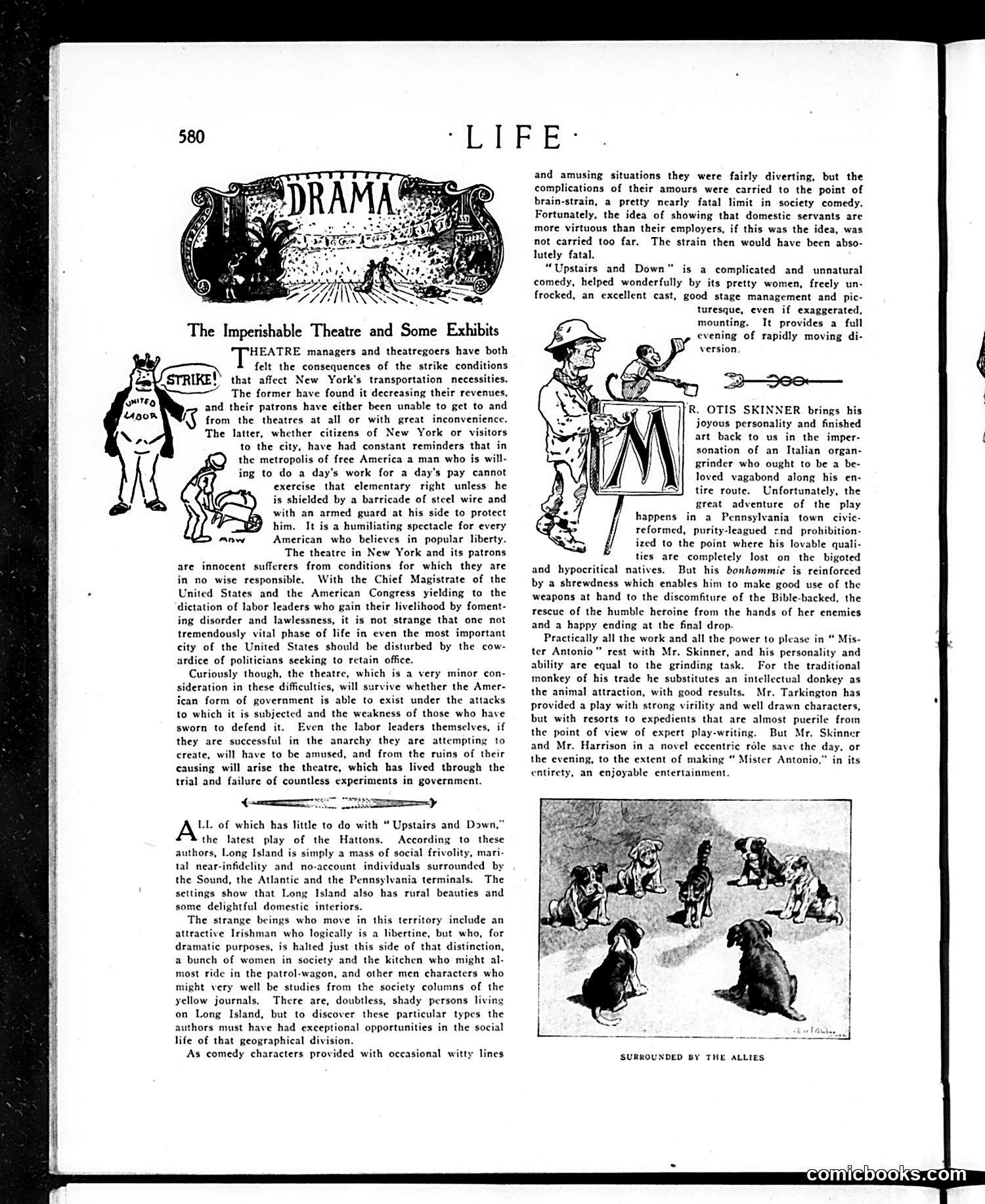
This page critiques New York's labor strike (appearing to reference transportation strikes affecting theater attendance). The left column argues that while theater managers and patrons suffer innocent losses, the real issue is larger: politicians' "cowardice" in yielding to labor leaders, undermining American governance and liberty. The piece argues that even amid government collapse, theater will survive—positioning it as a resilient cultural institution. The cartoon shows a figure labeled "STRIKE" alongside imagery suggesting labor conflict and restrictions on workers' freedom (armed guards, steel wire barriers). The satire targets political weakness in confronting labor unrest. The right column reviews the play "Upstairs and Down," describing Long Island society types—wealthy frivolous characters and servants—with thinly veiled criticism of the wealthy's moral failings. This serves as social satire about class hypocrisy on Long Island during the era.
📄 Transcribed text from this page (OCR, searchable)
Machine-transcribed from the original scan — historical spelling and the odd misread are preserved.
ee The Imperishable Theatre and Some Exhibits HEATRE managers and theatregoers have both felt the consequences of the strike conditions STRIKE! that affect New York’s transportation necessities. =’ The former have found it decreasing their revenues, PMITED and their patrons have either been unable to get to and from the theatres at all or with great inconvenience. The latter, whether citizens of New York or visitors to the city, have had constant reminders that in the metropolis of free America a man who is will- ing to do a day's work for a day’s pay cannot exercise that elementary right unless he is shielded by a barricade of stcel wire and with an armed guard at his side to protect him. It is a humiliating spectacle for every American who believes in popular liberty. The theatre in New York and its patrons are innocent sufferers from conditions for which they are in no wise responsible. With the Chief Magistrate of the United States and the American Congress yielding to the dictation of labor leaders who gain their livelihood by foment- ing disorder and lawlessness, it is not strange that one not tremendously vital phase of life in even the most important city of the United States should be disturbed by the cow- ardice of politicians seeking to retain office. Curiously though, the theatre, which is a very minor con- sideration in these difficulties, survive whether the Amer- ican form of government is able to exist under the attacks to which it is subjected and the weakness of those who have sworn to defend it. en the labor leaders themselves, if they are successful in the anarchy they are attempting to create, will have to be amused, and from the ruins of their causing will arise the theatre, which has lived through the trial and failure of countless experiments in government. —== A' of which has little to do with “ Upstairs and Down,” the latest play of the Hattons. According to these authors, Long Island is simply a mass of social frivolity, mari- tal near-infidelity and no-account individuals surrounded by the Sound, the Atlantic and the Pennsylvania terminals, The settings show that Long Island also has rural beauties and some delightful domestic interiors. The strange beings who move in this territory include an attractive Irishman who logically is a libertine, but who, for dramatic purposes, is halted just this side of that distinction, a bunch of women in society and the kitchen who might al- most ride in the patrol-wagon, and other men characters who might very well be studies from the society columns of the yellow journals, There are, doubtless, shady persons living on Long Island, but to discover these particular types the authors must have had exceptional opportunities in the social life of that geographical division. As comedy characters provided with occasional witty lines and amusing situations they were fairly diverting, but the complications of their amours were carried to the point of brain-strain, a pretty nearly fatal limit in society comedy. Fortunately, the idea of showing that domestic servants are more virtuous than their employers, if this was the idea, was not carried too far. The strain then would have been abso- lutely fatal. “Upstairs and Down" is a complicated and unnatural comedy, helped wonderfully by its pretty women, freely un- frocked, an excellent cast, good stage management and pic- turesque, even if exaggerated, mounting. It provides a full evening of rapidly moving di- version R. OTIS SKINNER brings his joyous personality and finished art back to us in the imper- sonation of an Italian organ- grinder who ought to be a be- loved vagabond along his en- tire route. Unfortunately, the great adventure of the play happens in a Pennsylvania town civic- reformed, purity-leagued znd_prohibition- ized to the point where his lovable quali- ties are completely lost on the bigoted and hypocritical natives. But his bonhommie is reinforced by a shrewdness which enables him to make good use of the weapons at hand to the discomfiture of the Bible-backed, the rescue of the humble heroine from the hands of her enemies and a happy ending at the final drop. Practically all the work and all the power to please in “ Mis- ter Antonio” rest with Mr. Skinner, and his personality and ability are equal to the grinding task. For the traditional monkey of his trade he substitutes an intellectual donkey as the animal attraction, with good results. Mr. Tarkington has provided a play with strong virility and well drawn characters, but with resorts to expedients that are almost puerile from the point of view of expert play-writing. But Mr. Skinner and Mr. Harrison in a novel eccentric réle save the day, or the evening, to the extent of making “ Mister Antonio.” in its entirety, an enjoyable entertainment. SURROUNDED BY THE ALLIES