
Life, 1916-10-05 · page 28 of 42
Life — October 5, 1916 — page 28: what you’re looking at
What you’re looking at
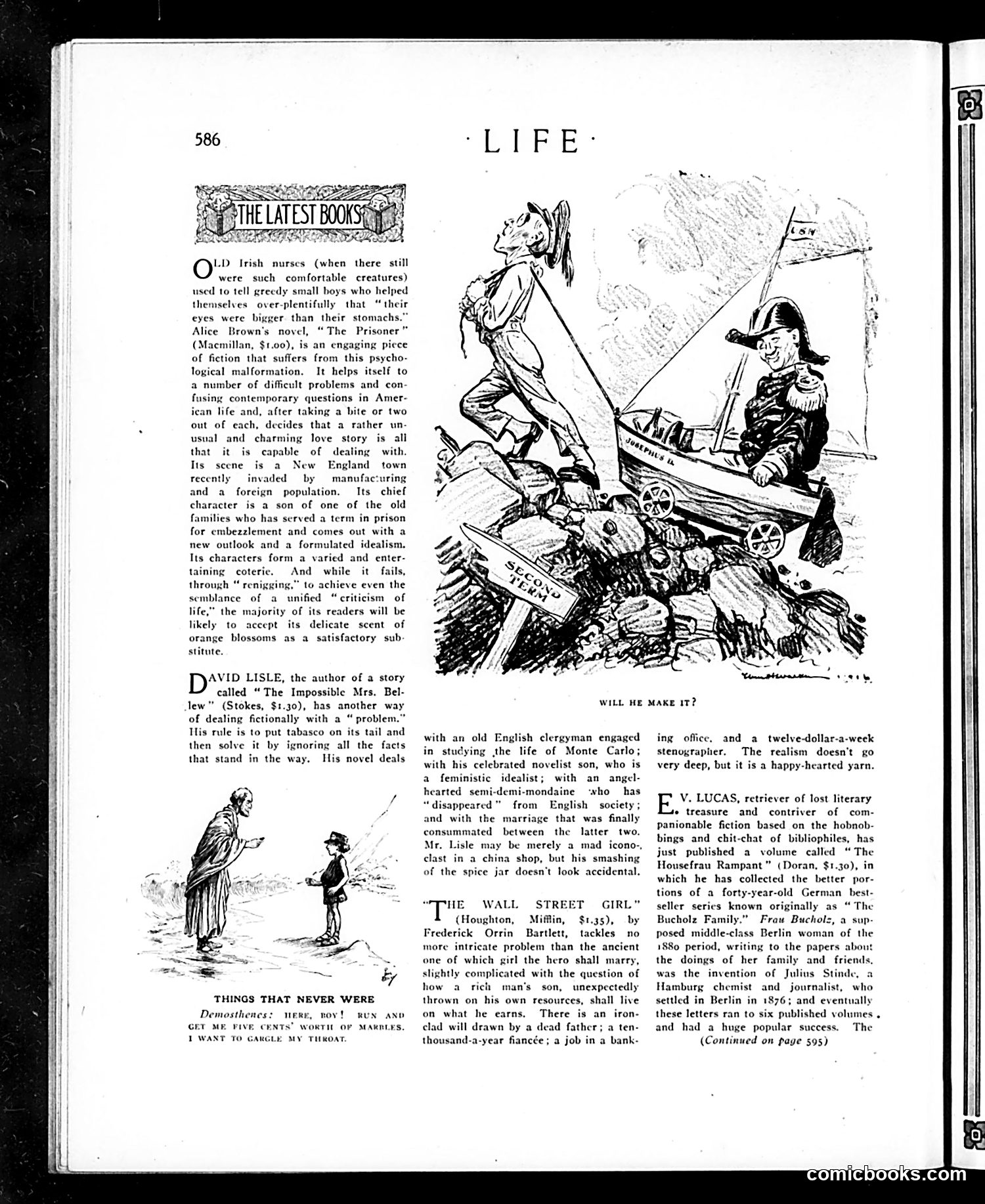
This page contains book reviews and satirical cartoons. The main cartoon, "Will He Make It?," depicts a figure on a tightrope labeled "SUCCESS" attempting to balance while carrying baggage, with onlookers below. This appears to comment on the precarious nature of achieving success in American life. The reviews discuss contemporary fiction dealing with "problems"—a period literary term for socially conscious novels. The critic notes Alice Brown's novel bites off more social issues than it can chew ("eyes bigger than stomach"), while David Lisle's work tackles its subject recklessly ("tabasco on its tail"). The small cartoon "Things That Never Were" mocks an absurd scenario: someone asking for five cents' worth of marbles to gargle their throat—satirizing illogical requests or nonsensical behavior. The reviews suggest early 1900s anxiety about American modernization, industrialization, and changing social values that fiction struggled to address meaningfully.
📄 Transcribed text from this page (OCR, searchable)
Machine-transcribed from the original scan — historical spelling and the odd misread are preserved.
LD Irish nurses (when there still were such comfortable creatures) used to tell greedy small boys who helped themselves over-plentifully that“ their eyes were bigger than their stomach Alice Brown's “The Prisoner" (Macmillan, $1.00), is an engaging piece of fiction that suffers from this psycho- logical malformation. It helps itself to a number of difficult problems and con- fusing contemporary questions in Amer- ican life and, after taking a bite or two out of each, decides that a rather un- usual and charming love story is all that it is capable of dealing with. Its scene is a New England town recently invaded by — manufac:uring and a foreign population. Its chief character is a son of one of the old families who has served a term in prison for embezzlement and comes out with a new outlook and a formulated idealism. Its characters form a varied and enter- taining coterie, And while it fails, through “ renigging,” to achieve even the semblance of a unified “criticism of life,” the majority of its readers will be likely to accept its delicate scent of orange blossoms as a satisfactory sub stitute. novel, D2 LISLE, the author of a story called “The Impossible Mrs. Bel- (Stokes, $1.30), has another way of dealing fictionally with a “ problem.” lew" to put tabasco on its tail and snoring all the facts His novel deals lis rule then solve it by that stand in the way. THINGS THAT NEVER WERE Demosthenes: were, woy! RUN AND CET ME FIVE CENTS’ WORTIL OF MAKRLES. 1 WANT TO GAKGLE MY THROAT. WILL HE MAKE IT? with an old English clergyman engaged in studying the life of Monte Carlo; with his celebrated novelist son, who is a feministic idealist; with an angel- hearted semi-demi-mondaine who has “disappeared” from English society; and with the marriage that was finally consummated between the latter two. Mr. Lisle may be merely a mad icono-, clast in a china shop, but his smashing of the spice jar doesn't look accidental. STREET GIRL” (Houghton, Mifflin, $1.35), by Frederick Orrin Bartlett, tackles no more intricate problem than the ancient one of which girl the hero shall marry, slightly complicated with the question of how a rich man’s son, unexpectedly thrown on his own resources, shall live on what he earns, There is an iron- clad will drawn by a dead father; a ten- thousand-a-year fiancée ; a job in a bank- HE WALL ing office, and a twelve-dollar-a-week stenographer. The realism doesn't go very deep, but it is a happy-hearted yarn. E V. LUCAS, retriever of lost literary treasure and contriver of com- Panionable fiction based on the hobnob- bings and chit-chat of bibliophiles, has just published a volume called “The Housefrau Rampant” (Doran, $1.30), in which he has collected the better por- tions of a forty-year-old German best- seller series known originally as “The Bucholz Family.” Frau Bucholz, a sup- posed middle-class Berlin woman of the 1880 period, writing to the papers about the doings of her family and fri was the invention of Julius Stinde, a Hamburg chemist and journalist, who settled in Berlin in 1876; and eventually these letters ran to six published volumes . and had a huge popular success. The (Continued on page 595)