
Life, 1916-10-05 · page 18 of 42
Life — October 5, 1916 — page 18: what you’re looking at
What you’re looking at
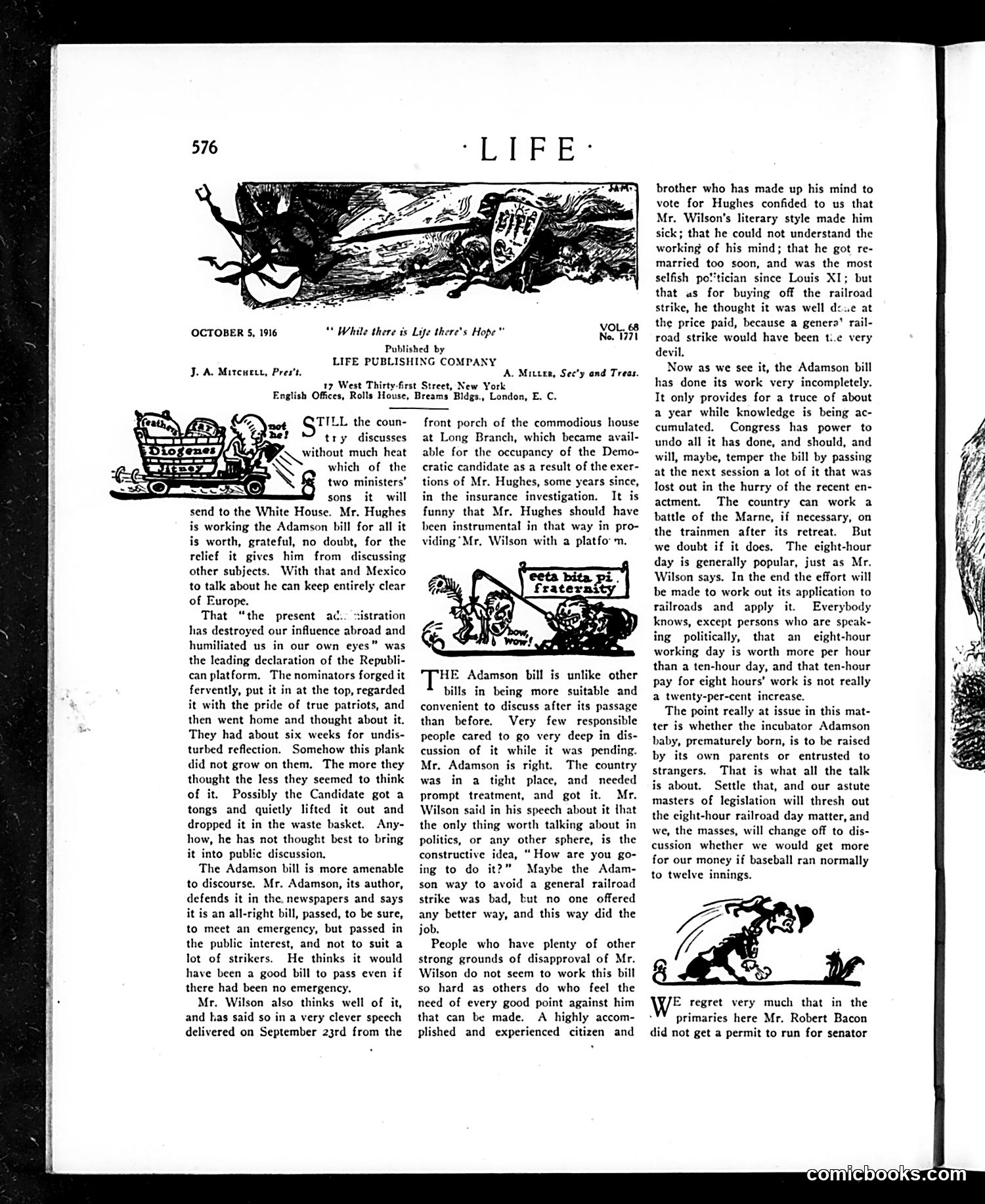
This editorial page discusses the **Adamson bill**—emergency legislation passed to prevent a railroad strike by establishing an eight-hour workday. The 1916 presidential race between **Wilson** (Democrat) and **Hughes** (Republican) frames the debate. The cartoons and text mock Hughes for exploiting the bill politically while avoiding substantive criticism. A key anecdote describes a Hughes supporter who opposes Wilson on literary style, intellect, and personal matters—yet admits Wilson handled the railroad crisis well and cheaply. The satire suggests Republicans lacked genuine policy objections to Wilson, so they seized on minor grievances. The piece argues the Adamson bill, while imperfect and temporary, pragmatically solved an urgent crisis. The real point: Wilson's practical governing success undermined Republican attacks, forcing critics to resort to personality-based complaints rather than substantive policy disagreement.
📄 Transcribed text from this page (OCR, searchable)
Machine-transcribed from the original scan — historical spelling and the odd misread are preserved.
OCTOBER §, 1916 “* While there is Life there's Hope” Published by LIFE PUBLISHING COMPANY J. A. Mitcurte, Pres’t. A. Mitter, Sec’y and Treas. 17 West Thirty-first Street, New York English Offices, Rolls House, Breams Bldgs., London, E. C. TILL the coun- try discusses without much heat S IN which of the two ministers’ sons it will send to the White House. Mr. Hughes is working the Adamson bill for all it is worth, grateful, no doubt, for the relief it gives him from discussing other subjects. With that and Mexico to talk about he can keep entirely clear of Europe. That “the present ac.. xistration has destroyed our influence abroad and humiliated us in our own eyes” was the leading declaration of the Republi- can platform, The nominators forged it fervently, put it in at the top, regarded it with the pride of true patriots, and then went home and thought about it. They had about six weeks for undis- turbed reflection. Somehow this plank did not grow on them, The more they thought the less they seemed to think of it. Possibly the Candidate got a tongs and quietly lifted it out and dropped it in the waste basket. Any- how, he has not thought best to bring it into public discussion, The Adamson bill is more amenable to discourse. Mr. Adamson, its author, defends it in the. newspapers and says it is an all-right bill, passed, to be sure, to meet an emergency, but passed in the public interest, and not to suit a lot of strikers. He thinks it would have been a good bill to pass even if there had been no emergency. Mr. Wilson also thinks well of it, and has said so in a very clever speech delivered on September 23rd from the front porch of the commodious house at Long Branch, which became avail- able for the occupancy of the Demo- cratic candidate as a result of the exer- tions of Mr. Hughes, some years since, in the insurance investigation. It is funny that Mr. Hughes should have been instrumental in that way in pro- viding’Mr. Wilson with a platfo:m. 'HE Adamson bill is unlike other bills in being more suitable and convenient to discuss after its passage than before. Very few responsible people cared to go very deep in dis- cussion of it while it was pending. Mr. Adamson is right. The country was in a tight place, and needed prompt treatment, and got it. Mr. Wilson said in his speech about it that the only thing worth talking about in politics, or any other sphere, is the constructive idea, “How are you go- ing to do it?” Maybe the Adam- son way to avoid a general railroad strike was bad, but no one offered any better way, and this way did the job. People who have plenty of other strong grounds of disapproval of Mr. Wilson do not seem to work this bill so hard as others do who feel the need of every good point against him that can be made. A highly accom- plished and experienced citizen and brother who has made up his mind to vote for Hughes confided to us that Mr. Wilson's literary style made him sick; that he could not understand the working of his mind; that he got re- married too soon, and was the most selfish pot'tician since Louis XI; but that as for buying off the railroad strike, he thought it was well dcue at the price paid, because a genera’ rail- road strike would have been ti.e very devil. Now as we see it, the Adamson bill has done its work very incompletely. It only provides for a truce of about a year while knowledge is being ac- cumulated. Congress has power to undo all it has done, and should, and will, maybe, temper the bill by passing at the next session a lot of it that was lost out in the hurry of the recent en- actment. The country can work a battle of the Marne, if necessary, on the trainmen after its retreat. But we doubt if it does. The eight-hour day is generally popular, just as Mr. Wilson says. In the end the effort will be made to work out its application to railroads and apply it. Everybody knows, except persons who are speak- ing politically, that an eight-hour working day is worth more per hour than a ten-hour day, and that ten-hour pay for eight hours’ work is not really a twenty-per-cent increase. The point really at issue in this mat- ter is whether the incubator Adamson baby, prematurely born, is to be raised by its own parents or entrusted to Strangers. That is what all the talk is about. Settle that, and our astute masters of legislation will thresh out the eight-hour railroad day matter, and we, the masses, will change off to dis- cussion whether we would get more for our money if baseball ran normally to twelve innings. WE regret very much that in the ‘ primaries here Mr. Robert Bacon did not get a permit to run for senator