
A complete issue · 41 pages · 1916
Life — September 28, 1916
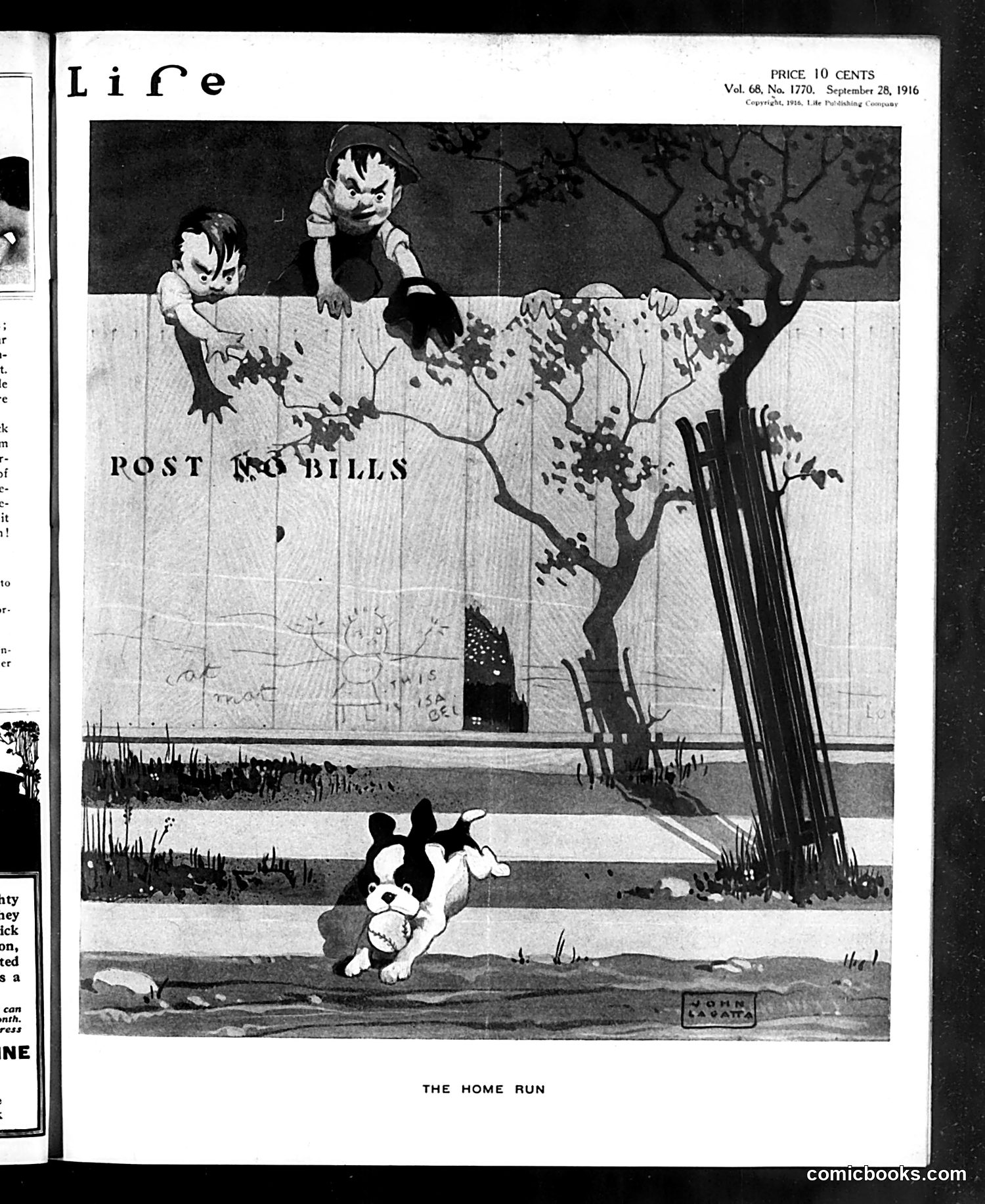
This cartoon depicts a domestic scene with satirical commentary on bill collection. Two caricatured children peer over a fence at "Post No Bills" signage, while a small dog runs below carrying what appears to be a bill in its mouth. The title "The Home Run" is a pun: a "home run" typically means scoring in baseball, but here it refers to a bill successfully "running" back to someone's home—suggesting debt collection or the inescapability of bills following a debtor. The children's crude drawings on the fence and the overall composition mock the futility of trying to avoid financial obligations. The cartoon likely comments on household financial struggles or the persistence of creditors during this pre-income-tax era.
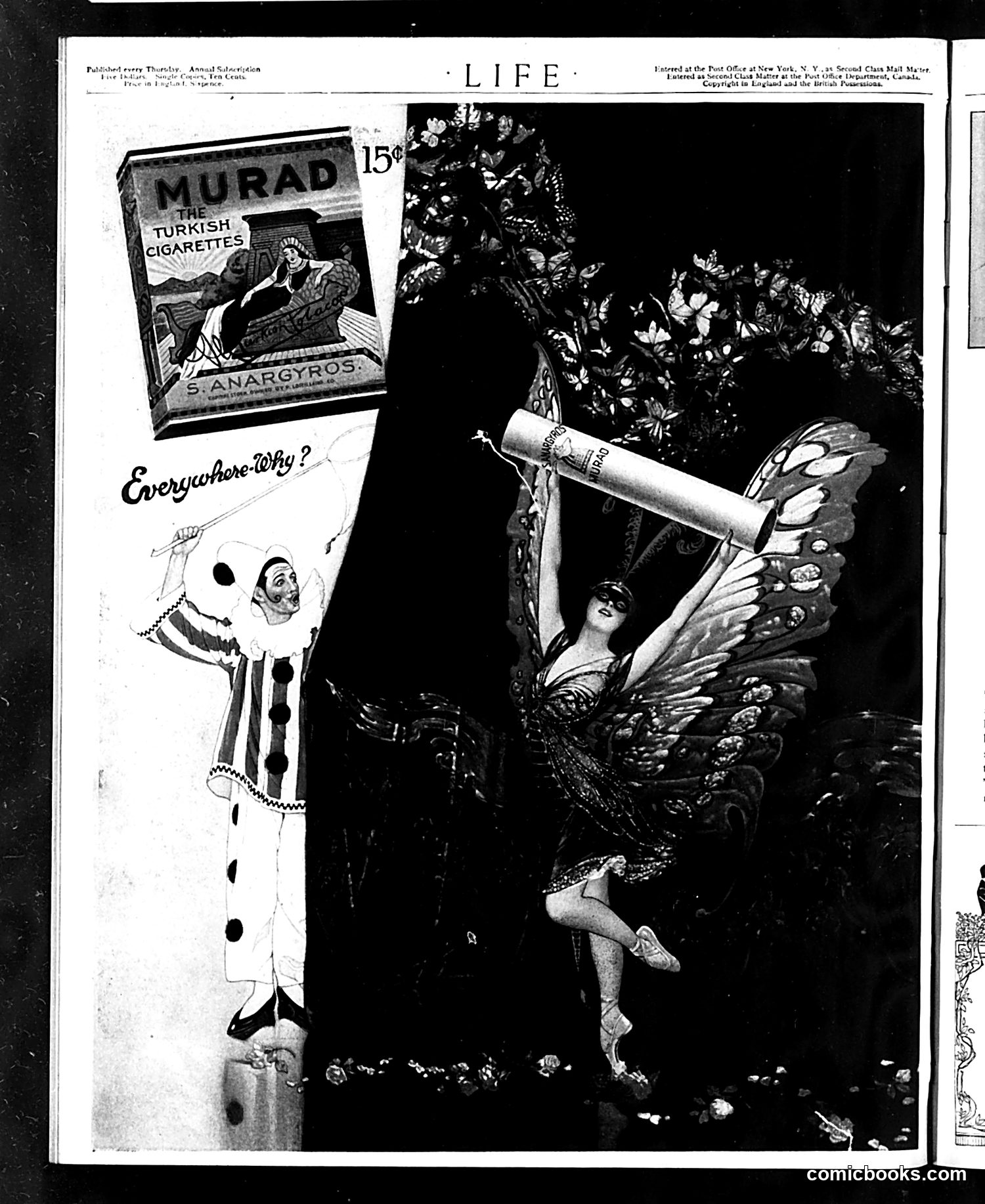
This page contains two distinct elements: **Left side:** A Murad Turkish Cigarettes advertisement (15¢) featuring a stylized figure asking "Everywhere—Why?" The ad uses decorative typography and an exotic aesthetic typical of early 20th-century cigarette marketing. **Right side:** A theatrical or artistic illustration showing a woman in elaborate fairy or butterfly-wing costume holding what appears to be a scroll or document, surrounded by ornate floral elements against a dark background. Without additional OCR text or caption information visible, the specific satirical message connecting these elements remains unclear. The page appears to be primarily advertising-driven rather than political commentary. The theatrical imagery on the right may relate to entertainment or society events of the era, but the exact reference cannot be determined from the visual content alone.
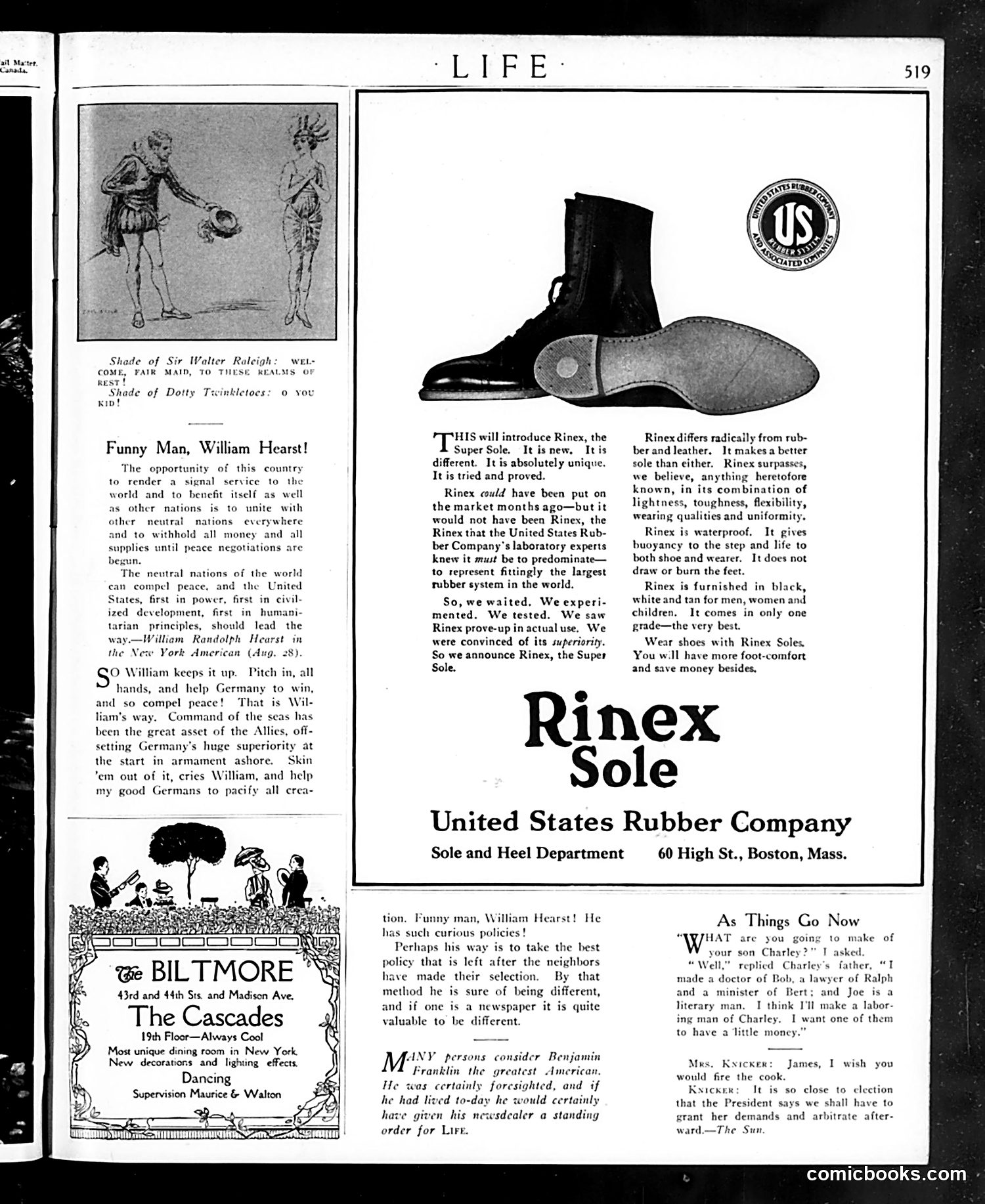
The page contains two distinct sections: **Left side:** A satirical article titled "Funny Man, William Hearst!" criticizing William Randolph Hearst's political positions. The text suggests Hearst advocates for peace and neutrality while Germany wins the war, calling his approach naive. The accompanying sketch shows two classical figures in dialogue. This appears to reference World War I debates about American intervention. **Right side:** A Rinex Sole shoe advertisement from United States Rubber Company, unrelated to the satire. **Bottom left:** An advertisement for The Cascades ballroom in New York. The political content mocks Hearst's pacifist stance as potentially harmful to Allied interests during WWI, positioning him as impractical despite good intentions.
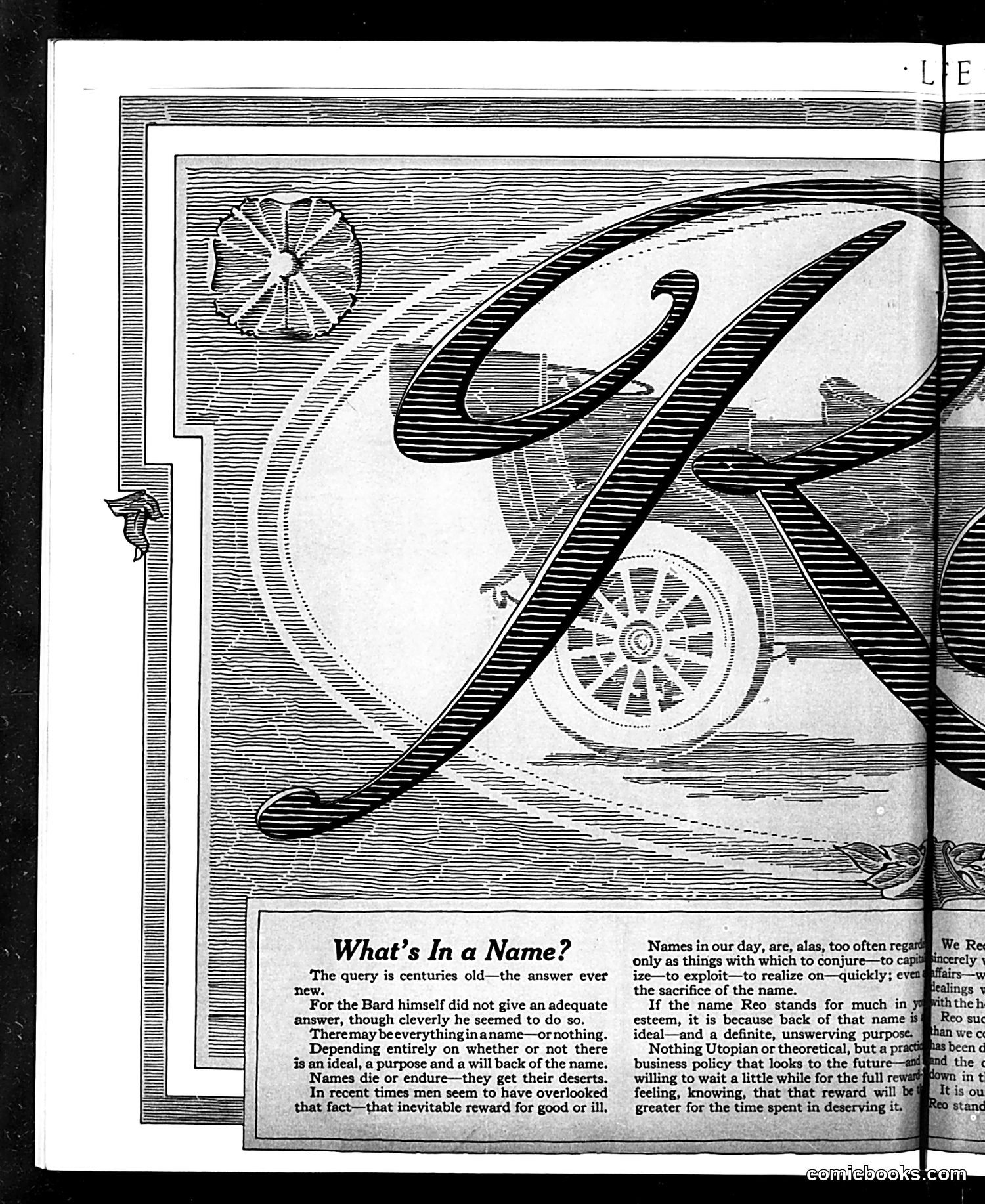
This page features an illustration of a luxury automobile with decorative Art Deco styling, accompanied by an article titled "What's In a Name?" The text discusses how brand names carry significance and purpose. It argues that names like "Reo" (the car brand shown) represent more than mere labels—they embody meaning and identity. The article suggests that in recent times, naming has become overlooked despite its importance for establishing reputation and reward. The satirical point appears mild: the piece playfully critiques how consumers often overlook the deliberate strategy behind product naming, treating names as arbitrary rather than recognizing they convey quality and intention. The Reo automobile serves as the example of a name meant to inspire confidence through its "definite, unwavering purpose." This reflects 1920s-era marketing philosophy emphasizing brand identity's psychological power.
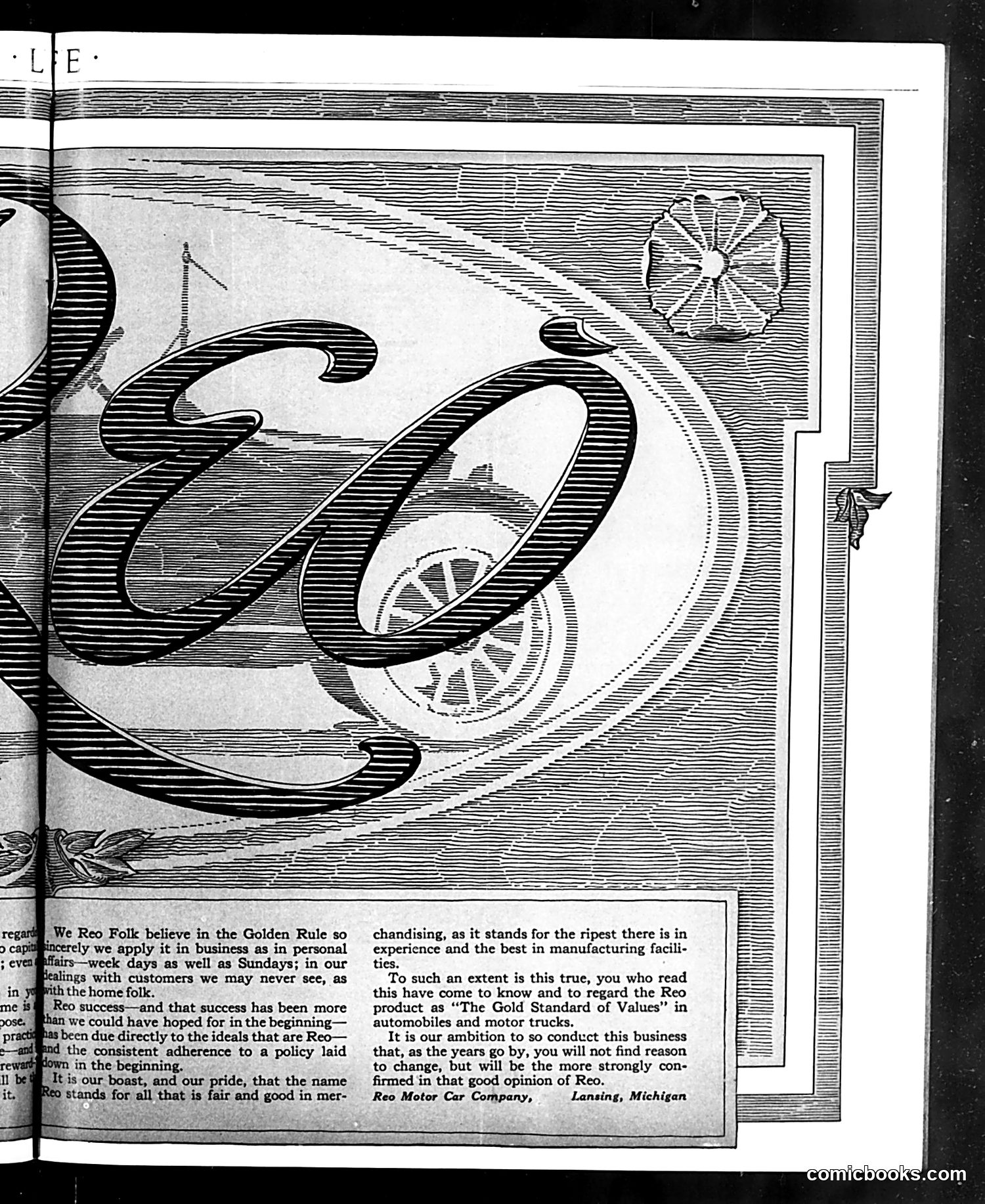
This page is **primarily an advertisement** for Reo Motor Car Company of Lansing, Michigan, not political satire. The large engraving shows an ornate letter "R" in decorative serif style—a common typographic element in early 20th-century advertising design. The accompanying text emphasizes Reo's business philosophy, claiming adherence to the "Golden Rule" in manufacturing and customer relations. The ad's message targets middle-class consumers: Reo promises quality products ("The Gold Standard of Values"), honest business practices, and consistency of values over time. This reflects early automotive-era marketing that appealed to consumer trust and ethical business conduct rather than purely technical specifications. There is **no political cartoon or satire present** on this page.
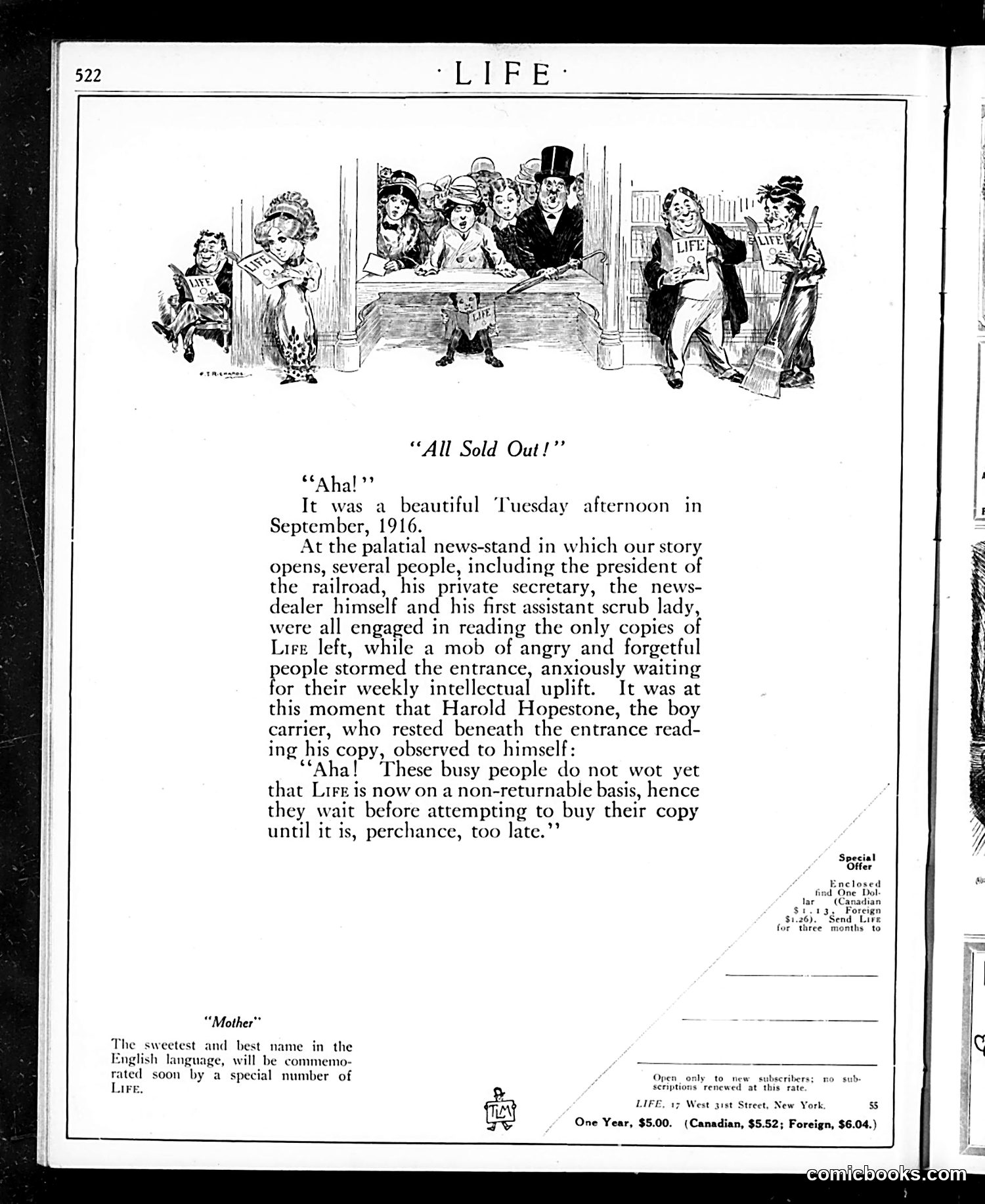
This cartoon satirizes the sudden popularity and scarcity of Life magazine itself. The scene depicts a crowded newsstand where copies are completely sold out, with eager customers waiting outside. The illustration shows well-dressed figures—apparently including railroad executives and other prominent people—desperately trying to obtain the last remaining copies. The joke is self-promotional: Harold Hopestone, a young newspaper carrier, observes that Life magazine has become so desirable that it's now sold on a non-returnable basis. The satire suggests Life's intellectual content has become so valuable and sought-after that people can no longer casually return unsold copies—they must purchase immediately or risk missing out entirely. It's essentially Life magazine boasting about its own circulation success and cultural relevance.
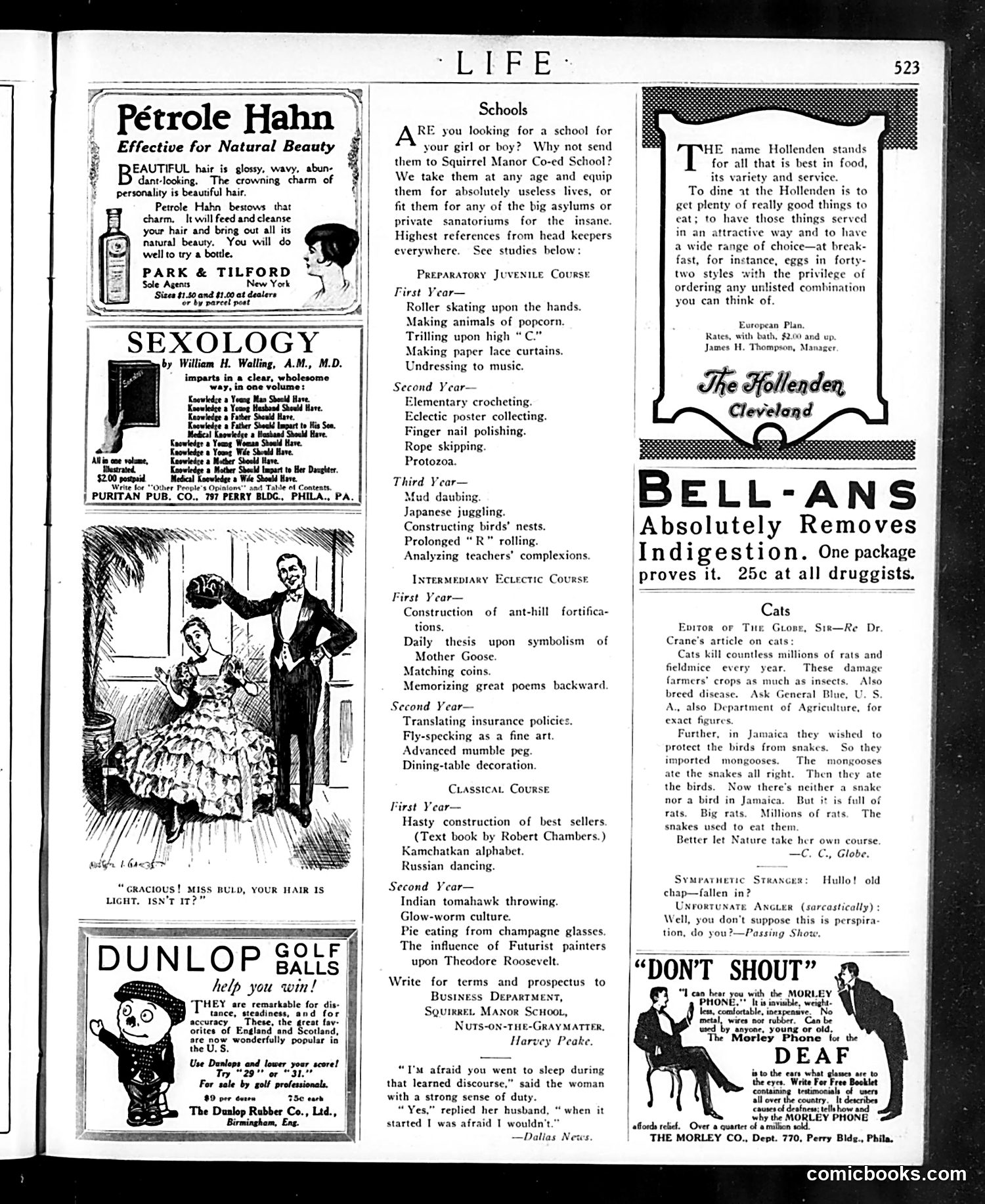
This page is primarily **advertisements and advice columns** rather than political satire. The main cartoon appears in the lower left: a man in formal attire holds a golf club while a woman in an elaborate dress sits nearby. The caption reads "GRACIOUS! MISS BULD, YOUR HAIR IS LIGHT, ISN'T IT?" — likely a humorous comment about the Pétrole Hahn hair product advertised above. The rest of the page contains: a "Schools" section describing Squirrel Manor Coeducational School's curriculum (presented somewhat humorously with absurd courses like "Japanese juggling" and "Pie eating from champagne glasses"); product advertisements (Sexology book, Bell-Ans antacid, Dunlop Golf balls, Morley Phone); and a brief "Cats" editorial discussing their pest-control value. **This is not primarily satirical content.**
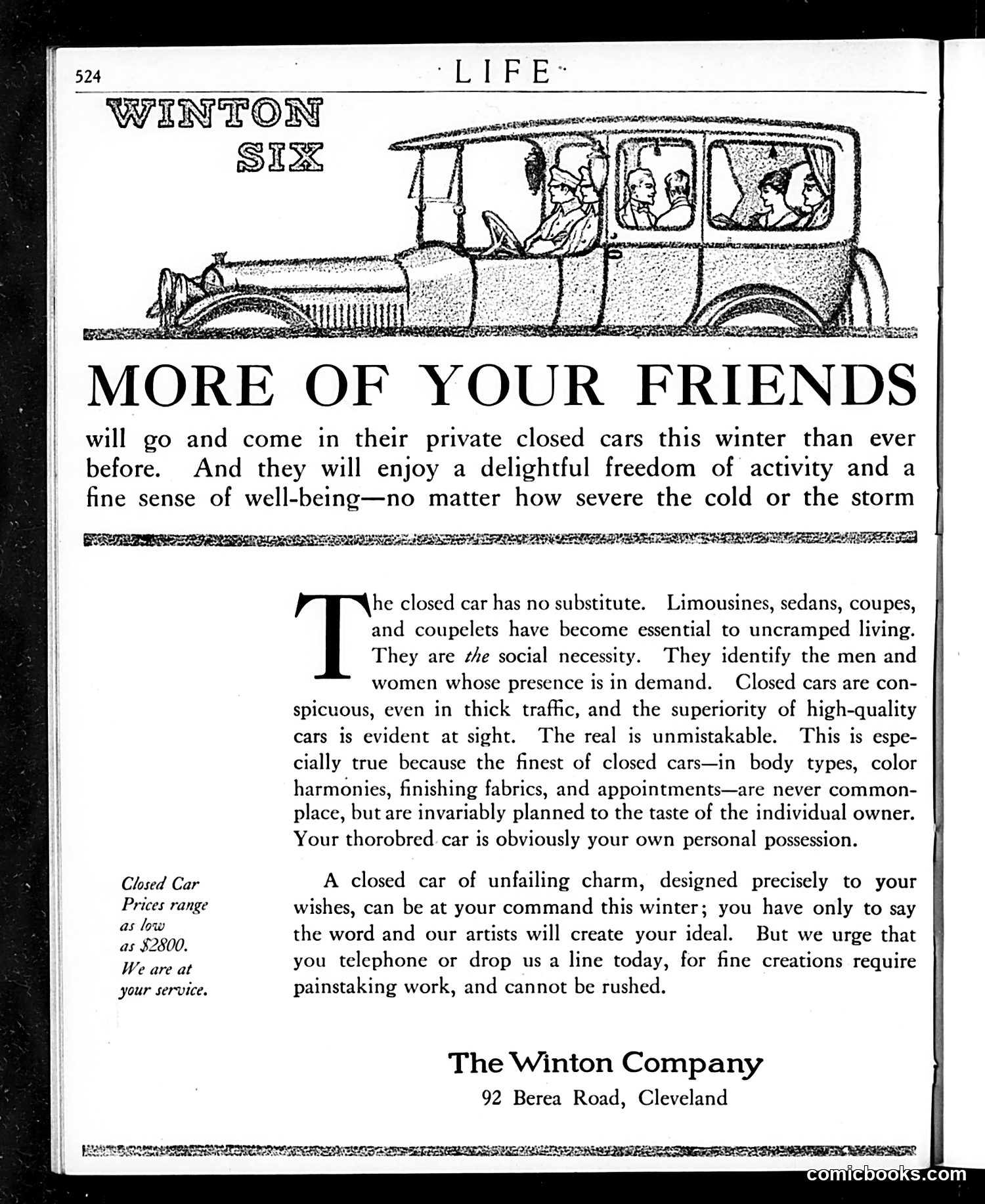
This is an **advertisement**, not satire or political content. The Winton Company (an early automobile manufacturer based in Cleveland) is marketing closed-car automobiles for winter driving. The ad's pitch centers on **social status**: closed cars have become a "social necessity" that identify people "whose presence is in demand." The illustration shows a well-dressed group traveling together in comfort—the appeal being freedom from harsh winter weather and conspicuous display of wealth and taste. The headline "More of Your Friends" emphasizes that closed cars are becoming standard among the affluent. The ad stresses customization and quality as markers of individual distinction. Prices started at $2,800 (substantial in the 1920s). This reflects early automotive marketing emphasizing luxury, social position, and protection from the elements.
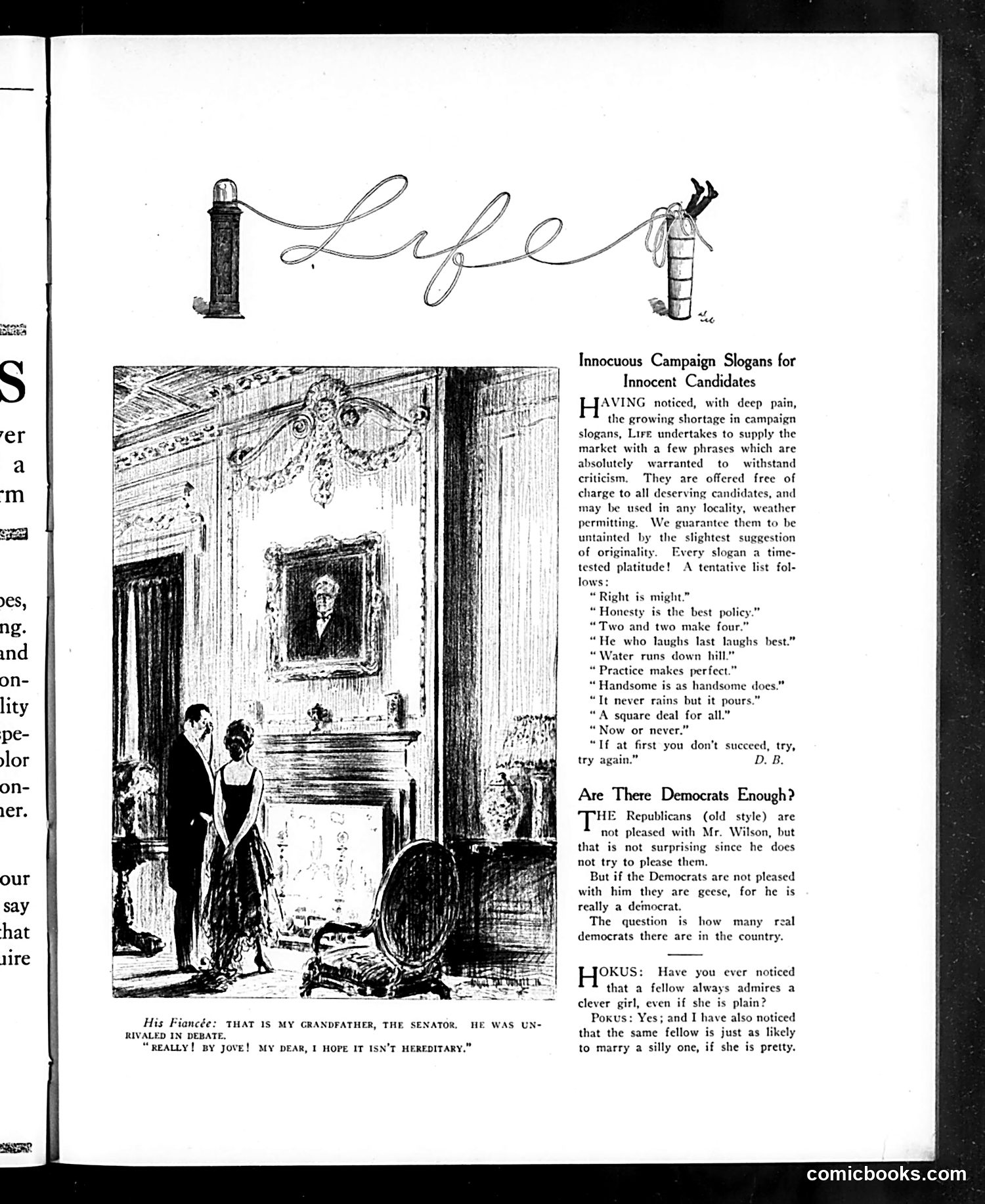
This page contains satirical political content from *Life* magazine. The top section offers "Innocuous Campaign Slogans for Innocent Candidates"—generic phrases like "Right is might" and "Practice makes perfect" intended for politicians seeking safe, non-controversial messaging. The main illustration depicts a fiancée showing her grandfather's portrait to her boyfriend, with the caption suggesting the grandfather was "unrivaled in debate" but hopes his legacy "isn't hereditary"—a joke about political families and whether debating talent passes through generations. Below, the section "Are There Democrats Enough?" questions whether genuine democrats exist in the country, critiquing both Republicans and Democrats. The dialogue between Hokus and Pokus follows, using classical comic-dialogue format to mock human nature and romantic selection. The content reflects early-20th-century American political skepticism and satirical commentary on campaign rhetoric.
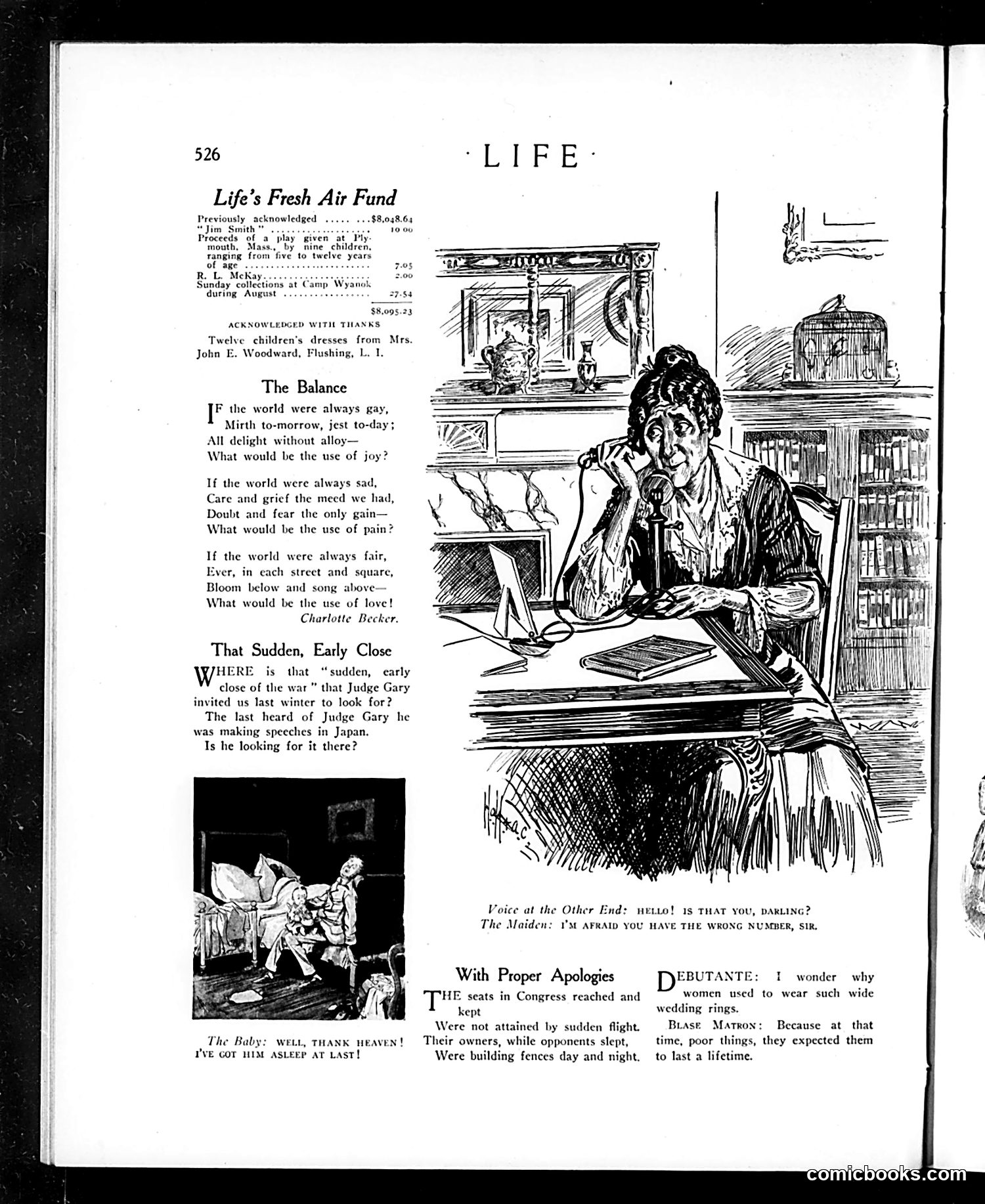
This page contains several humorous pieces typical of early 20th-century American satire: **"The Balance"** is a poem by Charlotte Becker exploring life's need for equilibrium—arguing that constant joy, sadness, or even perpetual blooming would be meaningless without contrast. **"That Sudden, Early Close"** satirizes Judge Gary's unexplained absence from public view, humorously speculating about his whereabouts (suggesting Japan). **"With Proper Apologies"** mocks Congress members for secretly building fences while opponents slept—a jab at underhanded political maneuvering. The page includes an illustration of a woman at a desk and another showing what appears to be a domestic scene. The humor relies on wordplay and situational irony typical of Life's satirical style during this era.
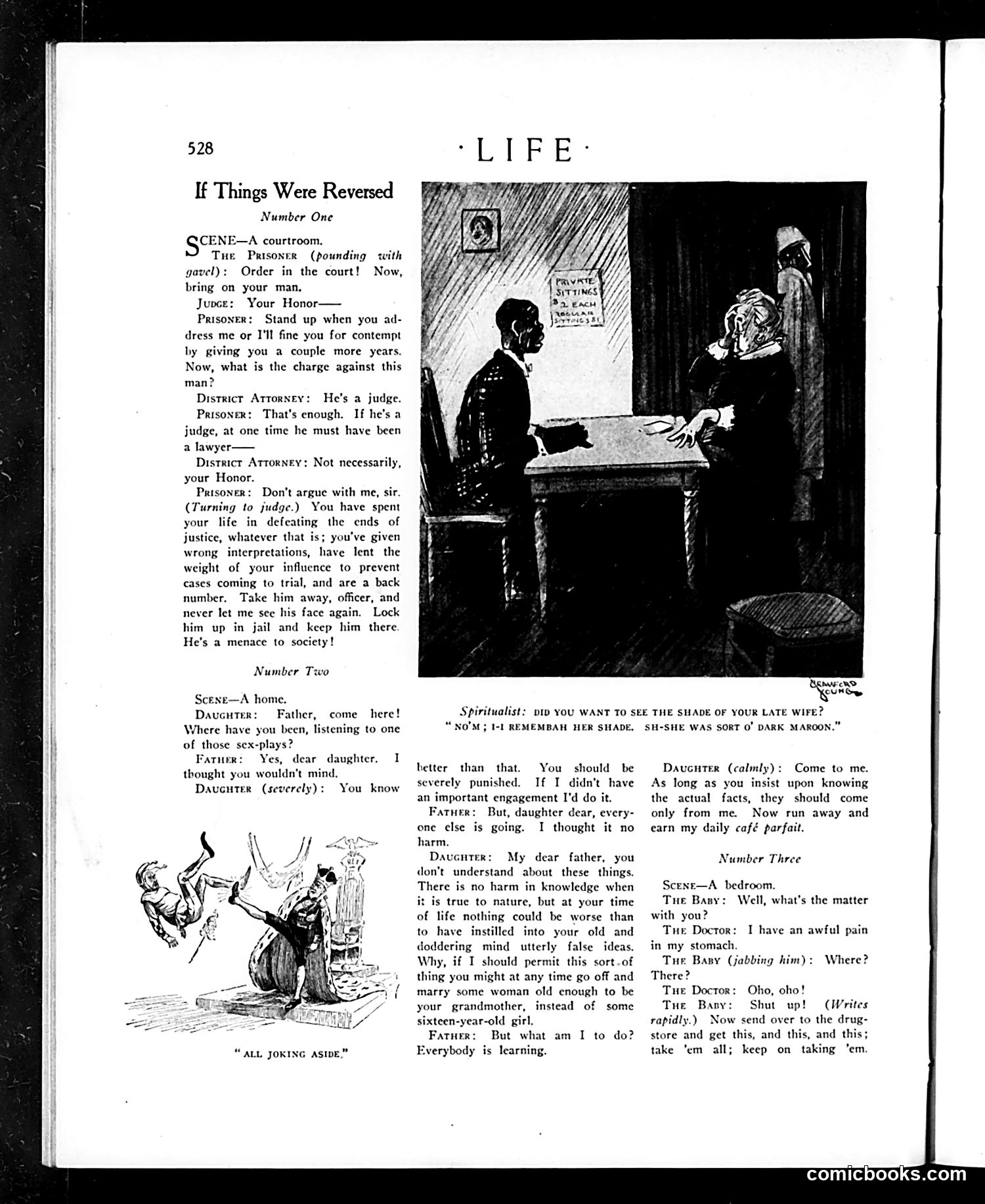
This three-scene satirical piece imagines a world where social hierarchies are inverted. **Scene One** depicts a prisoner lecturing a judge from the bench, reversing courtroom authority. The prisoner accuses the judge of judicial corruption—preventing cases from trial and abusing his influence—then orders the judge jailed as "a menace to society." **Scenes Two and Three** show domestic role reversals: a daughter patronizes her father about attending "see-plays," and a doctor takes orders from a baby patient. The satire's point appears to be social commentary on authority, class, and professional hierarchies—suggesting these structures depend on convention rather than inherent superiority. By flipping them absurdly, the cartoonist questions their legitimacy, likely appealing to early-20th-century audiences skeptical of institutional power.
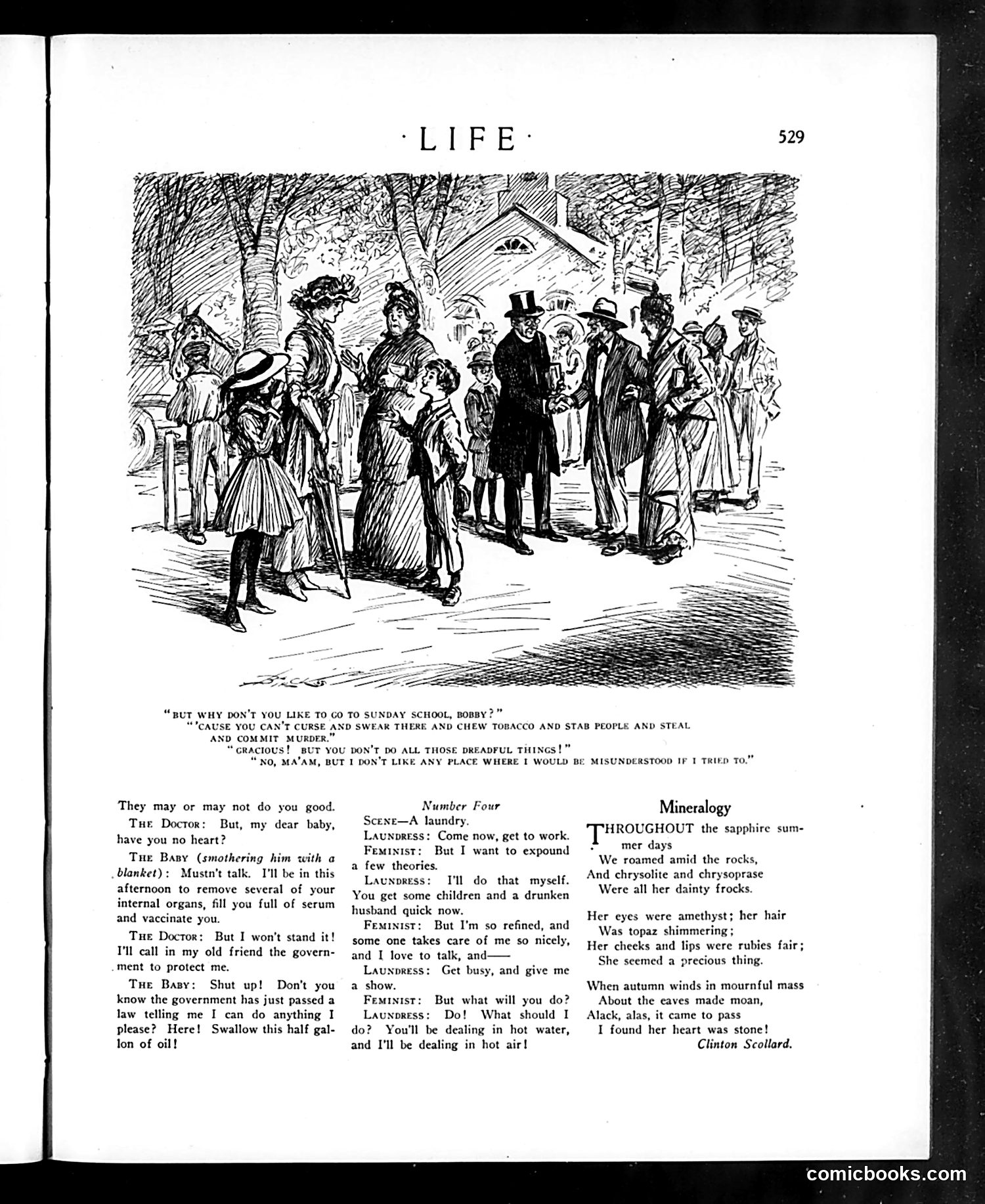
The top cartoon depicts a street scene where adults are gathered, with a young boy being questioned about why he won't attend Sunday school. The boy's response criticizes Sunday school attendees as hypocrites who "curse and swear there and chew tobacco and stab people and steal" while claiming to be "gracious." He concludes he'd be "misunderstood" if he tried to behave morally there. This is social satire on religious hypocrisy—the joke being that the boy, despite (or because of) his youth, has accurately identified the gap between Christian moral teaching and actual behavior of churchgoers. The cartoon mocks the corruption of religious institutions and the phoniness of adult morality. The lower section contains unrelated literary content.
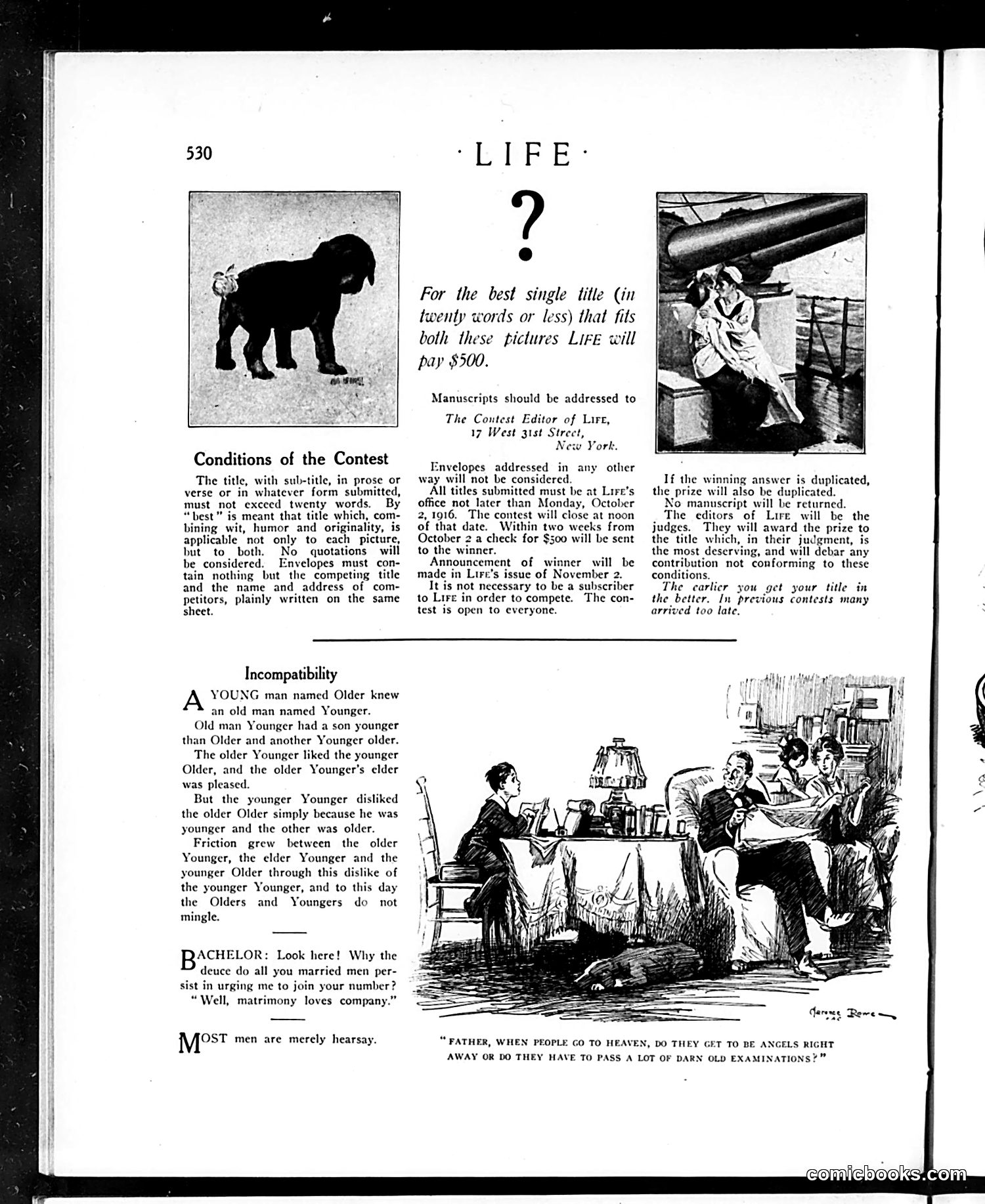
This page contains a **contest announcement** and **humorous sketches** rather than political satire. The contest asks readers to supply titles for two photographs—a dog and a person on what appears to be a ship or industrial structure. Life offered $500 for the best twenty-word-or-less title fitting both images. Below is a comedic piece titled "Incompatibility" mocking the naming conventions of families with names like "Older," "Younger," and "Younger Older"—creating absurd generational confusion. The joke plays on how such surnames create logical contradictions. A cartoon labeled "Father, when people go to heaven, do they get to be angels right away or do they have to pass a lot of darn old examinations?" depicts a child asking a father this theological question, satirizing formal examination culture by extending it comically to the afterlife.
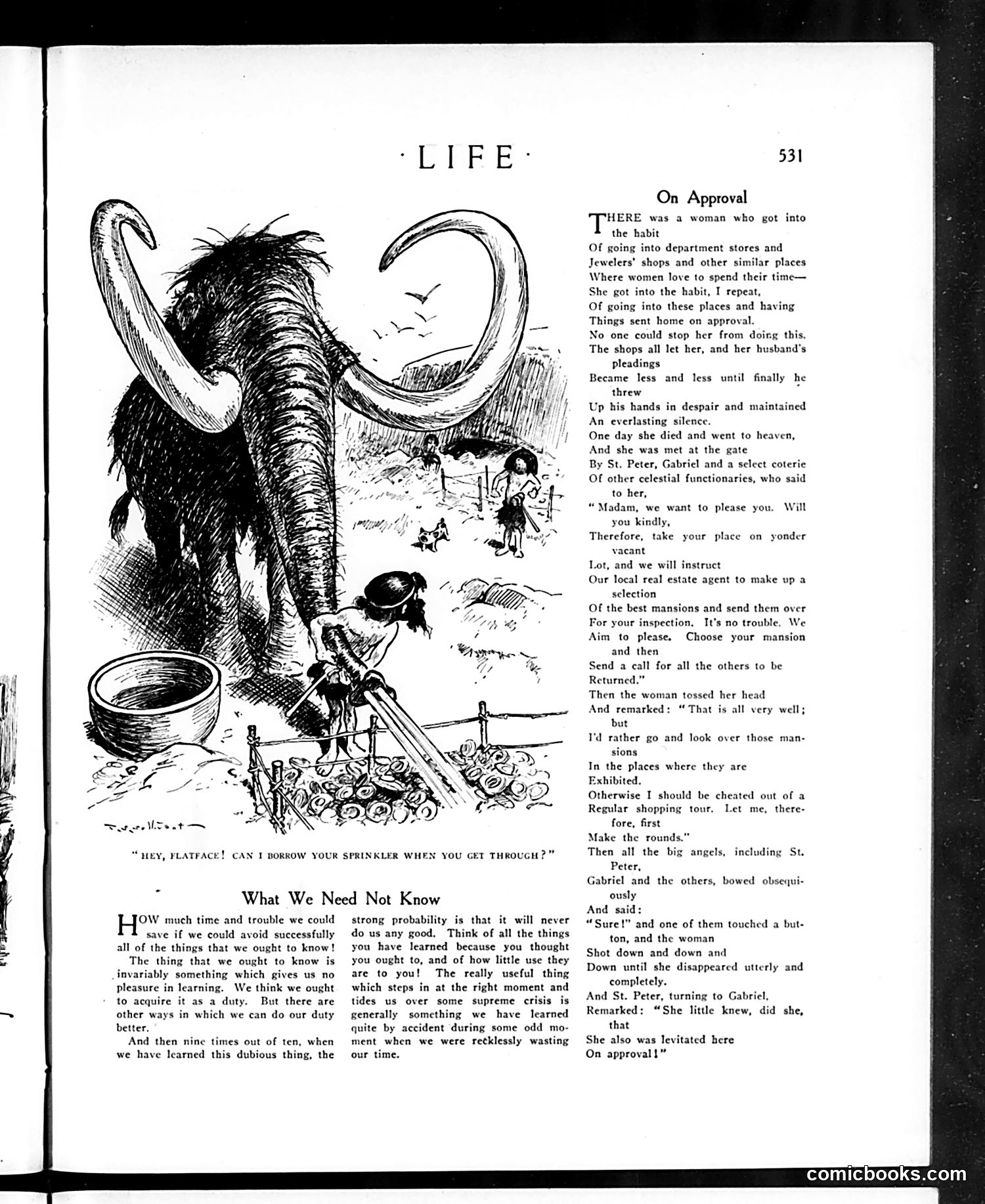
The cartoon at the bottom left depicts an elephant speaking to a small figure, asking "HEY, FLATFACE! CAN I BORROW YOUR SPRINKLER WHEN YOU GET THROUGH?" This is a humorous illustration playing on size contrast and anthropomorphization. The elephant, an enormous animal, is casually asking a tiny person to borrow their garden sprinkler—treating it as an ordinary neighborly request despite the absurd scale difference. The surrounding text includes two pieces: "On Approval" (a satirical story about a woman shopping for mansions) and "What We Need Not Know" (a philosophical essay about learning). The elephant cartoon appears designed as light comic relief amid these longer satirical pieces, typical of Life's format mixing visual and written humor.
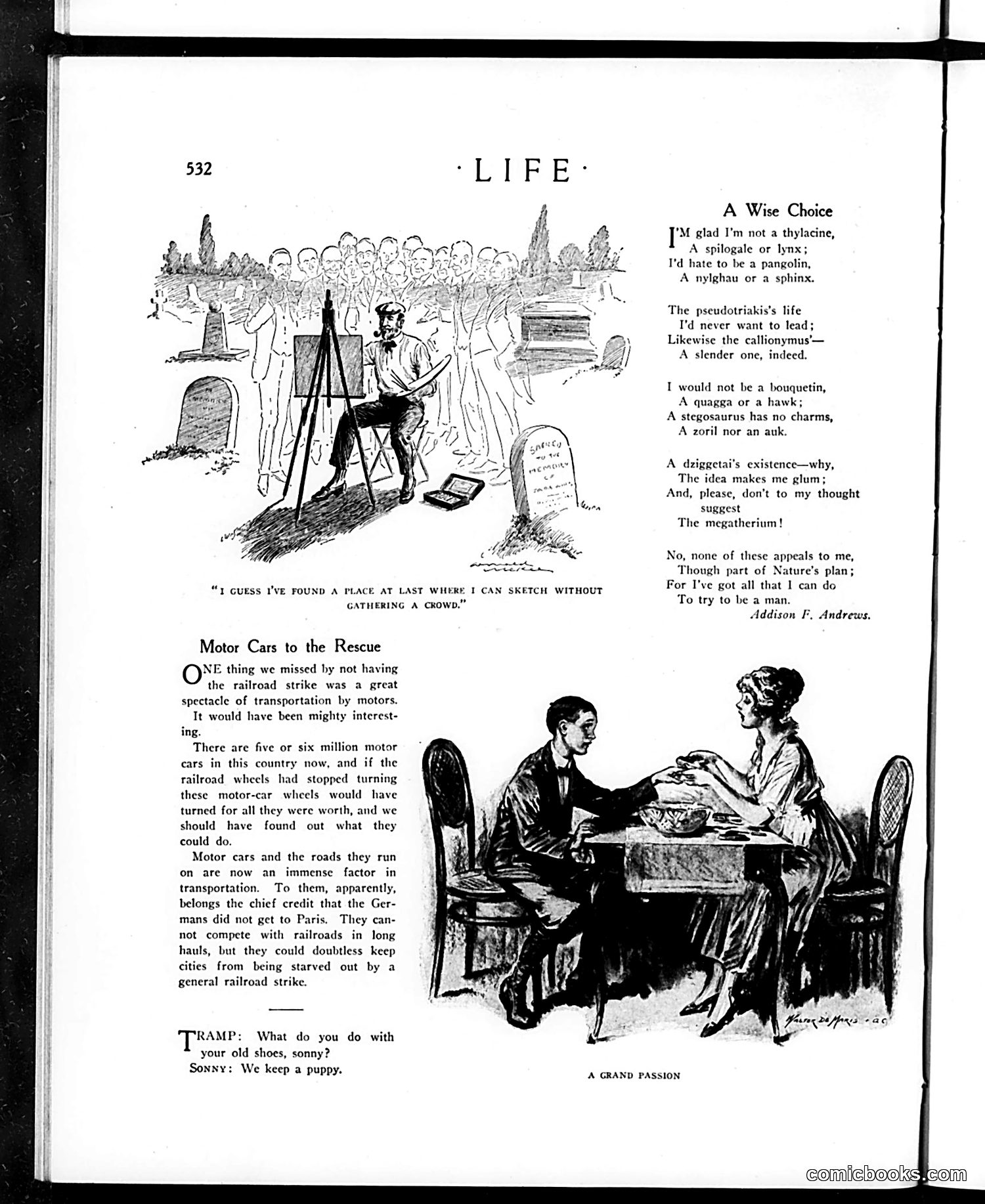
**"A Wise Choice"** is a humorous poem celebrating humanity over exotic animals. The speaker lists obscure creatures (thylacine, pangolin, stegosaurus, etc.) he's grateful *not* to be, concluding he's content simply "to try to be a man." The accompanying sketch shows an artist sketching in a cemetery—finally finding a place to work undisturbed by crowds. The satire gently mocks both pretentious naturalism and modern urban congestion. **"Motor Cars to the Rescue"** discusses how automobiles could have mitigated a potential railroad strike's damage. The piece notes five to six million motor cars exist and could supply cities if trains stopped running—crediting motors with helping Germans reach Paris (likely WWI reference). The accompanying joke compares old shoes to puppies, suggesting both are kept rather than discarded. Both pieces reflect early 20th-century concerns: transportation innovation, labor unrest, and modernity's promise.
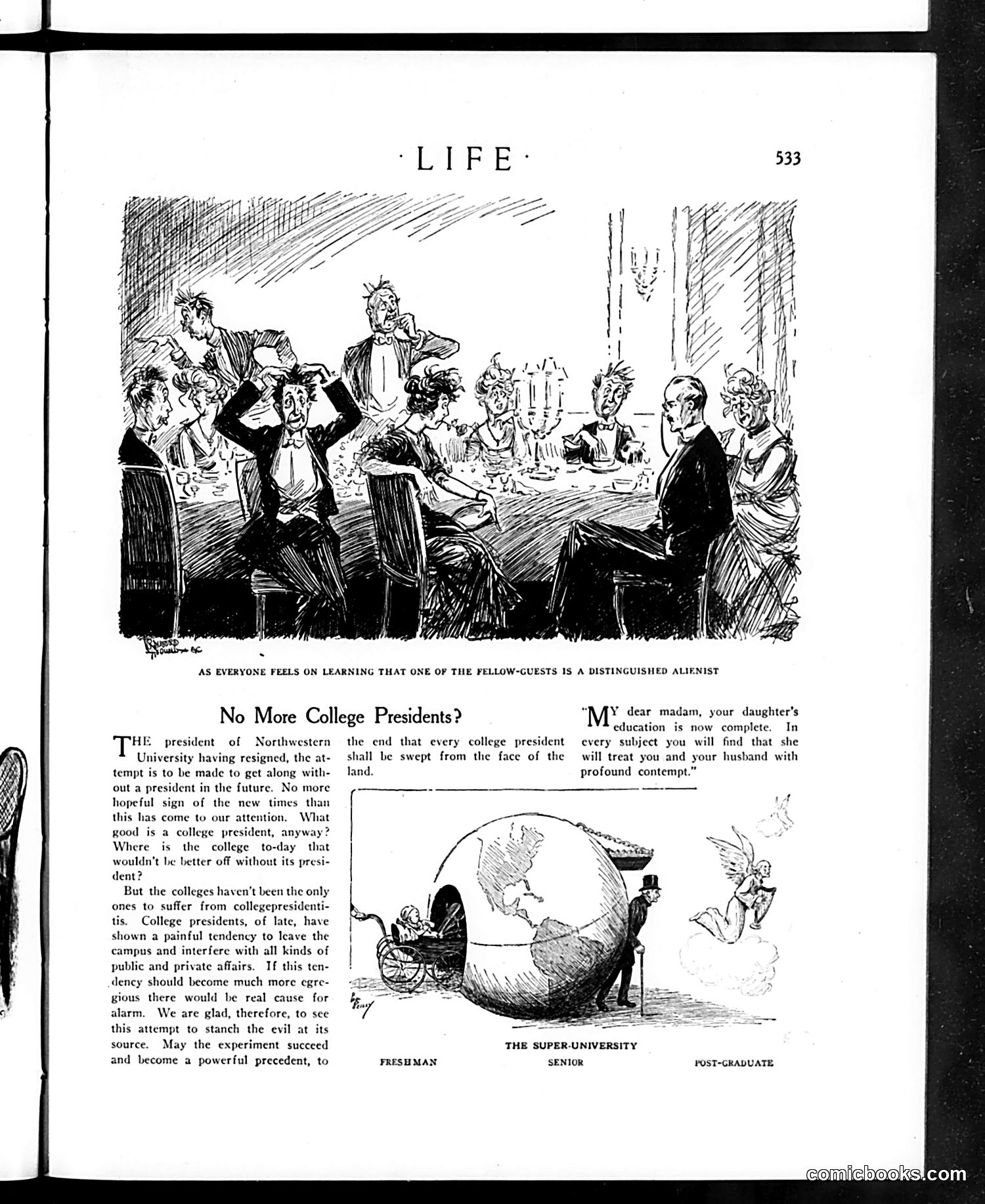
**Top cartoon**: Depicts dinner guests reacting with visible discomfort upon learning one attendee is a psychiatrist (an "alienist"—the archaic term for mental health specialists). The satire mocks social anxiety about psychology and psychoanalysis, which was still novel and somewhat suspect in early 20th-century America. **Main article & bottom cartoon**: Satirizes college presidents as wasteful administrators. The piece celebrates Northwestern University's attempt to operate without a president, arguing college leaders meddle in public affairs while contributing little value. The "Super-University" cartoon mocks the progression of education—showing how a post-graduate student's final lesson is contempt for their parents, suggesting higher education produces arrogant, ungrateful graduates disconnected from practical values. The satire targets both institutional bloat and education's perceived failure to instill character or respect.
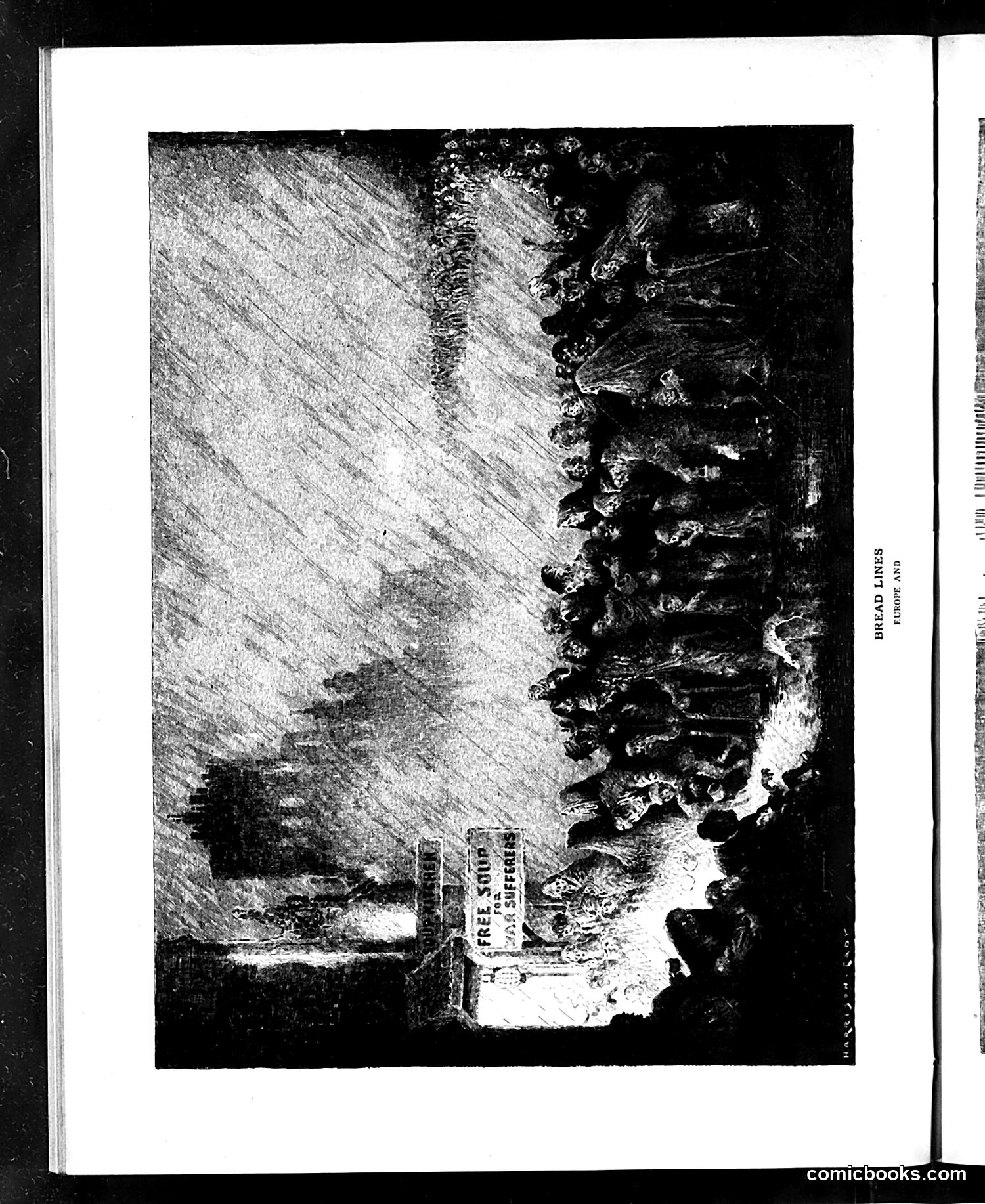
This page appears to be a photograph rather than a cartoon or satirical illustration. The image shows what looks like a rocky riverbank or geological formation, with water visible on the left side. The caption reads "BREAD LINES / FAMINE AND" (text appears cut off), suggesting this may be documenting economic hardship or food scarcity, possibly from the Great Depression era or another period of significant deprivation. However, the OCR'd text is largely illegible and doesn't clearly connect to the image. Without clearer text or caption information, I cannot confidently identify the specific political reference, time period, or satirical intent this page was meant to convey. The photograph itself doesn't contain obvious caricatures or cartoon elements typical of Life magazine's satirical content.
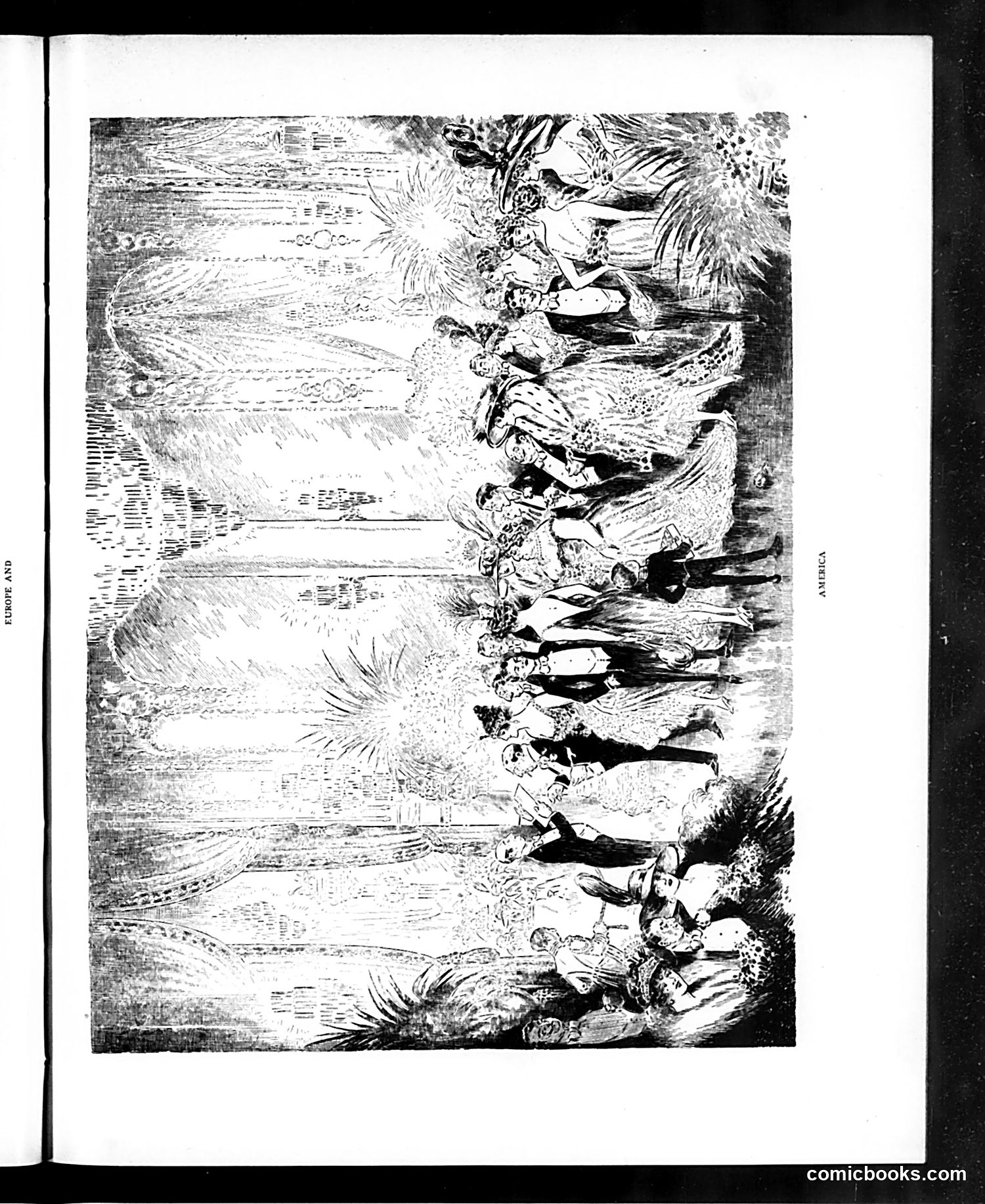
This appears to be a satirical illustration from *Life* magazine depicting a scene labeled "EUROPE AND" (title incomplete). The image shows multiple figures in period dress arranged in a landscape, rendered in a detailed engraving style typical of 19th-century satirical publications. However, the OCR text is too fragmentary to identify specific political figures or events referenced. Without the complete caption or article text, I cannot reliably determine which European political situation or historical moment this cartoon satirizes, nor can I identify the specific caricatured individuals with confidence. To provide accurate historical context for a modern reader, I would need clearer text identifying the subject matter, date, or the figures depicted.
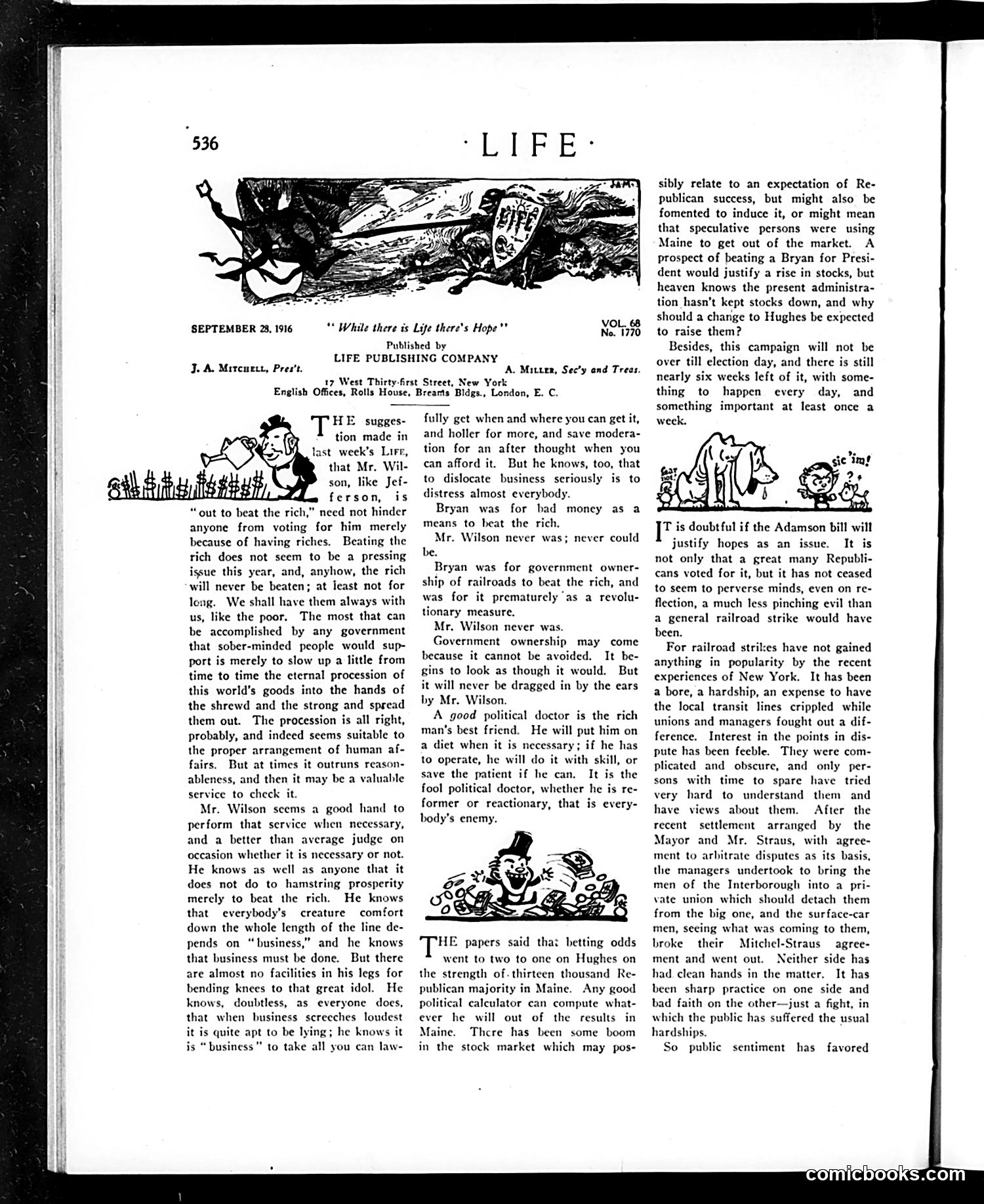
This page contains political commentary on the 1916 U.S. presidential election between incumbent Woodrow Wilson (Democrat) and challenger Charles Evans Hughes (Republican). **Main Arguments:** The text defends Wilson against criticism that he seeks to "beat the rich." It argues Wilson is a pragmatic "political doctor" who understands business necessity, unlike William Jennings Bryan (the previous Democratic candidate), who pushed radical measures like government railroad ownership and cheap currency to attack wealth. **Election Context:** Recent Republican gains in Maine (a 13,000-vote majority) have created betting odds favoring Hughes. The article dismisses speculation that this predicts national Republican victory or warrants stock market optimism, noting six weeks remain before election day. **The Cartoon:** The illustration at top appears to show a figure labeled "life" with a caduceus or staff, likely symbolizing the magazine's satirical role as social commentator during this pivotal election season. The overall tone suggests Life magazine supported Wilson's measured approach over what it portrayed as reckless reformism.
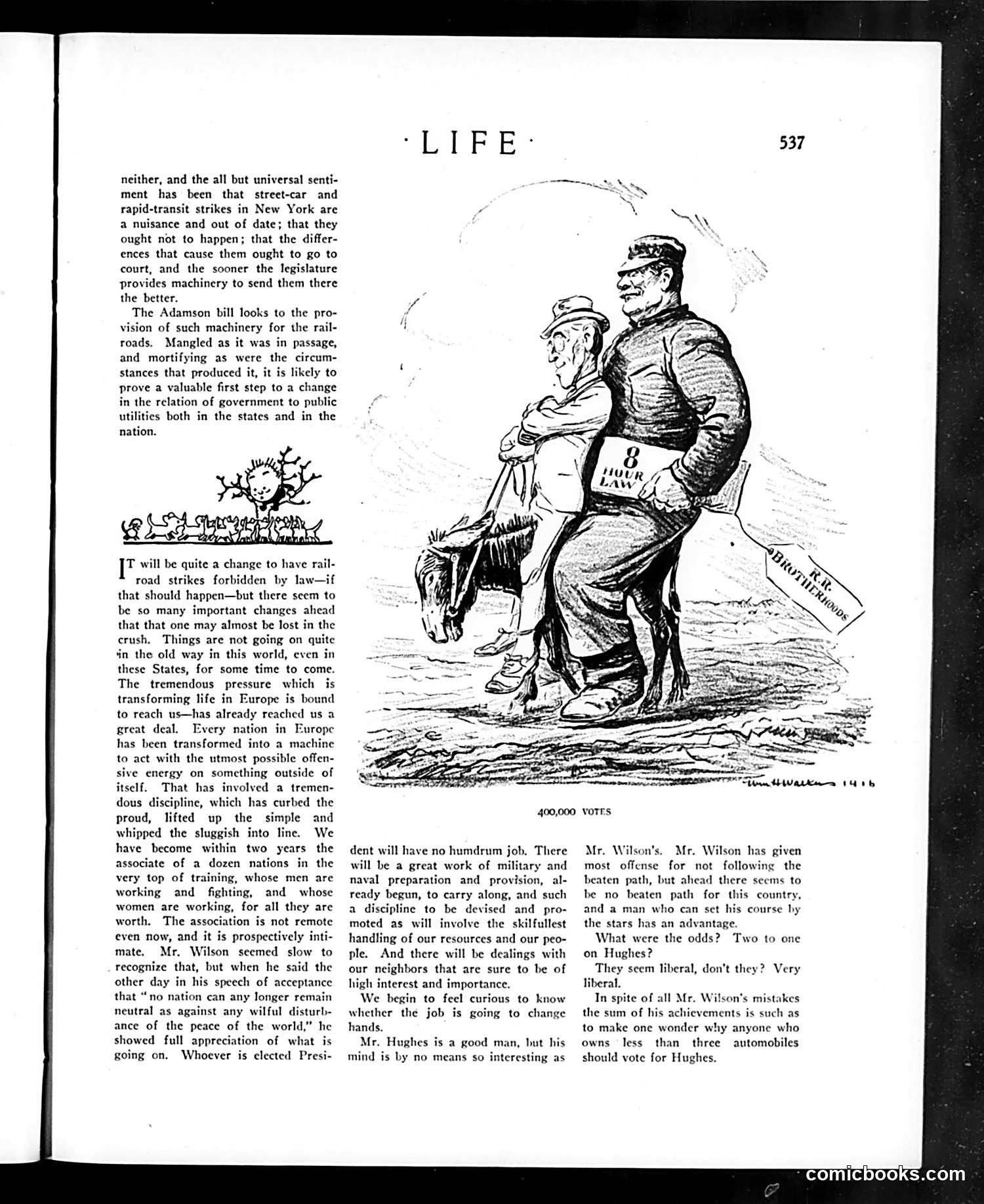
This is a political commentary on the 1916 U.S. presidential election between incumbent Woodrow Wilson and challenger Charles Evans Hughes. The cartoon depicts two figures (likely representing Wilson and Hughes) being carried or propelled forward—a visual metaphor for the momentum and forces shaping the election. The text argues that Wilson, despite missteps, better understands the transformative moment America faces. With World War I raging in Europe and U.S. involvement looming, the author contends that Wilson's ability to think beyond "the beaten path" makes him preferable to Hughes for navigating unprecedented challenges ahead. The final sarcastic jab—that anyone owning fewer than three automobiles should vote for Hughes—suggests Hughes represents wealthy interests, while Wilson represents broader constituencies. The "400,000 VOTES" caption likely references the electoral stakes in a close race.
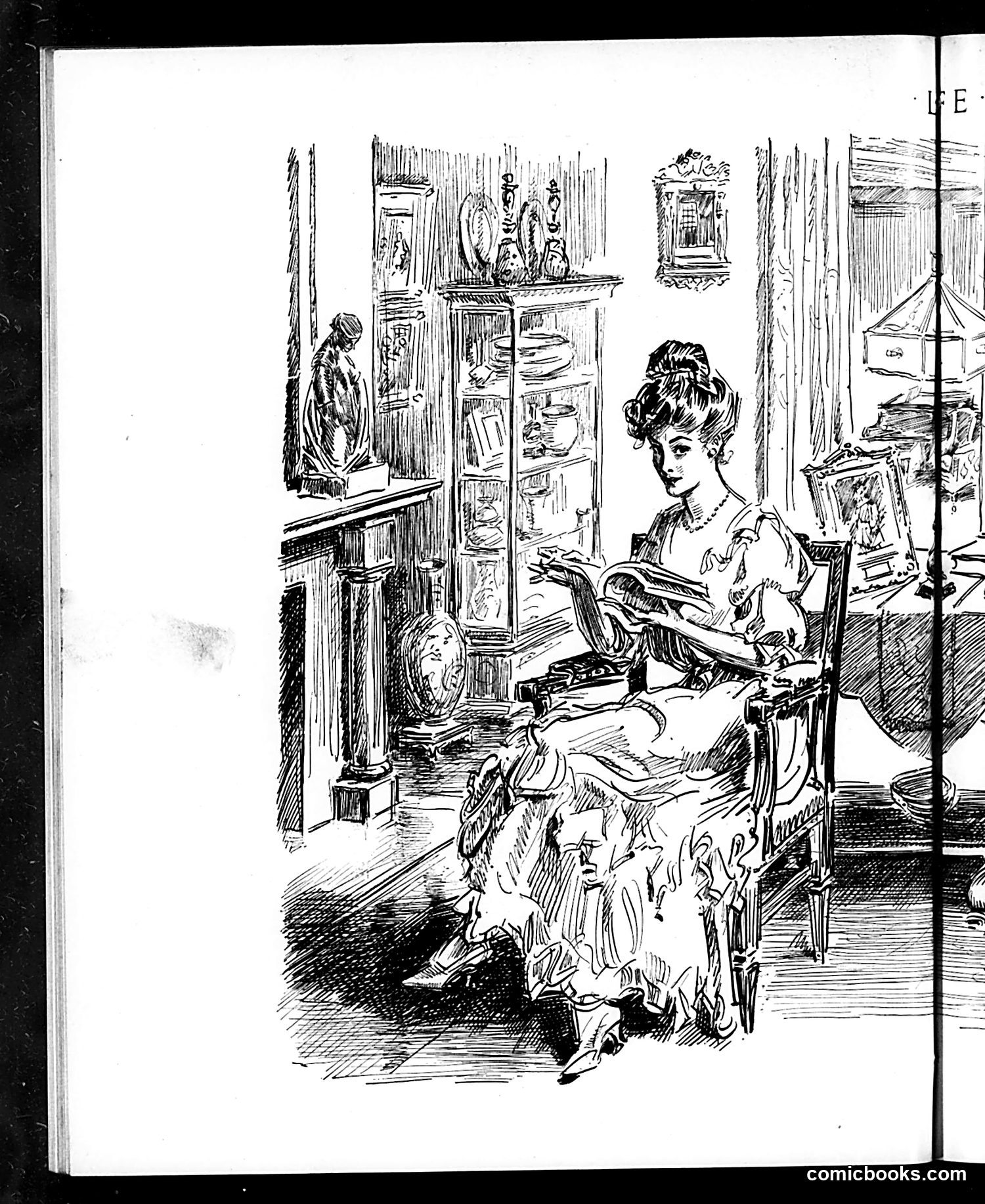
This is a pen-and-ink illustration depicting an elegant woman seated indoors, reading what appears to be a book or magazine. She's fashionably dressed in early 20th-century attire with her hair styled up. The room contains period furnishings including a mantelpiece with decorative objects, framed artworks on walls, and a coat stand visible on the right. The illustration appears to be from *Life* magazine's satirical or humorous section, though without additional OCR text or caption, the specific social commentary isn't entirely clear. It likely satirizes women's leisure activities, reading habits, or fashion of the Edwardian era, but the precise target of the satire remains unclear from the image alone.
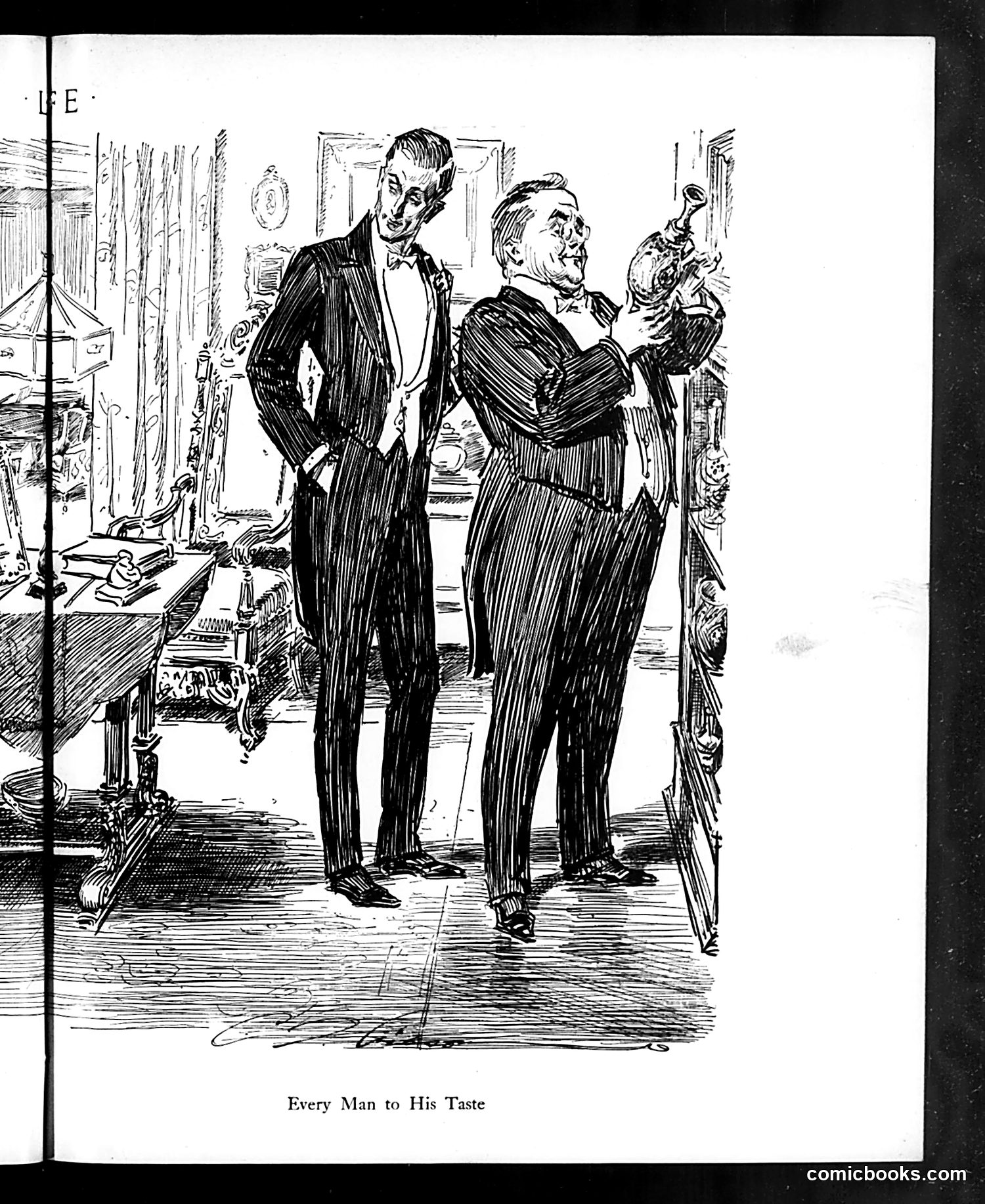
This cartoon depicts two well-dressed gentlemen in what appears to be an elegant interior setting. The man on the right holds what looks like a decorative object or artifact, while the man on the left observes. The title "Every Man to His Taste" suggests the cartoon is satirizing differing preferences or aesthetic choices, likely among the wealthy or cultured classes. Without additional context from the magazine's publication date or accompanying text, the specific figures and social commentary remain unclear. The sketch style and formal attire suggest this is commentary on class, refinement, or perhaps collecting habits among gentlemen of means, but the exact satirical target cannot be determined from the image alone.
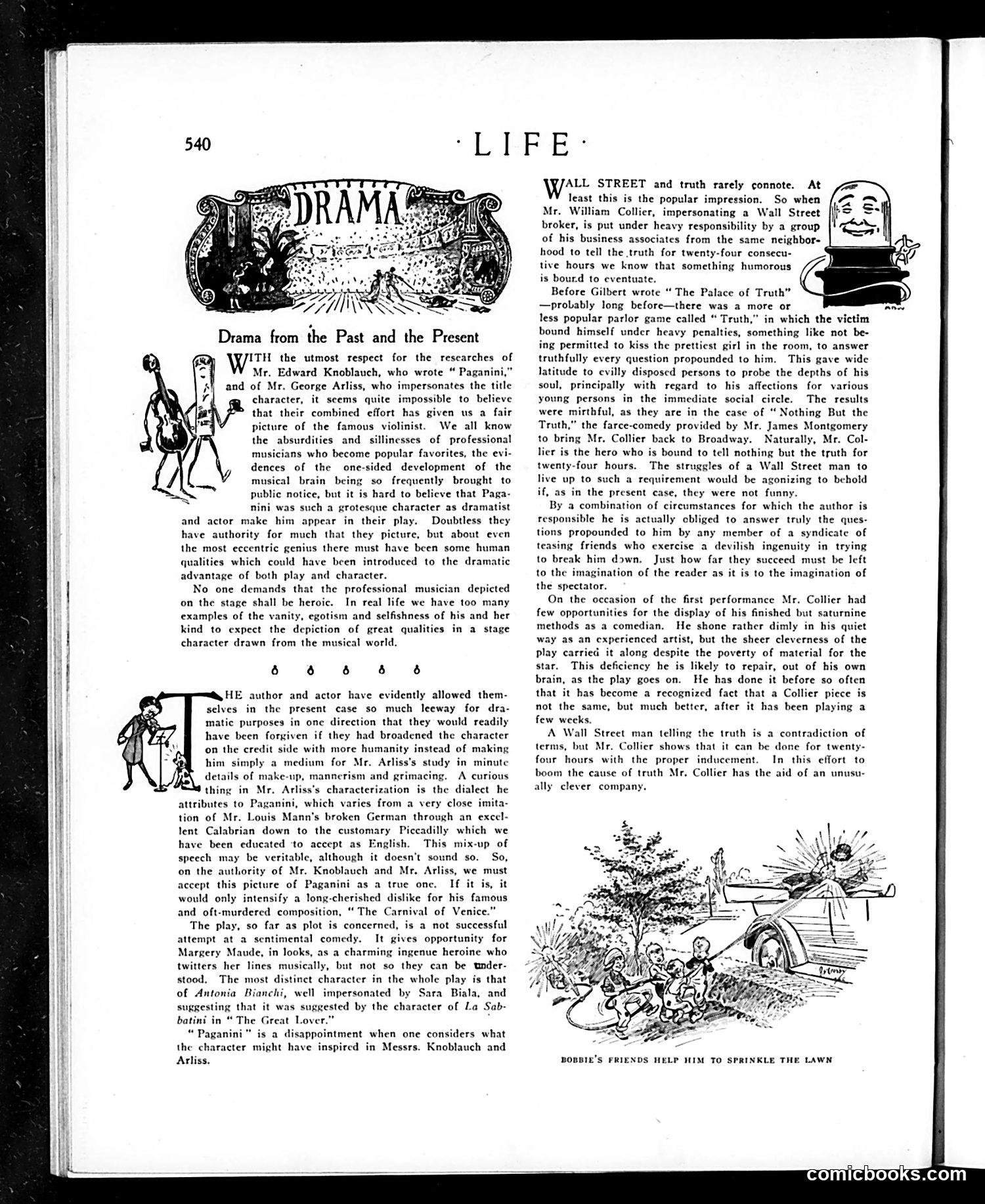
This page contains two theater reviews. The main article critiques a play called "Paganini," starring actor George Arliss as the famous violinist. The reviewer argues that while Arliss and playwright Knoblauch had historical authority for depicting Paganini as eccentric, they overdid it—presenting him as a grotesque caricature lacking human qualities. The critic particularly mocks Arliss's inconsistent dialect work and suggests the sentimental comedy fails dramatically despite capable supporting performances. The second review discusses a play called "Truth," starring William Collier as a Wall Street broker who must tell the truth for 24 hours. The reviewer references both a Gilbert play and an older parlor game of the same name where participants answer questions under penalty. Both reviews exemplify *Life* magazine's satirical theater criticism, mocking both theatrical excess and the social pretensions of their subjects.
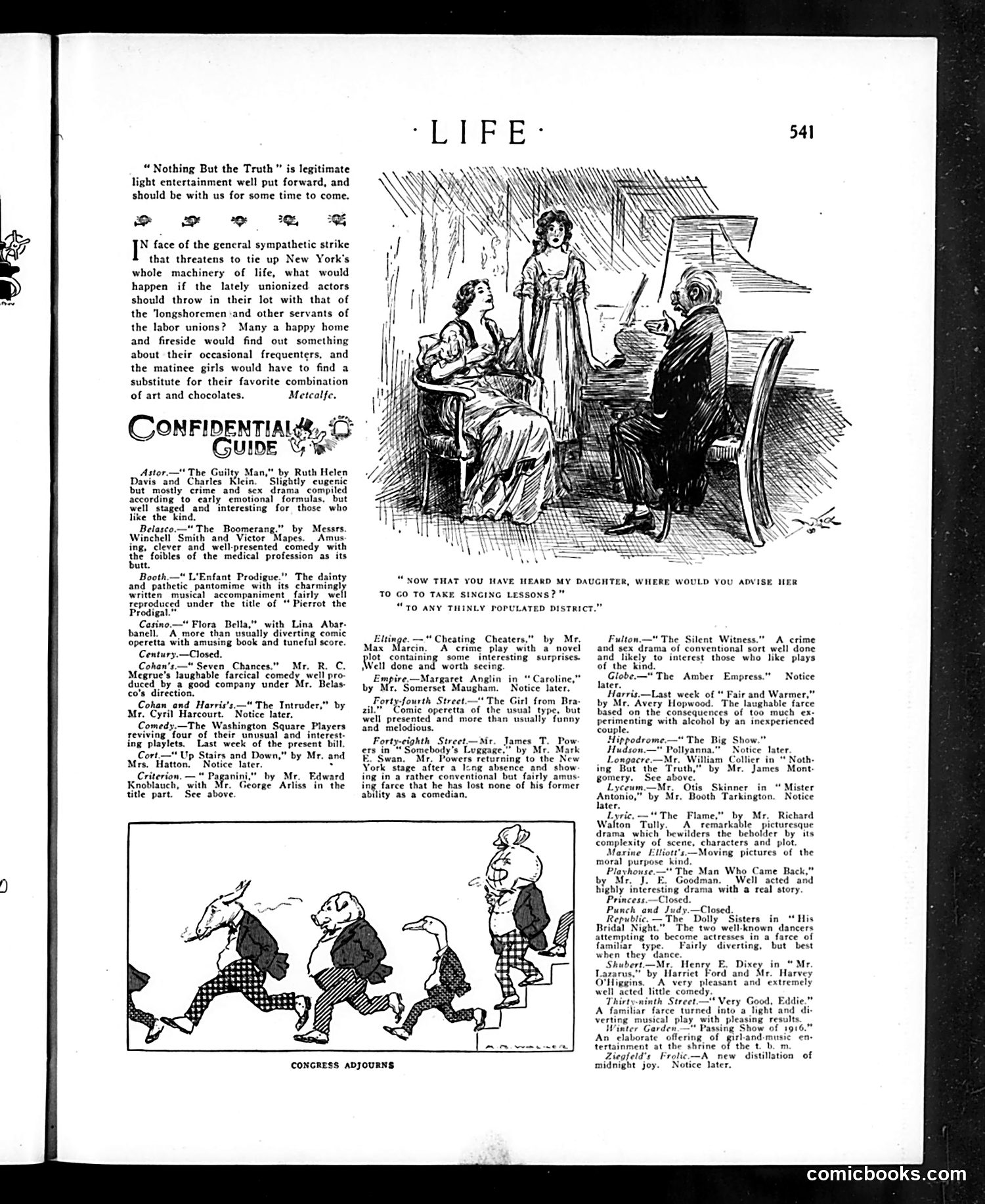
This page from Life magazine contains theater reviews and two cartoons satirizing early 1900s labor unionism and social etiquette. **Top cartoon/text**: Writer Metcalfe jokes that if unionized actors joined a general strike (threatening New York's "machinery of life"), wealthy families would discover uncomfortable truths about their hired help's "occasional frequenters." The satire targets both labor activism and upper-class hypocrisy—suggesting the rich benefit from not knowing their servants' lives too well. **Bottom cartoon ("Congress Adjourns")**: Shows congressmen literally running away, likely satirizing Congress's tendency to adjourn without accomplishing substantive work—a timeless American political complaint. **The page's main content** is a "Confidential Guide" to Broadway theaters, reviewing current productions. One embedded joke mocks a father asking where his daughter should take singing lessons; the answer is "any thinly populated district"—a common vaudeville-era joke about bad singers. The overall tone reflects Life's role as satirical commentary on American politics, society, and entertainment.
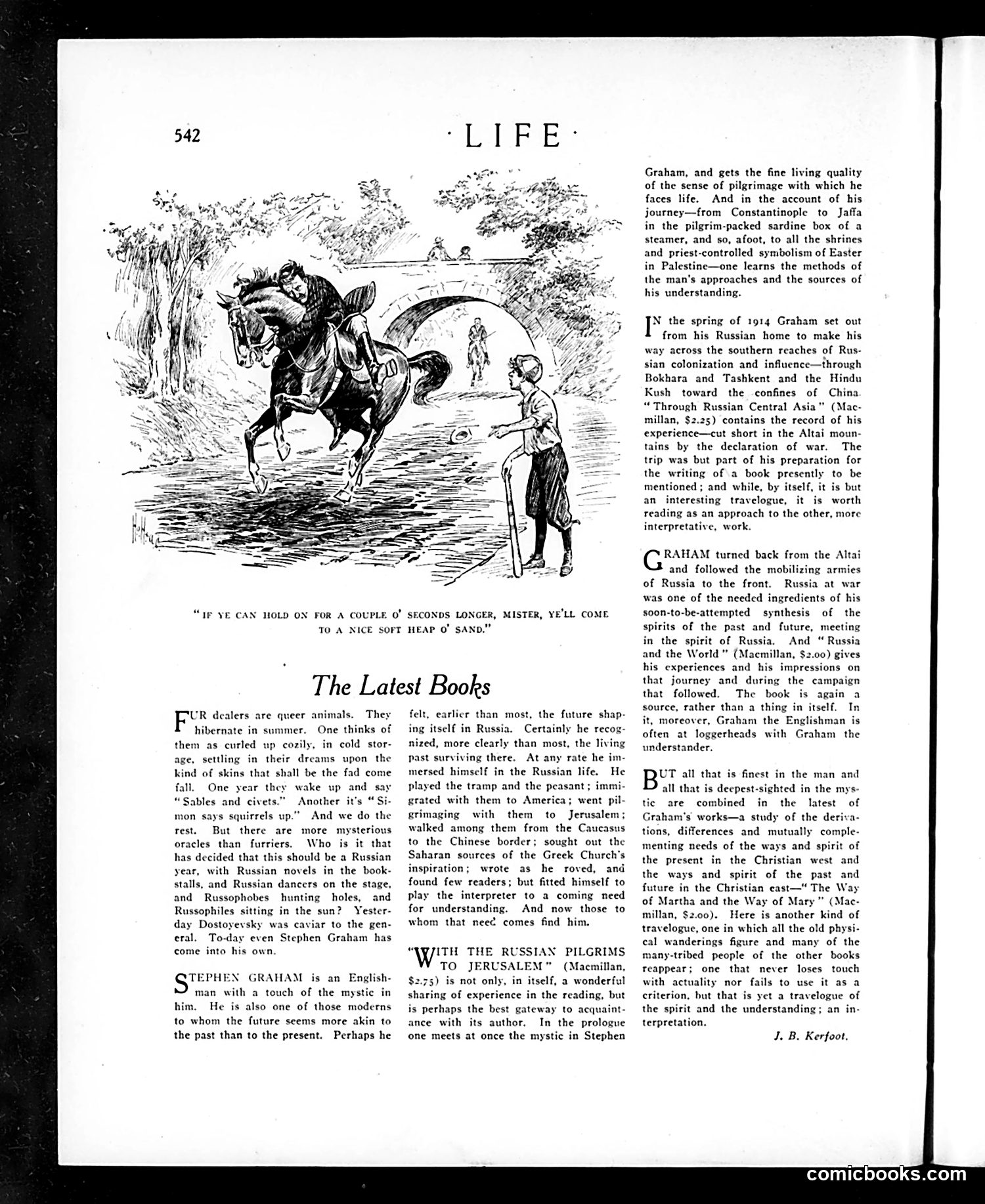
This page reviews English author Stephen Graham's recent works on Russia. The cartoon depicts a mounted soldier directing a weary foot-soldier toward "a nice soft heap of sand"—likely satirizing the brutal conditions soldiers faced during World War I. The review discusses Graham's books about Russian travels and WWI experiences, published around 1914-1915. The commentary reflects contemporary fascination with Russia, noting how Russian novels and culture suddenly became fashionable ("a Russian year"). Graham is portrayed as a mystical figure who embedded himself in Russian life before the war, then followed mobilizing armies to document the conflict. The reviewer suggests his books serve primarily as gateways to understanding Russia rather than as standalone works—though his latest synthesis of Russian past and future is praised as his finest achievement. The overall tone reflects wartime interest in understanding Russia as an ally.
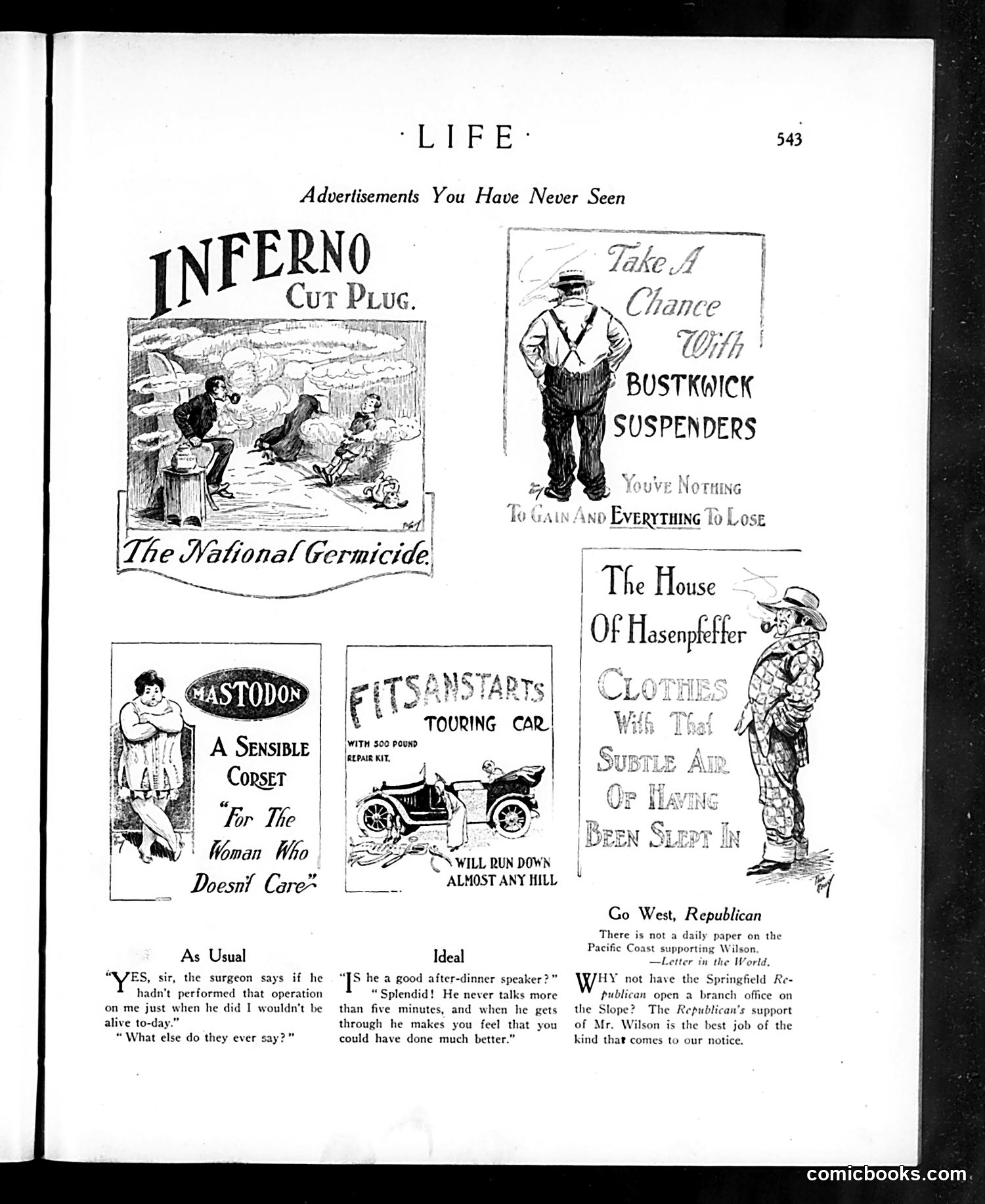
This page from *Life* combines vintage advertisements with political humor. The fake ads mock consumer products with absurdist exaggeration—"Inferno Cut Plug" tobacco promises germicide effects, "Fit Starts" touring car claims to climb nearly any hill, and "Mastodon" corsets promise comfort for women unconcerned with appearance. The bottom section contains satirical jokes. "As Usual" mocks doctors' self-aggrandizement: a surgeon takes credit for a patient's survival. "Ideal" ridicules after-dinner speakers who talk too much yet leave audiences feeling they could have performed better. Most politically pointed is "Go West, Republican," which references a *Springfield Republican* newspaper endorsing Woodrow Wilson (Democratic president). The satire suggests this endorsement is so absurd—a Republican paper supporting a Democrat—that it's the paper's "best job," implying the gesture is meaningless or self-contradictory. The letter quotes criticism that no Pacific Coast paper supports Wilson, making the endorsement newsworthy primarily for its oddness rather than its substance.
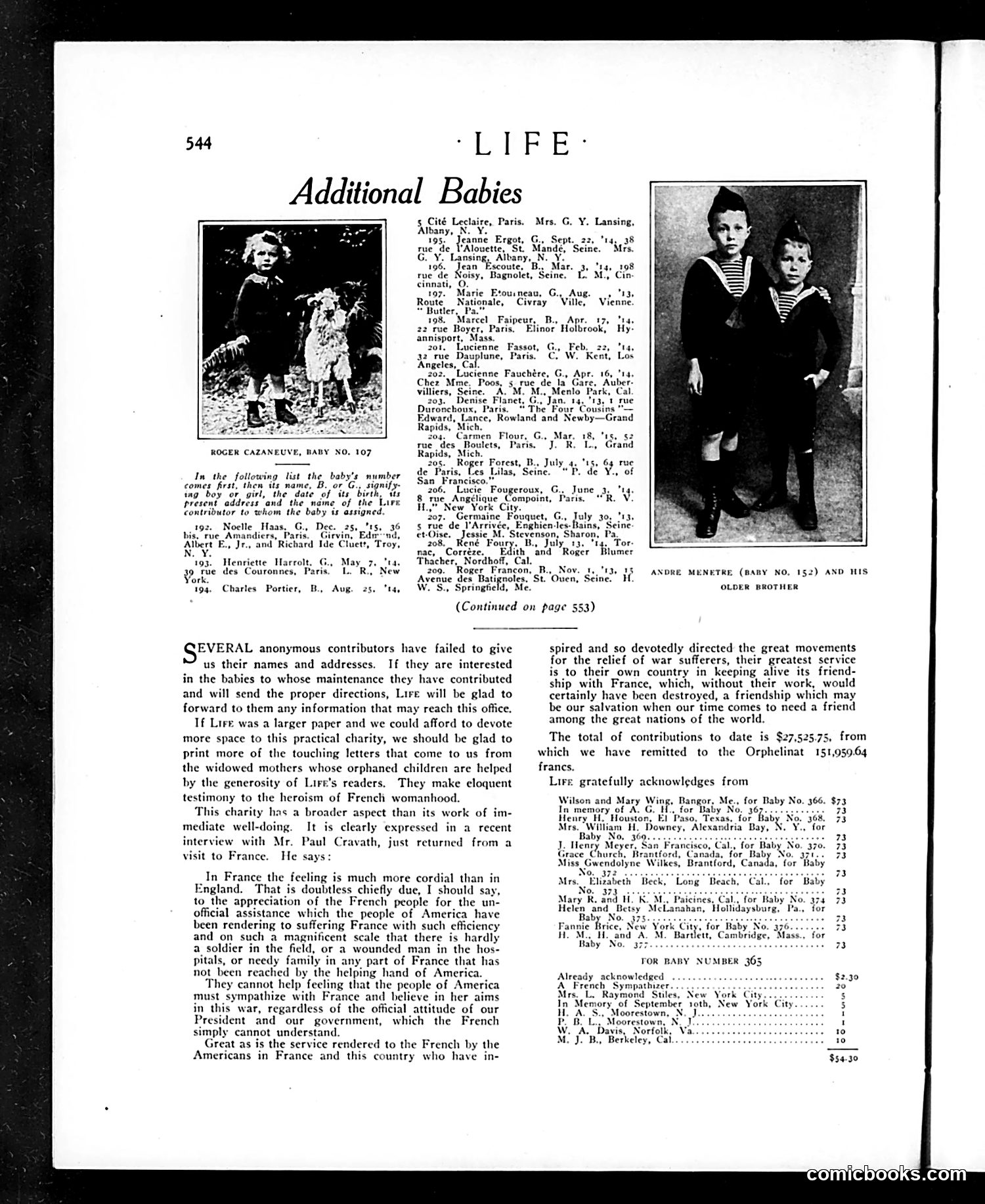
This page documents Life magazine's ongoing charitable effort to support French war orphans during World War I. The content lists newly enrolled babies in the sponsorship program, with donor names and addresses paired with specific children in France. The two photographs show children being supported by American donors—identified as "Roger Cazaneuve, Baby No. 107" and "Andre Menetre (Baby No. 152) and his Older Brother." The editorial text emphasizes Americans' moral obligation to aid France, noting the "cordial" French feeling toward American assistance. It references a recent visit by Paul Cravath to France and stresses that supporting French orphans strengthens Franco-American friendship—presenting the charity as both humanitarian and strategically important to maintaining wartime alliance. The page reports total contributions of $27,525.75, with funds remitted to the "Orphelinat" (orphanage). This represents Life's role as intermediary between American donors and vulnerable French children displaced by the war.
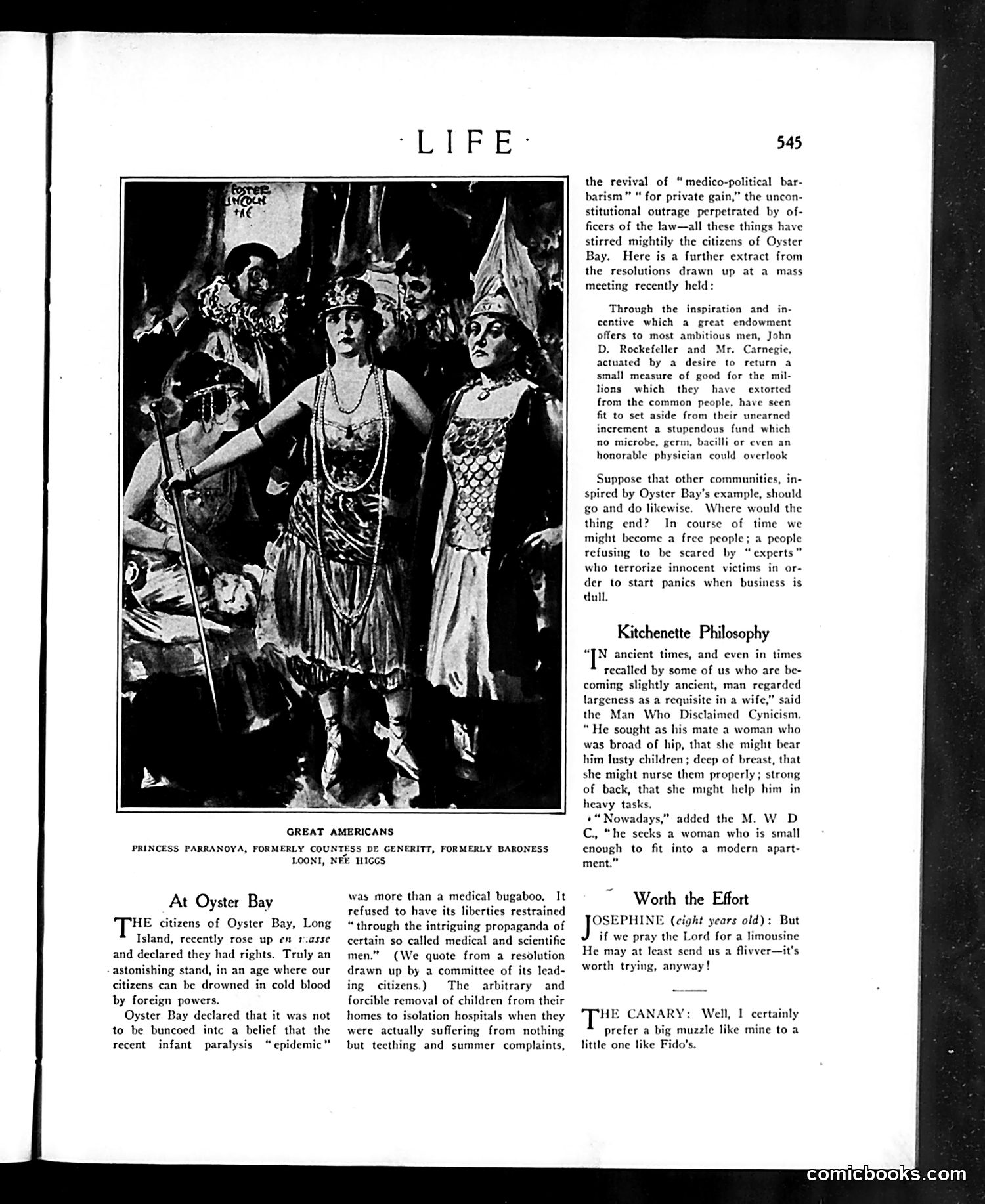
This Life magazine page satirizes early 20th-century public health resistance, particularly around polio prevention. The headline "Great Americans" mockingly presents "Princess Parranoya" (a pun on "paranoia")—a fabricated aristocratic figure representing the paranoid citizens of Oyster Bay, Long Island. The main satire targets the community's refusal to accept medical quarantine measures for infantile paralysis (polio), dismissing the disease as merely "teething and summer complaints." The text quotes their resolution denying the epidemic's reality and opposing "intriguing propaganda of certain so called medical and scientific men." The piece criticizes this anti-expert stance, sarcastically noting that if other communities followed Oyster Bay's example of rejecting public health interventions, society would descend into chaos where "experts" couldn't protect citizens. The satire suggests the resistance stems from irrational fear and distrust of scientific authority rather than legitimate concerns. The secondary sections—on wealthy philanthropists funding health initiatives and brief humorous observations—fill the remaining page space.
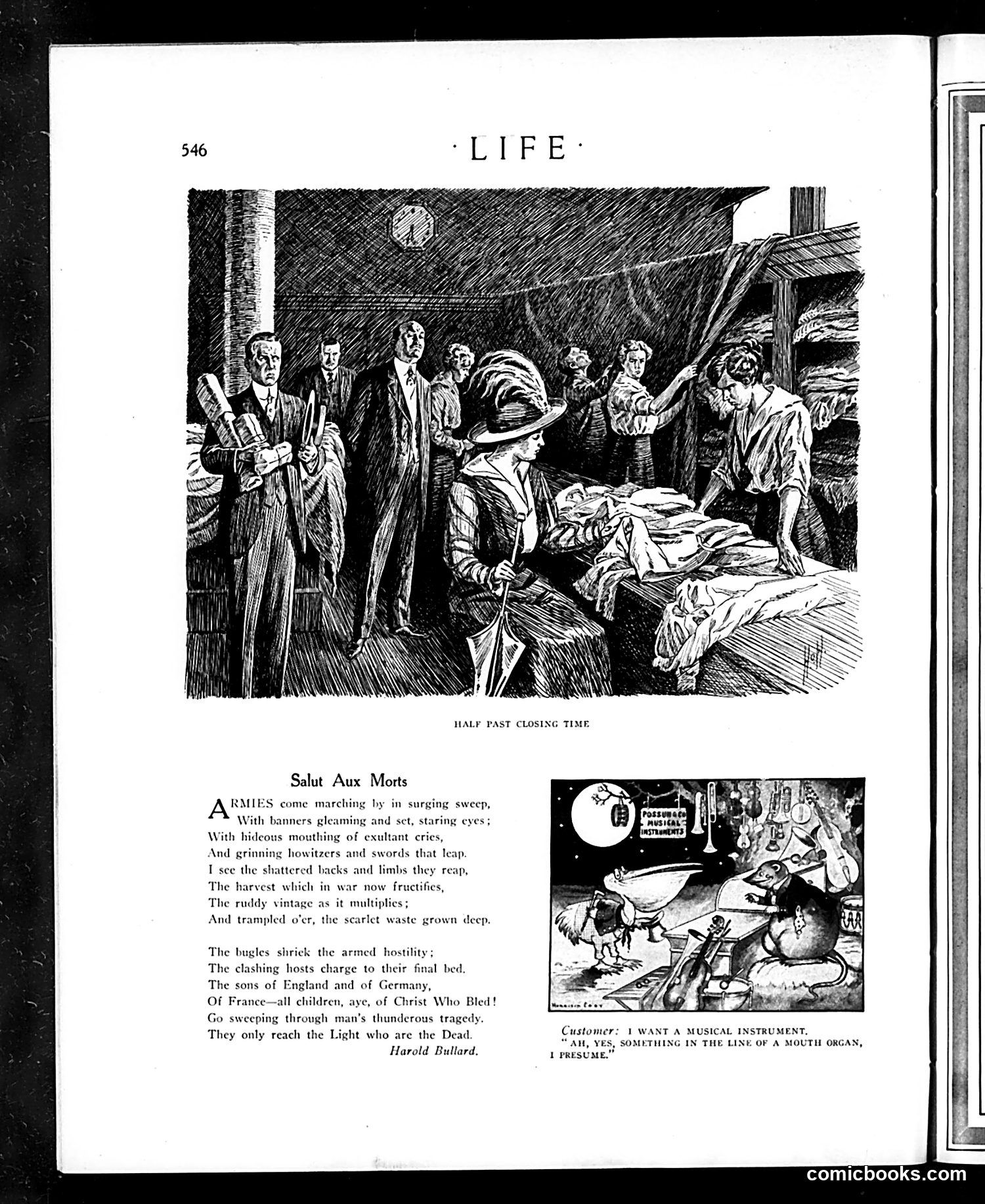
**Main Illustration ("Half Past Closing Time"):** Shows what appears to be a military recruiting or enlistment scene in a pub or bar at closing time. Men in civilian dress and military uniforms are present, suggesting recruitment of soldiers—likely during World War I based on the wartime imagery. **Poem ("Salut Aux Morts"):** A serious anti-war poem by Harold Bullard lamenting the carnage of warfare. It contrasts the pageantry of armies ("banners gleaming") with graphic horror ("shattered backs and limbs"). The poem emphasizes shared humanity—English and German soldiers are all "children of Christ"—suggesting the futility of their mutual destruction. **Bottom Cartoon:** A customer requests a "mouth organ" (harmonica) from a music shop, with an ambiguous punchline about it being "in the line of a mouth organ." The joke's precise meaning is unclear today. **Overall Tone:** The page juxtaposes patriotic military imagery with anti-war sentiment, reflecting wartime ambivalence about armed conflict and mass conscription.
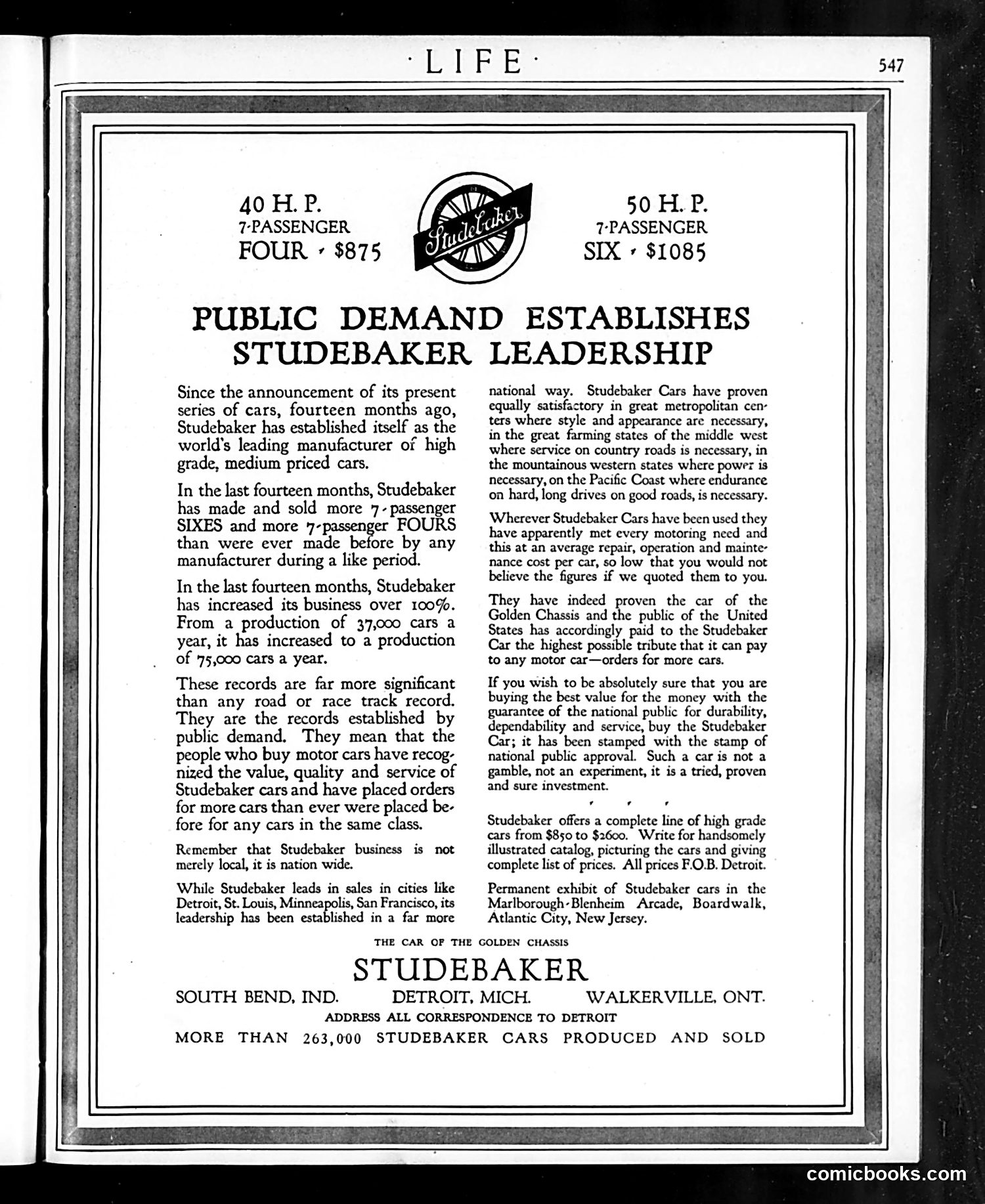
This is **not a cartoon or satire**—it's a straightforward automobile advertisement from Life magazine (page 547). There is no political or social commentary. The page advertises Studebaker cars, emphasizing their market dominance and reliability. The company claims to have doubled production in fourteen months and sold more seven-passenger models than any competitor. The rhetoric appeals to "public demand" as validation: ordinary Americans choosing Studebaker proves its quality. The ad targets both urban and rural buyers, claiming the cars perform equally well in cities, farming regions, and mountainous terrain. Pricing ranges from $850 to $2,600 (F.O.B. Detroit), positioning Studebaker as "high grade, medium priced." The logo at top features a wheel emblem labeled "Studebaker—The Car of the Golden Chassis." Manufacturing locations listed are South Bend, Indiana; Detroit, Michigan; and Walkerville, Ontario. This represents early 20th-century automotive marketing emphasizing mass-market appeal and proven consumer choice as quality indicators.
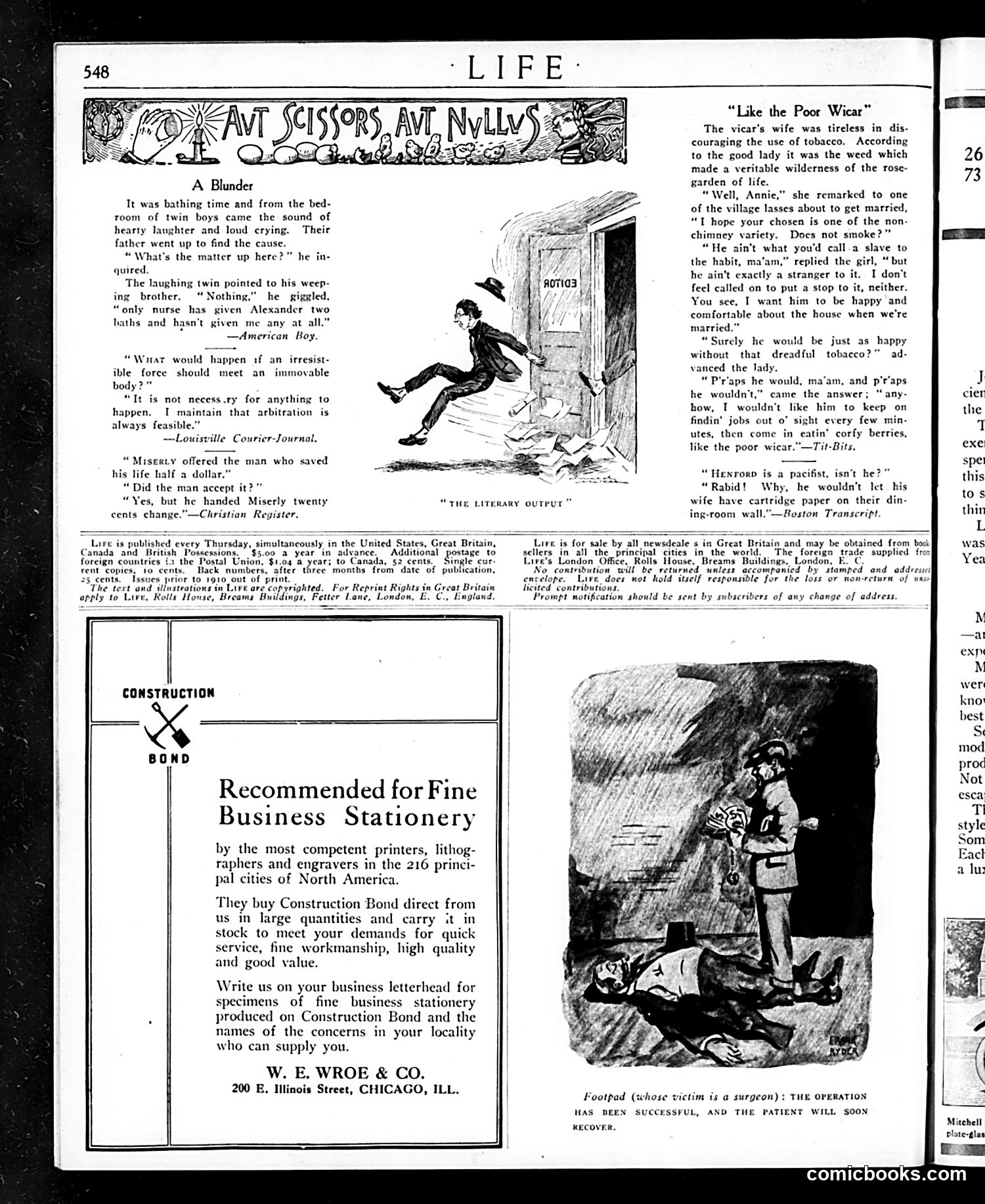
This page contains several short humorous pieces typical of early 20th-century satirical magazines: **"A Blunder"** jokes about twin boys at bath time—one twin received two baths while the other received none, leading to crying and laughter. **"The Literary Output"** cartoon depicts a man stumbling backward out a doorway (labeled "90103"), illustrating the absurdity of meeting "an irresistible force" with "an immovable body"—a philosophical paradox rendered literally. **"Like the Poor Vicar"** is a dialogue between a vicar's wife discouraging tobacco use and a village girl defending her fiancé's smoking as harmless—the joke being the woman compares tobacco to her husband the vicar's unsavory habits. **The bottom cartoon** shows a footpad (mugger) reassuring his robbery victim that "the operation has been successful"—dark humor playing on the victim being a surgeon who'd understand medical language. The page also includes a **Construction Bond paper advertisement** targeting printers and lithographers. The humor relies on wordplay, paradox, and ironic twists typical of period comedy—relatively gentle satire without specific political targets.
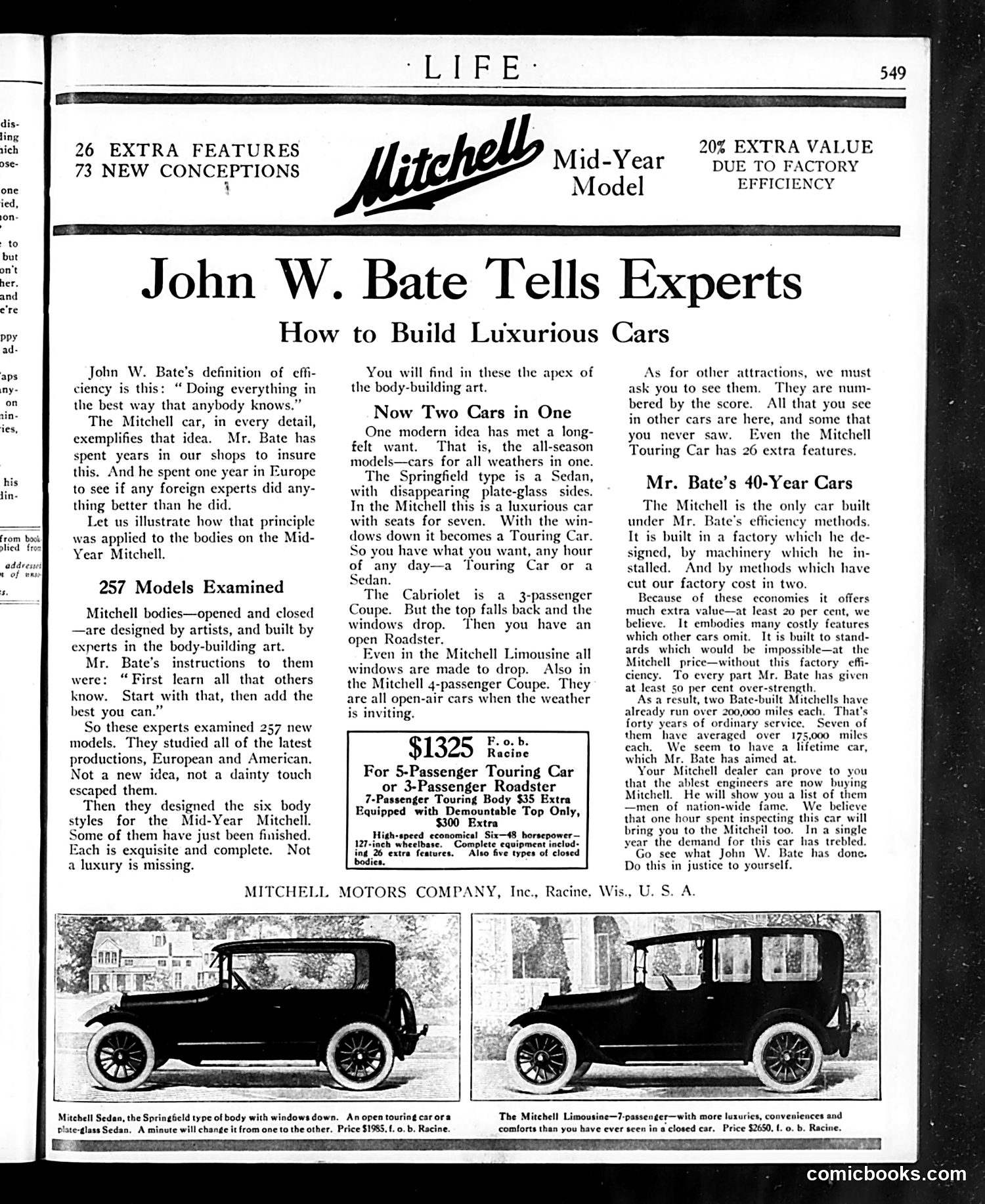
This is primarily a **vintage automobile advertisement**, not a political cartoon. It appears in *Life* magazine (page 549) promoting the Mitchell Motor Company's mid-year automobile models. **What's Being Advertised:** The Mitchell car, positioned as a luxury vehicle built with exceptional efficiency. John W. Bate is presented as the company's efficiency expert who examined 257 competing car models before designing Mitchell's bodies. **Key Sales Pitch:** - "Two cars in one": convertible models that function as both closed sedans and open-air touring cars - 26 extra features in the touring car - Claimed durability (vehicles allegedly running 200,000+ miles) - Factory efficiency delivering "20% extra value" - Prices ranging from $1,325 to higher amounts **Historical Context:** This reflects the 1920s auto industry's competition and marketing emphasis on technological innovation, convertibility, and engineering prowess as status symbols. The detailed specifications and comparisons suggest car-buying was becoming more sophisticated and consumer-focused. The page contains no satire—it's straightforward period advertising rhetoric.
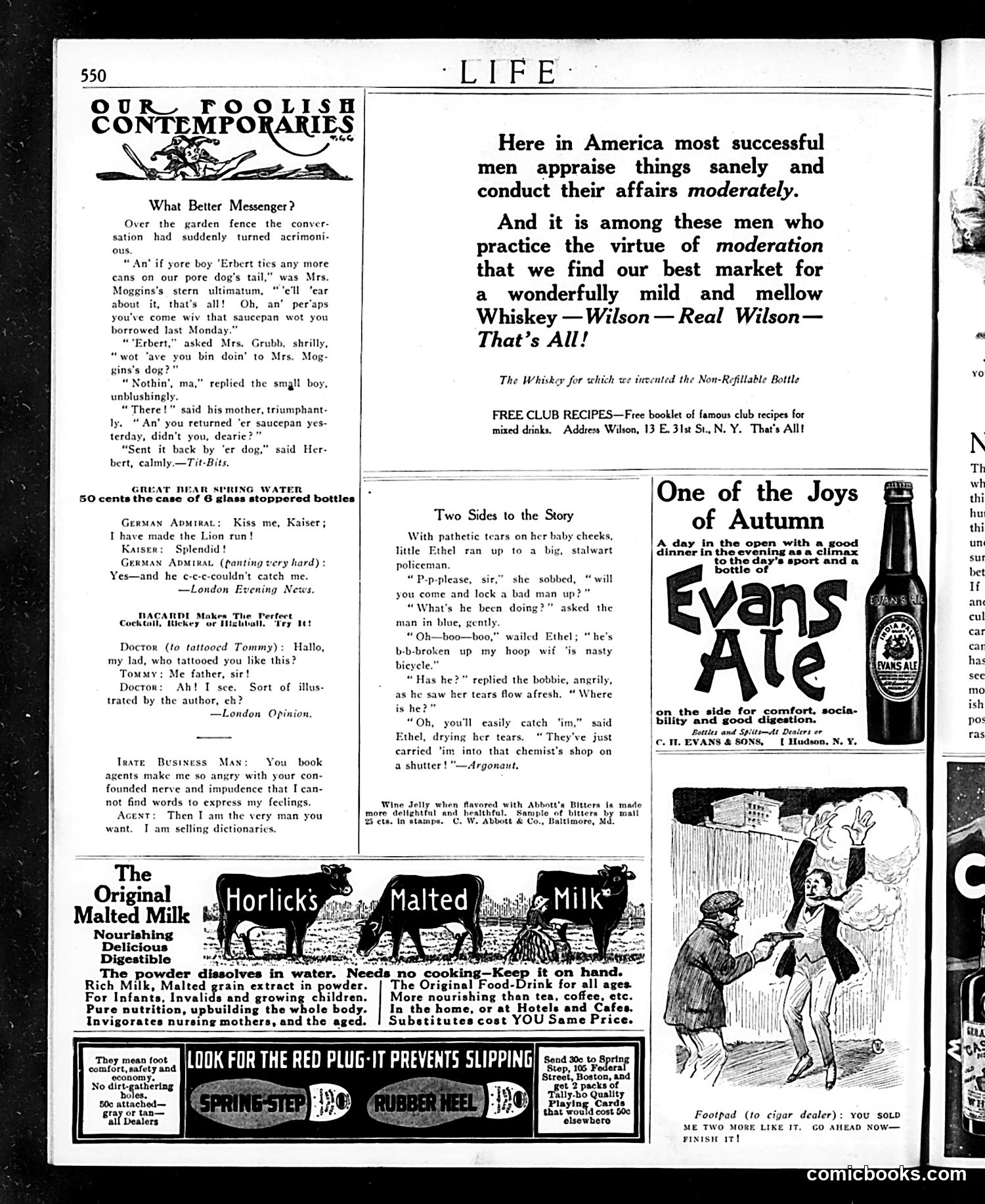
This page contains primarily **advertisements and humorous short jokes** rather than political cartoons. The content reflects early 20th-century American humor and product marketing. **The jokes** include: - A domestic dispute between neighbors about a boy tying cans to a dog's tail, resolved when the boy admits he returned the borrowed saucepan "by her dog" - A German Admiral boasting to the Kaiser about making "the Lion run" (likely referencing Britain in WWI), then admitting he couldn't catch it - A tattooed sailor whose father illustrated him - A book agent selling dictionaries to an angry businessman **Major advertisements** promote Wilson Whiskey (emphasizing "moderation"), Horlick's Malted Milk, Evans Ale, Spring-Step shoe heels, and Abbott's Bitters. The whiskey ad specifically targets successful American businessmen practicing moderation—notable given Prohibition debates of the era. **"Two Sides to the Story"** is a sentimental anecdote about a girl reporting a vandal to a policeman. The page is essentially a snapshot of Edwardian-era consumer culture and light entertainment.
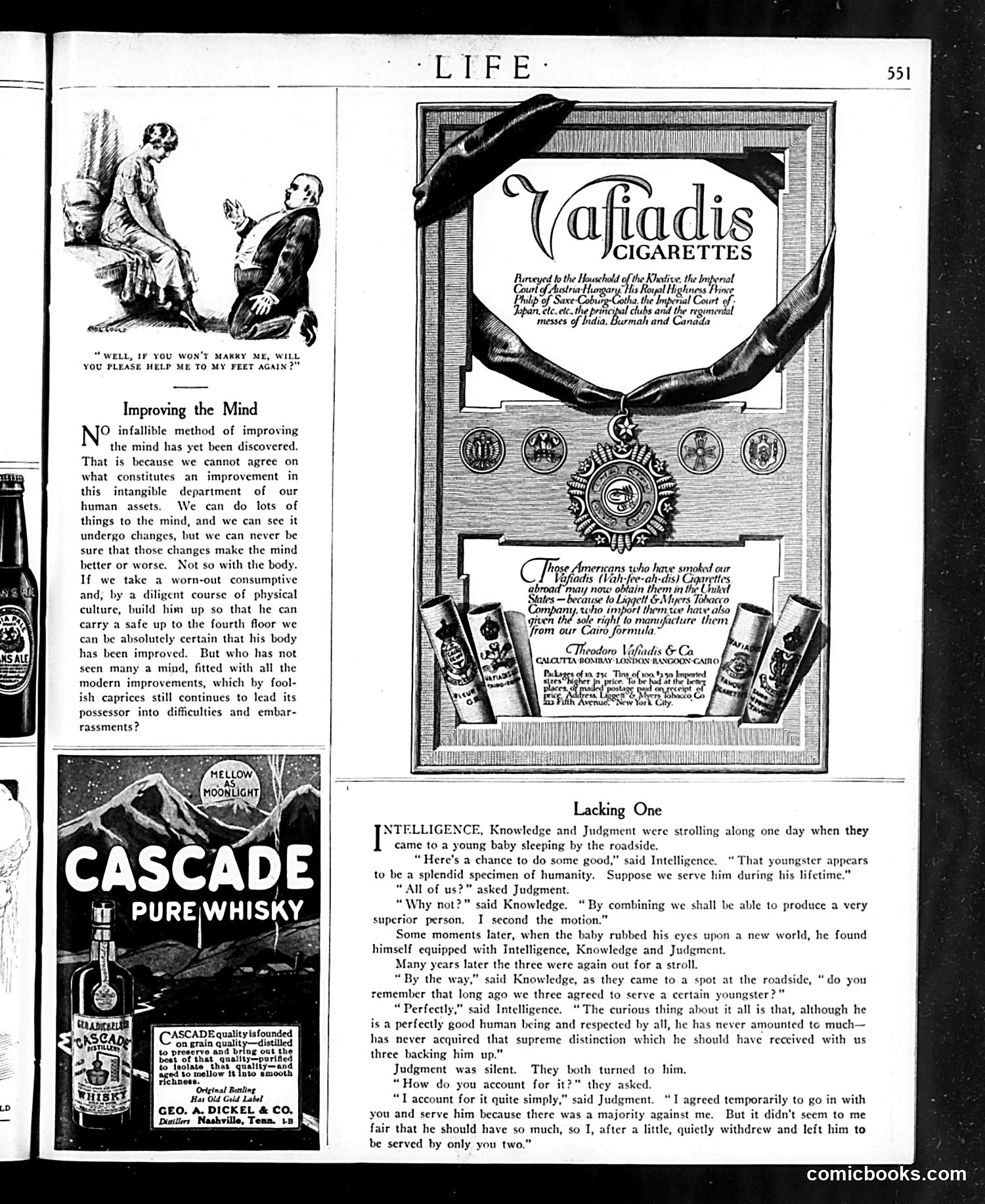
**The Cartoon "Improving the Mind":** This is satirical social commentary, not political. A woman rejects a man's marriage proposal, then asks him to help her up—illustrating the essay's point: while physical improvement is measurable (the text uses the example of a weakling gaining strength to carry a safe upstairs), mental improvement is subjective and unreliable. The joke suggests that education and "self-improvement" don't guarantee better judgment or character. **"Lacking One":** An allegorical fable where three personified qualities—Intelligence, Knowledge, and Judgment—gift a baby with their combined abilities. Years later, they discover he hasn't achieved distinction despite their help. Judgment reveals he *withdrew* early because he disagreed with being outvoted by the other two. The moral: Intelligence and Knowledge without sound Judgment fail; Judgment must remain present to guide their application. **The Advertisements:** Standard period ads for Cascade Whisky and Vafiadis Cigarettes (imported from Cairo).
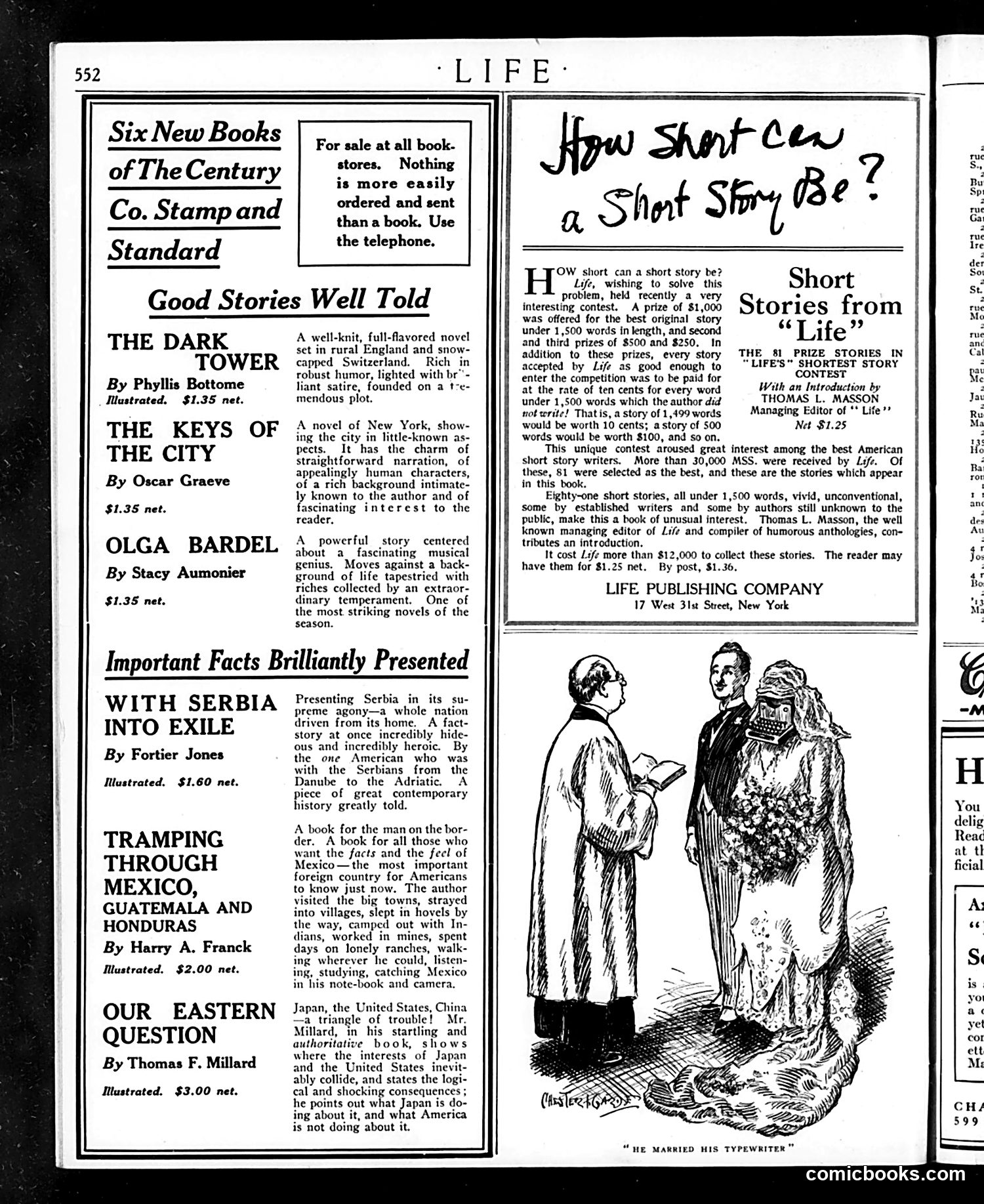
This page is primarily **advertising for books**, not political satire. The left column promotes six novels and nonfiction works from Century Co., describing their plots and themes. Titles include works on Serbia's World War I exile and travel guides to Central America and the Far East—reflecting contemporary American interests in foreign affairs and exploration. The right side advertises a collection of short stories from Life magazine's "Shortest Story Contest," which challenged writers to compose compelling narratives under 1,500 words. The contest offered substantial prizes ($1,000 first place) plus per-word payment for accepted entries, generating 30,000+ submissions. The accompanying sketch shows two men (one reading) in period dress—illustrating the genteel literary culture being marketed. This is essentially a **book catalog page**, not political commentary or satire. The content reflects early 20th-century publishing and American reading interests.
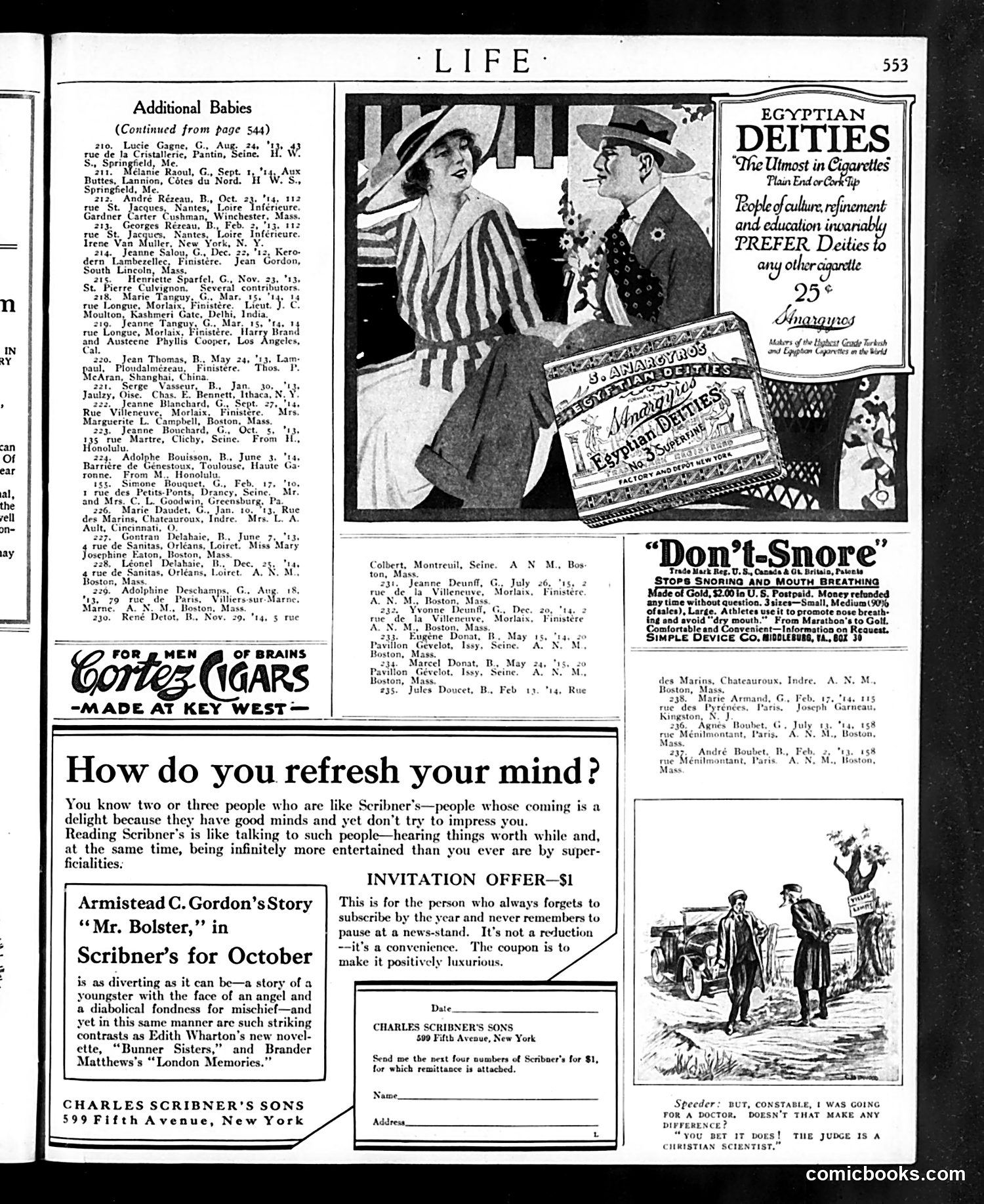
This page is primarily **advertising and editorial content** rather than political satire. The main elements include: **Egyptian Deities Cigarettes ad**: A large advertisement featuring two figures in Egyptian-style costume and imagery, promoting cigarettes as culturally refined products. **"Don't Snore" device ad**: A commercial product advertisement for a anti-snoring device with a humorous illustrated scenario. **Cortez Cigars ad**: A smaller advertisement for cigars marketed to men. **Scribner's Magazine promotion**: Editorial material advertising Scribner's magazine and an upcoming story by Armistead C. Gordon titled "Mr. Bolster," with a subscription offer. **"Additional Babies" list**: Birth announcements from readers. The page lacks significant political or social satire. It represents typical early 20th-century magazine content mixing commercial advertising with literary promotion and reader announcements. The Egyptian Deities cigarette ad's appeal to "culture, refinement and education" reflects period advertising strategies linking consumer products to aspirational values.
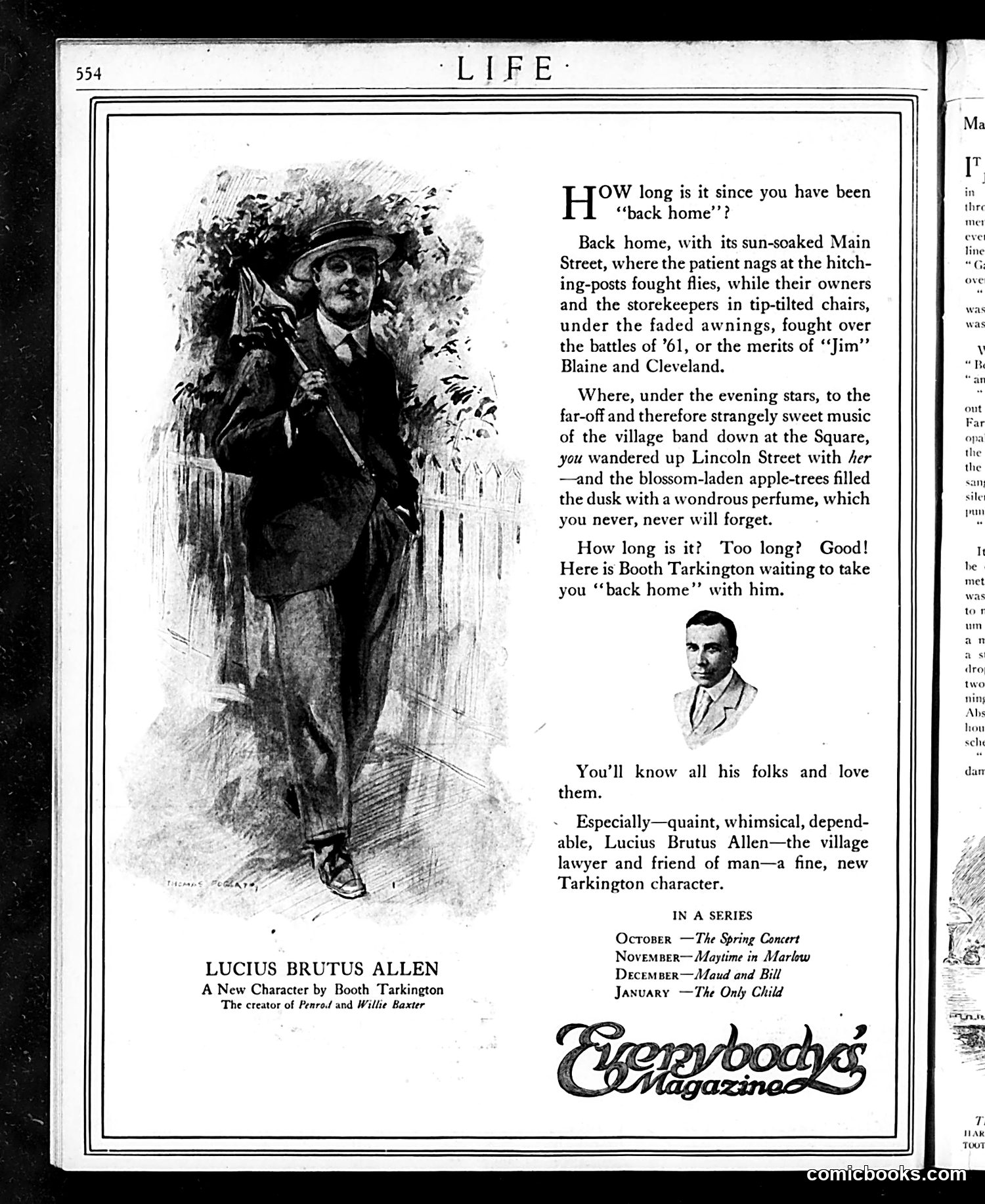
This is an advertisement for a serialized fiction series by Booth Tarkington in *Everybody's Magazine*, introducing a new character named Lucius Brutus Allen. The appeal is explicitly **nostalgic Americana**: the text romanticizes small-town life—hitching posts, village bands, apple blossoms on Lincoln Street—evoking a pre-industrial American past. References to "the battles of '61" (Civil War) and politicians James G. Blaine and Grover Cleveland (prominent late-1800s figures) ground this in a specific era. The sketch depicts Allen as a small-town lawyer—described as "quaint, whimsical, dependable"—embodying the idealized rural gentleman. The advertisement promises readers will "know all his folks and love them," selling escapism through familiar, wholesome Americana. This reflects early-20th-century magazine culture's appetite for sentimental rural narratives, positioning Tarkington (author of *Penrod* and *Willie Baxter*) as the chronicler of vanishing American small-town life.
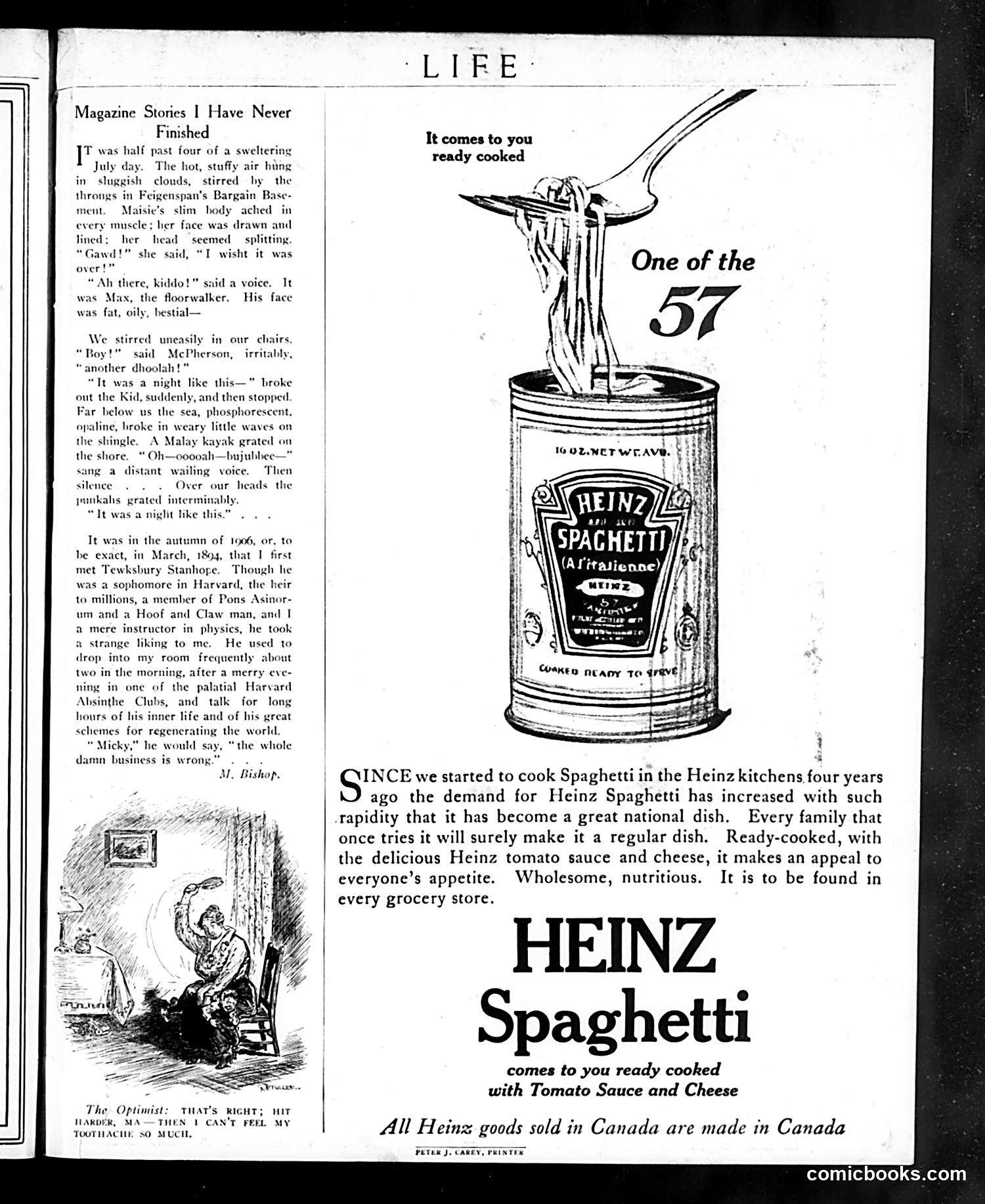
This page combines literary content with advertising, typical of early 20th-century magazines. **The Story Section** ("Magazine Stories I Have Never Finished") is satirical commentary on overwrought literary fiction. It mocks melodramatic short stories popular in pulp magazines—featuring clichéd elements like swooning heroines, sinister villains ("Max, the floorwalker"), exotic settings (Malay shores), and pretentious narrative devices (internal monologues, atmospheric descriptions). The title itself signals the joke: these stories are so tedious that readers abandon them unfinished. **The Cartoon** (bottom left) shows "The Optimist," illustrating the magazine's satirical bent. A figure recommends hitting harder to distract from toothache pain—absurd logic presented as wisdom. **The Advertisement** for Heinz Spaghetti occupies the right side, showing a tin with pasta being spooned out. This represents the era when canned, ready-to-eat convenience foods were novel marketing innovations, marketed as modern progress. The juxtaposition suggests Life's role as entertainment and consumer commentary for educated, middle-class readers.
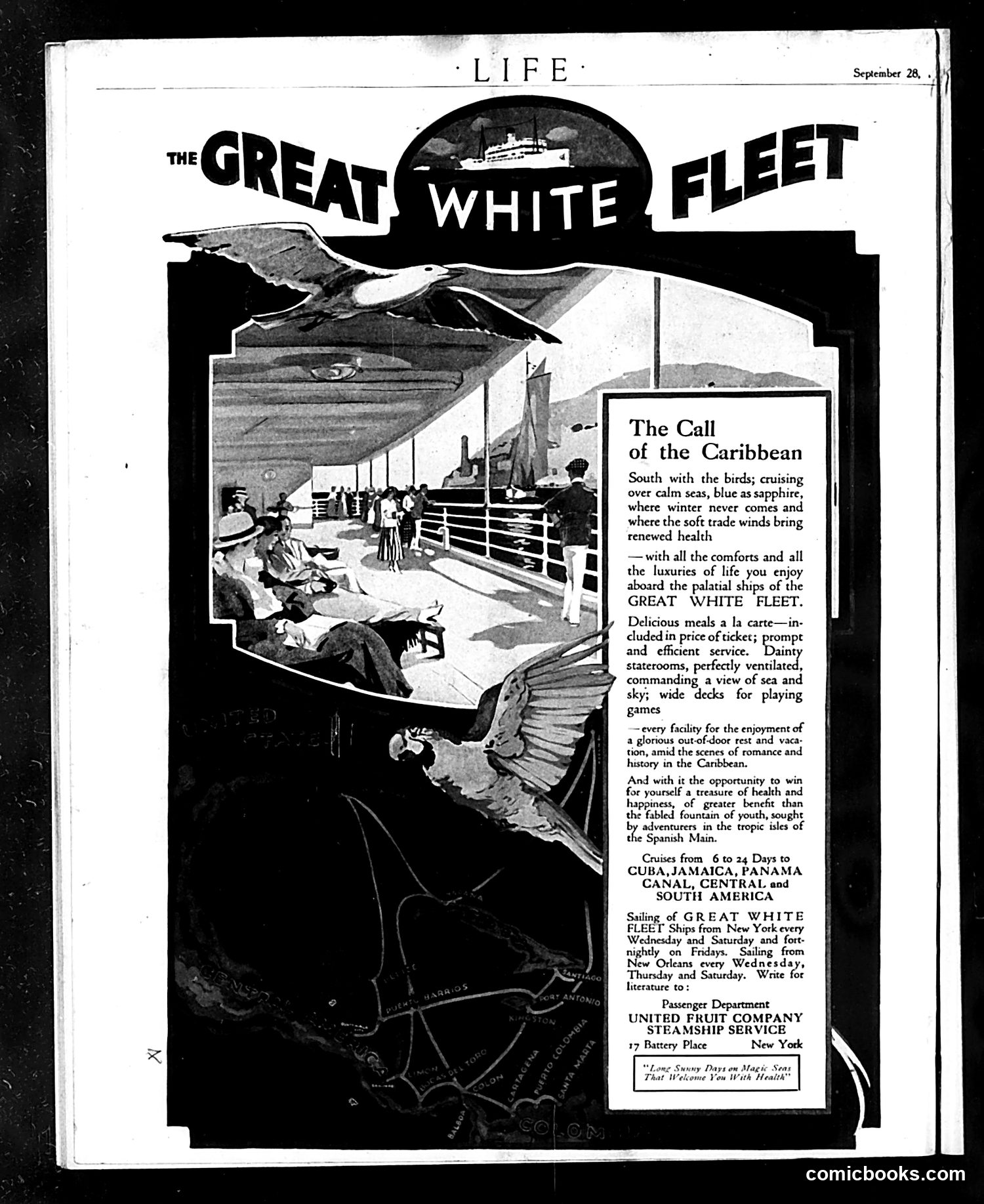
This is **not satire or a political cartoon** — it's a straightforward cruise ship advertisement from the United Fruit Company's "Great White Fleet." The page promotes Caribbean vacations to Cuba, Jamaica, Panama, and Central/South America, emphasizing exotic leisure: calm seas, tropical health benefits, fine dining, and comfortable staterooms. The decorative illustrations show seabirds and a ship, establishing an aspirational travel aesthetic. The reference to the "fabled fountain of youth" in the "Spanish Main" appeals to early 20th-century fantasies about tropical rejuvenation. **Historical context:** The United Fruit Company was a major American corporation with significant economic and political interests throughout Central America and the Caribbean. While the ad itself contains no obvious satire, modern readers should recognize that this company's commercial dominance in the region had serious geopolitical implications, though those are not addressed on this page. This appears to be a standard commercial advertisement in *Life* magazine, not editorial commentary.

I can see this is a page from Life magazine, but the image quality is extremely poor—almost entirely black with only a white margin visible on the left side. The OCR text only shows "comicbooks.com," which appears to be a watermark rather than actual page content. I cannot reliably identify any cartoon figures, political references, or satirical content from this image. To accurately explain what this page means to a modern reader, I would need a clearer, higher-contrast scan where the actual artwork and text are legible. If you have a better-quality version of this page, I'd be happy to analyze it properly.