
Life, 1916-09-28 · page 16 of 41
Life — September 28, 1916 — page 16: what you’re looking at
What you’re looking at
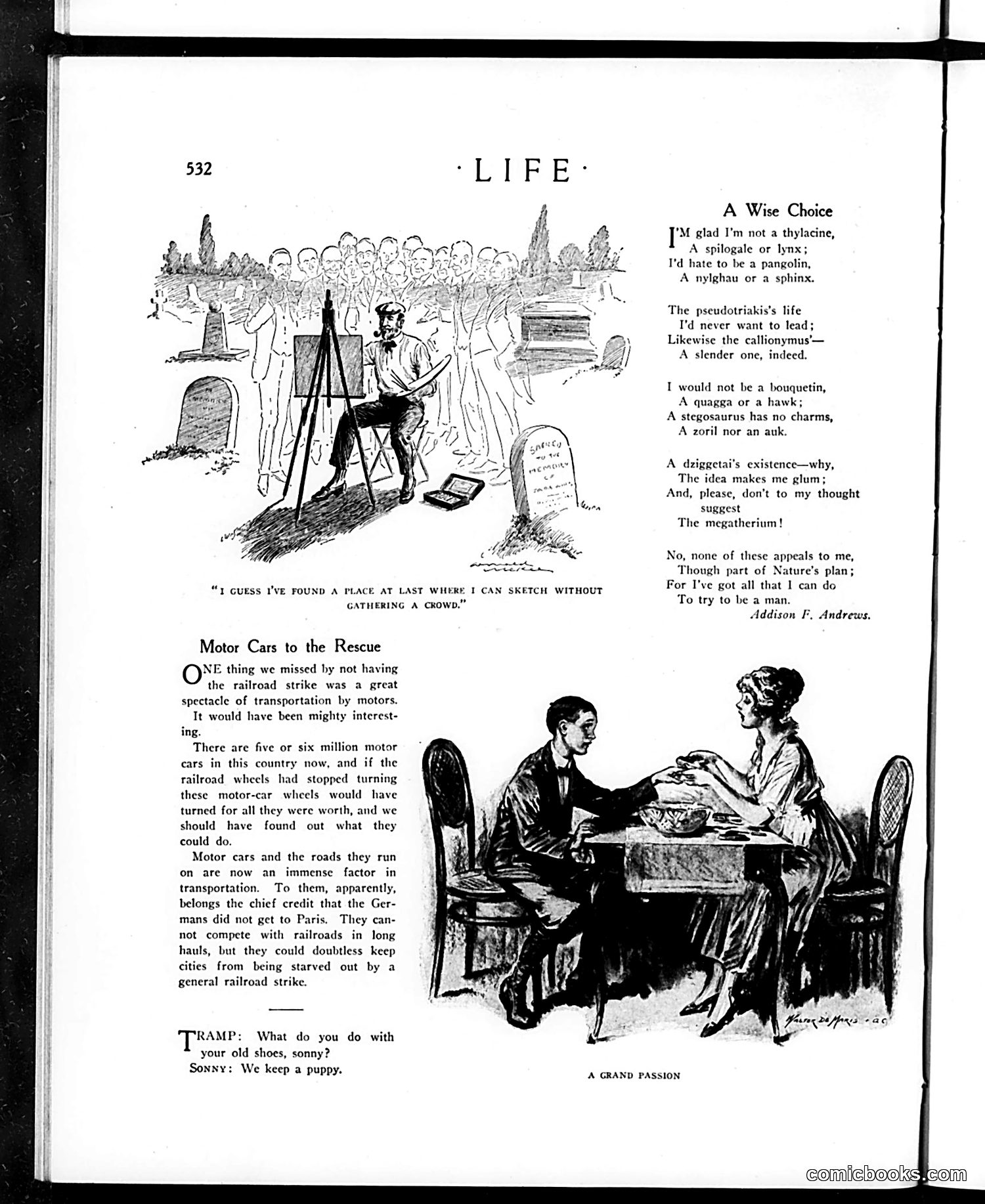
**"A Wise Choice"** is a humorous poem celebrating humanity over exotic animals. The speaker lists obscure creatures (thylacine, pangolin, stegosaurus, etc.) he's grateful *not* to be, concluding he's content simply "to try to be a man." The accompanying sketch shows an artist sketching in a cemetery—finally finding a place to work undisturbed by crowds. The satire gently mocks both pretentious naturalism and modern urban congestion. **"Motor Cars to the Rescue"** discusses how automobiles could have mitigated a potential railroad strike's damage. The piece notes five to six million motor cars exist and could supply cities if trains stopped running—crediting motors with helping Germans reach Paris (likely WWI reference). The accompanying joke compares old shoes to puppies, suggesting both are kept rather than discarded. Both pieces reflect early 20th-century concerns: transportation innovation, labor unrest, and modernity's promise.
📄 Transcribed text from this page (OCR, searchable)
Machine-transcribed from the original scan — historical spelling and the odd misread are preserved.
A Wise Choice M glad I'm not a thylacine, A spilogale or lynx; I'd hate to be a pangolin, A nylghau or a sphinx. The pseudotriakis’s life I'd never want to lead; Likewise the callionymus’— A slender one, indeed. I would not be a bouquetin, A quagga or a hawk; A stegosaurus has no charms, A zoril nor an auk. A dziggetai’s existence—why, The idea makes me glum; And, please, don’t to my thought suggest The megatherium! No, none of these appeals to me, Though part of Nature's plan; For I've got all that 1 can do To try to be a man. Addison F, Andrews. “1 GUESS I'VE FOUND A PLACE AT LAST WHERE I CAN SKETCH WITHOUT GATHERING A CROWD.” Motor Cars to the Rescue O thing we missed by not having the railroad strike was a great spectacle of transportation by motors. It would have been mighty interest- ing. There are five or six million motor cars in this country now, and if the railroad wheels had stopped turning these motor-car wheels would have turned for all they were worth, and we should have found out what they could do. Motor cars and the roads they run on are now an immense factor in transportation. To them, apparently, belongs the chief credit that the Ger- mans did not get to Paris. They can- not compete with railroads in long hauls, but they could doubtless keep cities from being starved out by a general railroad strike. RAMP: What do you do with your old shoes, sonny? Sonny: We keep a puppy. A GRAND PASSION comicbookss