
Life, 1916-09-28 · page 24 of 41
Life — September 28, 1916 — page 24: what you’re looking at
What you’re looking at
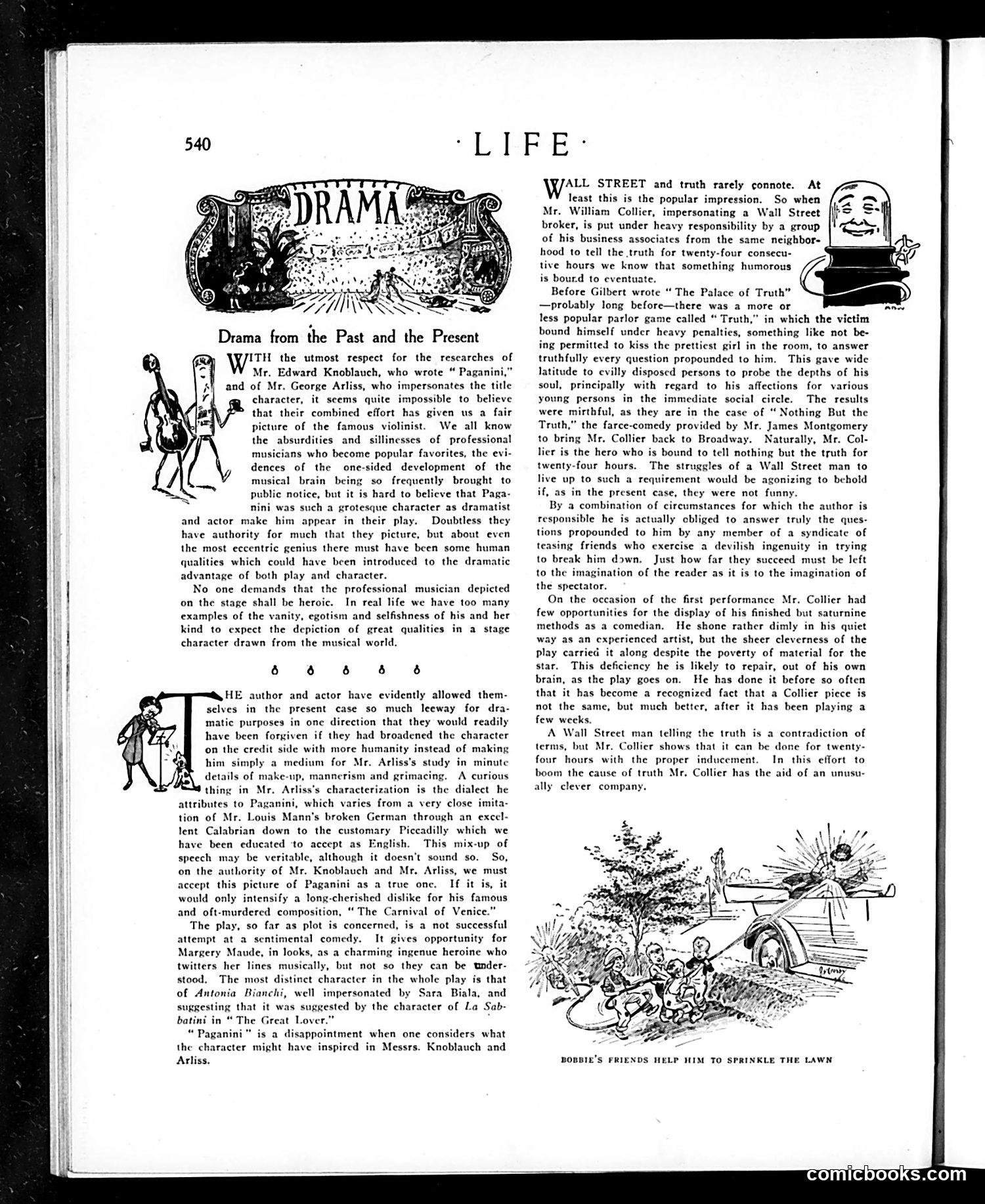
This page contains two theater reviews. The main article critiques a play called "Paganini," starring actor George Arliss as the famous violinist. The reviewer argues that while Arliss and playwright Knoblauch had historical authority for depicting Paganini as eccentric, they overdid it—presenting him as a grotesque caricature lacking human qualities. The critic particularly mocks Arliss's inconsistent dialect work and suggests the sentimental comedy fails dramatically despite capable supporting performances. The second review discusses a play called "Truth," starring William Collier as a Wall Street broker who must tell the truth for 24 hours. The reviewer references both a Gilbert play and an older parlor game of the same name where participants answer questions under penalty. Both reviews exemplify *Life* magazine's satirical theater criticism, mocking both theatrical excess and the social pretensions of their subjects.
📄 Transcribed text from this page (OCR, searchable)
Machine-transcribed from the original scan — historical spelling and the odd misread are preserved.
*L EP'E * Drama from the Past and the Present ITH the utmost respect for the researches of Mr. Edward Knoblauch, who wrote “ Pagan and of Mr. George Arliss, who impersonates the title character, it scems quite impossible to believe that their combined effort has given us a fair picture of the famous violinist. We all know the absurdities and sillinesses of professional musicians who become popular favorites, the evi- dences of the one-sided development of the musical brain being so frequently brought to public notice, but it is hard to believe that Paga- nini was such a grotesque character as dramatist and actor make him appear in their play. Doubtless they have authority for much that they picture, but about even the most eccentric genius there must have been some human qualities which could have been introduced to the dramatic advantage of both play and character. No one demands that the professional musician depicted on the stage shall be heroic. In real life we have too many examples of the vanity, egotism and selfishness of his and her kind to expect the depiction of great qualities in a stage character drawn from the musical world. é é 8 4 é HE author and actor have evidently allowed them- selves in the present case so much leeway for dra- matic purposes in one direction that they would readily have been forgiven if they had broadened the character on the credit side with more humanity instead of making him simply a medium for Mr. Arliss’s study in minute details of make-up, mannerism and grimacing. A curious thing in Mr. Arliss’s characterization is the dialect he attributes to Paganini, which varies from a very close imita- tion of Mr. Louis Mann's broken German through an excel- lent Calabrian down to the customary Piccadilly which we have been educated to accept as English. This mix-up of speech may be veritable, although it doesn’t sound so. So, on the authority of Mr. Knoblauch and Mr. Arliss, we must accept this picture of Paganini as a true onc. If it is, it would only intensify a long-cherished dislike for his famous and oft-murdered composition, “The Carnival of Venice.” The play, so far as plot is concerned, is a not successful attempt at a sentimental comedy. It gives opportunity for Margery Maude, in looks, as a charming ingenue heroine who twitters her lines musically, but not so they can be under- stood. The most distinct character in the whole play is that of Antonia Bianchi, well impersonated by Sara Biala, and suggesting that it was suggested by the character of La Sab- batini in “The Great Lover.” “Paganini” is a disappointment when one considers what the character might have inspired in Messrs. Knoblauch and Arliss. Wak STREET and truth rarely connote. At least this is the popular impression. So when Mr. William Collier, impersonating a Wall Street broker, is put under heavy responsibility by a group of his business associates from the same neighbor- hood to tell the truth for twenty-four consecu- tive hours we know that something humorous is bourd to eventuate. Before Gilbert wrote “ The Palace of Truth” —probably long before—there was a more or less popular parlor game called “ Truth,” in which the victim bound himself under heavy penalties, something like not be- ing permitted to kiss the prettiest girl in the room, to answer truthfully every question propounded to him, This gave wide latitude to evilly disposed persons to probe the depths of his soul, principally with regard to his affections for various young persons in the immediate social circle. The results were mirthful, as they are in the case of “Nothing But the Truth,” the farce-comedy provided by Mr. James Montgomery to bring Mr. Collier back to Broadway. Naturally, Mr. Col- lier is the hero who is bound to tell nothing but the truth for twenty-four hours. The struggles of a Wall Street man to live up to such a requirement would be agonizing to behold if, as in the present case, they were not funny. By a combination of circumstances for which the author is responsible he is actually obliged to answer truly the ques- tions propounded to him by any member of a syndicate of teasing friends who exercise a devilish ingenuity in trying to break him down. Just how far they succeed must be left to the imagination of the reader as it is to the imagination of the spectator. On the occasion of the first performance Mr. Collier had few opportunities for the display of his finished but saturnine methods as a comedian, He shone rather dimly in his quiet way as an experienced artist, but the sheer cleverness of the play carried it along despite the poverty of material for the star. This deficiency he is likely to repair, out of his own brain, as the play goes on. He has done it before so often that it has become a recognized fact that a Collier piece is not the same, but much better, after it has been playing a few weeks. A Wall Street man telling the truth is a contradiction of terms, but Mr. Collier shows that it can be done for twenty- four hours with the proper inducement. In this effort to boom the cause of truth Mr. Collier has the aid of an unusu- ally clever company, DOBBIE’S FRIENDS HELP HIM TO SPRINKLE THE LAWN — Comicbooks.com