
Life, 1916-09-28 · page 20 of 41
Life — September 28, 1916 — page 20: what you’re looking at
What you’re looking at
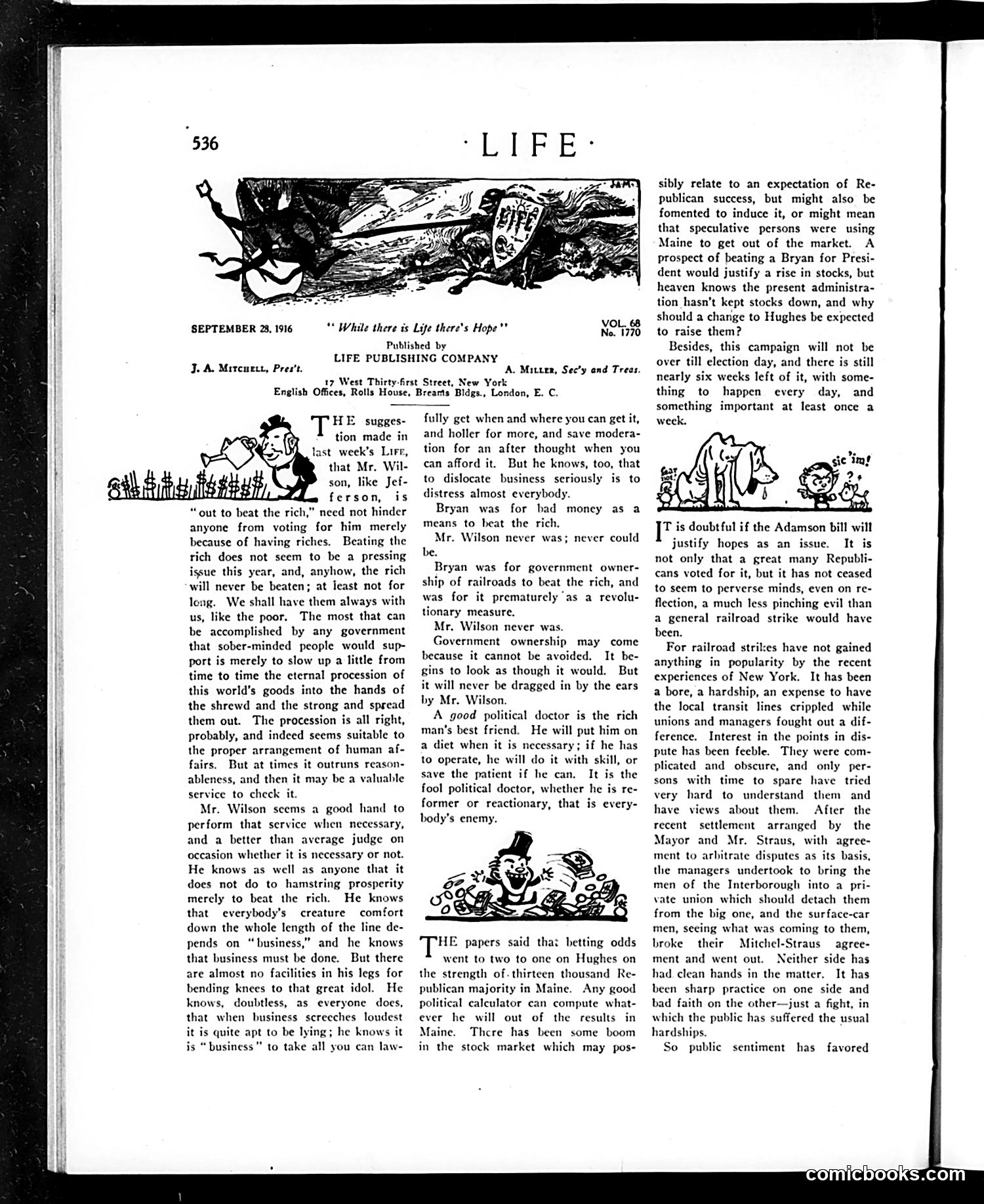
This page contains political commentary on the 1916 U.S. presidential election between incumbent Woodrow Wilson (Democrat) and challenger Charles Evans Hughes (Republican). **Main Arguments:** The text defends Wilson against criticism that he seeks to "beat the rich." It argues Wilson is a pragmatic "political doctor" who understands business necessity, unlike William Jennings Bryan (the previous Democratic candidate), who pushed radical measures like government railroad ownership and cheap currency to attack wealth. **Election Context:** Recent Republican gains in Maine (a 13,000-vote majority) have created betting odds favoring Hughes. The article dismisses speculation that this predicts national Republican victory or warrants stock market optimism, noting six weeks remain before election day. **The Cartoon:** The illustration at top appears to show a figure labeled "life" with a caduceus or staff, likely symbolizing the magazine's satirical role as social commentator during this pivotal election season. The overall tone suggests Life magazine supported Wilson's measured approach over what it portrayed as reckless reformism.
📄 Transcribed text from this page (OCR, searchable)
Machine-transcribed from the original scan — historical spelling and the odd misread are preserved.
SEPTEMBER 23, 1916 ‘* While there is Life there's Hope"” VOL. 68 No. 1770 Published by LIFE PUBLISHING COMPANY J. A. Mitcuett, Pres’t. A. Mittrr, Sec’y ond Treas. 17 West Thirty-first Street, New York English Offices, Rolls House, Breams Bldgs, London, E. C. HE sugges- tion made in last week’s Lire, that Mr. Wil- son, like Jef- ferson, is “out to beat the rich,” need not hinder anyone from voting for him merely because of having riches. Beating the rich does not seem to be a pressing issue this year, and, anyhow, the rich will never be beaten; at least not for long. We shall have them always with us, like the poor, The most that can be accomplished by any government that sober-minded people would sup- port is merely to slow up a little from time to time the eternal procession of this world’s goods into the hands of the shrewd and the strong and spread them out. The procession is all right, probably, and indeed seems suitable to the proper arrangement of human af- fairs. But at times it outruns reason- ableness, and then it may be a valuable service to check it. Mr. Wilson seems a good hand to perform that service when necessary, and a better than average judge on occasion whether it is necessary or not. He knows as well as anyone that it does not do to hamstring prosperity merely to beat the rich. He knows that everybody's creature comfort down the whole length of the line de- pends on “business,” and he knows that business must be done. But there are almost no facilities in his legs for bending knees to that great idol. He knows, doubtless, as everyone does, that when business screeches loudest it is quite apt to be lying; he knows it is “ business" to take all you can law- fully get when and where you can get it, and holler for more, and save modera- tion for an after thought when you can afford it. But he knows, too, that to dislocate business seriously is to distress almost everybody. Bryan was for bad money as a means to beat the rich, Mr. Wilson never was; never could be. Bryan was for government owner- ship of railroads to beat the rich, and was for it prematurely “as a revolu- tionary measure. Mr, Wilson never was. Government ownership may come because it cannot be avoided. It be- gins to look as though it would. But it will never be dragged in by the ears by Mr. Wilson. A good political doctor is the rich man's best friend. He will put him on a diet when it is necessary; if he has to operate, he will do it with skill, or save the patient if he can. It is the fool political doctor, whether he is re- former or reactionary, that is every- body’s enemy. HE papers said that betting odds went to two to one on Hughes on the strength of.thirteen thousand Re- publican majority in Maine. Any good political calculator can compute what- ever he will out of the results in Maine. Thcre has been some boom in the stock market which may pos- sibly relate to an expectation of Re- publican success, but might also be fomented to induce it, or might mean that speculative persons were using Maine to get out of the market. A prospect of beating a Bryan for Presi- dent would justify a rise in stocks, but heaven knows the present administra- tion hasn't kept stocks down, and why should a change to Hughes be expected to raise them? Besides, this campaign will not be over till election day, and there is still nearly six wecks left of it, with some- thing to happen every day, and something important at least once a week. T is doubtful if the Adamson bill will justify hopes as an issue. It is not only that a great many Republi- cans voted for it, but it has not ceased to seem to perverse minds, even on re- flection, a much less pinching evil than a general railroad strike would have been. For railroad strilzes have not gained anything in popularity by the recent experiences of New York. It has been a bore, a hardship, an expense to have the local transit lines crippled while unions and managers fought out a dif- ference. Interest in the points in dis- pute has been feeble. They were com- plicated and obscure, and only per- sons with time to spare have tried very hard to understand them and have views about them. After the recent settlement arranged by the Mayor and Mr. Straus, with agree- ment to arbitrate disputes as its basis, the managers undertook to bring the men of the Interborough into a pri- vate union which should detach them from the big one, and the surface-car men, seeing what was coming to them, broke their Mitchel-Straus agree- ment and went out. Neither side has had clean hands in the matter. It has been sharp practice on one side and bad faith on the other—just a fight, in which the public has suffered the usual hardships. So public favored sentiment has