
Life, 1916-09-28 · page 21 of 41
Life — September 28, 1916 — page 21: what you’re looking at
What you’re looking at
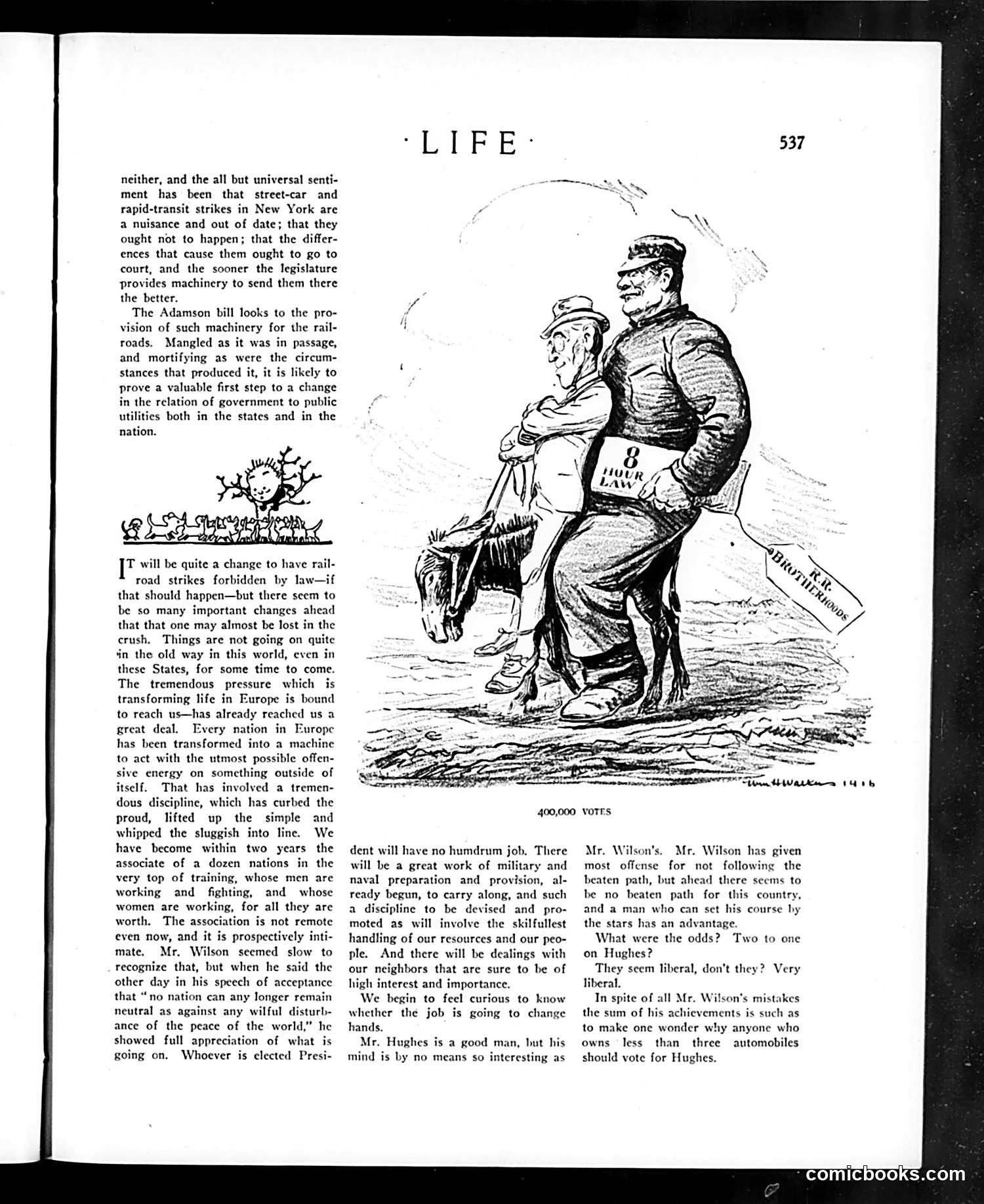
This is a political commentary on the 1916 U.S. presidential election between incumbent Woodrow Wilson and challenger Charles Evans Hughes. The cartoon depicts two figures (likely representing Wilson and Hughes) being carried or propelled forward—a visual metaphor for the momentum and forces shaping the election. The text argues that Wilson, despite missteps, better understands the transformative moment America faces. With World War I raging in Europe and U.S. involvement looming, the author contends that Wilson's ability to think beyond "the beaten path" makes him preferable to Hughes for navigating unprecedented challenges ahead. The final sarcastic jab—that anyone owning fewer than three automobiles should vote for Hughes—suggests Hughes represents wealthy interests, while Wilson represents broader constituencies. The "400,000 VOTES" caption likely references the electoral stakes in a close race.
📄 Transcribed text from this page (OCR, searchable)
Machine-transcribed from the original scan — historical spelling and the odd misread are preserved.
neither, and the all but universal senti- ment has been that street-car and rapid-transit strikes in New York are a nuisance and out of date; that they ought not to happen; that the differ- ences that cause them ought to go to court, and the sooner the legislature provides machinery to send them there the better. The Adamson bill looks to the pro- vision of such machinery for the rail- roads. Mangled as it was in passage, and mortifying as were the circum- stances that produced it is likely to prove a valuable first step to a change in the relation of government to public utilities both in the states and in the nation. T will be quite a change to have rail road strikes forbidden by law—if that should happen—but there seem to be so many important changes ahead that that one may almost be lost in the crush, Things are not going on quite ‘in the old way in this world, even in these States, for some time to come. The tremendous pressure which is transforming life in Europe is bound to reach us—has already reached us a great deal. Every nation in Europe has been transformed into a machine to act with the utmost possible offen- sive energy on something outside of itself. That has involved a tremen- dous discipline, which has curbed the proud, lifted up the simple and whipped the sluggish into line. We have become within two years the associate of a dozen nations in the very top of training, whose men are working and fighting, and whose women are working, for all they are worth, The association is not remote even now, and it is prospectively inti- mate. Mr. Wilson seemed slow to recognize that, but when he said the other day in his speech of acceptance that “no nation can any longer remain neutral as against any wilful disturb- ance of the peace of the world,” he showed full appreciation of what is going on. Whoever is elected Presi- mapa I Tn are 1 tb 400,000 voTrs dent will have no humdrum job, There will be a great work of military and naval preparation and provision, al- ready begun, to carry along, and such a discipline to be devised and pro- moted as will involve the skilfullest handling of our resources and our peo- ple. And there will be dealings with our neighbors that are sure to be of high interest and importance. We begin to feel curious to know whether the job is going to change hands. Mr. Hughes is a good man, but his mind is by no means so interesting as Mr. Wilson's. Mr. Wilson has given most offense for not following the beaten path, but ahead there seems to be no beaten path for this count: and a man who can set his course hy the stars has an advantage. What were the odds? Two to one on Hughes? They seem liberal, don’t they? Very liberal. In spite of all Mr. Wilson's mista the sum of his achievements is such as to make one wonder why anyone who owns less than three automobiles should vote for Hughes.