
Life, 1916-09-28 · page 26 of 41
Life — September 28, 1916 — page 26: what you’re looking at
What you’re looking at
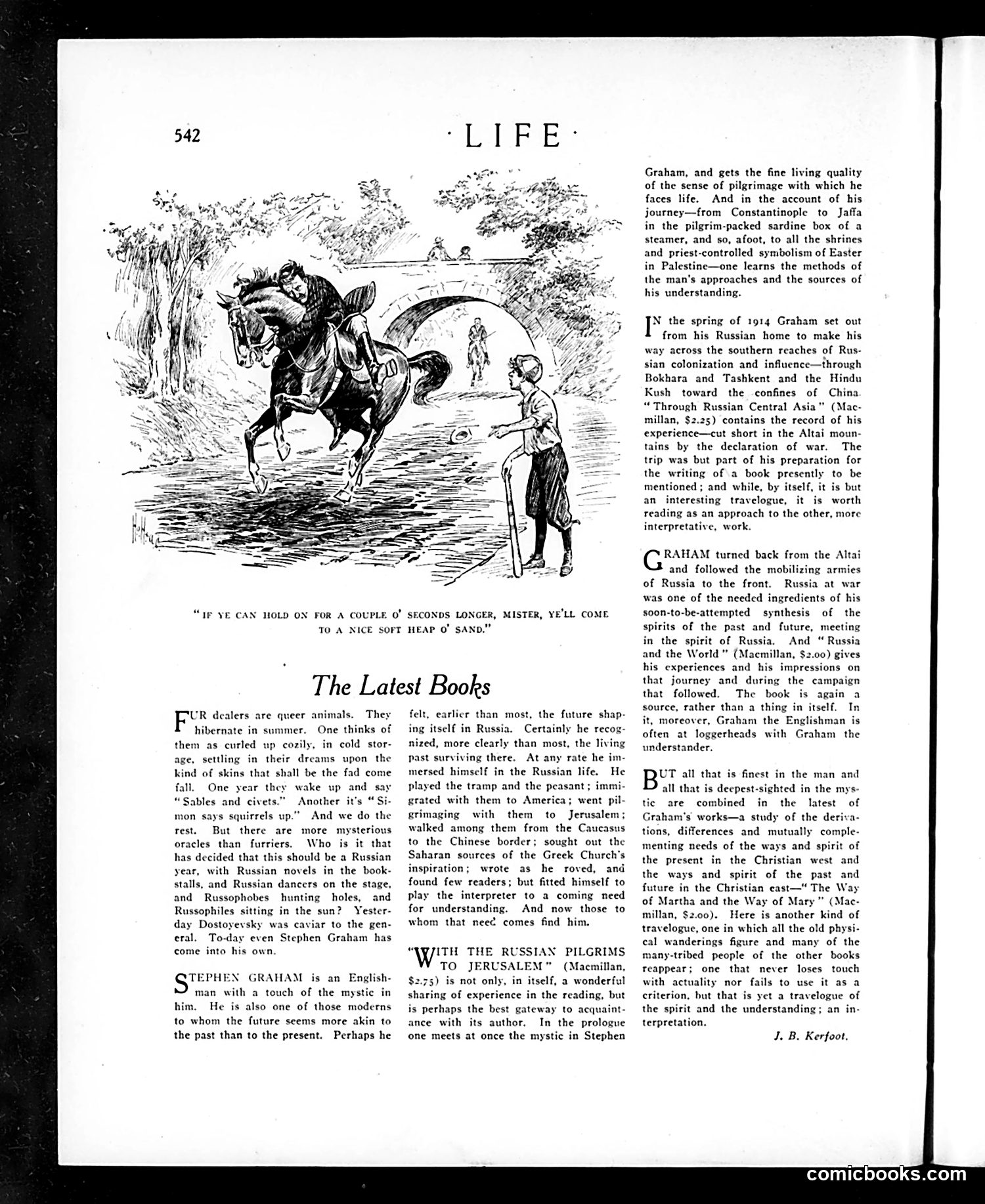
This page reviews English author Stephen Graham's recent works on Russia. The cartoon depicts a mounted soldier directing a weary foot-soldier toward "a nice soft heap of sand"—likely satirizing the brutal conditions soldiers faced during World War I. The review discusses Graham's books about Russian travels and WWI experiences, published around 1914-1915. The commentary reflects contemporary fascination with Russia, noting how Russian novels and culture suddenly became fashionable ("a Russian year"). Graham is portrayed as a mystical figure who embedded himself in Russian life before the war, then followed mobilizing armies to document the conflict. The reviewer suggests his books serve primarily as gateways to understanding Russia rather than as standalone works—though his latest synthesis of Russian past and future is praised as his finest achievement. The overall tone reflects wartime interest in understanding Russia as an ally.
📄 Transcribed text from this page (OCR, searchable)
Machine-transcribed from the original scan — historical spelling and the odd misread are preserved.
“IF YE CAN HOLD ON FOR A COUPLE 0’ SECONDS LONGER, MISTER, YE'LL COME TO A NICE SOFT HEAP 0’ SAN! The Latest Books UR dealers are queer animals. They hibernate in summer. One thinks of them as curled up cozily, in cold stor- . settling in their dreams upon the ind of skins that shall be the fad come fall. One year they wake up and sa} ables and civets.” Another it's “ Si- mon says squirrels up.” And we do the rest. But there are more mysterious oracles than furriers. Who is it that has decided that this should be a Russian year, with Russian novels in the book- stalls, and Russian dancers on the stage, and Russophobes hunting holes, and Russophiles sitting in the sun? Yester- day Dostoyevsky was caviar to the gen- eral. To-day even Stephen Graham has come into his own. Ss HEN GRAHAM is an English- man with a touch of the mystic in him. He is also one of those moderns to whom the future seems more akin to the past than to the present. Perhaps he felt, earlier than most, the future shap- ing itself in Russia. Certainly he recog- nized, more clearly than most, the living past surviving there. At any rate he im- mersed himself in the Russian life. He played the tramp and the peasant grated with them to America; went pil- grimaging with them to Jerusalem; walked among them from the Caucasus to the Chinese border; sought out the Saharan sources of the Greek Church's inspiration; wrote as he roved, and found few readers; but fitted himself to play the interpreter to a coming need for understanding. And now those to whom that need comes find him. ™ ITH THE RUSSIAN PILGRIMS TO JERUSALEM” (Macmillan, $2.75) is not only, in itself, a wonderful sharing of experience in the reading, but is perhaps the best gateway to acquaint- ance with its author, In the prologue one meets at once the mystic in Stephen Graham, and gets the fine living quality of the sense of pilgrimage with which he faces life. And in the account of his journey—from Constantinople to Jaffa in the pilgrim-packed sardine box of a steamer, and so, afoot, to all the shrines and priest-controlled symbolism of Easter in Palestine—one learns the methods of the man’s approaches and the sources of his understanding. N the spring of 1914 Graham set out from his Russian home to make his way across the southern reaches of Rus- sian colonization and influence—through Bokhara and Tashkent and the Hindu Kush toward the confines of China Through Russian Central Asia” (Mac- millan, $2.25) contains the record of experience—eut short in the Altai moun- tains by the declaration of war. The trip was but part of his preparation for the writing of a book presently to be mentioned ; and while, by itself, it is but an interesting travelogue, it is worth reading as an approach to the other, more interpretative, work. RAHAM turned back from the Altai and followed the mobilizing armies of Russia to the front. Russia at war was one of the needed ingredients of his soon-to-be-attempted synthesis of the spirits of the past and future, meeting in the spirit of Russia. And “ Russia and the World" (Macmillan, $2.00) gives his experiences and his impressions on that journey and during the campaign that followed. The book is again a source, rather than a thing in itself. In it, moreover, Graham the Englishman is often at loggerheads with Graham the understander. UT all that is finest in the man and all that is deepest-sighted in the mys- tic are combined in the latest of Graham’s works—a study of the deri: tions, differences and mutually comple- menting needs of the ways and spirit of the present in the Christian west and the ways and spirit of the past and future in the Christian east— The Way of Martha and the Way of Mary" (Mac- millan, $2.00). Here is another kind of travelogue, one in which all the old physi- cal wanderings figure and many of the many-tribed people of the other books reappear; one that never loses touch actuality nor fails to use it as a criterion, but that is yet a travelogue of the spirit and the understanding; an in- terpretation. J. B. Kerfoot, comicbooks.com