
A complete issue · 38 pages · 1916
Life — August 3, 1916
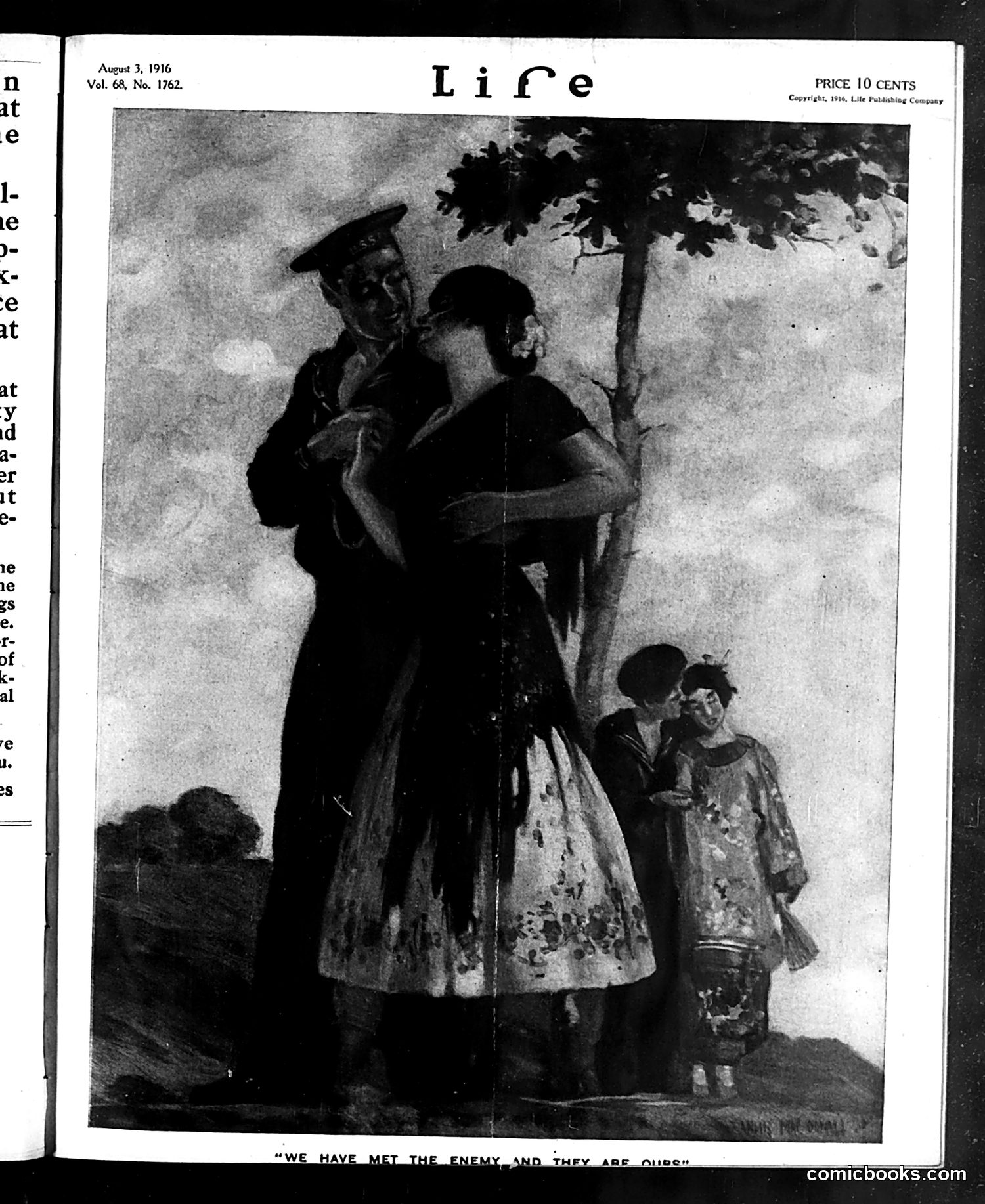
This is a **Life magazine cover from August 3, 1916** showing a dramatic silhouette illustration with the caption "WE HAVE MET THE ENEMY AND THEY ARE OURS." The image depicts what appears to be a military or authority figure holding a woman and child, with another child nearby. The composition and caption suggest this is **WWI-related propaganda or commentary**. The famous quote is from Commodore Perry (1813), repurposed here—likely referencing American military involvement or preparedness debates of 1916, when the U.S. was debating entry into World War I. The figures' silhouettes and domestic setting (woman, children) may suggest either: celebrating military protection of civilians, or possibly satirizing militaristic rhetoric by showing its human cost. Without additional text on this page, the exact satirical point remains somewhat ambiguous, though the theatrical composition suggests commentary on wartime messaging.
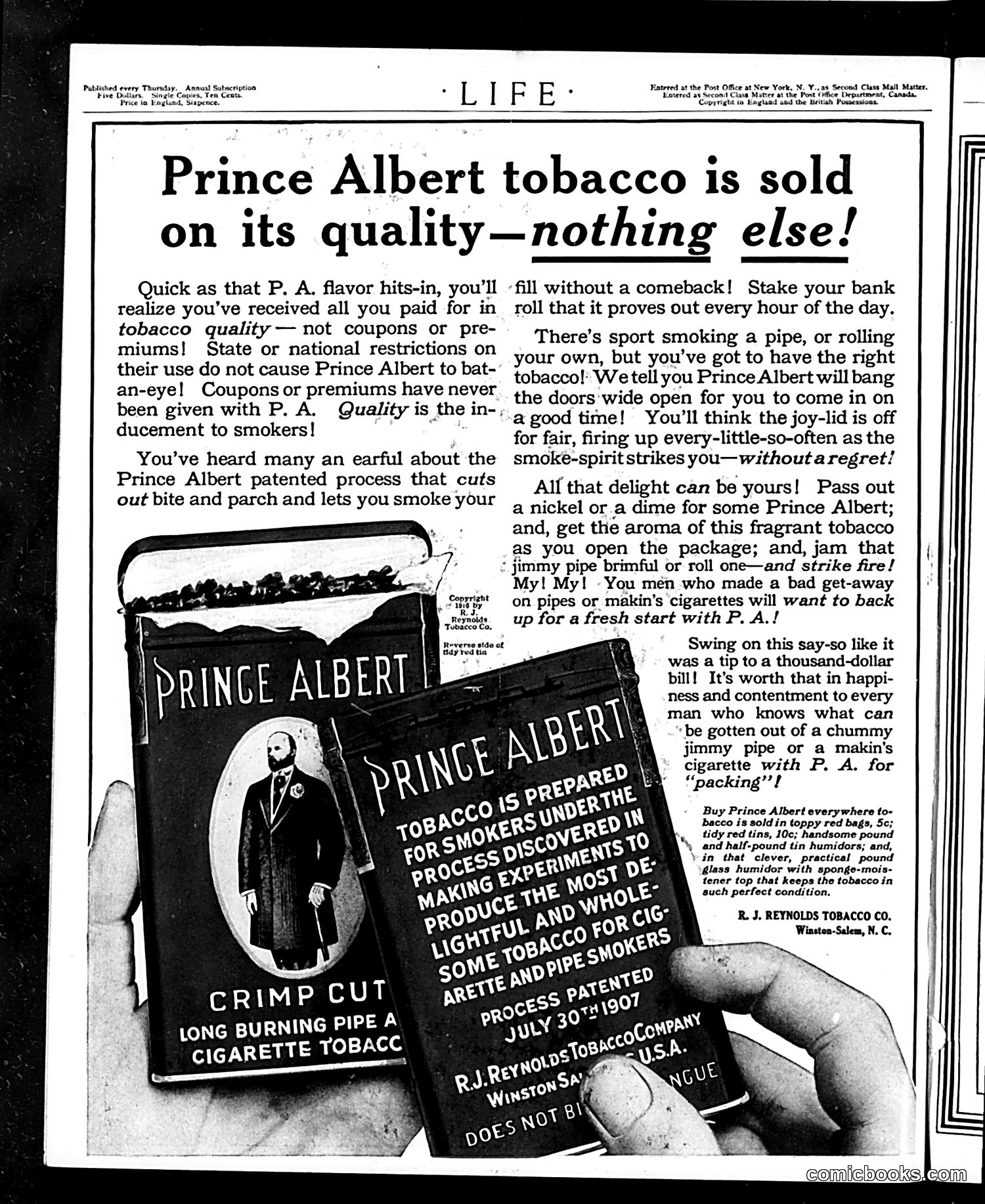
This page is **primarily a tobacco advertisement**, not satire or political cartoon. It promotes Prince Albert tobacco, manufactured by R.J. Reynolds Tobacco Company (Winston-Salem, N.C.). The ad features a man in formal dress (the "Prince Albert" figure) and product packaging. The headline emphasizes that Prince Albert is "sold on its quality—nothing else!" — meaning it contains no coupons or premiums, unlike competitors. The text highlights a patented process that "cuts out bite and parch," allowing smokers to use the tobacco in pipes or rolled cigarettes. The ad promises satisfaction and encourages readers to try the product for a nickel or dime. This represents early 20th-century tobacco marketing, before health warnings existed. The "Prince Albert" branding uses formal imagery to suggest quality and sophistication.
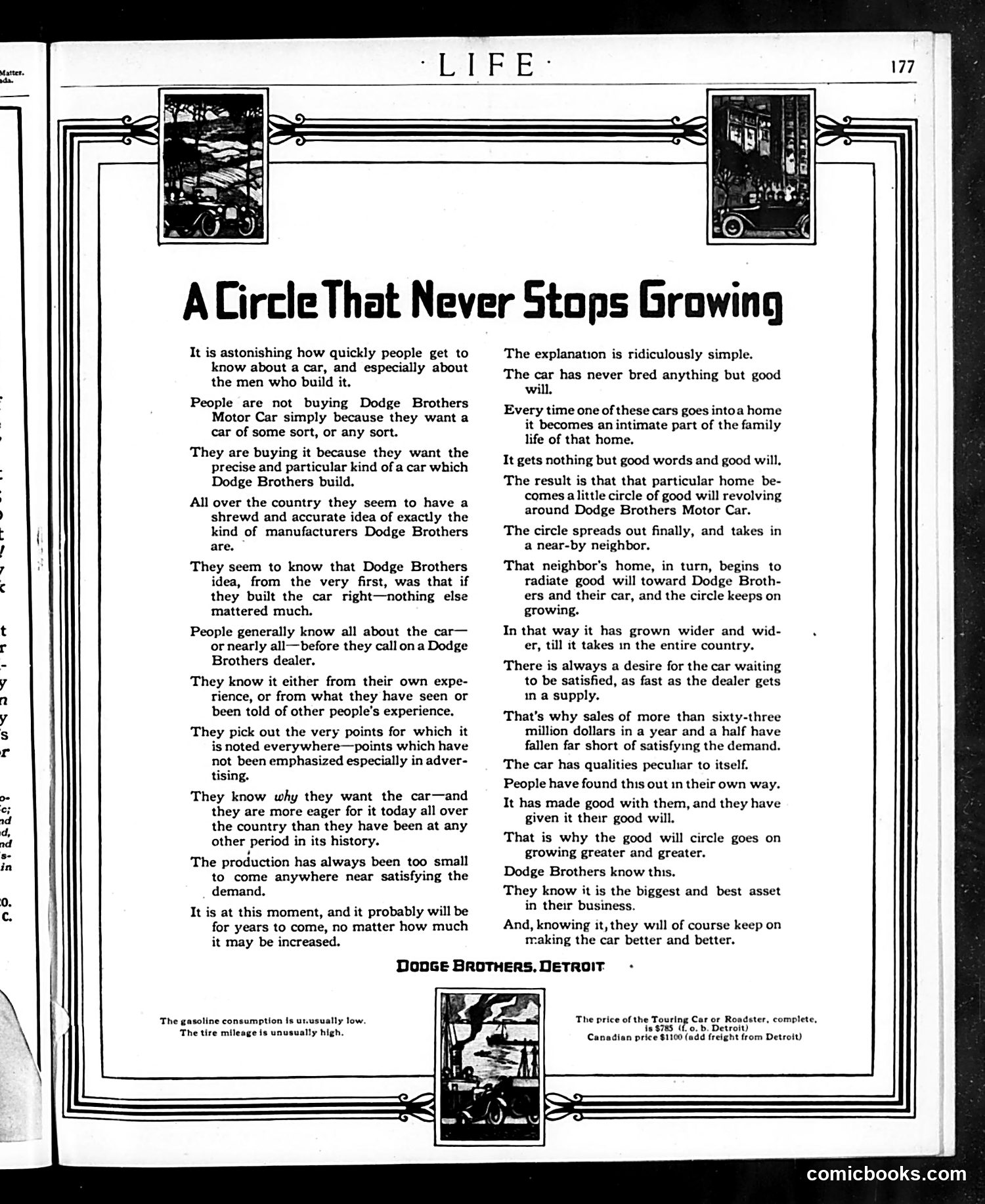
This appears to be **advertising copy rather than satire or political commentary**. The page promotes Dodge Brothers automobiles through an article titled "A Circle That Never Stops Growing." The text uses metaphorical language about reputation and word-of-mouth marketing—claiming that satisfied Dodge owners inspire neighbors to purchase the same car, creating an expanding "circle of good will." This describes organic consumer enthusiasm rather than mocking anything. The three small images show cars and presumably owners, illustrating the advertisement's narrative about satisfied customers. **For modern readers**: This is early 20th-century automobile marketing emphasizing quality, reliability, and social proof—the idea that widespread ownership validates the product. It's straightforward promotional material, not satire or commentary on current events.
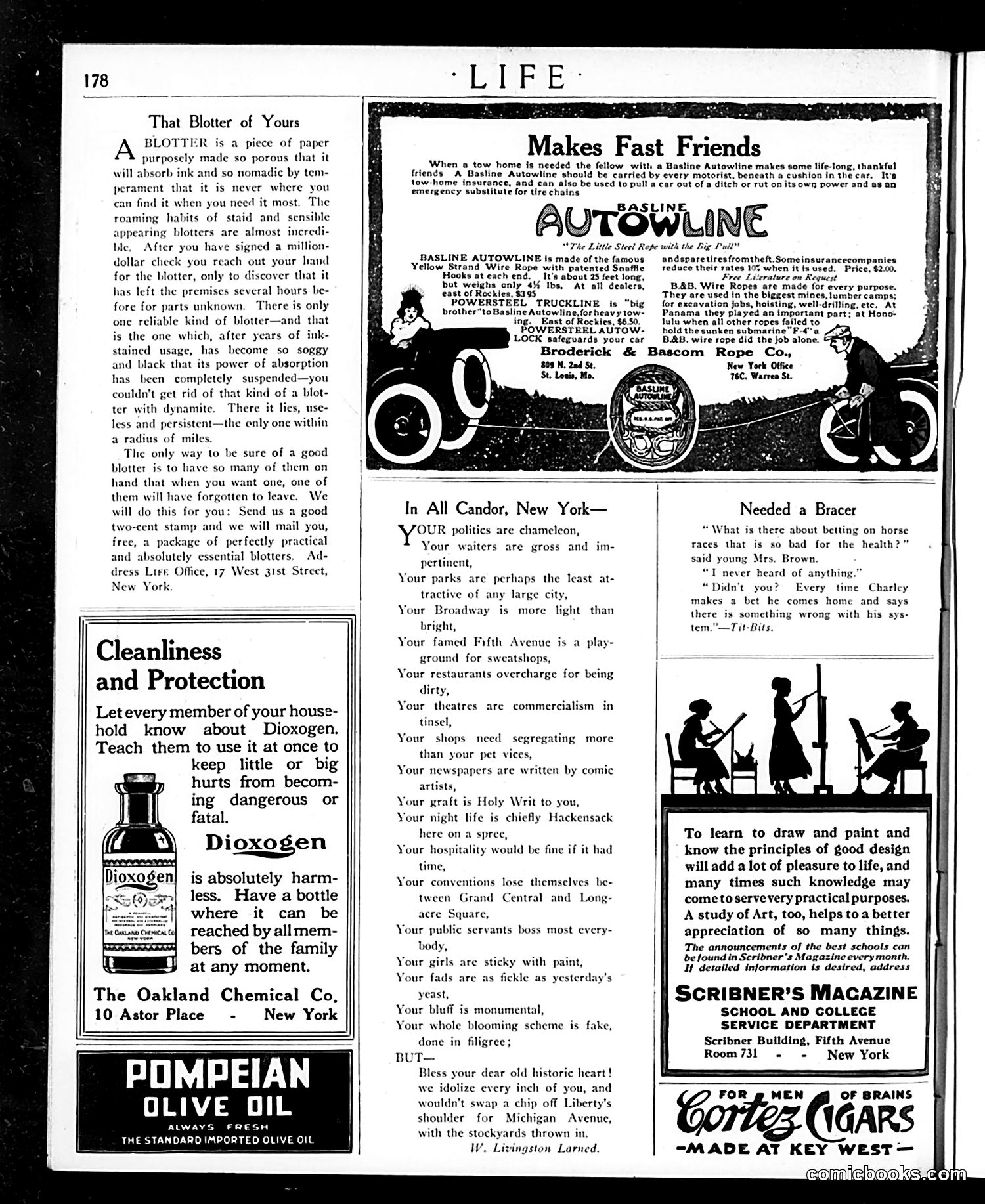
This page is primarily **advertising and miscellaneous content** rather than political satire. The main items are: 1. **Blotter advertisement** (top left): A practical piece promoting ink blotters from Life magazine's office. 2. **Autowline tire rope ad** (center): Marketing automotive safety equipment with illustrations of cars and mechanics. 3. **"In All Candor, New York"** (center-right): A satirical poem mocking New York City's various shortcomings—dirty restaurants, commercial theaters, overcharging shops, and poor hospitality. It's social criticism of urban life rather than political commentary. 4. **"Needed a Bracer"** (right): A brief humorous anecdote about horse racing and betting habits. The remaining space contains product advertisements (Dioxogen, Pompeian Olive Oil, Cortez Cigars) and Scribner's Magazine promotion. No significant political figures or major satirical cartoons appear on this page.
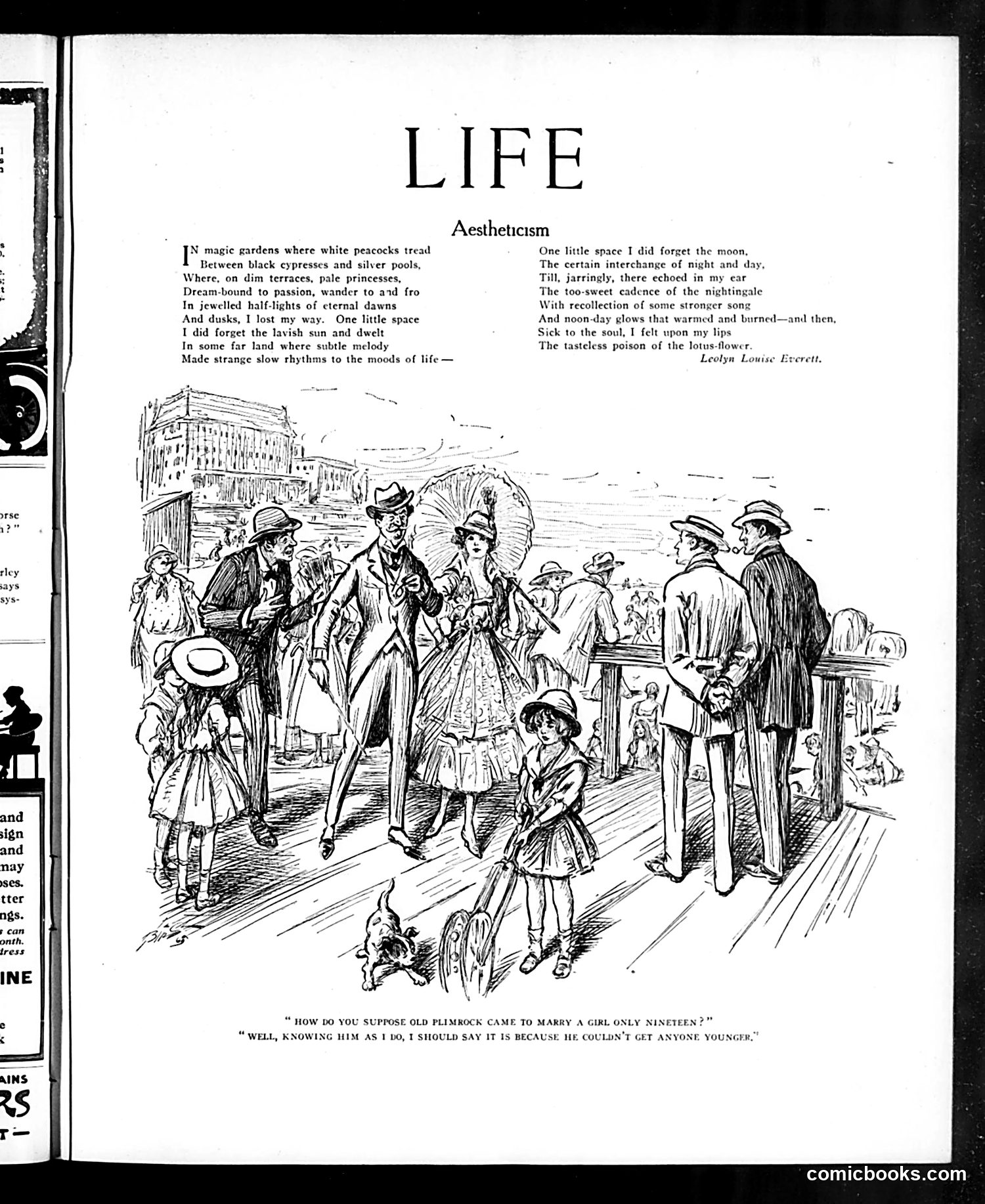
This page satirizes the Aesthetic Movement of the late 19th century—a cultural trend emphasizing "art for art's sake" and affected refinement over practical values. **The Poem (left):** Describes a speaker lost in aesthetic indulgence in magical gardens, eventually poisoned by a lotus flower—mocking how devotion to beauty can be spiritually or morally destructive. **The Cartoon (center):** Depicts fashionable society figures parading through streets with parasols and affected poses, representing the movement's superficial pretensions. **The Caption/Joke (bottom):** A woman explains an old man's late marriage by saying "he couldn't get anyone younger"—crude satire suggesting aesthetes are vain, aging, and ultimately ridiculous despite their cultivated pretenses. The overall message: The Aesthetic Movement is shallow vanity masquerading as sophistication.
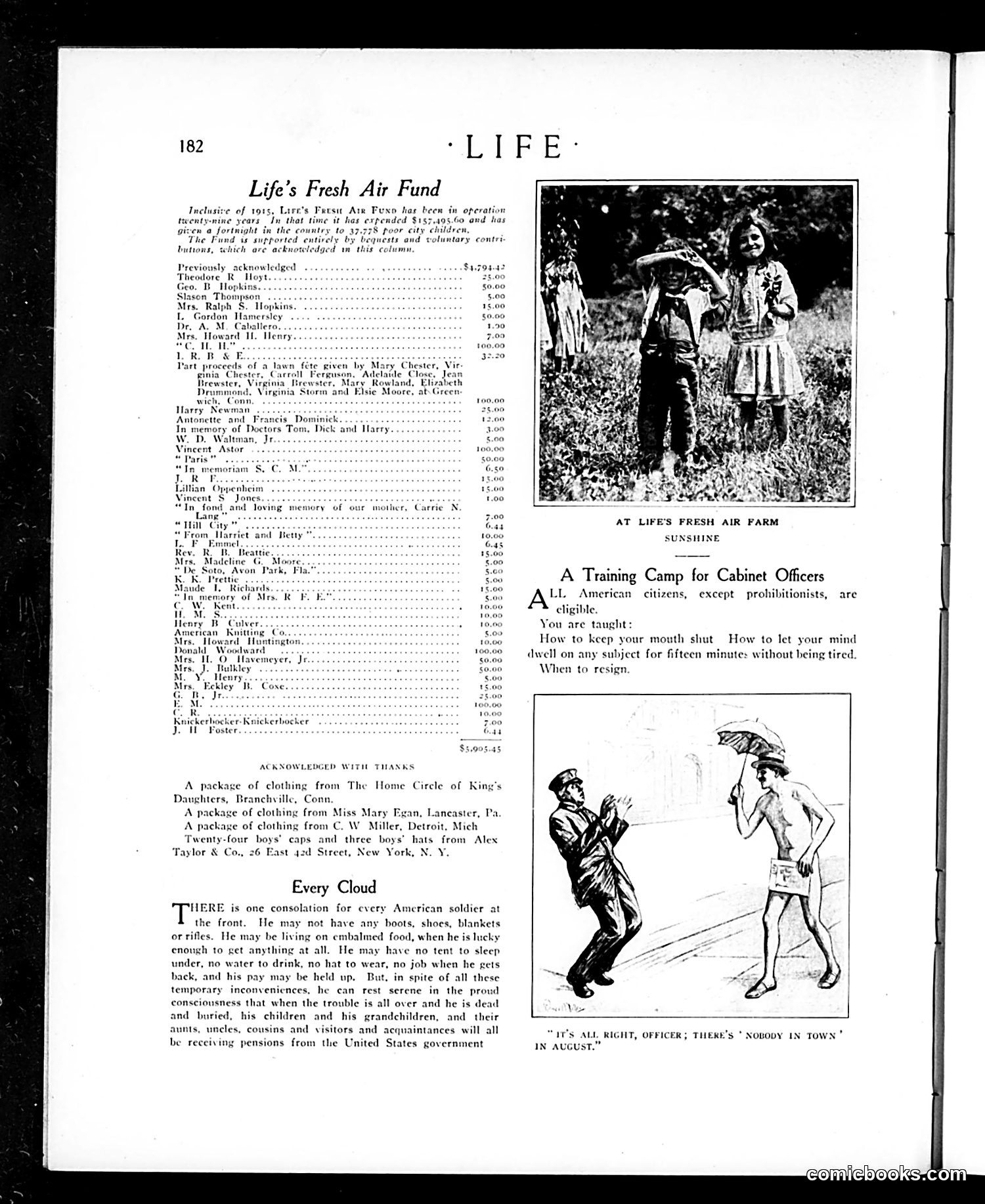
This page contains two distinct elements: **Life's Fresh Air Fund** (left column): A charitable fundraising list documenting donations to provide poor city children with fresh air/country experiences. The total raised was $1,005.43. **The Cartoon** (bottom right): Titled "It's All Right, Officer; There's 'Nobody in Town' in August," it depicts a military officer encountering a nearly-nude man during summer. The joke plays on the phrase "nobody in town"—literally visualizing it by showing an actual absence of people during the hot season when Americans traditionally left cities. This is satirical commentary on summer exodus behavior, treating an officer's concern about public indecency as absurd when the city is abandoned anyway. Both elements reflect wartime America (the fund references soldiers), with the cartoon offering gentle social satire about urban summer migration patterns.
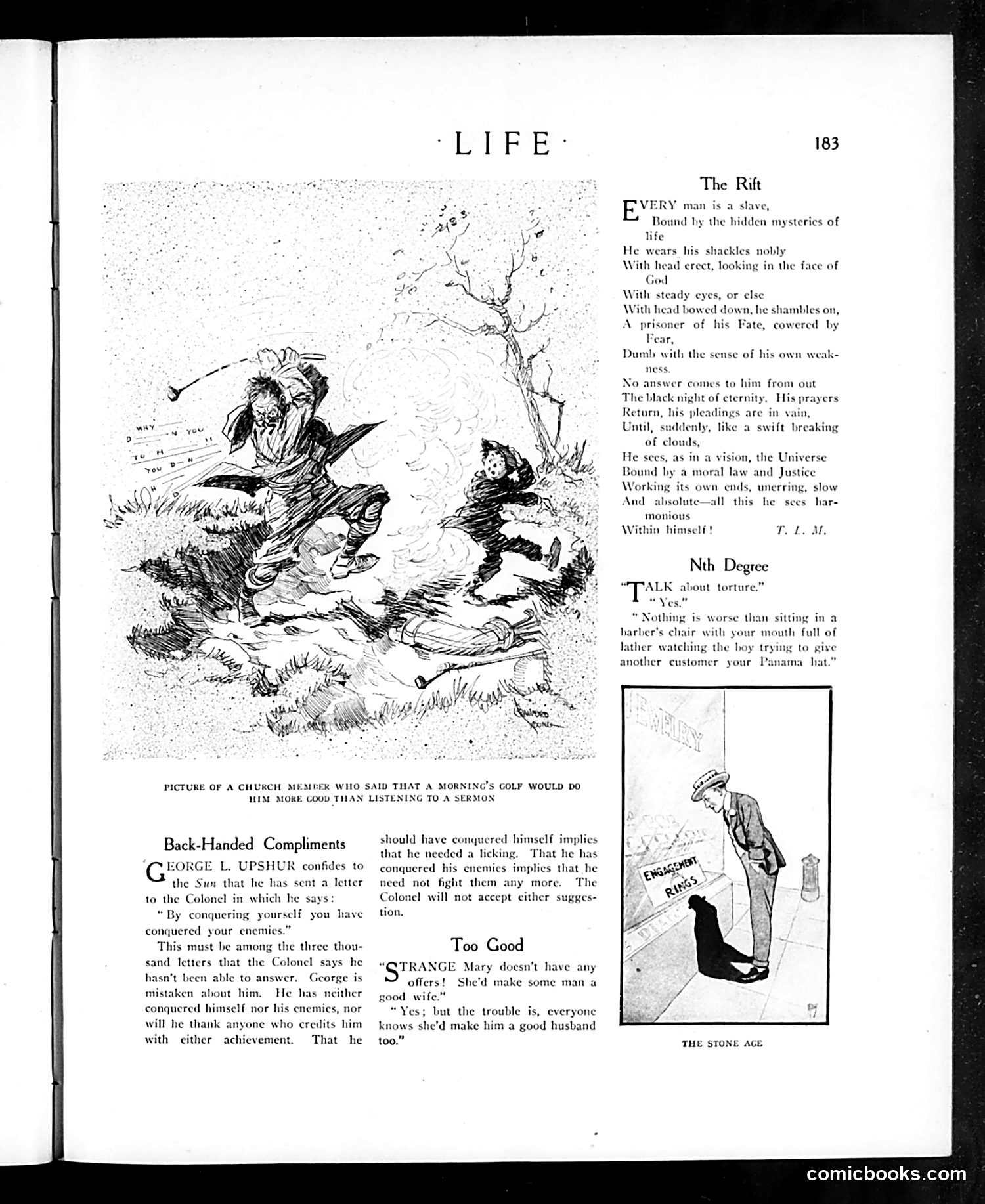
This page contains three separate satirical pieces: 1. **"The Rift"** (top): A philosophical poem by T.L.M. about human suffering and existential bondage, illustrated with a sketch of a distressed figure. 2. **"Picture of a Church Member..."** (center): A cartoon mocking religious hypocrisy—showing someone claiming golf is more beneficial than sermons. 3. **"Back-Handed Compliments"** (middle): A brief satire on Colonel George L. Upshur's letter, mocking how he "conquered himself" by conquering enemies, then refuses credit or acknowledgment—absurd false modesty. 4. **"Nth Degree"** (right): Jokes about discomfort, including a barber-chair torture comparison. 5. **"Too Good"** (bottom right): Commentary on marriage expectations—a woman who makes a "good wife" is expected to also make a "good husband." The overall tone is cynical about human nature, social pretension, and gender roles.
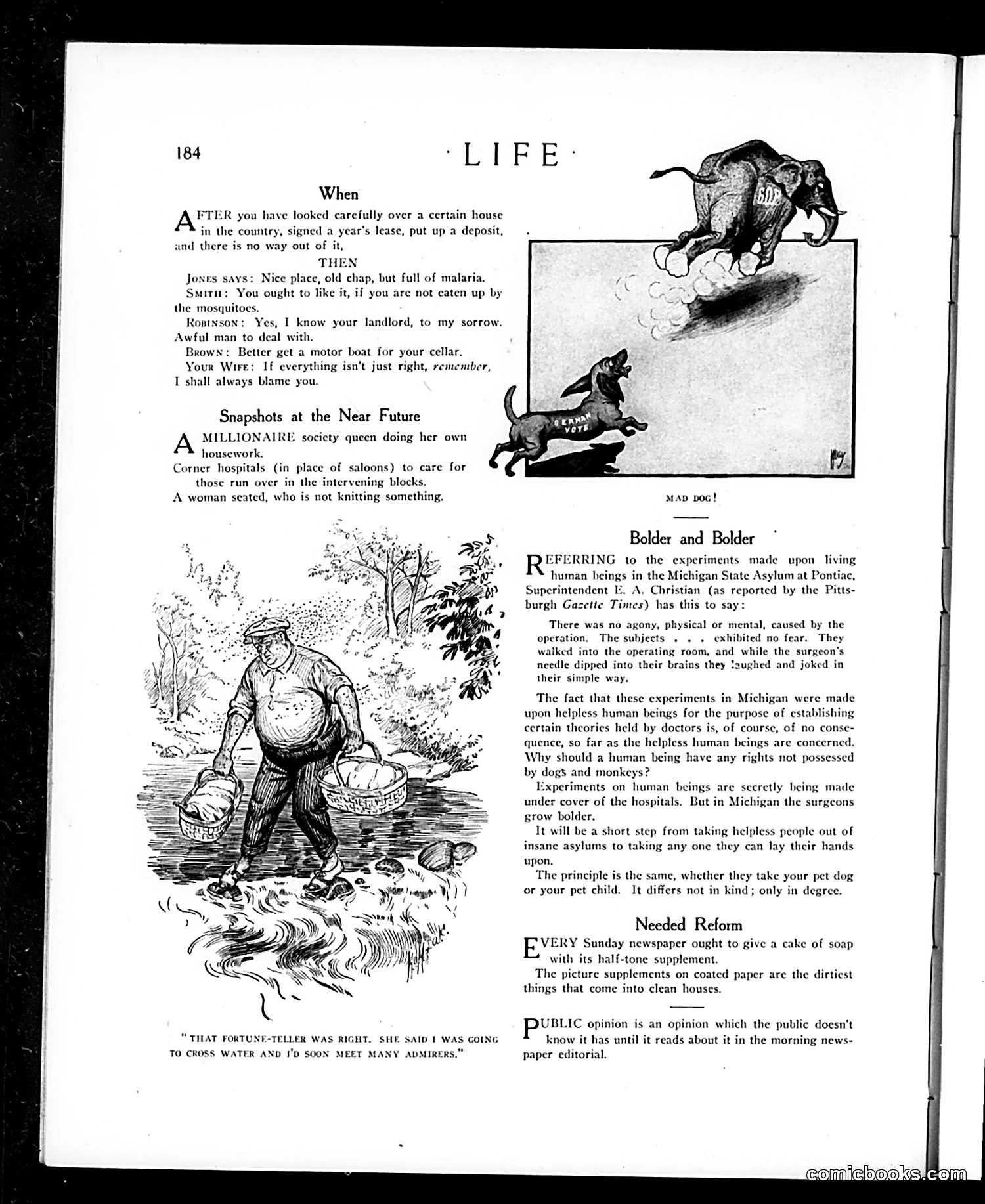
This page contains several satirical pieces mocking contemporary issues: **Top Cartoon**: Shows an elephant and donkey (Republican and Democratic symbols) in conflict, labeled "MAD DOG!" - likely commenting on partisan political hostility. **"Snapshots at the Near Future"**: Satirizes anticipated social changes, including millionaires doing housework and corner hospitals replacing saloons - mocking wealth redistribution anxieties and Prohibition. **"Bolder and Bolder"**: Criticizes unethical medical experiments on human subjects at Michigan State Asylum at Pontiac. The text expresses outrage that doctors experiment on institutionalized patients without consent, comparing such treatment to animal testing. **"Needed Reform"**: Brief critiques of newspaper supplements and public opinion formation. The page primarily attacks medical ethics violations and social anxieties about modernization.
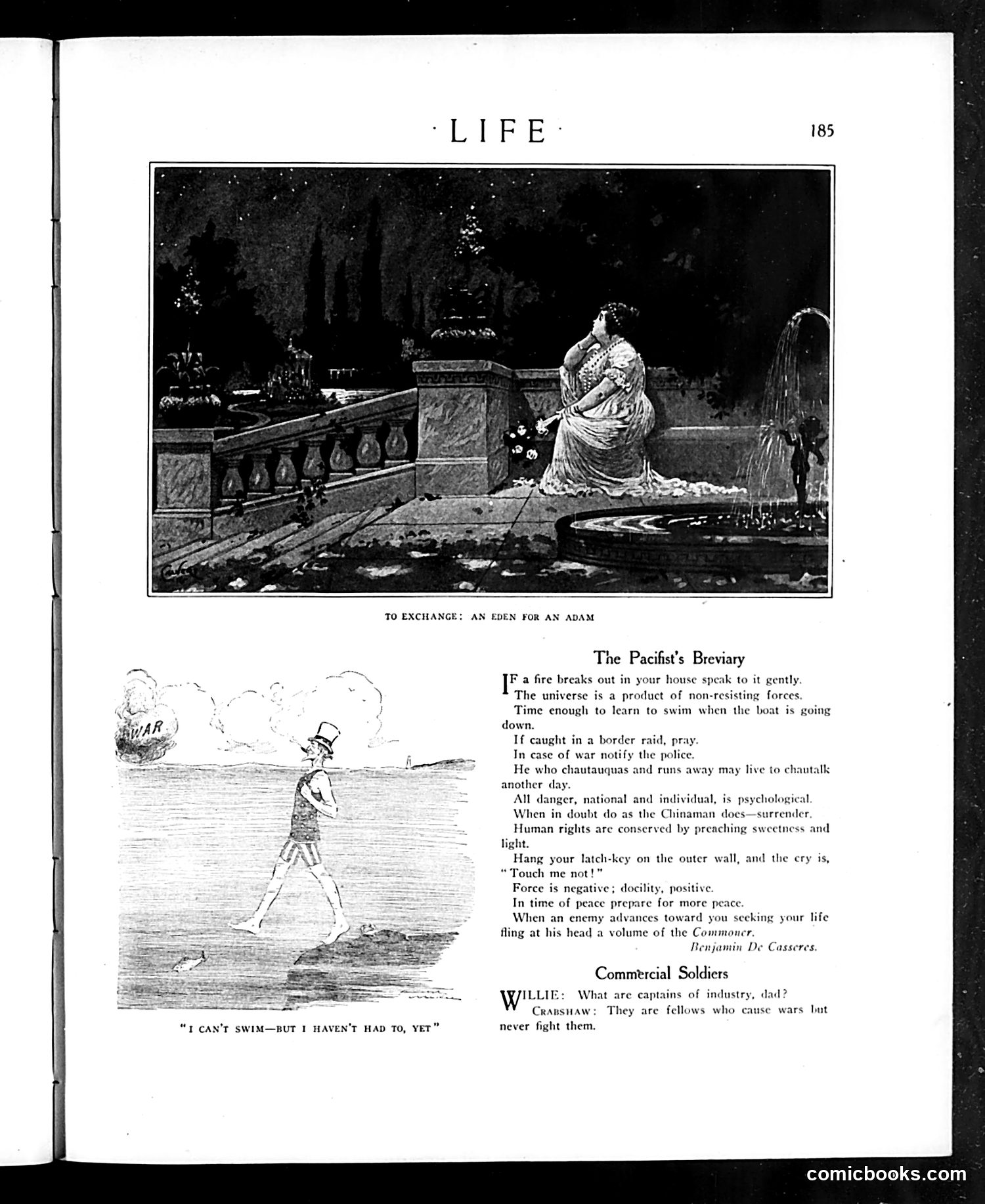
**Top Image: "To Exchange: An Eden for an Adam"** A woman in classical dress mourns at a tomb in a moonlit garden. This appears to be a literary or philosophical reference, likely invoking the biblical Eden story—suggesting a meditation on loss, sacrifice, or the exchange of innocence for experience. The exact allusion is unclear without more context. **"The Pacifist's Breviary"** A series of pacifist aphorisms attributed to Benjamin De Casseres, offering tongue-in-cheek advice for avoiding conflict (learn to swim, surrender in war, hang your latch-key outside). It satirizes pacifist philosophy as impractical or cowardly. **"Commercial Soldiers"** A brief dialogue where a father explains that "captains of industry" cause wars but never fight them—social commentary on wealthy industrialists profiting from warfare while others sacrifice lives.
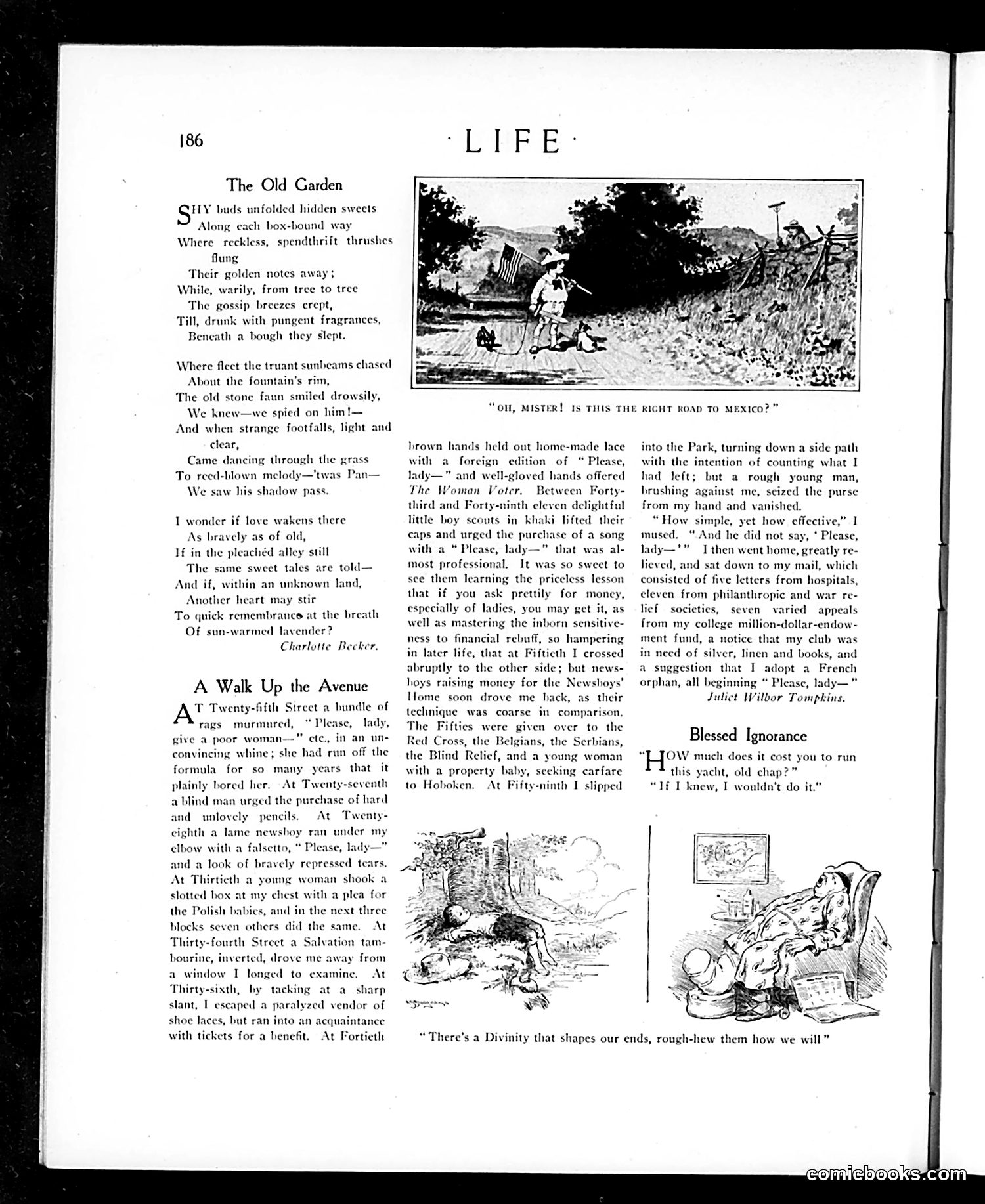
This page contains literary content and illustrations rather than political cartoons. The main features are: **"The Old Garden"** - A poem by Charlotte Becker about an overgrown garden where children play and discover nature's beauty. **"A Walk Up the Avenue"** - A humorous piece describing encounters with street beggars from Twenty-fifth to Fortieth Street in what appears to be New York City. It satirizes the various panhandling techniques used by poor women—their different pitches, emotional appeals, and persistence—reflecting turn-of-the-century urban poverty and street life. **"Blessed Ignorance"** - A brief joke about the cost of running a household. The accompanying illustrations are decorative rather than satirical, showing garden scenes and domestic life. The page reflects early 20th-century American attitudes toward urban poverty and homelessness through gentle, observational humor.
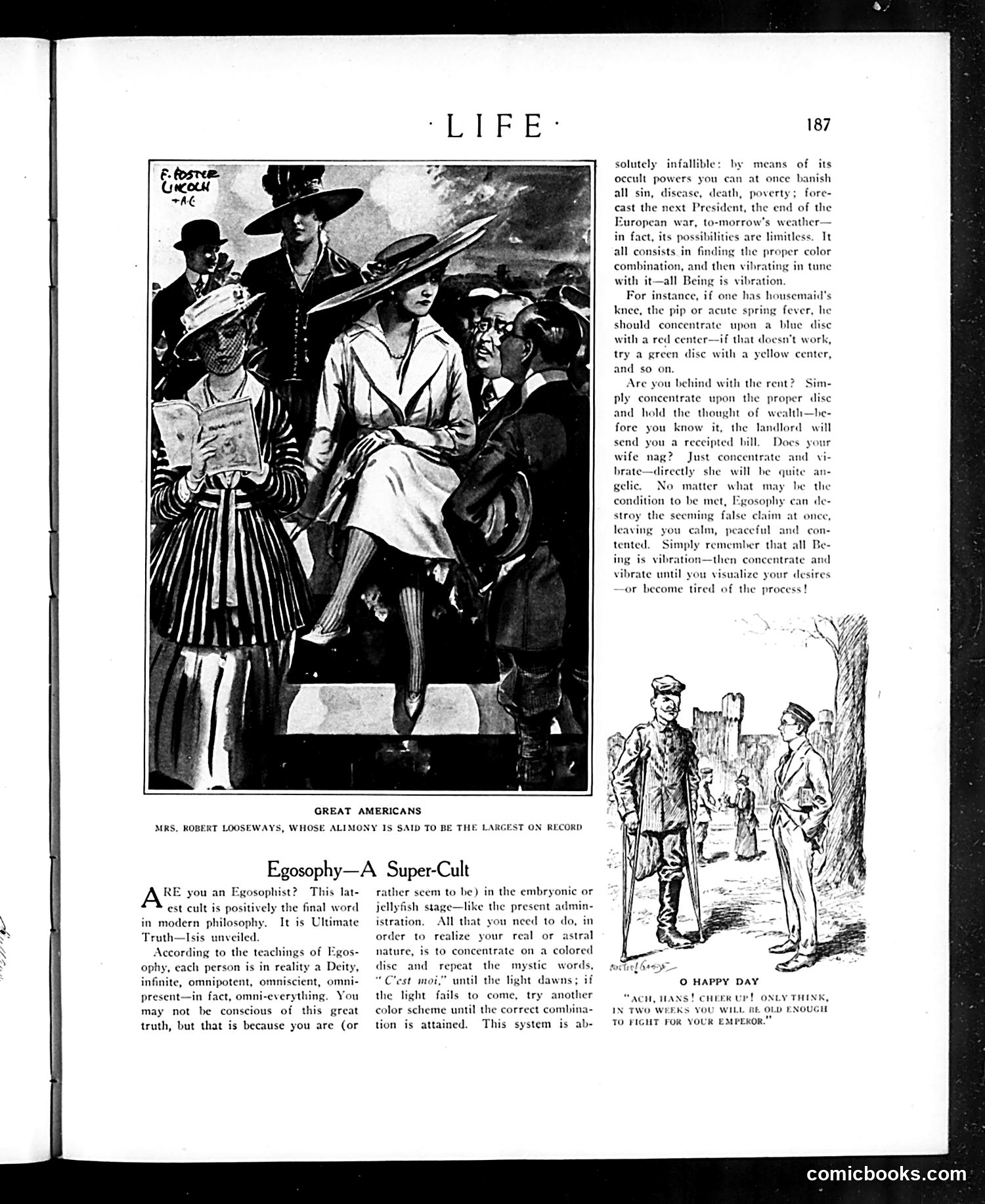
**Top Image:** This illustration is labeled "Great Americans" and identifies "Mrs. Robert Looseways, Whose Alimony is Said to Be the Largest on Record." The cartoon satirizes wealthy women of the era through this fictional character—likely mocking the growing phenomenon of high-profile divorce settlements and alimony payments among the American elite. The woman's fashionable dress and the surrounding figures suggest commentary on wealth inequality and marital dissolution among the rich. **Bottom Section:** "Egosophy—A Super-Cult" satirizes New Thought and occult philosophical movements popular in early 20th-century America. The text mocks these belief systems' promises of personal power through concentration and visualization techniques—portraying them as superficial "super-cults" exploiting gullible followers seeking self-improvement.
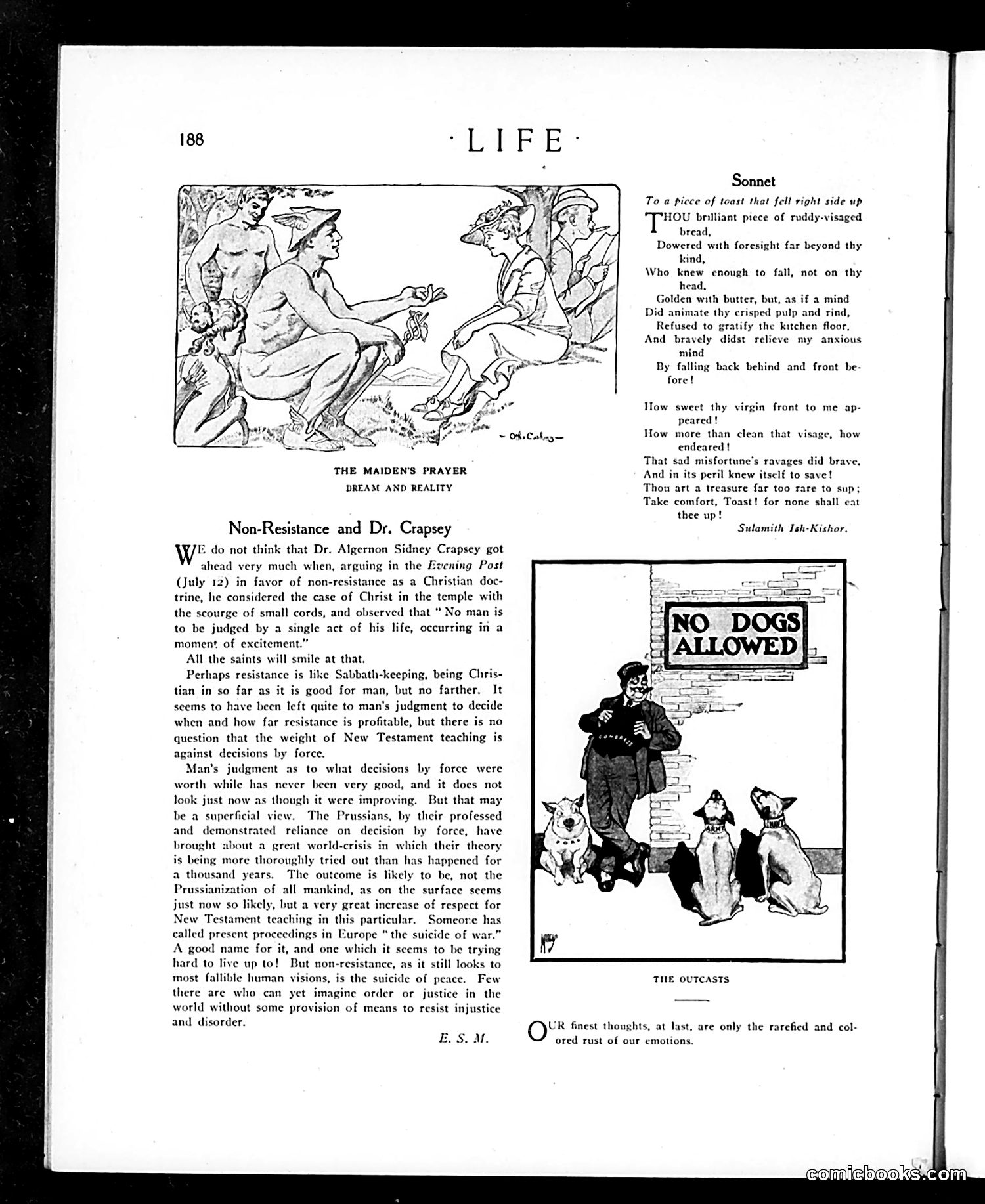
This cartoon depicts a child standing beside dogs beneath a "NO DOGS ALLOWED" sign. The satire likely comments on social exclusion and discrimination through visual metaphor—the child and dogs are grouped together as unwanted "outcasts." The accompanying article "Non-Resistance and Dr. Crapsey" discusses Christian doctrine regarding resistance to force, referencing debates about pacifism versus practical defense against injustice. The article's closing line—"OUR finest thoughts, at last, are only the rarefied and colored rust of our emotions"—suggests emotional impulses underlie our stated principles. The cartoon's juxtaposition of innocent figures barred entry appears to critique how society arbitrarily excludes vulnerable groups, paralleling the philosophical tensions about resistance discussed in the text.
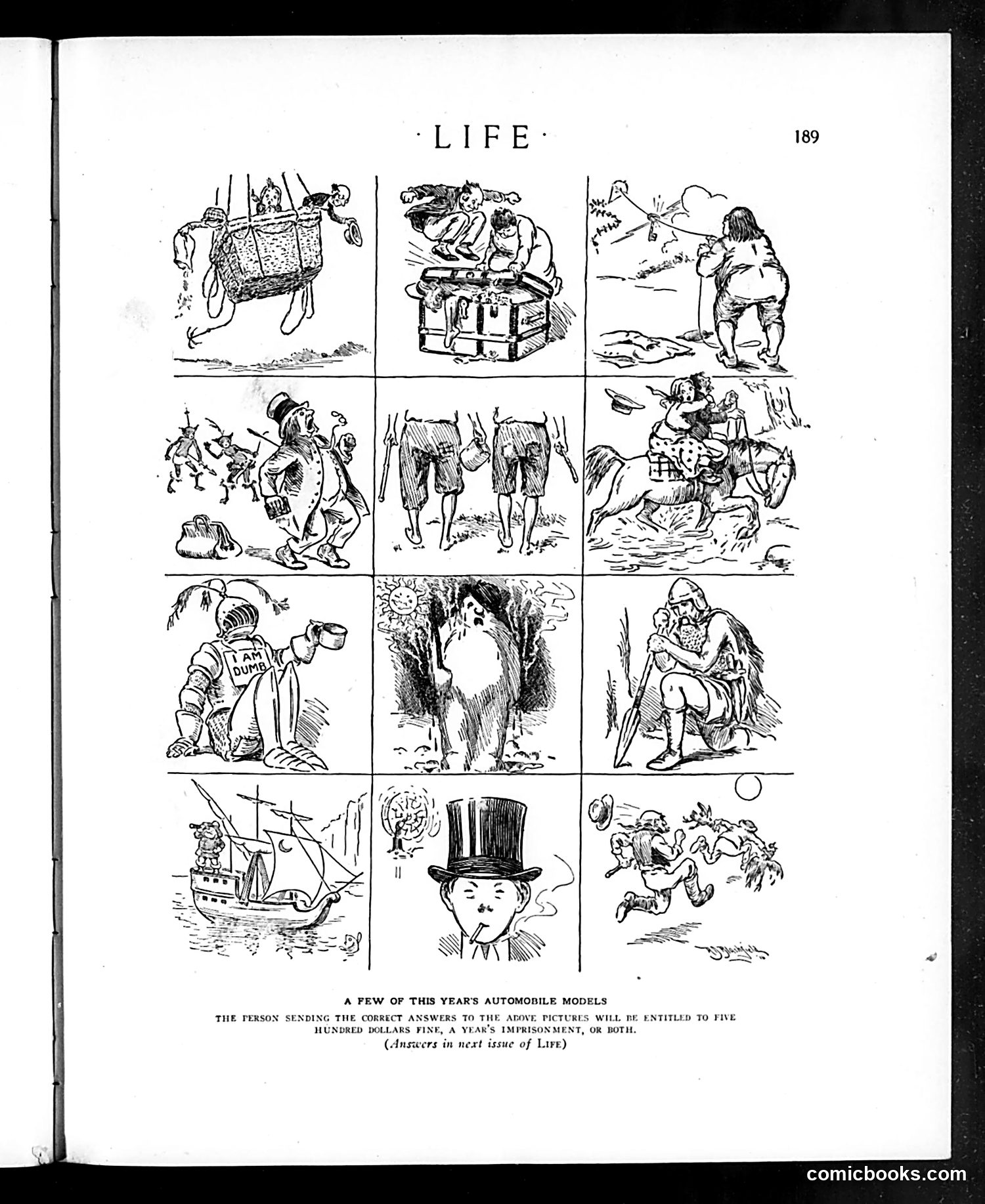
This page from *Life* magazine presents a visual puzzle contest rather than political satire. The caption states: "A FEW OF THIS YEAR'S AUTOMOBILE MODELS" and announces that readers who send correct answers to the pictured automobiles will win "FIVE HUNDRED DOLLARS FINE, A YEAR'S IMPRISONMENT, OR BOTH." The twelve cartoon panels use exaggerated, absurdist imagery—characters drowning, colliding, exploding, and suffering various disasters—rather than depicting actual cars. The joke satirizes automobile safety and the chaos of early 1900s motoring. By framing dangerous situations as "automobile models," *Life* mocks both vehicle design and reckless drivers. The promised legal penalties humorously suggest cars themselves are criminal contraptions. This reflects contemporary anxiety about automobiles as dangerous new technology.
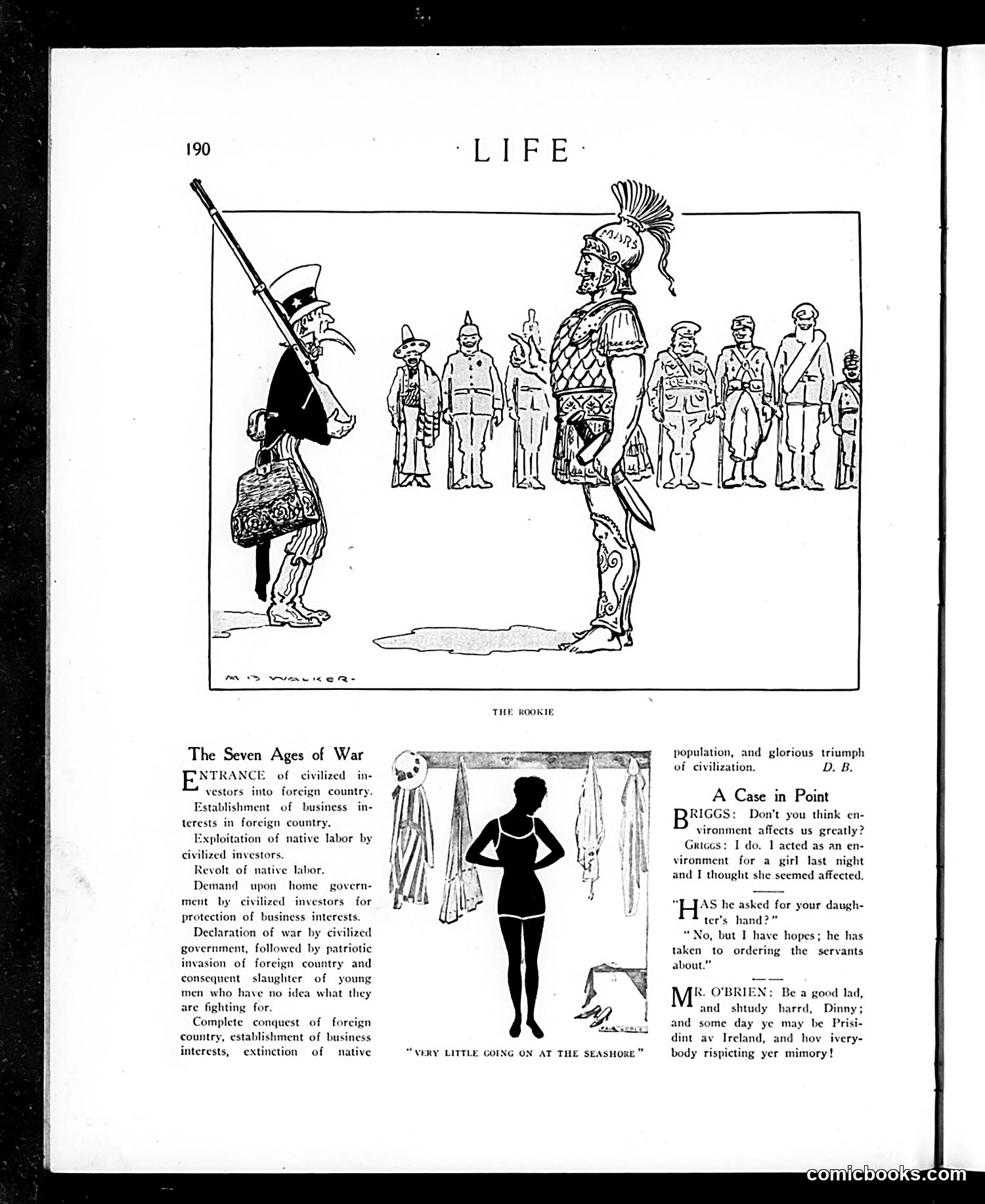
The top cartoon by M.S. Walker depicts a military officer confronting an indigenous leader, with soldiers lined up behind. The caption "The Bookie" and accompanying text "The Seven Ages of War" outline imperialist expansion: entering foreign countries, exploiting native labor, declaring war, invasion, and conquest while establishing business interests. This satirizes the justifications used for colonialism and military intervention. The "seven ages" framework critiques how Western powers systematized imperial conquest as inevitable civilization-building. The lower illustration and dialogue snippets appear unrelated—comedic vignettes about social life. The page overall presents contrasting content typical of *Life*'s satirical approach: serious political critique alongside light humor and advertisements.
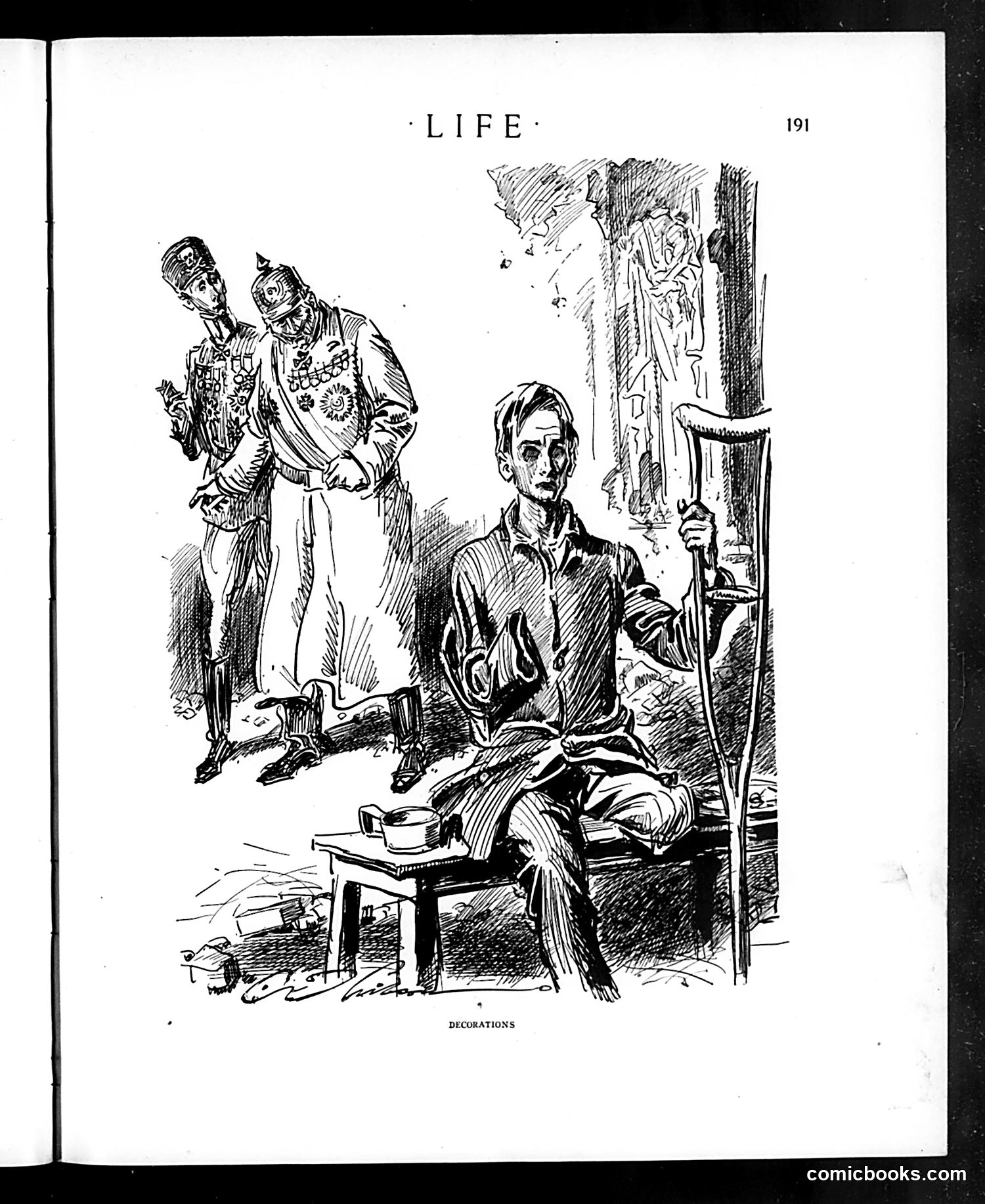
This satirical cartoon from *Life* magazine appears to depict a military awards ceremony. Two highly decorated officers stand before a seated soldier or enlisted man, who holds a rifle and sits modestly. The officers' uniforms are covered with medals and decorations, while the seated figure wears plain military dress. The satire likely critiques the disparity between officers and enlisted men—specifically, how military honors and recognition were distributed unequally by rank. The title "Decorations" suggests irony about the contrast between the officers' heavily adorned uniforms and the humble appearance of the ordinary soldier. This may reference broader concerns about military hierarchy, fairness in awarding commendations, or the undervaluing of common soldiers' contributions.
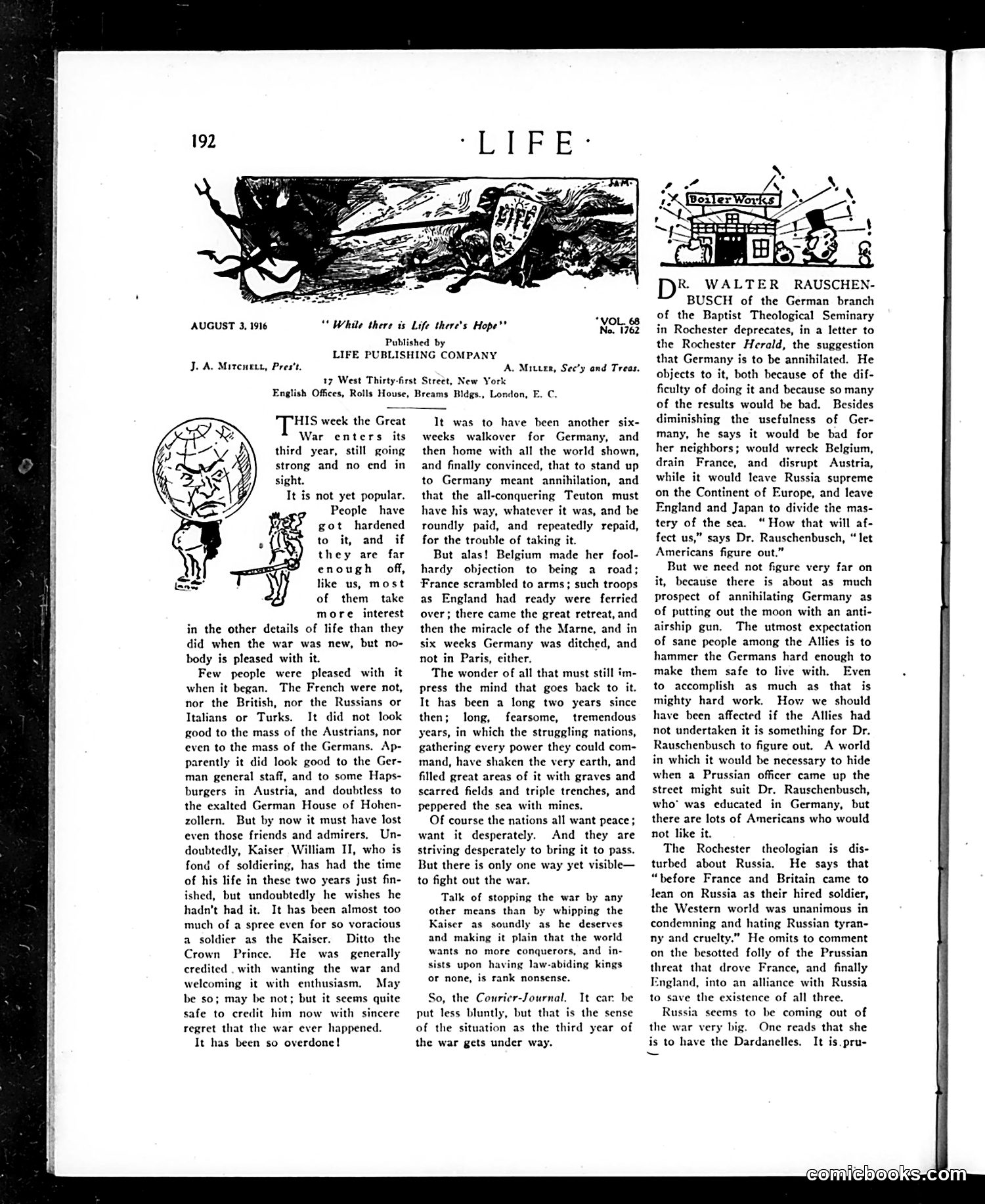
This page contains editorial commentary on World War I entering its third year. The main cartoon (left) depicts a globe-headed figure—likely representing the world or public opinion—appearing exhausted or weighted down, symbolizing global weariness with the ongoing conflict. The editorial argues that the war, initially expected to be a quick German victory ("six weeks walkover"), has instead become a prolonged, devastating struggle. It references Germany's failed plans, Belgium's resistance, and the costly Battle of the Marne. The right column features a response from Dr. Walter Rauschenbusch, a German-American theologian, objecting to suggestions that Germany should be annihilated. He argues such an outcome would harm neighbors like Belgium, France, and Austria, and strengthen Russia—reflecting German-American perspective on war aims in 1916, before U.S. entry into the war.
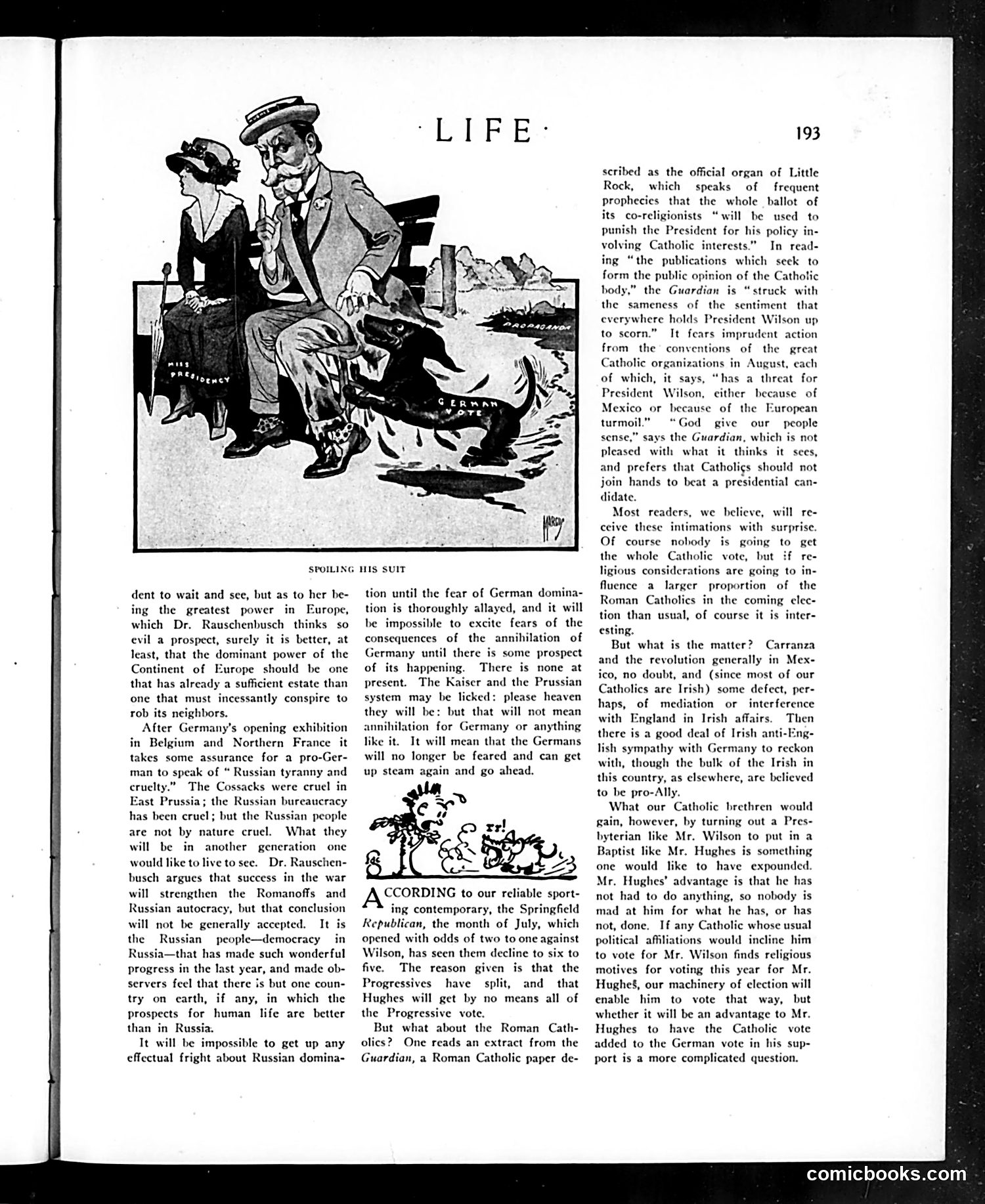
## The Cartoon: "Spoiling His Suit" The main cartoon depicts a well-dressed man (labeled "German") being deliberately soiled or ruined by two figures—a woman and another man in a hat. The "suit" being spoiled is a visual pun on both literal clothing and Germany's "case" or position. ## Context This is from the 1916 presidential election period. The page discusses whether Catholic voters will support President Wilson's re-election, given tensions over his Mexican policy and WWI neutrality stance. The cartoon appears to satirize pro-German arguments circulating in American debate. The accompanying editorial argues against those defending German interests, suggesting Germany's aggression in Belgium and Northern France makes such defenses morally indefensible—hence "spoiling" Germany's rhetorical "suit" or argument. ## The Point Life magazine is mocking pro-German voices in American politics who tried to maintain Germany's reputation despite documented atrocities, suggesting their position is already irreparably damaged ("spoiled").
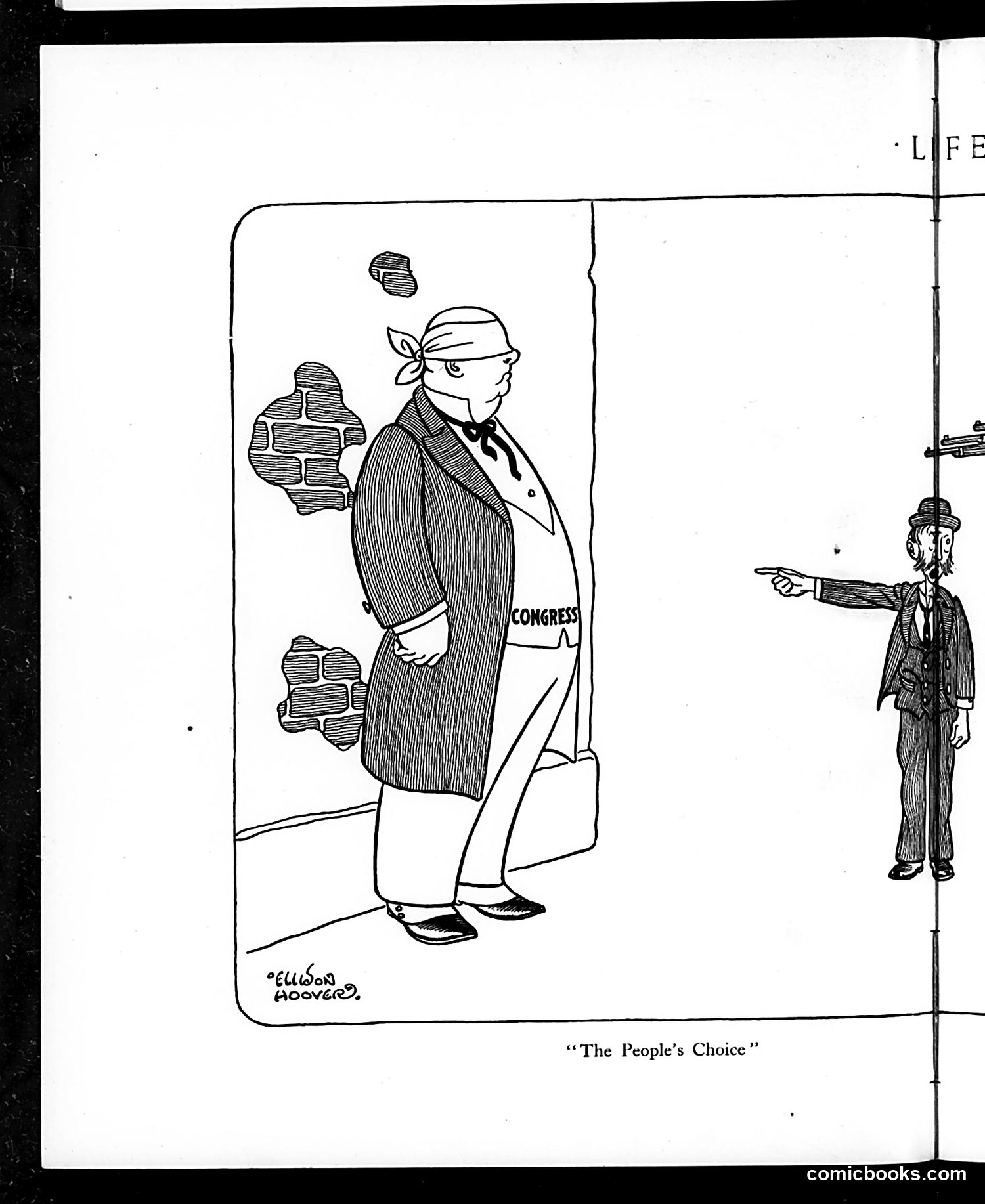
This cartoon, signed by Cesare (Cesare Mazzantini), depicts a figure labeled "CONGRESS" as a well-dressed man carrying bricks—appearing to construct or reinforce a wall behind him. On the right stands a thin, somewhat disheveled figure pointing accusingly at Congress. The satire critiques Congress's apparent unresponsiveness or obstruction regarding some public demand or crisis. The "People's Choice" title suggests the cartoon contrasts what ordinary citizens want with what their elected representatives actually do. The bricks likely symbolize bureaucratic obstruction or failed construction of needed policy. The pointing figure—possibly representing a taxpayer, citizen, or specific political opponent—confronts this disconnect between public will and congressional action. The cartoon mocks Congress's self-serving behavior and disconnection from constituents.
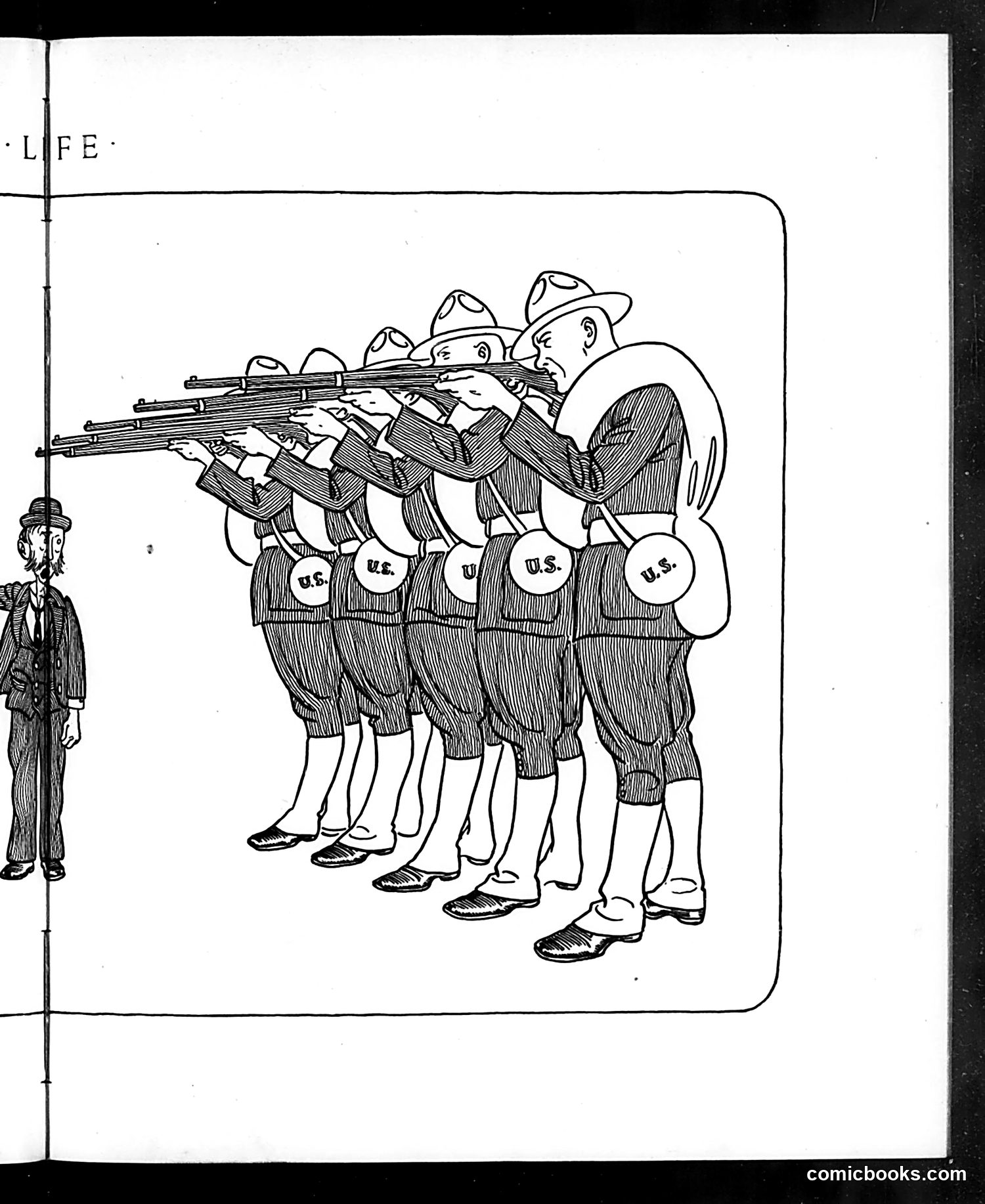
This satirical cartoon depicts five U.S. soldiers (marked with "U.S." on their uniforms) standing in unified military formation, aiming rifles in the same direction. A solitary civilian figure in business attire stands to the left, isolated and facing the opposite direction. The cartoon critiques **unified military power versus civilian dissent or opposition**. The "LIFE" masthead suggests this is commentary on American military or political consensus. The stark visual contrast—many armed soldiers versus one lone civilian—suggests satire about overwhelming force, groupthink, or the suppression of individual civilian voice during a period of military mobilization (likely WWI or WWII era, given the uniform style and magazine's satirical nature). The cartoon's message appears to critique either militarism's dominance or civilian powerlessness.
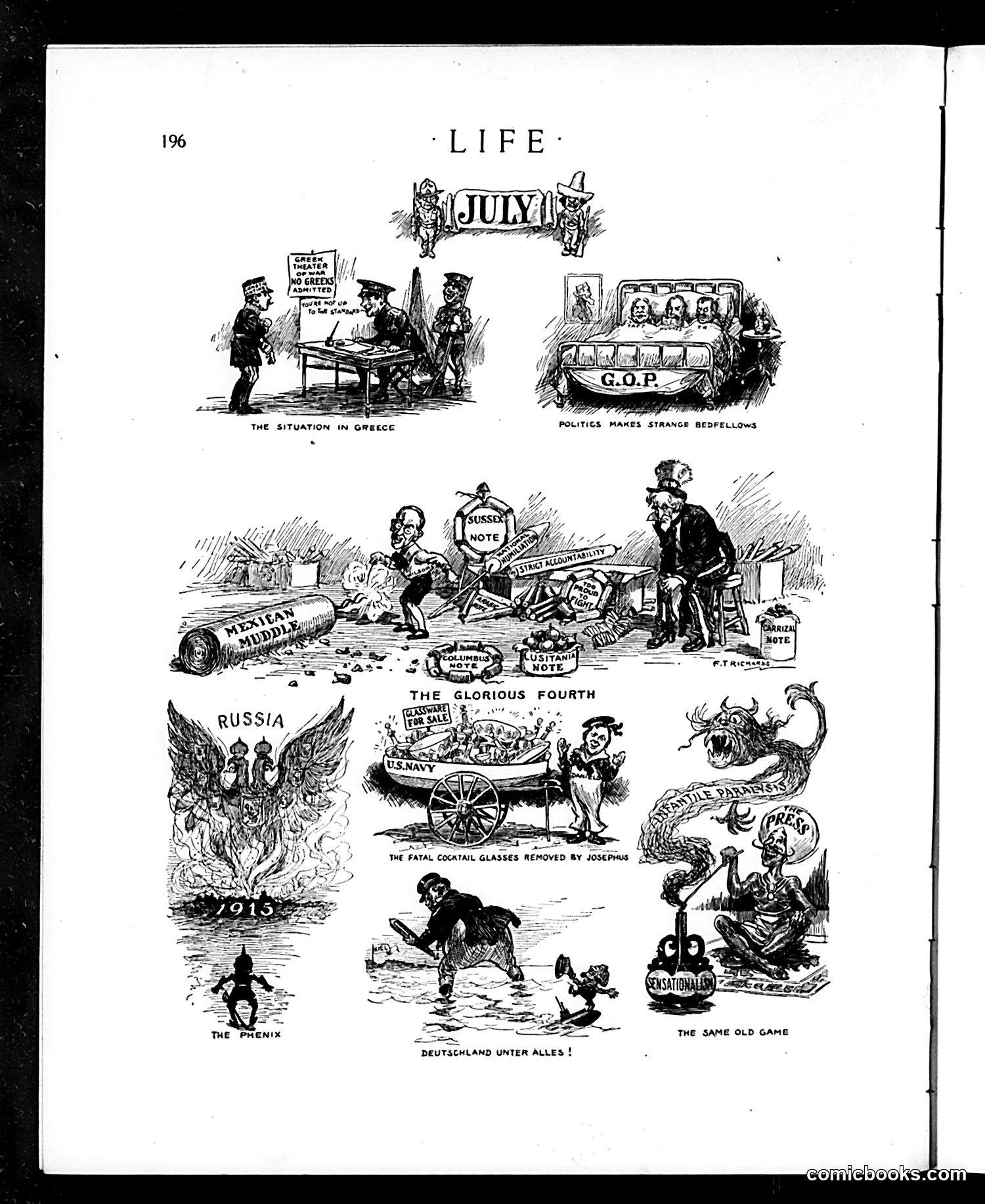
This page contains multiple satirical cartoons commenting on World War I politics. "The Situation in Greece" depicts diplomatic negotiations, while "Politics Makes Strange Bedfellows" shows the GOP as an overcrowded vehicle, suggesting uncomfortable political alliances. "The Glorious Fourth" portrays American Independence Day amid wartime chaos, with references to Sussex Notes (likely the Sussex pledge crisis involving German U-boats). The lower cartoons address European conflict: "The Phenix" depicts Russia rising from flames marked "1915"; "Deutschland Unter Alles" shows Germany drowning; and "The Same Old Game" presents a monster (representing ongoing militarism or imperialism) emerging from sensationalism and press coverage. The cartoons collectively satirize American neutrality debates, European war dynamics, and the perceived cyclical nature of international conflict during WWI's second year.
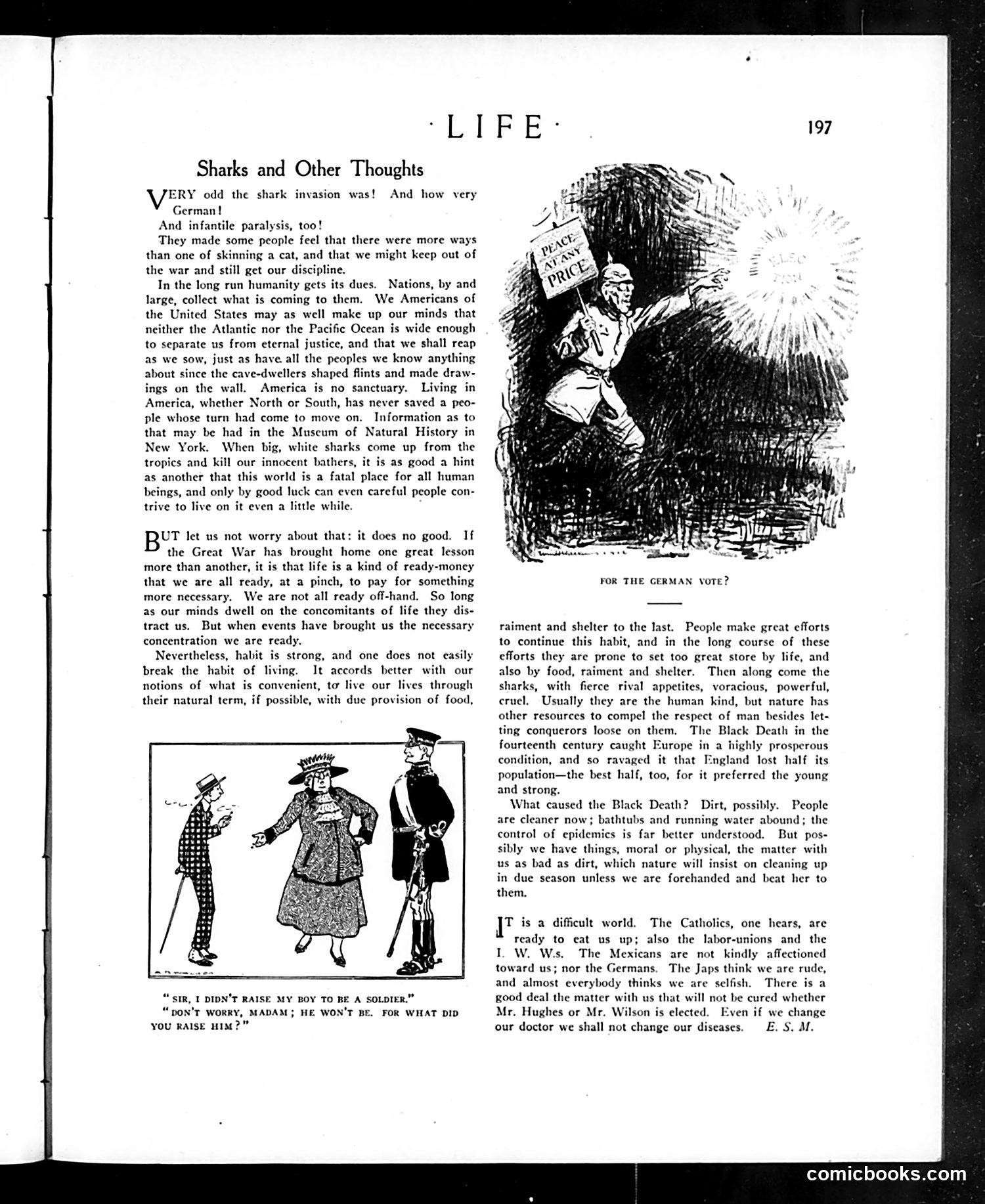
This Life magazine page from the WWI era contains a political cartoon and accompanying essay critiquing American isolationism and pacifism. **The Cartoon:** Shows a woman (labeled "FOR THE GERMAN VOTE?") holding a book titled "Peace" while sharks circle. The caption references the famous anti-war song "I Didn't Raise My Boy to Be a Soldier," sarcastically asking what purpose mothers who raised pacifist sons actually served. **The Point:** The essay argues that recent crises—shark attacks, polio epidemics, and ongoing WWI—reveal America's false sense of sanctuary. The author contends that isolationism is futile; nations face inevitable consequences for their choices. The cartoon suggests that German-American voters opposing American intervention were naïve or complicit, implying pacifism amounted to serving German interests. **Context:** Published during the 1916 election (Hughes vs. Wilson referenced), this reflects American debate over entering WWI, with anti-German sentiment and suspicion of German-American political influence running high.
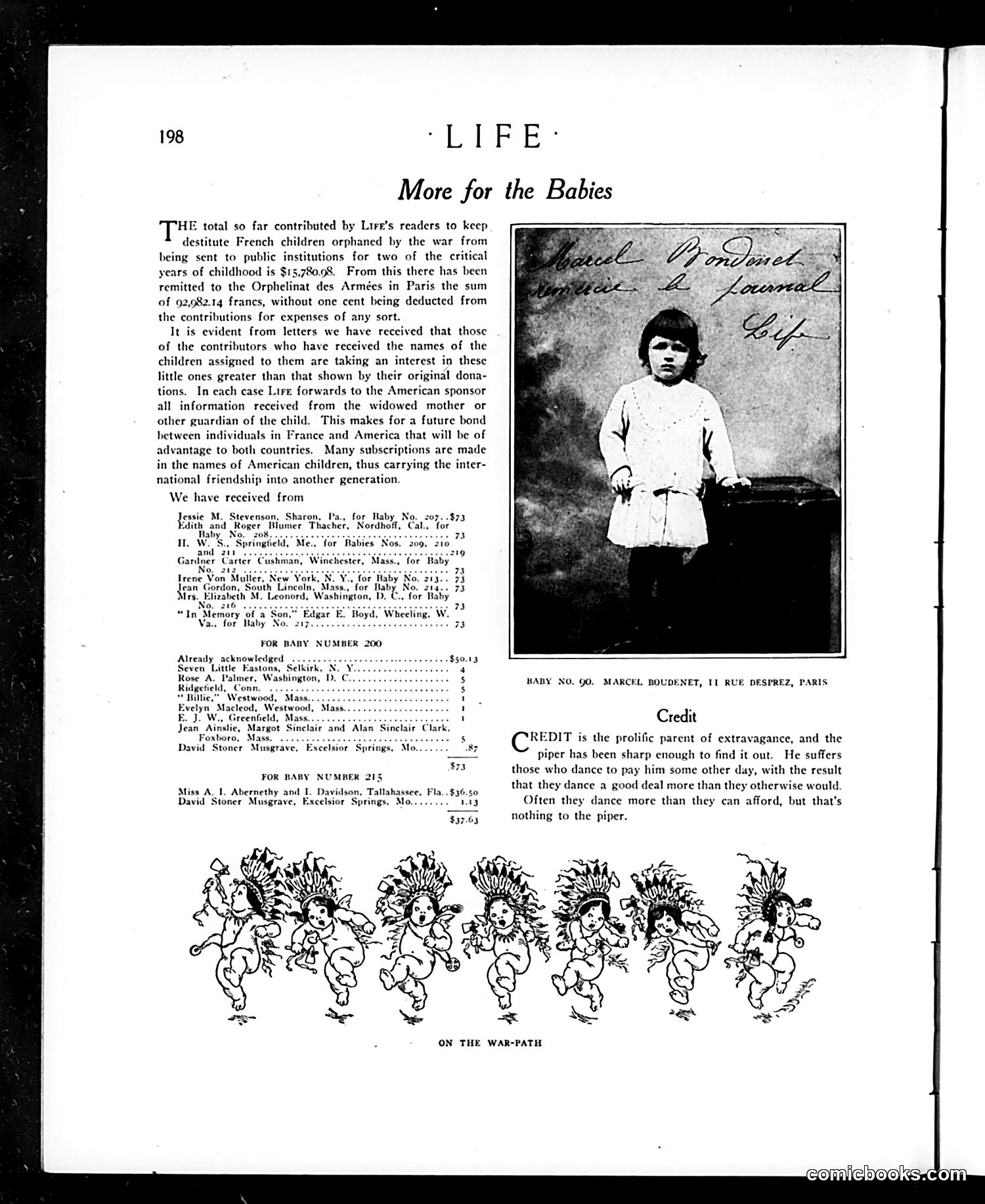
This page documents *Life* magazine's charitable campaign to support French war orphans during World War I. The main content is a fundraising update showing contributions readers sent to keep French children out of institutions. The photograph shows "Baby No. 90, Marcel Boudenet" from Paris—one of the orphans sponsored through the program, which paired American donors with specific French children. The small cartoon at bottom ("On the War-Path") depicts cherubs/babies marching in a line, likely satirizing the militaristic context of the war itself—a darkly humorous visual metaphor. The "Credit" section is a separate satirical piece about how credit enables excessive spending and dancing, unrelated to the orphan campaign above it. The overall page reflects WWI-era American philanthropy and *Life*'s use of humor and human-interest stories to encourage charitable giving toward European war victims.
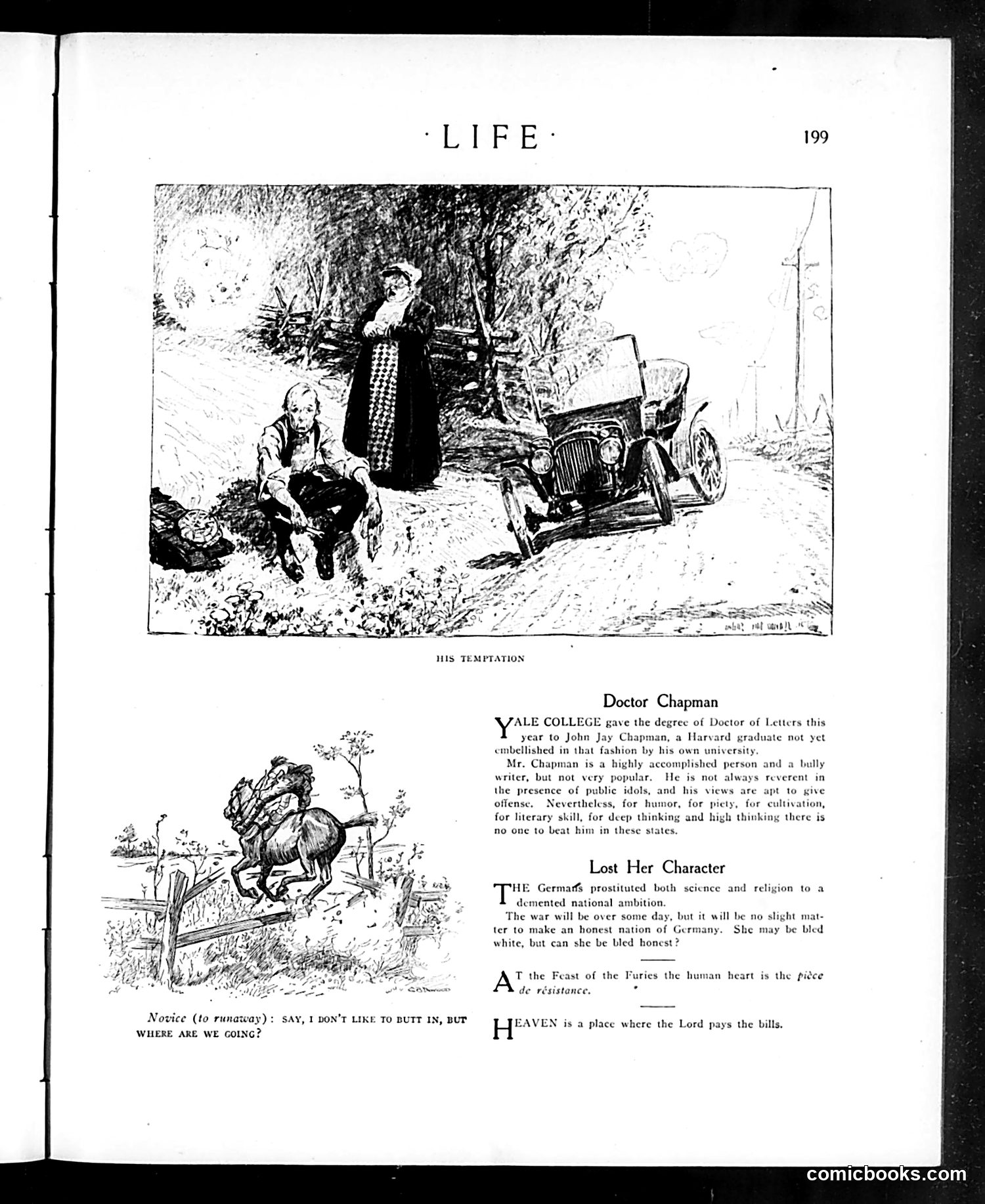
This page from *Life* magazine contains satirical commentary on early 20th-century topics: **"His Temptation"** (top cartoon): Shows a man in a car encountering a woman and child on a rural road. The caption suggests a moral test—likely satirizing the temptation of wealth or modern excess represented by the automobile. **Doctor Chapman profile**: Celebrates John Jay Chapman, a Harvard-educated writer and social critic known for irreverent commentary on public figures. The text praises his wit and intellect while noting he's unpopular for his blunt opinions. **"Lost Her Character"**: A harsh commentary on Germany during or after World War I, suggesting the nation compromised its moral integrity through nationalism and militarism. The rhetorical question asks whether Germany can be reformed morally. **Bottom cartoon**: A runaway (likely a child) encounters a "novice" (apparent vagrant), who offers cynical street philosophy about heaven—a dig at poverty and religious platitudes offered to the desperate. The page reflects *Life*'s satirical approach to war, morality, and social hypocrisy.
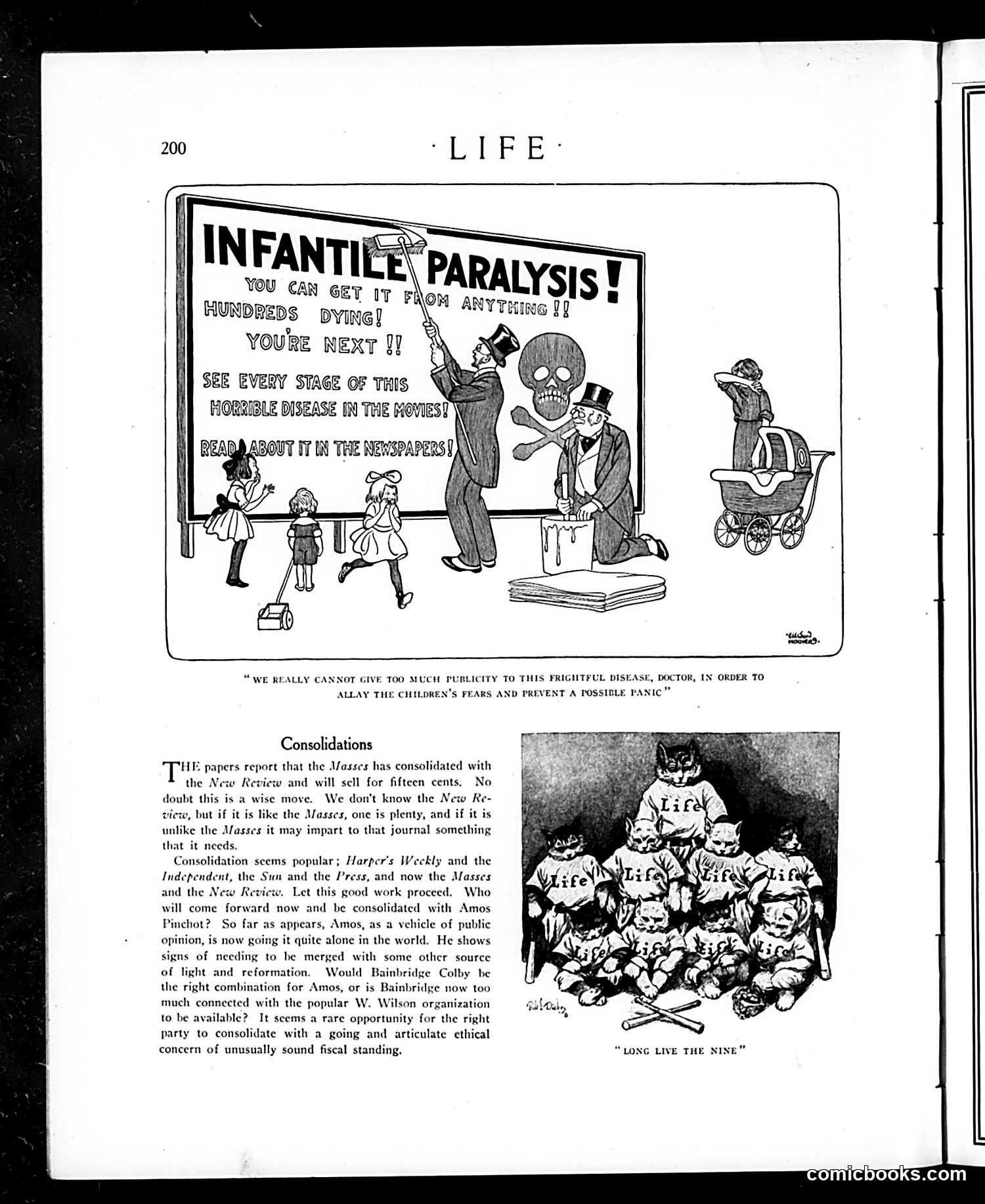
**The Cartoon (top):** A satirical attack on sensationalist public health messaging. Street hustlers promote "Infantile Paralysis!" as a disease spectacle, using fear-mongering language ("HUNDREDS DYING!" "YOU'RE NEXT!!") to attract attention—treating a genuine health crisis as entertainment. The skull-faced figure and carnival-barker style mock the irresponsible dramatization of polio, which was a real and serious threat at the time. The caption critiques this approach, arguing such publicity spreads panic rather than preventing disease. **The Text Section:** Satirizes newspaper consolidations then occurring in American media. The author mocks the merger trend, suggesting most consolidations are unnecessary. The passage then sarcastically "recommends" that progressive figures like Amos Pinchot merge with other publications or organizations—implying they're struggling and need strengthening through combination. This is social/political satire rather than straight news commentary. **"Long Live the Nine"** (photograph): Unclear without additional context, likely referencing a specific group or organization of that era.
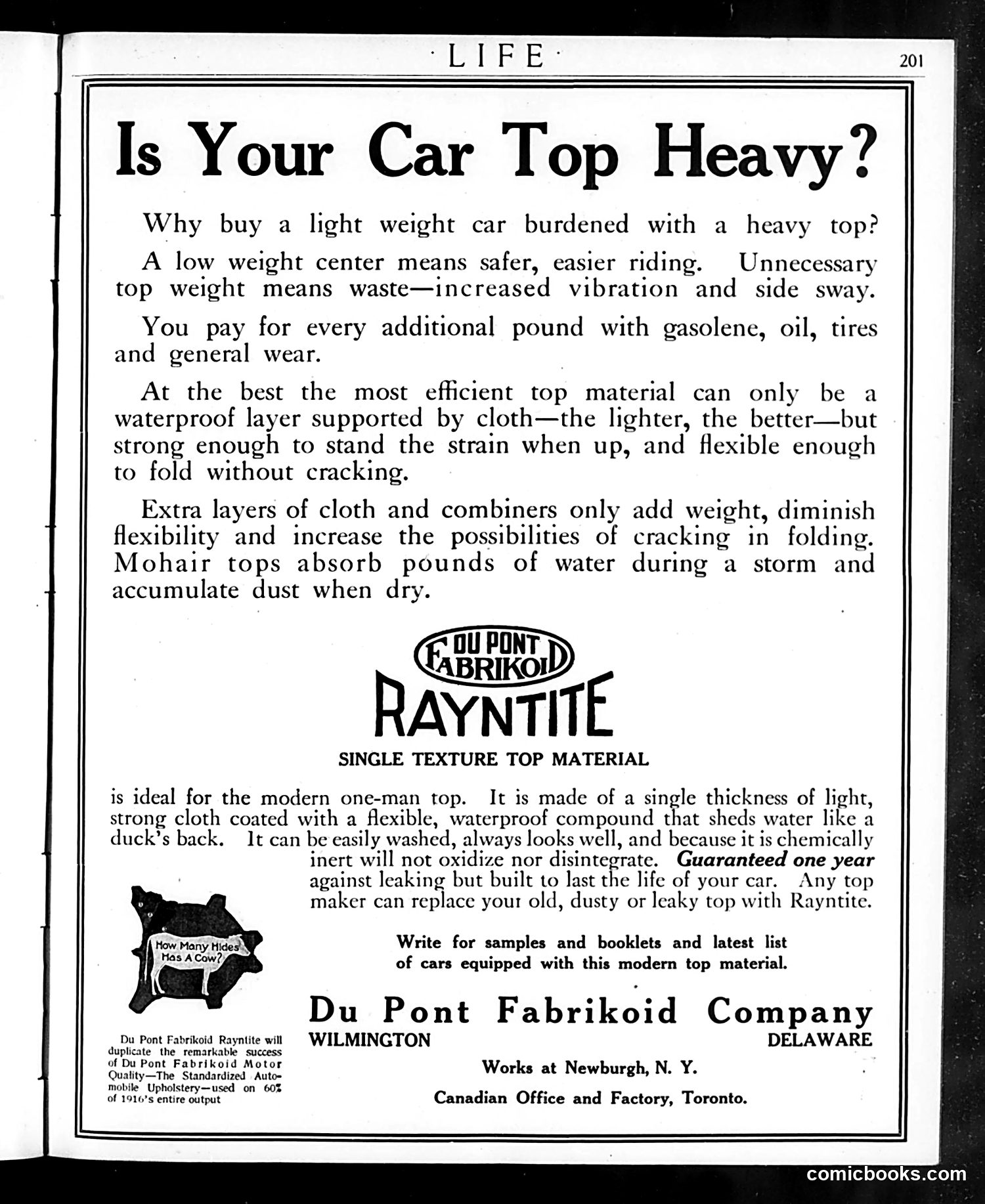
This is **not a cartoon or satire**, but a **straightforward advertisement** for Du Pont Fabrikoid's "Rayntite" car-top material, appearing in *Life* magazine (page 201). The ad argues against heavy convertible tops by appealing to practical concerns: excessive weight reduces fuel efficiency, increases vibration, and causes wear. It positions Rayntite—a single-layer, lightweight, waterproof cloth coating—as the superior solution. The small cow illustration with text ("How Many Hides Has A Cow?") is a branding element, not satire. The advertisement targets early-automotive-era consumers (pre-1920s, based on references to "one-man tops") concerned with fuel costs and reliability. It emphasizes that Du Pont's product was already standard on 60% of 1916 vehicle production, lending authority to the pitch. This represents typical early-20th-century *Life* advertising strategy: using editorial-style copy and technical arguments to sell industrial products to middle-class readers.
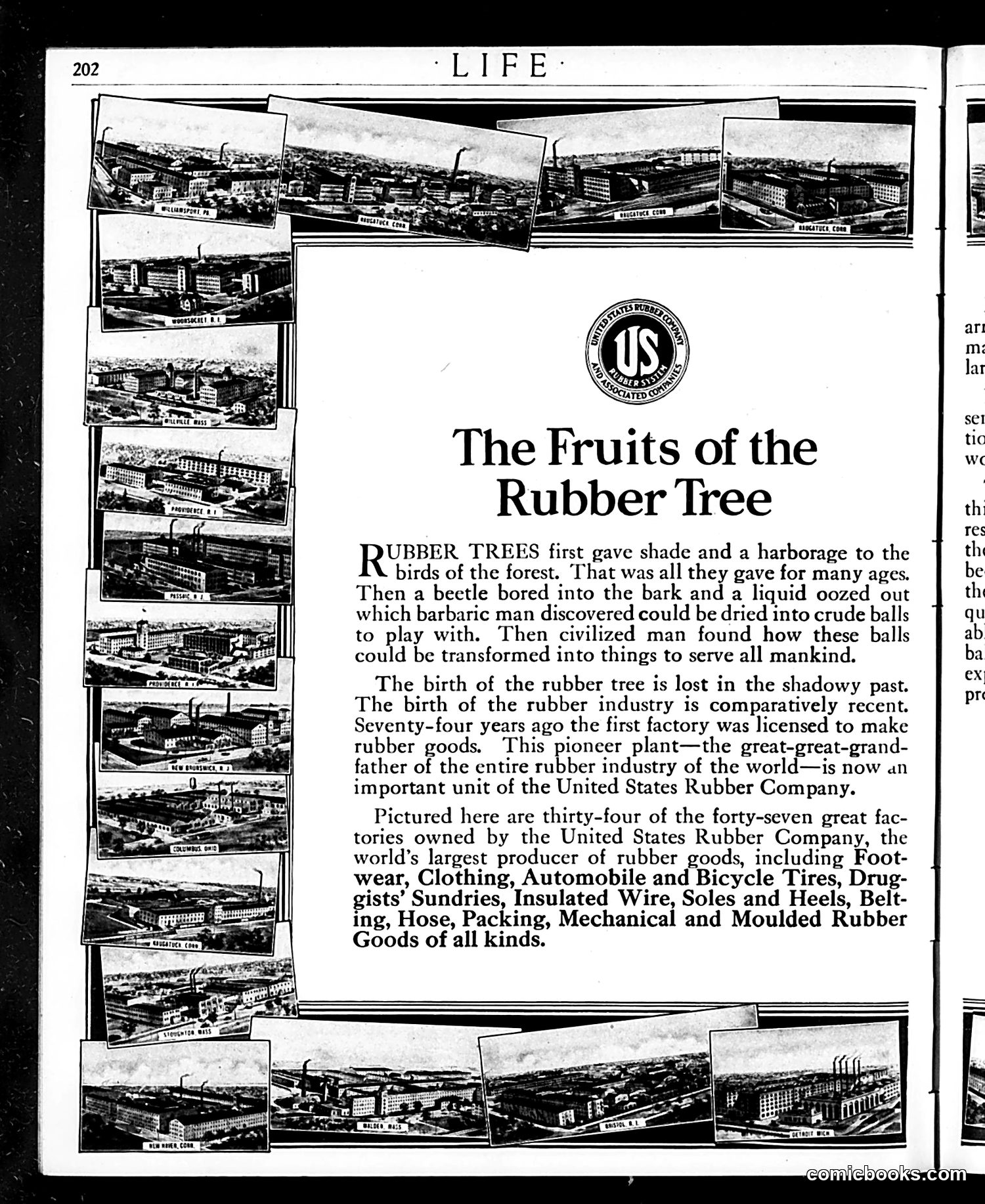
This is not a political cartoon but rather **corporate advertising** for the United States Rubber Company, disguised as an article. The page presents a narrative celebrating rubber's evolution from natural material to industrial product, then highlights U.S. Rubber's dominance: the company owns 34 of 47 major American rubber factories and produces everything from tires to footwear. The surrounding factory photographs (appearing to number around 34) visually reinforce this industrial scale and success. For modern readers: this represents **early 20th-century industrial propaganda**—when major corporations bought magazine space to present themselves as pioneering forces of civilization and progress. The breathless tone ("civilized man found how these balls could be transformed") reflects period attitudes about industrial manufacturing as inherently progressive. The U.S. Rubber Company essentially uses Life's editorial space as a corporate self-promotion vehicle.
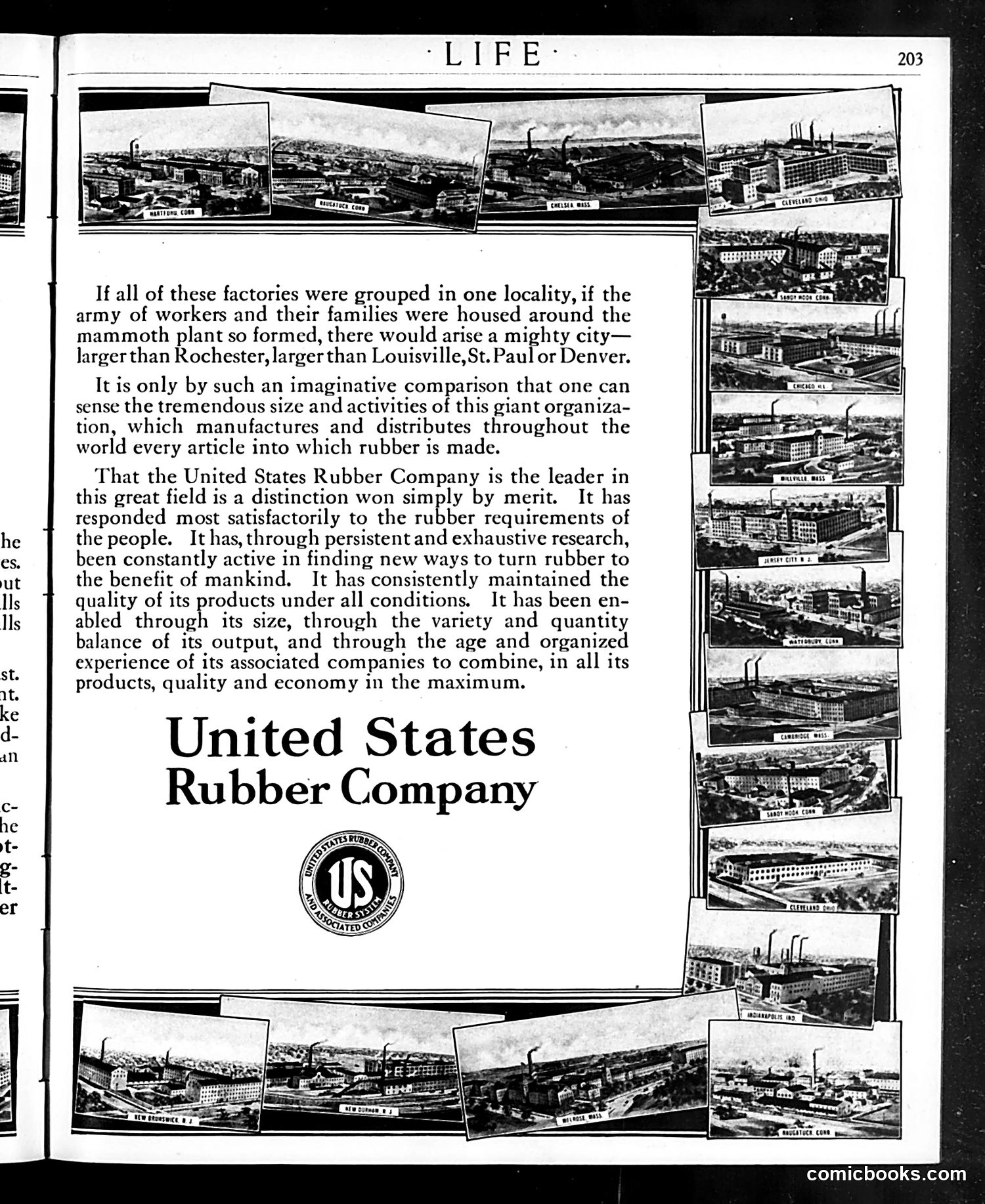
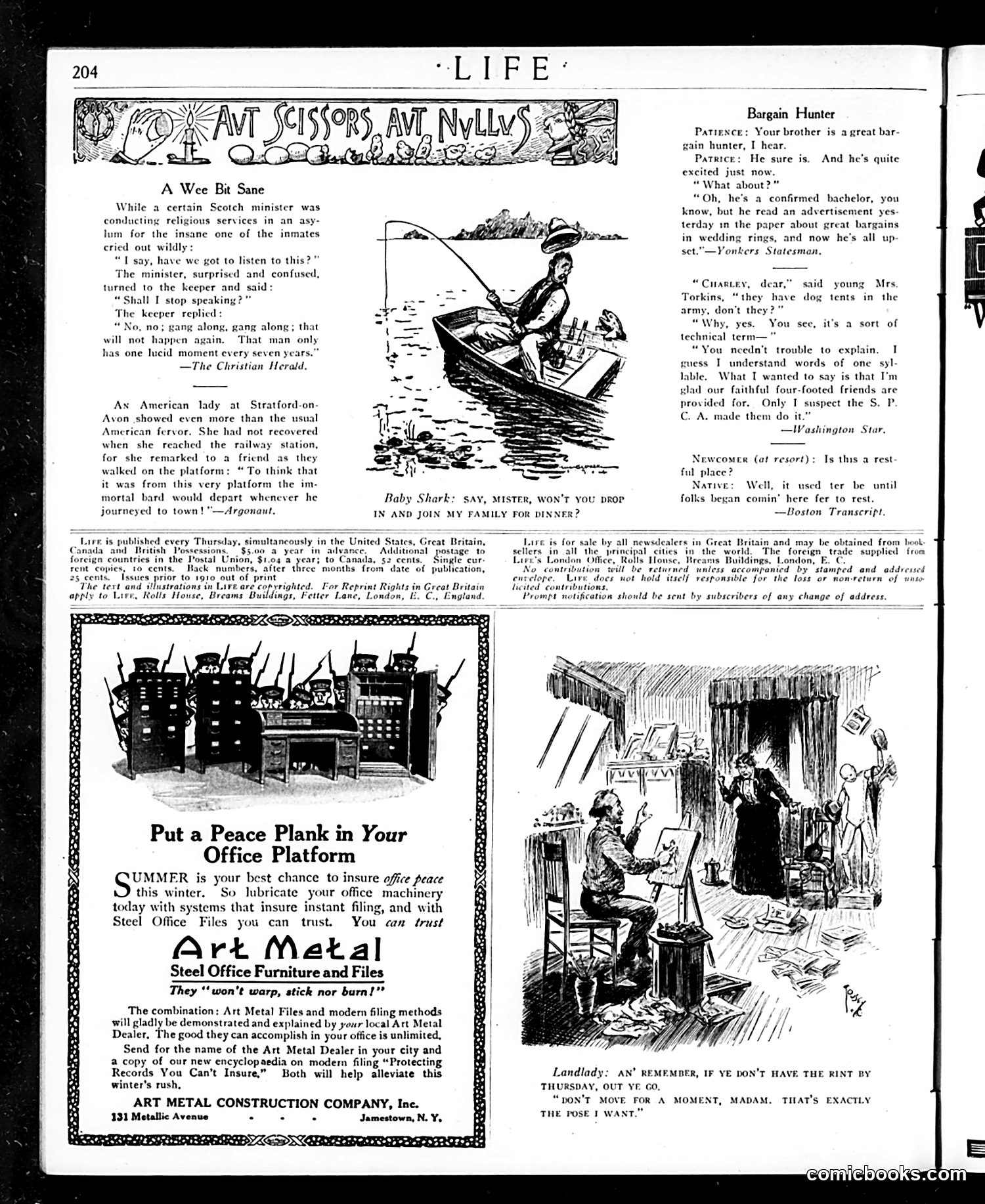
This page contains several humorous anecdotes typical of early 20th-century Life magazine's satirical humor: **"A Wee Bit Sane"**: A Scottish minister conducting chapel services in an asylum is interrupted by an inmate demanding silence. The keeper explains the man "has one lucid moment every seven years"—the joke being that his one moment of sanity is complaining about the service itself. **"Bargain Hunter"**: A bachelor reads wedding ring advertisements and suddenly wants to marry—satirizing how advertising manipulates consumer behavior and life choices. **"Baby Shark" cartoon**: Shows someone inviting another to family dinner, with the caption suggesting absurd formality. The page also includes advertisements for Art Metal filing systems ("Put a Peace Plank in Your Office Platform") and a landlady sketch about rent collection. These pieces reflect early 1900s preoccupations: institutional care, commercial advertising's persuasive power, and domestic/office humor. The tone assumes readers familiar with Victorian social conventions and middle-class anxieties.
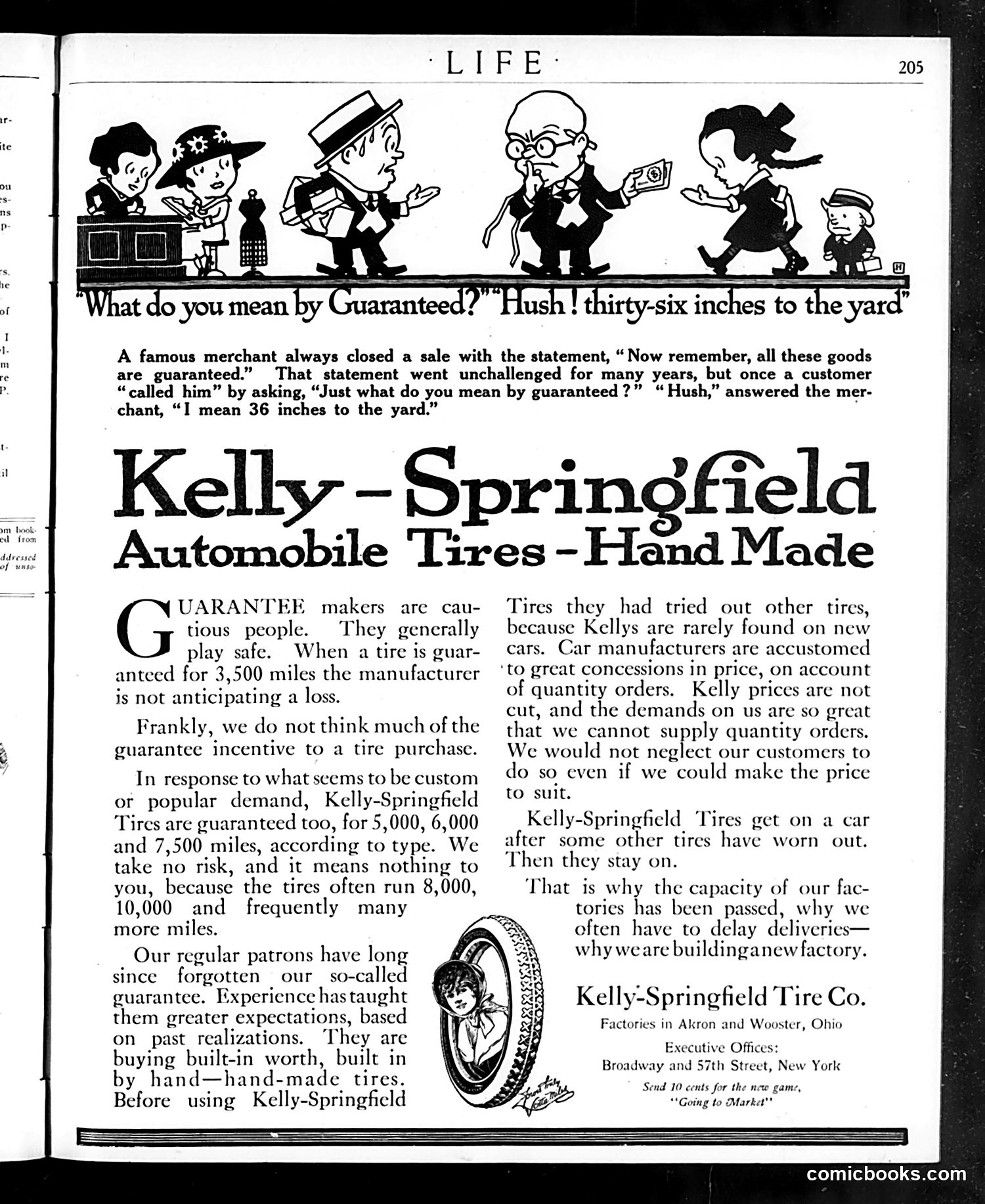
The opening cartoon satirizes deceptive advertising. A merchant claims goods are "guaranteed," but when challenged, reveals the guarantee means nothing: "36 inches to the yard"—a dishonest measure. This mocks merchants who use vague guarantees as sales tactics without meaningful substance. The advertisement that follows is for Kelly-Springfield Automobile Tires. Ironically, it uses the same subject to advertise *against* guarantees. The company argues that tire guarantees are meaningless marketing—manufacturers set low mileage guarantees (3,500 miles) they're confident tires will exceed. Kelly-Springfield's guarantee (5,000-7,500 miles) is likewise irrelevant since their hand-made tires typically last 8,000-10,000+ miles. The ad positions Kelly-Springfield as honest: customers buy actual durability ("built-in worth"), not false promises. This was apparently a real tire company competing on quality rather than marketing claims—a pitch that would resonate with readers just shown a satire on guarantee-based deception.
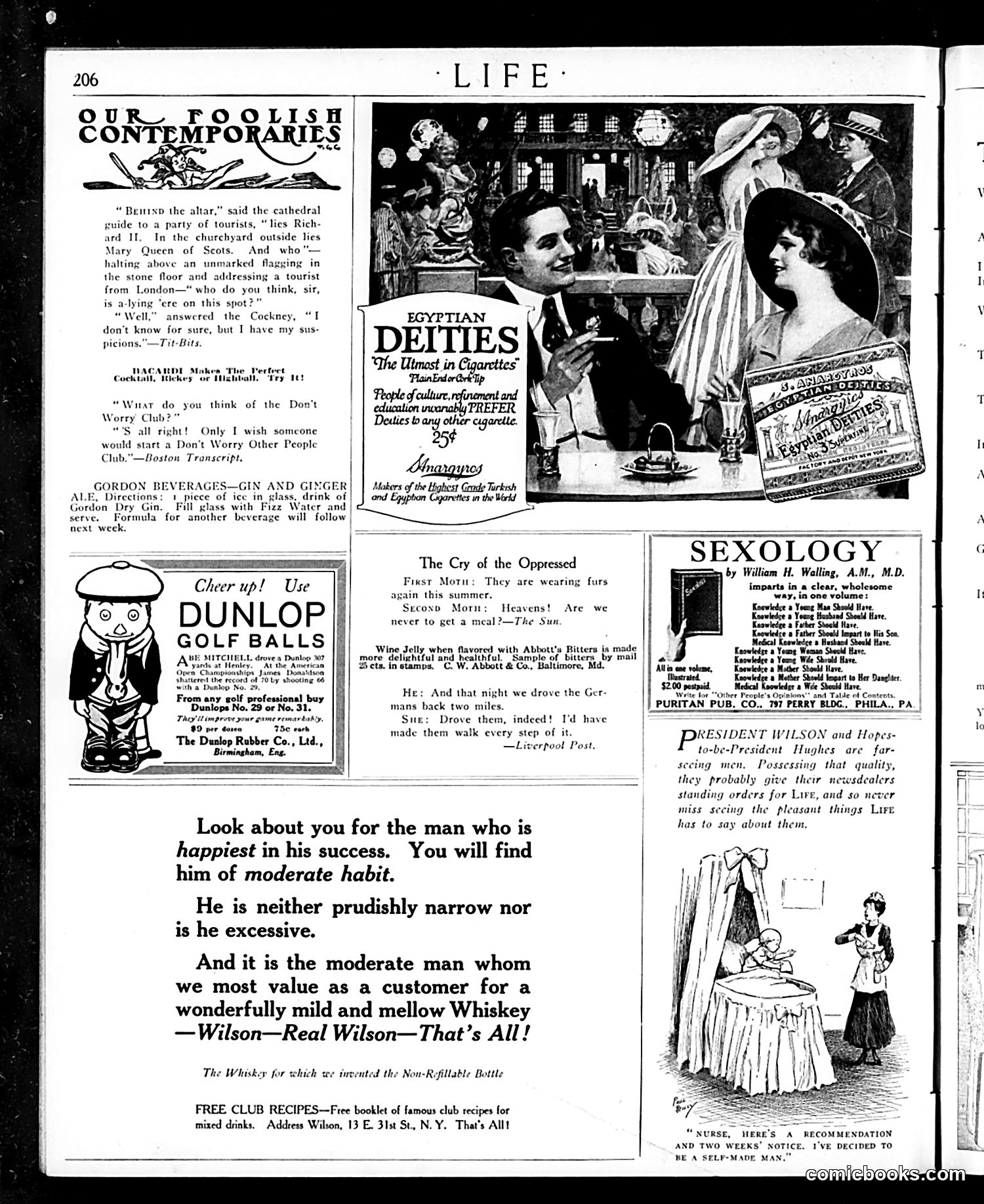
This page is primarily **advertising and humor columns** from an early 20th-century American satirical magazine. The content includes brief comedic anecdotes mocking various subjects: - **Tourism/British culture**: A cathedral tour guide's joke about tourists' ignorance - **Social anxiety**: Jokes about "Don't Worry Clubs" (likely referencing early 1900s self-help fads) - **WWI references**: A dialogue where a woman criticizes her companion's boast about driving back Germans—she says they should have *walked* - **Gender/fashion**: Women complaining about others wearing furs while they can't afford meals (post-war economic hardship) The page is dominated by **period advertisements** for Wilson Whiskey, Egyptian Deities cigarettes, Dunlop golf balls, and a "Sexology" book—typical commercial content. A notable political reference appears in italics: Wilson (President Woodrow Wilson) and Hughes (likely 1916 presidential candidate Charles Evans Hughes) are flattered as "far-seeing men" who presumably buy *Life* magazine. The overall tone is lighthearted social satire typical of the era's humor magazines.
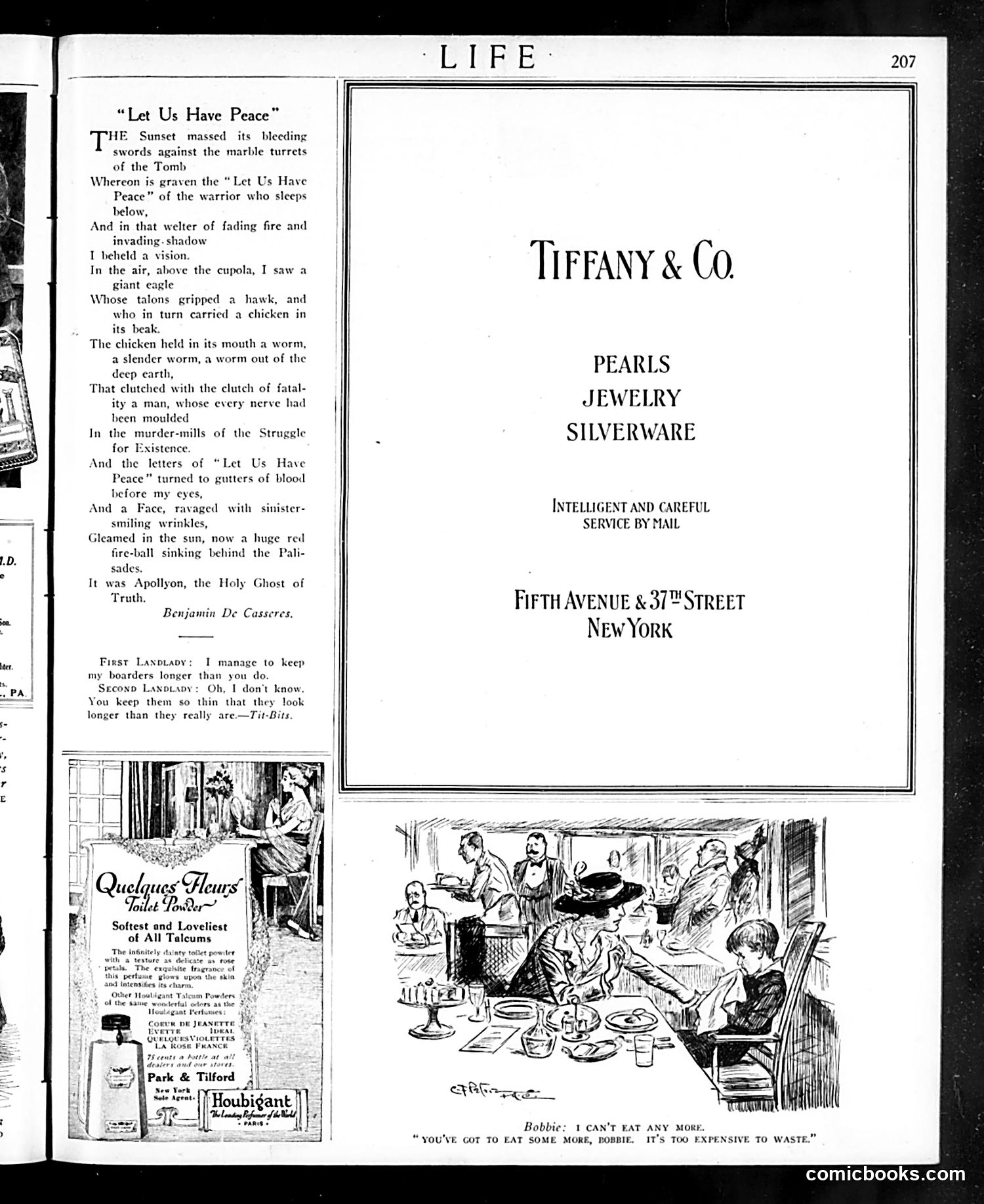
This page mixes serious and light content. The poem "Let Us Have Peace" by Benjamin De Casseres is a dark, allegorical vision referencing Grant's famous post-Civil War phrase. The poem describes a nightmarish chain of predation—eagle gripping hawk gripping chicken gripping worm gripping man—suggesting that existence itself is fundamentally violent struggle. The vision ends with "Apollyon" (evil personified) appearing as the sun sets on a tomb, transforming peace into bloodshed. It's philosophical pessimism about human nature. Below this serious work sits a humorous landlady joke playing on body image: one landlady keeps boarders thin to make them appear taller (thus "longer"), while her competitor's boarders look shorter because they're actually well-fed. The page also contains advertisements for luxury goods (Tiffany & Co.) and toilet powder, typical of the magazine's commercial side. The final cartoon shows a mother pressuring her reluctant child ("Robbie") to overeat, calling wasted food "expensive"—wartime or Depression-era domestic economy humor.
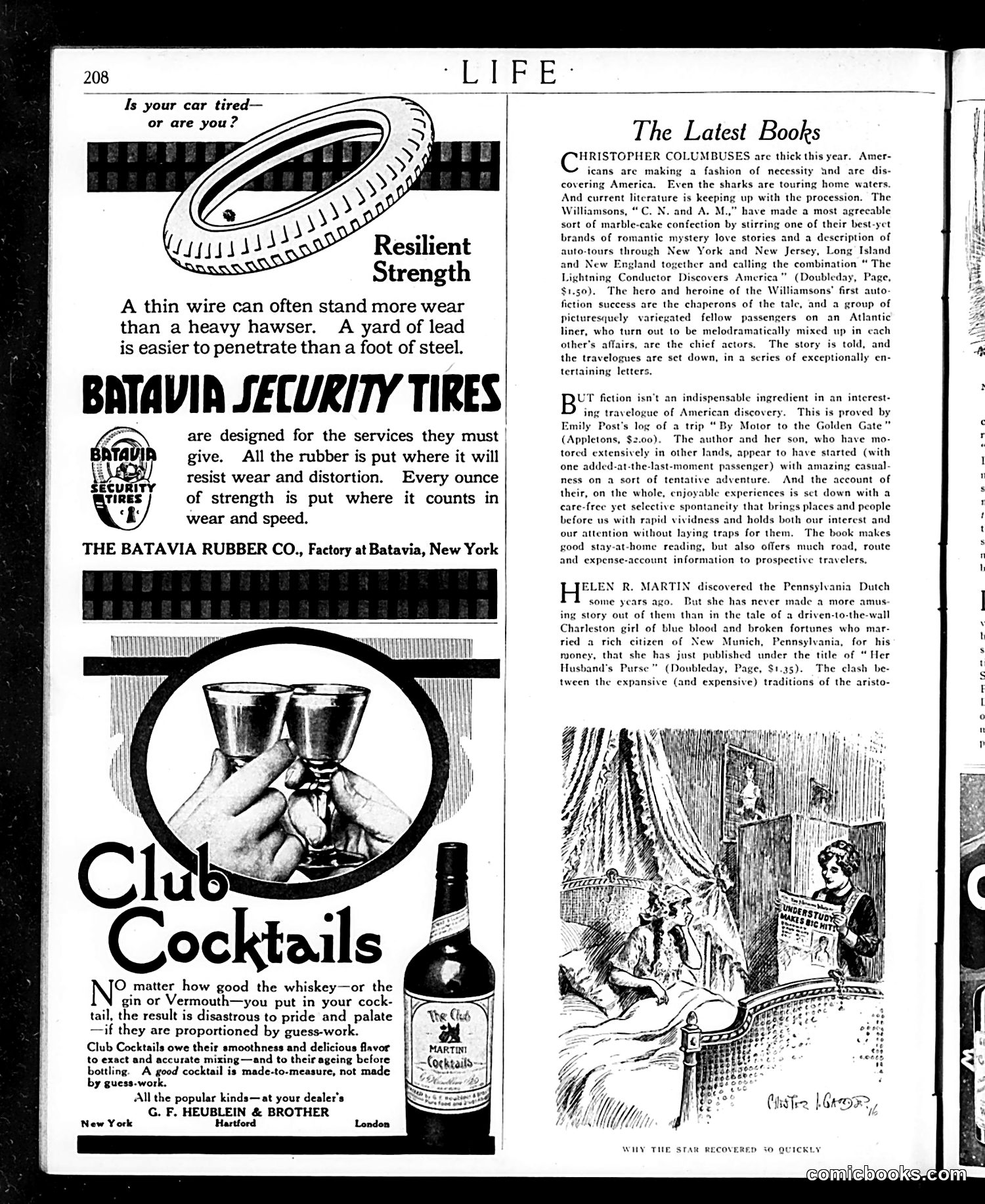
This is primarily a **advertisements and book reviews page** rather than political satire. The **advertisements** include: - **Batavia Security Tires**: Uses a philosophical comparison (thin wire vs. heavy rope) to argue for thoughtful tire engineering—strength placed where needed, not wasted - **Club Cocktails**: Critiques prohibition-era home bartenders, arguing that cocktails require precision mixing, not "guess-work" The **book reviews section** discusses contemporary literature: - Multiple "Christopher Columbus" themed books reflecting Americans' fashion for discovering their own country - Travel narratives by the Williamsons and Emily Post about touring America by automobile - Helen R. Martin's novel about a Charleston aristocrat marrying a Pennsylvania Dutch businessman The cartoonish illustration at bottom right appears to accompany the book section but is captioned only "WHY THE STAR RECOVERED SO QUICKLY"—its specific reference is unclear from the visible text. The page reflects 1910s-era concerns: automobile culture, cocktail culture during Prohibition, and American travel/discovery themes.
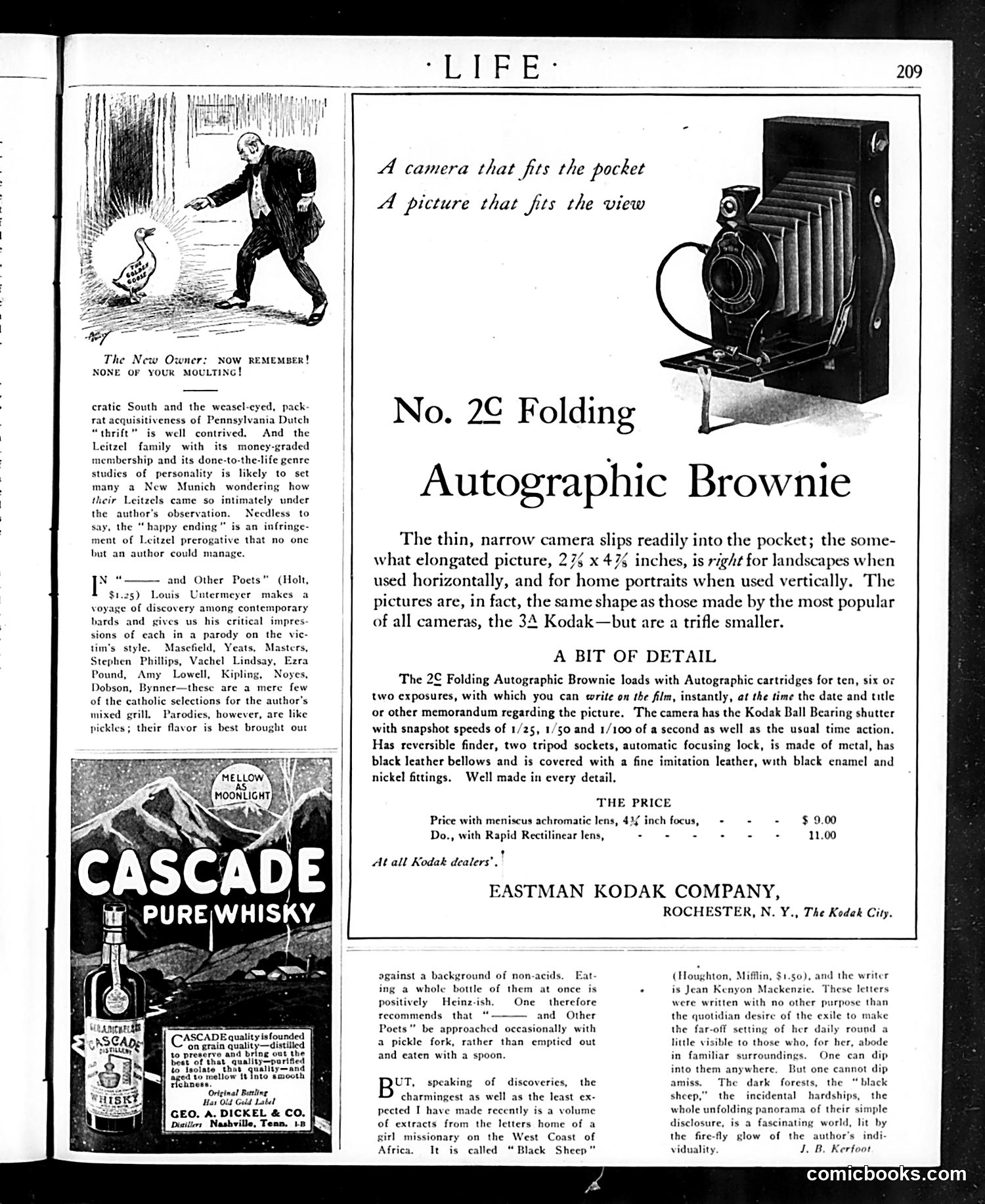
The page contains one political cartoon in the upper left, titled "The New Owner: Now Remember! None of Your Moulting!" **The Cartoon:** A well-dressed man in formal attire gestures sternly at a molting bird (appearing to be a duck or goose). The joke targets newly wealthy owners of properties or possessions—the "new owner" is instructing his acquisition not to shed feathers, treating a living creature with the imperious demands of someone unaccustomed to ownership. The satire mocks the pretentiousness and unrealistic expectations of the newly rich, who approach their purchases with comical domineering attitudes. **Context:** This reflects early 20th-century American class satire, poking fun at nouveau riche sensibilities—a common Life magazine target. The humor assumes readers recognize the absurdity of ordering a bird not to molt, as a metaphor for controlling the uncontrollable or making unreasonable demands of one's possessions. The page's remaining content is primarily advertising (Kodak cameras, Cascade whiskey) and book reviews.
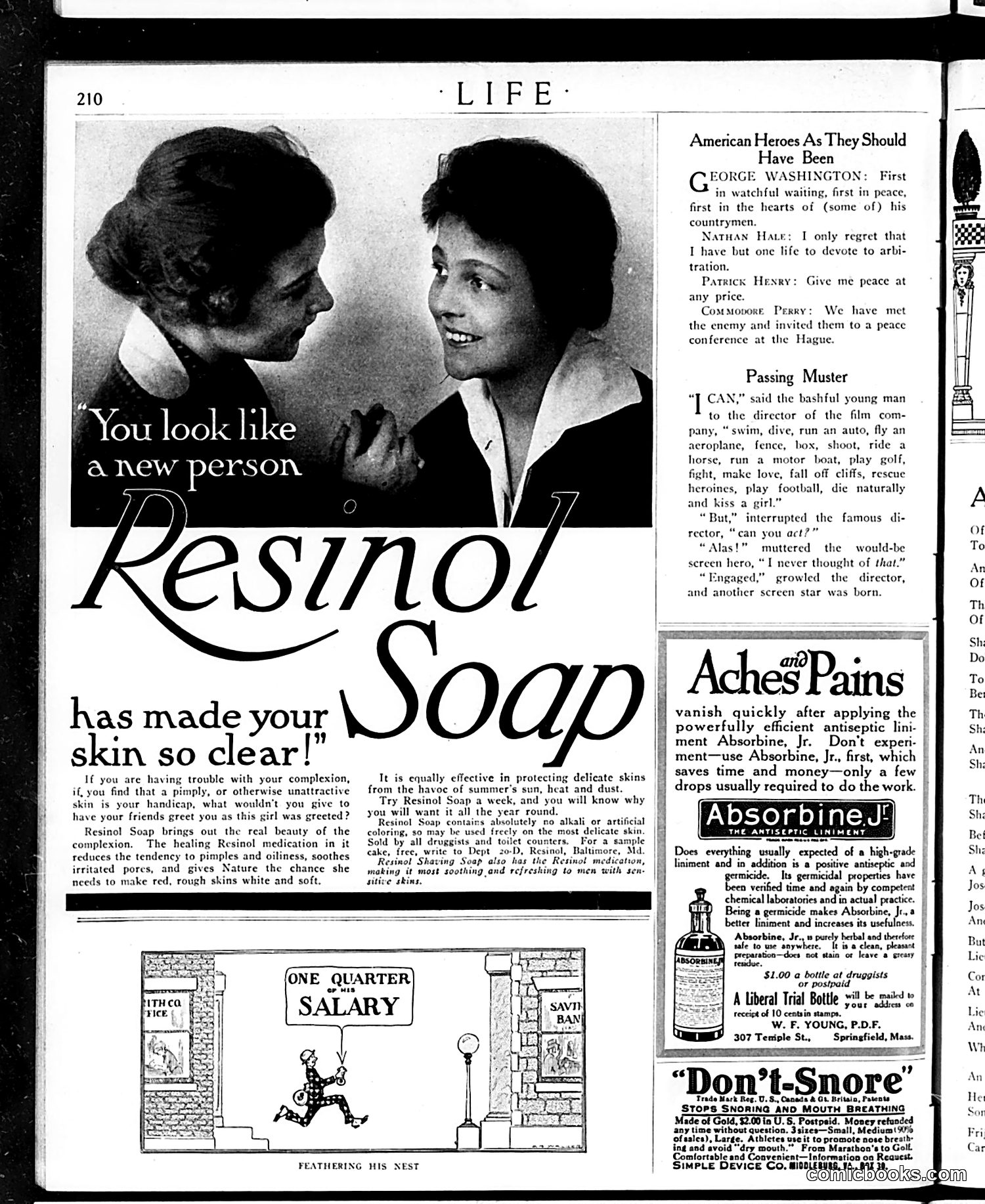
This satirical section mocks pacifist sentiment in early-20th-century America by reimagining famous historical figures as peace advocates. It inverts their actual legacies: - **George Washington** is portrayed as passive, not actively "first" in hearts but merely "waiting" - **Nathan Hale** (who famously said he had "but one life" to give for his country) is recast as devoted to "arbitration" instead - **Patrick Henry** (who declared "Give me liberty or death") now demands "peace at any price" - **Commodore Perry** (known for military action) invites enemies to peace conferences The joke targets contemporary American isolationists and pacifists by suggesting their ideology contradicts American heroic tradition. It's satirizing the growing peace movement and anti-war sentiment of the era through absurdist reversal of patriotic rhetoric. The page also contains period advertisements (Resinol Soap, Absorbine liniment, "Don't-Snore" device) unrelated to the satire.
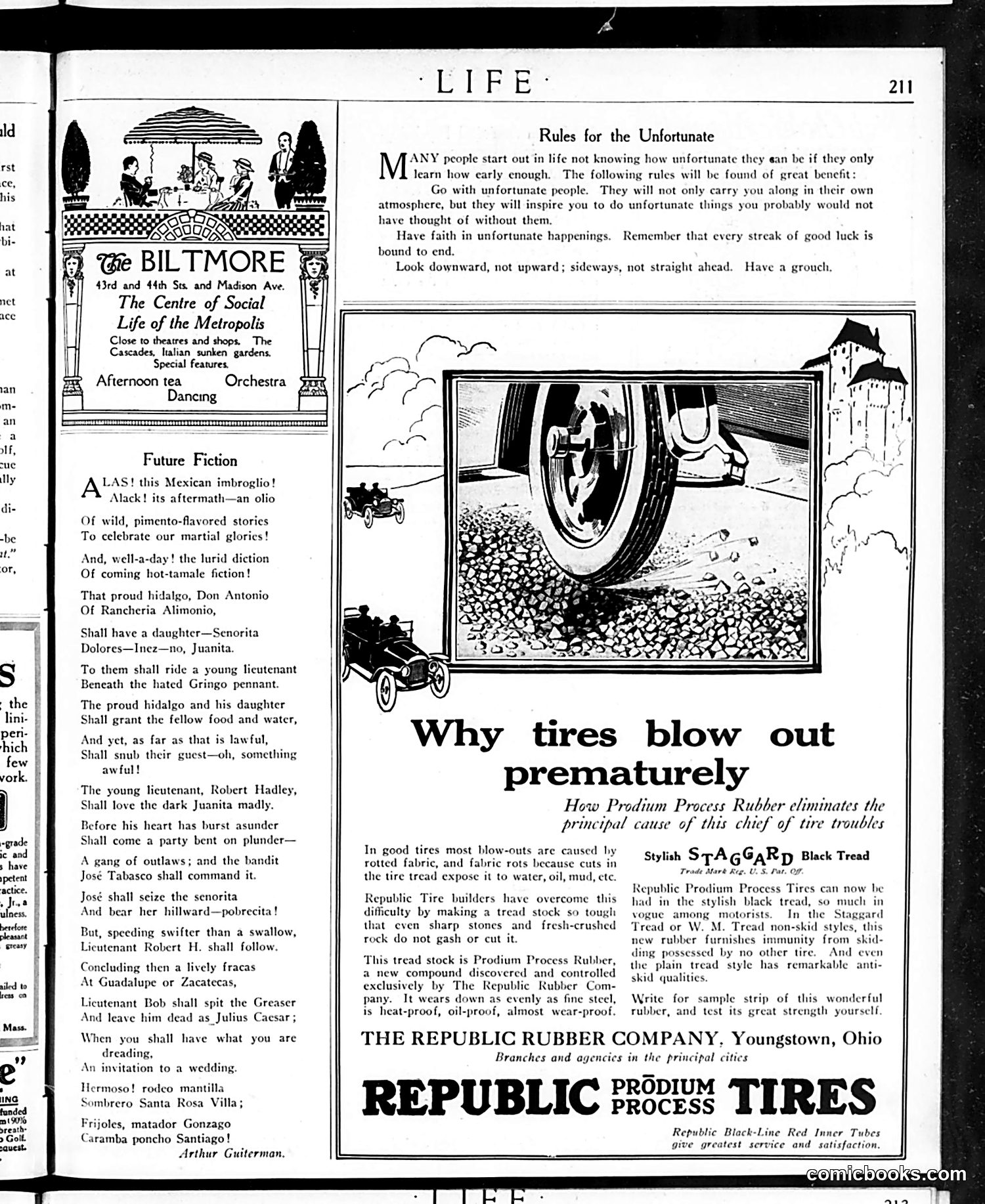
This page contains two distinct elements: satirical poetry and advertising. **"Future Fiction" poem by Arthur Guiterman** mocks predictable Mexican-themed melodramas then popular in American literature and theater. The piece satirizes overwrought romantic tales featuring stock characters: a proud hidalgo, his daughter Juanita, an American lieutenant protagonist, and bandit José Tabasco. The poem ridicules the formulaic plot (romance, abduction, rescue) and stereotypical language ("hot-tamale fiction," Spanish words for comedic effect). Guiterman's satire targets both the genre's predictability and American audiences' appetite for exoticized, dramatized depictions of Mexico. **"Rules for the Unfortunate"** is brief satirical advice suggesting one attract misfortune by associating with unlucky people and maintaining a pessimistic outlook. **The Republic Rubber Company tire advertisement** occupies the right side, explaining why tires blow out and promoting their "Prodium Process Rubber" solution. This is straightforward product marketing rather than satirical content.
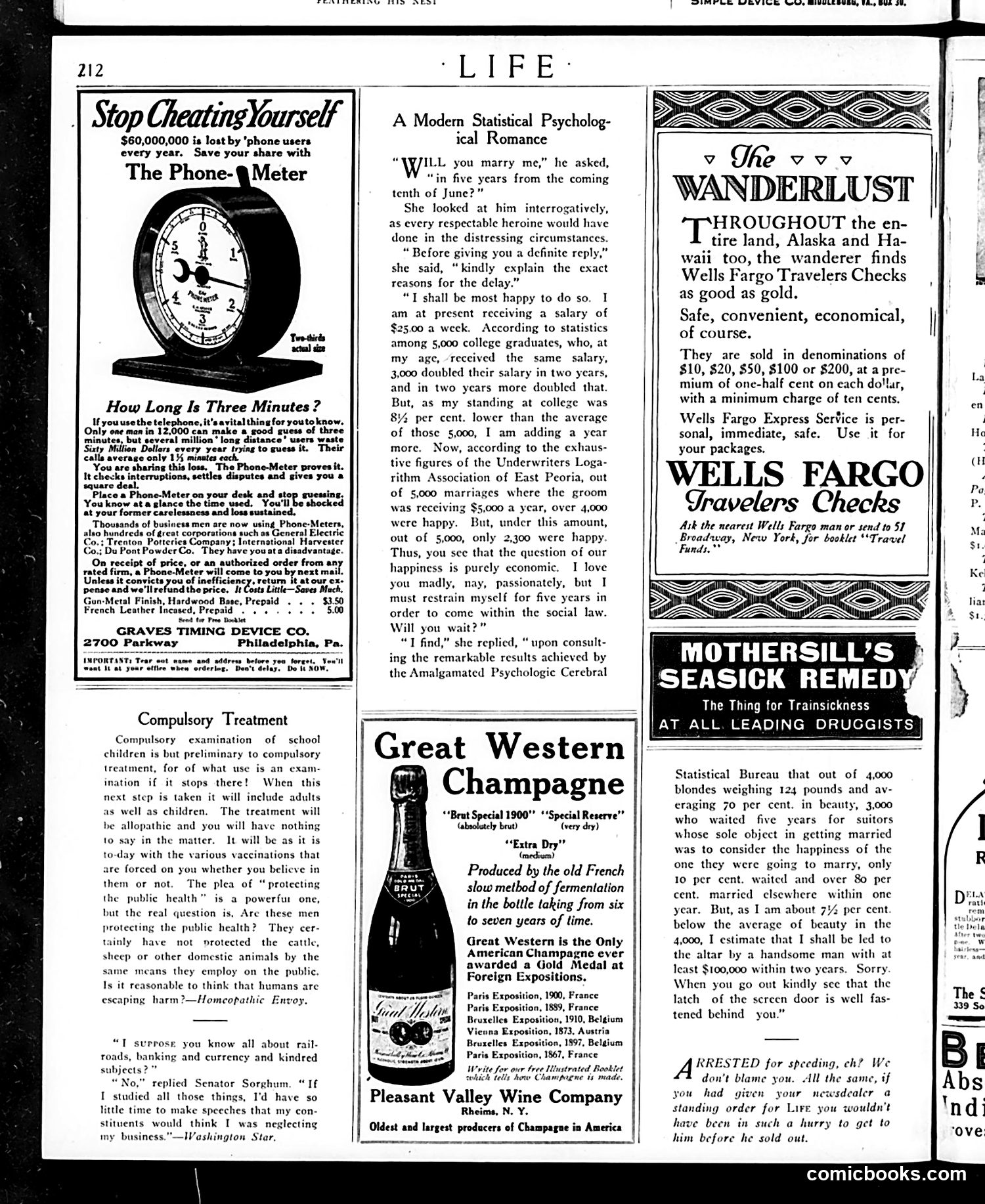
This page primarily contains **advertisements** interspersed with one satirical piece: "A Modern Statistical Psychological Romance." The main satire mocks the era's obsession with statistics and pseudo-scientific reasoning applied to personal decisions. A suitor proposes marriage, then justifies a five-year delay by citing statistics about college graduates' salary growth, underwriters' data on marriages by income level, and "Amalgamated Psychologie Cerebral" findings—elaborate numerical arguments for what is essentially an emotional commitment. The humor lies in the absurdity of reducing love and marriage to economic calculations and dubious statistical claims. The surrounding ads (Phone-Meter, Wells Fargo checks, champagne, seasickness remedy) reflect early 20th-century consumer culture, while a brief section on "Compulsory Treatment" discusses mandatory school health examinations. The satire reflects contemporary anxieties about industrialization, quantification of human experience, and the growing authority of "experts" armed with statistics.
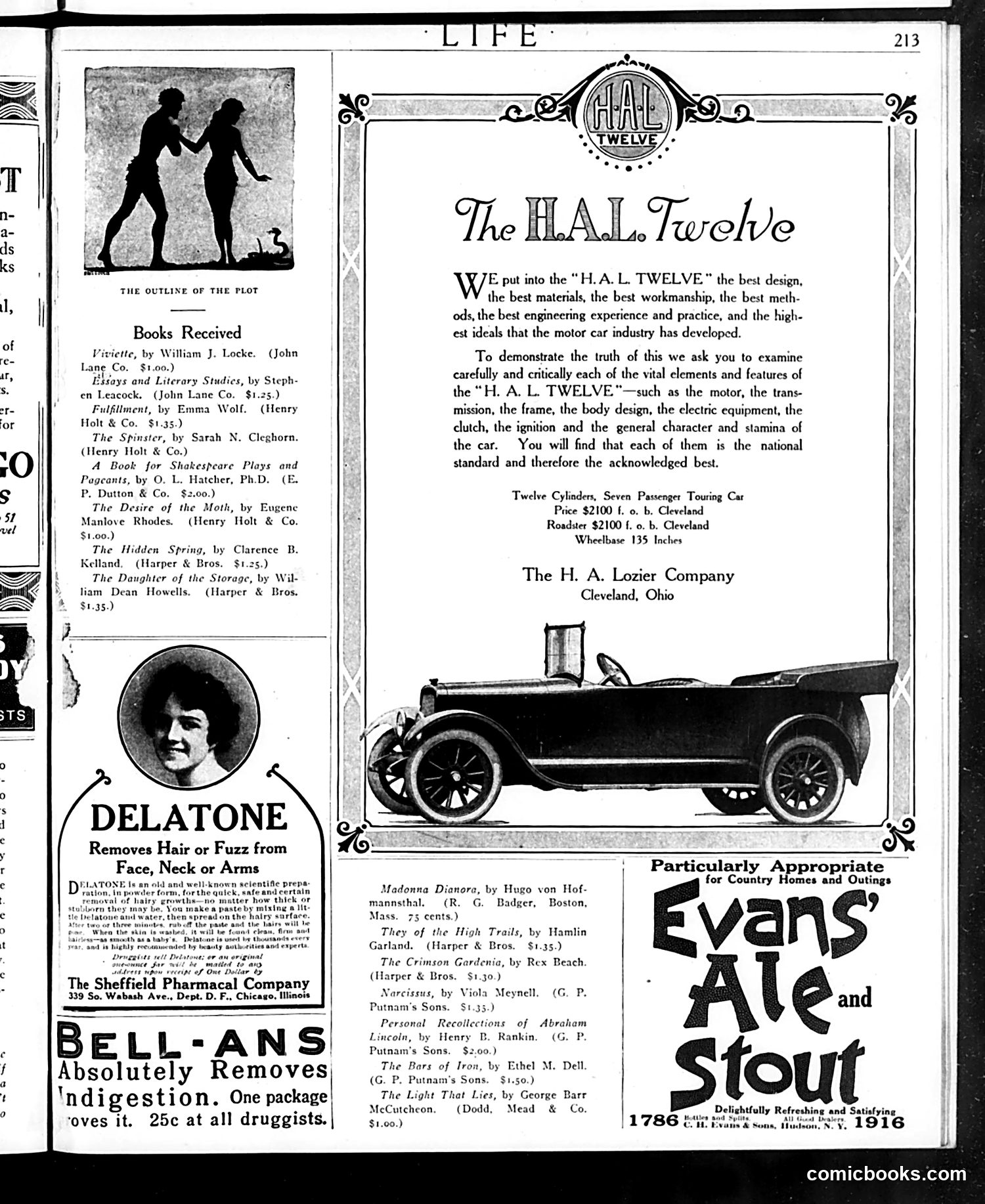
This page is primarily **advertising and book reviews**, not political satire. The main content includes: **"The Outline of the Plot"** (top left): A silhouette illustration of two figures in dramatic pose, likely promoting a serialized story or play featured in *Life*. **Book Reviews**: A list of contemporary 1916 literary releases, including works by William Dean Howells and Hamlin Garland. **Period Advertisements**: - DELATONE (hair removal product) - BELL-ANS (indigestion remedy) - H.A.L. Twelve (luxury automobile, $2,100) - Evans Ale and Stout (beverages) **No political cartoons appear on this page.** The silhouette at top is illustrative rather than satirical. This is a typical magazine page mixing editorial content with commercial advertisements—standard *Life* magazine format from the 1910s, before the publication became primarily a photo-focused weekly.
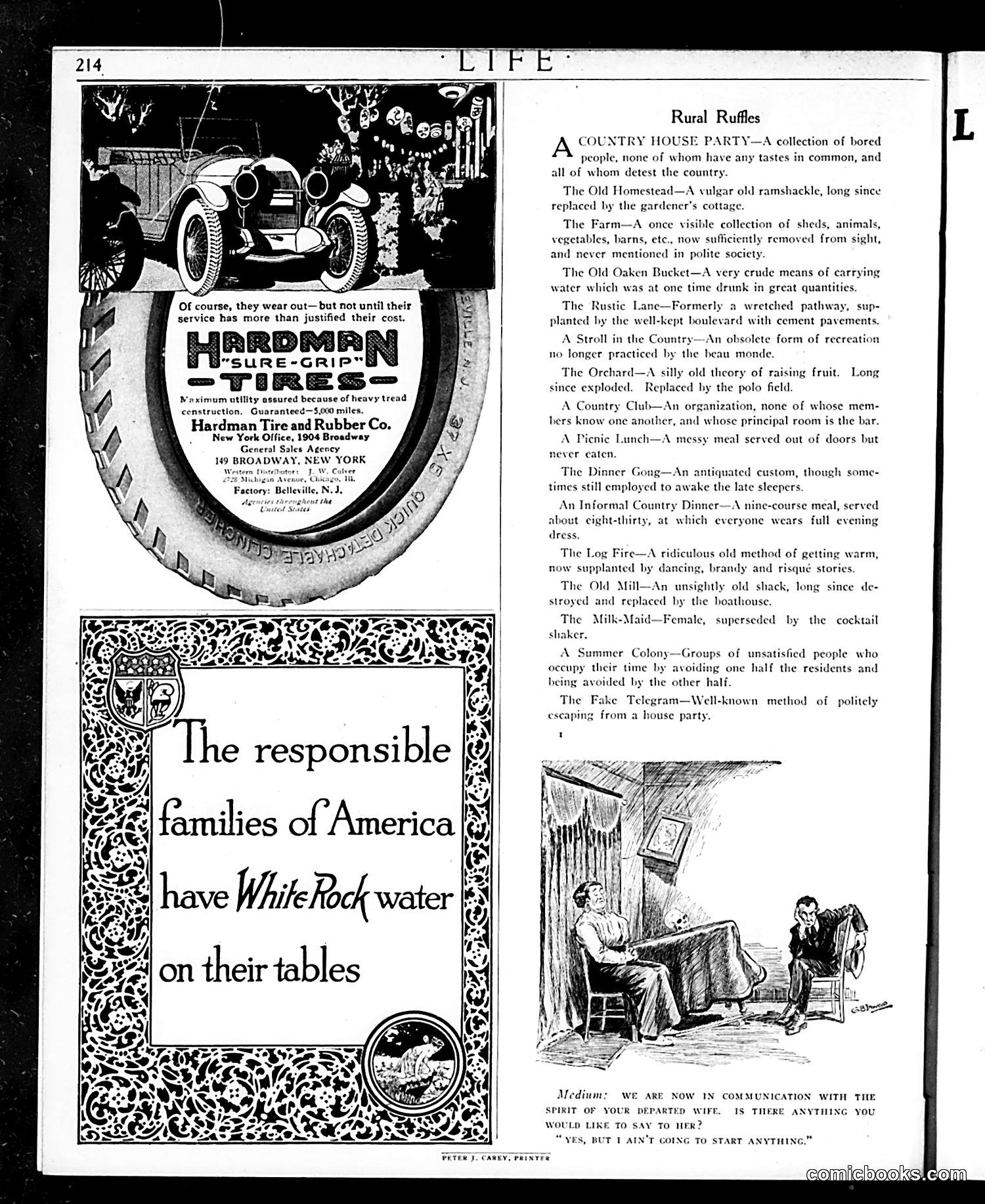
This page satirizes upper-class affectation and hypocrisy about rural life. The "Rural Ruffles" section mocks wealthy urbanites who romanticize countryside living while actually despising it. Key targets include: - **The Country House Party**: Bored rich people pretending to enjoy nature - **Replaced traditions**: Old barns/orchards replaced by polo fields and boathouses—genuine farm life erased for leisure - **The Summer Colony**: Residents deliberately avoid each other despite sharing the same space - **The Fake Telegram**: A polite excuse to escape boring house parties The cartoon below satirizes séance culture: a man claims he won't "start anything" when supposedly contacted by his dead wife's spirit—suggesting marital discord so severe he fears communicating even with her ghost. Both pieces ridicule the pretense and unhappiness underlying wealthy American social life.