
Life, 1916-08-03 · page 10 of 38
Life — August 3, 1916 — page 10: what you’re looking at
What you’re looking at
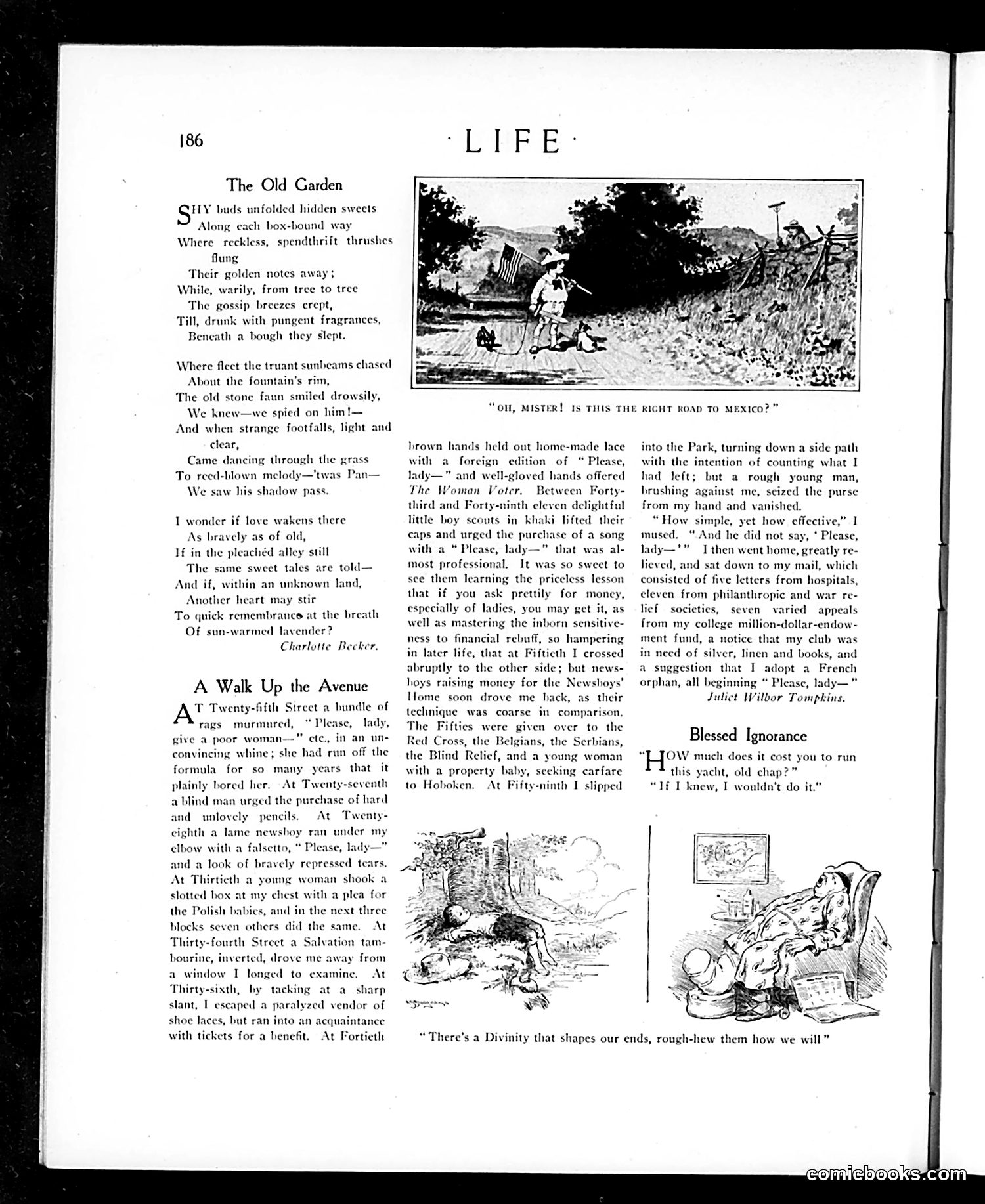
This page contains literary content and illustrations rather than political cartoons. The main features are: **"The Old Garden"** - A poem by Charlotte Becker about an overgrown garden where children play and discover nature's beauty. **"A Walk Up the Avenue"** - A humorous piece describing encounters with street beggars from Twenty-fifth to Fortieth Street in what appears to be New York City. It satirizes the various panhandling techniques used by poor women—their different pitches, emotional appeals, and persistence—reflecting turn-of-the-century urban poverty and street life. **"Blessed Ignorance"** - A brief joke about the cost of running a household. The accompanying illustrations are decorative rather than satirical, showing garden scenes and domestic life. The page reflects early 20th-century American attitudes toward urban poverty and homelessness through gentle, observational humor.
📄 Transcribed text from this page (OCR, searchable)
Machine-transcribed from the original scan — historical spelling and the odd misread are preserved.
186 The Old Garden HY buds unfolded hidden sweets Along cach box-bound way Where reckless, spendthrift: thrushes flung Their golden notes away; While, warily, from tree to tree The gossip breezes crept, Till, drunk with pungent fragrances, Beneath a bough they slept. Where ficet the truant sunbeams chased About the fountain’s rim, The old stone faun smiled drowsily, We knew—we spied on him!— And when strange footfalls, light and clear, Came da To reed: We saw his shadow pass. ncing through the grass »wn melody—'twas Pan— I wonder if love wakens there cly as of old, alley still are told— As bra If in the pleachéd The same sweet And if, within an unknown land, Another heart may stir To quick remembrance at the breath Of sun-warmed lavender? Charlotte Becker. ale: A Walk Up the Avenue A Twenty-fifth Street a bundle of “DP lady, ete, im an un- rags murmured, sc, give a poor woman convincing whine; she had run off the ny years that it At Twenty-seventh formula for so 1 plainly bored her. a blind man urged the purchase of hard pencils, At) Twenty- ran under my and unlovely eighth a lame newsho: elbow with a falsetto, and a look of bravely repressed tears. At Thirticth a slotted box atm the Polish babies, and in the next three Mocks seven others the same. At Thirty-fourth Street a Salvation tam- bourine, inverted, drove me away from a window I longed to examine. At Thirty-sixth, by tacking at a. sharp ped a paralyzed vendor of young woman shook chest with a plea for slant, I ese shoe laces, but ran into an acquaintance with tickets for a benefit. At Fortieth “OM, MISTER! IS THIS THE brown hands held out home-made lace with foreign edition of “ Please, lady—" and well-gloved hands offered The Woman Voter. Between Forty- third and Forty-ninth eleven delightful little boy scouts in khaki lifted their caps and urged the purchase of a song with a “Please, lady—" that was al- most professional, It was so sweet to sce them learning the priceless lesson that if you ask prettily for money, esp lly of ladies, you may get it, as well as mastering the inborn sensi ness to financial rebuff, so hampering in later life, that at Fiftieth I crossed abruptly to the other side; but news- hoys raising moncy for the Newshoys’ Home soon drove me hack, as their technique was coarse in comparison, The Fifties were given over to the Red Cross, the Belgians, the Serbians, the Blind Relief, and a young woman with a property baby, seeking carfare to Hoboken. ty-ninth I slipped vee RIGHT ROAD TO MEXICO?” into the Park, turning down a side path with the intention of counting what I had left; but a rough young man, brushing against me, seized the purse from my hand and vanished. “How simple, yet how effective,” I “And he did not say, * Ple lady—'" I then went home, greatly re- lieved, and sat down to my mail, which consisted of five letters from hospitals, eleven from philanthropic and war re- lief societies, varied appeals from my college million-dollar-endow- ment fund, a notice that my club was in need of silver, linen and books, and A suggestion that I adopt a French orphan, all beginning “ Please, lady—" Juliet Wilbor Tompkins. mused. seven Blessed Ignorance “LOW much does it cost you to run this yacht, old chap?” “If T knew, I wouldn't do it.” “There's a Divinity that shapes our ends, rough-hew them how we will”