
Life, 1916-08-03 · page 12 of 38
Life — August 3, 1916 — page 12: what you’re looking at
What you’re looking at
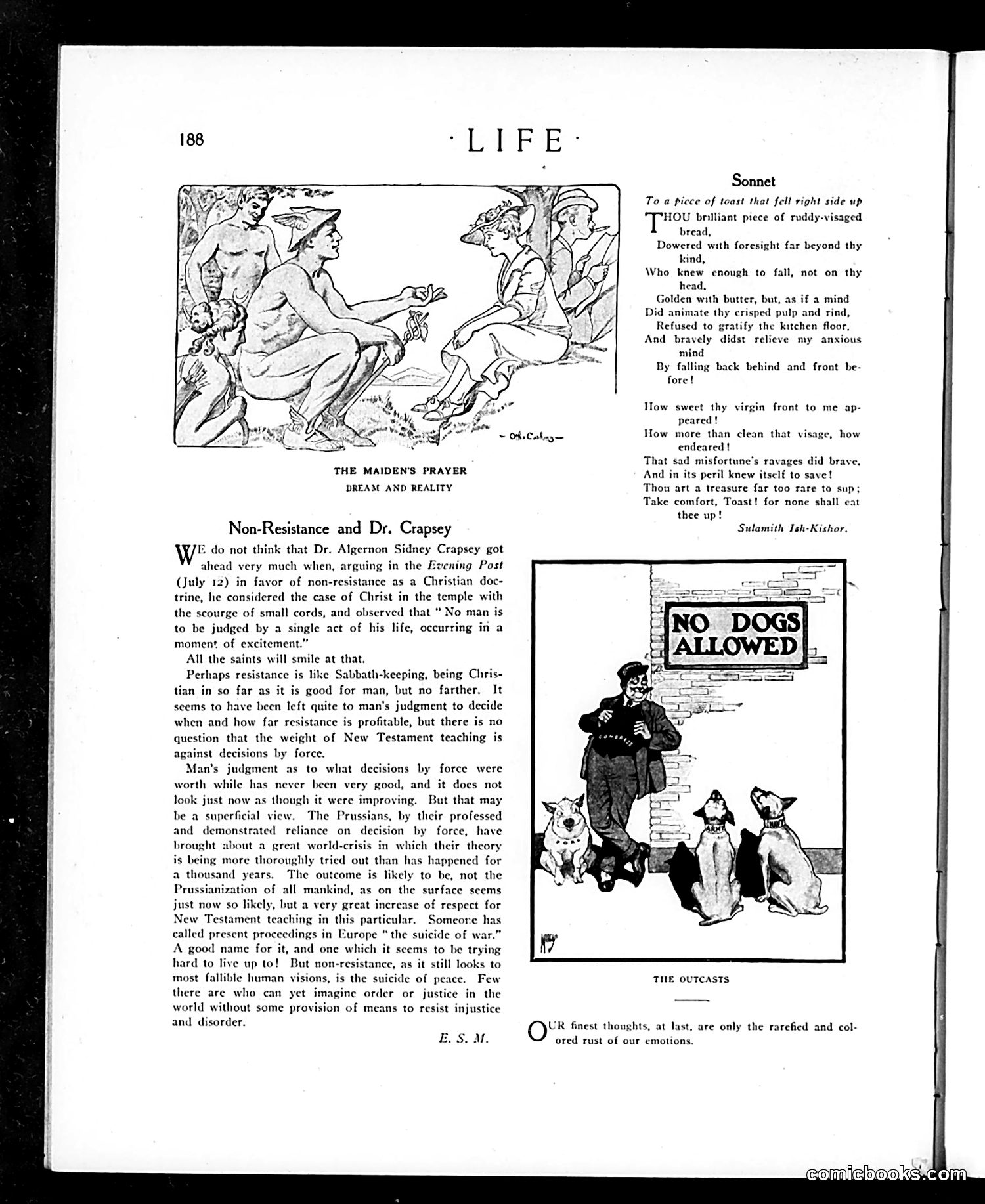
This cartoon depicts a child standing beside dogs beneath a "NO DOGS ALLOWED" sign. The satire likely comments on social exclusion and discrimination through visual metaphor—the child and dogs are grouped together as unwanted "outcasts." The accompanying article "Non-Resistance and Dr. Crapsey" discusses Christian doctrine regarding resistance to force, referencing debates about pacifism versus practical defense against injustice. The article's closing line—"OUR finest thoughts, at last, are only the rarefied and colored rust of our emotions"—suggests emotional impulses underlie our stated principles. The cartoon's juxtaposition of innocent figures barred entry appears to critique how society arbitrarily excludes vulnerable groups, paralleling the philosophical tensions about resistance discussed in the text.
📄 Transcribed text from this page (OCR, searchable)
Machine-transcribed from the original scan — historical spelling and the odd misread are preserved.
Sonnet To a pice of toast that fell right side up HOU brilliant piece of ruddy-visaged bread, Dowered with foresight far beyond thy kind, Who knew cnough to fall, not on thy head, Golden with butter, but, as if a mind Did animate thy crisped pulp and rind, Refused to gratify the kitchen floor, And bravely didst relieve my anxious mind By falling back behind and front be- fore! How sweet thy virgin front to me ap- peared! How more than clean that visage, how endeared! That sad misfortune’s ravages did brave, THE MAIDEN'S PRAYER And in its peril knew itself to save! DREAM AND REALITY Thou art a treasure far too rare to sup; Take comfort, Toast! for none shall eat thee up! Non-Resistance and Dr. Crapsey Sulamith Ish-Kishor. 2 do not think that Dr. Algernon Sidney Crapsey got ahead very much when, arguing in the Evening Post (July 12) in favor of non-resistance as a Christian doc- trine, he considered the case of Christ in the temple with the scourge of small cords, and observed that “ No man is to be judged by a single act of his life, occurring in a moment of excitement.” All the saints will smile at that. Perhaps resistance is like Sabbath-keeping, being Chris- tian in so far as it is good for man, but no farther. It seems to have been left quite to man’s judgment to decide when and how far resistance is profitable, but there is no question that the weight of New Testament teaching is against decisions by force, Man's judgment as to what decisions by force were worth while has never been very good, and it does not look just now as though it were improving. But that may be a superficial view. The Prussians, by their professed and demonstrated reliance on decision by force, have ought about a great world-crisis in which their theory ing more thoroughly tried out than has happened for a thousand years. The outcome is likely to be, not the Prussianization of all mankind, as on the surface seems just now so likely, but a very great increase of respect for New Testament teaching in this particular. Someore has called present proceedings in Europe “the suicide of war. A good name for it, and one which it scems to be trying hard to live up to! But non-resistance, most fallible human visions, is the sui zs cw THE OUTCASTS there are who can yet imagine order or justice in the world without some provision of means to res and disorder, UR finest thoughts, at last, are only the rarefied and col- ored rust of our emotions.