
Life, 1916-08-03 · page 21 of 38
Life — August 3, 1916 — page 21: what you’re looking at
What you’re looking at
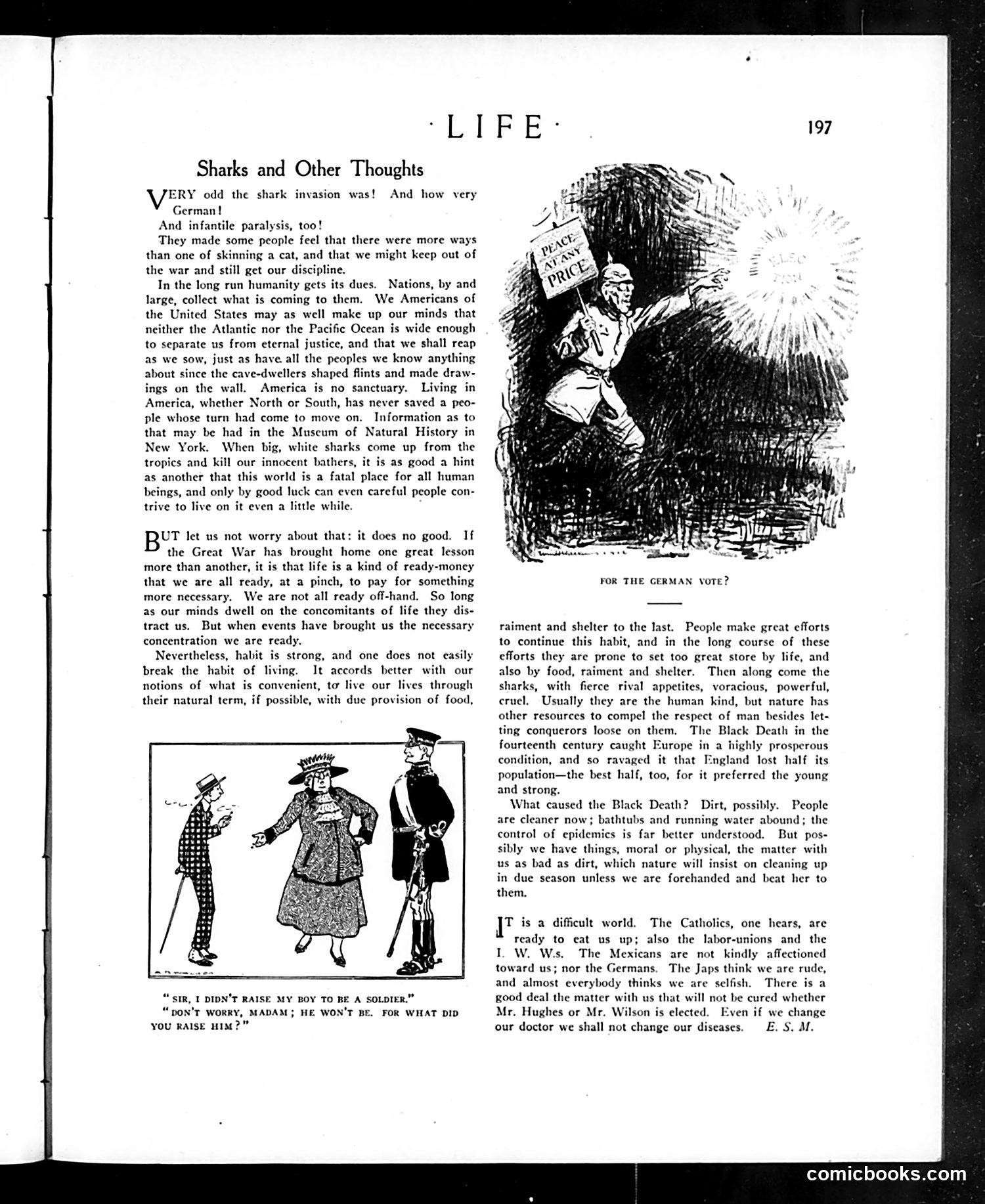
This Life magazine page from the WWI era contains a political cartoon and accompanying essay critiquing American isolationism and pacifism. **The Cartoon:** Shows a woman (labeled "FOR THE GERMAN VOTE?") holding a book titled "Peace" while sharks circle. The caption references the famous anti-war song "I Didn't Raise My Boy to Be a Soldier," sarcastically asking what purpose mothers who raised pacifist sons actually served. **The Point:** The essay argues that recent crises—shark attacks, polio epidemics, and ongoing WWI—reveal America's false sense of sanctuary. The author contends that isolationism is futile; nations face inevitable consequences for their choices. The cartoon suggests that German-American voters opposing American intervention were naïve or complicit, implying pacifism amounted to serving German interests. **Context:** Published during the 1916 election (Hughes vs. Wilson referenced), this reflects American debate over entering WWI, with anti-German sentiment and suspicion of German-American political influence running high.
📄 Transcribed text from this page (OCR, searchable)
Machine-transcribed from the original scan — historical spelling and the odd misread are preserved.
*LIFE- Sharks and Other Thoughts RY odd the shark invasion was! And how very German! And infantile paralysis, too! They made some people feel that there were more ways than one of skinning a cat, and that we might keep out of the war and still get our discipline. In the long run humanity gets its dues. Nations, by and large, collect what is coming to them. We Americans of the United States may as well make up our minds that neither the Atlantic nor the Pacific Ocean is wide enough to separate us from eternal justice, and that we shall reap as we sow, just as have. all the peoples we know anything about since the cave-dwellers shaped flints and made draw- ings on the wall. America is no sanctuary. Living in America, whether North or South, has never saved a peo- ple whose turn had come to move on. Information as to that may be had in the Museum of Natural History in New York. When big, white sharks come up from the tropics and kill our innocent bathers, it is as good a hint as another that this world is a fatal place for all human beings, and only by good luck can even careful people con- trive to live on it even a little while. Bur let us not worry about that: it does no good. If the Great War has brought home one great lesson more than another, it is that life is a kind of ready-money that we are all ready, at a pinch, to pay for something more necessary. We are not all ready off-hand. So long as our minds dwell on the concomitants of life they dis- tract us. But when events have brought us the necessary concentration we are ready. Nevertheless, habit is strong, and one does not easily break the habit of living. It accords better with our notions of what is convenient, to live our lives through their natural term, if possible, with due provision of food, “SIR, I DIDN'T RAISE MY BOY TO BE A SOLDIER.” DON'T WORRY, MADAM; HE WON'T BE. FOR WHAT DID YOU RAISE HIM?” FOR THE GERMAN VOTE? raiment and shelter to the last. People make great efforts to continue this habit, and in the long course of these efforts they are prone to set too great store by life, and also by food, raiment and shelter. Then along come the sharks, with fierce rival appetites, voracious, powerful, cruel, Usually they are the human kind, but nature has other resources to compel the respect of man besides let- ting conquerors loose on them. The Black Death in the fourteenth century caught Europe in a highly prosperous condition, and so ravaged it that England lost half its population—the best half, too, for it preferred the young and strong. What caused the Black Death? Dirt, possibly. People are cleaner now; bathtubs and running water abound; the control of epidemics is far better understood. But pos- sibly we have things, moral or physical, the matter with us as bad as dirt, which nature will insist on cleaning up in due season unless we are forehanded and beat her to them. T is a difficult world. The Catholics, one hears, are ready to eat us up; also the labor-unions and the I. W. Ws. The Mexicans are not kindly affectioned toward us; nor the Germans. The Japs think we are rude, and almost everybody thinks we are selfish. There is a good deal the matter with us that will not be cured whether Mr. Hughes or Mr. Wilson is elected. Even if we change our doctor we shall not change our diseases. E. S. M. comicbooks.com