
Life, 1916-08-03 · page 16 of 38
Life — August 3, 1916 — page 16: what you’re looking at
What you’re looking at
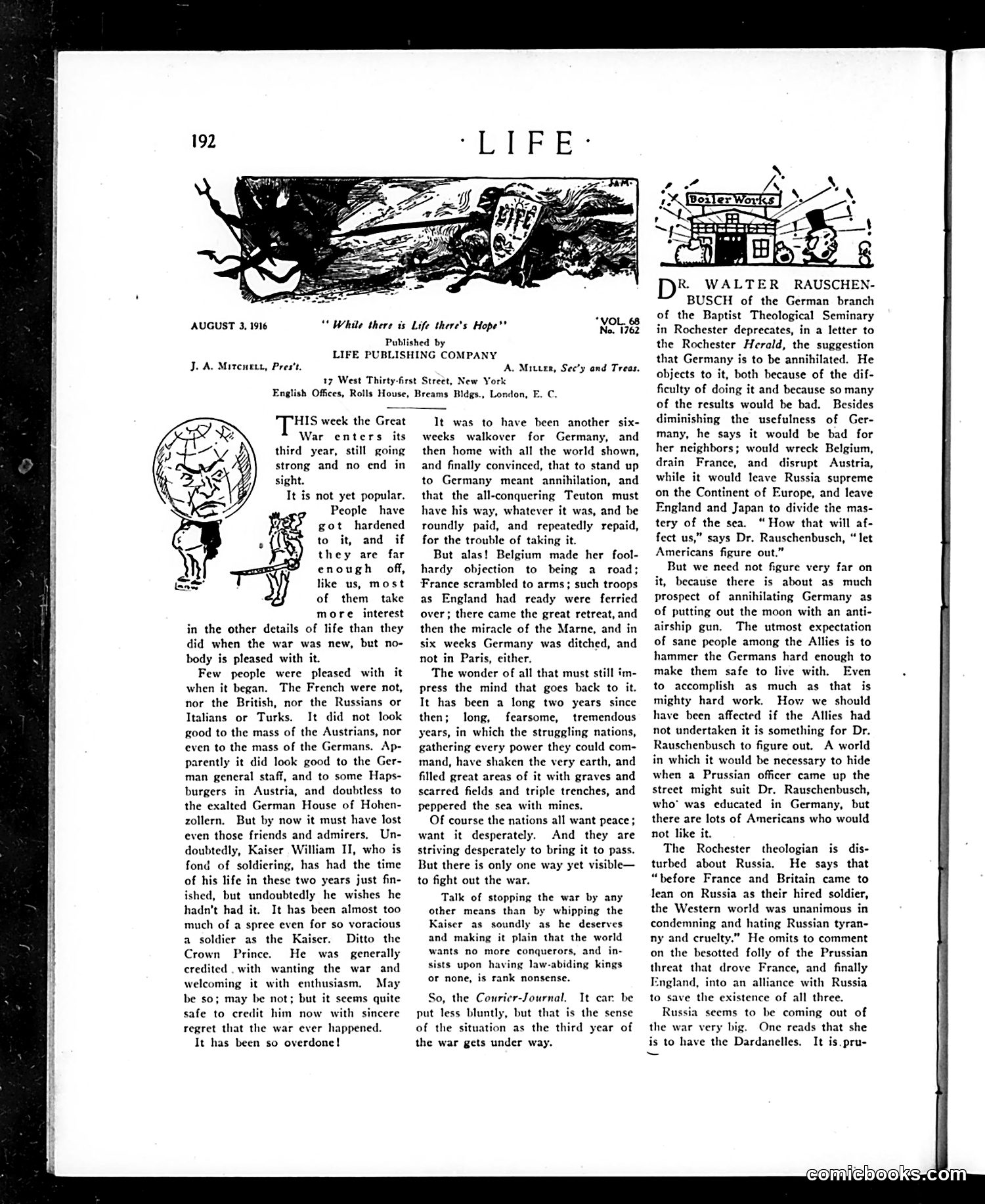
This page contains editorial commentary on World War I entering its third year. The main cartoon (left) depicts a globe-headed figure—likely representing the world or public opinion—appearing exhausted or weighted down, symbolizing global weariness with the ongoing conflict. The editorial argues that the war, initially expected to be a quick German victory ("six weeks walkover"), has instead become a prolonged, devastating struggle. It references Germany's failed plans, Belgium's resistance, and the costly Battle of the Marne. The right column features a response from Dr. Walter Rauschenbusch, a German-American theologian, objecting to suggestions that Germany should be annihilated. He argues such an outcome would harm neighbors like Belgium, France, and Austria, and strengthen Russia—reflecting German-American perspective on war aims in 1916, before U.S. entry into the war.
📄 Transcribed text from this page (OCR, searchable)
Machine-transcribed from the original scan — historical spelling and the odd misread are preserved.
AUGUST 3, 1916 ‘* While there is Life there's Hope’* No, 1762 Published by LIFE PUBLISHING COMPANY J. A. Mitenent, Pres't. A. Mittrr, Sec’y and Treas, 17 West Thirty-first Street, New York English Offices, Rolls House, Breams Bldgs., London, E. C. 'HIS week the Great War enters its third year, still going strong and no end in sight. It is not yet popular, People have got hardened to it, and if they are far enough off, like us, most of them take more interest in the other details of life than they did when the war was new, but no- body is pleased with it. Few people were pleased with it when it began. The French were not, nor the British, nor the Russians or Italians or Turks. It did not look good to the mass of the Austrians, nor even to the mass of the Germans. Ap- parently it did look good to the Ger- man general staff, and to some Haps- burgers in Austria, and doubtless to the exalted German House of Hohen- zollern. But by now it must have lost even those friends and admirers, Un- doubtedly, Kaiser William II, who is fond of soldiering, has had the time of his life in these two years just fin- ished, but undoubtedly he wishes he hadn't had it. It has been almost too much of a spree even for so voracious a soldier as the Kaiser. Ditto the Crown Prince. He was generally credited . with wanting the war and welcoming it with enthusiasm, May be so; may be not; but it seems quite safe to credit him now with sincere regret that the war ever happened. It has been so overdone! It was to have been another six- weeks walkover for Germany, and then home with all the world shown, and finally convinced, that to stand up to Germany meant annihilation, and that the all-conquering Teuton must have his way, whatever it was, and be roundly paid, and repeatedly repaid, for the trouble of taking it. But alas! Belgium made her fool- hardy objection to being a road; France scrambled to arms; such troops as England had ready were ferried over; there came the great retreat, and then the miracle of the Marne, and in six weeks Germany was ditched, and not in Paris, either, The wonder of all that must still im- press the mind that goes back to it. It has been a long two years since then; long, fearsome, tremendous years, in which the struggling nations, gathering every power they could com- mand, have shaken the very earth, and filled great areas of it with graves and scarred fields and triple trenches, and peppered the sea with mines. Of course the nations all want peace; want it desperately. And they are striving desperately to bring it to pass. But there is only one way yet visible— to fight out the war. Talk of stopping the war by any other means than by whipping the Kaiser as soundly as he deserves and making it plain that the world wants no more conquerors, and in- sists upon having law-abiding kings or none, is rank nonsense. So, the Courier-Journal. It car be put less bluntly, but that is the sense of the situation as the third year of the war gets under way. R. WALTER RAUSCHEN- BUSCH of the German branch of the Baptist Theological Seminary in Rochester deprecates, in a letter to the Rochester Herald, the suggestion that Germany is to be annihilated. He objects to it, both because of the dif- ficulty of doing it and because so many of the results would be bad. Besides diminishing the usefulness of Ger- many, he says it would be bad for her neighbors; would wreck Belgium, drain France, and disrupt Austria, while it would leave Russia supreme on the Continent of Europe, and leave England and Japan to divide the mas- tery of the sea. “How that will af- fect us,” says Dr, Rauschenbusch, “let Americans figure out.” But we need not figure very far on it, because there is about as much prospect of annihilating Germany as of putting out the moon with an anti- airship gun, The utmost expectation of sane people among the Allies is to hammer the Germans hard enough to make them safe to live with. Even to accomplish as much as that is mighty hard work. How we should have been affected if the Allies had not undertaken it is something for Dr. Rauschenbusch to figure out. A world in which it would be necessary to hide when a Prussian officer came up the street might suit Dr. Rauschenbusch, who’ was educated in Germany, but there are lots of Americans who would not like it. The Rochester theologian is turbed about Russia. He says that “before France and Britain came to lean on Russia as their hired soldier, the Western world was unanimous in condemning and hating Russian tyran- ny and cruelty.” He omits to comment on the besotted folly of the Prussian threat that drove France, and finally England, into an alliance with Russia to save the existence of all three. Rus seems to be coming out of the war very big. One reads that she is to have the Dardanelles. It is.pru-