
A complete issue · 41 pages · 1916
Life — June 29, 1916
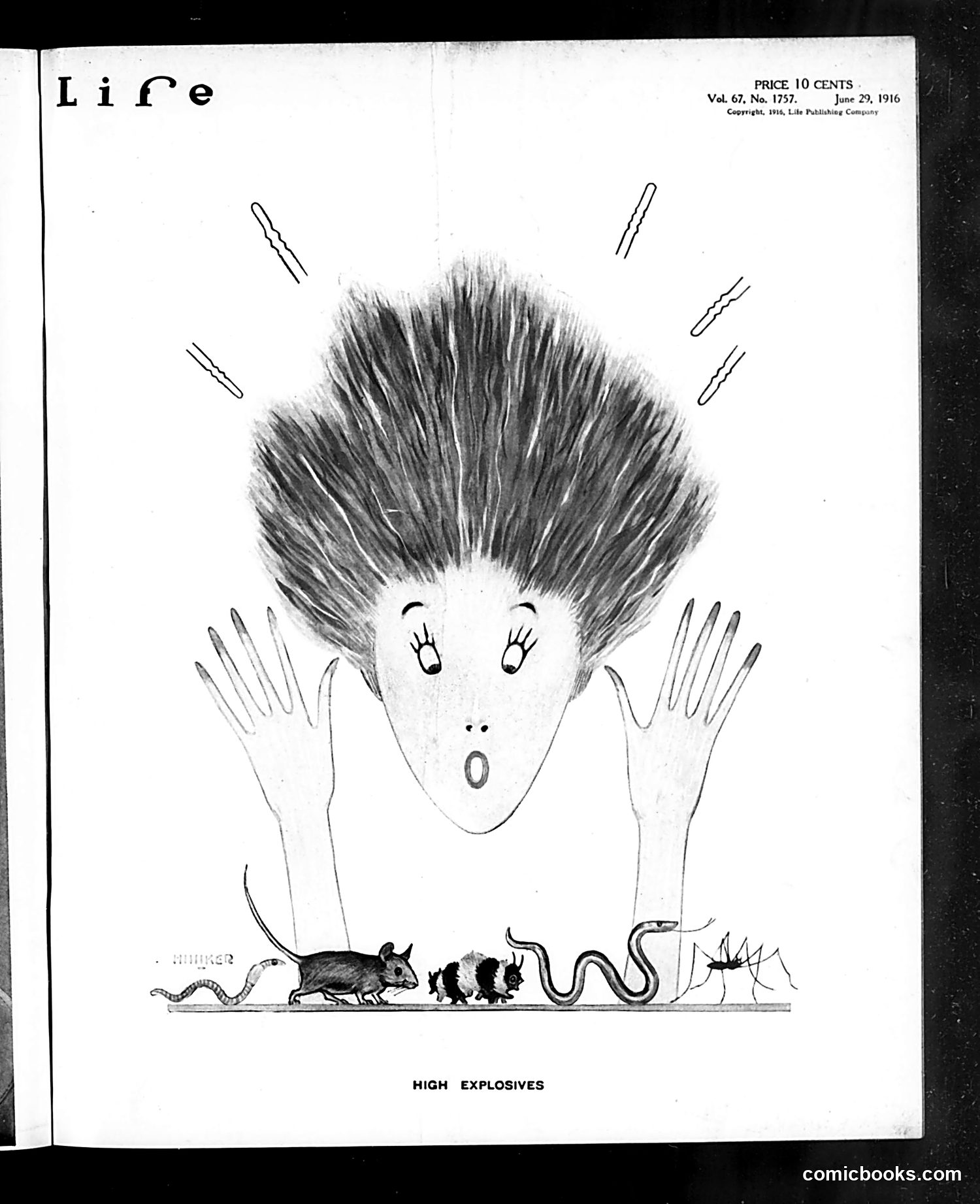
This cartoon satirizes women's hairstyles of the era, specifically the dramatic "pompadour" or volumetric updos that were fashionable during the 1910s. The illustration depicts a woman with an exaggerated, spiky tower of hair standing on end, her face showing shock or surprise. The title "High Explosives" is a pun—comparing the theatrical, attention-grabbing hairstyle to literal explosives. Around her feet are depicted various small creatures: rats, insects, and snakes, likely representing the chaos or "explosion" of fashion excess. The satire mocks both the impracticality of the era's elaborate hairstyles and perhaps the women who wore them, suggesting such fashions were literally explosive or dangerously over-the-top. This reflects contemporary anxieties about changing women's styles and social roles.
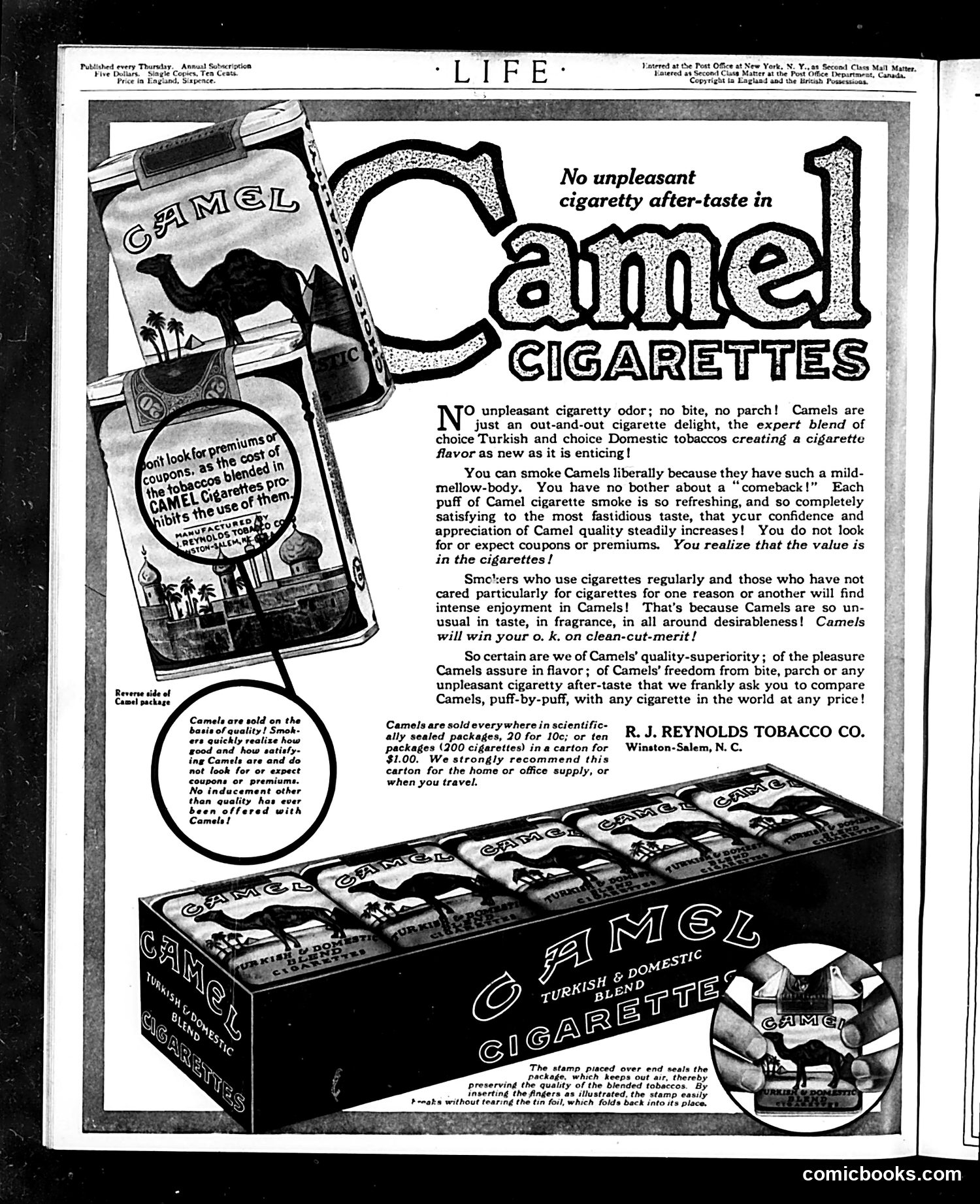
This is **not a cartoon or satire** — it's a straightforward cigarette advertisement for Camel brand, published in *Life* magazine. The ad emphasizes Camel's blend of "Turkish and choice Domestic tobaccos," highlighting that smoking Camels produces "no unpleasant cigaretty after-taste," "no bite, no parch." It appeals to both regular smokers and non-smokers by promising superior quality and flavor. The imagery shows the iconic Camel logo (a dromedary camel with palm trees) and product packaging. A circular detail explains the "stamp" sealing mechanism that "preserves the tobacco in its original freshness." This reflects early 20th-century cigarette marketing before health warnings, when tobacco companies emphasized taste and quality as primary selling points to expand their consumer base.
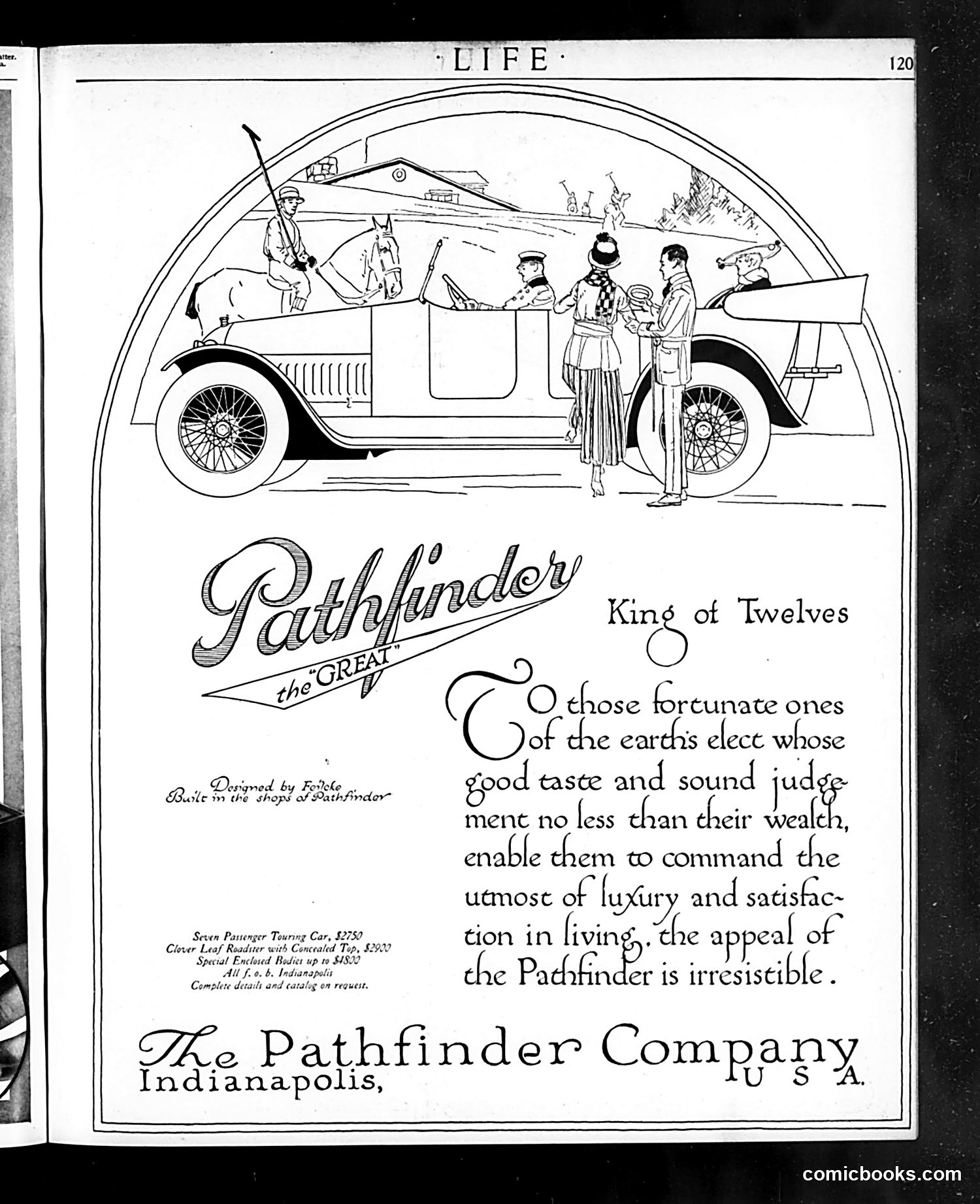
This page is primarily an **automobile advertisement** rather than political satire. It advertises the Pathfinder car, marketed as "King of Twelves" (likely referring to a 12-cylinder engine). The illustration depicts a luxury touring car with seven passengers—elegantly dressed men and women in 1920s attire, some standing, suggesting the vehicle's spacious interior. A figure on horseback appears in the background. The accompanying text employs flowery language to appeal to wealthy buyers, claiming the Pathfinder enables "the utmost of luxury and satisfaction in living" for those with both wealth and good taste. The ad lists specifications and pricing ($1,750-$1,850), and notes "Complete details and catalog on request." This represents typical early-twentieth-century automotive marketing targeting affluent consumers.
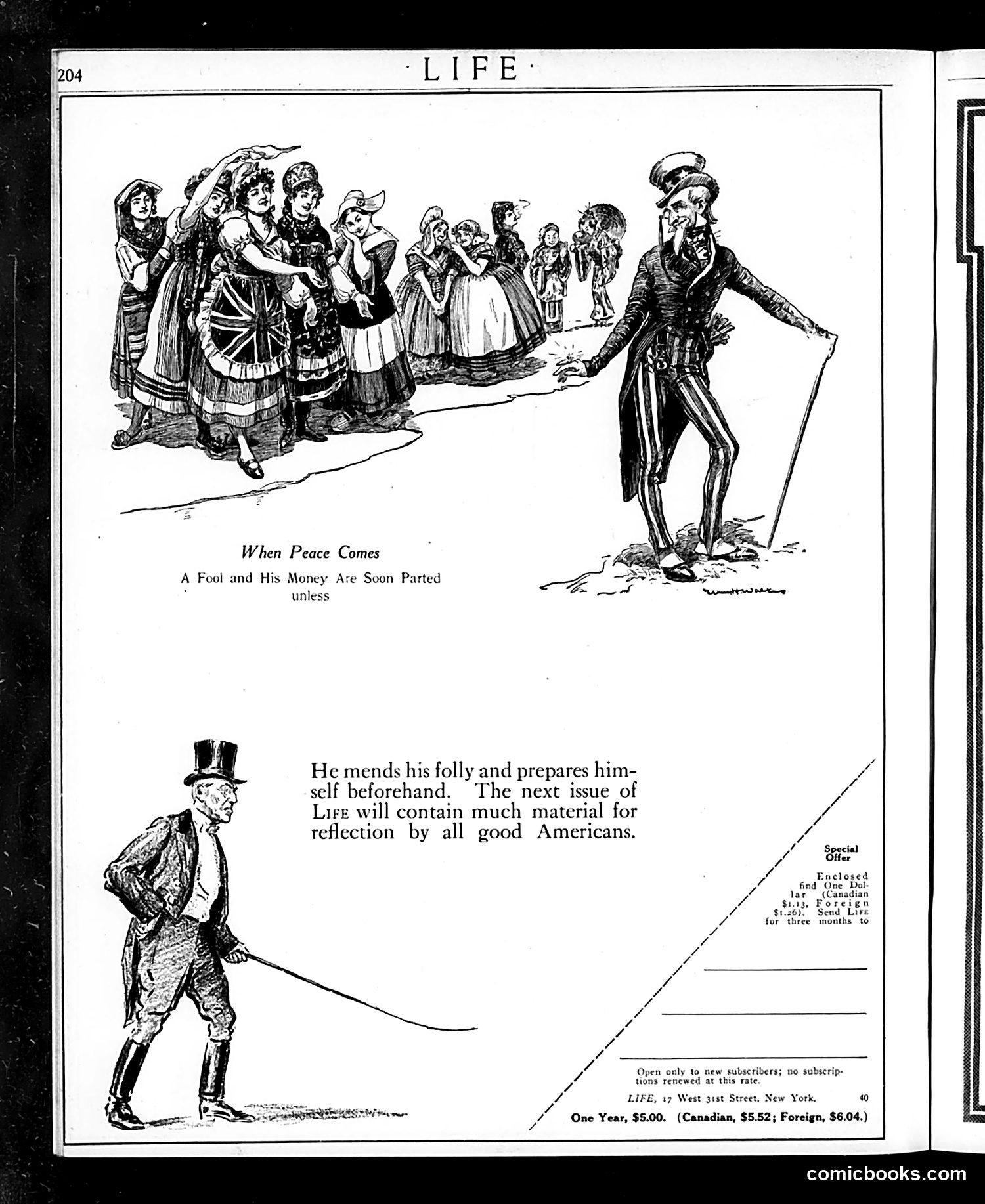
This page from *Life* magazine presents a satirical commentary on post-WWI peace negotiations. The upper cartoon depicts a military or diplomatic figure (right) addressing a group of women and civilians, with text reading "When Peace Comes / A Fool and His Money Are Soon Parted / unless / He mends his folly and prepares himself beforehand." The accompanying text promises the next issue will contain "much material for reflection by all good Americans." The lower cartoon shows Uncle Sam (identifiable by his top hat) holding a fishing line, suggesting he's being hooked or manipulated. The satire appears to warn Americans that during peacetime, they risk being financially or politically exploited unless they remain vigilant and informed. The cynical tone reflects post-WWI American skepticism about diplomatic promises and international dealings.
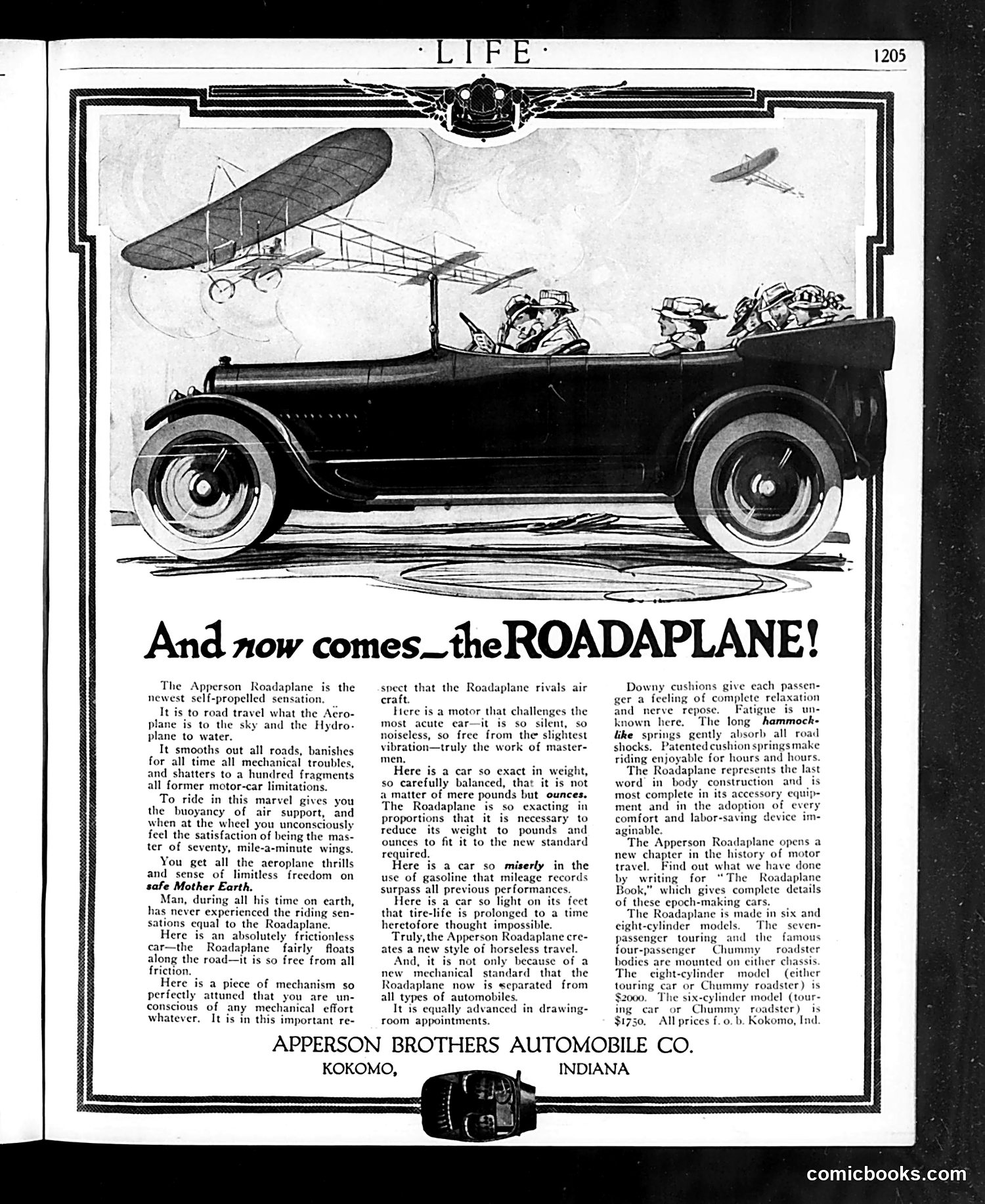
This is primarily **advertising**, not satirical content. It's a full-page advertisement for the Apperson Roadaplane, manufactured by Apperson Brothers Automobile Company in Kokomo, Indiana. The illustration depicts a fantastical vehicle combining automobile and aircraft features—a car with an airplane wing mounted above it, shown carrying passengers while small aircraft fly nearby. This reflects early-1900s optimism about emerging aviation technology. The advertising copy emphasizes the vehicle's innovative engineering: a powerful, quiet motor; exceptional lightness; advanced suspension ("Downy cushions"); and fuel efficiency. The copy positions the Roadaplane as revolutionary transportation representing progress and freedom ("safe Mother Earth"). There is no political satire present—this is straightforward automotive marketing from the era when aviation-automobile hybrids represented technological aspiration.
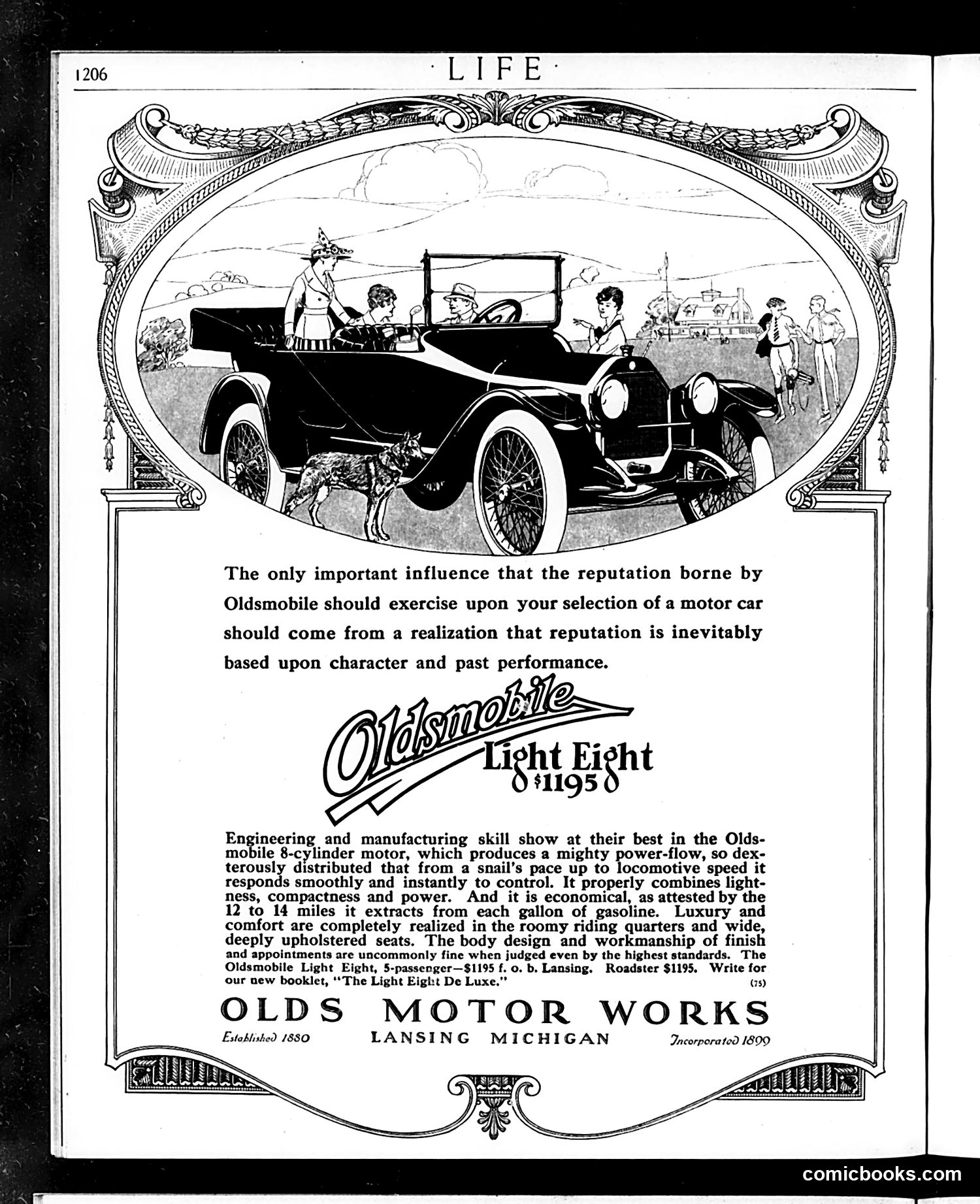
This is primarily an **advertisement**, not satire or political commentary. It's a 1910s-era Oldsmobile "Light Eight" car ad from Life magazine. The illustration depicts a fancy open-air automobile carrying well-dressed passengers on an outing, with pedestrians and a town visible in the background—imagery designed to appeal to affluent buyers. The text's main pitch emphasizes that Oldsmobile's **reputation rests on "character and past performance."** The ad highlights engineering quality, fuel efficiency ("12 to 14 miles per gallon"), and luxury features like comfortable seating. There's no political satire here. It's straightforward vintage advertising using aspirational imagery of leisure and sophistication to sell automobiles to the wealthy—typical of early-twentieth-century marketing in upscale publications.
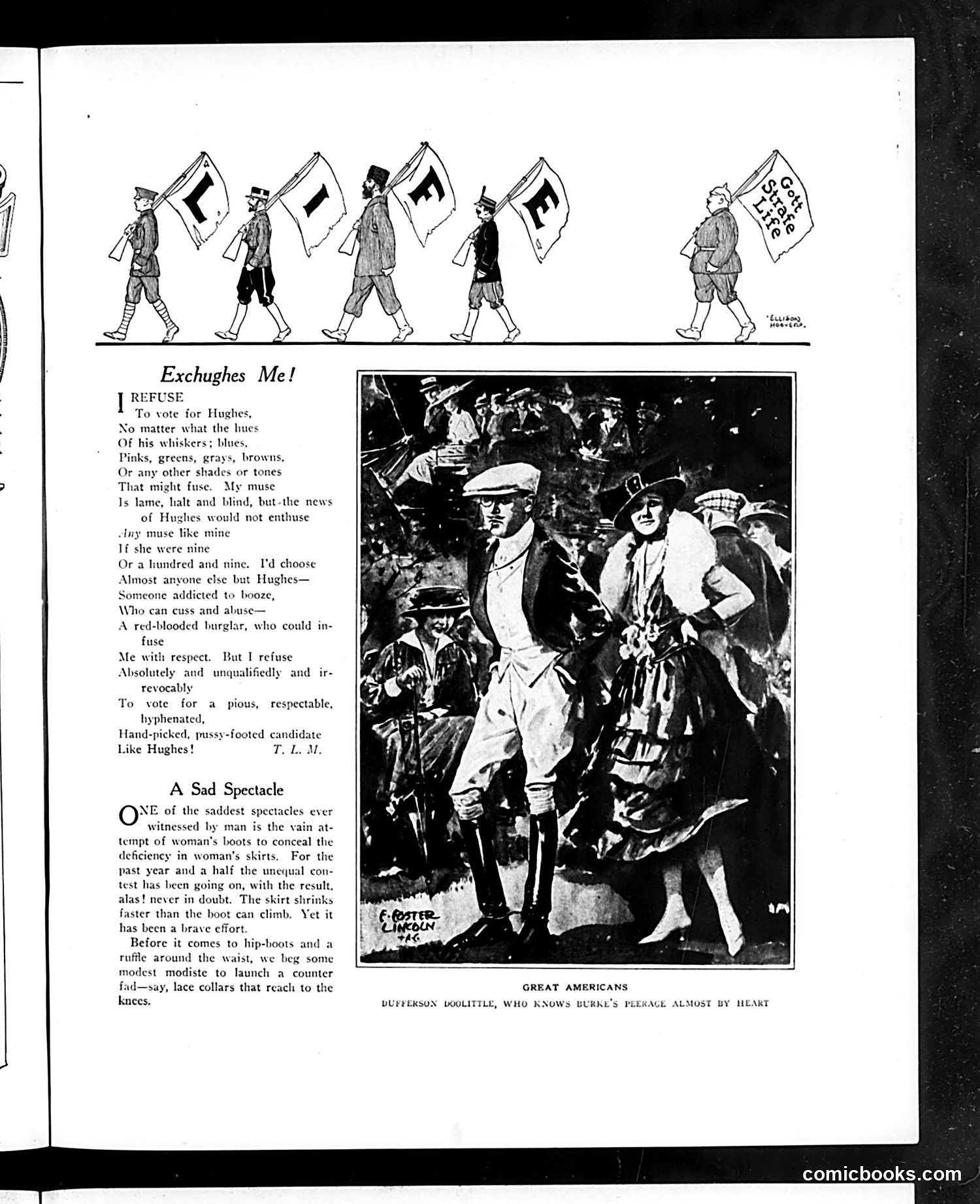
The top cartoon shows five figures carrying flags in a procession, titled "Exchanges Me!" The leftmost four carry identical flags marked with "F" (likely representing a political faction or party), while the rightmost figure carries a different banner reading "Save the Republic." The accompanying poem "I Refuse" by T.L.M. expresses refusal to vote for a candidate named Hughes based on party affiliation alone, regardless of the candidate's personal qualities. The bottom section, "A Sad Spectacle," discusses women's fashion—specifically the controversy over hemlines and skirt lengths, presenting this as a metaphor for larger social concerns. The photograph captioned "Great Americans" appears to show political figures, though specific identities aren't clear from the image alone. The overall theme critiques mindless party loyalty versus independent political judgment.
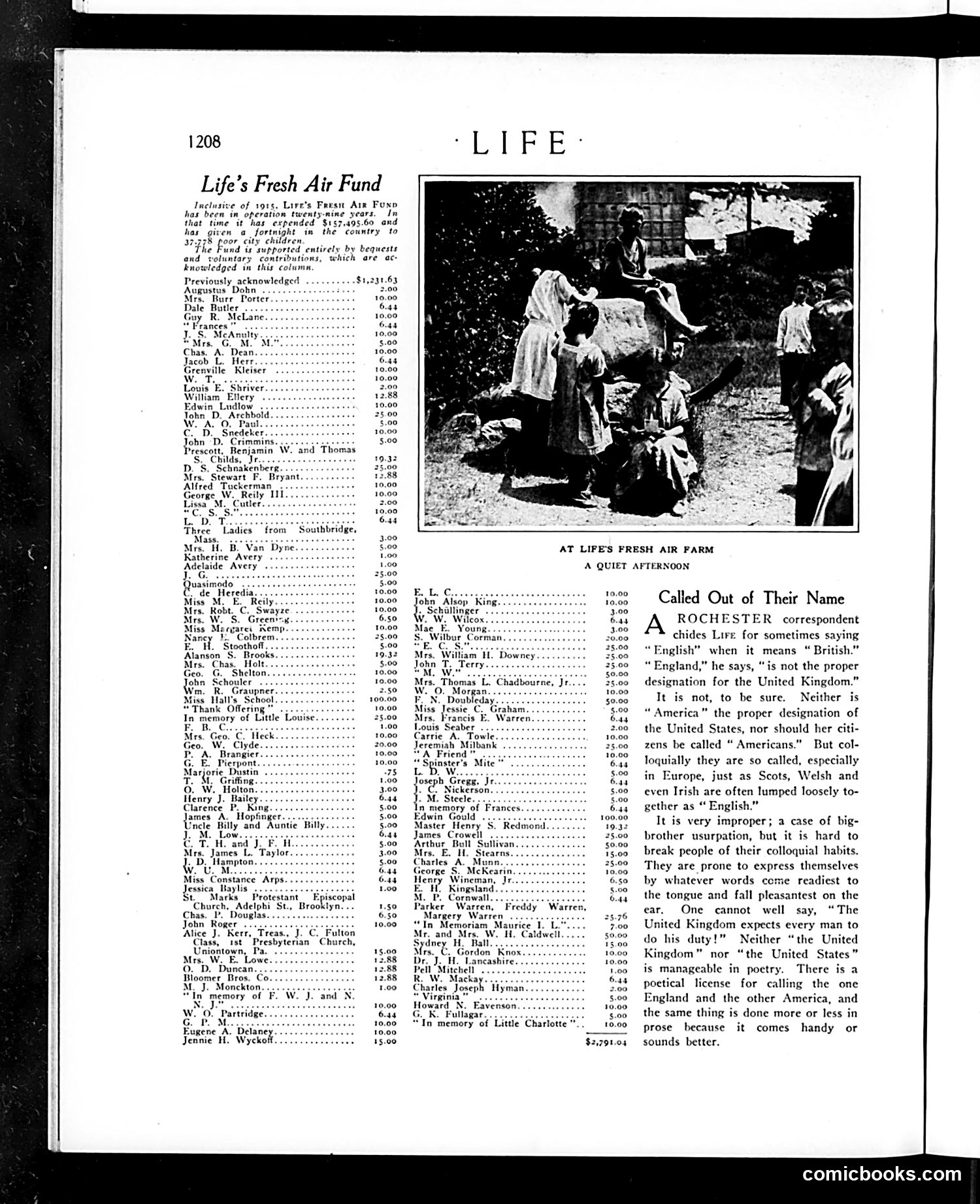
This page contains two distinct sections: **Left side:** A fundraising list for "Life's Fresh Air Fund," documenting contributions to send children to the countryside for health benefits—a common Progressive Era charitable initiative. **Right side:** An article titled "Called Out of Their Name" discussing British vs. American terminology. The accompanying photograph shows people at "Life's Fresh Air Farm" during "A Quiet Afternoon." The article's argument: British people call themselves "English" when they mean "British," while Americans misuse "American" to mean only the United States. The author argues both nations improperly narrow broader geographic terms, and that Americans especially misuse colloquial language carelessly—a jab at American linguistic habits compared to more precise British speech. This reflects early 20th-century American anxieties about cultural refinement and Anglo-American relations.
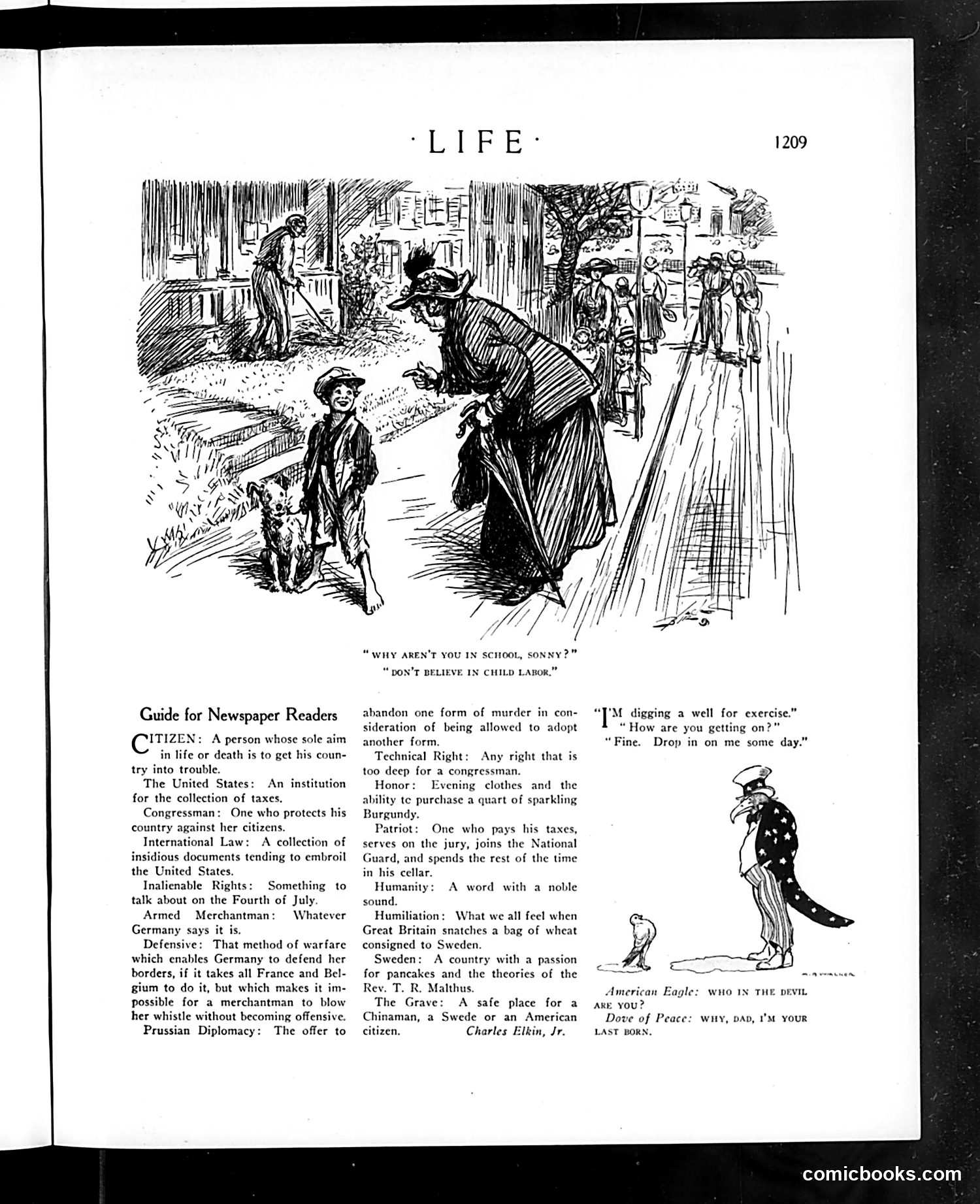
This page from *Life* magazine contains two distinct elements: **Top Cartoon:** Shows a street scene where an adult confronts a child laborer, asking "Why aren't you in school, Sonny?" The child replies "Don't believe in child labor." This is satirical commentary on child labor practices—the joke inverts expectations by having the child reject the very exploitation he's experiencing, highlighting the absurdity of widespread child labor in industrial America. **Bottom Section:** A "Guide for Newspaper Readers" that sardonically defines political and patriotic terms. Entries mock concepts like "Congressman" (protects country against citizens) and "Patriot" (pays taxes, serves jury duty, spends rest of time in cellar). The satire critiques hollow patriotic rhetoric and government hypocrisy during what appears to be World War I era.
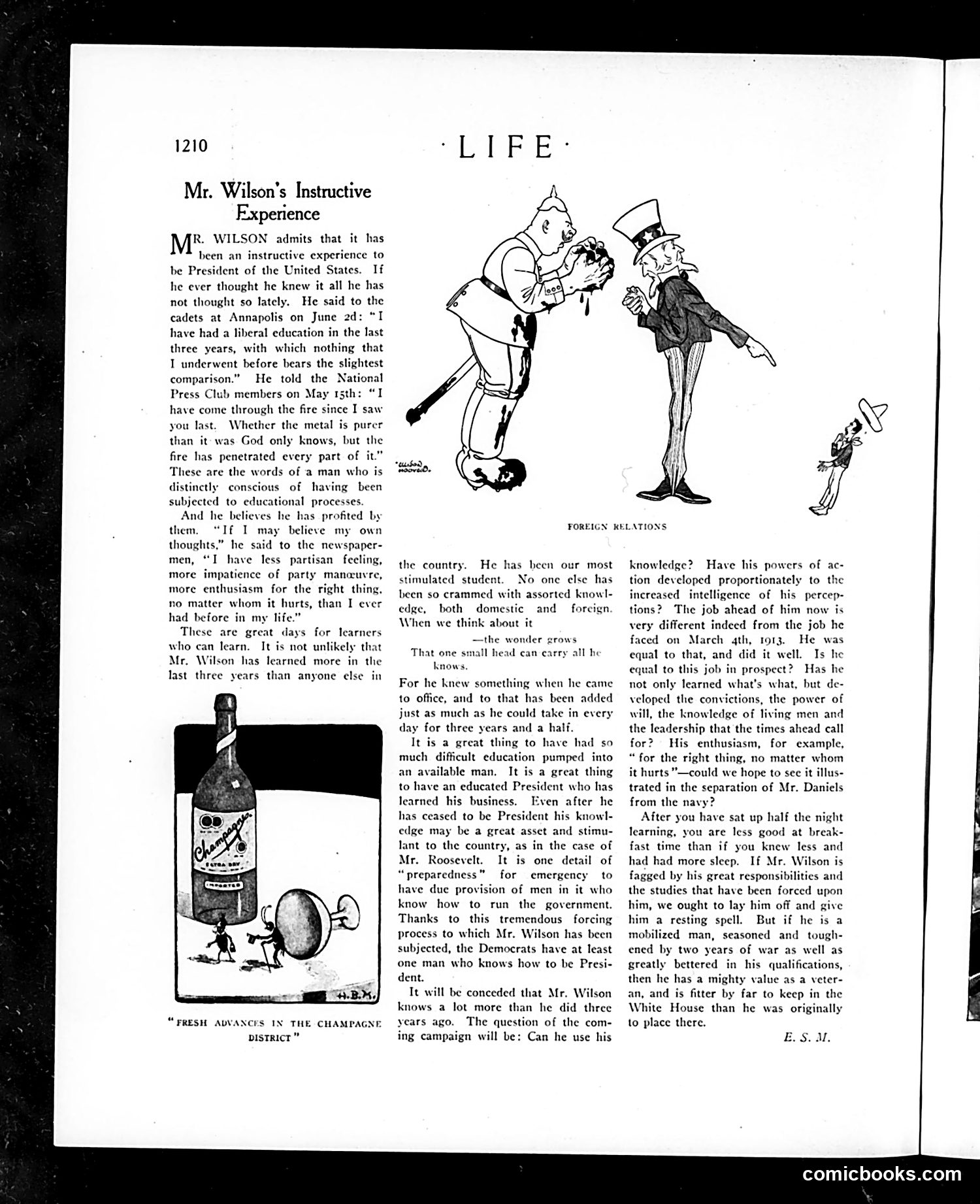
This page satirizes President **Woodrow Wilson's** preparedness for office. The left cartoon, captioned "Fresh Advances in the Champagne District," depicts a military figure wrestling with a large champagne bottle—likely mocking Wilson's learning curve during World War I. The main article praises Wilson's three years of experience as an "instructive" education, noting he's learned more than expected. However, the right cartoon presents a contrasting view: a tall, thin Uncle Sam figure appears condescending toward a smaller military officer, suggesting skepticism about whether Wilson's experience truly qualified him. The satire questions whether Wilson adequately prepared for his presidential responsibilities, particularly regarding foreign relations and military matters during wartime.
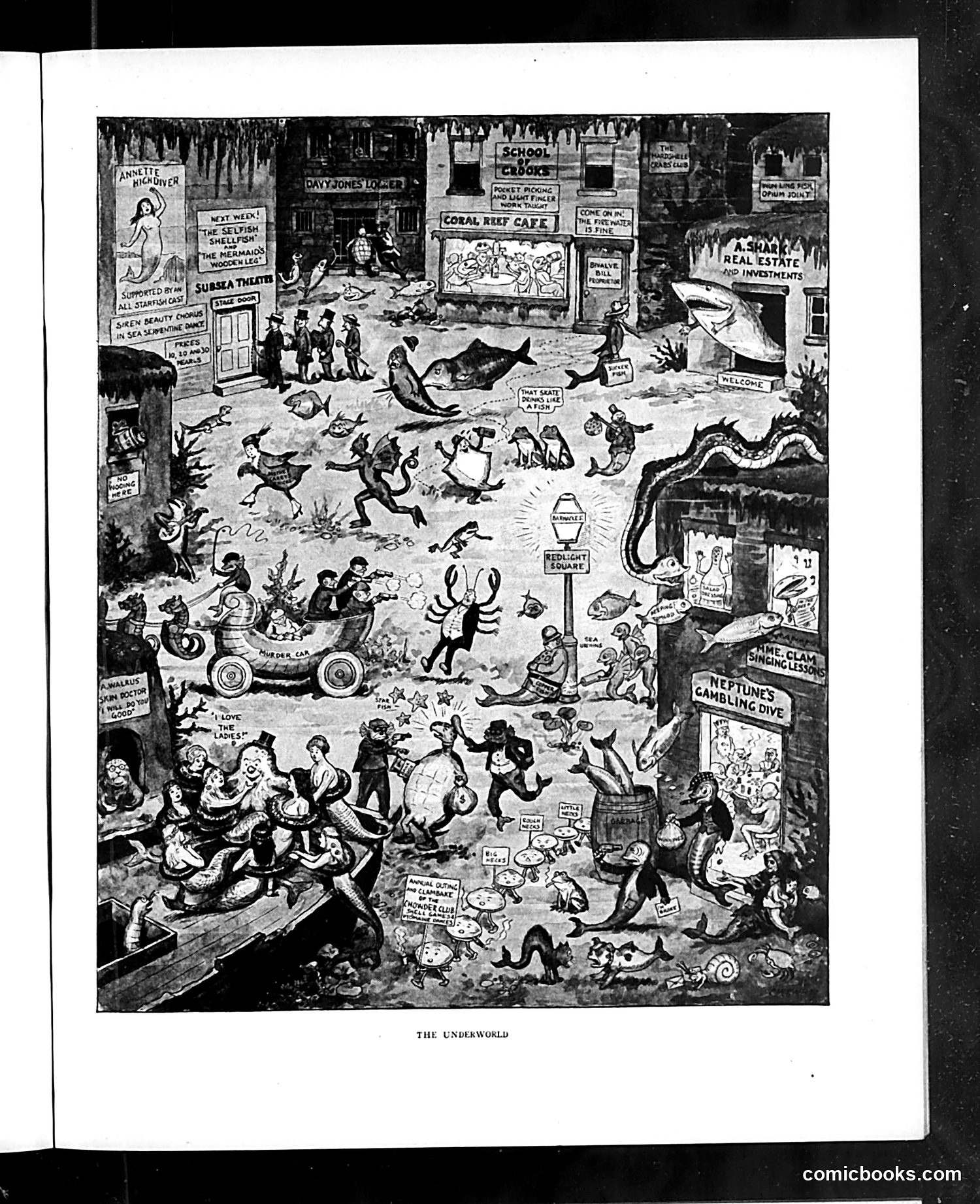
This satirical illustration depicts an underwater city inhabited by fish, octopuses, and other sea creatures operating human institutions. The cartoon shows an elaborate parody of surface society: storefronts advertise "Coral Reef Cafe," "School Crooks," and "Neptune's Calling Dive"; characters engage in typical urban activities like shopping, dining, and entertainment. The satire appears to mock contemporary city life and human civilization by presenting it through an absurdist lens—suggesting that underwater creatures operate society with the same follies, commercialism, and social structures as humans. The dense, chaotic composition filled with countless characters emphasizes the complexity and crowdedness of modern urban existence, presented here as fundamentally ridiculous when mirrored by fish.
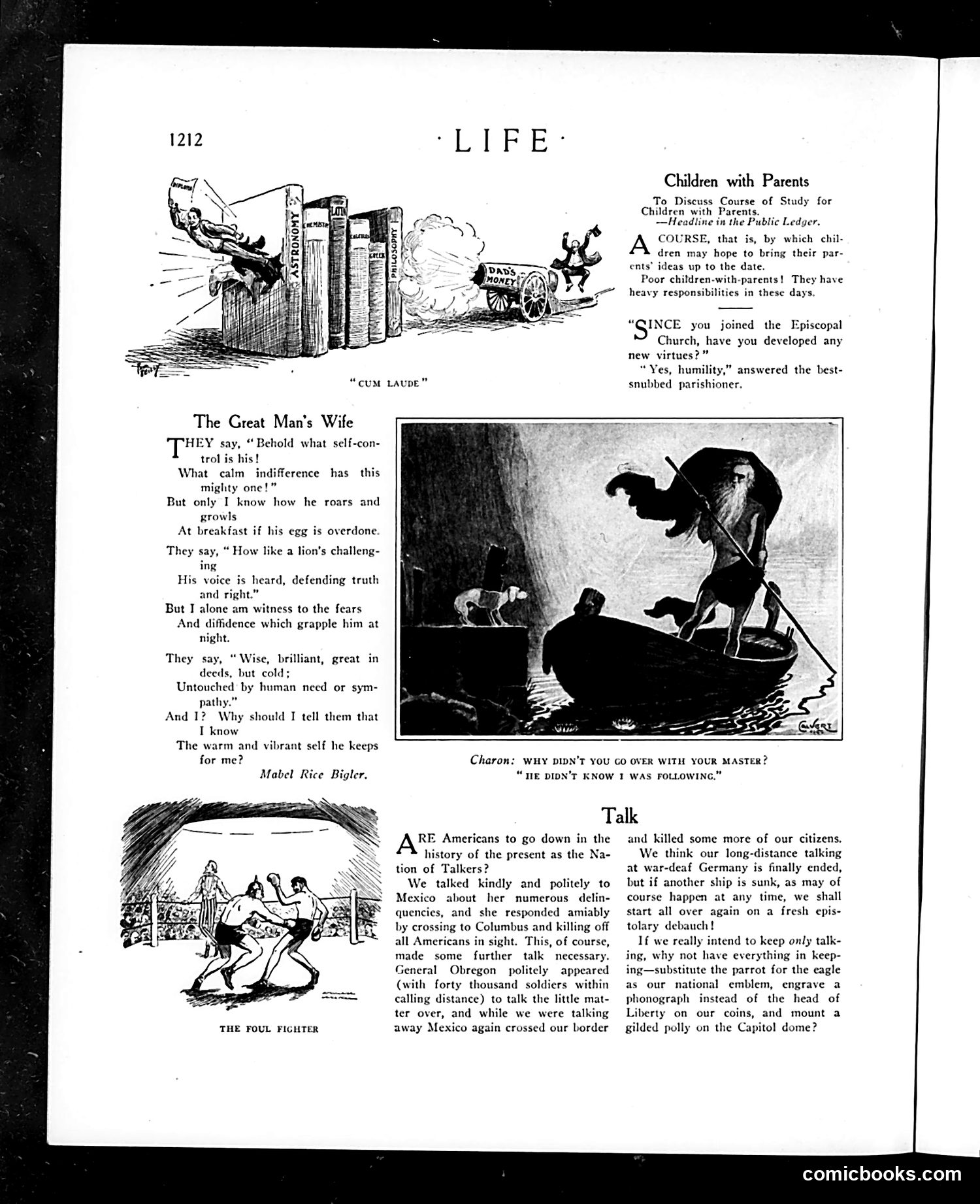
This Life magazine page contains satirical commentary on American discourse around World War I. The cartoon titled "Talk" criticizes Americans' endless talking about foreign policy. It references discussion of Mexico's "numerous delinquencies" and General Oregón's forces near the border, suggesting Americans debated military intervention while doing little. The piece mocks this tendency to talk endlessly about replacing national symbols—suggesting we discuss swapping the eagle on coins for a parrot as "our national emblem" because Americans are such talkers. The other content includes a poem "The Great Man's Wife" (by Mabel Rice Bigler) and classical mythological cartoon "The Foul Fighter." These appear less politically charged, focusing instead on domestic and timeless themes rather than immediate wartime concerns.
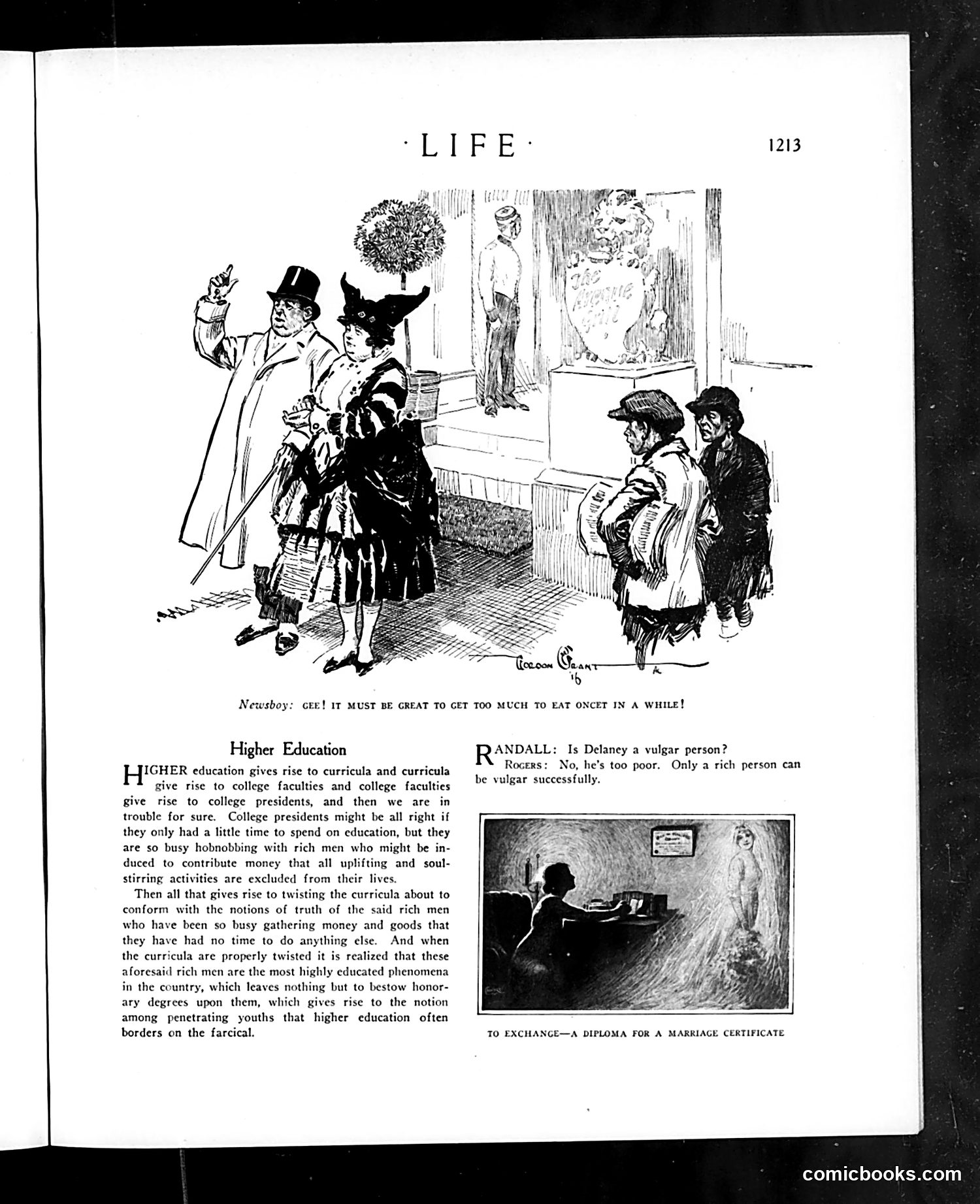
The top cartoon depicts wealthy socialites at what appears to be an art gallery or cultural venue. The caption "Newboy: CUT! IT MUST BE GREAT TO GET TOO MUCH TO EAT ONCE IN A WHILE!" mocks the pretentiousness of the scene—a street urchin comments on the affluent people's excessive consumption. The accompanying essay "Higher Education" satirizes how universities cater to wealthy donors rather than genuine scholarship. It argues that college curricula are twisted to flatter rich benefactors, leaving these wealthy graduates poorly educated despite their "honorary degrees." The bottom cartoon, captioned "TO EXCHANGE—A DIPLOMA FOR A MARRIAGE CERTIFICATE," shows a woman trading educational credentials for matrimony, mocking the notion that higher education for women serves primarily as a path to advantageous marriage rather than intellectual pursuit.
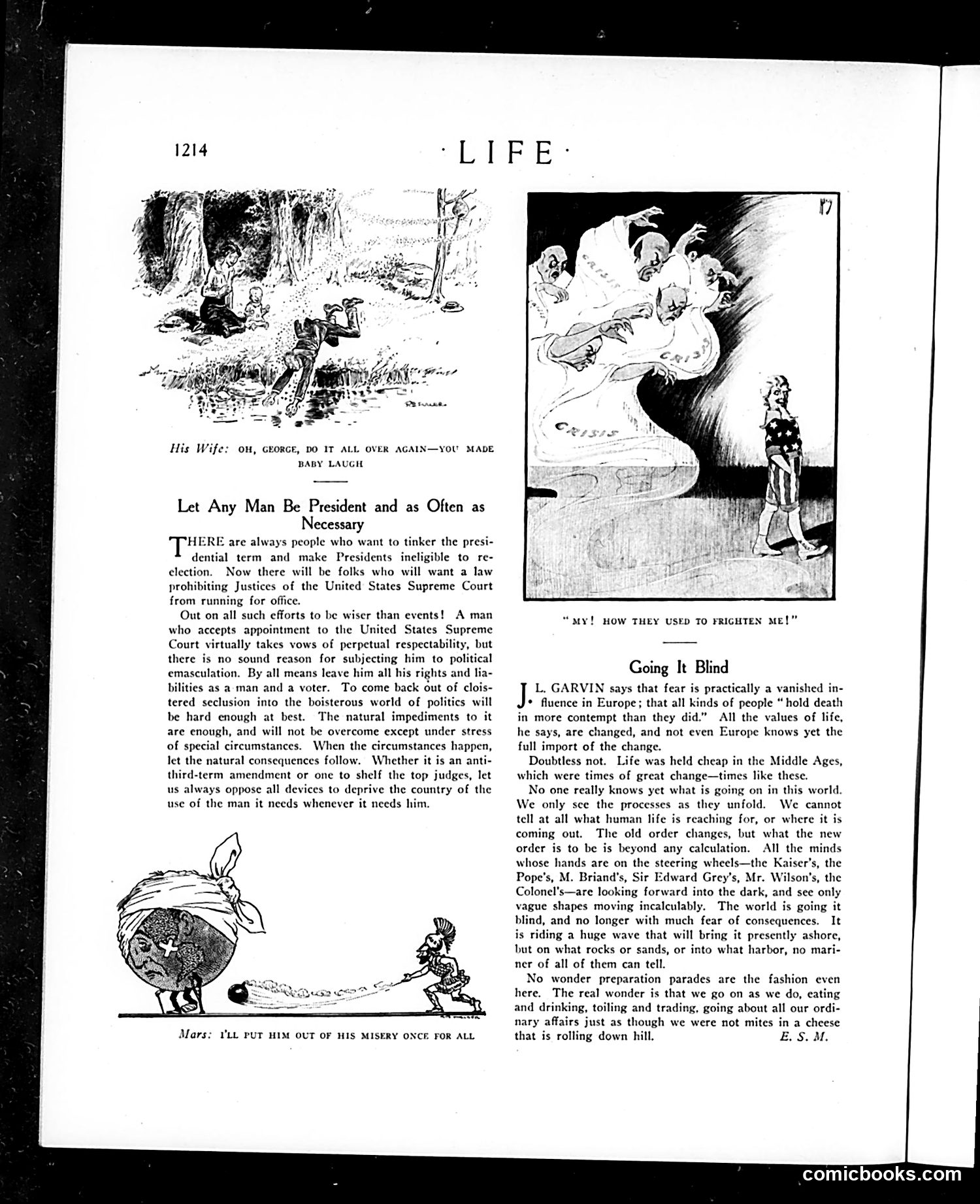
**Top cartoon:** Shows a man covered in mud after apparent domestic chaos. His wife says "Oh, George, do it all over again—you made baby laugh." The joke satirizes masculine incompetence at domestic tasks—the husband created mess but accidentally entertained the child, so she wants him to repeat the mishap. **Article "Let Any Man Be President":** Argues against restricting Supreme Court justices from running for office, advocating for merit-based leadership rather than arbitrary term limits. **"Going It Blind" article:** References J.L. Garvin discussing European uncertainty about post-WWI changes. The accompanying illustration shows a child frightened by a large, looming figure, metaphorically representing widespread anxiety about an unknowable future during a period of massive social upheaval.
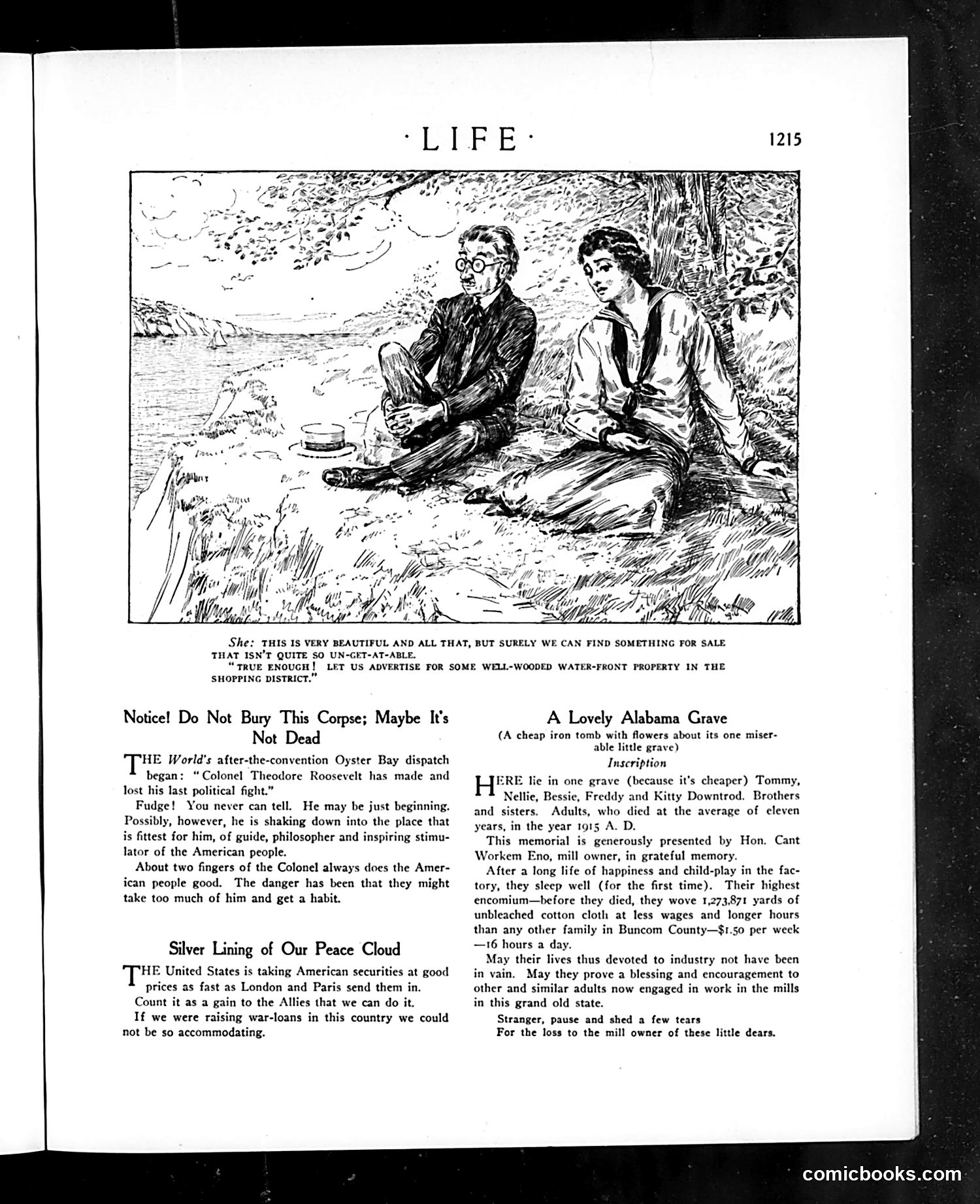
The top cartoon depicts two men on a beach discussing real estate. One wears glasses and formal attire; the other is dressed casually. The caption suggests they're trying to sell waterfront property in a shopping district—satirizing opportunistic post-convention real estate speculation. The three articles below address serious post-WWI topics: Colonel Theodore Roosevelt's continued political influence, a memorial to child mill workers in Alabama who died at age eleven after grueling factory labor, and American financial securities being sold to Allied nations to fund war efforts. The satire targets profiteering and exploitation during the World War I era—contrasting trivial beach-front sales schemes with grave human costs: child labor deaths and wartime financial schemes benefiting the wealthy.
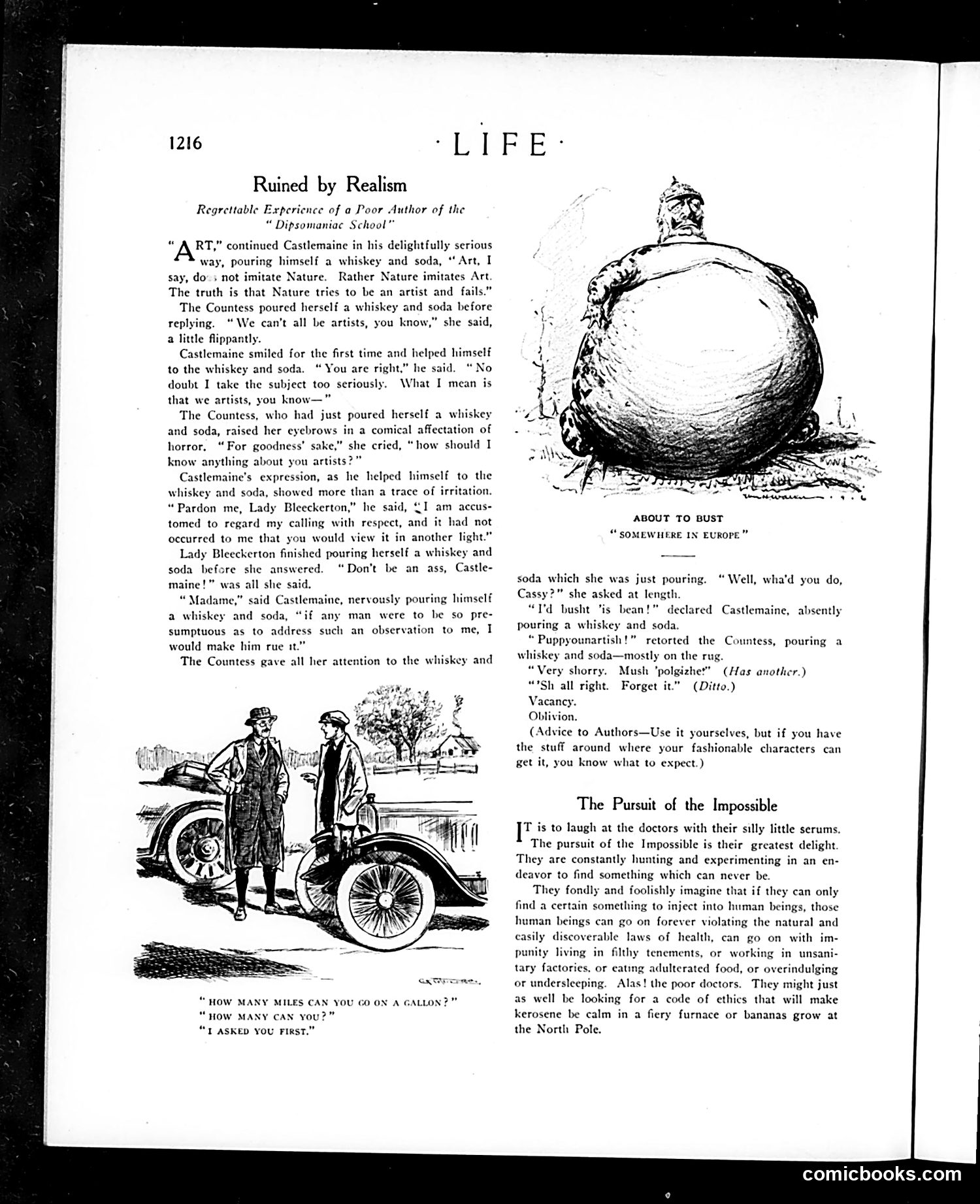
This is a two-part satirical piece mocking pretentious artists and impractical doctors. **Upper story**: A pompous author named Castlemaine lectures a Countess about art imitating nature—while repeatedly pouring himself whiskey and soda. The joke escalates as both characters drink increasingly, their speech deteriorates ("T'd busht 'is bean"), and they become oblivious drunk. The satire targets authors of the "Dipsomaniac School" (literally alcohol-obsessed writers) who produce high-minded artistic philosophy while being functional alcoholics. The irony: Castlemaine proves art *does* imitate nature—specifically, natural human degradation. **Lower section ("The Pursuit of the Impossible")**: A separate editorial mocks doctors for seeking medical solutions to social problems. It argues their "serums" are futile because poor health results from bad living conditions (tenements, factories, adulterated food), not curable disease. Doctors chase impossible cures rather than addressing actual causes—like making "kerosene calm in a fiery furnace." Both pieces critique professional pretension masking futility.
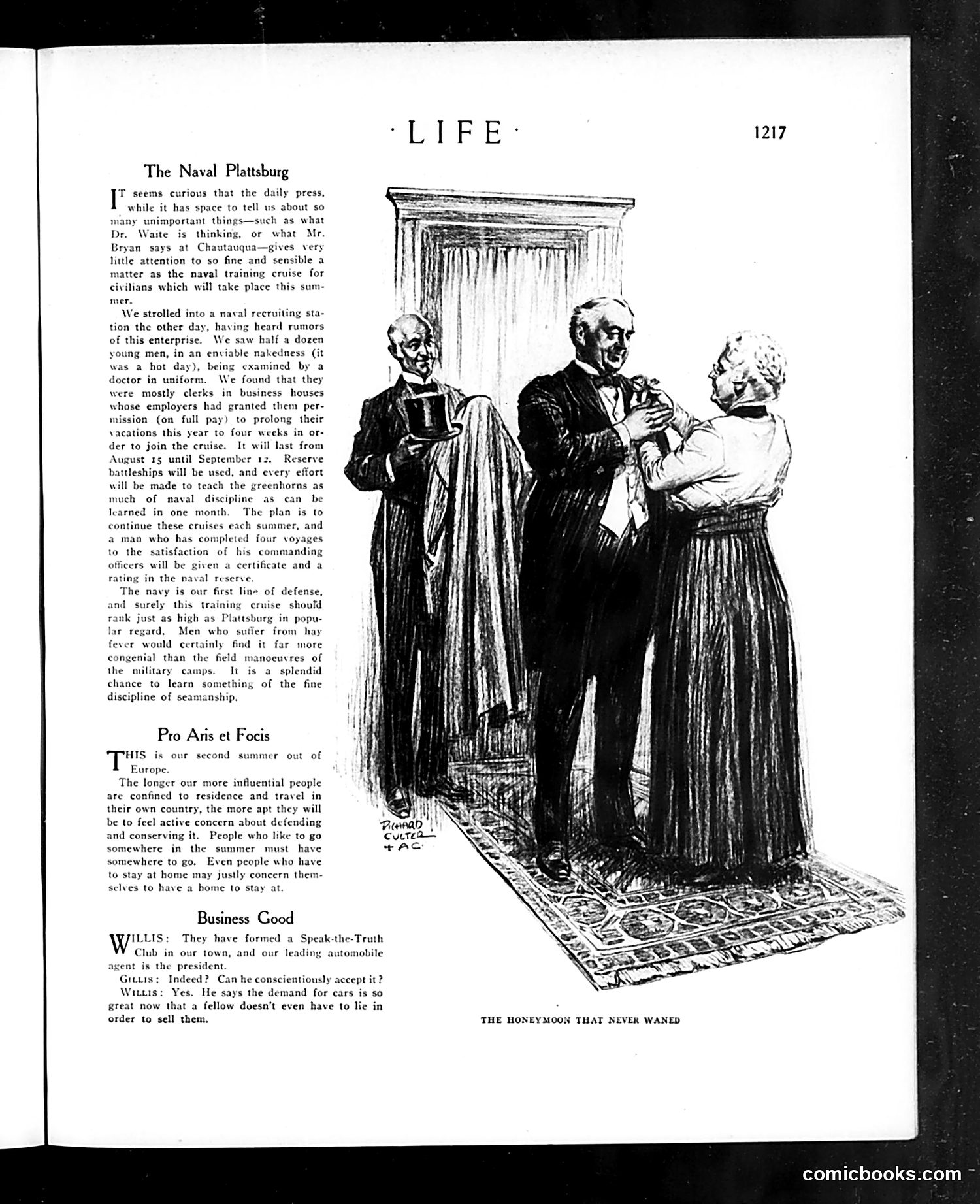
This Life magazine page contains three distinct items: **"The Naval Plattsburg"** discusses a naval training cruise for civilians—a summer program where business clerks could take four-week naval reserve training on battleships (August-September). The article argues this deserves as much public attention as the Plattsburg military training camp, offering an appealing alternative for those with health concerns. **"Pro Aris et Focis"** (Latin: "for hearth and home") addresses Europeans confined to America during wartime (likely WWI-era), arguing prolonged domestic residence makes citizens more invested in defending their country. **"Business Good"** is a humorous dialogue: Willis's town has formed a "Speak-the-Truth Club" led by an automobile dealer. When questioned if he can ethically accept this role, Willis jokes that car demand is so high the dealer "doesn't even have to lie in order to sell them"—satirizing both automobile salesmen's reputation for dishonesty and wartime economic prosperity. The accompanying illustration shows a couple examining a carpet—captioned "The Honeymoon That Never Waned"—likely related to one of these sections, though the connection remains unclear.
This editorial-cartoon page satirizes the U.S. government's escalating tensions with Mexican leader Carranza as a convenient political tool. The author argues that conflict with Mexico serves as useful military "practice" during an election year when politicians compete to appear patriotic and prepared for war. The piece mocks how both major parties (Democrats and Republicans) have adopted nearly identical platforms emphasizing "Americanism and preparedness," leaving little substantive difference between them. The author notes that actual military conflict would inject real drama into an otherwise bland campaign. The page also references Wilson's League to Enforce Peace proposal, quoting Bryan's skepticism about international involvement—a central debate of 1916. The overall tone is cynically pragmatic: rather than deplore potential war, the writer frames Mexican conflict as convenient timing for testing America's military readiness before the November election.
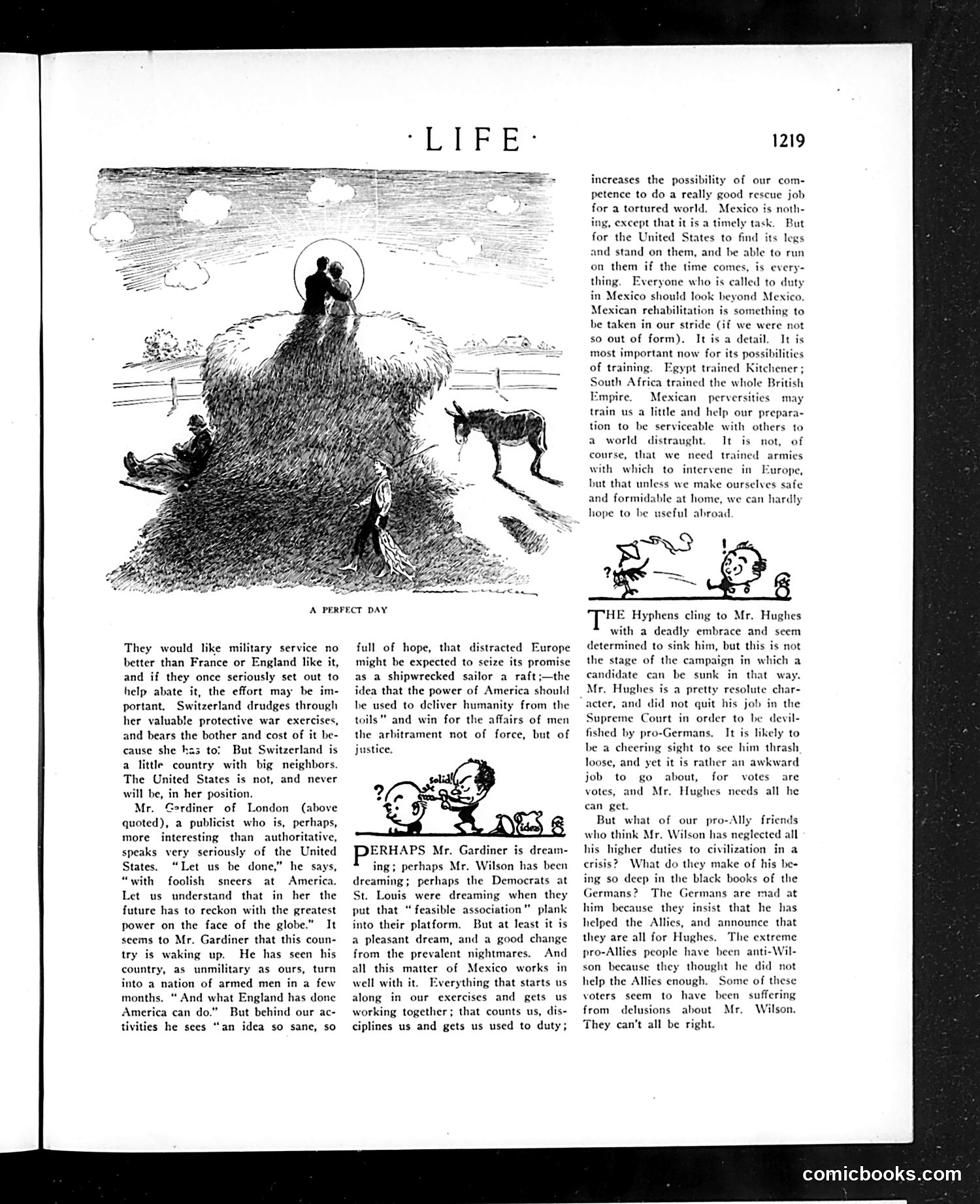
This 1919 page discusses American military preparedness and the 1916 presidential election. The main cartoon, "A Perfect Day," depicts an idealized pastoral scene symbolizing America's potential strength. The text argues that U.S. military training—currently being tested through intervention in Mexico—serves a larger purpose: preparing America to be a responsible world power capable of enforcing justice rather than force in international affairs. It references President Wilson's vision of a "feasible association" (likely referring to what would become the League of Nations). The page also discusses Charles Evans Hughes (the Republican challenger) being attacked by "Hyphens"—a period term for German-American and other ethnic voters seen as having divided loyalties. Ironically, Germans opposed Hughes because they believed Wilson had secretly aided the Allies, while pro-Allied Americans criticized Wilson for insufficient support. The satire highlights this impossible political position: Wilson was simultaneously accused of being both pro-German and pro-Allied.
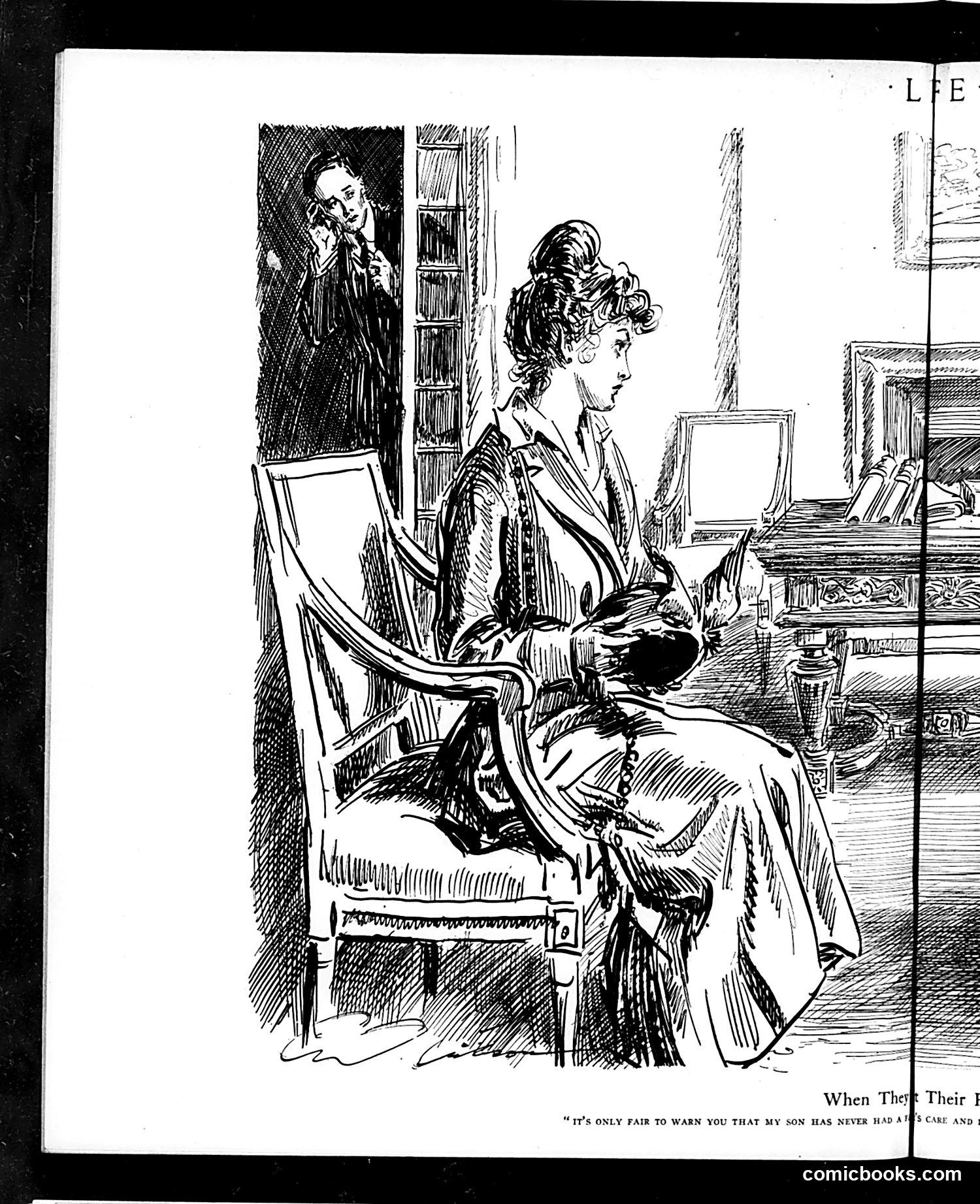
This is a domestic comedy illustration depicting a conversation between a woman seated in a parlor and a man in the doorway (visible in shadow in the background). The woman, dressed in early 20th-century attire, appears to be warning the man about her son's lack of proper care or upbringing—the caption's incomplete text suggests she's cautioning him about the boy's behavior or character defects. The satire targets parental anxiety and social expectations around child-rearing. The woman's formal warning implies concern that the son's inadequate upbringing makes him unsuitable—possibly as an employee, suitor, or associate. The joke lies in her blunt, almost apologetic disclosure of her parental shortcomings, reflecting period anxieties about social propriety and the consequences of poor maternal supervision. The illustration's refined interior setting contrasts with her admission of failure.
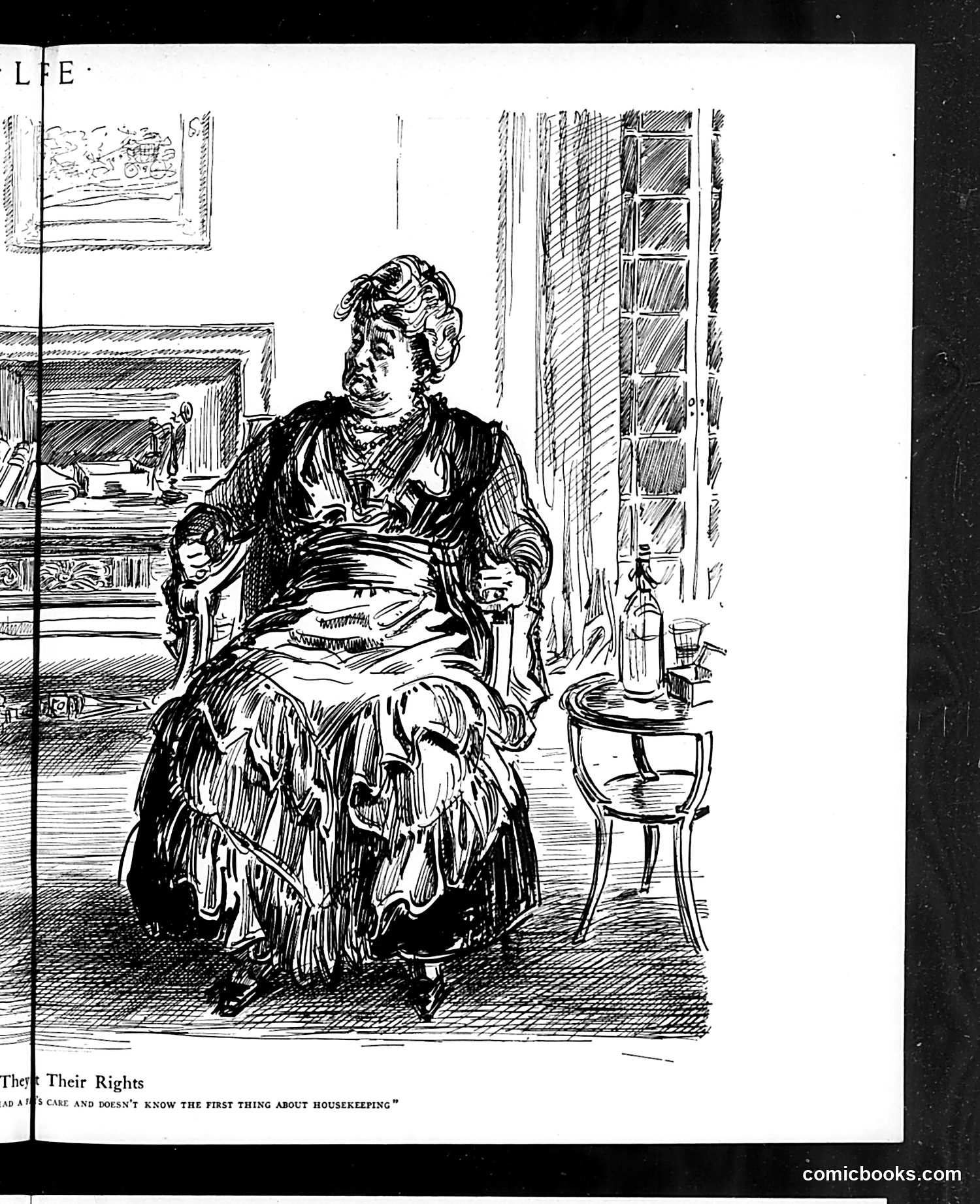
This appears to be a satirical cartoon from Life magazine titled "Their Rights" commenting on women's roles and education. The image shows a woman seated indoors, depicted in a somewhat unflattering manner with exaggerated features typical of period caricature. The caption's reference to someone who "cares and doesn't know the first thing about housekeeping" suggests the satire targets educated women—possibly advocates for women's rights or higher education—by mocking their domestic incompetence. This reflects early-20th-century debates about women's education and suffrage, where opponents argued that educated women neglected traditional homemaking duties. The cartoon appears to mock feminist aspirations by suggesting education made women unsuitable for domestic roles, a common anti-suffrage argument of the era.
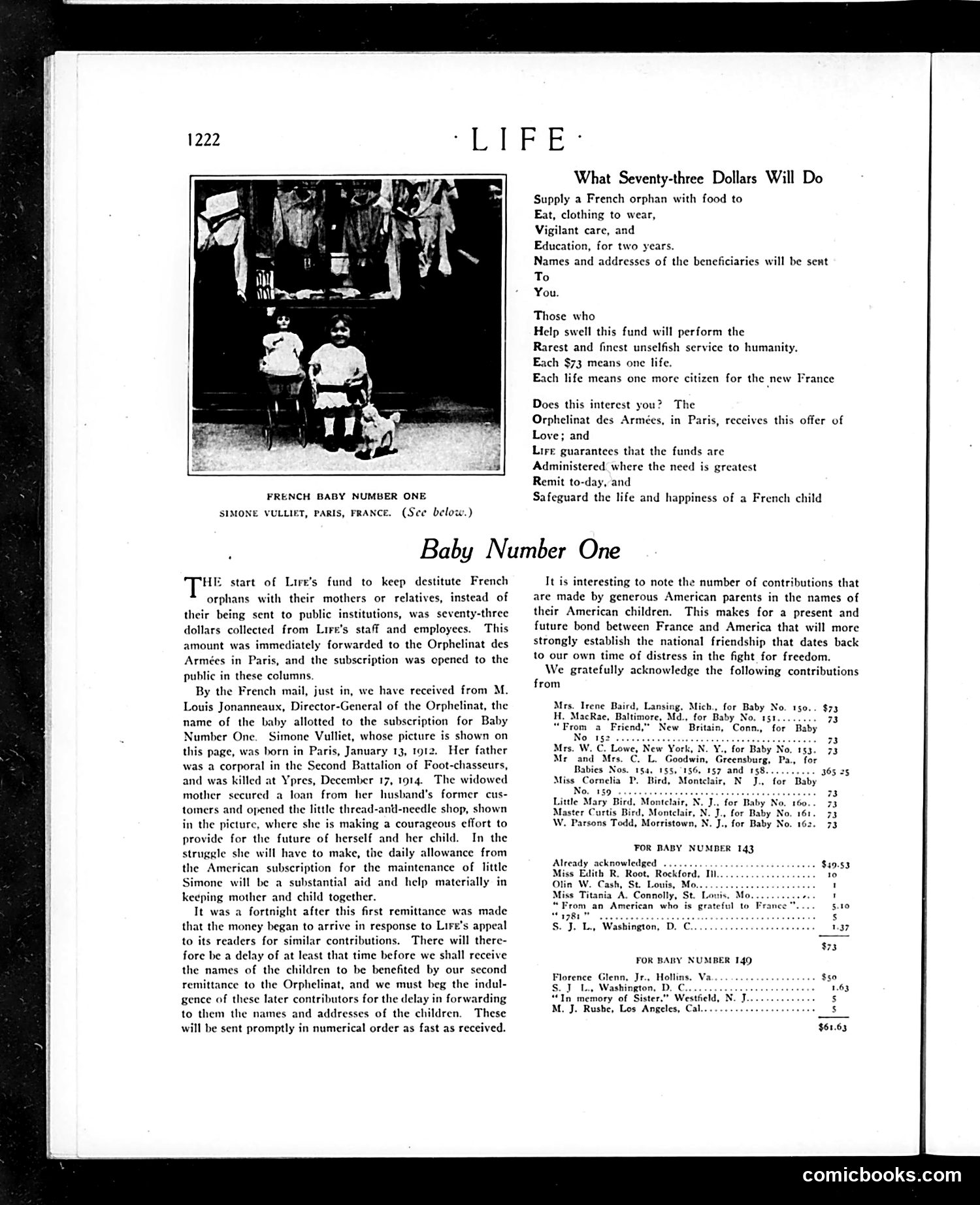
This is not a cartoon but a charitable fundraising appeal from *Life* magazine, likely published during World War I (context: references to soldiers killed at Ypres in 1914). The page shows an actual photograph of **Simone Vulliet**, a French orphan born in 1912 whose father died in combat. *Life* solicited $73 donations from American readers to support French war orphans for two years, coordinated through the *Orphelinat des Armées* (Army Orphanage) in Paris. The appeal emphasizes that contributions directly help keep orphans with surviving relatives rather than institutionalizing them. The text highlights American donors' patriotic generosity—noting that some contribute in their own children's names, creating an emotional bond between nations. Listed below are actual donors who funded multiple children, demonstrating the campaign's success. This represents *Life's* post-war humanitarian advocacy and appeal to American readers' sympathies for European war victims.
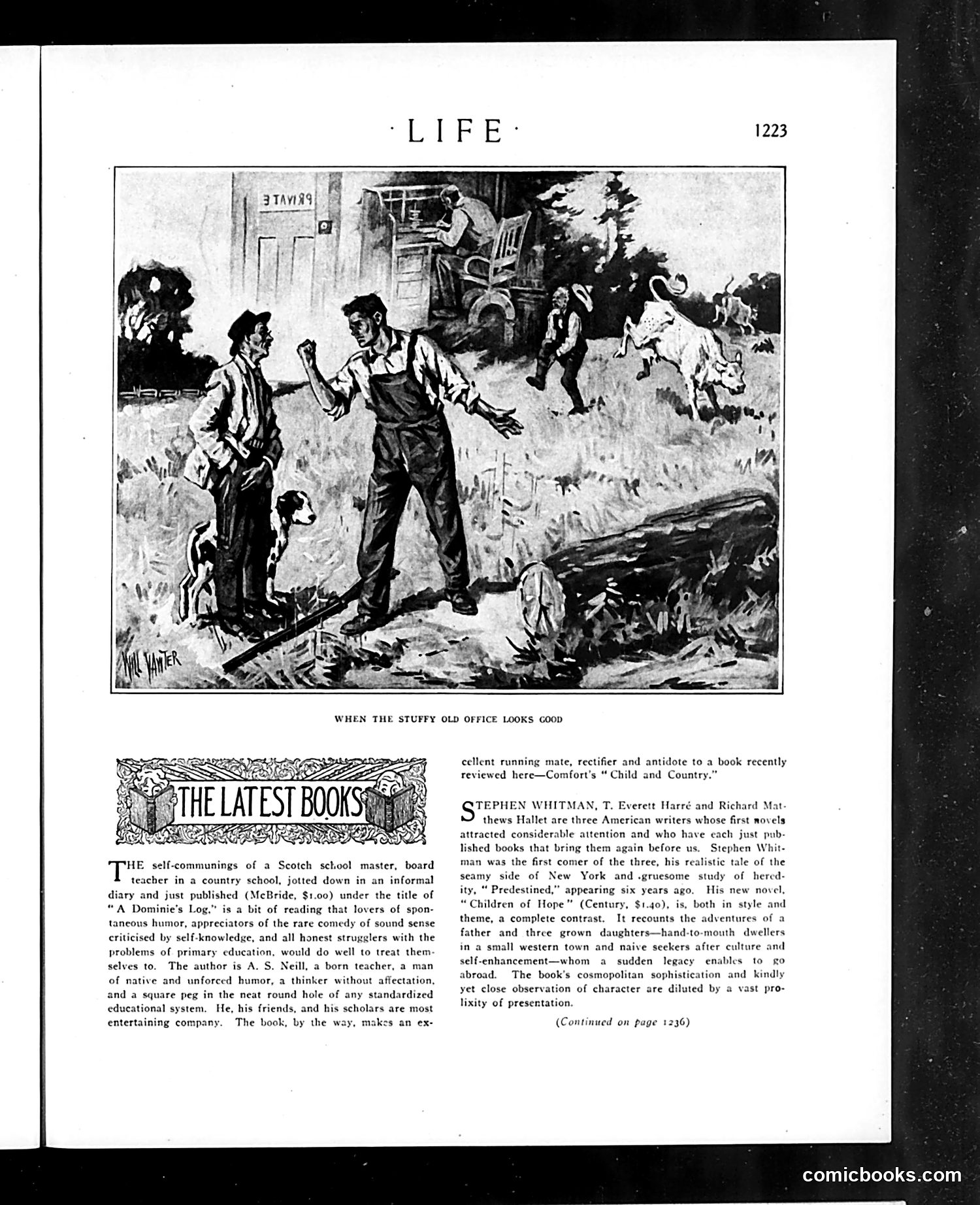
This cartoon depicts men discovering an old, abandoned office building or structure in a rural/outdoor setting. The title suggests the humor: these men are so exhausted or dissatisfied with their current circumstances that even a decrepit "stuffy old office" appears appealing to them—a commentary on the contrast between urban workplace tedium and rural or outdoor hardship. The page primarily reviews books, particularly "A Dominie's Log" by A.S. Neill (a Scottish schoolmaster's diary) and novels by Stephen Whitman, T. Everett Harré, and Richard Matthews Hallet. The cartoon's meaning depends on whether it illustrates one of these books or serves as standalone social satire about work versus nature. Given the rural setting and men's apparent relief, it likely satirizes early-20th-century attitudes about urban versus rural life—the ironic appeal of monotonous office work compared to backbreaking farm or outdoor labor.
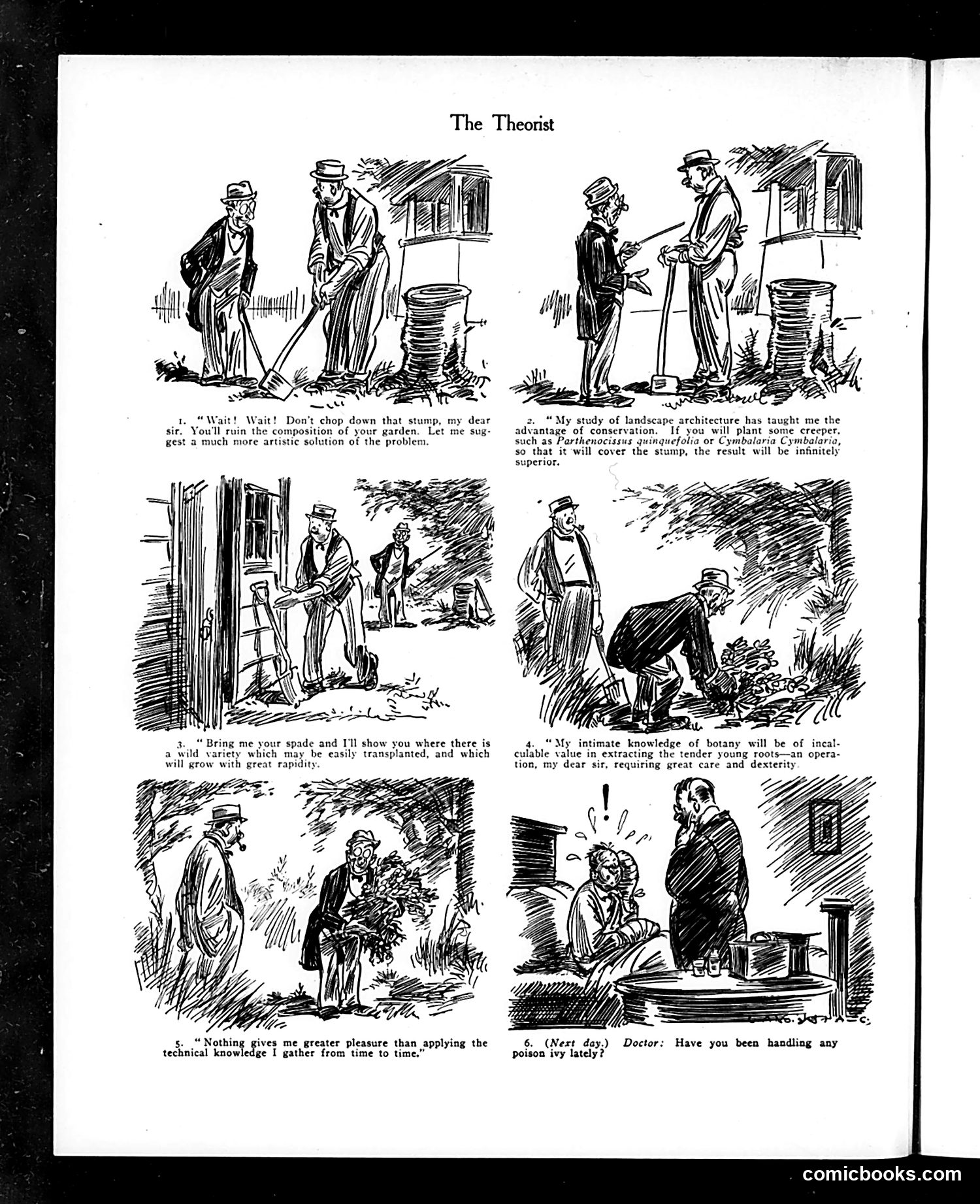
This satirical comic mocks a pretentious amateur who lectures a homeowner about removing a garden stump. The "theorist" pontificates using grandiose botanical and architectural terminology—citing Latin plant names and principles of "landscape architecture" and "conservation." The joke builds across six panels: the theorist offers increasingly elaborate "solutions" involving creeping vines and careful root extraction, impressing himself with his technical knowledge. The punchline arrives when the doctor asks if the theorist has been handling poison ivy—implying his "expert" work has resulted in a nasty rash, undermining all his pretentious posturing. The satire targets a recognizable type: the self-important amateur who uses jargon to seem knowledgeable while producing poor practical results. His flowery language and false expertise contrast sharply with the simple problem (removing a stump) and the humiliating reality of his incompetence.
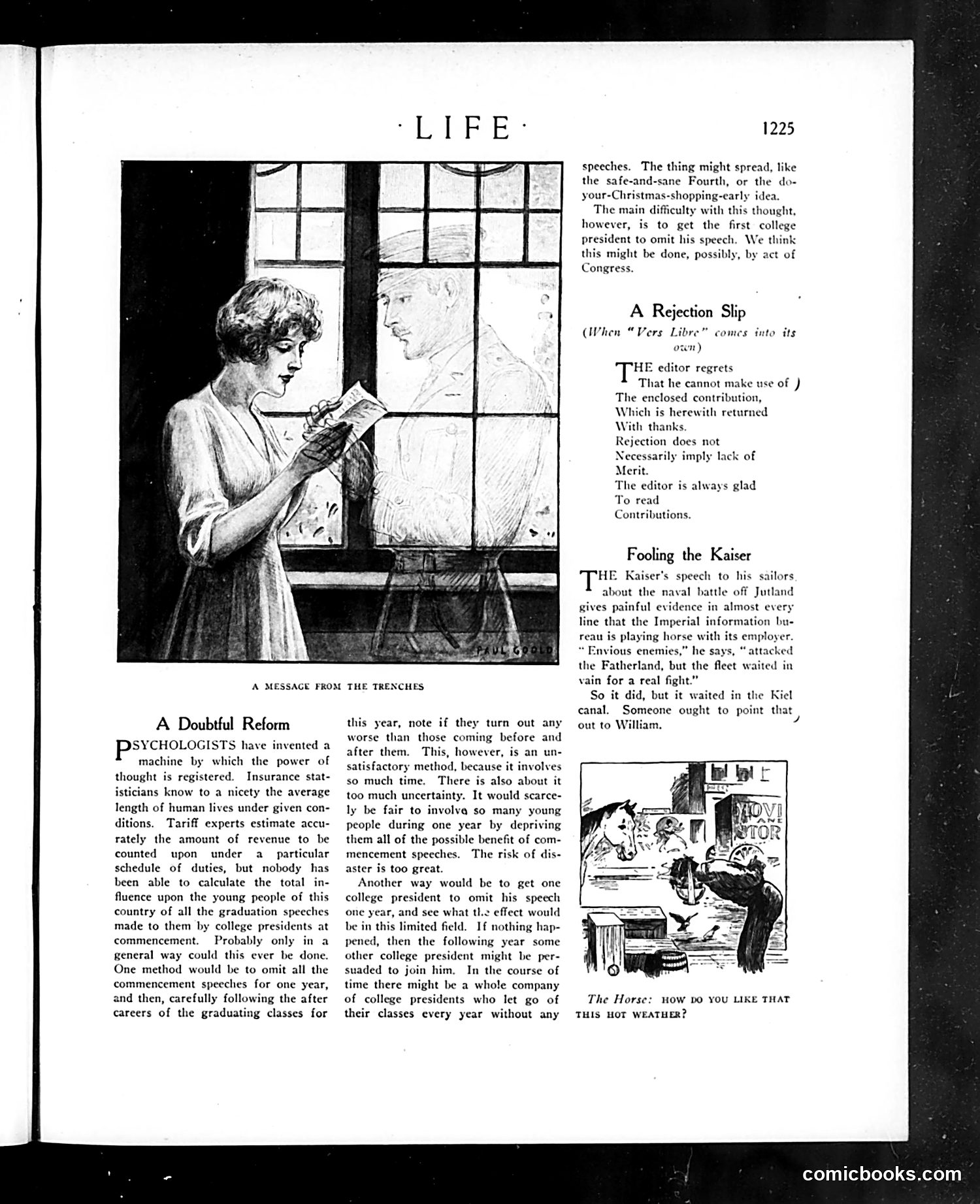
This page contains three satirical pieces: **"A Doubtful Reform"** mocks college commencement speeches as having unmeasurable impact on graduates. The author humorously suggests the only way to test their value would be to omit them entirely for a year—but notes the real obstacle is convincing even one college president to skip giving his speech. The satire targets academic vanity and empty ritual. **"A Rejection Slip"** parodies the then-emerging "vers libre" (free verse) poetry movement. It's written itself in fragmented, unconventional form—mimicking the style it ridicules. The joke is that even a rejection slip, formatted as experimental poetry, becomes incomprehensible. **"Fooling the Kaiser"** criticizes German Emperor Wilhelm II's claims about the 1916 Battle of Jutland. Wilhelm claimed his fleet "waited in vain for a real fight," but Life's author notes the fleet actually waited in the Kiel canal—implying Germany lost and retreated, contradicting Wilhelm's propaganda. The bottom cartoon shows a horse in hot weather, continuing the "Fooling the Kaiser" theme through visual pun.
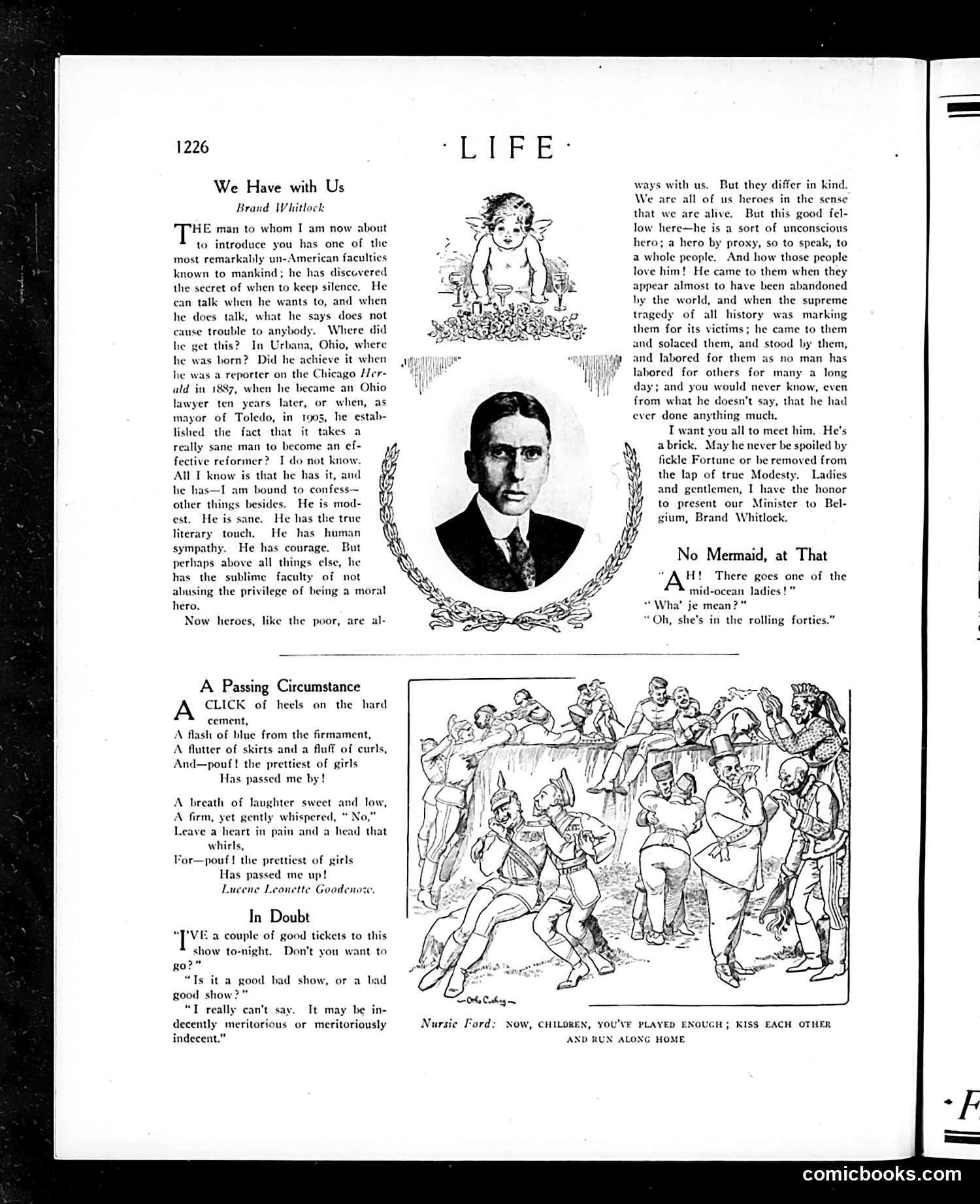
This page introduces **Brand Whitlock**, who served as U.S. Minister to Belgium. The introductory essay praises him as a rare "moral hero"—a man of restraint, modesty, and genuine accomplishment who doesn't boast about his good deeds. The author notes Whitlock's background as an Ohio lawyer, Chicago reporter, and Toledo mayor known for effective reform. The cartoons and poems below are typical Life magazine filler content unrelated to Whitlock: - **"A Passing Circumstance"**: A sentimental poem about a pretty girl passing by - **"In Doubt"**: A joke about uncertainty over whether a theater show is "good bad" or "bad good" - **"No Mermaid, at That"**: A pun about a woman in the "rolling forties" (both age and ocean waters) - **The illustration**: Shows children playing, with a nurse telling them to kiss and go home The page exemplifies early 20th-century American humor—genteel, mildly risqué, and focused on social manners.
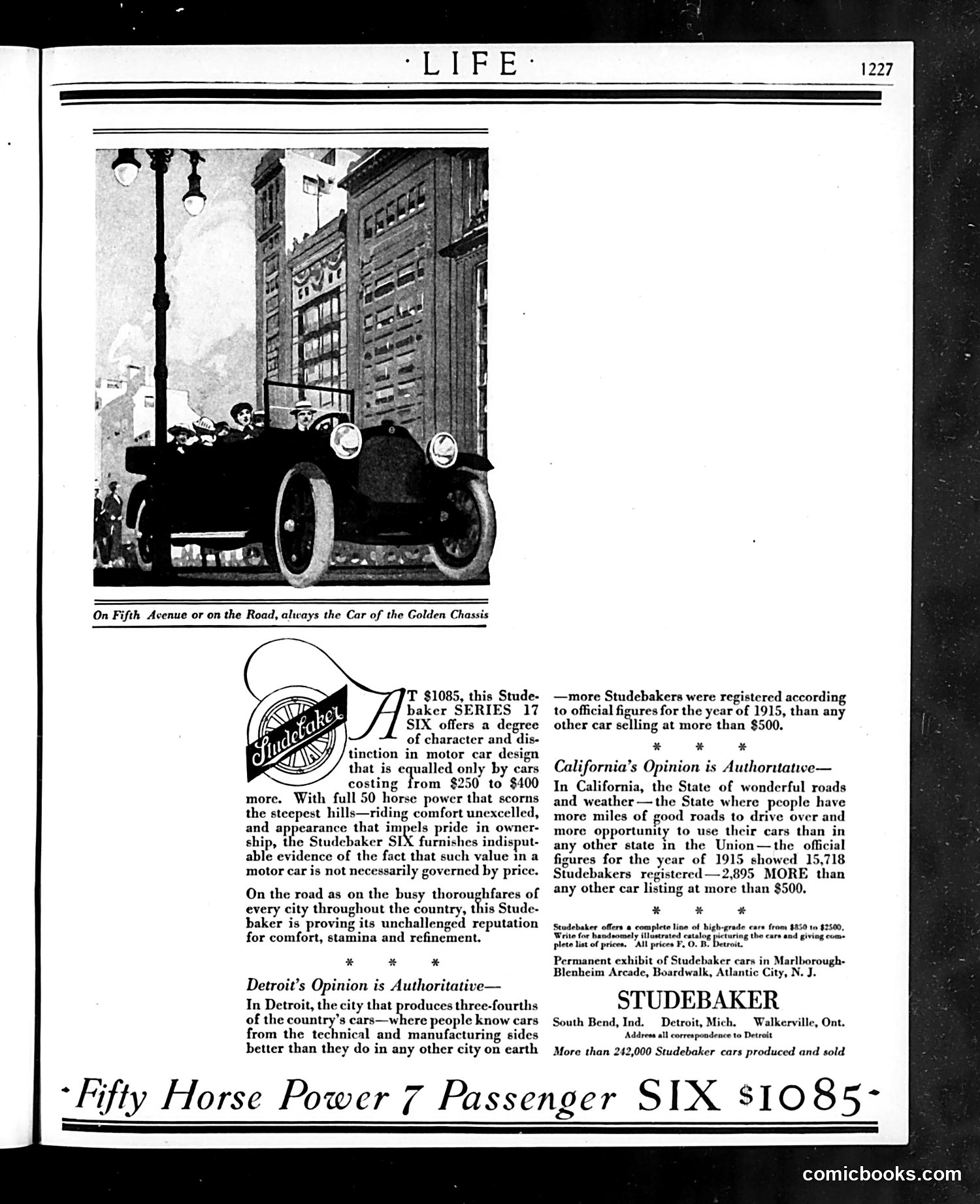
This is primarily a **car advertisement**, not political satire. The page promotes the 1915 Studebaker Series 17 SIX automobile at $1,085. The photograph shows a luxury car on a fashionable urban street ("On Fifth Avenue or on the Road"), establishing the vehicle's prestige. The advertisement's strategy is to claim **value despite price**: the car offers features (50 horsepower, comfort, appearance) comparable to vehicles costing $250-$400 more. The "authoritative opinion" sections cite sales data from Detroit (car manufacturing hub) and California (extensive road infrastructure) to prove the Studebaker outsells competing vehicles in the $500+ category. The phrase "Car of the Golden Chassis" suggests elegance and worth. For modern readers: this reflects early automotive marketing emphasizing practical specifications and comparative pricing to justify premium cost—a strategy still used today.
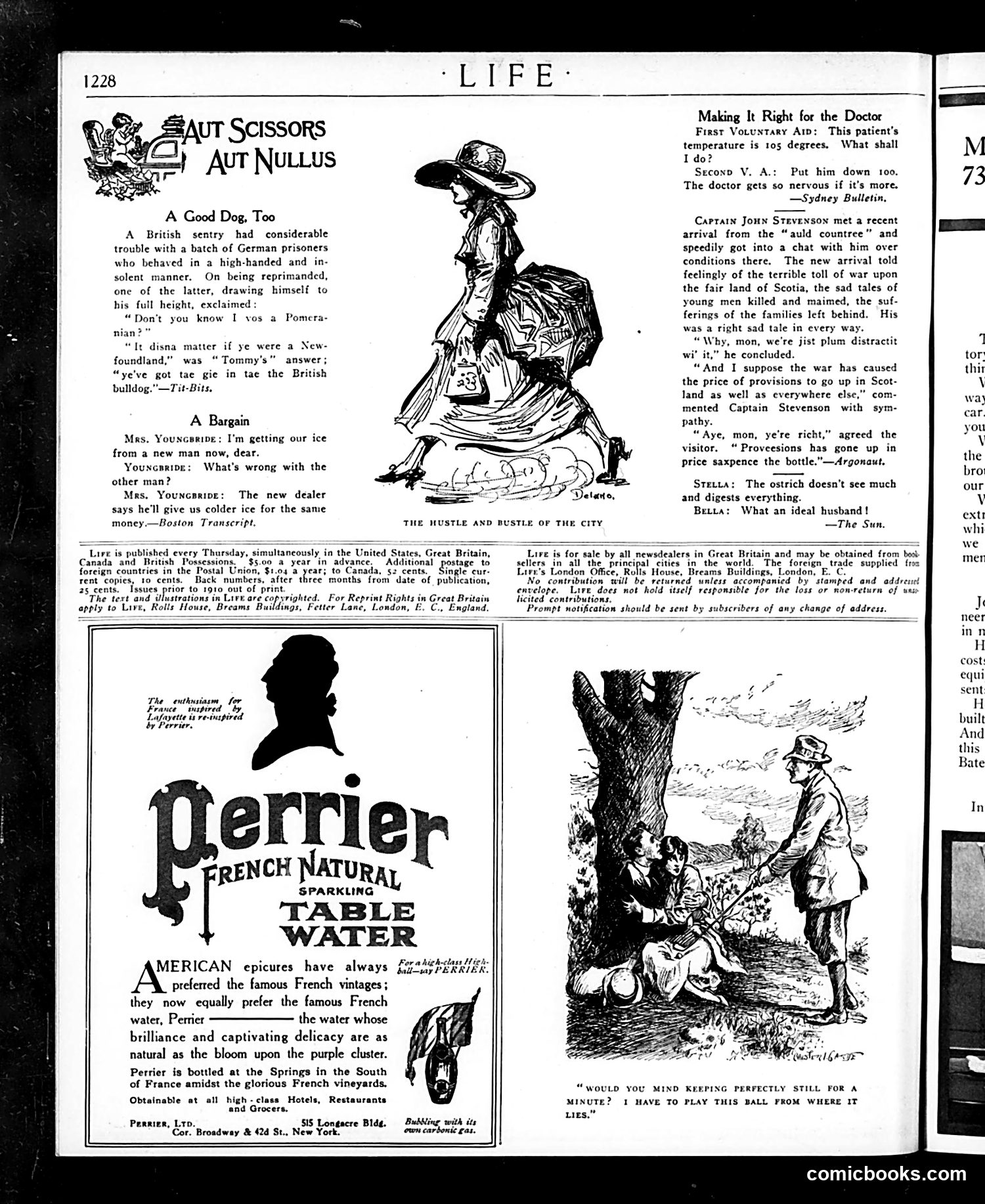
This page contains several short humorous anecdotes and advertisements typical of Life's satirical format circa WWI era. **"A Good Dog, Too"**: A British sentry reprimands a German prisoner of war who arrogantly claims superiority by invoking his Pomeranian heritage. The joke plays on the dog breed name—the prisoner thinks bloodline matters, but the "Tommy" (British soldier) dismissively ranks all under the "British bulldog," a patriotic metaphor. **"A Bargain" and other brief jokes**: Light domestic humor about ice dealers and medical practice, unrelated to larger events. **The main cartoon** shows a man playing golf near a tree, asking someone to stay still so he can hit his ball from an awkward position—a visual gag about golf etiquette. **Advertisement**: Perrier water ad leverages "enthusiasm for France" (likely WWI allied sentiment) to promote French sparkling water as superior to French wine, positioning it as patriotic consumption. The page is primarily **light entertainment and advertising**—characteristic of Life's mix of social satire, domestic humor, and commercial promotion for an affluent American readership.
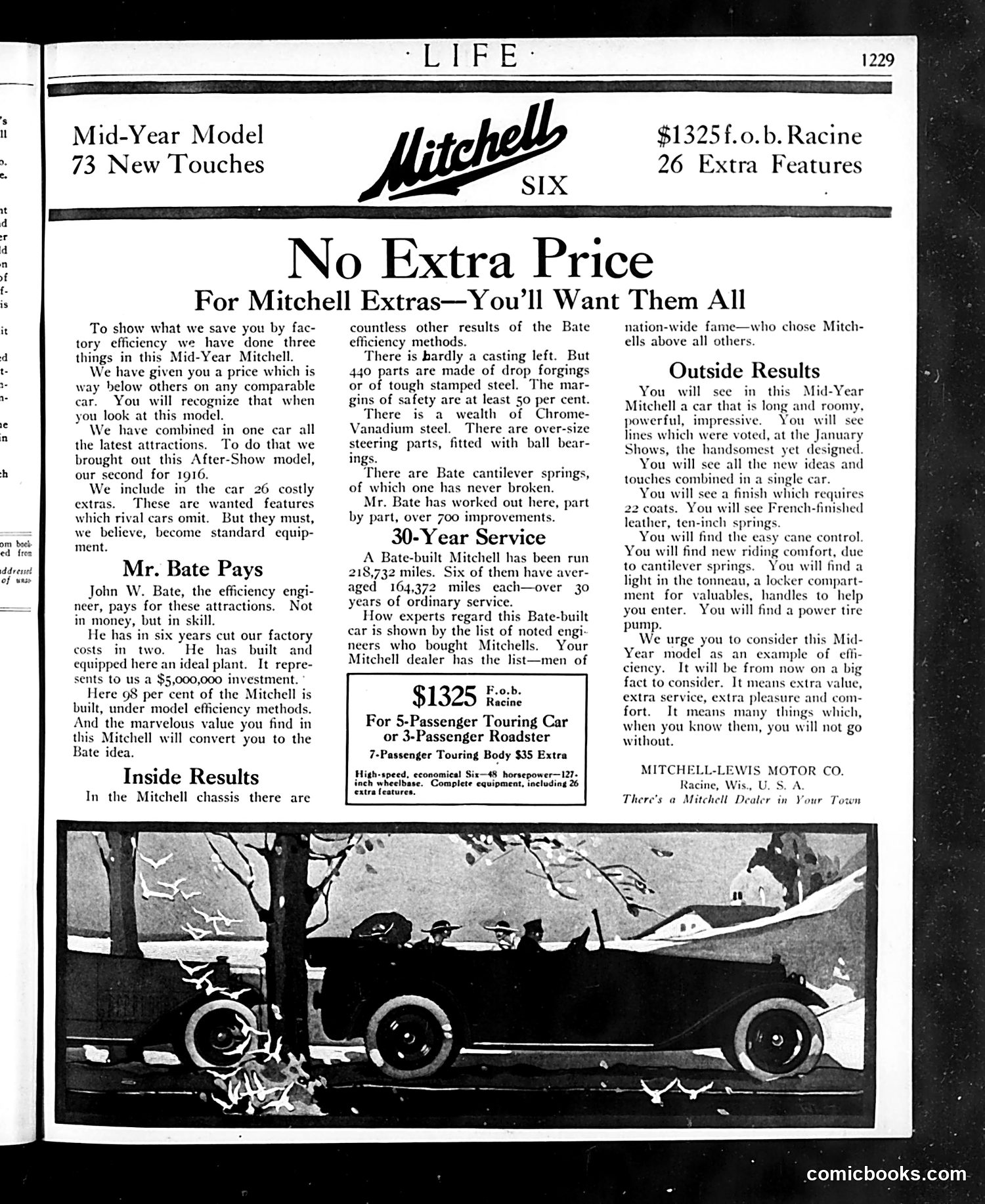
This is a 1916 automobile advertisement, not a political cartoon. The page promotes the Mitchell Six, a mid-priced car manufactured in Racine, Wisconsin, priced at $1,325. The ad emphasizes manufacturing efficiency achieved by "John W. Bate," an efficiency engineer who allegedly reduced factory costs through streamlined production methods. The key sales pitch: the car includes 26 "costly extras" at no additional price because factory efficiency allows the manufacturer to absorb these costs. The advertisement highlights durability claims (citing a vehicle driven 218,732 miles), quality materials (Chrome-Vanadium steel, drop forgings), and technical features (cantilever springs, safety margins). The photograph shows the car's sleek profile. This represents early 20th-century automotive marketing emphasizing industrial efficiency and value—themes that resonated with progressive-era American consumers interested in technological advancement and economy.
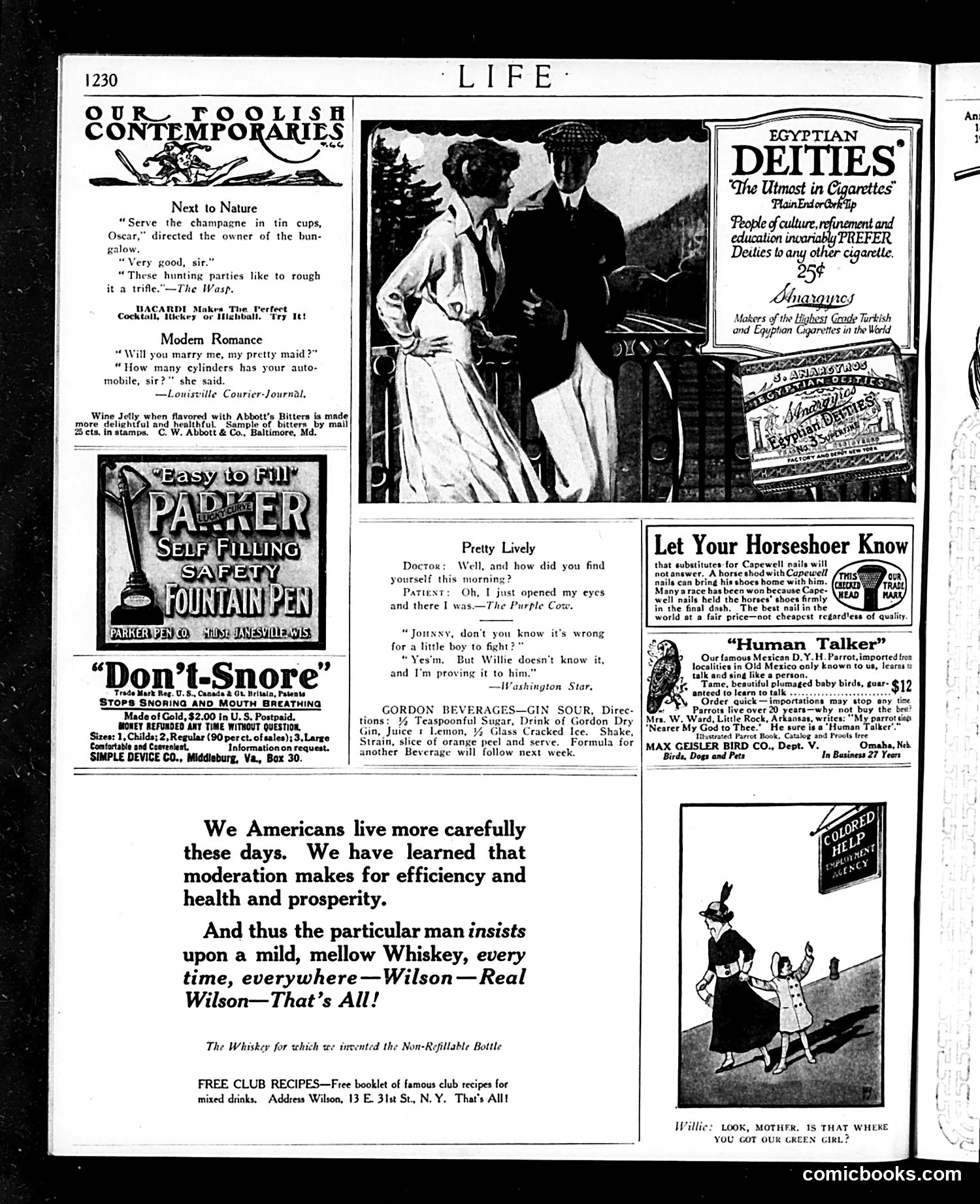
This page is primarily **advertising**, not political satire. The content consists of: **Main Elements:** - Multiple commercial advertisements (Parker fountain pens, Wilson whiskey, Egyptian Deities cigarettes, Bacardi rum) - Small humor snippets and jokes scattered throughout - One cartoon at bottom right showing a boy and girl, with dialogue implying the girl is a maid ("our green girl") **The Satire/Humor:** The page's central message appears in the large Wilson whiskey advertisement: Americans should embrace "moderation" for "efficiency and health and prosperity." This is ironic given Prohibition was in effect during this period—the ad promotes whiskey while framing it as responsible behavior. The bottom cartoon's joke about a "green girl" (inexperienced maid) is mild domestic humor. **Historical Context:** This appears to be from the Prohibition era, when alcohol advertising used coded language about "moderation" and "responsibility" to market illegal or soon-to-be-illegal products. The page reflects early 20th-century consumer culture and advertising strategy more than political commentary.
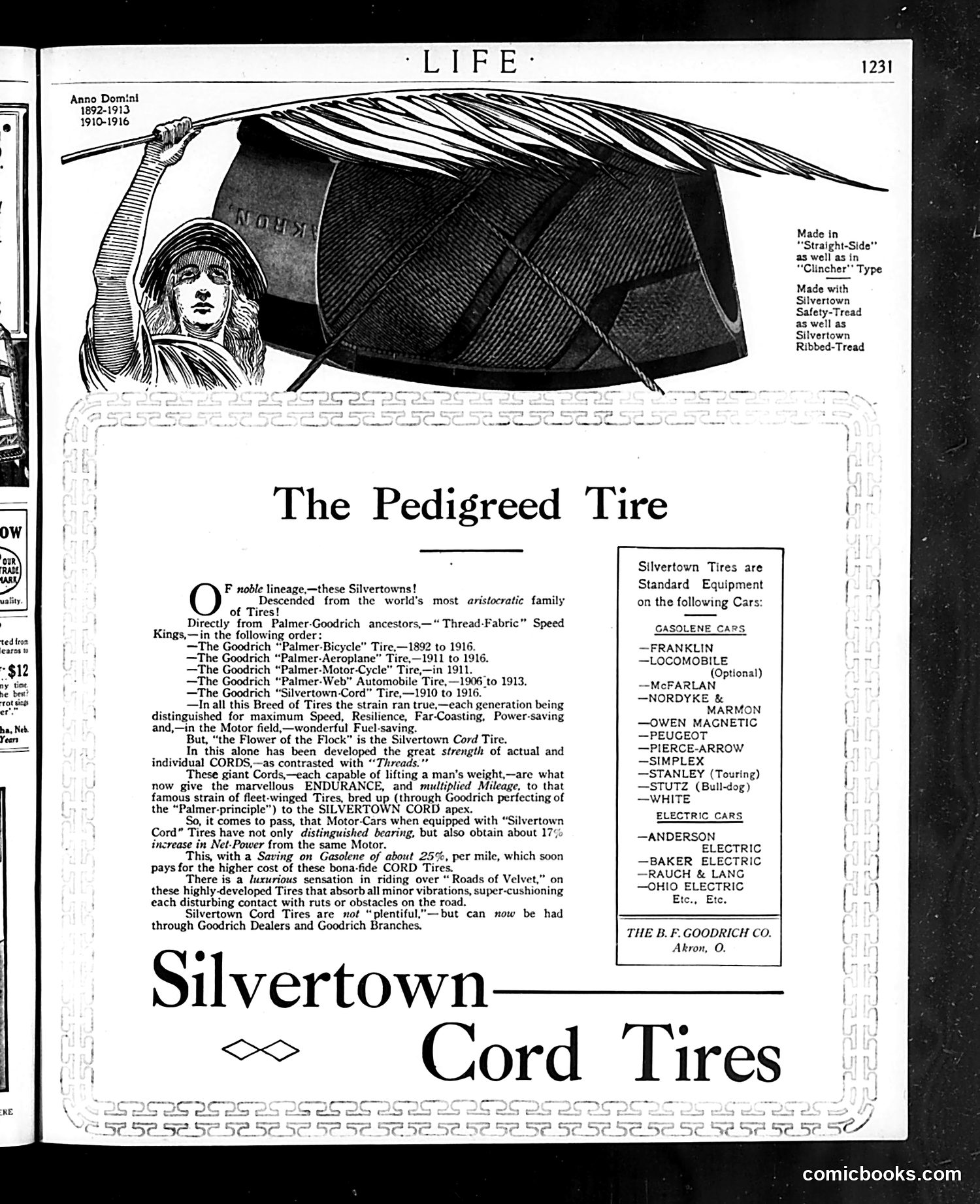
This is primarily a **Silvertown Cord Tire advertisement** from Life magazine (circa 1910-1916), not political satire. The "pedigree" conceit humorously traces tire lineage through Goodrich's product evolution: bicycle tires (1892), airplane tires (1911), motorcycle tires, and automobile tires, culminating in the superior "Silvertown Cord" model. The aristocratic imagery—including a noble woman holding a torch at the top—sarcastically elevates tire genealogy to match human "blue blood" lineage. The advertisement emphasizes cord construction (individual strands capable of lifting a man's weight) versus threaded construction, promising superior durability, fuel efficiency (25% savings), and a cushioned ride ("Roads of Velvet"). It lists prestigious car brands—Franklin, Pierce-Arrow, Stanley—as standard equipment users to reinforce quality through association. The satire gently mocks excessive marketing claims while effectively selling the product through wit rather than straightforward promotion.
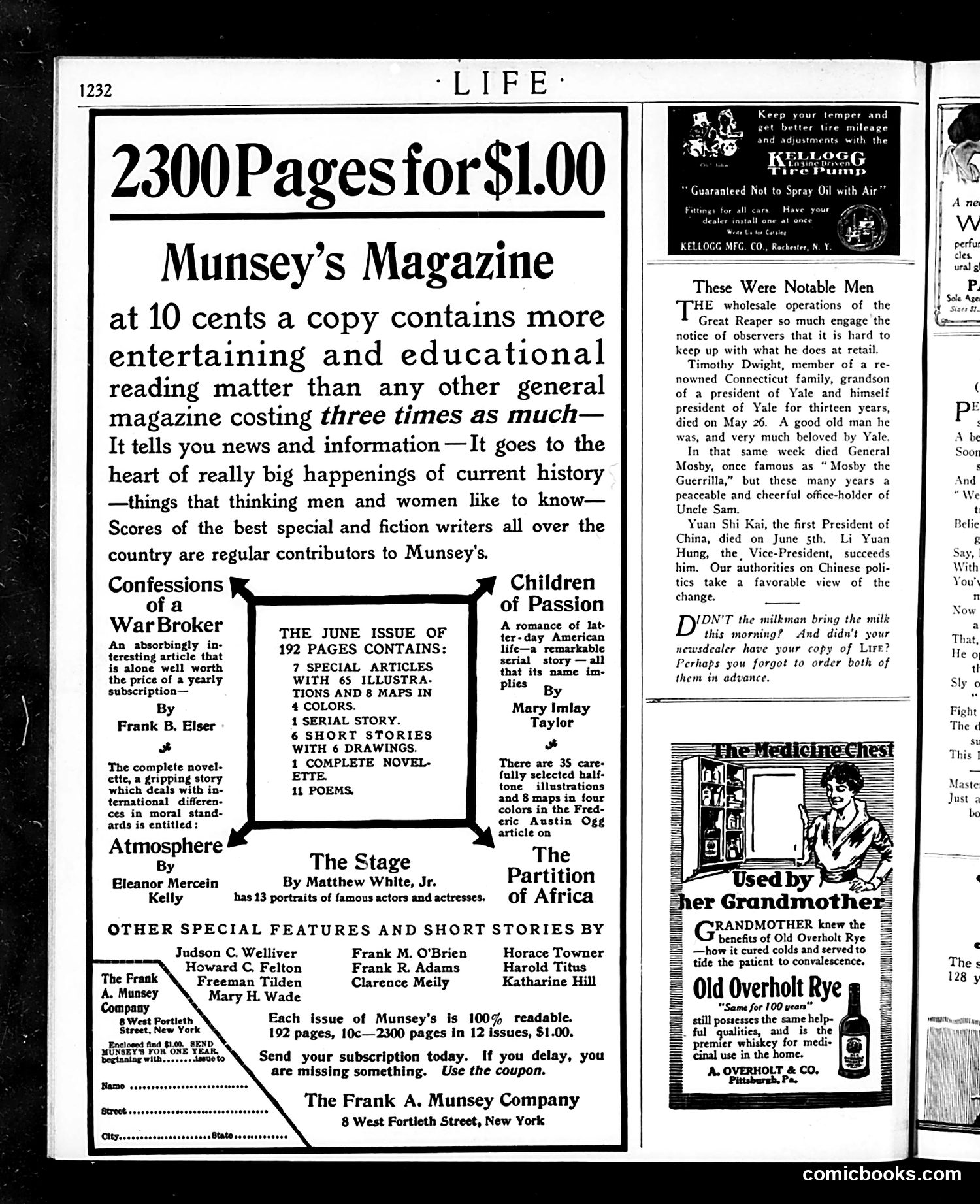
This page is primarily **advertising**, not satire or political commentary. It promotes Munsey's Magazine—a popular early 20th-century publication offering 192 pages for 10 cents, emphasizing value against competitors costing three times more. The content describes the June issue's features: serialized fiction, articles on current events (notably the political transition in China following Yuan Shi Kai's death), and contributions from established writers. The "These Were Notable Men" section is an obituary column noting recent deaths of Timothy Dwight (Yale president) and General Mosby. The right column contains two unrelated advertisements: a Kellogg's fire pump product and Old Overholt Rye whiskey, marketed for medicinal purposes—a common sales pitch during the Prohibition era's approach, legitimizing alcohol as medicine. There is **no political cartoon or satire** on this page.
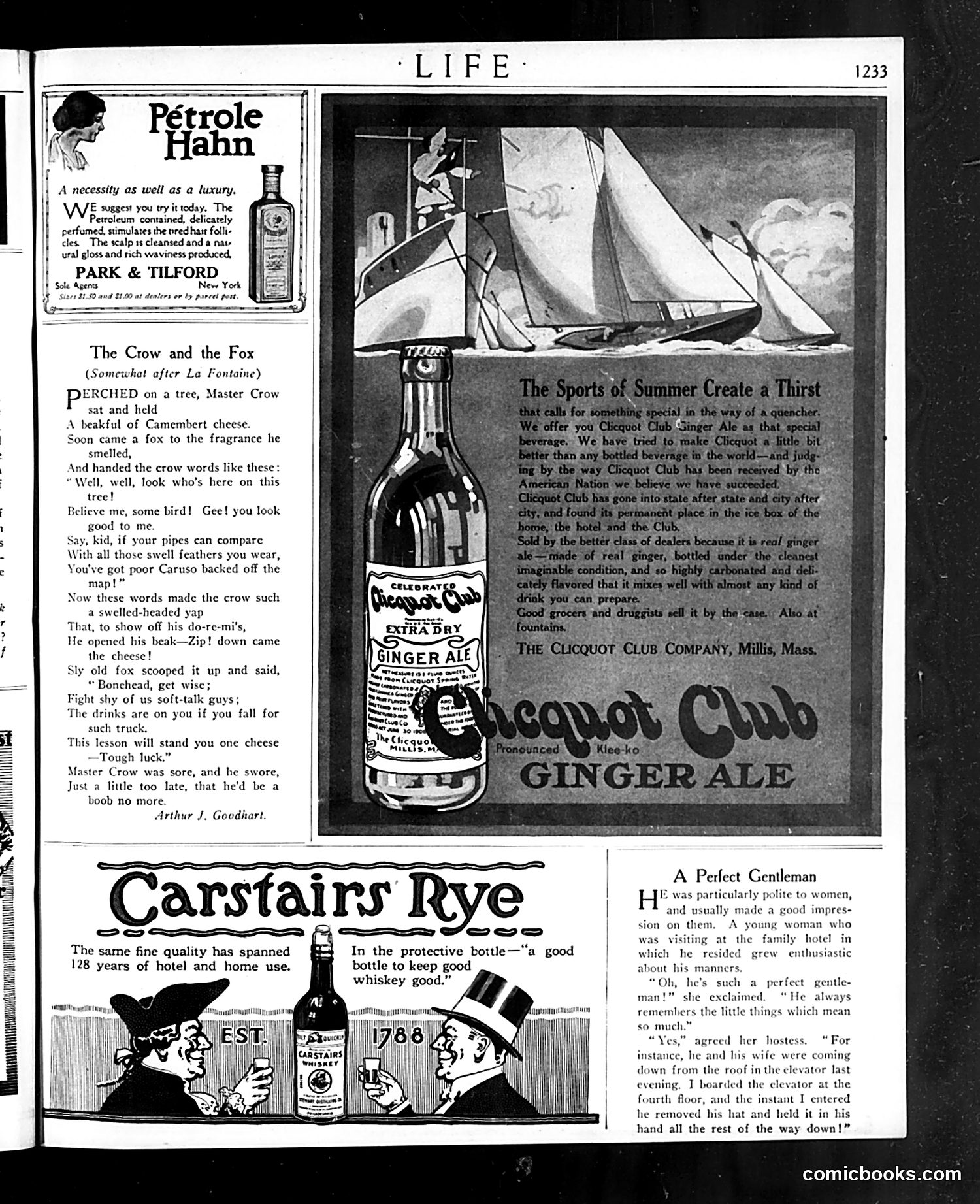
This page is primarily **advertisements and light humor**, not political satire. **"The Crow and the Fox"** is a fable adaptation (credited to Arthur J. Goodhart) teaching the moral: don't be fooled by flattery. A vain crow drops cheese when tricked by a fox's compliments—a timeless lesson about vanity and gullibility, not contemporary satire. **"A Perfect Gentleman"** is a short humorous anecdote about a man so obsessively polite that he removes his hat in an elevator—absurdist humor mocking excessive etiquette. The rest are **product advertisements**: Pétrole Hahn hair tonic (Park & Tilford), Clicquot Club Ginger Ale, and Carstairs Rye whiskey. The page reflects **1920s advertising culture** where brands occupied significant magazine space. The humor is gentle and moralistic rather than cutting social commentary—typical of Life's lighter editorial content between ads.
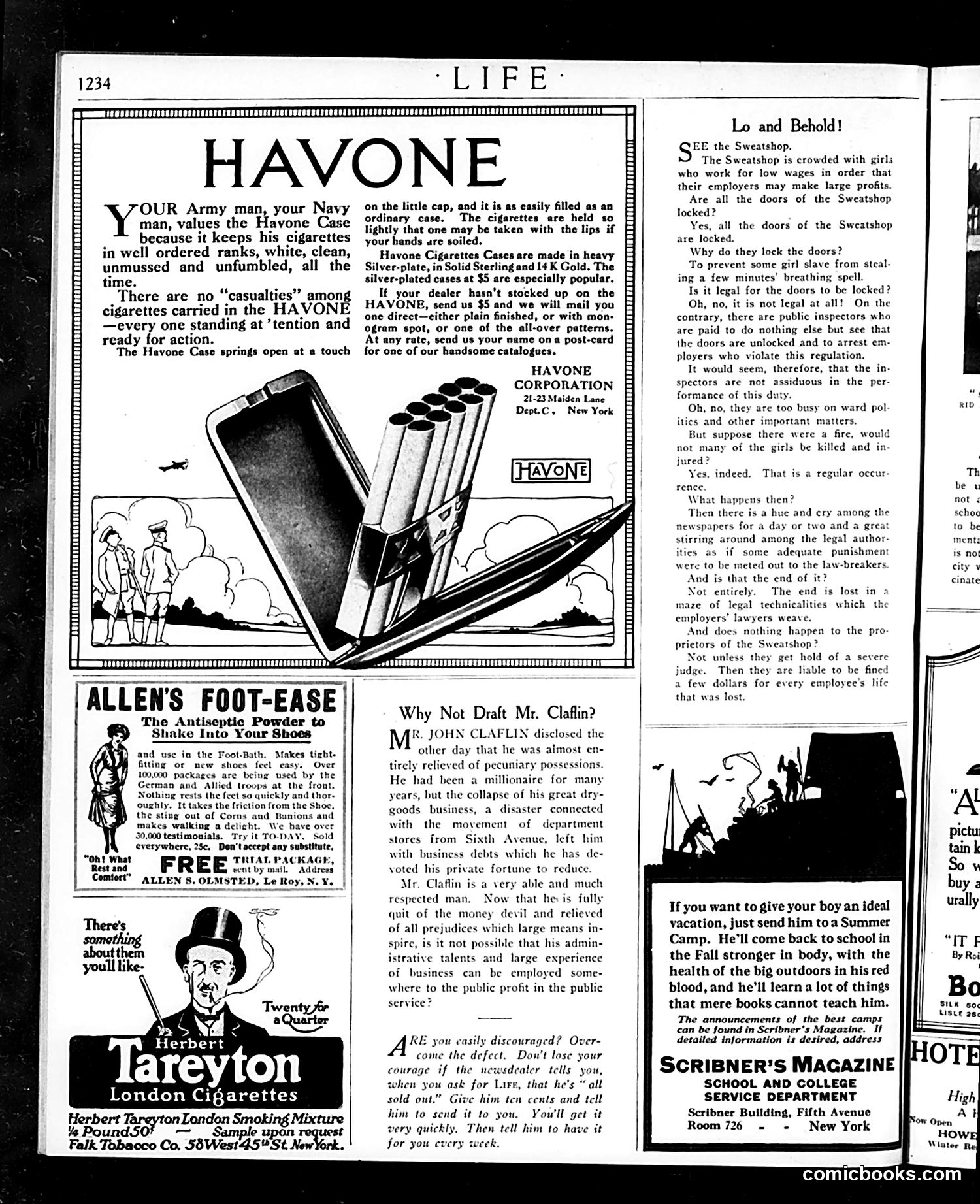
This page mixes **advertisements with social commentary**. The main satire targets **labor exploitation in sweatshops**. The "Lo and Behold!" section uses a question-and-answer format to expose the contradiction between labor laws and their enforcement. It describes a sweatshop with locked doors—illegal, yet inspectors supposedly assigned to prevent it do nothing because they're "too busy on ward politics." The implied critique: **government corruption and negligence allow dangerous working conditions to persist**, resulting in preventable deaths from fires. The other major content is **product advertising** (Havone cigarette cases, Allen's Foot-Ease powder, Herbert Tareyton cigarettes), which was typical for Life magazine. A brief mention of "Why Not Draft Mr. Claflin?" discusses a wealthy businessman's financial downfall, suggesting his business experience might benefit public service—likely reflecting WWI-era debates about resource allocation. The satire's power lies in its **deadpan exposure of systemic indifference to worker safety**.
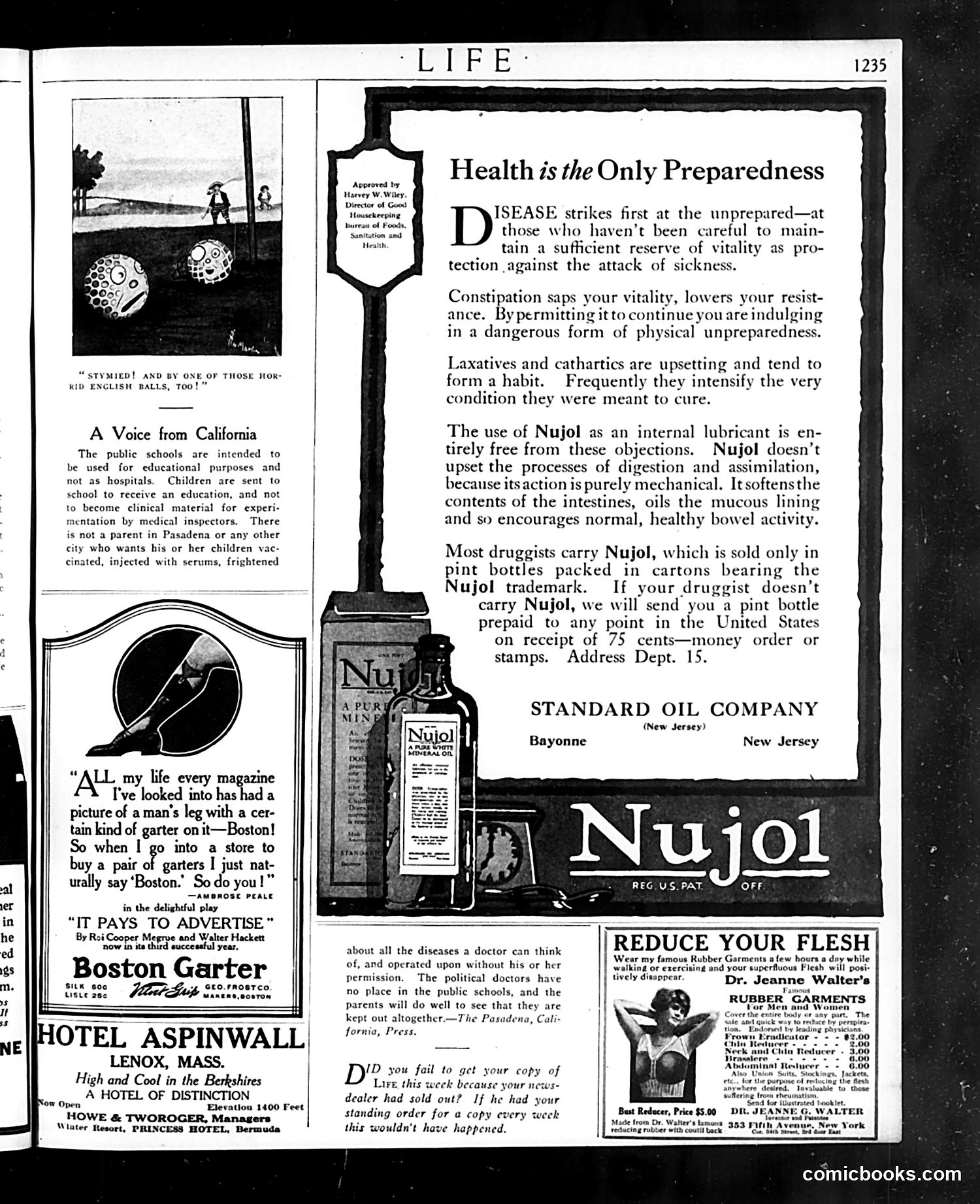
This page consists primarily of **advertisements** rather than political satire. The dominant content is a Nujol laxative ad that co-opts the language of wartime "preparedness" (likely referencing WWI-era public health campaigns) to sell an internal lubricant as a form of physical readiness against disease. The notable editorial content is "A Voice from California," which expresses **anti-vaccination sentiment**—criticizing mandatory school vaccination programs and medical inspection of children, arguing parents shouldn't permit their kids to become "clinical material for experimentation." This reflects early 20th-century resistance to public health measures, though the letter doesn't identify the specific controversy. The other ads (Boston Garter, Hotel Aspinwall, Dr. Jeanne Walter's rubber reducing garments) are period commercial appeals unrelated to satire or politics. The page primarily demonstrates how Life magazine monetized editorial space alongside advertising rather than functioning as pure satire.
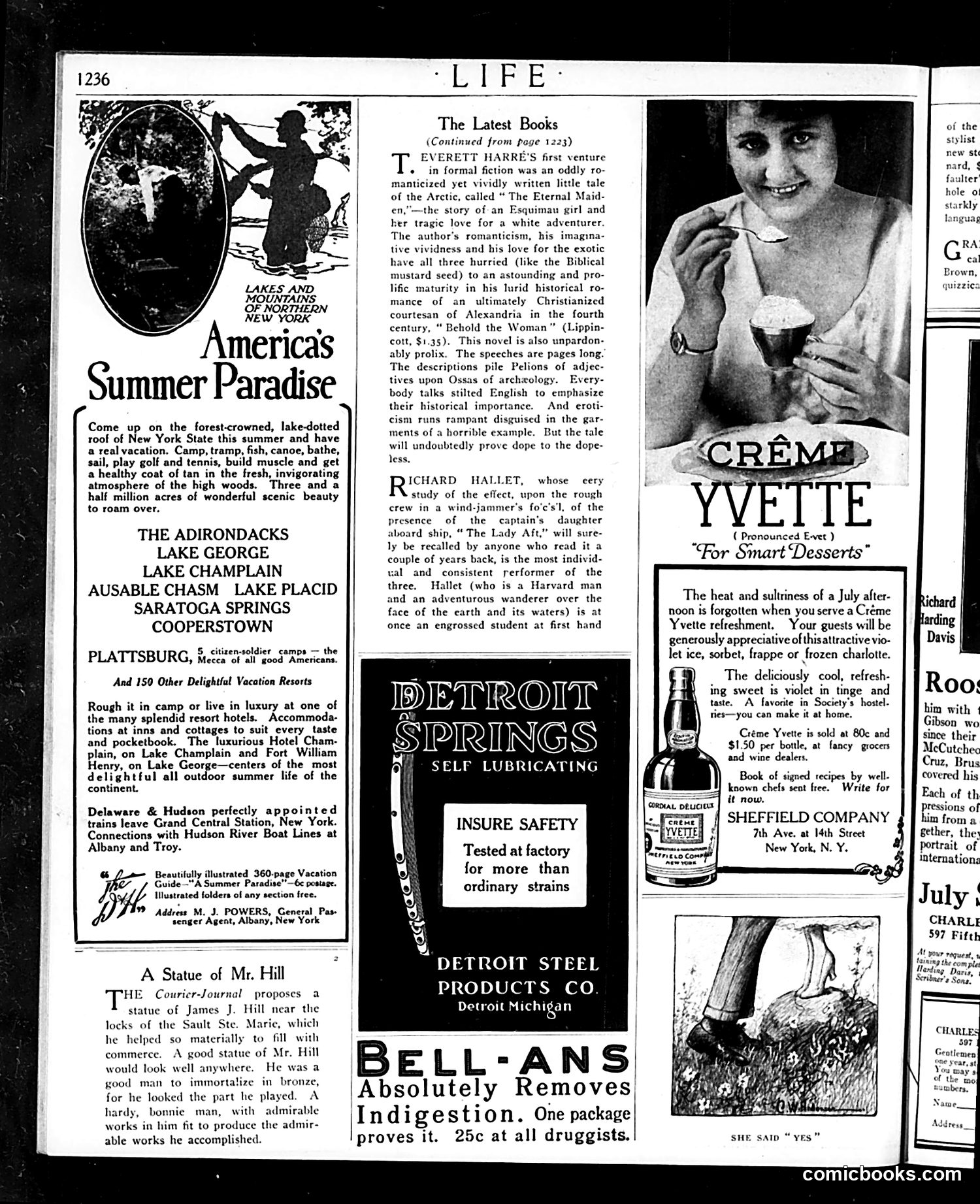
This page is primarily **advertising and book reviews**, not political satire. The main content includes: **Book Reviews:** Everett Harre's novels are critiqued—his Arctic tale "The Eternal Maiden" and his historical romance "Behold the Woman" (set in 4th-century Alexandria). Richard Hallet's "The Lady Aft" (a sea story) is also discussed. The reviews are literary criticism rather than satire. **Advertisements:** The page features vacation promotions (Adirondacks, Lake George), product ads (Detroit Springs lubricant, Bell-Ans indigestion remedy, Créme Yvette dessert), and a brief mention of proposing a statue of James J. Hill near Sault Sainte Marie. **No significant political cartoon or satire appears on this page.** The content reflects early 20th-century consumer culture and literary discussion typical of *Life* magazine's format during this era.
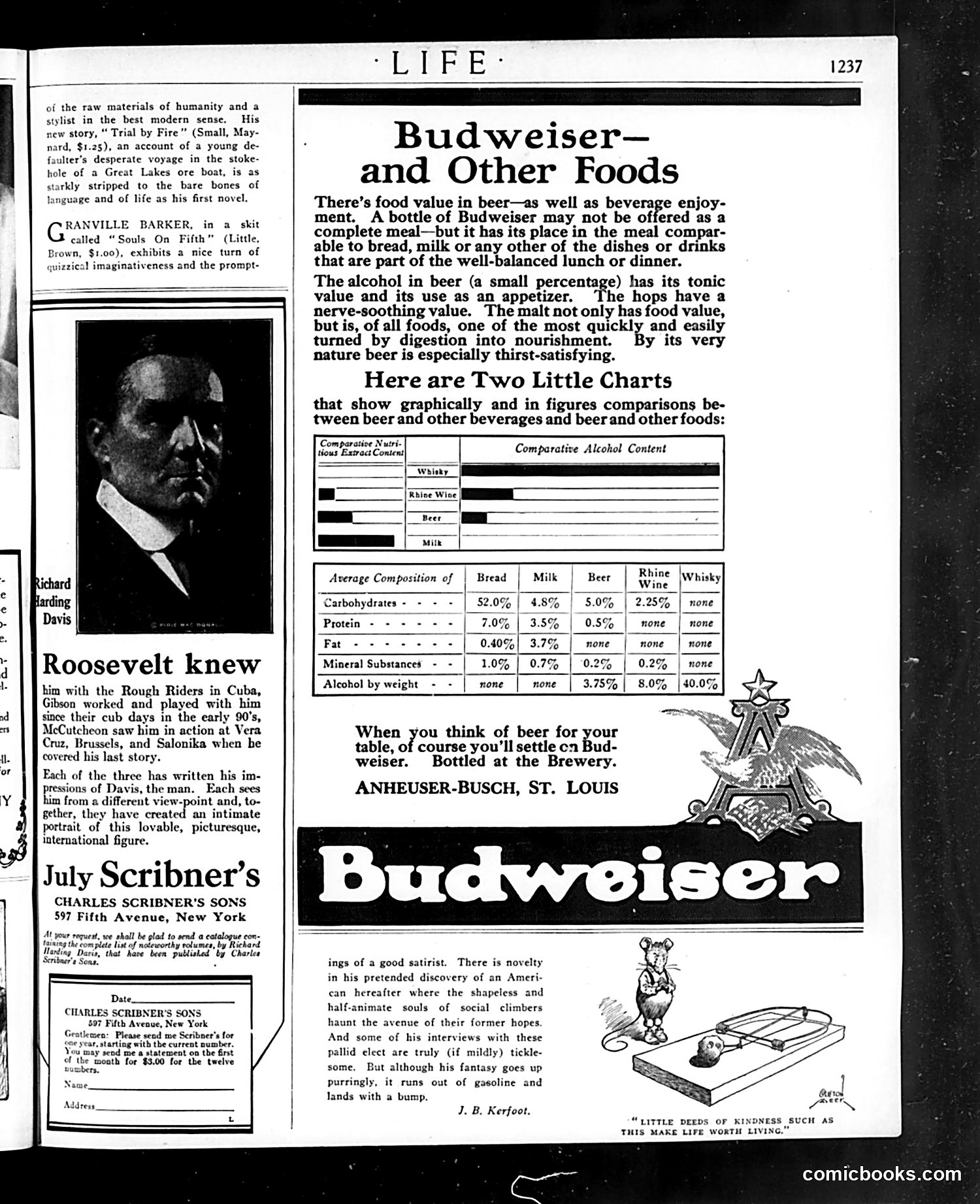
This page is primarily **advertising**, featuring a major Budweiser ad promoting beer as a nutritious food product. The ad includes comparative nutritional charts claiming beer contains valuable carbohydrates, protein, and minerals comparable to bread and milk, with lower alcohol content than whiskey or wine. The upper left contains a portrait of **Richard Harding Davis** (a prominent journalist and author of the era), accompanied by text advertising a Scribner's publication featuring three writers' impressions of Davis. The references to Roosevelt, the Rough Riders, Cuba, and Vera Cruz establish Davis as a celebrated international correspondent. The page also includes brief book reviews and subscription offers for Scribner's magazine. **Context for modern readers:** This represents pre-Prohibition era advertising (likely early 1910s), when beer was routinely marketed as a health food with nutritional benefits—a claim that would later be legally prohibited. The Budweiser branding and St. Louis origin are prominently featured.
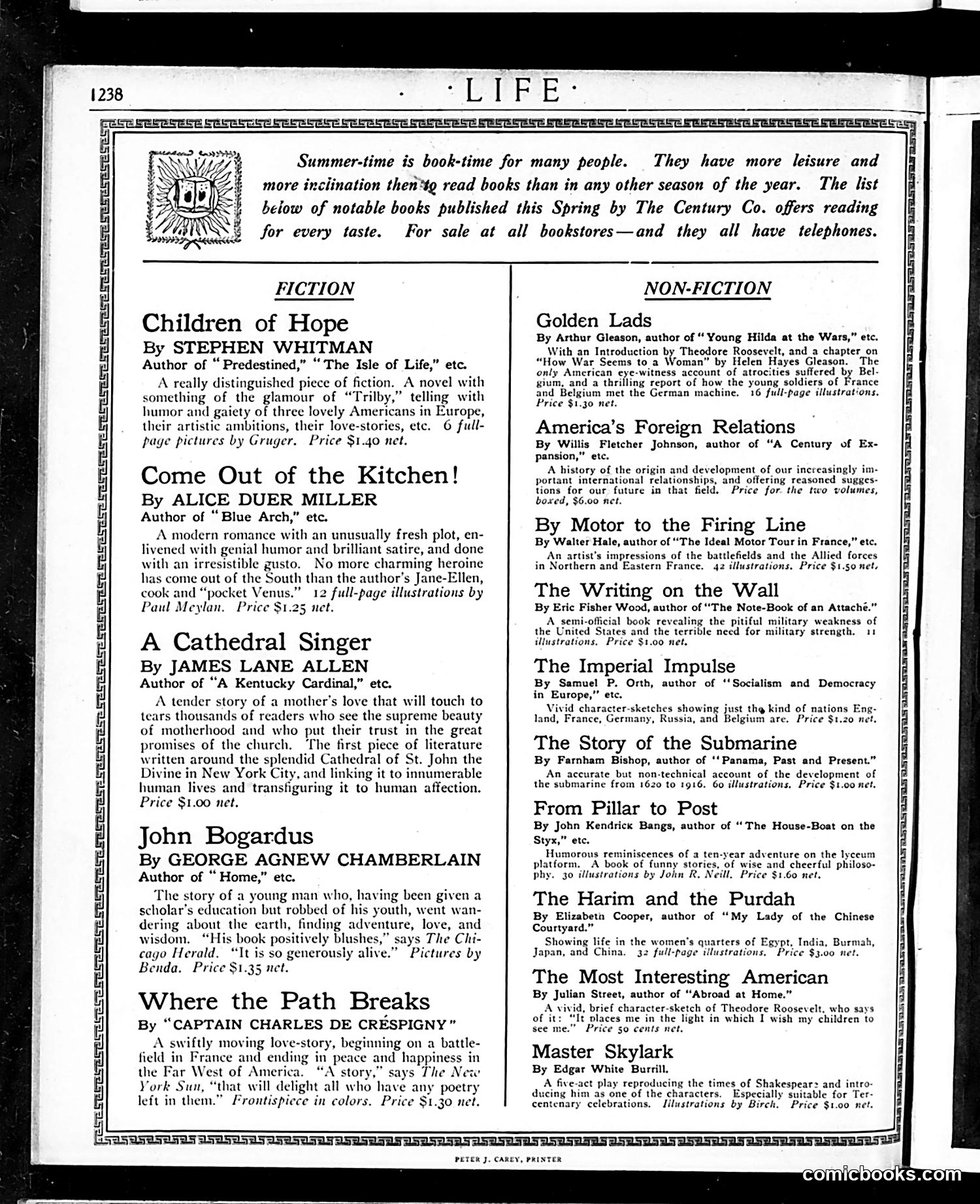
This is a straightforward **book advertisement**, not a political cartoon. The Century Company publishing house paid for this full-page ad promoting their Spring releases. The page divides offerings into Fiction and Non-Fiction. Fiction titles include romance novels like "Come Out of the Kitchen!" and "Children of Hope"—light summer reading. The Non-Fiction section reveals the historical moment: **World War I**. Multiple titles address the ongoing European conflict: "Golden Lads" (eyewitness accounts of German atrocities in Belgium), "By Motor to the Firing Line" (battlefield impressions), and "The Writing on the Wall" (arguing for U.S. military preparedness). Theodore Roosevelt's endorsement of one book confirms this pre-1917 American context of debating intervention. The ad's opening framing—that summer is "book-time"—suggests publishers expected leisure readers would tackle serious war literature alongside entertainment.
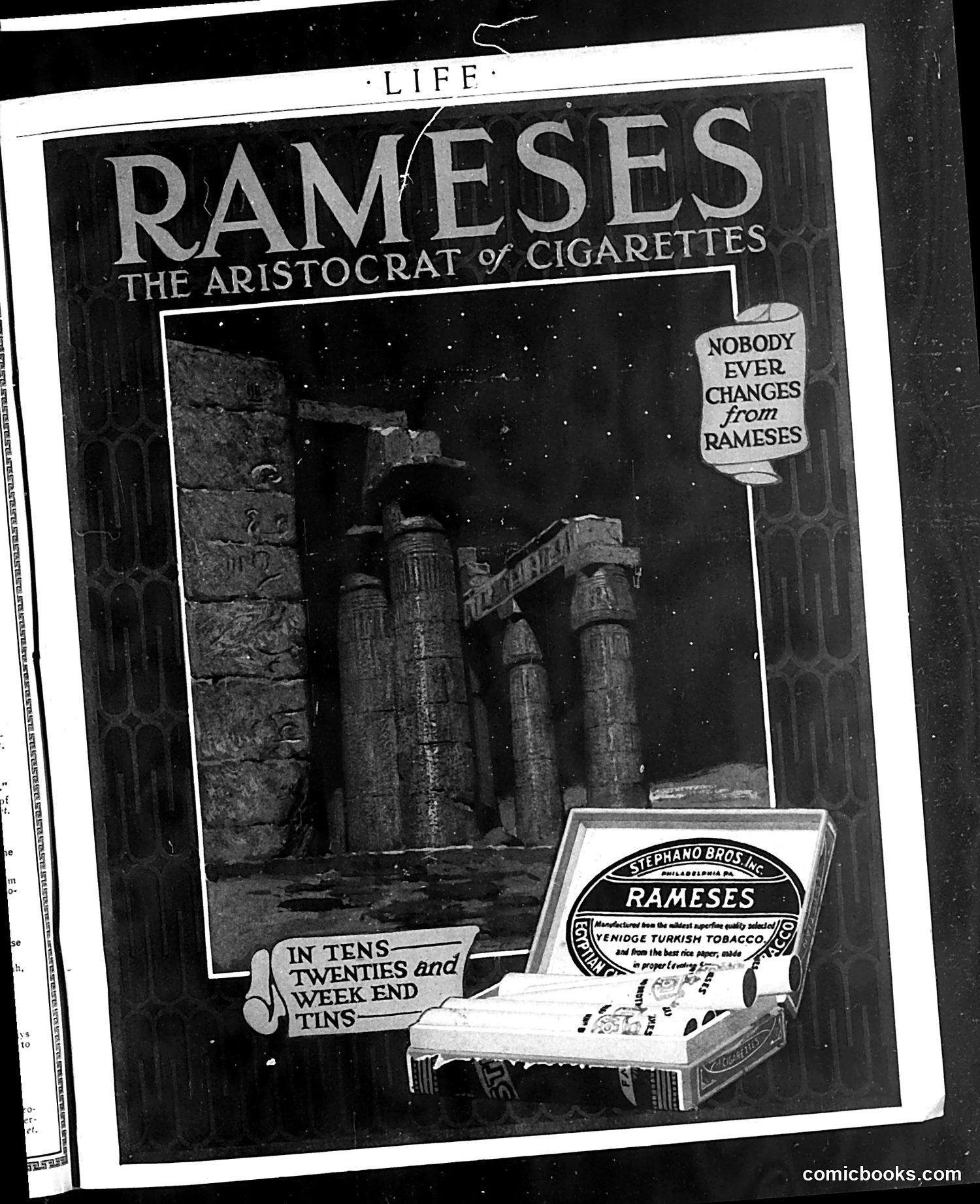
This is a magazine advertisement for Rameses cigarettes, marketed as "The Aristocrat of Cigarettes." The imagery uses Egyptian temple architecture and imagery to create an exotic, luxurious brand identity. The prominent banner states "NOBODY EVER CHANGES from RAMESES," suggesting brand loyalty. The product is shown in packaging labeled as made by Stephano Bros. in Philadelphia, containing "Venidge Turkish Tobacco." Text indicates availability "IN TENS, TWENTIES and WEEK END TINS." This appears to be straightforward early-to-mid 20th century cigarette marketing, using orientalist imagery to convey sophistication and exclusivity. Modern readers should note this predates widespread health warnings about smoking and represents an era when tobacco advertising appeared freely in mainstream magazines.
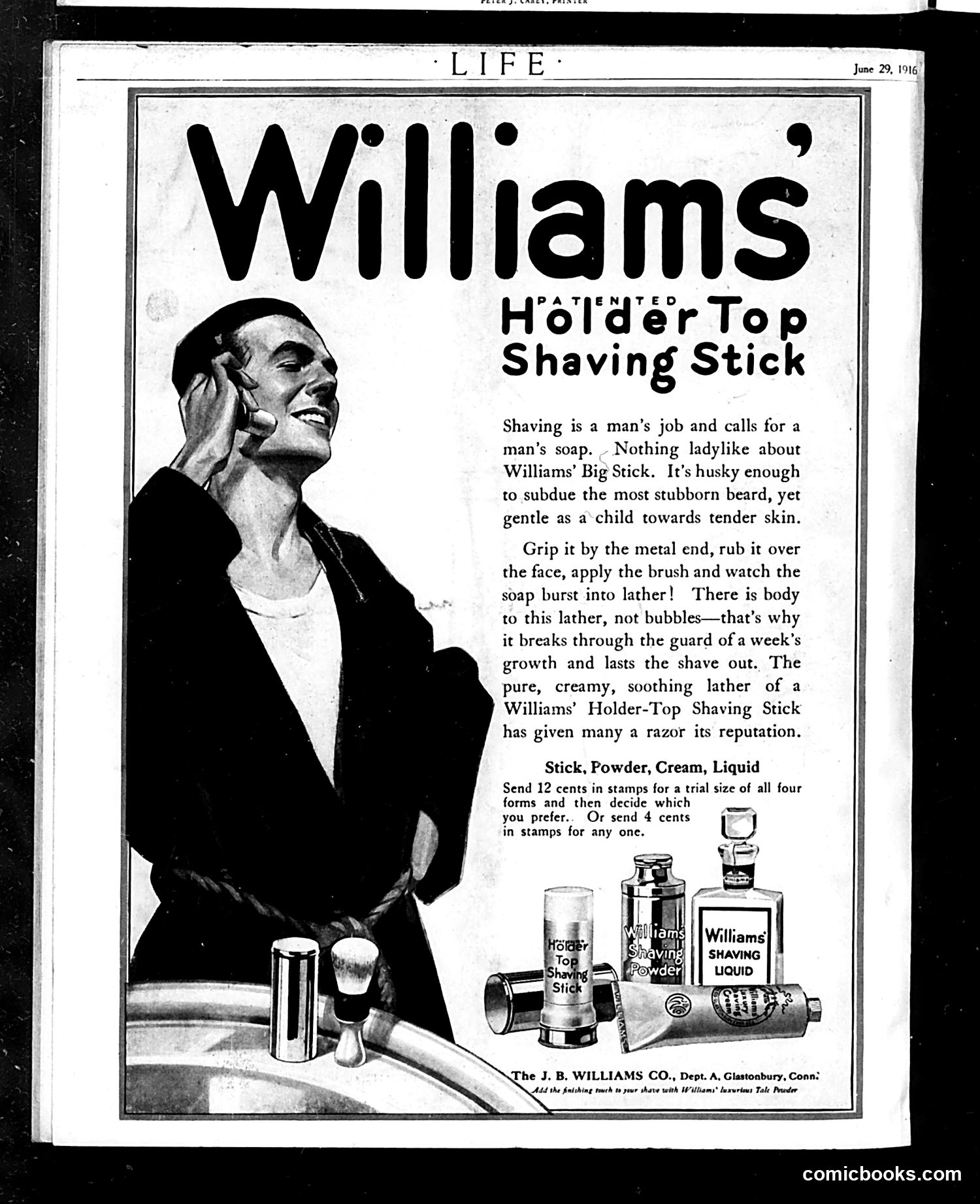

I can see this is a page from Life magazine (dated 1916 based on the marking in the upper left), but the image is almost entirely black or severely degraded, making it impossible to discern any cartoon, caricature, text, or satirical content. The only legible element is the "comicbooks.com" watermark at the bottom right. Without being able to see the actual illustrations or read the OCR text clearly (which appears to contain only symbols or formatting marks), I cannot identify the figures, political references, or explain the satirical point. The page would need better image quality or restoration to analyze properly.