
Life, 1916-06-29 · page 23 of 41
Life — June 29, 1916 — page 23: what you’re looking at
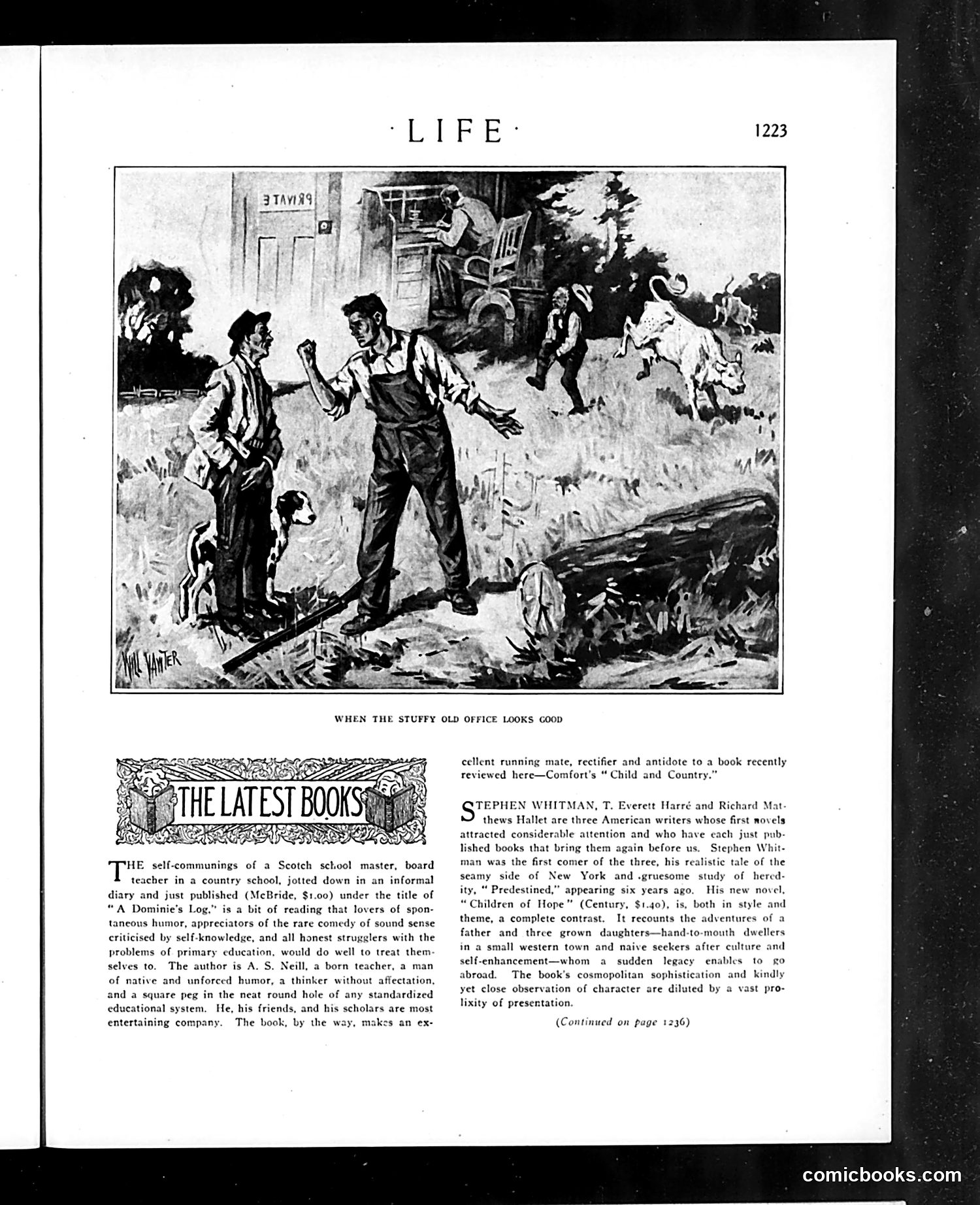
What you’re looking at
This cartoon depicts men discovering an old, abandoned office building or structure in a rural/outdoor setting. The title suggests the humor: these men are so exhausted or dissatisfied with their current circumstances that even a decrepit "stuffy old office" appears appealing to them—a commentary on the contrast between urban workplace tedium and rural or outdoor hardship. The page primarily reviews books, particularly "A Dominie's Log" by A.S. Neill (a Scottish schoolmaster's diary) and novels by Stephen Whitman, T. Everett Harré, and Richard Matthews Hallet. The cartoon's meaning depends on whether it illustrates one of these books or serves as standalone social satire about work versus nature. Given the rural setting and men's apparent relief, it likely satirizes early-20th-century attitudes about urban versus rural life—the ironic appeal of monotonous office work compared to backbreaking farm or outdoor labor.
📄 Transcribed text from this page (OCR, searchable)
Machine-transcribed from the original scan — historical spelling and the odd misread are preserved.
3 TAVIAG| WHEN THE STUFFY OLD OFFICE LOOKS GooD HE self-communings of a Scotch school master, board teacher in a country school, jotted down in an informal diary and just published (McBride, $1.00) under the title of “A Dominie’s Log.” is a bit of reading that lovers of spon- taneous humor, appreciators of the rare comedy of sound sense criticised by self-knowledge, and all honest strugglers with the problems of primary education, would do well to treat them- selves to. The author is A. S. Neill, a born teacher, a man of native and unforced humor, a thinker without affectation, and a square peg in the neat round hole of any standardized educational system. He, his friends, and his scholars are most entertaining company. The book, by the way, ma cellent running mate, rectifier and antidote to a book recently reviewed here—Comfort’s “ Child and Country.” TEPHEN WHITMAN, T. Everett Harré and Richard Mat thews Hallet are three American writers whose first novels attracted considerable attention and who have each just lished books that bring them again before us. Stephen Wh man was the first comer of the three, his realistic tale of the seamy side of New York and .gruesome study of hered- ity, “ Predestined,” appearing six years ago. His new novel, “Children of Hope” (Century, $1.40), is, both in style and theme, a complete contrast, It recounts the adventures of a father and three grown daughters—hand-to-mouth dwelle: in a small western town and naive seekers after culture and self-enhancement—whom a sudden legacy enables to go abroad. The book’s cosmopolitan sophistication and kindly yet close observation of character are diluted by a vast pro- lixity of presentation. (Continued on page 1236) comicbooks.com