
Life, 1916-06-29 · page 19 of 41
Life — June 29, 1916 — page 19: what you’re looking at
What you’re looking at
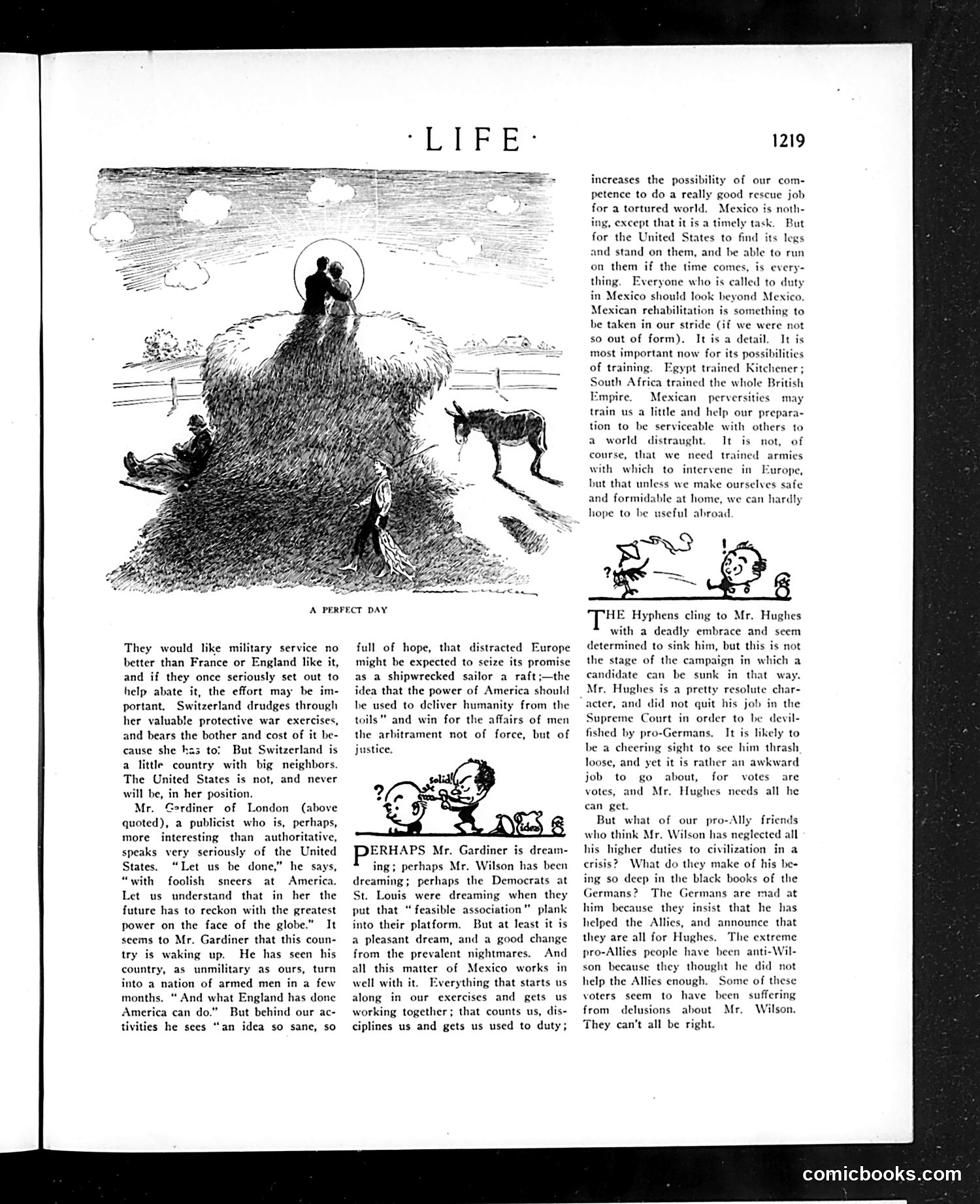
This 1919 page discusses American military preparedness and the 1916 presidential election. The main cartoon, "A Perfect Day," depicts an idealized pastoral scene symbolizing America's potential strength. The text argues that U.S. military training—currently being tested through intervention in Mexico—serves a larger purpose: preparing America to be a responsible world power capable of enforcing justice rather than force in international affairs. It references President Wilson's vision of a "feasible association" (likely referring to what would become the League of Nations). The page also discusses Charles Evans Hughes (the Republican challenger) being attacked by "Hyphens"—a period term for German-American and other ethnic voters seen as having divided loyalties. Ironically, Germans opposed Hughes because they believed Wilson had secretly aided the Allies, while pro-Allied Americans criticized Wilson for insufficient support. The satire highlights this impossible political position: Wilson was simultaneously accused of being both pro-German and pro-Allied.
📄 Transcribed text from this page (OCR, searchable)
Machine-transcribed from the original scan — historical spelling and the odd misread are preserved.
A PERFECT DAY They would like military service no better than France or England like it, and if they once seriously set out to help abate it, the effort may be im- portant. Switzerland drudges through her valuable protective war exercises, and bears the bother and cost of it be- cause she has But Switzerland is a little country with big neighbors. The United States is not, and never will be, in her position. Mr. Gerdiner of London (above quoted), a publicist who is, perhaps, more interesting than authori , speaks very seriously of the United States. “Let us be done,” he say: “with foolish sneers at Ameri Let us understand that in her the future has to reckon with the greatest power on the face of the globe.” It scems to Mr. Gardiner that this coun- try is waking up. He has seen his country, as unmilitary as ours, turn into a nation of armed men in a few months. “ And what England has done America can do.” But behind our ac- tivities he sees “an idea so sane, so full of hope, that distracted Europe might be expected to seize its promise as a shipwrecked sailor a raft;—the idea that the power of America should be used to deliver humanity from the toils” and win for the affairs of men the arbitrament not of force, but of justice, ERHAPS Mr. Gardiner is dream- ing; perhaps Mr. Wilson has been dreaming; perhaps the Democrats at St. Louis were dreaming when they put that “feasible association” plank into their platform. But at least it is a pleasant dream, and a good change from the prevalent nightmares. And all this matter of Mexico works in well with it. Everything that starts us along in our exercises and gets us working together; that counts us, dis- ciplines us and gets us used to duty; 1219 increases the possibility of our com- petence to do a really good rescue job for a tortured world. Mexico is noth- ing, except that it is a timely task. But for the United States to find its legs and stand on them, and be able to run on them if the time comes, is every- thing. Everyone who is called to duty in Mexico should look beyond Mexico, Mexican rehabilitation is something to be taken in our stride (if we were not so out of form). It is a detail. It is most important now for its possibilities of training. Egypt trained Kitchener; South Africa trained the whole British Empire. Mexican may train us a little and help our prepara- tion to be serviceable with others to a world distraught. It is not, of course, that we need trained armies with which to intervene in Europe, but that unless we make ourselves safe and formidable at home, we can hardly perversities hope to be useful abroad HE Hyphens cling to Mr. Hughes with a deadly embrace and seem determined to sink him, but this is not the stage of the campaign in which a candidate can be sunk in that way. Mr. Hughes is a pretty resolute char- acter, and did not quit his job in the Supreme Court in order to be devil- fished by pro-Germans. It is likely to be a cheering sight to see him thrash. loose, and yet it is rather an awkward job to go about, for votes are votes, and Mr. Hughes needs all he can get. But what of our pro-Ally friends who think Mr. Wilson has neglected all his higher duties to civilization in a crisis? What do they make of his be- ing so deep in the black books of the Germans? The Germans are mad at him because they insist that he has helped the Allies, and announce that they are all for Hughes. The extreme pro-Allies people have been anti-Wil- son because they thought he did not help the Allics enough. Some of these voters seem to have been suffering from delusions about Mr. Wilson. They can’t all be right. comicbooks.com