
Life, 1916-06-29 · page 25 of 41
Life — June 29, 1916 — page 25: what you’re looking at
What you’re looking at
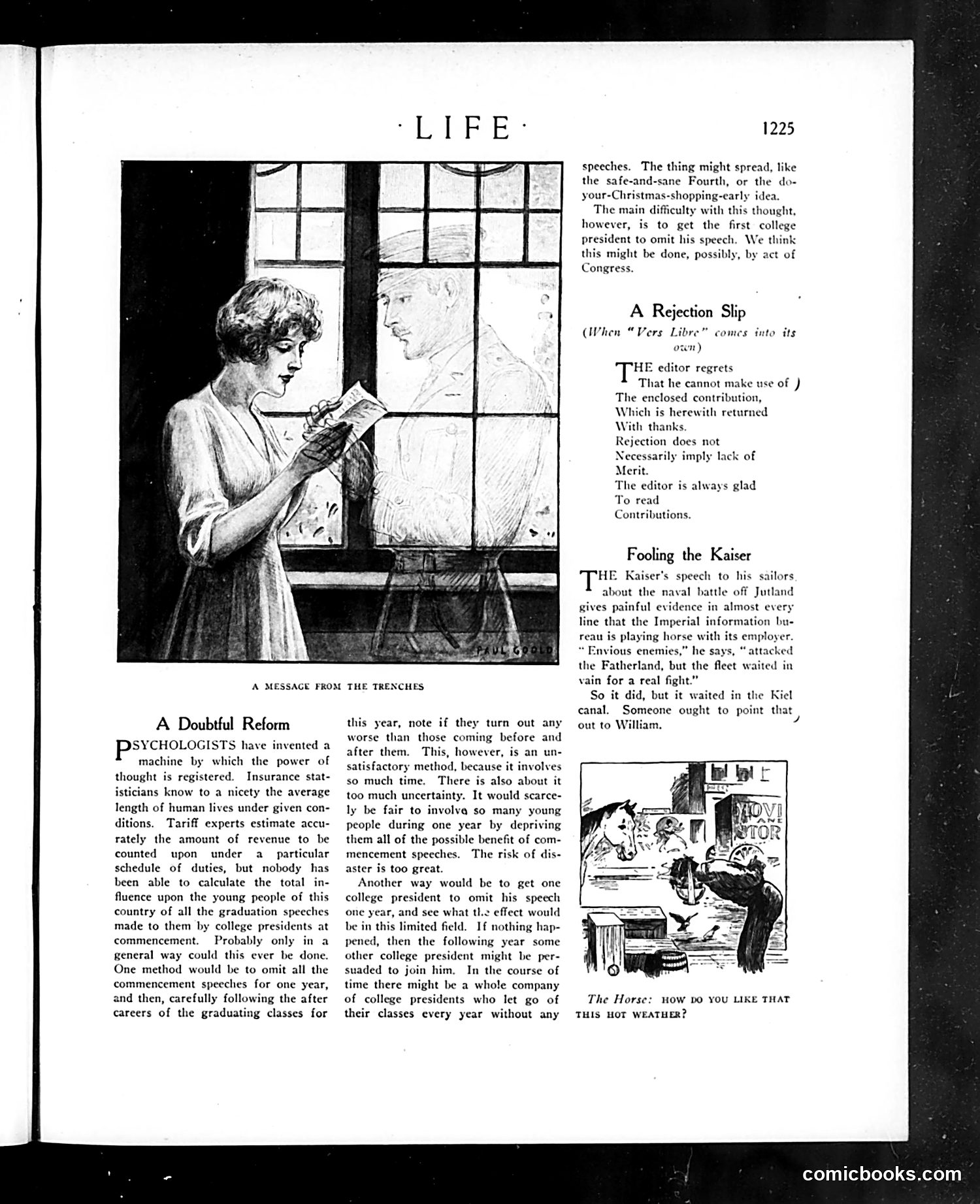
This page contains three satirical pieces: **"A Doubtful Reform"** mocks college commencement speeches as having unmeasurable impact on graduates. The author humorously suggests the only way to test their value would be to omit them entirely for a year—but notes the real obstacle is convincing even one college president to skip giving his speech. The satire targets academic vanity and empty ritual. **"A Rejection Slip"** parodies the then-emerging "vers libre" (free verse) poetry movement. It's written itself in fragmented, unconventional form—mimicking the style it ridicules. The joke is that even a rejection slip, formatted as experimental poetry, becomes incomprehensible. **"Fooling the Kaiser"** criticizes German Emperor Wilhelm II's claims about the 1916 Battle of Jutland. Wilhelm claimed his fleet "waited in vain for a real fight," but Life's author notes the fleet actually waited in the Kiel canal—implying Germany lost and retreated, contradicting Wilhelm's propaganda. The bottom cartoon shows a horse in hot weather, continuing the "Fooling the Kaiser" theme through visual pun.
📄 Transcribed text from this page (OCR, searchable)
Machine-transcribed from the original scan — historical spelling and the odd misread are preserved.
A MESSAGE FROM THE TRENCHES A Doubtful Reform SYCHOLOGISTS have invented a machine by which the power of thought is registered. Insurance stat- isticians know to a nicety the average length of human lives under given con- ditions. Tariff experts estimate accu- rately the amount of revenue to be counted upon under a_ particular schedule of duties, but nobody has been able to calculate the total in- fluence upon the young people of this country of all the graduation speeches made to them by college presidents at commencement. Probably only in a general way could this ever be done. One method would be to omit all the commencement speeches for one year, and then, carefully following the after careers of the graduating classes for this year, note if they turn out any worse than those coming before and after them. This, howeve: an un- satisfactory method, because it involves so much time. There is also about it too much uncertainty. It would scarce- ly be fair to involva so many young people during one year by depriving them all of the possible benefit of com- mencement speeches. The risk of dis- aster is too great. Another way would be to get one college president to omit his speech one year, and see what tLe effect would be in this limited field. If nothing hap- pened, then the following year some other college president might be per- suaded to join him. In the course of time there might be a whole company of college presidents who let go of their classes every year without any 1225 speeches. The thing might spread, like the safe-and-sane Fourth, or the do- your-Christmas-shopping-early idea. The main difficulty with this thought, however, is to get the first college president to omit his speech, We think this might be done, possibly, by act of Congress. A Rejection Slip (When “Vers Libre” comes into its own) HE editor regrets That he cannot make use of ) The enclosed contribution, Which is herewith returned With thanks. Rejection does not Necessarily imply lack of Merit. Phe editor is always glad To read Contributions, Fooling the Kaiser HE Kaiser's speech to his sailors about the naval battle off Jutland gives painful evidence in almost every line that the Imperial information bu- reau is playing horse with its employer. “ Envious enemies,” he say attacked the Fatherland, but the fleet waited in vain for a real fight.” So it did, but it waited in the Kiel canal. out to William, THIS HOT WEATHER? Someone ought to point that | comicbooks.com