
A complete issue · 40 pages · 1915
Life — December 23, 1915
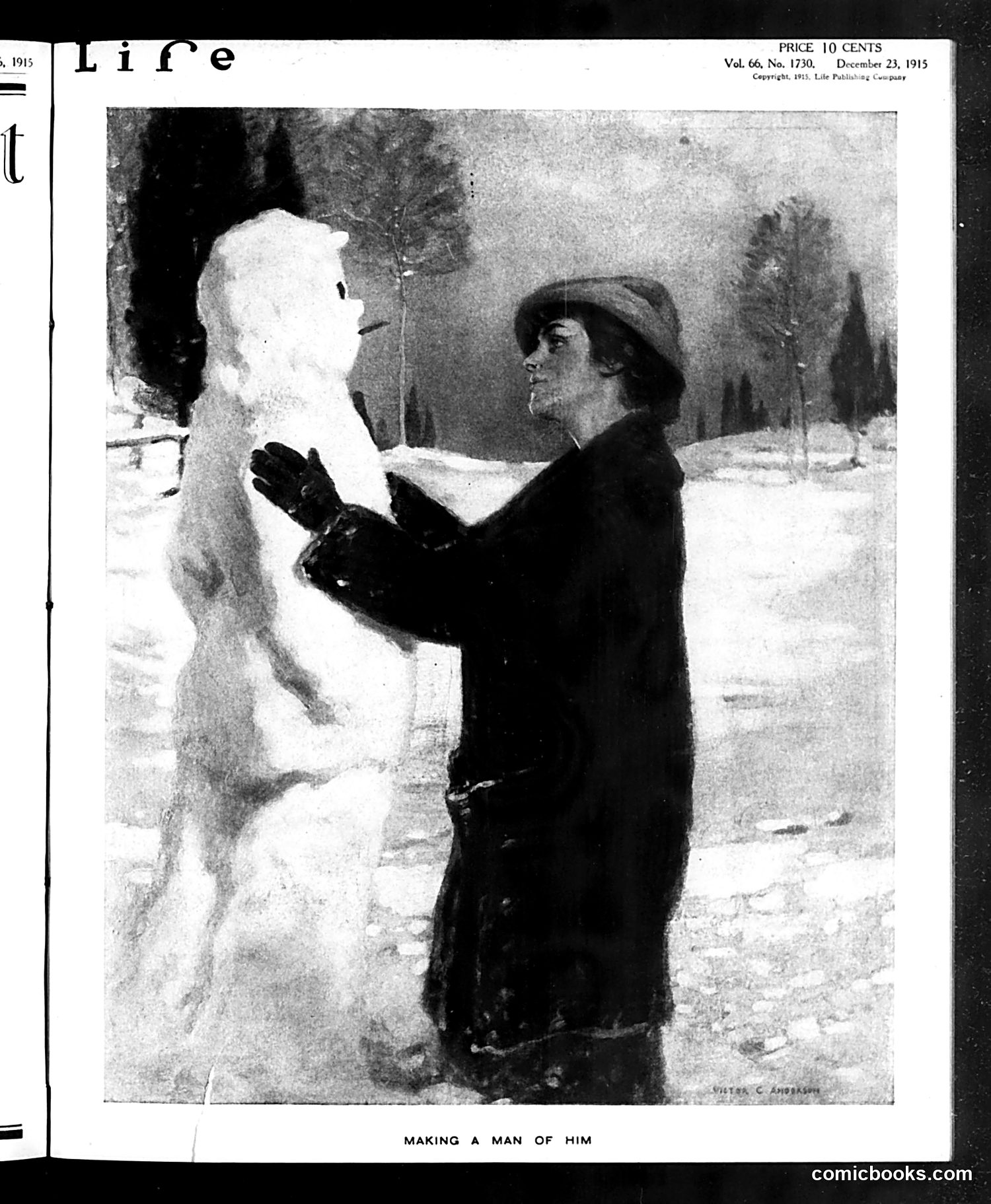
The caption reads "MAKING A MAN OF HIM," showing a woman in dark winter clothing sculpting a large snowman in a snowy landscape with evergreen trees. This appears to be a visual pun or gentle satire about feminine influence and character-building. The woman is literally "making a man" out of snow—a play on the common phrase meaning to develop someone's character or maturity, often through discipline or guidance. Given the 1915 date and Life's satirical nature, this likely comments on women's roles in society during the Progressive Era, possibly addressing debates about women's education, influence, or capabilities. The snowman serves as both literal subject and metaphor for malleable masculinity shaped by female hands. The meaning is humorous rather than pointed political satire.
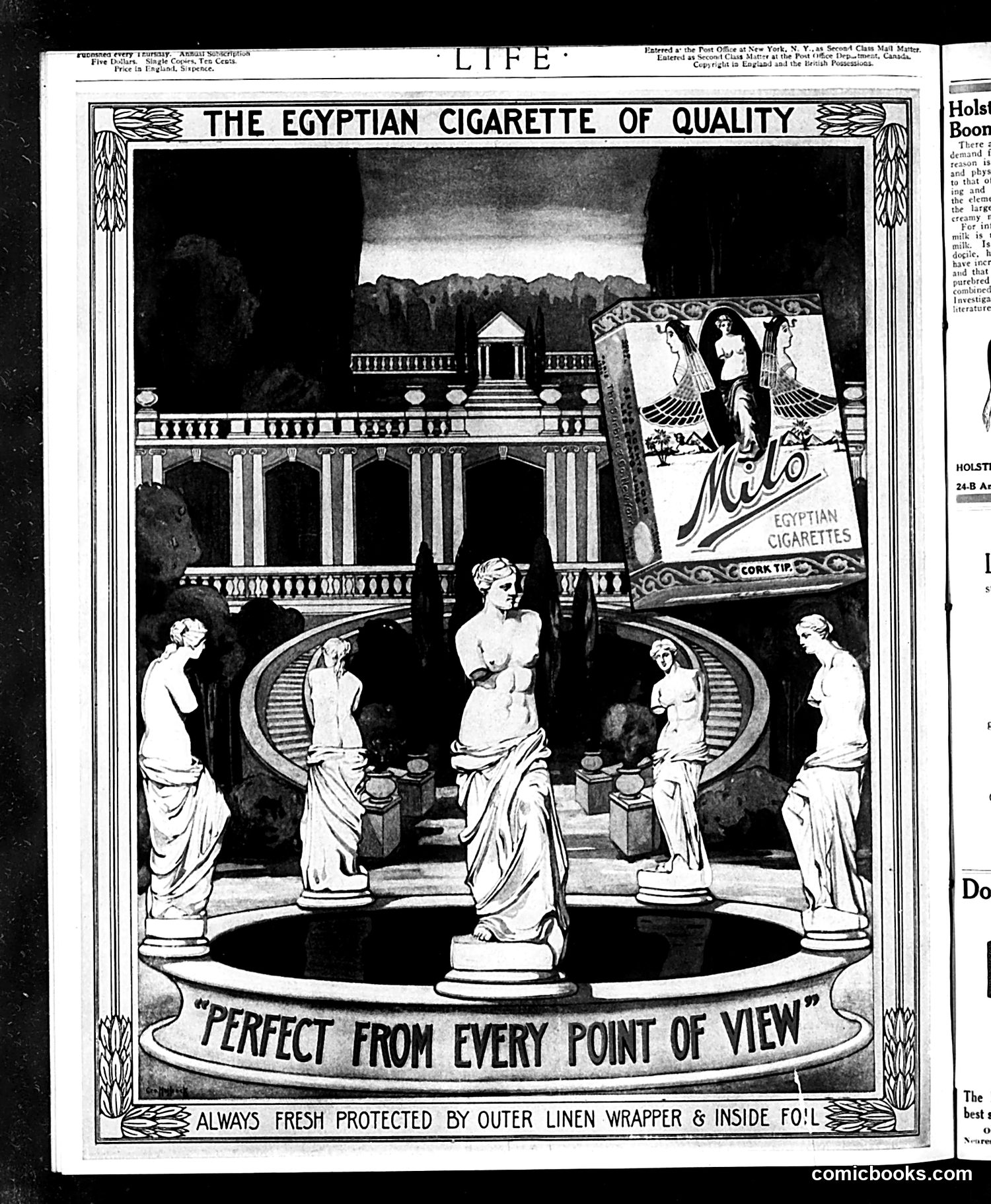
This is a **cigarette advertisement**, not political satire. The ad promotes "Milo" Egyptian cigarettes using classical aesthetic imagery. The composition depicts five nude or partially draped female figures arranged symmetrically around a central pool in a Greco-Roman setting with columned architecture. A Milo cigarette package is prominently displayed upper right. The tagline "Perfect from Every Point of View" is the sales pitch—the classical statuary poses suggest the product's aesthetic appeal and quality. The text emphasizes freshness and packaging protection. This reflects early 20th-century advertising conventions: using classical/artistic imagery and female figures to market luxury consumer goods. There is no political commentary visible—this is straightforward product promotion using aspirational artistic references to signal quality and sophistication to potential buyers.
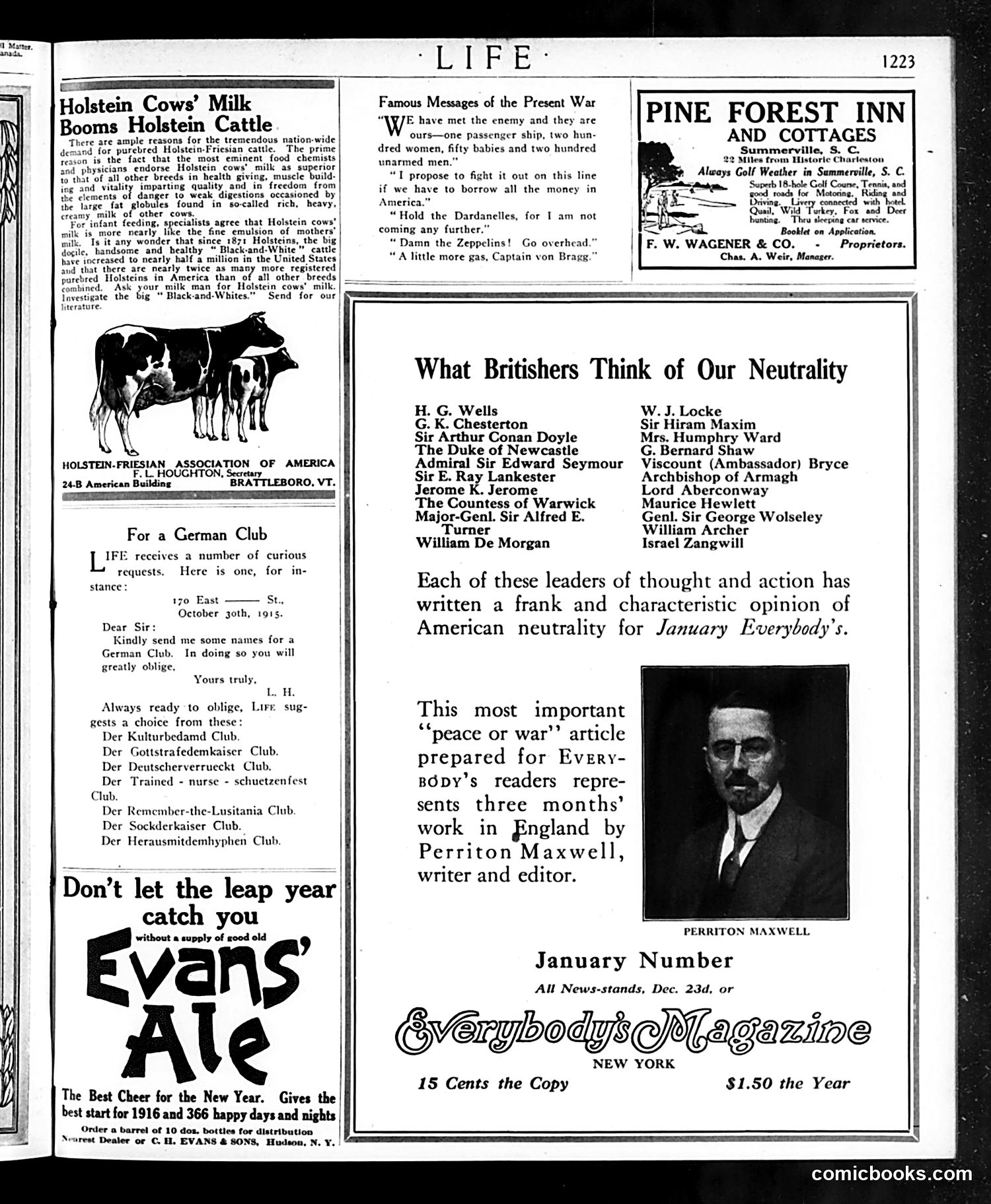
This page is primarily **advertising and editorial content** rather than political satire. The main feature announces a January issue of *Everybody's Magazine* that will publish essays by prominent British figures (H.G. Wells, Arthur Conan Doyle, etc.) discussing American neutrality during World War I. The piece emphasizes this is "important" content about "peace or war," suggesting the U.S. neutrality debate was a major contemporary concern. The surrounding advertisements—for Holstein cattle milk, Evans' Ale, and Pine Forest Inn—are commercial rather than satirical. A small item requests names for a "German Club," likely reflecting how German-American organizations operated during WWI. The page reflects pre-1917 American debate about WWI involvement, with British voices appealing to American public opinion on the neutrality question.
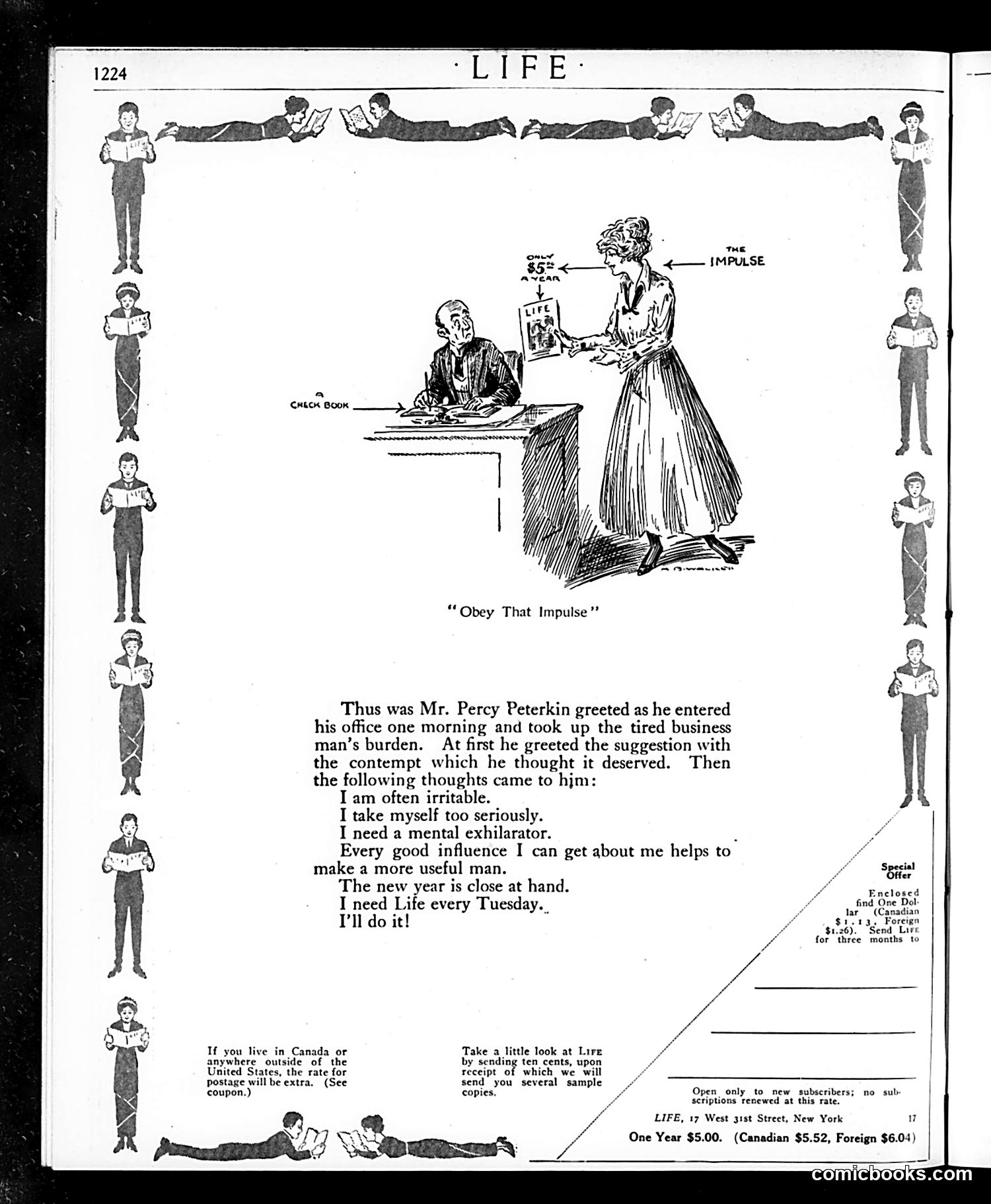
This page satirizes the New Year's resolution phenomenon through Mr. Percy Peterkin's character arc. The cartoon shows a woman presenting Peterkin (seated at his desk with a "Check Book") with a copy of *Life* magazine, labeled "The Impulse." The satire operates on two levels: First, the caption "Obey That Impulse" mocks how easily people act on whims. Second, Peterkin's internal monologue—admitting he's "often irritable," takes himself "too seriously," and needs "a mental exhilarator"—presents self-awareness immediately undercut by his resolution to buy *Life* magazine every Tuesday as his supposed self-improvement solution. The joke: impulse purchases of entertainment magazines won't actually reform character flaws. It's promotional satire advertising the magazine itself.
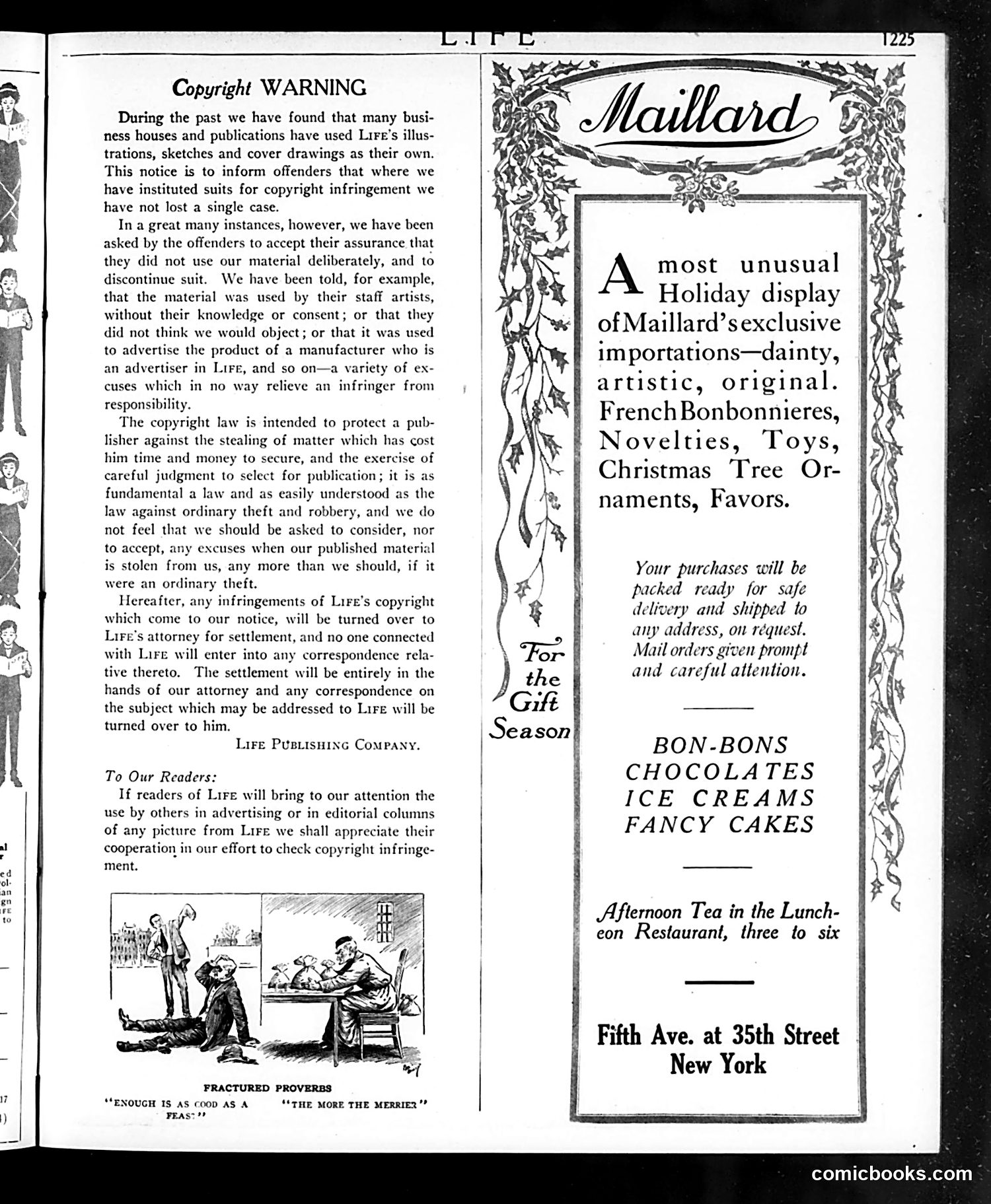
This page is **primarily advertising**, not political satire. The right side features a Maillard holiday advertisement for French luxury goods (chocolates, bonbons, toys, ornaments) available at their Fifth Avenue location in New York. The left side contains a **copyright warning** from Life Publishing Company and a small cartoon labeled "Fractured Proverbs" showing two figures with the captions "Enough is as good as a feast" and "The more the merries." This appears to be a light visual pun rather than political commentary—a whimsical take on familiar sayings, using the characters' positions or expressions for humor. The page is primarily commercial in nature, with minimal satirical content.
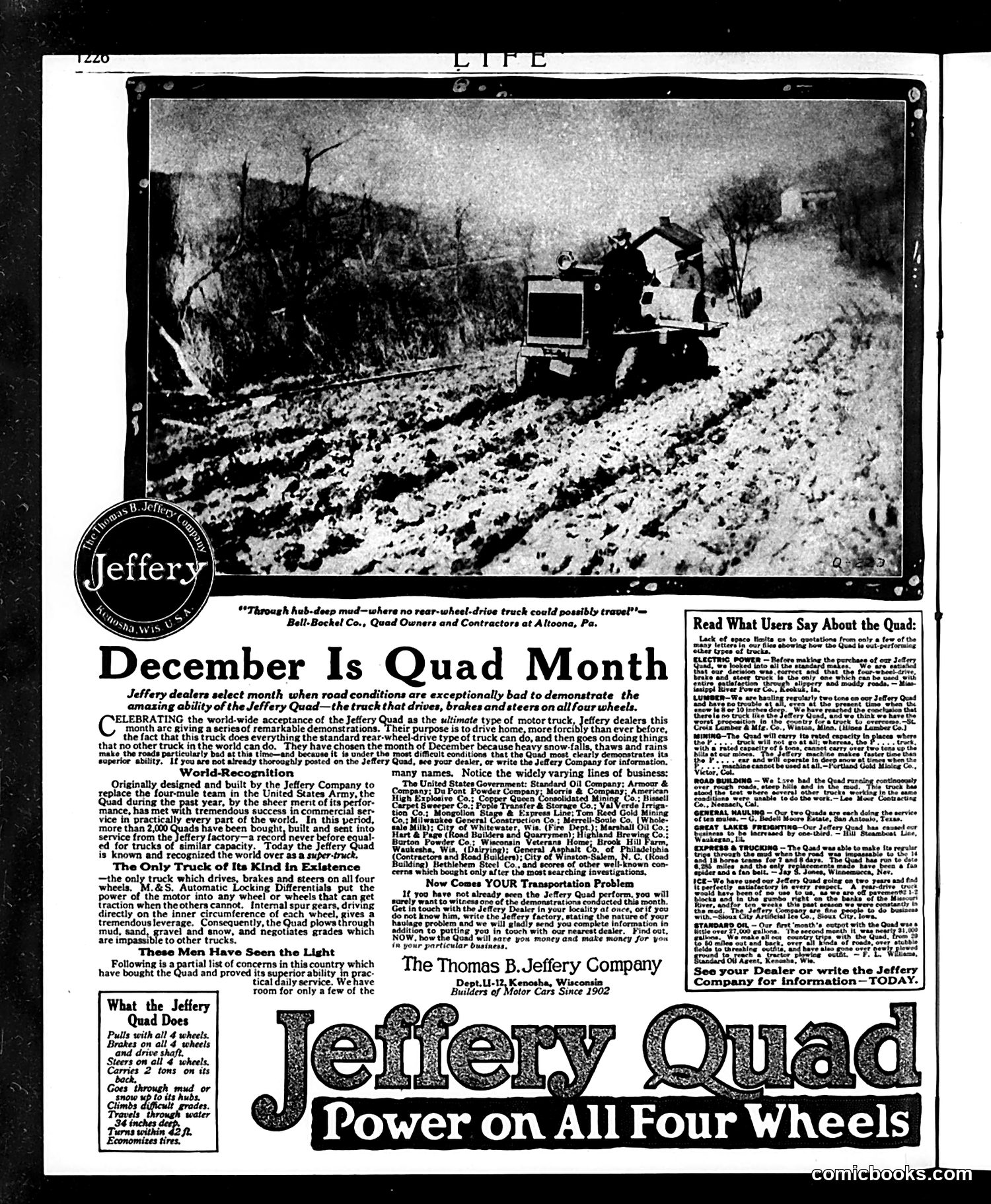
This page is primarily **advertising**, not satire or political commentary. It's a full-page advertisement for the Jeffery Quad truck, published by The Thomas B. Jeffery Company of Kenosha, Wisconsin. The central image shows a Jeffery Quad truck navigating deep mud—a practical demonstration of the vehicle's capability. The headline "December Is Quad Month" promotes the truck's four-wheel drive and steering system as superior to standard vehicles, particularly for winter conditions. The accompanying testimonial section ("Read What Users Say About the Quad") features customer endorsements emphasizing the truck's performance in difficult terrain. This represents early automotive advertising that emphasized practical utility and real-world performance rather than style or luxury.
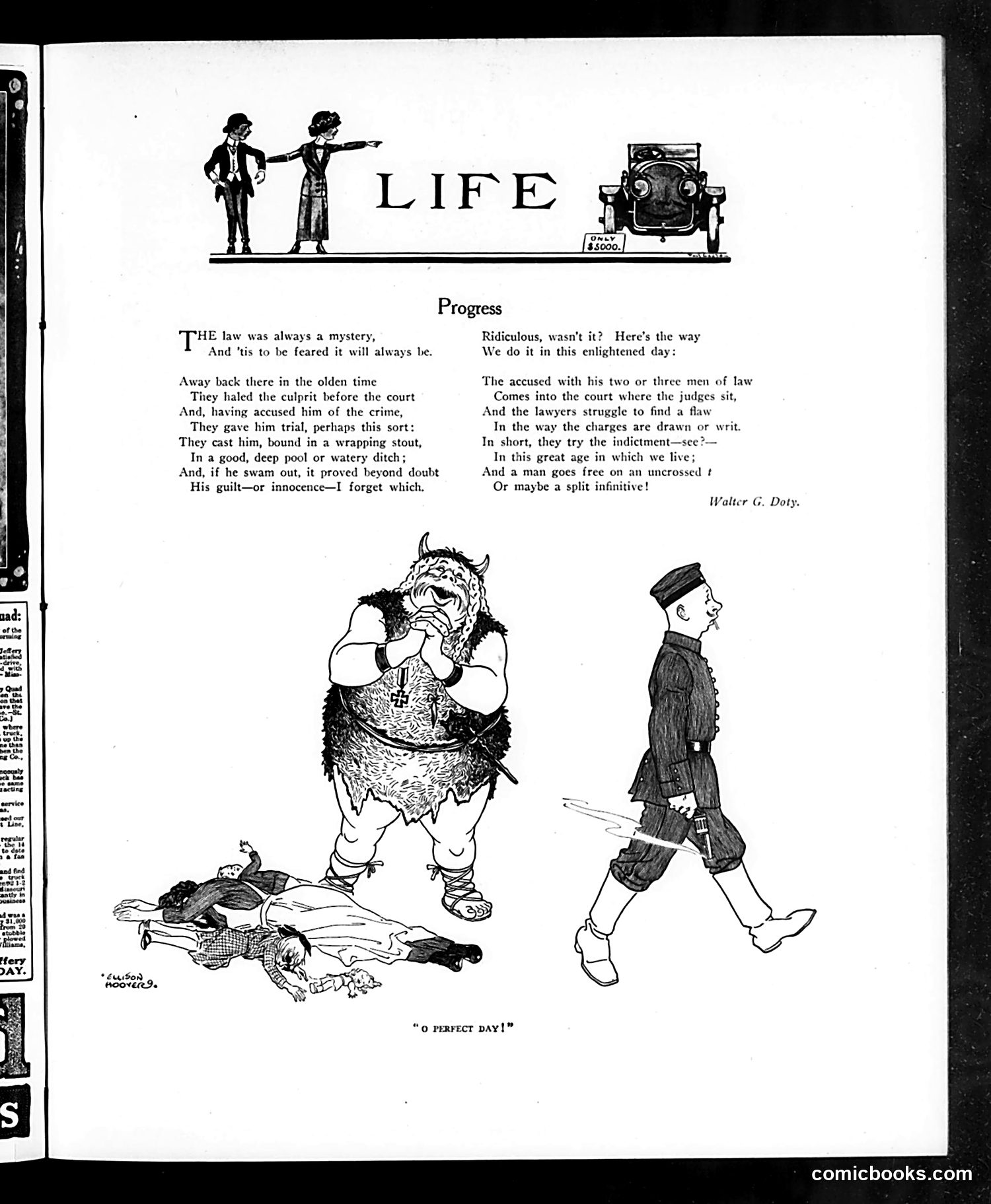
This satirical page contrasts old and new legal systems. The poem by Walter G. Doty describes how medieval justice was swift and brutal—accused criminals were simply executed by drowning. The modern section mocks contemporary law as absurdly complex: accused persons now endure lengthy court proceedings with multiple lawyers arguing over procedural technicalities ("charges are drawn or writ"). The cartoon below illustrates this: a brutish, demonic figure labeled "Justice" stands over a dead body while a well-dressed man walks past—captioned "A PERFECT DAY!" This dark humor suggests that modern legal processes are so inefficient and corrupted that even genuine justice becomes a grotesque mockery, leaving the same moral outcome as medieval brutality.
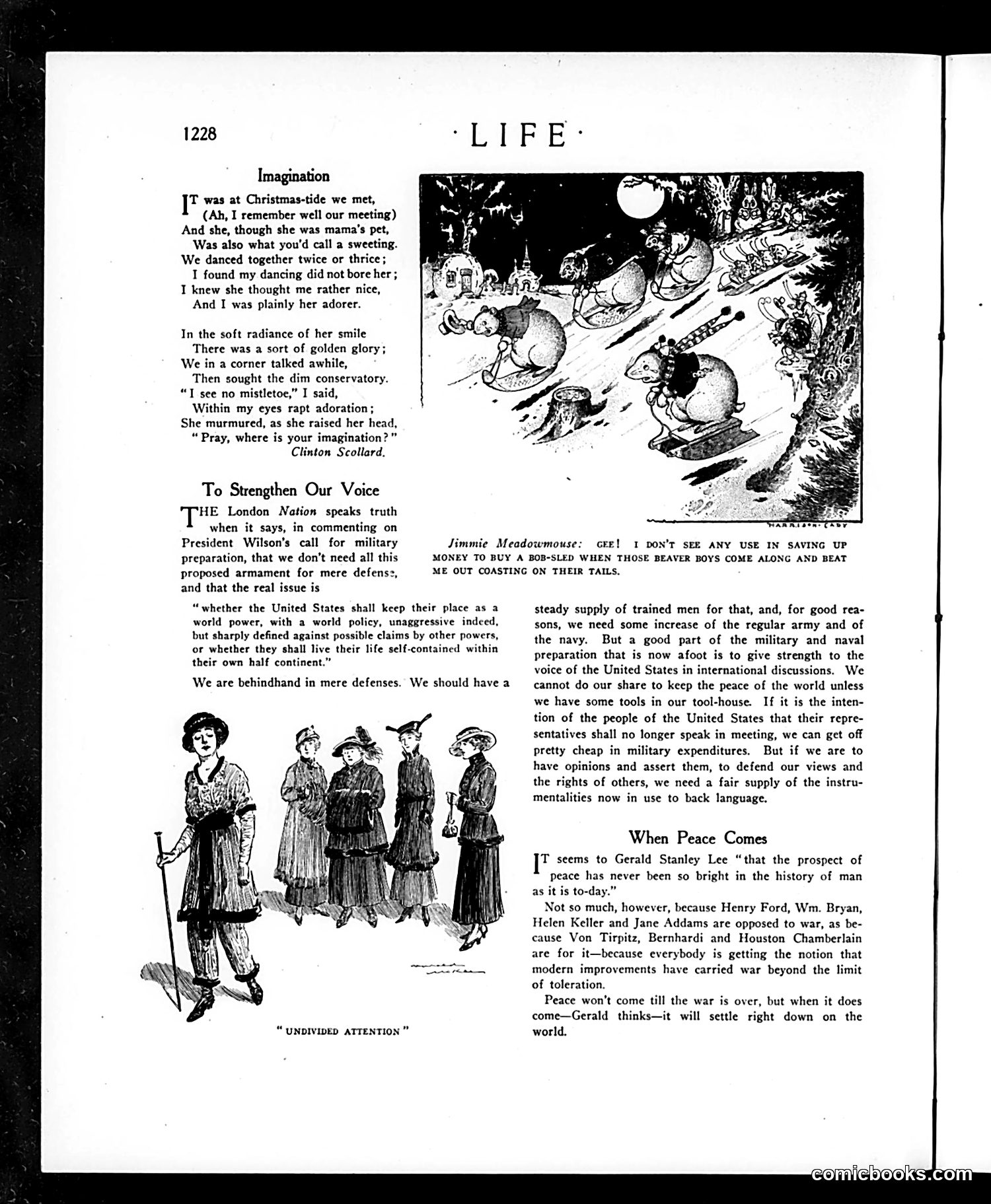
**"Undivided Attention" Cartoon:** This sketch depicts five women in military-style uniforms or formal dress, with one prominently featured holding what appears to be a rifle. The illustration supports the article "To Strengthen Our Voice," which argues for U.S. military preparedness and increased defense spending. The women represent female civic participation or potential military support during a period of international tension (likely pre-WWI or interwar era, given the context about President Wilson). **Main Article:** The editorial opposes pacifist arguments by figures named (Henry Ford, William Bryan, Helen Keller, Jane Addams, and others) who opposed war. It argues that military strength is necessary for maintaining peace and America's international voice, asserting that modern society has exceeded traditional limits of tolerance, making armed capability essential.
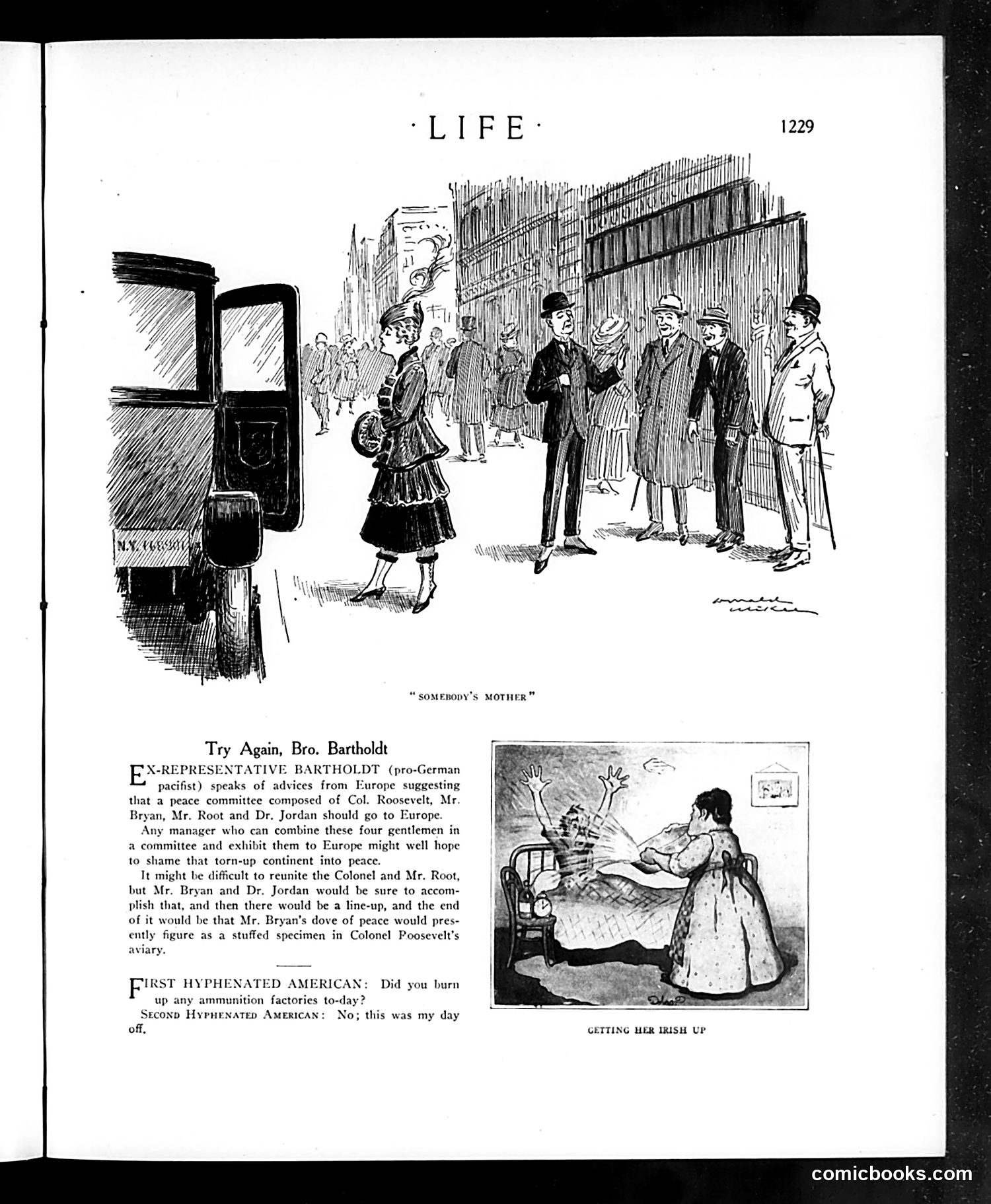
The main cartoon titled "Somebody's Mother" depicts a woman approaching a doorway while several men in suits and hats stand nearby on a street, suggesting an urban setting. Below are two joke items: **"Try Again, Bro. Bartholdt"** criticizes Ex-Representative Bartholdt (identified as pro-German pacifist) for proposing that Roosevelt, Bryan, Root, and Jordan travel to Europe to promote peace. The satire mocks this as impractical and suggests the outcome would merely result in these figures becoming "stuffed specimens in Colonel Roosevelt's aviary"—implying Roosevelt would collect them as trophies. **The hyphenated American joke** plays on ethnic identity tensions of the WWI era, contrasting two American immigrants' attitudes toward munitions production during wartime. The smaller cartoon "Getting Her Irish Up" shows a woman pulling at a man on a bed, likely referencing Irish-American stereotypes.
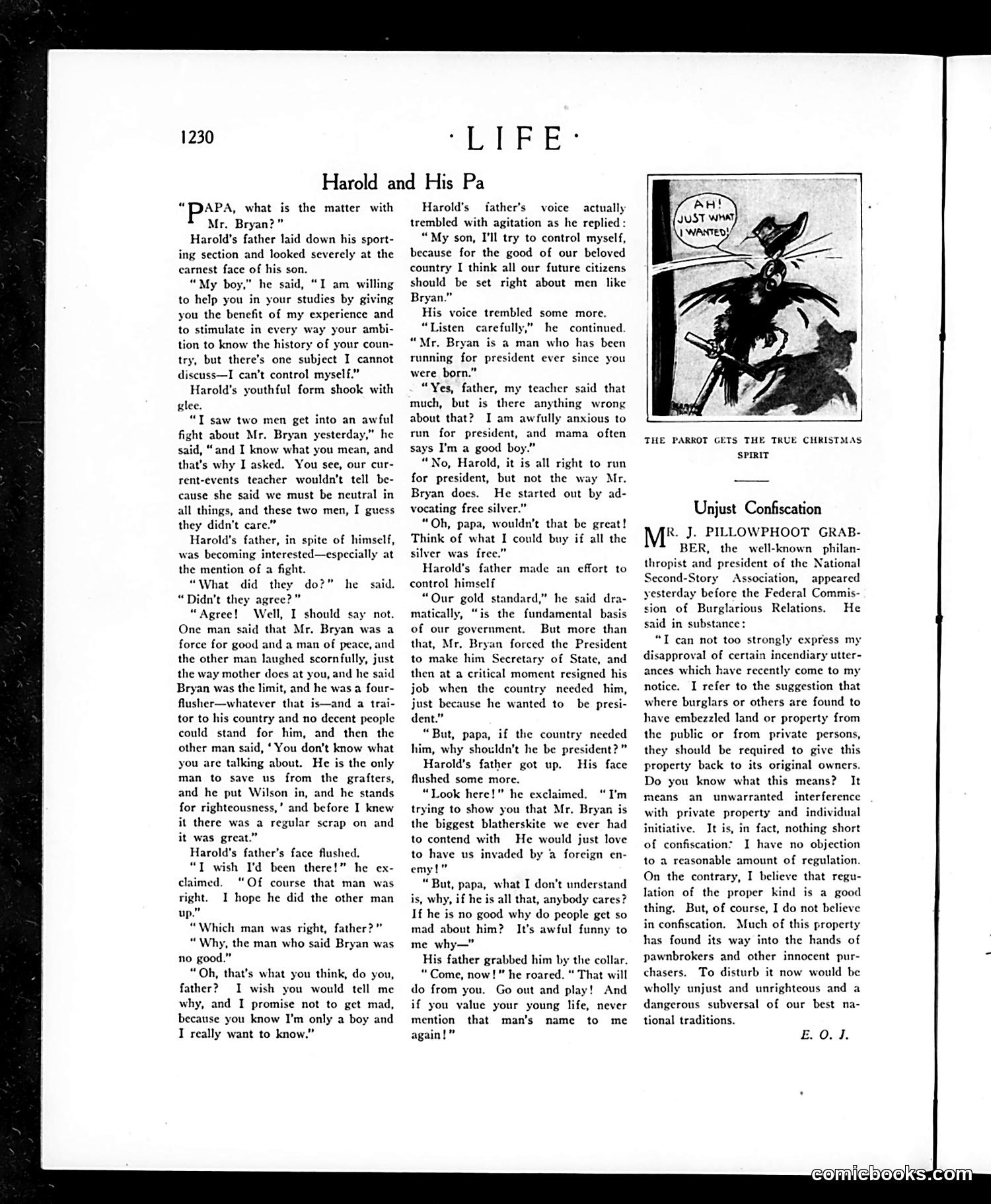
This page contains two distinct sections: **"Harold and His Pa"** (left): A story about a boy whose father opposes William Jennings Bryan's presidential candidacy. The father advocates for the gold standard ("Our gold standard...is the fundamental basis of our government"), while Harold wants Bryan to win. This reflects the 1896-1900 era's fierce debate over monetary policy—Bryan championed free silver, while conservatives defended the gold standard. The satire mocks parental political lecturing to children. **"Unjust Confiscation"** (right): An article by J. Pillow Phoot Grabber criticizing government seizure of stolen goods from burglars and other criminals. He argues such confiscation represents "unwarranted interference with private property." This appears satirical—the absurd name "Pillow Phoot Grabber" and the ridiculous stance (defending criminals' property rights) suggest mockery of laissez-faire ideology taken to illogical extremes. The small illustration shows a parrot receiving "the true Christmas spirit."
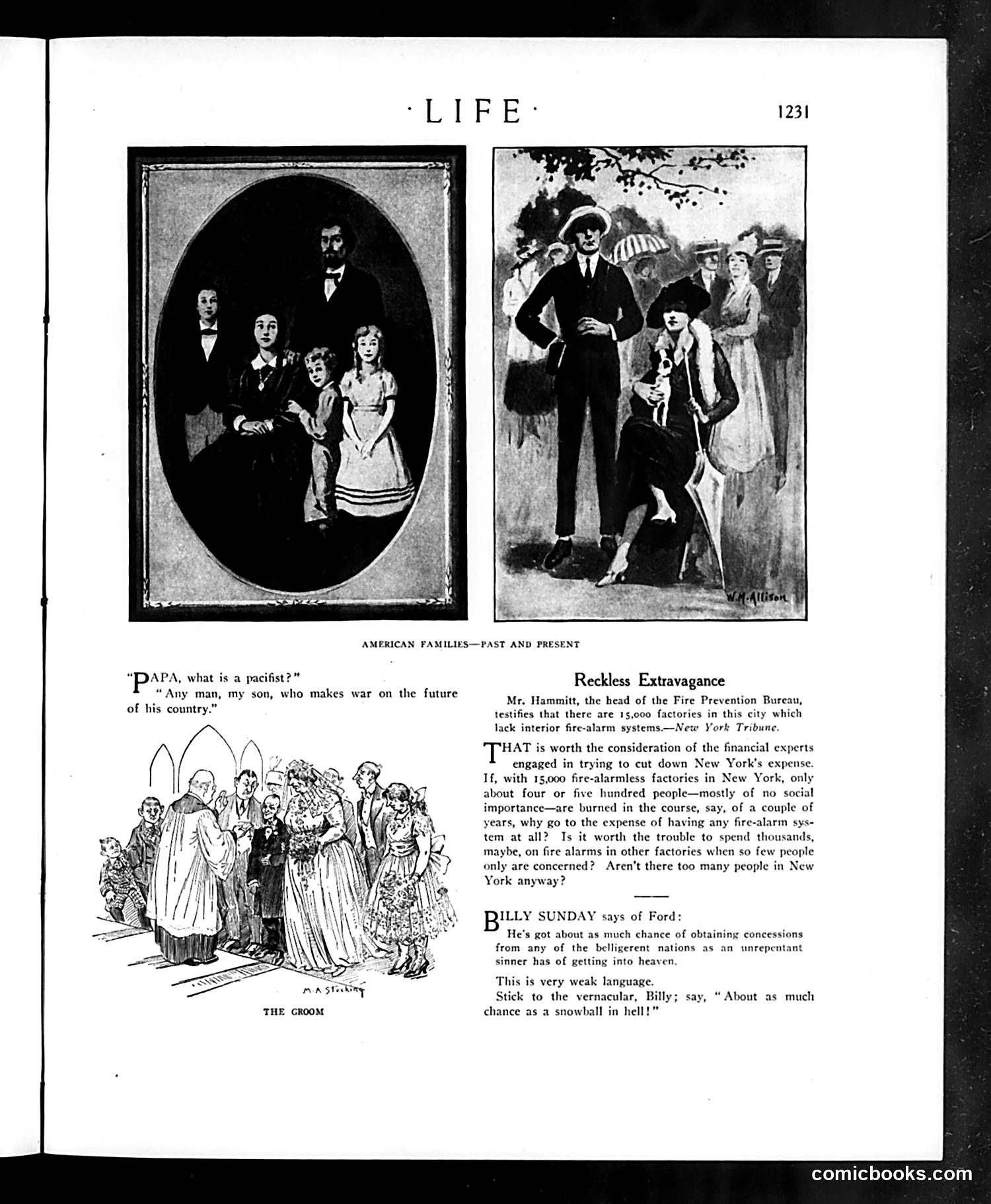
This Life page contrasts historical and contemporary American society through three images and accompanying commentary. The left panel shows a formal Victorian-era family portrait, paired with a dialogue where a child asks their father "Papa, what is a pacifist?"—a reference to pre-World War I pacifism debates. The right panel depicts a modern outdoor scene, likely satirizing contemporary social attitudes or behavior. Below, "The Groom" cartoon shows a wedding party, while the text "Reckless Extravagance" criticizes New York's spending on fire-prevention systems despite 15,000 factories lacking alarms. Billy Sunday (a famous evangelist) is quoted making a crude comparison about obtaining "concessions" from bellicose nations—the editor dismissively counters this as weak reasoning. The overall theme mocks shifting American values and priorities.
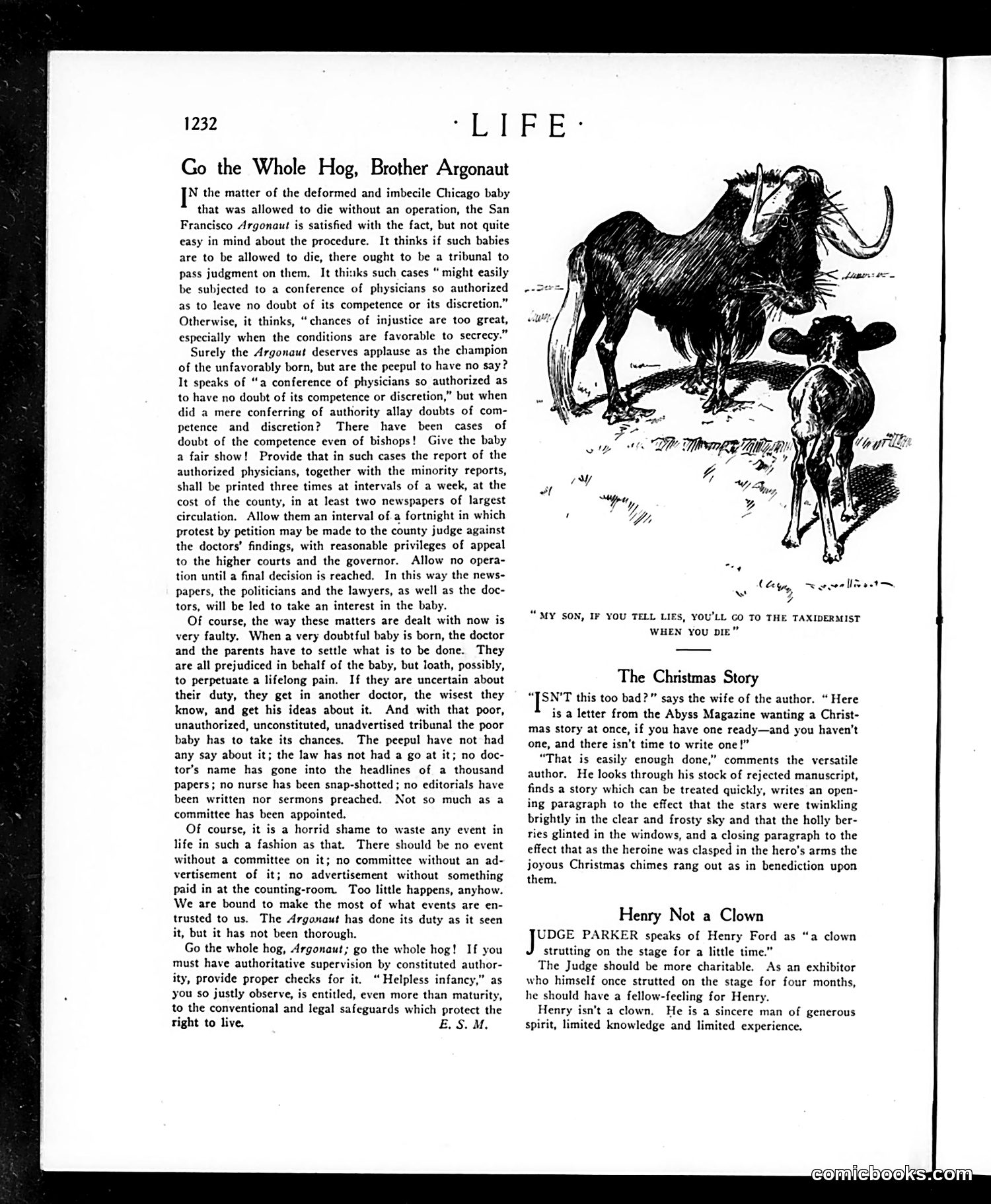
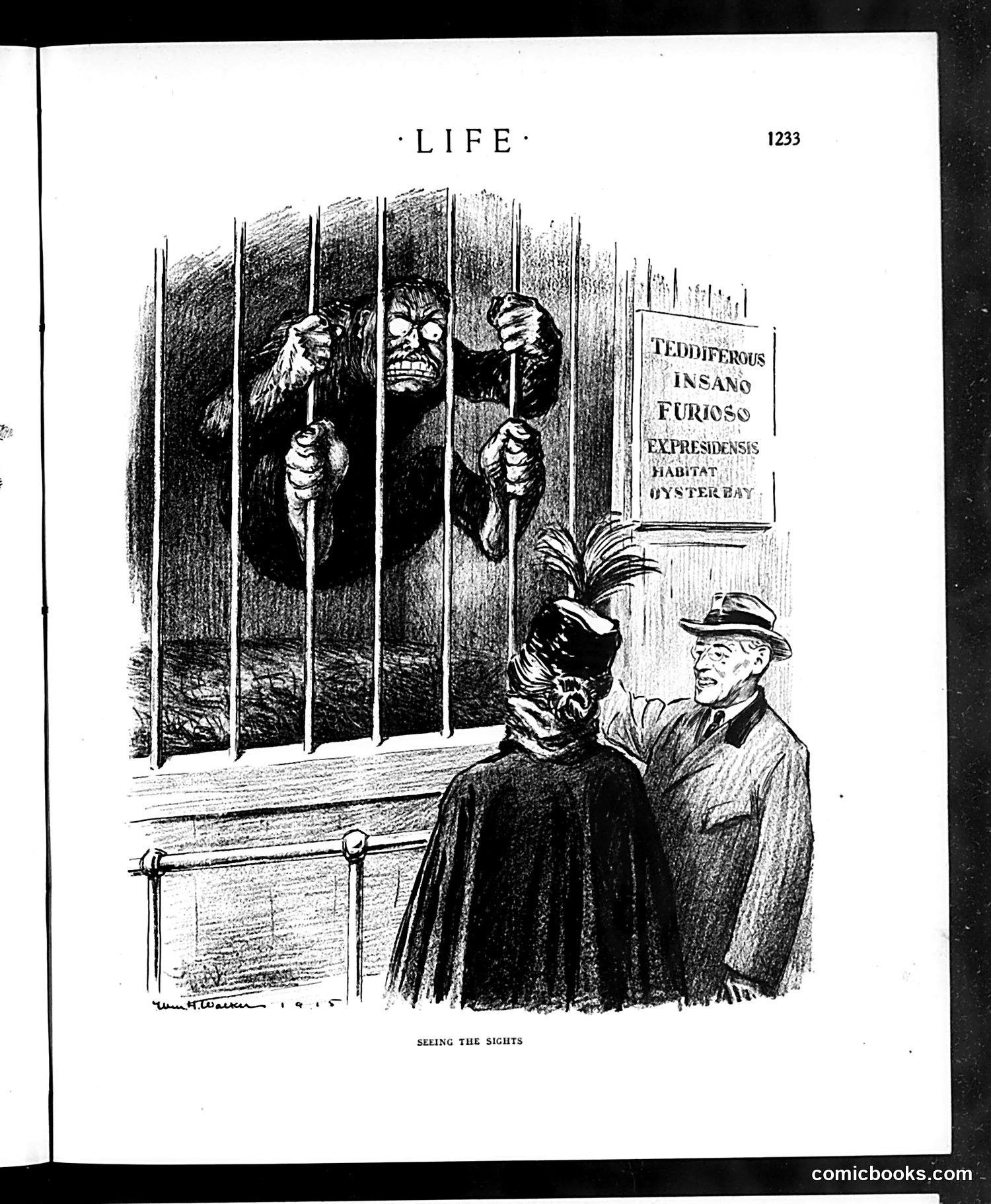
This cartoon satirizes a zoo or menagerie visit. Two well-dressed visitors observe dangerous animals behind bars—appearing to be wild primates or apes. A sign visible in the cage reads "TEDDIFEROUS INSANO FURIOSO" with Latin-sounding pseudo-scientific names including "EXPRESIDENSIS" and "HARBOR OYSTER BAY." The humor relies on comparing the caged animals to former presidents or political figures, likely Theodore Roosevelt (suggested by "Teddy" reference and "Harbor Oyster BAY"—possibly Oyster Bay, Roosevelt's home). The satire suggests prominent political figures are as dangerous and worthy of confinement as wild beasts, worthy only of being displayed for public amusement rather than holding power. This reflects common early 20th-century political mockery of specific leaders.
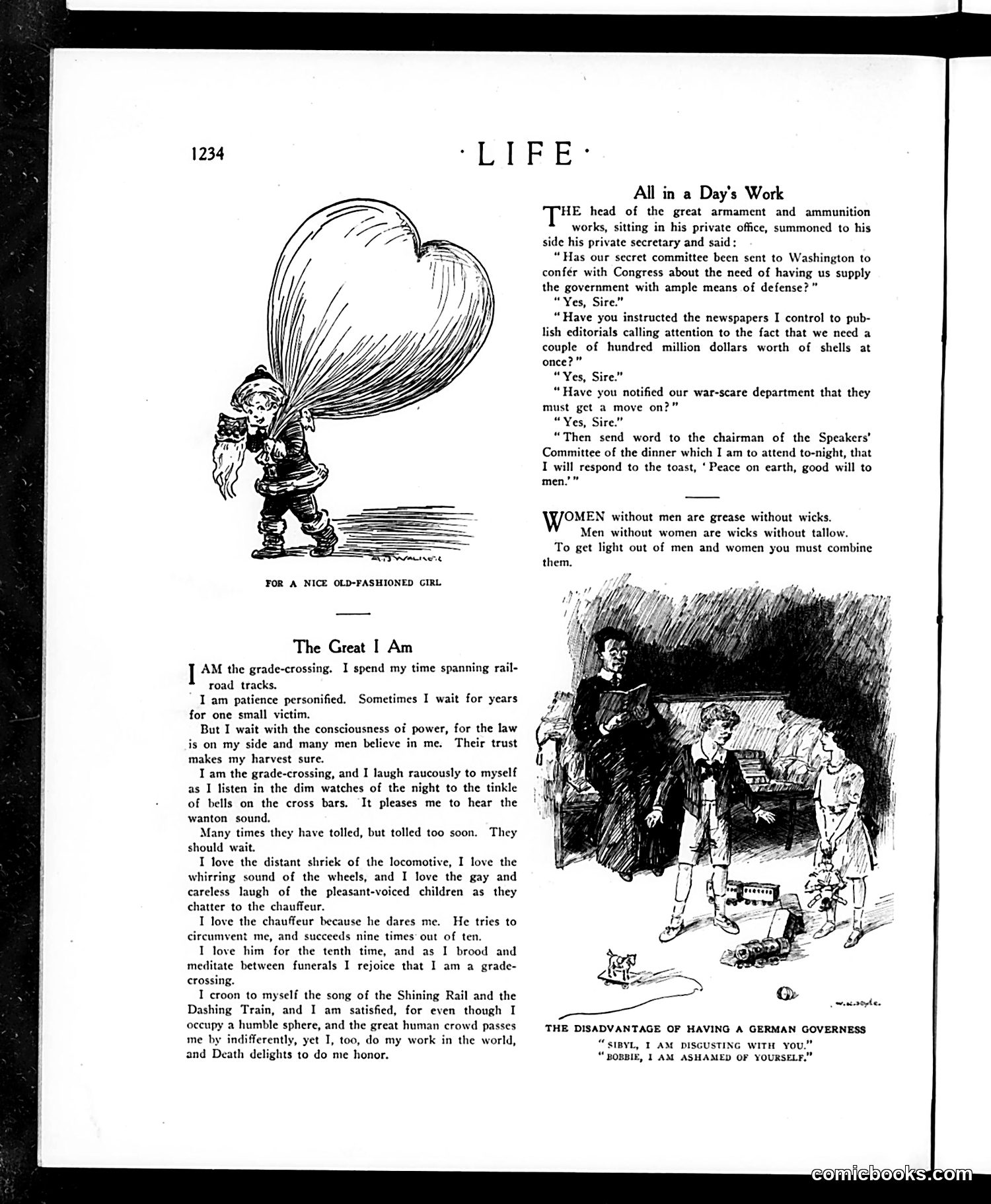
**"All in a Day's Work"** depicts a military/industrial official orchestrating war preparations: directing newspapers to publish propaganda about ammunition shortages, instructing a "war-scare department," and planning to deliver a patriotic dinner toast. The satire targets how government manufactures public anxiety to justify military spending and defense budgets. **"For a Nice Old-Fashioned Girl"** shows a cherubic figure holding a massive heart-shaped balloon—likely satirizing sentimentality or romantic excess. **"The Great I Am"** is a personification poem from the perspective of a railroad grade-crossing, expressing satisfaction with its humble but essential role. **"The Disadvantage of Having a German Governess"** cartoon shows a governess with children, captioned with dialogue suggesting cultural/national tension—likely reflecting anti-German sentiment during or after World War I.
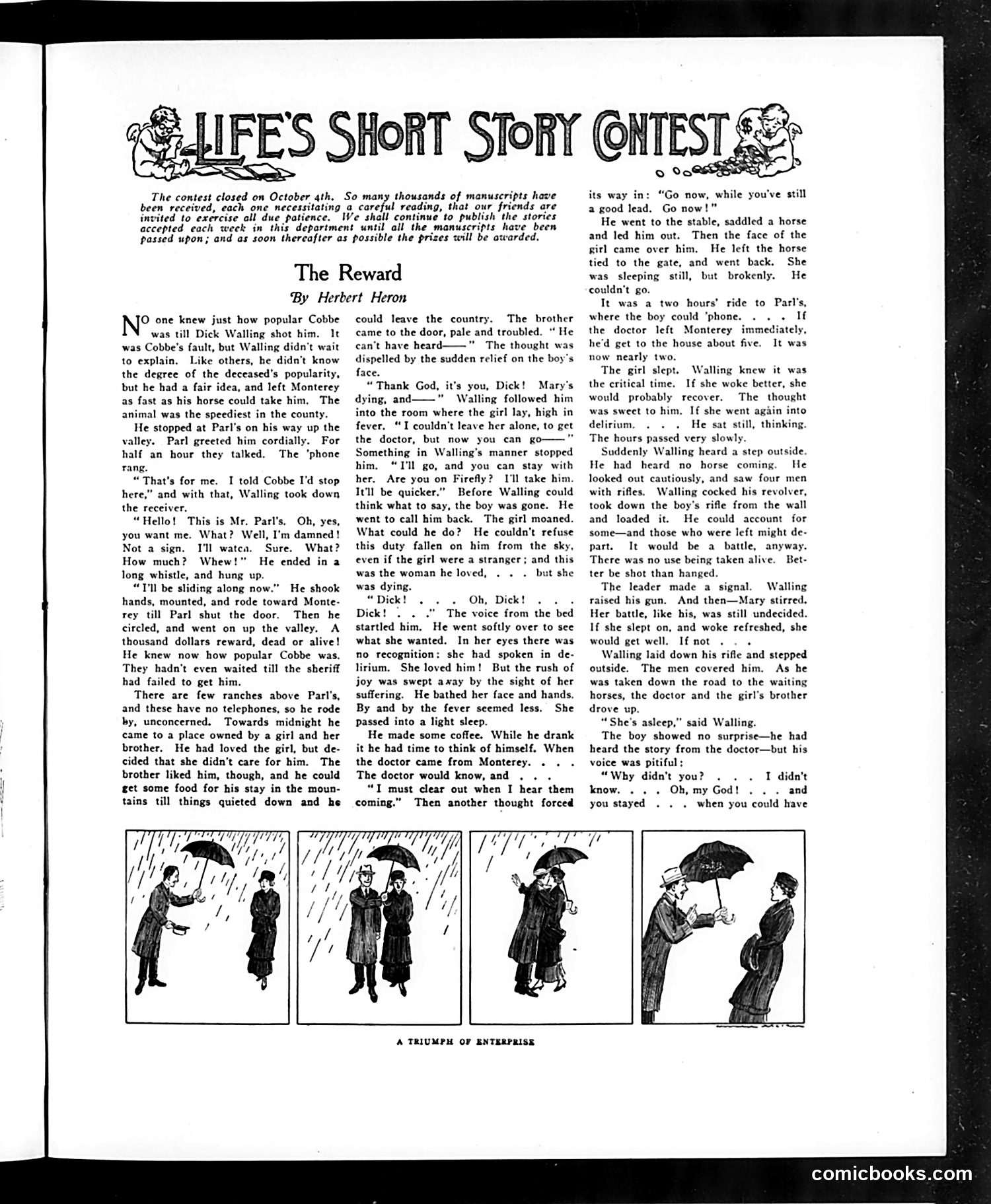
This is a short story (not a political cartoon) from Life's contest. The narrative follows a man named Walling who must choose between duty and love during an emergency. The plot: A boy is critically ill; Walling must ride to fetch a doctor from Monterey. His sweetheart, Mary, is also gravely ill upstairs and begs him not to leave. Walling faces an impossible choice—abandon the dying boy to stay with Mary, or fulfill his moral obligation. He chooses duty, retrieves the doctor, and both patients survive. The four comic panels at bottom (titled "A Triumph of Enterprise") appear to humorously illustrate the journey, showing two figures with umbrellas in rain. This reflects early-20th-century values: duty and self-sacrifice triumph over personal desire.
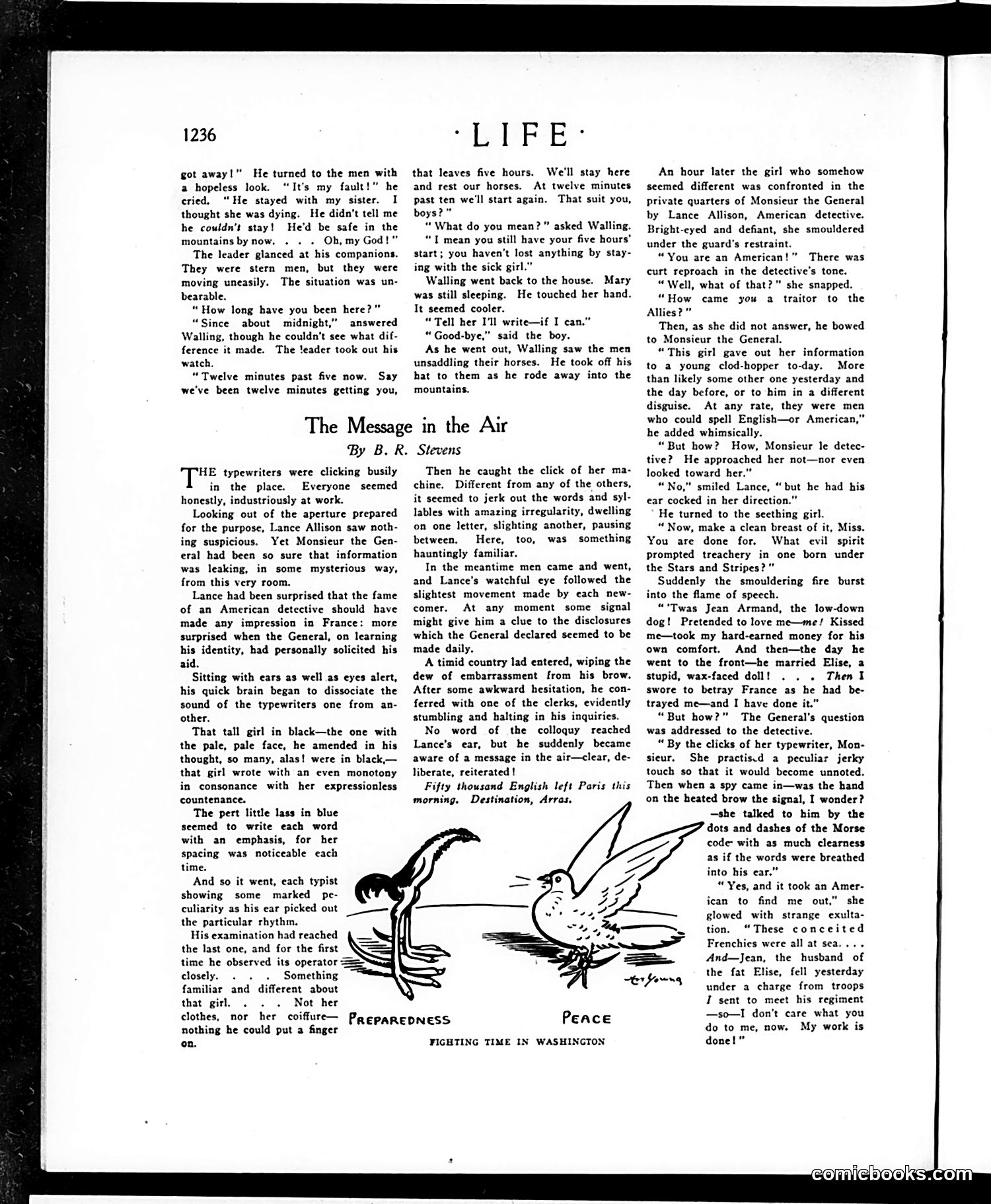
This page contains a short story by B.R. Stevens about an American detective (Lance Allison) working for a French general during what appears to be World War I. The detective is stationed in an office to identify who is leaking military information. The narrative demonstrates spy-craft through observation: Allison distinguishes typists by the unique rhythmic patterns of their machines—a clever metaphor for identifying individuals through distinctive characteristics. He eventually detects a coded message being transmitted through the typewriter's deliberate irregularities: "Fifty thousand English left Paris this morning. Destination, Arras." The illustrations labeled "Preparedness" and "Peace" (showing a dove) appear to reference wartime vigilance themes. The story exemplifies early-20th-century spy fiction popular during WWI, emphasizing technological detection and the danger of enemy agents embedded within Allied operations. The narrative suggests that even seemingly innocent office work could mask espionage activities.
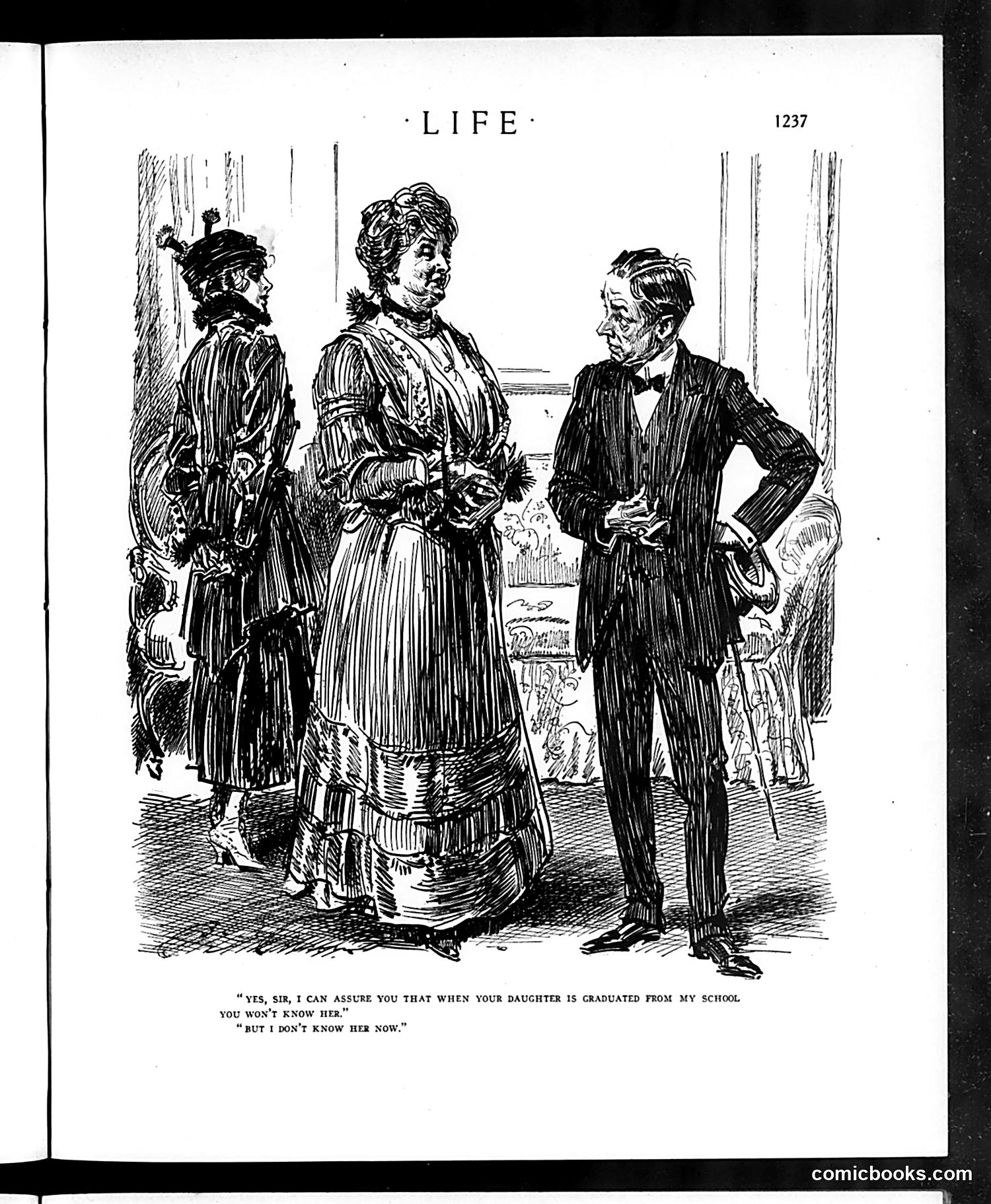
This satirical cartoon from Life magazine depicts a conversation between a man and what appears to be a headmistress or school administrator. The joke plays on the double meaning of "won't know her." The headmistress reassures a father that his daughter will be thoroughly transformed by her school education—implying such significant personal development that he'll find her unrecognizable. However, the father's deadpan response—"But I don't know her now"—suggests he's already estranged from or unfamiliar with his own daughter. The satire mocks both pretentious educational institutions that promise radical transformation, and absentee fathers who are disconnected from their children's lives. The humor arises from the father's unexpected honesty about his existing alienation from his daughter, rather than engaging with the school's sales pitch about improvement.
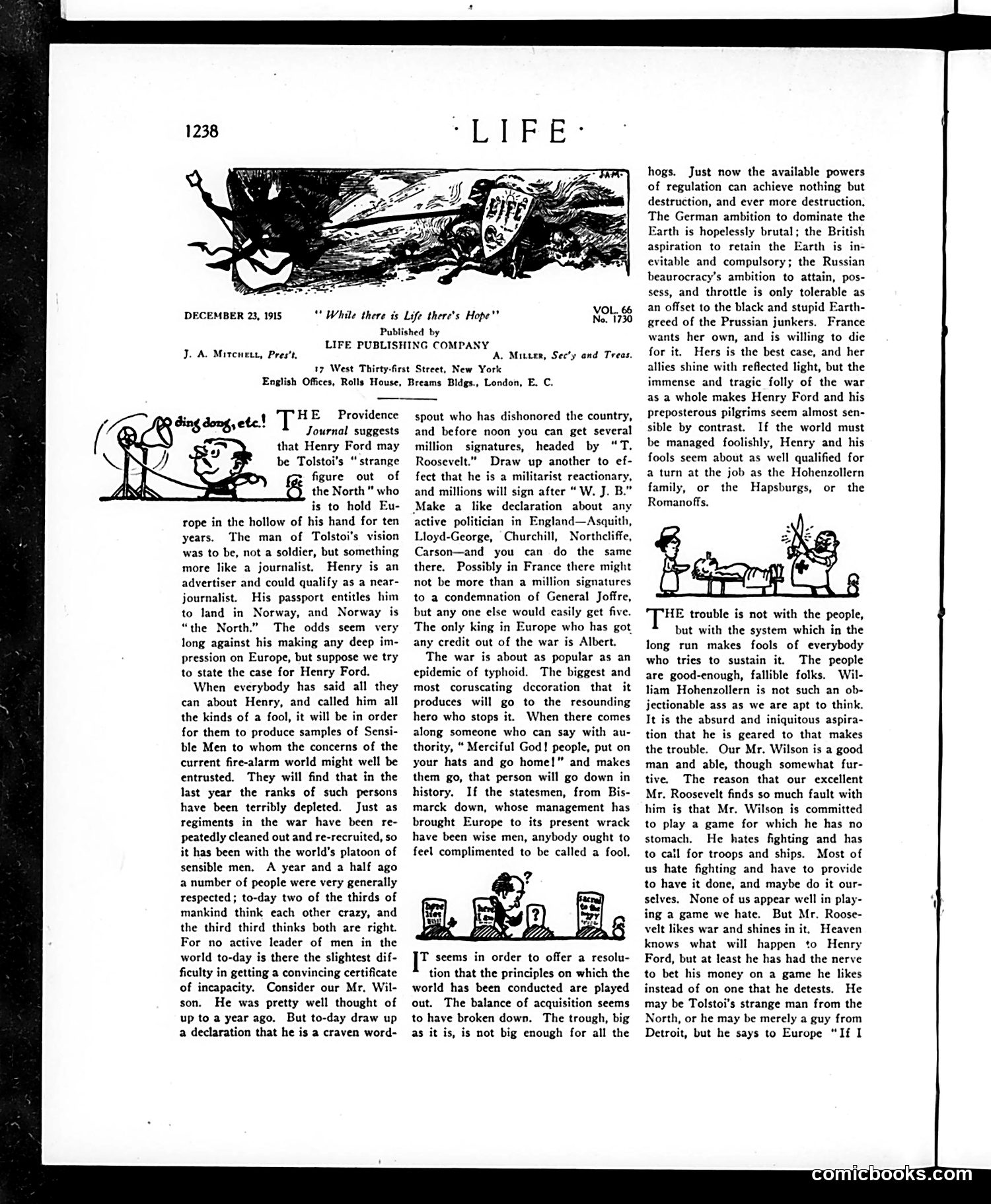
This page satirizes Henry Ford's peace mission to Europe during World War I. The *Providence Journal* facetiously suggests Ford might be the "strange man from the North" prophesied by Tolstoi to stop European conflict—a figure entrusted to "hold Europe in the hollow of his hand for ten years." The satire is biting: the article argues that in wartime, *everyone* is considered a fool by someone. It lists major political figures (Wilson, Asquith, Lloyd-George, Churchill) to show how universal condemnation has become. The real "hero," the piece suggests, will be whoever can say "people, put on your hats and go home!"—and make them listen. The underlying critique: Ford, an industrialist and advertiser rather than statesman, is as qualified as anyone else to broker peace, given how thoroughly existing leaders have failed. The war has made fools of everyone, making a car manufacturer's intervention almost logical by contrast.
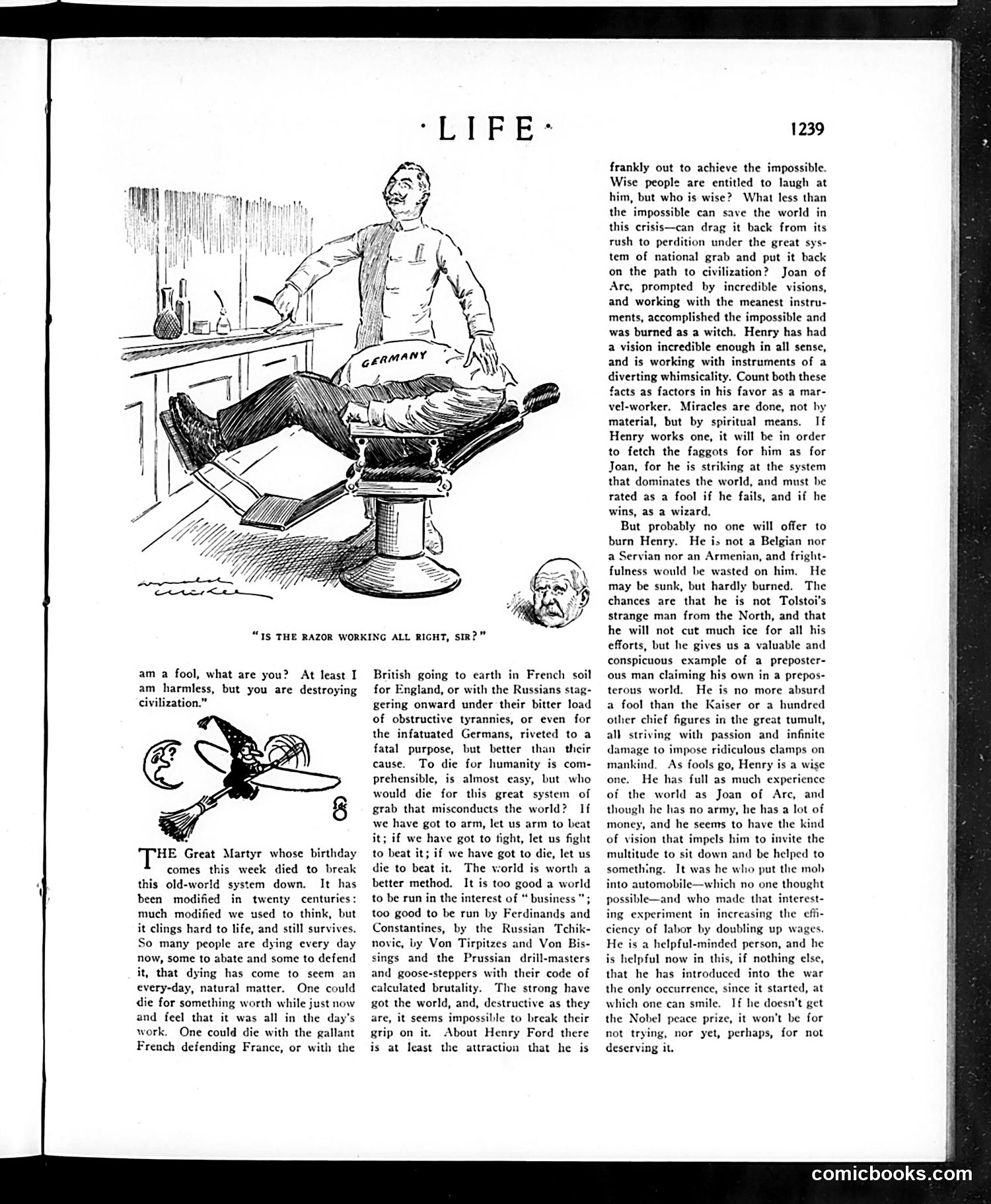
This 1914-1918 era *Life* page satirizes competing responses to World War I through Henry Ford and historical comparison. **The Main Cartoon**: Shows a dentist asking "Is the razor working all right, sir?" while a patient labeled "GERMANY" lies in the chair. This is dark wartime humor depicting military destruction as a necessary "treatment." **The Editorial Essay**: Defends Henry Ford's pacifist efforts and peace activism as idealistic rather than foolish. The author compares Ford to Joan of Arc—both pursuing "impossible" visions against entrenched systems. While acknowledging Ford lacks an army, he praises his wealth and ability to mobilize public support. **The Context**: The piece criticizes pre-war monarchical systems (Kaiser, Tsar, Serbian/Armenian rulers) as the true fools causing civilization's destruction. It argues that only radical change—not accepting the status quo—can save the world. **The Satire**: By equating Ford with Joan of Arc and calling him "wise" despite his pacifism in wartime, *Life* both mocks Ford's naivety and endorses systemic critique over militarism.
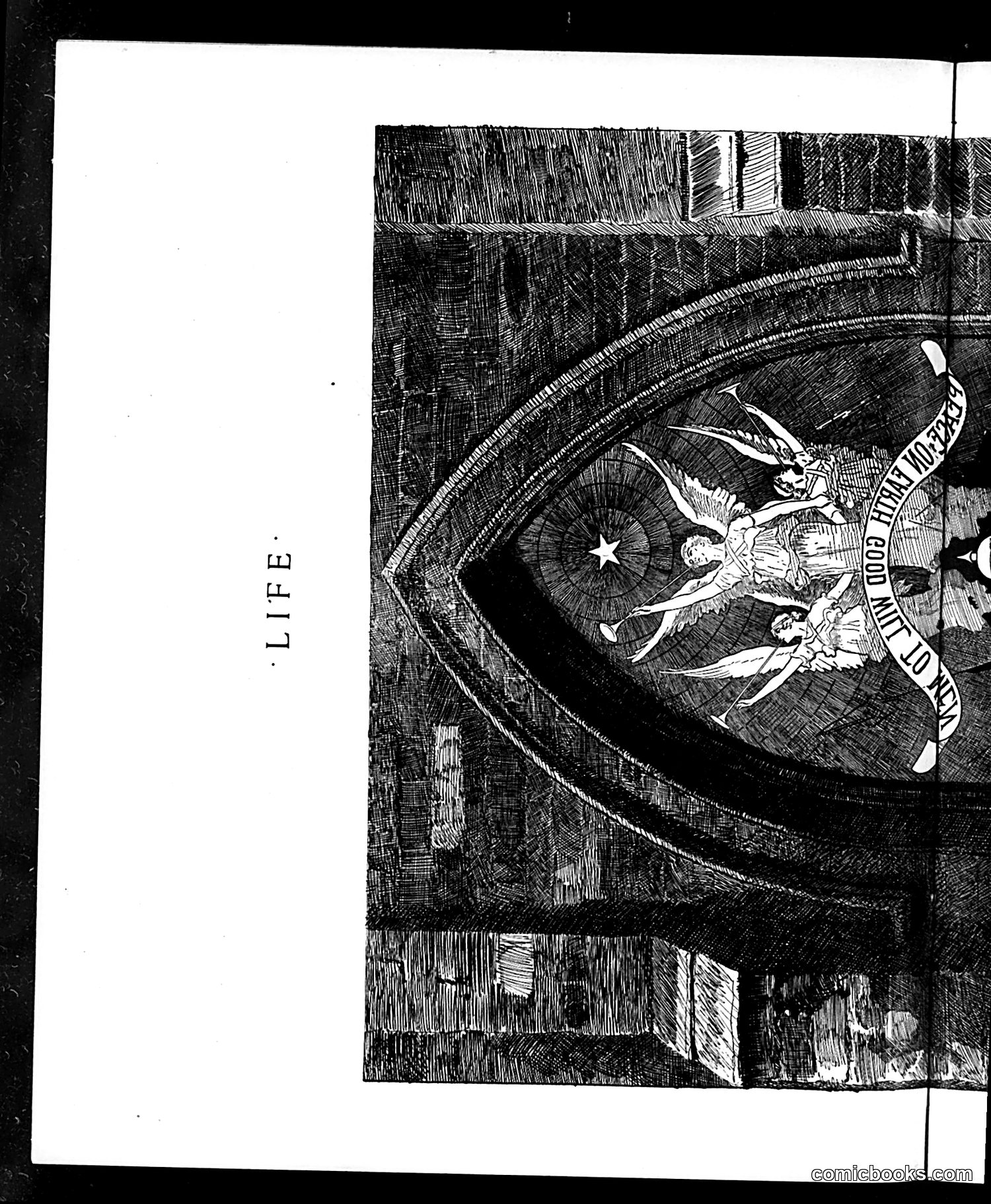
This page shows the title "LIFE" on the left side. The right side contains a black and white engraving depicting an interior scene with classical architectural elements—a domed ceiling and arched structures. Two figures appear to be in conversation or interaction within this grand setting. There's a circular seal or emblem visible with text around its border (partially legible as "...OF UNIT GOOD LIFE..."), suggesting this is likely allegorical or satirical commentary. However, without clearer visibility of the specific text on the seal and the precise identities of the figures depicted, I cannot definitively explain what political or social satire this particular cartoon conveys. The classical architectural style suggests commentary on government or institutional themes, but the exact point requires more legible text or additional context.
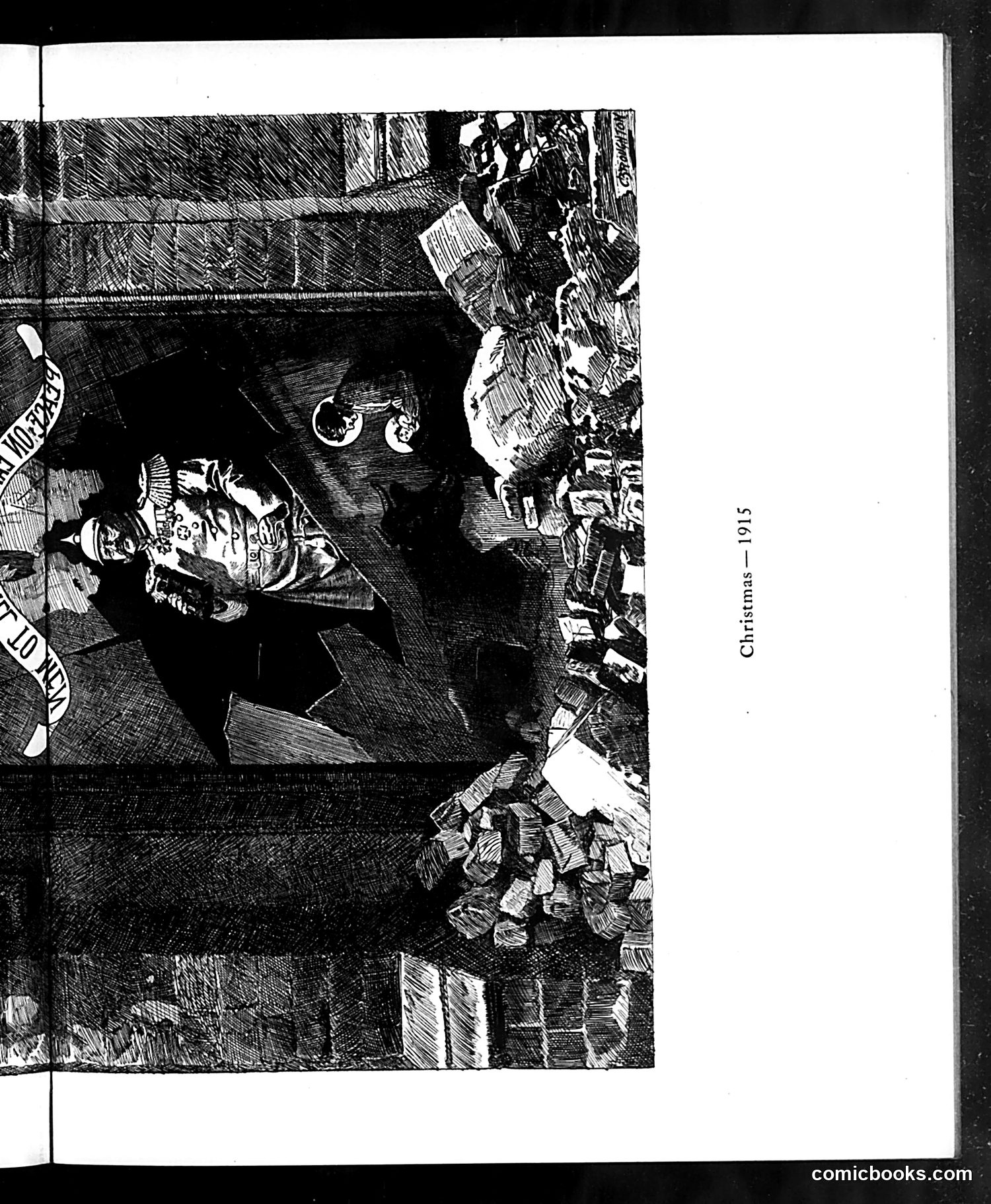
This appears to be a Christmas-themed illustration from Life magazine's 1915 holiday issue. The image is a detailed black-and-white engraving or etching showing an indoor Christmas scene. While the specific satirical content is difficult to parse from this reproduction, the dense crosshatching and dramatic contrasts are characteristic of Life's visual style during this period. Given the 1915 date—two years into World War I—any Christmas imagery from this era likely carried implicit commentary on the war's impact on holiday celebrations, either in America or regarding the conflict abroad. However, without clearer identification of specific figures or readable text within the illustration itself, I cannot definitively explain the particular satire or social commentary intended.
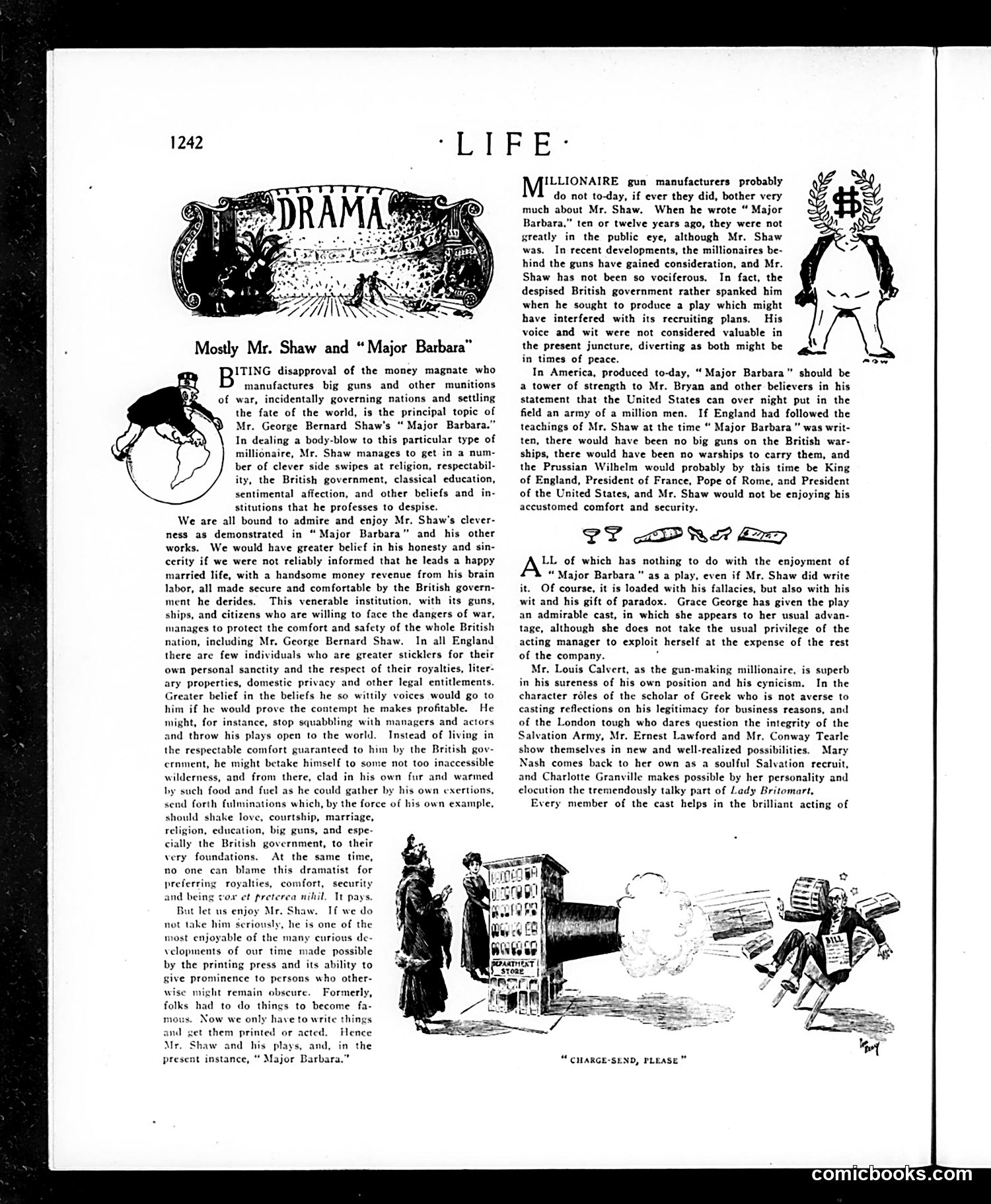
This page critiques **George Bernard Shaw's play "Major Barbara"** through pointed satire about Shaw himself. **The Central Irony:** Shaw, a famous socialist and pacifist, publicly condemns millionaire arms manufacturers in his play. Yet the article notes Shaw lives comfortably off British government protections and royalties from his own profitable works—the very system he attacks. The critic challenges Shaw's sincerity: if he truly despises the British government, guns, and capitalism, why not abandon comfort and actually live by his principles in the wilderness? **Political Context:** The piece references Shaw's clash with British authorities over play censorship (likely regarding military recruitment). It also mentions **William Jennings Bryan's American political position** about rapid military mobilization. **The Cartoon** (bottom) shows a cannon firing at caricatured figures, illustrating the play's central conflict between pacifism and arms manufacturing. The satire mocks not Shaw's ideas but his hypocrisy—condemning systems while profiting from them.
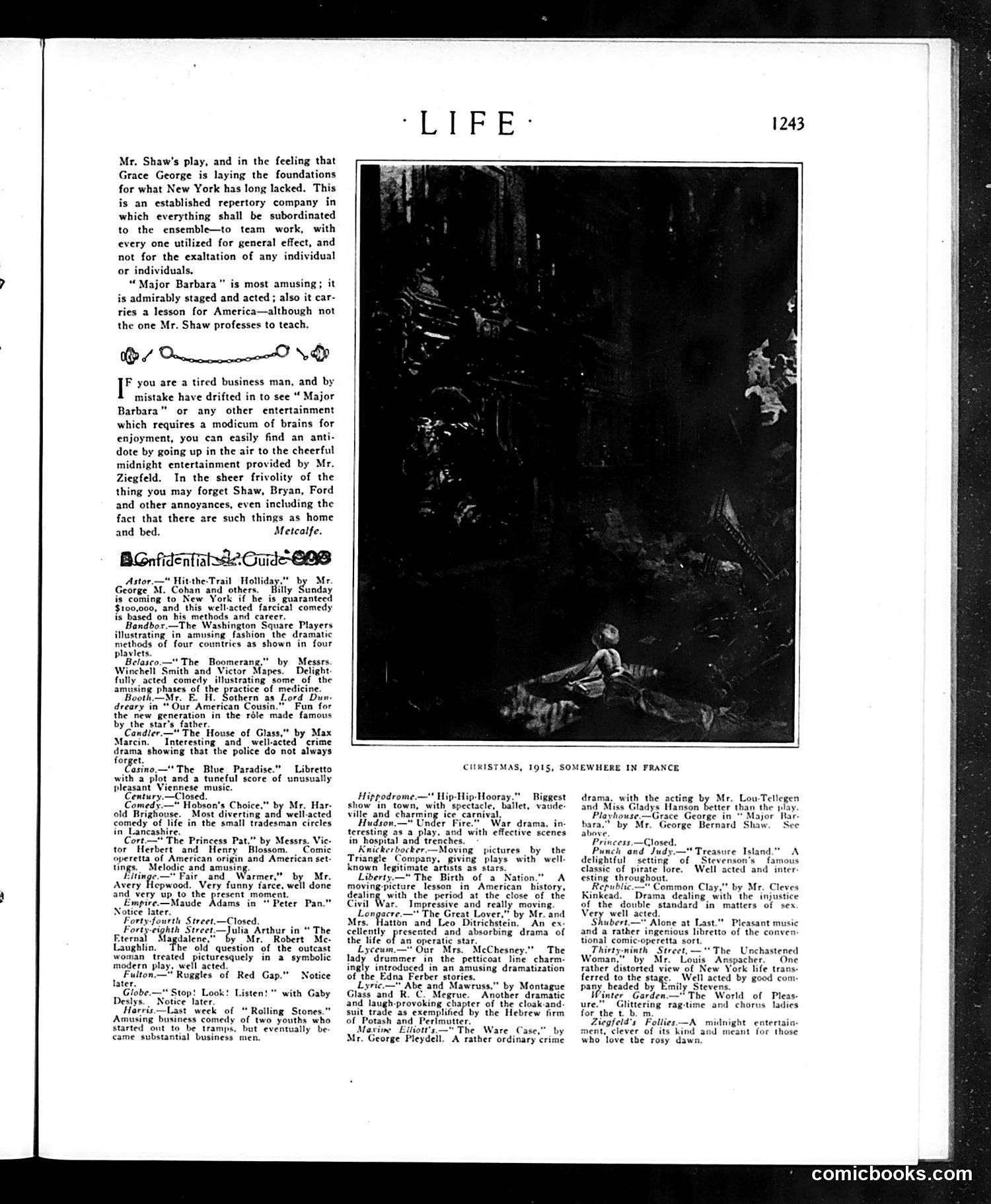
This page reviews Broadway entertainment, contrasting intellectual theater with frivolous spectacle. The main text criticizes George Bernard Shaw's "Major Barbara" as requiring "a modicum of brains for enjoyment," then suggests tired businessmen seeking mindless entertainment should visit Florenz Ziegfeld's show instead—describing his revue as "sheer frivolity" where one can "forget Shaw, Bryan, Ford and other annoyances." The satire targets both Shaw's didactic drama and Ziegfeld's escapist productions, while poking fun at American audiences unwilling to engage serious ideas. References to Billy Sunday (evangelical preacher) in the play "Hit-the-Trail Holliday" add contemporary political context. The accompanying theater listings represent NYC's robust 1915 stage scene. The photograph shows what appears to be a WWI-related drama ("Christmas, 1915, Somewhere in France").
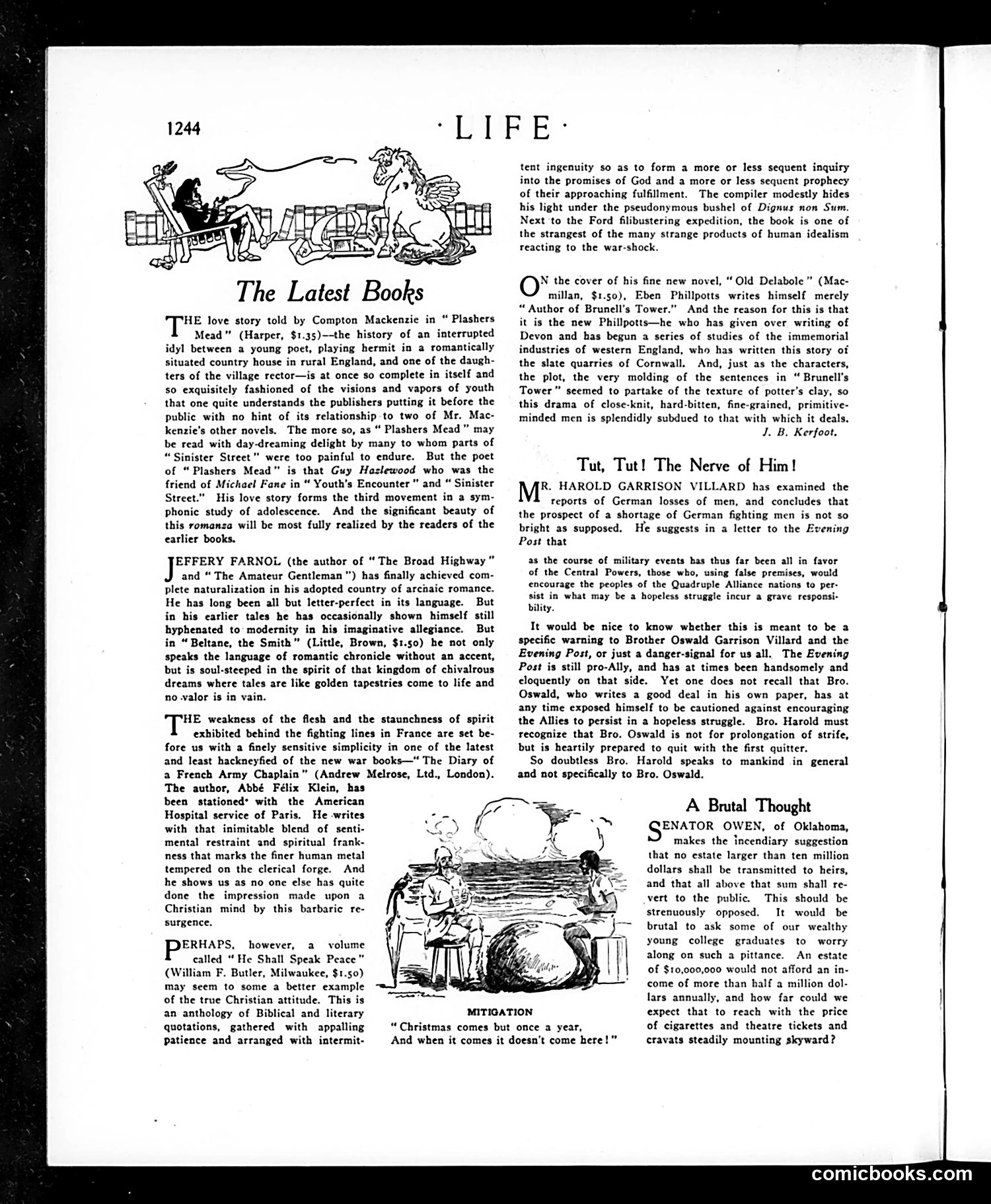
This page primarily reviews new books rather than featuring political cartoons. The content discusses literary works by British and American authors popular during WWI era. Two small cartoon illustrations appear: 1. **Top illustration**: Shows a figure conversing with a horse—likely illustrating Compton Mackenzie's romantic novel "Plashers Mead" set in rural England. 2. **Bottom illustration labeled "MITIGATION"**: Depicts figures around what appears to be a sparse Christmas meal, with the caption "Christmas comes but once a year, / And when it comes it doesn't come here!" This satirizes wartime scarcity and the difficulty of obtaining holiday provisions during WWI, when rationing and shortages affected civilians and soldiers alike. The reviews themselves discuss war literature and religious texts addressing the psychological toll of the conflict on Christian minds. The satirical intent is modest—the magazine uses humor to acknowledge wartime hardships rather than mounting serious political critique.
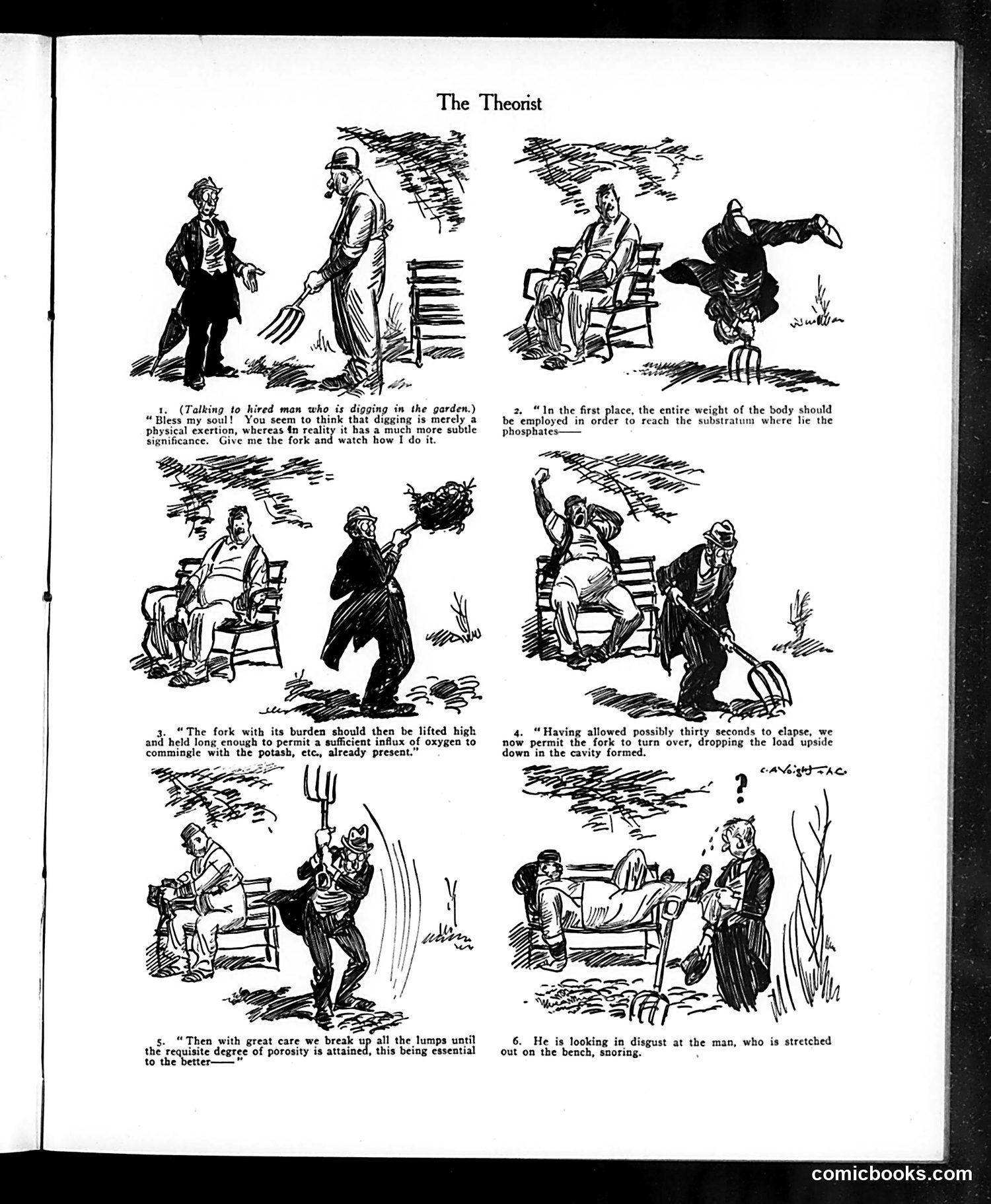
This satirical cartoon mocks armchair intellectuals who overcomplicate simple physical tasks with pseudo-scientific jargon. A well-dressed man lectures a hired garden worker about "proper" digging technique, invoking grandiose concepts like "phosphates," "oxygen," "potash," and "porosity" to describe what is fundamentally manual labor. The joke builds across six panels: the theorist's verbose explanations grow increasingly absurd while he demonstrates the work. The punchline arrives when the exhausted worker, having listened to this endless pseudointellectual monologue, simply collapses asleep on a bench—the theorist's condescension and overexplanation having accomplished nothing but exhaustion. This satirizes a common social type: educated men who use complex language to seem superior while adding no practical value, contrasting useless theory against honest physical work. The cartoon critiques intellectual pretension and class condescension.
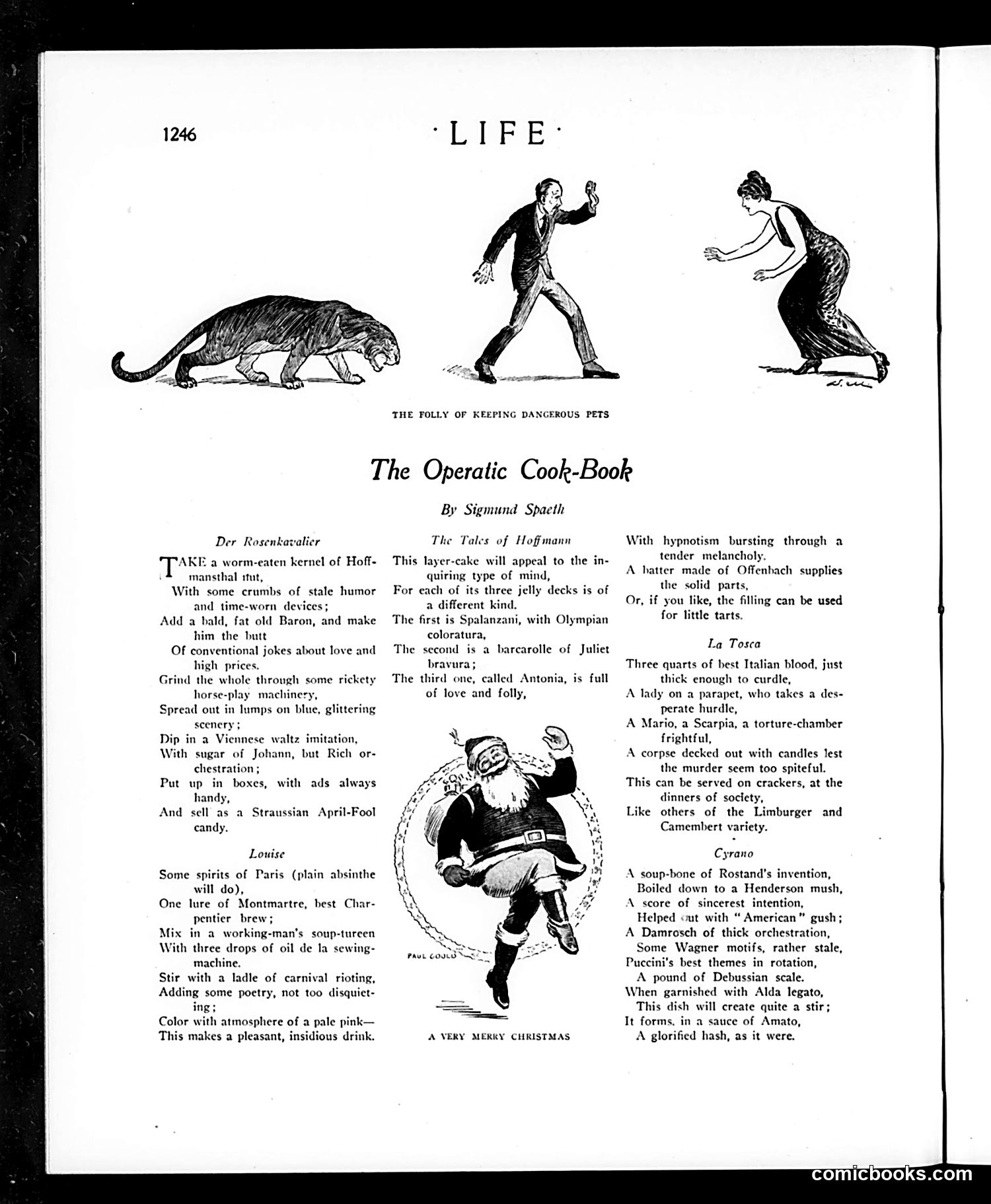
The top cartoon shows a progression: a dangerous wild animal (appears to be a panther or similar beast), a man defending himself, and a woman fleeing. The title satirizes keeping exotic pets as foolish and hazardous. Below this, "The Operatic Cook-Book" by Sigmund Spaeth parodies popular operas of the era—*Der Rosenkavalier*, *The Tales of Hoffmann*, *La Tosca*, and *Cyrano*—by presenting them as recipes. The satire ridicules these operas as superficial theatrical confections: combining worn-out plots, formulaic emotion ("love and high prices"), obvious staging tricks, and recycled musical themes patched together by famous composers and conductors (Offenbach, Wagner, Puccini, Damrosch). The implied joke: these celebrated operas, despite critical acclaim, are mere artistic "junk food"—assembling stale ingredients into showy but insubstantial productions. It's mockery of contemporary opera's commercialism and artistic pretension dressed in highbrow language.
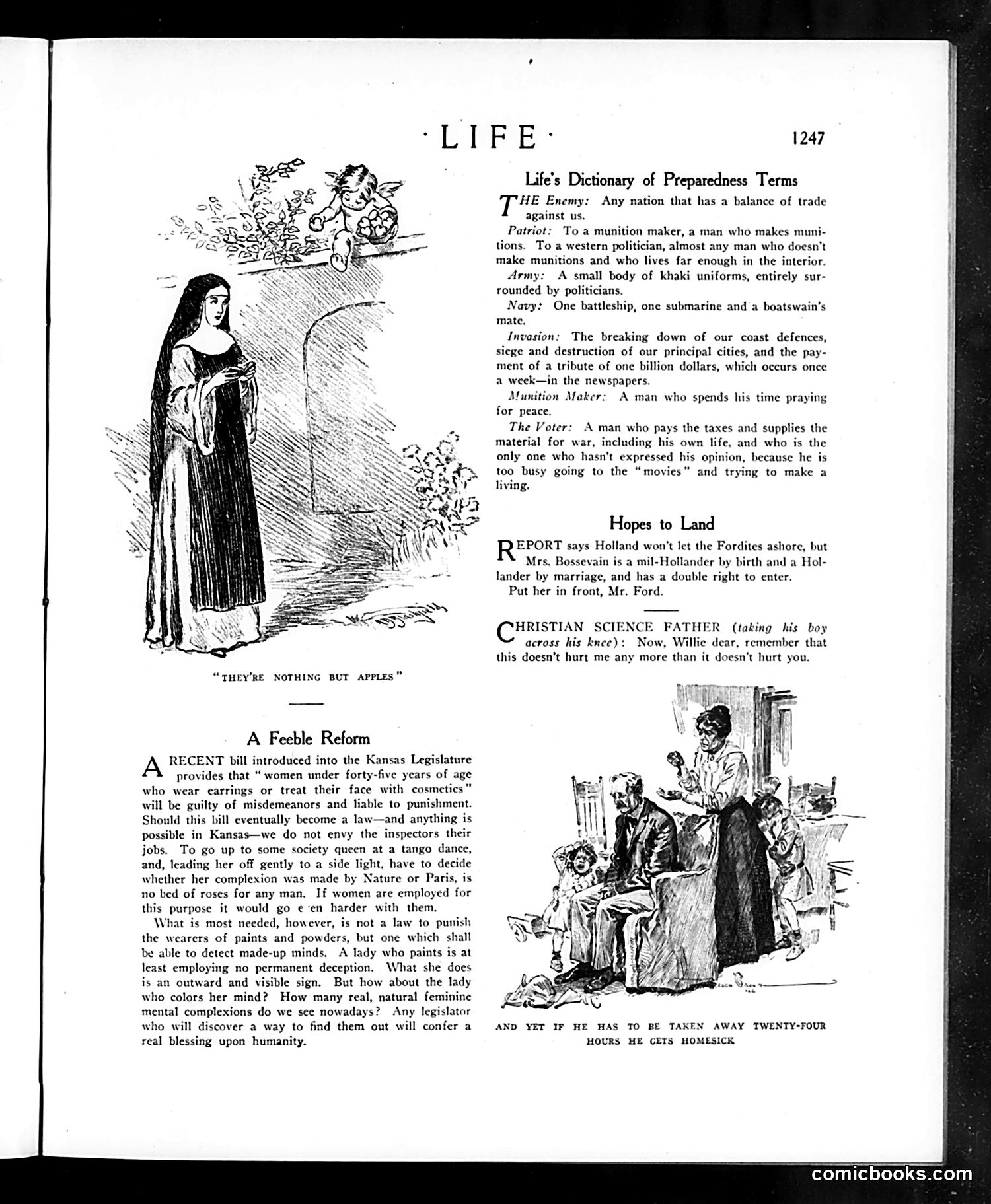
This page satirizes American preparedness debates, likely from the World War I era. The "Dictionary of Preparedness Terms" mocks military-industrial rhetoric through cynical redefinitions: "The Enemy" means any trading rival; "Patriot" means munition makers or interior politicians; "The Voter" is powerless—paying for war while distracted by movies. The top cartoon shows a serene woman labeled "They're Nothing But Apples," apparently contrasting peaceful reality with war hysteria. "A Feeble Reform" ridicules a Kansas bill banning cosmetics on young women, arguing the real problem isn't painted faces but "painted minds"—dishonest thinking. The author sarcastically questions inspectors' ability to distinguish natural from artificial complexions. The "Christian Science Father" cartoon jokes about paradoxical logic: a father beats his son while claiming it hurts himself more, echoing Christian Science's denial of physical reality—a contemporary target of satire. Overall, the page criticizes war profiteering, voter apathy, and questionable social legislation with sharp political humor.
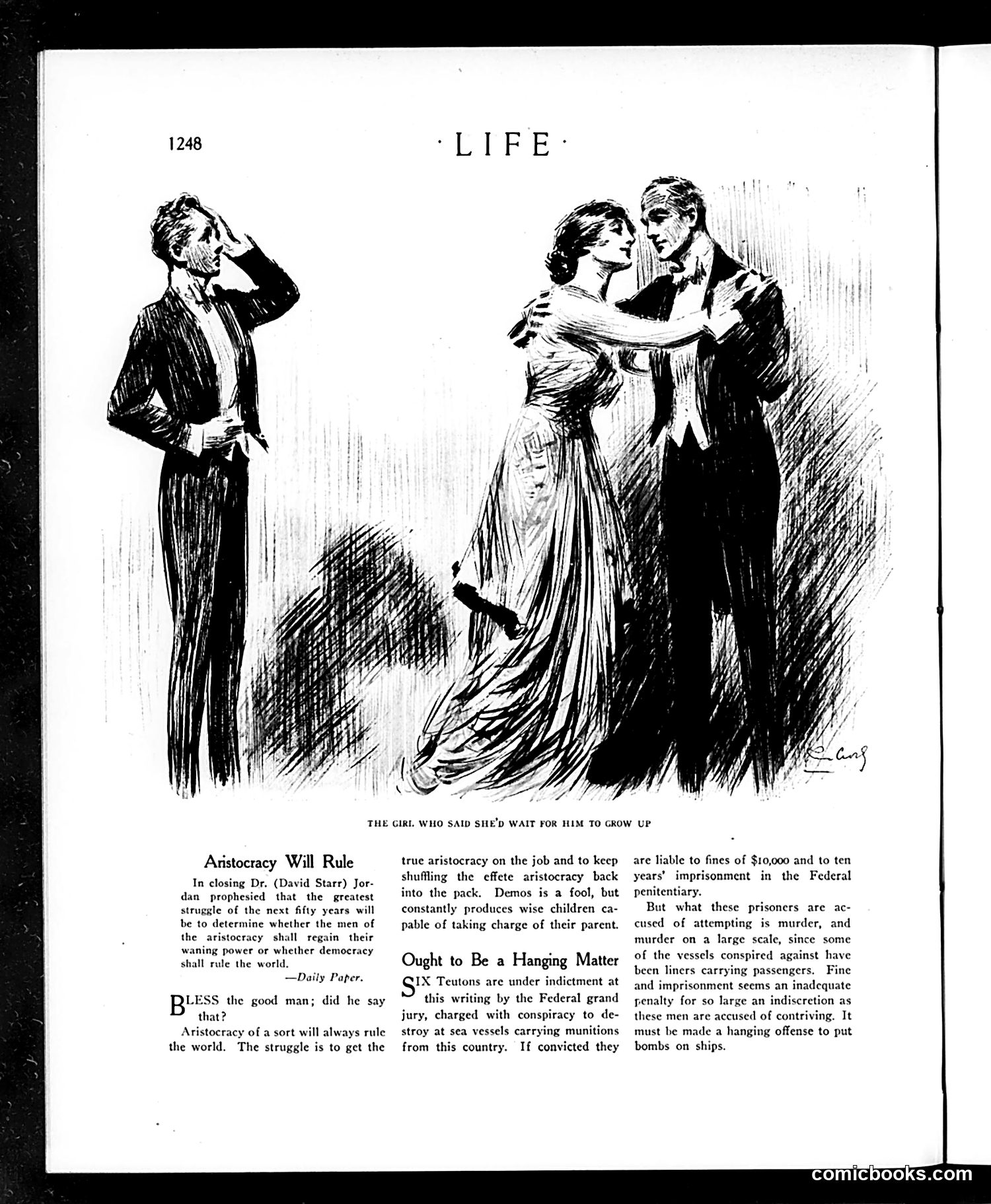
**The Cartoon**: The sketch titled "The Girl Who Said She'd Wait for Him to Grow Up" depicts a domestic scene where a man stands alone on the left (appearing discontented), while a woman in an elegant dress embraces another man on the right. The visual joke suggests the woman did *not* wait—she married someone else while the first man was figuratively or literally still "growing up" (maturing/becoming successful). **The Articles**: Two separate opinion pieces address serious political topics: 1. **"Aristocracy Will Rule"** references Dr. David Starr Jordan's prediction about the coming century's central struggle: whether hereditary aristocracy or democracy will prevail. The writer argues true merit-based "aristocracy" (talented leaders) should govern, not effete inherited elites. 2. **"Ought to Be a Hanging Matter"** discusses six German nationals indicted for conspiracy to destroy munitions-carrying ships. The author argues their potential sentences (fines and imprisonment) are inadequate for what amounts to attempted mass murder of civilian passengers, proposing capital punishment instead. This appears to reflect pre-WWI or WWI-era American concerns about German sabotage operations.
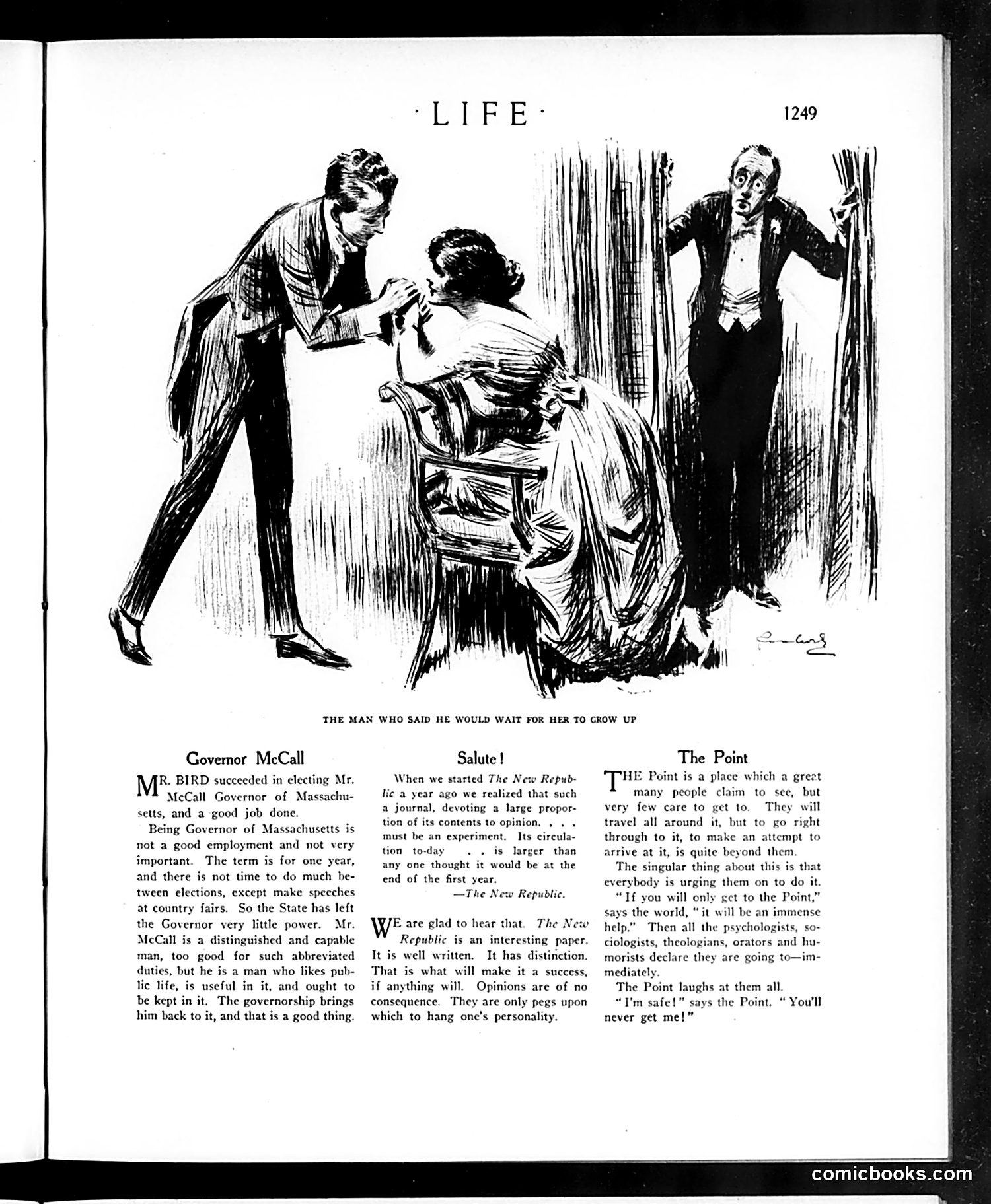
This page contains three brief satirical pieces typical of Life's commentary style. **"Governor McCall"** praises newly-elected Massachusetts Governor McCall as a capable man, noting that while the governorship is a limited one-year position with little power (mostly ceremonial speeches at country fairs), it's good that he returns to public life. **"Salute!"** congratulates *The New Republic* magazine on exceeding its first-year circulation projections, arguing its success comes from quality writing and distinctive voice rather than from mere opinion-mongering. **"The Point"** is an allegorical piece suggesting that people pursue abstract goals (represented as "the Point") they never quite reach. Despite universal encouragement from psychologists, theologians, and others to attain this goal, the Point remains elusive and laughs at their failure—likely satirizing the gap between human aspiration and achievement. The cartoon depicts a woman being presented to men, illustrating the caption "The Man Who Said He Would Wait for Her to Grow Up," though the specific reference is unclear.
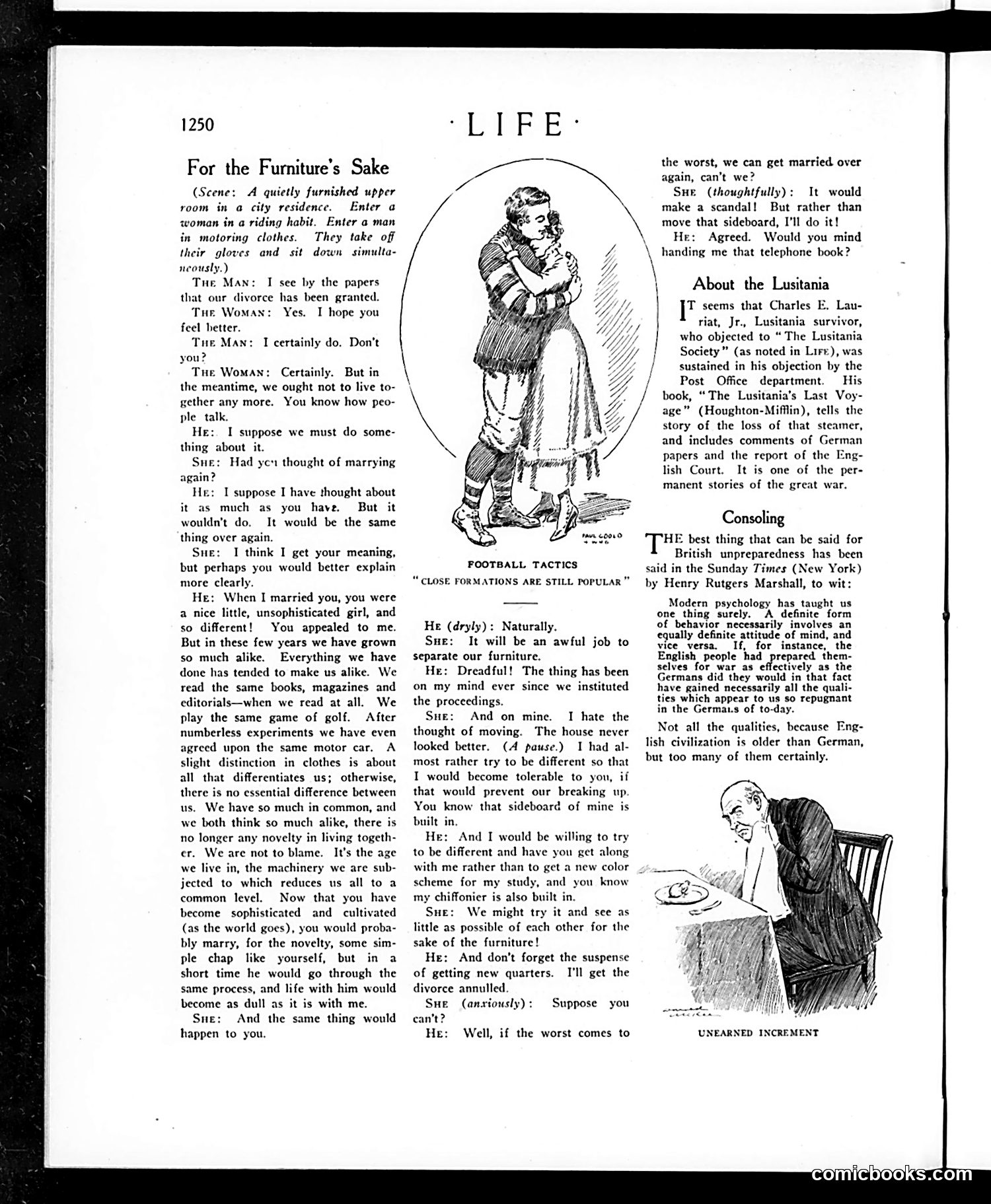
This page contains a satirical dialogue between a divorcing couple who discover they have become so identical in tastes and habits that they've lost all novelty and appeal for each other. The humor lies in their absurd conclusion: rather than separate their shared furniture (particularly built-in pieces like a sideboard and chiffonier), they decide to *stay married* and simply avoid each other, then potentially remarry later for a fresh scandal. The satire critiques early 20th-century marriage and modern life—how industrial standardization and shared consumer culture have eliminated individual distinction. The couple blames "the machinery we are subjected to which reduces us all to a common level," reflecting anxieties about mass production erasing personal identity. The accompanying illustrations show a woman in riding habit (indicating leisure-class status) and a cartoon labeled "Unearned Increment" about wealth accumulation. The page also includes brief notes on the *Lusitania* (the 1915 ship sinking) and British military preparedness—contemporary serious topics alongside the satirical marriage sketch.
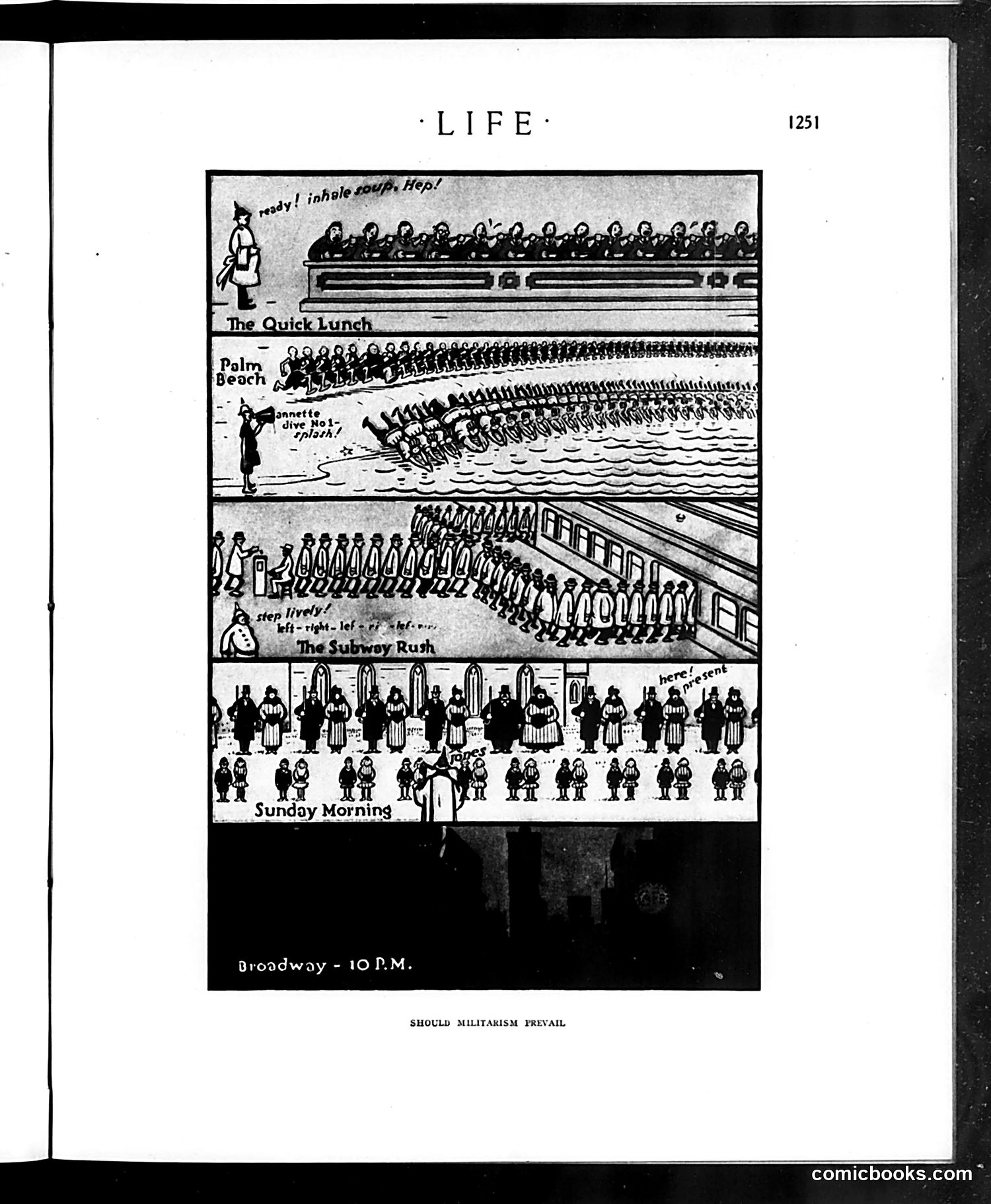
This is a satirical cartoon from Life magazine titled "Should Militarism Prevail." It depicts five scenes of synchronized, regimented group behavior in everyday American settings: "The Quick Lunch" (people eating in formation), "Palm Beach" (swimmers diving in unison), "The Subway Rush" (commuters lined up mechanically), and "Sunday Morning" (churchgoers in perfect rows). The satire critiques the erosion of American individualism, warning that unchecked militarism could impose rigid conformity on civilian life. Each scene shows ordinary activities transformed into military-style drills, suggesting that militaristic values—discipline, uniformity, obedience—threaten to invade and dehumanize normal society. The caption serves as a cautionary question about whether such regimentation is desirable for a democratic nation.
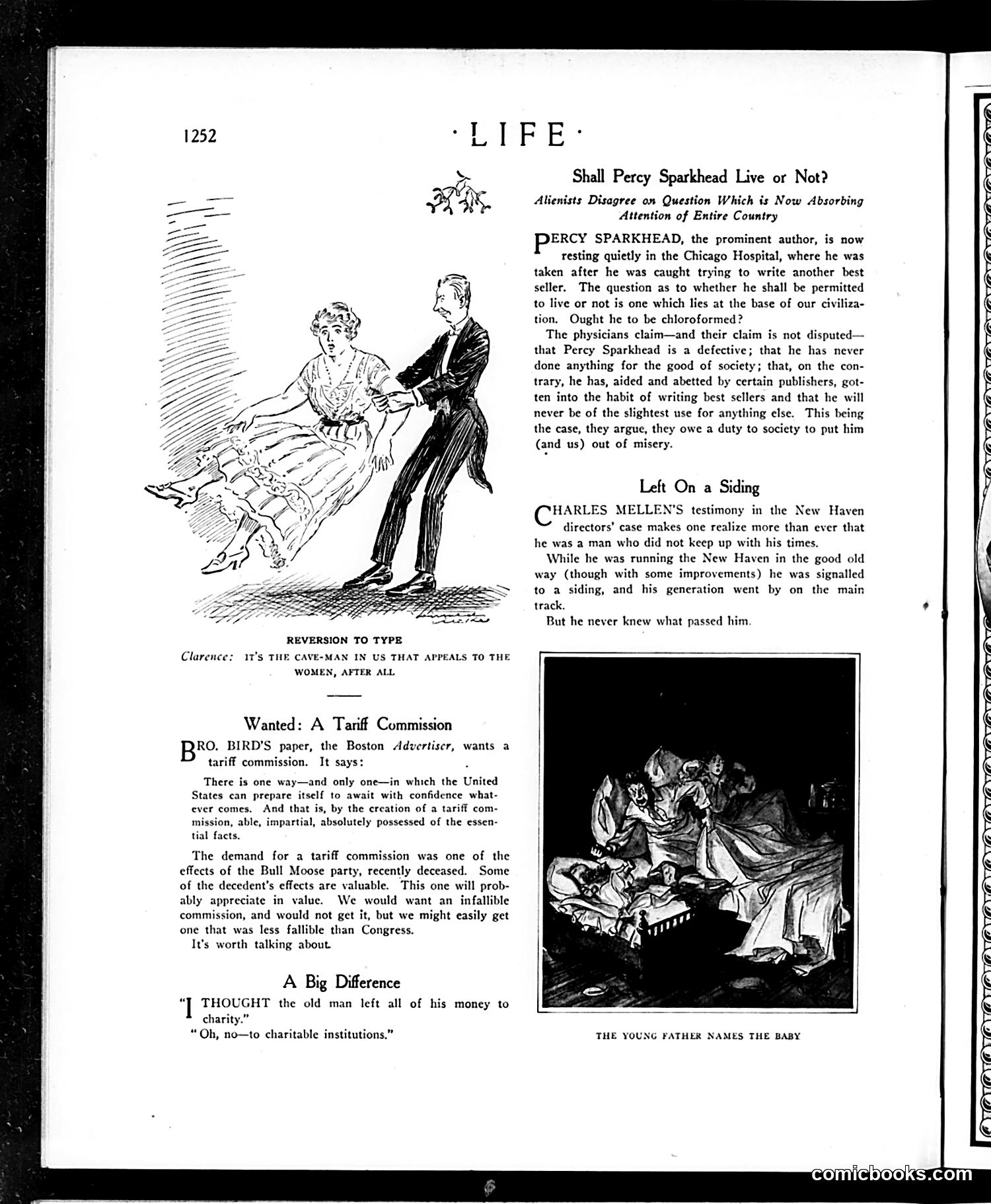
**"Shall Percy Sparkhead Live or Not?"** mocks both sensationalist debates and the literary establishment. Percy Sparkhead appears to be a fictional author caricature representing prolific but artistically worthless popular writers of the era. The satire targets physicians debating whether such writers deserve to live, sarcastically suggesting society would benefit from their "chloroforming." It's dark humor criticizing: (1) best-selling authors who churn out commercial trash; (2) publishers enabling mediocre work; (3) contemporary obsession with eugenic debates and "fitness." **"Reversion to Type"** (top cartoon) depicts a man physically controlling a woman, captioned that "cave-man" instincts appeal to women—a sexist jab at both male dominance and female nature. **"Left On a Siding"** references Charles Mellen, New Haven Railroad director, using railroad metaphor: Mellen ran his business in outdated ways and was "signalled to a siding" while progress moved forward on the main track—he failed to modernize. The page reflects early 20th-century anxieties: literary standards, corporate management, and gender dynamics.
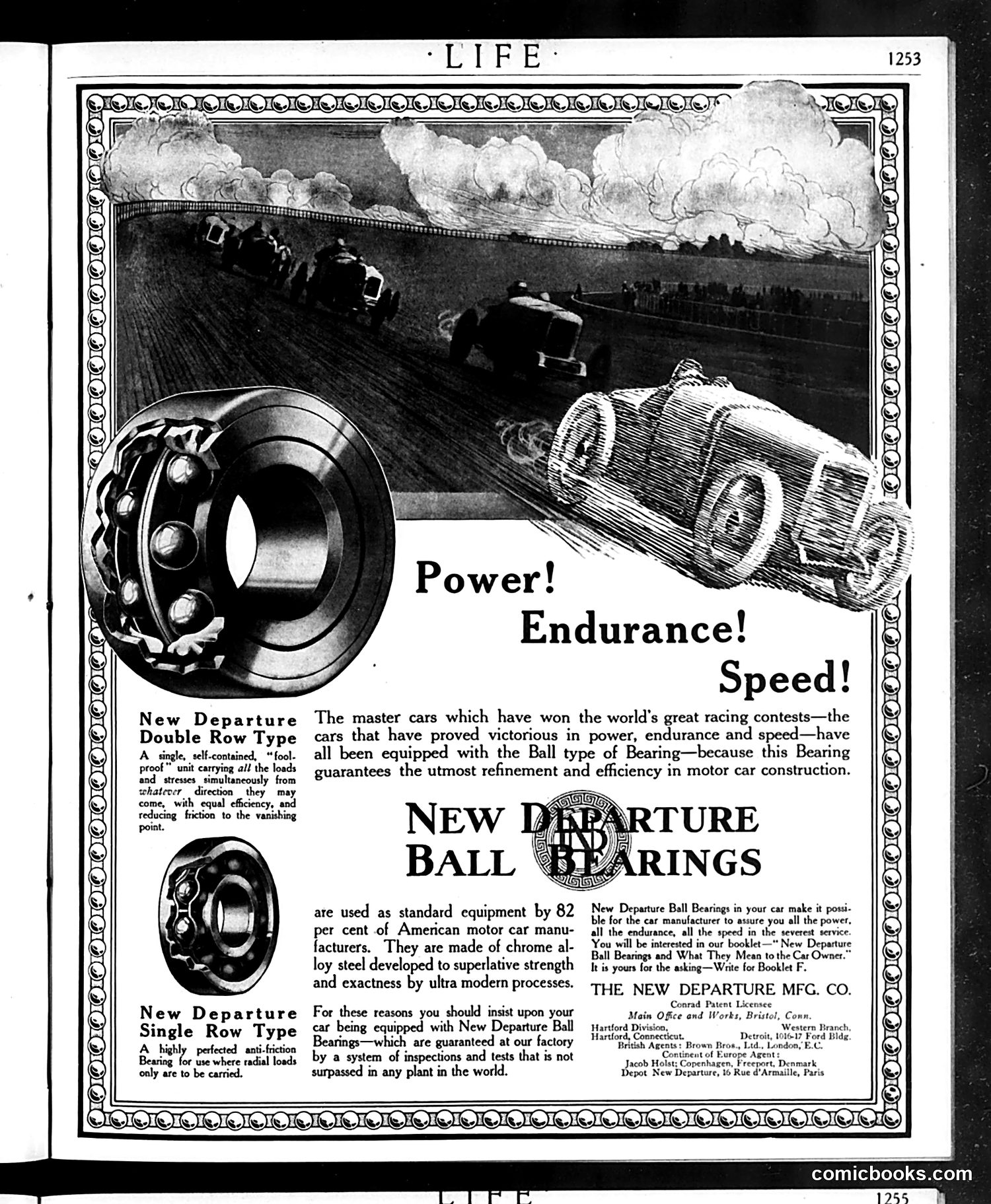
This is **not a political cartoon** but rather a **full-page advertisement** for industrial ball bearings, appearing in *Life* magazine (page 1253). The ad promotes New Departure brand ball bearings as essential components in high-performance automobiles. The imagery shows racing cars in action, emphasizing "Power! Endurance! Speed!"—qualities the bearings allegedly guarantee. Two technical diagrams illustrate the Double Row and Single Row bearing types. The advertisement's authority claim rests on racing pedigree: master cars winning "the world's great racing contests" allegedly used these bearings, and 82% of American motor manufacturers employed them as standard equipment. This reflects the early automotive era's marketing strategy of linking consumer products to racing success and technological superiority—establishing the brand through competitive legitimacy rather than celebrity endorsement.
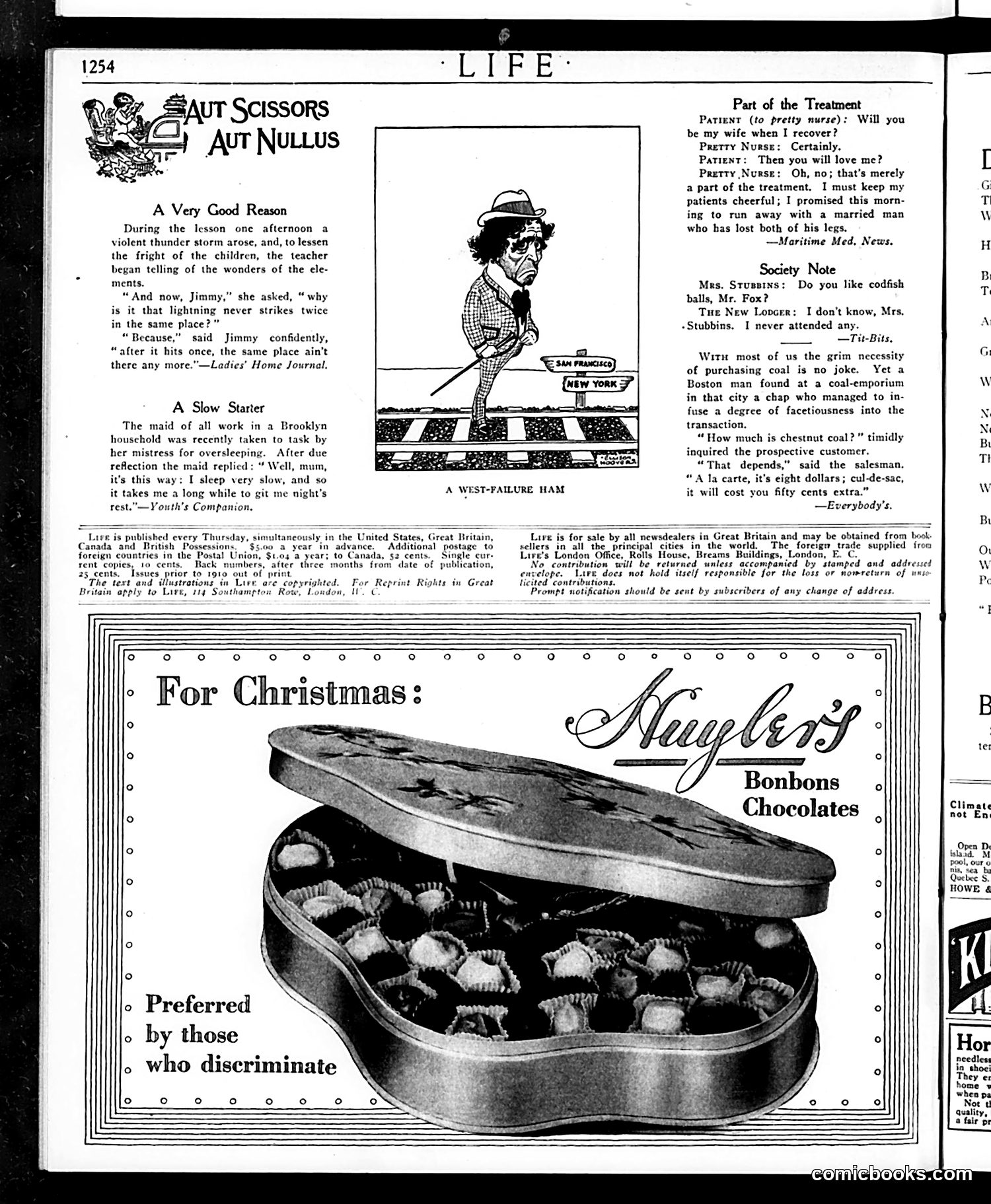
This page contains three brief humorous anecdotes and a Christmas advertisement for Newybrg's Bonbons Chocolates. **The cartoons/jokes:** 1. "A Very Good Reason"—A teacher asks why lightning never strikes twice in the same place. A child answers logically: after the first strike, "the same place ain't there any more"—a play on the idea that lightning destroys what it hits. 2. "Part of the Treatment"—A hospitalized patient propositions a nurse; she agrees to marry him, but clarifies her affection is merely professional care. She admits she's actually planning to run away with a married amputee patient, adding darkly comic irony to her "cheerful bedside manner." 3. "A Slow Starter"—A maid oversleeping explains she "sleeps very slow," making her morning routine lengthy—absurdist humor about inefficiency. 4. "A West-Failure Ham"—The caption appears incomplete or unclear in context. The **advertisement** for Newybrg's chocolates emphasizes exclusivity ("preferred by those who discriminate"), typical early 20th-century marketing.
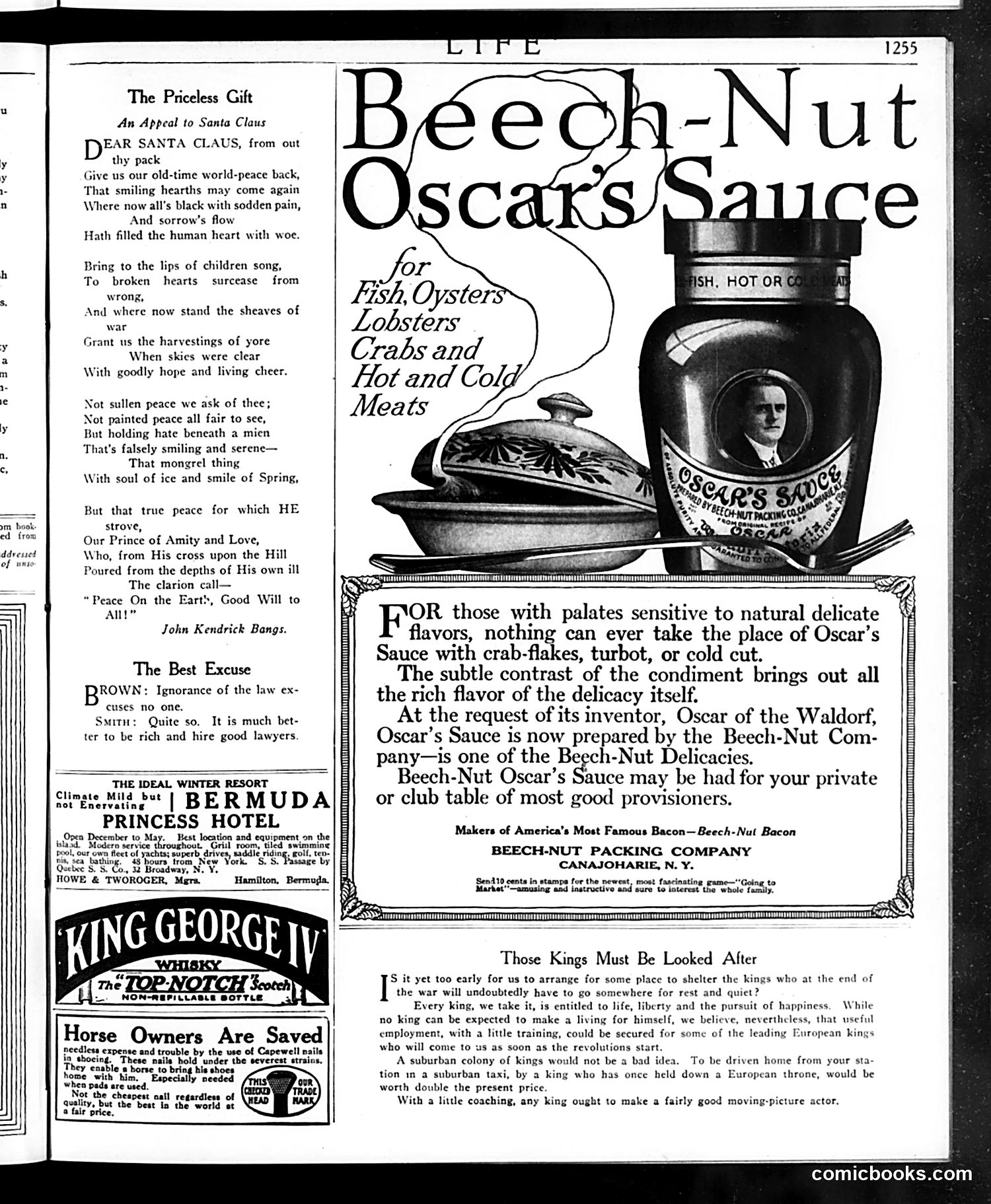
This page from Life magazine (appears to be WWI-era, based on references to war) combines satirical commentary with period advertising. **The Main Satire:** The article "Those Kings Must Be Looked After" mocks the impending collapse of European monarchies after WWI. It proposes a darkly humorous "solution": establishing a suburban colony where deposed kings could be employed in menial work—driving taxis or becoming movie actors. The satire targets both the obsolescence of monarchy and American attitudes toward these fallen rulers, suggesting they're useless without their crowns and must be "retrained" for ordinary employment. The joke's bite comes from treating the end of centuries-old dynasties as a practical employment problem. **Other Content:** The left side includes sentimental war-related poetry ("The Priceless Gift") appealing to Santa for peace, typical of wartime sentiment. The page is otherwise dominated by period advertisements for sauces, whisky, hotels, and horse supplies—typical Life magazine content of the era. The satire assumes readers' familiarity with ongoing European political upheaval and finds dark humor in the kings' reduced circumstances.
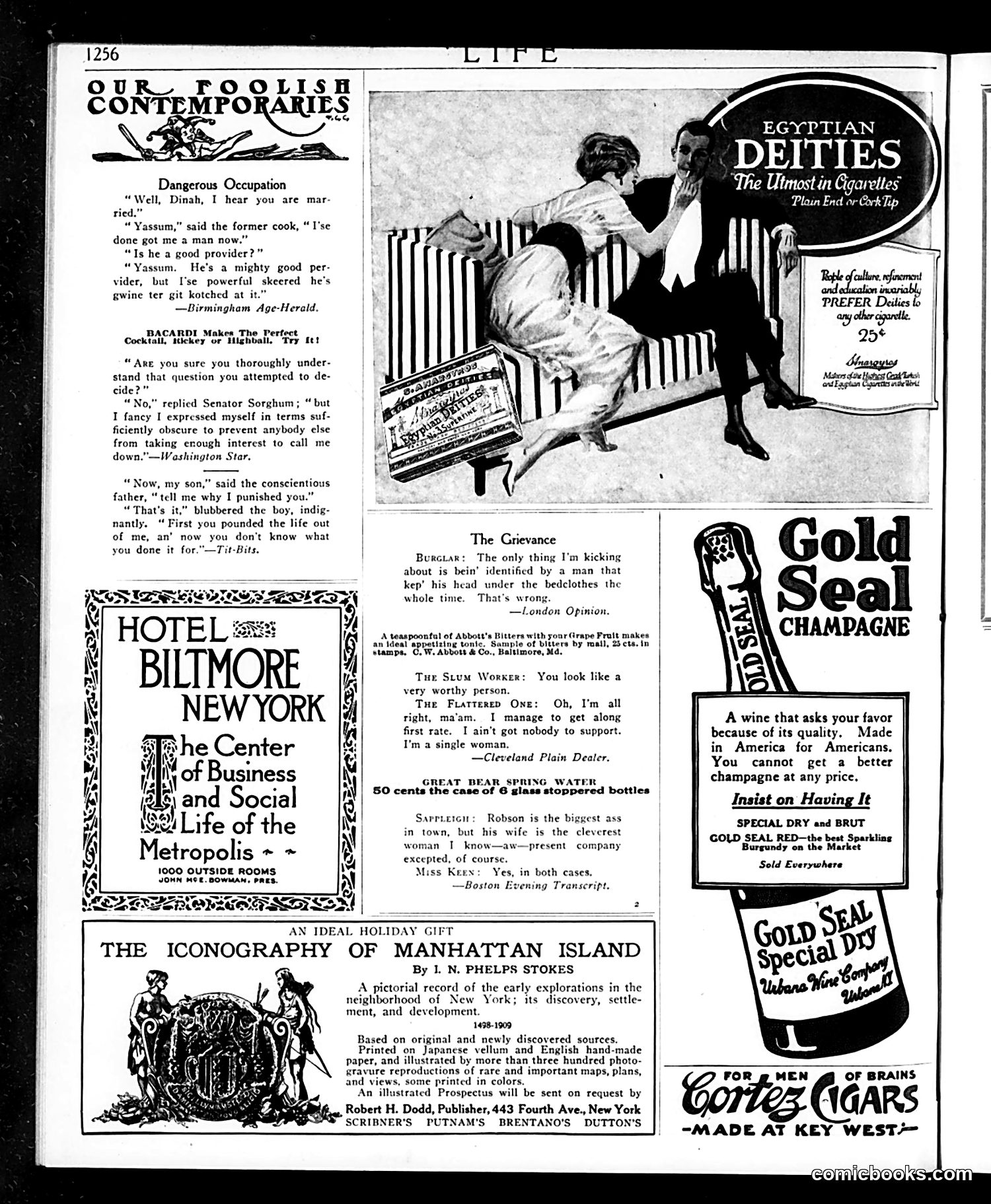
This page contains **short humor pieces and period advertisements** rather than political cartoons. The jokes mock: - **Racial stereotypes**: A dialogue with a Black domestic worker using exaggerated dialect, common in early 20th-century "humor" - **Political evasion**: A senator admits he deliberately obscures his statements so nobody will challenge him—satire of political obfuscation - **Gender/class commentary**: A "flattered" single working woman claims she "manages" without support, contrasted with a male burglar complaining about being identified by a witness who hid under bedclothes The visual element shows a couple in a crib, advertising Egyptian Deities cigarettes at 25 cents. **The advertisements dominate**: Bacardi cocktails, Hotel Biltmore, Cortez Cigars, Gold Seal Champagne, and a book on Manhattan's history reflect early 1900s American consumer culture and leisure. The satire assumes readers will find these scenarios amusing—standards that would be offensive today.
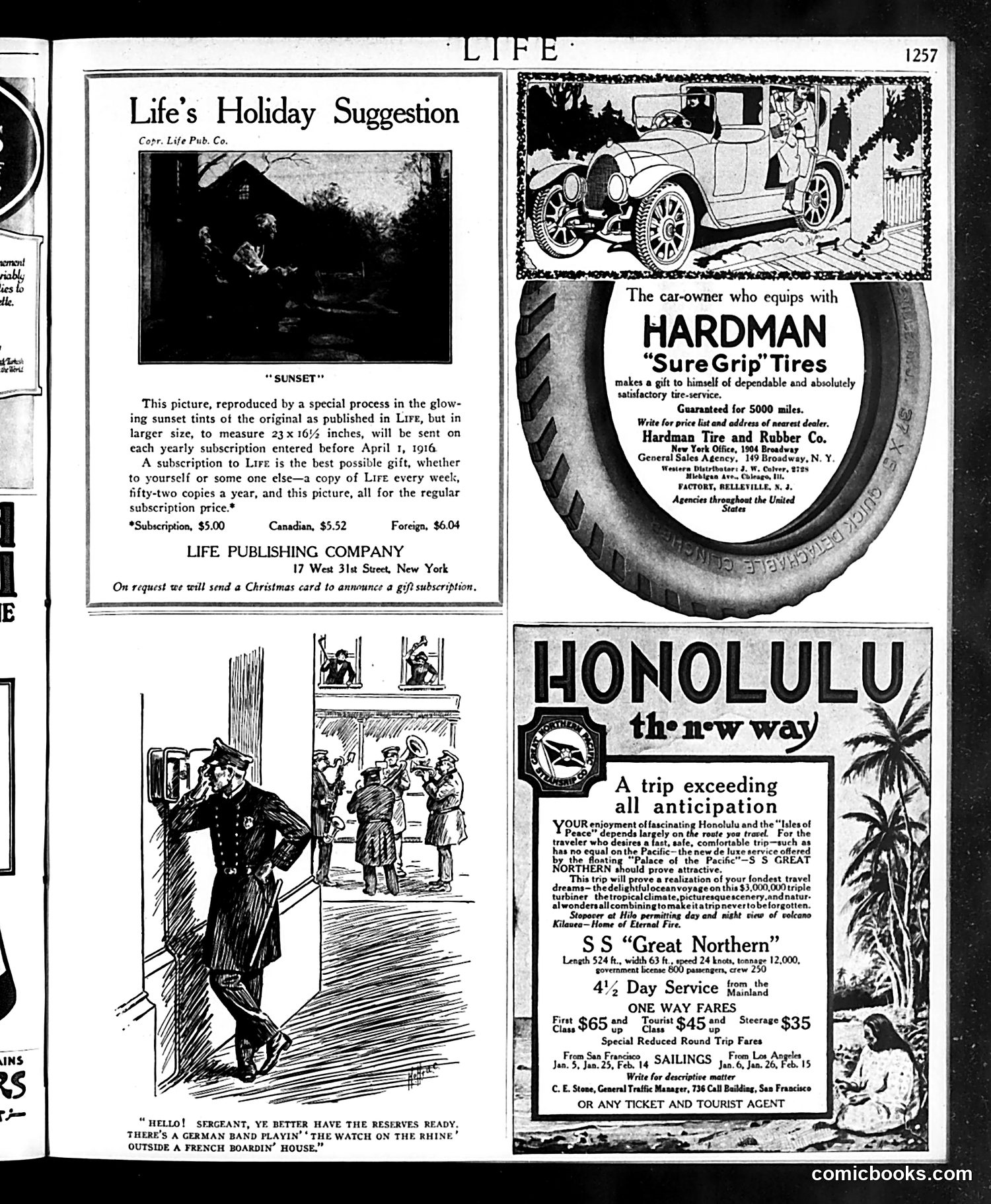
This page is primarily **advertising and subscription promotion** rather than political satire. However, the bottom cartoon contains a topical reference: The sketch depicts a sergeant warning of a German military band playing "The Watch on the Rhine" outside a French boarding house. This is a **World War I reference**—the song is a famous German patriotic march, and the joke plays on the tension of the period (the U.S. was not yet in the war, which began in 1914). The humor relies on the absurdity of a German band openly playing nationalist music near French soldiers, suggesting either audacious German confidence or the sergeant's paranoia about enemy presence. The rest of the page consists of **commercial advertisements**: Life magazine subscription offers with a landscape photo ("Sunset"), Hardman tires, and a Hawaiian cruise on the SS "Great Northern." These ads are typical period marketing with no satirical content.
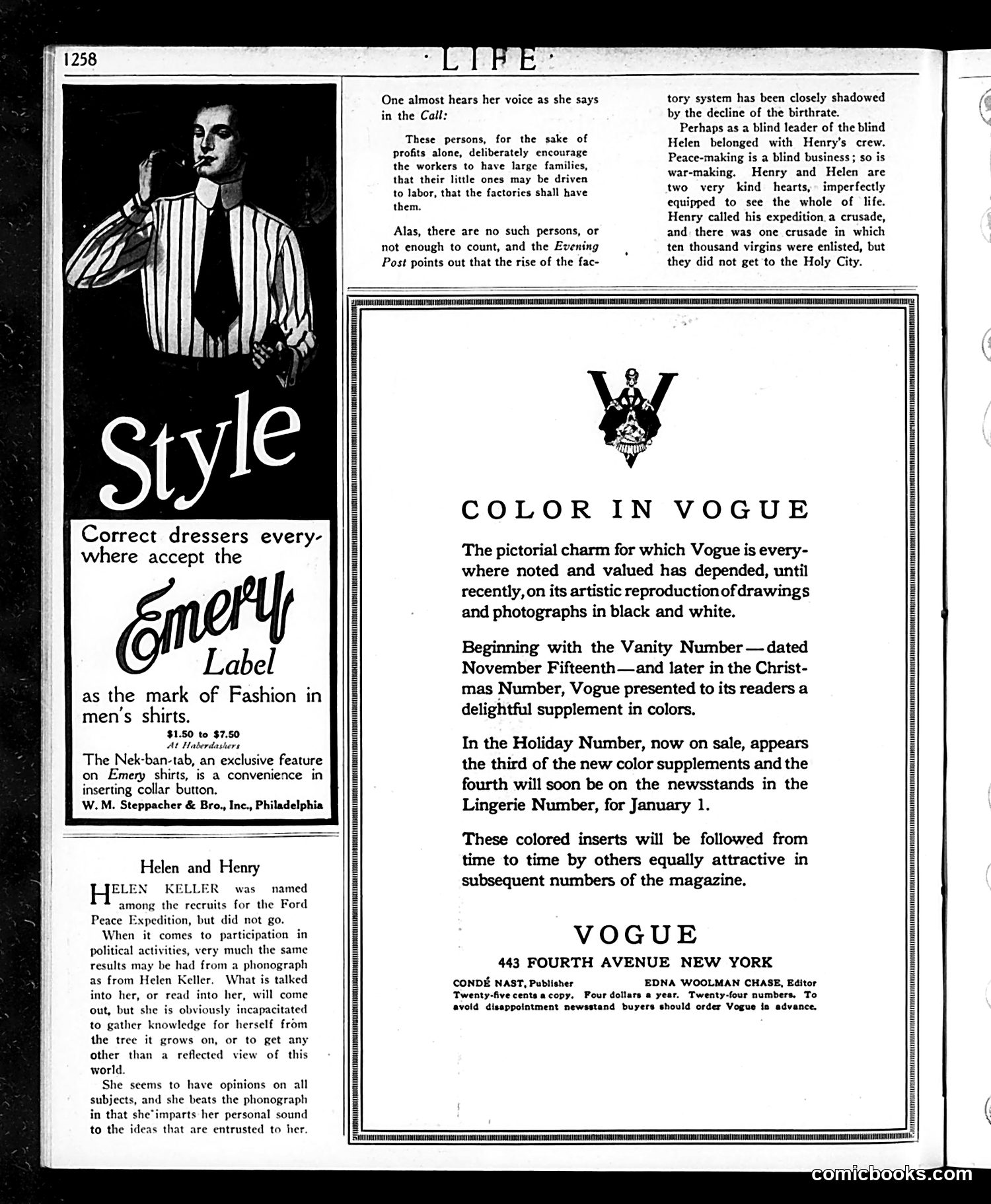
This page satirizes **Helen Keller**'s participation in Henry Ford's 1916 Peace Expedition. The article mocks Keller for advocating about labor and factory conditions while seemingly lacking firsthand knowledge to back her claims. The satire turns on an ironic contrast: Keller argued that factory owners deliberately encouraged large families to create a cheap labor supply. *Life* ridicules this as baseless opinion—the "Evening Post" apparently refuted it by showing industrial growth coincided with *declining* birth rates. The piece compares her to a "phonograph," suggesting she merely repeats arguments fed to her rather than forming independent judgments. The comparison to a "blind leader of the blind" makes her activism seem contradictory given her disabilities and apparent reliance on secondhand information. This represents *Life's* skeptical, often dismissive editorial voice toward progressive reformers of that era—even famous, sympathetic figures like Keller.
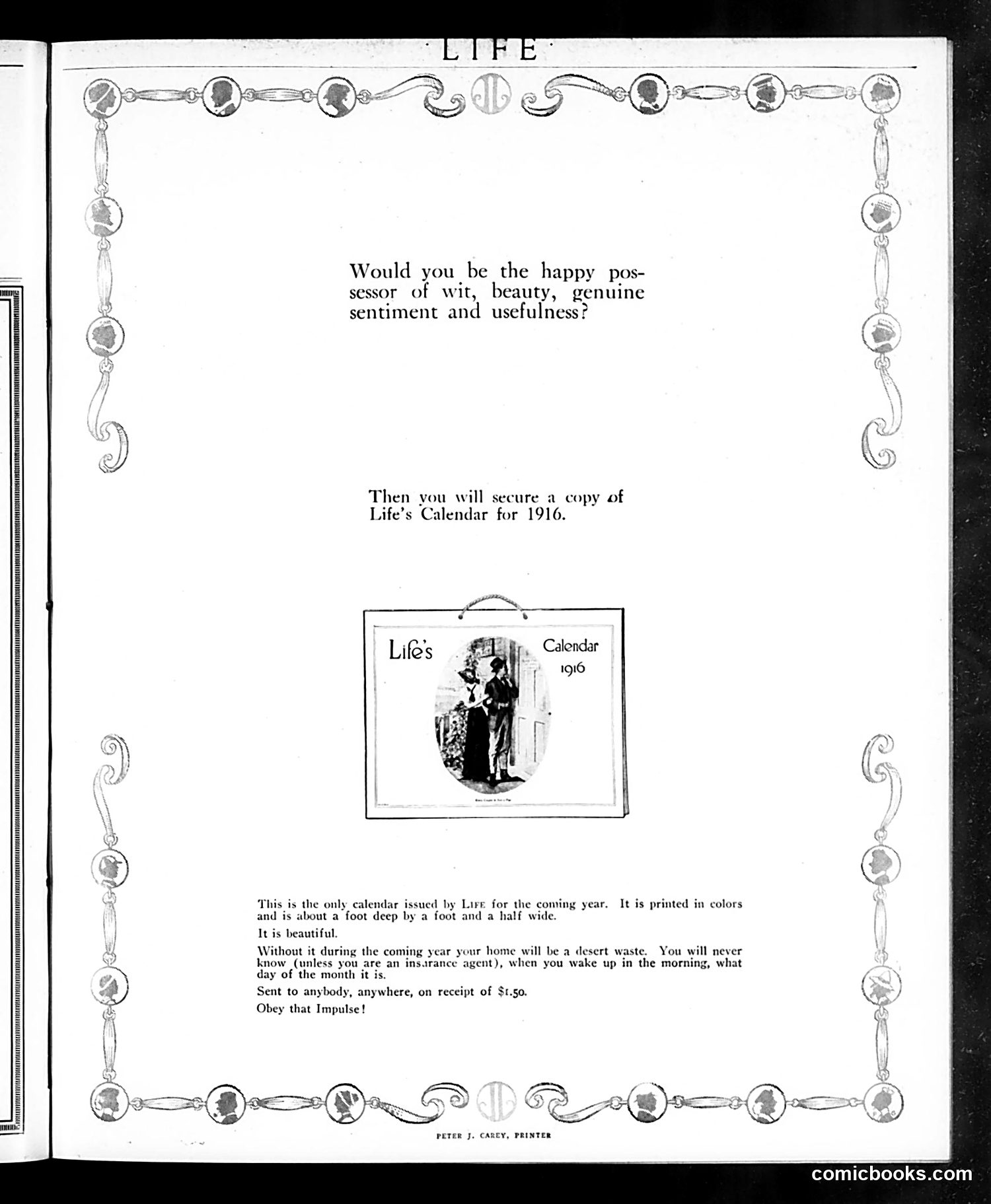
This is a **product advertisement**, not political satire. Life magazine is promoting its 1916 calendar as a luxury item. The ad uses **exaggerated, humorous language** to sell the calendar: - Claims owning it grants "wit, beauty, genuine sentiment and usefulness" - Warns that homes without it become "desert waste" - Jokes that only non-insurance agents won't know what day it is without it The decorative border features **portrait medallions** (likely of notable figures of the era, though not clearly identifiable here) connected by ornamental chains—a design choice suggesting sophistication and prestige. The calendar itself is described as **"printed in colors"** (noteworthy for 1916), measuring roughly 12x18 inches. At $1.50, it was a premium product. The tone is **tongue-in-cheek mockery of consumer desire**—Life's typical satirical approach to advertising and materialism. The final line, "Obey that Impulse!" sarcastically encourages impulse buying.
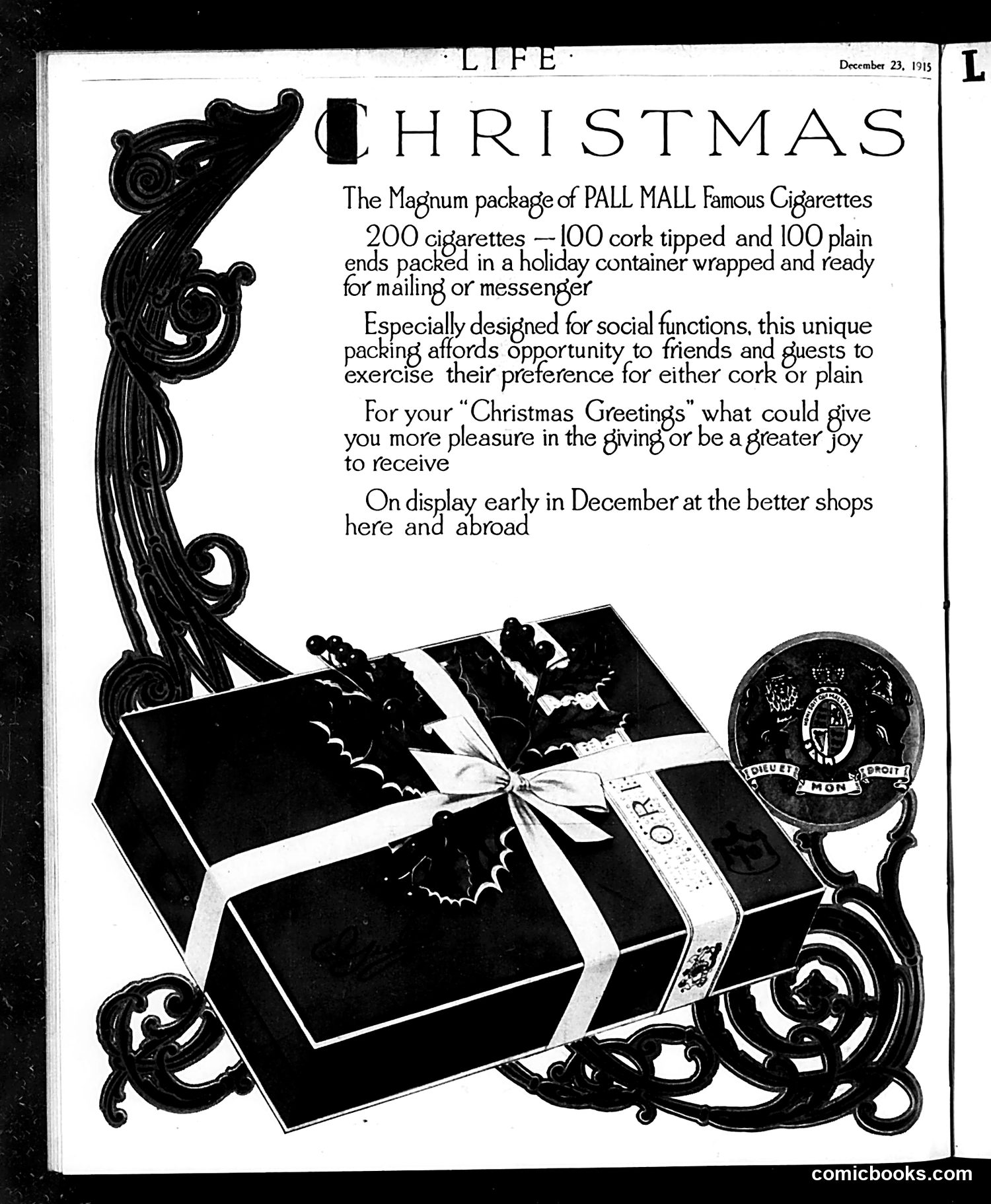
This is a **cigarette advertisement**, not political satire. It's a 1915 Life magazine ad for Pall Mall cigarettes' luxury "Magnum package" Christmas gift offering—200 cigarettes (100 cork-tipped, 100 plain) in an ornate holiday container. The decorative elements (the elaborate scrollwork borders and ribbon-tied gift box illustration) emphasize premium positioning. The copy appeals to early-20th-century social conventions: presenting cigarettes as an appropriate, thoughtful Christmas gift for social gatherings where guests could choose their preferred smoking style. This reflects the pre-health-warning era when cigarettes were normalized luxury goods marketed like fine spirits today. The "better shops here and abroad" language targets affluent consumers. There is no cartoon or political commentary—just commercial promotion using festive, elegant design.