
Life, 1915-12-23 · page 22 of 40
Life — December 23, 1915 — page 22: what you’re looking at
What you’re looking at
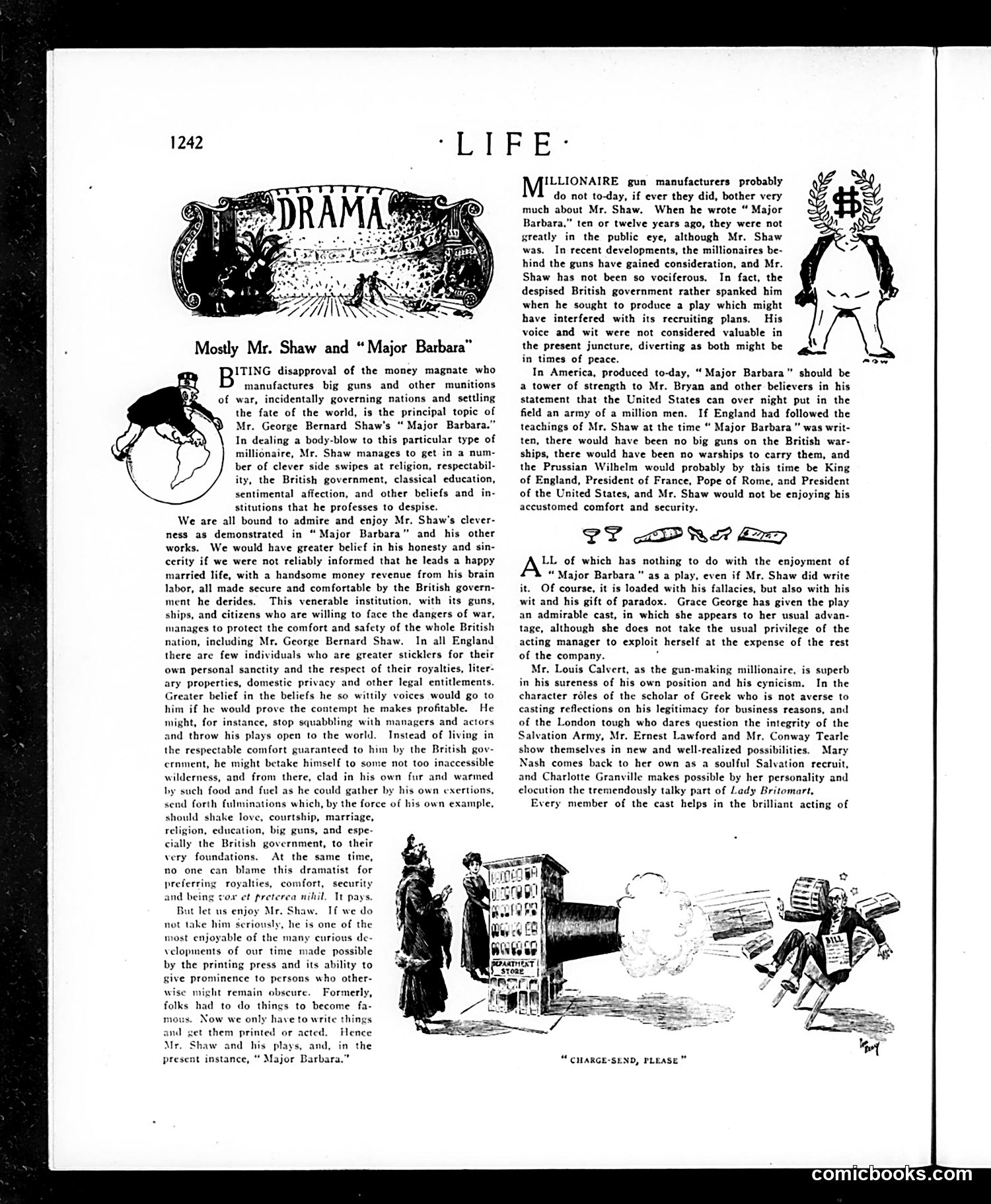
This page critiques **George Bernard Shaw's play "Major Barbara"** through pointed satire about Shaw himself. **The Central Irony:** Shaw, a famous socialist and pacifist, publicly condemns millionaire arms manufacturers in his play. Yet the article notes Shaw lives comfortably off British government protections and royalties from his own profitable works—the very system he attacks. The critic challenges Shaw's sincerity: if he truly despises the British government, guns, and capitalism, why not abandon comfort and actually live by his principles in the wilderness? **Political Context:** The piece references Shaw's clash with British authorities over play censorship (likely regarding military recruitment). It also mentions **William Jennings Bryan's American political position** about rapid military mobilization. **The Cartoon** (bottom) shows a cannon firing at caricatured figures, illustrating the play's central conflict between pacifism and arms manufacturing. The satire mocks not Shaw's ideas but his hypocrisy—condemning systems while profiting from them.
📄 Transcribed text from this page (OCR, searchable)
Machine-transcribed from the original scan — historical spelling and the odd misread are preserved.
“EAE Mostly Mr. Shaw and “Major Barbara” ITING disapproval of the money magnate who manufactures big guns and other munitions of war, incidentally governing nations and settling —~ the fate of the world, is the principal topic of Mr. George Bernard Shaw's “ Major Barbara.” In dealing a body-blow to this particular type of millionaire, Mr. Shaw manages to get in a num- ber of clever side swipes at religion, respectabil- ity, the British government, classical education, sentimental affection, and other beliefs and in- stitutions that he professes to despise. We are all bound to admire and enjoy Mr. Shaw's clever- ness as demonstrated in “ Major Barbara” and his other works. We would have greater belief in his honesty and sin- cerity if we were not reliably informed that he leads a happy married life, with a handsome money revenue from his brain labor, all made secure and comfortable by the British govern- ment he derides, This venerable institution, with its guns, ships, and citizens who are willing to face the dangers of war, manages to protect the comfort and safety of the whole British nation, including Mr. George Bernard Shaw. In all England there are few individuals who are greater sticklers for their own personal sanctity and the respect of their royalties, liter- ‘y properties, domestic privacy and other legal entitlements. Greater belief in the beliefs he so wittily voices would go to him if he would prove the contempt he makes profitable. He might, for instance, stop squabbling with managers and actors and throw his plays open to the world. Instead of living in the respectable comfort guaranteed to him by the British gov- ernment, he might betake himself to some not too inaccessible wilderness, and from there, clad in his own fur and warmed hy such food and fuel as he could gather by his own exertions, send forth fulminations which, by the force of his own example, should shake love, courtship, marriage, religion, education, big guns, and espe- cially the British government, to their very foundations. At the same time, no one can blame this dramatist for preferring royalties, comfort, security ox et preterea nihil. It pays. If we do and be But let us enj not take him seriously, he most enjoyable of the many curious de- velopments of our time made possible by the printing press and its ability to give prominence to persons who other- wise might remain obscure. Former! folks had to do things to becom mous. Now we only have to write thin Hence Mr. Shaw and his plays, and, in the present instance, “ Major Barbara, one of the and get them printed or acted. ILLIONAIRE gun manufacturers probably 4 So do not to-day, if ever they did, bother very <, much about Mr. Shaw. When he wrote “ Major A Barbara,” ten or twelve years ago, they were not SQ greatly in the public eye, although Mr. Shaw 3 was. In recent developments, the millionaires be- hind the guns have gained consideration, and Mr. Shaw has not been so vociferous. In fact, the despised British government rather spanked him when he sought to produce a play which might have interfered with its recruiting plans. His / voice and wit were not considered valuable in the present juncture, diverting as both might be \ in times of peace. _ In America, produced to-day, “ Major Barbara” should be a tower of strength to Mr. Bryan and other believers in his statement that the United States can over night put in the field an army of a million men. If England had followed the teachings of Mr, Shaw at the time “ Major Barbara” was writ- ten, there would have been no big guns on the British war- ships, there would have been no warships to carry them, and the Prussian Wilhelm would probably by this time be King of England, President of France, Pope of Rome, and President of the United States, and Mr. Shaw would not be enjoying his accustomed comfort and security. Pl aDRre? Bp LL of which has nothing to do with the enjoyment of “ Major Barbara" as a play, even if Mr. Shaw did write it. Of course, it is loaded with his fallacies, but also with his wit and his gift of paradox. Grace George has given the play an admirable cast, in which she appears to her usual advan- tage, although she does not take the usual privilege of the acting manager to exploit herself at the expense of the rest of the company. ‘ Mr. Louis Calvert, as the gun-making millionaire, is superb in his sureness of his own position and his cynicism. In the character roles of the scholar of Greek who is not averse to casting reflections on his legitimacy for business reasons, and of the London tough who dares question the integrity of the Salvation Army, Mr. Ernest Lawford and Mr, Conway Tearle show themselves in new and well-realized possibilities. Mary Nash comes back to her own as a soulful Salvation recruit, and Charlotte Granville makes possible by her personality and elocution the tremendously talky part of Lady Britomart, Every member of the cast helps in the brilliant acting of 7 POARTHERT | y_stoae | fi ly! “ CHARGE-SEND, PLEASE” NaS comicbooks.com