
Life, 1915-12-23 · page 18 of 40
Life — December 23, 1915 — page 18: what you’re looking at
What you’re looking at
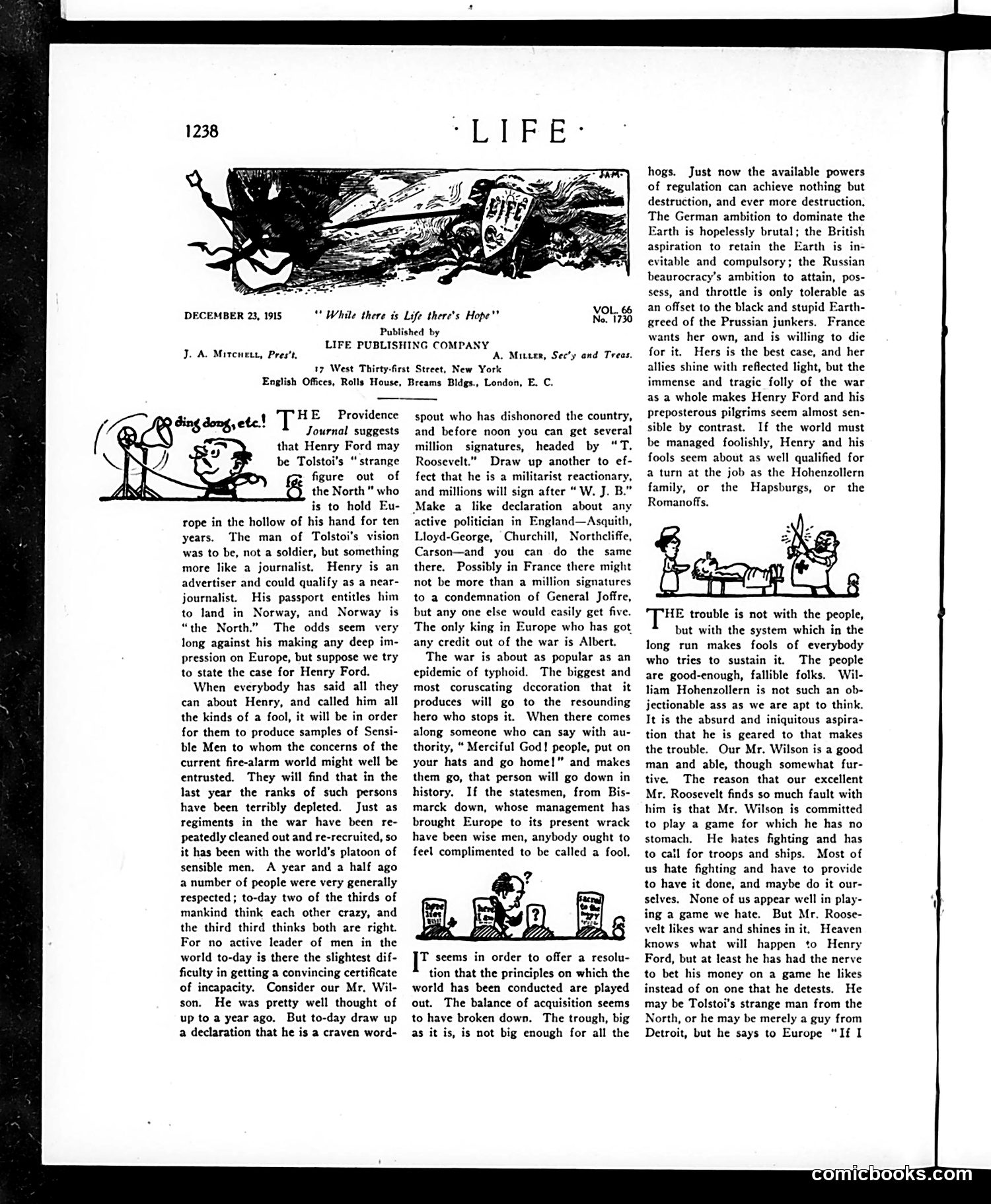
This page satirizes Henry Ford's peace mission to Europe during World War I. The *Providence Journal* facetiously suggests Ford might be the "strange man from the North" prophesied by Tolstoi to stop European conflict—a figure entrusted to "hold Europe in the hollow of his hand for ten years." The satire is biting: the article argues that in wartime, *everyone* is considered a fool by someone. It lists major political figures (Wilson, Asquith, Lloyd-George, Churchill) to show how universal condemnation has become. The real "hero," the piece suggests, will be whoever can say "people, put on your hats and go home!"—and make them listen. The underlying critique: Ford, an industrialist and advertiser rather than statesman, is as qualified as anyone else to broker peace, given how thoroughly existing leaders have failed. The war has made fools of everyone, making a car manufacturer's intervention almost logical by contrast.
📄 Transcribed text from this page (OCR, searchable)
Machine-transcribed from the original scan — historical spelling and the odd misread are preserved.
DECEMBER 23, 1915 “While there is Life there's Hope"’ Published by LIFE PUBLISHING COMPANY J. A. Mitcnent, Pres’t, A. Mittrr, Sec’y and Treas. 17 West Thirty-first Street, New York English Offices, Rolls House, Breams Bldgs., London, E. C. HE Providence Journal suggests that Henry Ford may be Tolstoi’s “strange figure out of & the North" who is to hold Eu- rope in the hollow of his hand for ten years. The man of Tolstoi’s vision was to be, not a soldier, but something more like a journalist. Henry is an advertiser and could qualify as a near- journalist. His passport entitles him to land in Norway, and Norway is “the North.” The odds seem very long against his making any deep im- pression on Europe, but suppose we try to state the case for Henry Ford. When everybody has said all they can about Henry, and called him all the kinds of a fool, it will be in order for them to produce samples of Sensi- ble Men to whom the concerns of the current fire-alarm world might well be entrusted. They will find that in the last year the ranks of such persons have been terribly depleted. Just as regiments in the war have been re- peatedly cleaned out and re-recruited, so it has been with the world’s platoon of sensible men. A year and a half ago a number of people were very generally respected; to-day two of the thirds of mankind think each other crazy, and the third third thinks both are right. For no active leader of men in the world to-day is there the slightest dif- ficulty in getting a convincing certificate of incapacity. Consider our Mr. Wil- son. He was pretty well thought of up to a year ago, But to-day draw up a declaration that he is a craven word- spout who has dishonored the country, and before noon you can get several million signatures, headed by “T. Roosevelt.” Draw up another to ef- fect that he is a militarist reactionary, and millions will sign after “ W. J. B.” Make a like declaration about any active politician in England—Asquith, Lloyd-George, Churchill, Northcliffe, Carson—and you can do the same there. Possibly in France there might not be more than a million signatures to a condemnation of General Joffre, but any one else would casily get five. The only king in Europe who has got any credit out of the war is Albert. The war is about as popular as an epidemic of typhoid. The biggest and most coruscating decoration that it produces will go to the resounding hero who stops it. When there comes along someone who can say with au- thority, “ Merciful God! people, put on your hats and go home!” and makes them go, that person will go down in history, If the statesmen, from Bis- marck down, whose management has brought Europe to its present wrack have been wise men, anybody ought to feel complimented to be called a fool. T seems in order to offer a resolu- tion that the principles on which the world has been conducted are played out. The balance of acquisition seems to have broken down, The trough, big as it is, is not big enough for all the hogs. Just now the available powers of regulation can achieve nothing but destruction, and ever more destruction, The German ambition to dominate the Earth is hopelessly brutal; the British aspiration to retain the Earth is in- evitable and compulsory; the Russian beaurocracy’s ambition to attain, pos- sess, and throttle is only tolerable as an offset to the black and stupid Earth- greed of the Prussian junkers. France wants her own, and is willing to die for it. Hers is the best case, and her allies shine with reflected light, but the immense and tragic folly of the war as a whole makes Henry Ford and his preposterous pilgrims seem almost sen- sible by contrast. If the world must be managed foolishly, Henry and his fools seem about as well qualified for a turn at the job as the Hohenzollern family, or the Hapsburgs, or the Romanofts. THE trouble is not with the people, but with the system which in the long run makes fools of everybody who tries to sustain it. The people are good-enough, fallible folks. Wil- liam Hohenzollern is not such an ob- jectionable ass as we are apt to think. It is the absurd and iniquitous aspira- tion that he is geared to that makes the trouble. Our Mr. Wilson is a good man and able, though somewhat fur- tive. The reason that our excellent Mr. Roosevelt finds so much fault with him is that Mr. Wilson is committed to play a game for which he has no stomach. He hates fighting and has to call for troops and ships. Most of us hate fighting and have to provide to have it done, and maybe do it our- selves, None of us appear well in play- ing a game we hate. But Mr. Roose- velt likes war and shines in it. Heaven knows what will happen to Henry Ford, but at least he has had the nerve to bet his money on a game he likes instead of on one that he detests. He may be Tolstoi’s strange man from the North, or he may be merely a guy from Detroit, but he says to Europe “If I