
Life, 1915-12-23 · page 19 of 40
Life — December 23, 1915 — page 19: what you’re looking at
What you’re looking at
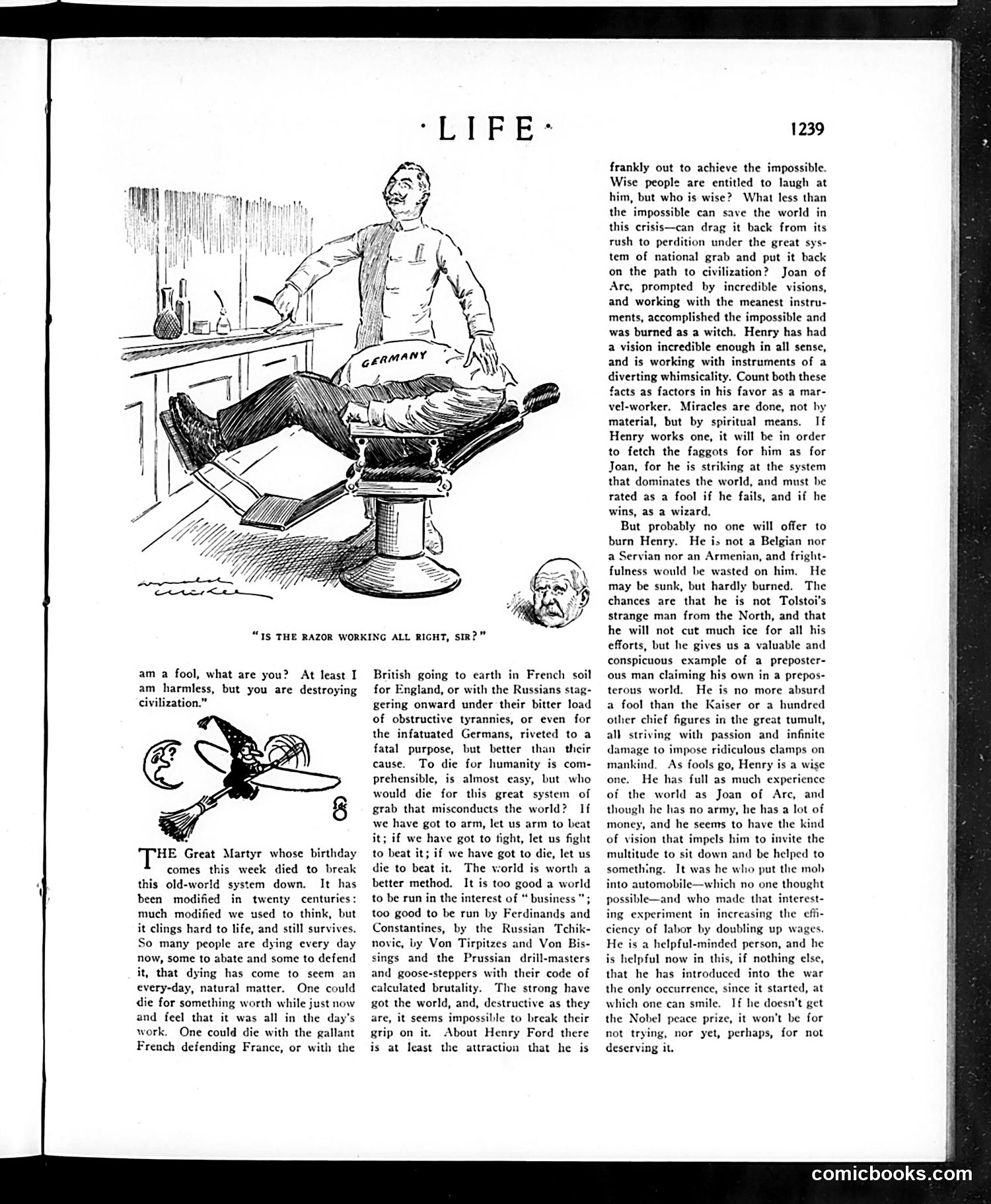
This 1914-1918 era *Life* page satirizes competing responses to World War I through Henry Ford and historical comparison. **The Main Cartoon**: Shows a dentist asking "Is the razor working all right, sir?" while a patient labeled "GERMANY" lies in the chair. This is dark wartime humor depicting military destruction as a necessary "treatment." **The Editorial Essay**: Defends Henry Ford's pacifist efforts and peace activism as idealistic rather than foolish. The author compares Ford to Joan of Arc—both pursuing "impossible" visions against entrenched systems. While acknowledging Ford lacks an army, he praises his wealth and ability to mobilize public support. **The Context**: The piece criticizes pre-war monarchical systems (Kaiser, Tsar, Serbian/Armenian rulers) as the true fools causing civilization's destruction. It argues that only radical change—not accepting the status quo—can save the world. **The Satire**: By equating Ford with Joan of Arc and calling him "wise" despite his pacifism in wartime, *Life* both mocks Ford's naivety and endorses systemic critique over militarism.
📄 Transcribed text from this page (OCR, searchable)
Machine-transcribed from the original scan — historical spelling and the odd misread are preserved.
“IS THE RAZOR WORKING ALL RIGHT, SIR?” am a fool, what are you? At least I am harmless, but you are destroying civilization.” HE Great Martyr whose birthday comes this week died to break this old-world system down. It has been modified in twenty centuries: much modified we used to think, but it clings hard to life, and still survives. So many people are dying every day now, some to abate and some to defend. it, that dying has come to seem an every-day, natural matter. One could die for something worth while just now and feel that it was all in the day's work. One could die with the gallant French defending France, or with the British going to earth in French soil for England, or with the Russians stag- gering onward under their bitter load of obstructive tyrannies, or even for the infatuated Germans, riveted to a fatal purpose, but better than their cause. To die for humanity is com- prehensible, is almost easy, but who would die for this great system of grab that misconducts the worl If we have got to arm, let us arm to beat it; if we have got to fight, let us fight to beat it; if we have got to die, let us die to beat it. The world is worth a better method. It is too good a world to be run in the interest of “ business "; too good to be run by Ferdinands and Constantines, by the Russian Tchik- novic, by Von Tirpitzes and Von Bis- sings and the Prussian drill-masters and goose-steppers with their code of calculated brutality. The strong have got the world, and, destructive as they are, it seems impossible to break their grip on it. About Henry Ford there is at least the attraction that he is 1239 frankly out to achieve the impossible. Wise people are entitled to laugh at him, but who is wise? What less than the impossible can save the world in this crisis—can drag it back from its rush to perdition under the great sys- tem of national grab and put it back on the path to civilization? Joan of Arc, prompted by incredible visions, and working with the meanest instru- ments, accomplished the impossible and was burned as a witch. Henry has had a vision incredible enough in all sense, and is working with instruments of a diverting whimsicality. Count both these facts as factors in his favor as a mar- vel-worker. Miracles are done, not by material, but by spiritual means. If Henry works one, it will be in order to fetch the faggots for him as for Joan, for he is striking at the system that dominates the world, and must be rated as a fool if he fails, and if he wins, as a wizard, But probably no one will offer to burn Henry. He is not a Belgian nor a Servian nor an Armenian, and fright- fulness would be wasted on him. He may be sunk, but hardly burned. The chances are that he is not Tolstoi's strange man from the North, and that he will not cut much ice for all his efforts, but he gives us a valuable and conspicuous example of a preposter- ous man claiming his own in a prepos- terous world. He is no more absurd a fool than the Kaiser or a hundred other chief figures in the great tumult, all striving with passion and infinite damage to impose ridiculous clamps on mankind. As fools go, Henry is a wise one. He has full as much experience of the world as Joan of Arc, and though he has no army, he has a lot of money, and he seems to have the kind of vision that impels him to invite the multitude to sit down and be helped to something. It was he who put the mob into automobile—which no one thought possible—and who made that interest ing experiment in increasing the effi- ciency of labor by doubling up wages. He is a helpful-minded person, and he is helpful now in this, if nothing else, that he has introduced into the war the only occurrence, since it started, at which one can smile. If he doesn’t get the Nobel peace prize, it won't be for not trying, nor yet, perhaps, for not deserving it. comicbooks.com