
Life, 1915-12-23 · page 24 of 40
Life — December 23, 1915 — page 24: what you’re looking at
What you’re looking at
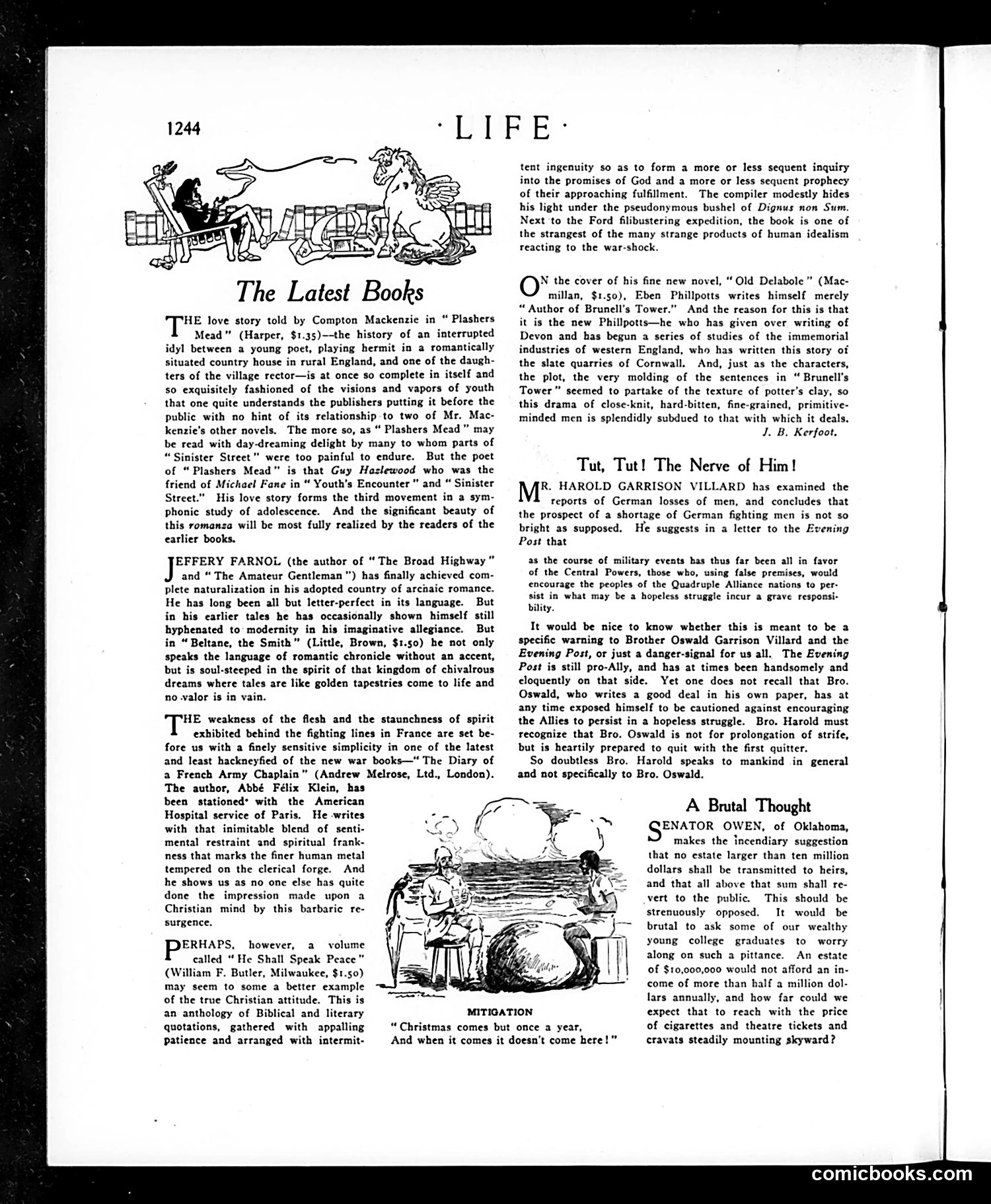
This page primarily reviews new books rather than featuring political cartoons. The content discusses literary works by British and American authors popular during WWI era. Two small cartoon illustrations appear: 1. **Top illustration**: Shows a figure conversing with a horse—likely illustrating Compton Mackenzie's romantic novel "Plashers Mead" set in rural England. 2. **Bottom illustration labeled "MITIGATION"**: Depicts figures around what appears to be a sparse Christmas meal, with the caption "Christmas comes but once a year, / And when it comes it doesn't come here!" This satirizes wartime scarcity and the difficulty of obtaining holiday provisions during WWI, when rationing and shortages affected civilians and soldiers alike. The reviews themselves discuss war literature and religious texts addressing the psychological toll of the conflict on Christian minds. The satirical intent is modest—the magazine uses humor to acknowledge wartime hardships rather than mounting serious political critique.
📄 Transcribed text from this page (OCR, searchable)
Machine-transcribed from the original scan — historical spelling and the odd misread are preserved.
“PPE HE love story told by Compton Mackenzie in “ Plashers Mead" (Harper, $1.35)—-the history of an interrupted idyl between a young poet, playing hermit in a romantically situated country house in rural England, and one of the daugh- ters of the village rector—is at once so complete in itself and so exquisitely fashioned of the visions and vapors of youth that one quite understands the publishers putting it before the public with no hint of its relationship to two of Mr. Mac- kenzie’s other novels. The more so, as “ Plashers Mead” may be read with day-dreaming delight by many to whom parts of “Sinister Street were too painful to endure. But the poet of “Plashers Mead” is that Guy Hazlewood who was the friend of Michael Fane in “ Youth's Encounter " and “ Sinister Street.” His love story forms the third movement in a sym- phonic study of adolescence. And the significant beauty of this romanza will be most fully realized by the readers of the earlier books. EFFERY FARNOL (the author of “The Broad Highway” and “ The Amateur Gentleman”) has finally achieved com- plete naturalization in his adopted country of archaic romance. He has long been all but letter-perfect in its language. But in his earlier tales he has occasionally shown himself still hyphenated to modernity in his imaginative allegiance. But in “Beltane, the Smith” (Little, Brown, $1.50) he not only speaks the language of romantic chronicle without an accent, but is soul-steeped in the spirit of that kingdom of chivalrous dreams where tales are like golden tapestries come to life and no valor is in vain. 'HE weakness of the flesh and the staunchness of spirit exhibited behind the fighting lines in France are set be- fore us with a finely sensitive simplicity in one of the latest and least hackneyfied of the new war books—“ The Diary of a French Army Chaplain” (Andrew Melrose, Ltd., London). The author, Abbé Félix Klein, has been stationed’ with the American Hospital service of Paris. He writes with that inimitable blend of senti- mental restraint and spiritual frank- ness that marks the finer human metal tempered on the clerical forge. And he shows us as no one else has quite done the impression made upon a Christian mind by this barbaric re- surgence, ERHAPS, however, a volume called “He Shall Speak Peace” (William F, Butler, Milwaukee, $1.50) may seem to some a better example of the true Christian attitude. This is an anthology of Biblical and literary quotations, gathered with appalling Patience and arranged with intermit- MITIGATION “Christmas comes but once a year, And when it comes it doesn’t come here!” tent ingenuity so as to form a more or less sequent inquiry into the promises of God and a more or less sequent prophecy of their approaching fulfillment. The compiler modestly hides his light under the pseudonymous bushel of Dignus non Sum. Next to the Ford filibustering expedition, the book is one of the strangest of the many strange products of human idealism reacting to the war-shock. N the cover of his fine new novel, “Old Delabole” (Mac- millan, $1.50), Eben Phillpotts writes himself merely “ Author of Brunell’s Tower.” And the reason for this is that it is the new Phillpotts—he who has given over writing of Devon and has begun a series of studies of the immemorial industries of western England, who has written this story of the slate quarries of Cornwall. And, just as the characters, the plot, the very molding of the sentences in “ Brunell’s Tower” seemed to partake of the texture of potter's clay, so this drama of close-knit, hard-bitten, fine-grained, primitive- minded men is splendidly subdued to that with which it deals. J. B. Kerfoot. Tut, Tut! The Nerve of Him! R. HAROLD GARRISON VILLARD has examined the reports of German losses of men, and concludes that the prospect of a shortage of German fighting men is not so bright as supposed. He suggests in a letter to the Evening Post that as the course of military events has thus far been all in favor of the Central Powers, those who, using false premises, would encourage the peoples of the Quadruple Alliance nations to per- sist in what may be a hopeless struggle incur a grave responsi- bility. It would be nice to know whether this is meant to be a specific warning to Brother Oswald Garrison Villard and the Evening Post, or just a danger-signal for us all. The Evening Post is still pro-Ally, and has at times been handsomely and eloquently on that side. Yet one does not recall that Bro. Oswald, who writes a good deal in his own paper, has at any time exposed himself to be cautioned against encouraging the Allies to persist in a hopeless struggle. Bro. Harold must recognize that Bro. Oswald is not for prolongation of strife, but is heartily prepared to quit with the first quitter. So doubtless Bro. Harold speaks to mankind in general and not specifically to Bro. Oswald. A Brutal Thought ENATOR OWEN, of Oklahoma, makes the incendiary suggestion that no estate larger than ten million dollars shall be transmitted to heirs, and that all above that sum shall re- vert to the public. This should be strenuously opposed. It would be brutal to ask some of our wealthy young college graduates to worry along on such a pittance. An estate of $10,000,000 would not afford an in- come of more than half a million dol- lars annually, and how far could we expect that to reach with the price of cigarettes and theatre tickets and cravats steadily mounting skyward? comicbooks.com