
Life, 1915-12-23 · page 30 of 40
Life — December 23, 1915 — page 30: what you’re looking at
What you’re looking at
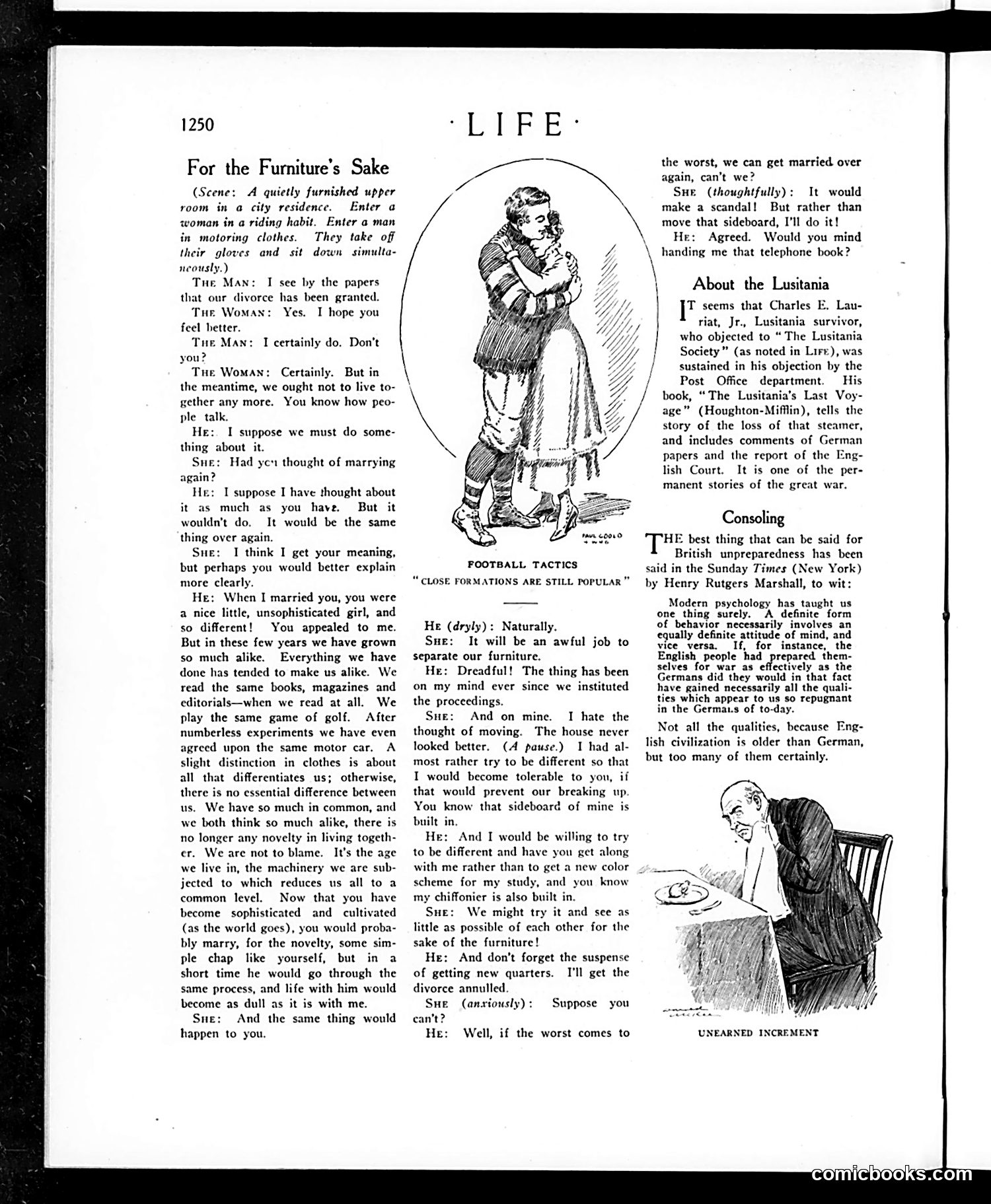
This page contains a satirical dialogue between a divorcing couple who discover they have become so identical in tastes and habits that they've lost all novelty and appeal for each other. The humor lies in their absurd conclusion: rather than separate their shared furniture (particularly built-in pieces like a sideboard and chiffonier), they decide to *stay married* and simply avoid each other, then potentially remarry later for a fresh scandal. The satire critiques early 20th-century marriage and modern life—how industrial standardization and shared consumer culture have eliminated individual distinction. The couple blames "the machinery we are subjected to which reduces us all to a common level," reflecting anxieties about mass production erasing personal identity. The accompanying illustrations show a woman in riding habit (indicating leisure-class status) and a cartoon labeled "Unearned Increment" about wealth accumulation. The page also includes brief notes on the *Lusitania* (the 1915 ship sinking) and British military preparedness—contemporary serious topics alongside the satirical marriage sketch.
📄 Transcribed text from this page (OCR, searchable)
Machine-transcribed from the original scan — historical spelling and the odd misread are preserved.
1250 For the Furniture’s Sake (Scene: A quietly furnished upper room in a city residence. Enter a woman in a riding habit. Enter a man in motoring clothes. They take off their gloves and sit down simulta- neously.) Tue Man: that our di Tur Woma feel hetter. Tie Man: you? Tue Woman: Certainly. But in the meantime, we ought not to live to- gether any more. You know how peo- ple talk. He: I suppose we must do some- thing about it. Sue: Had yeu thought of marrying IT see by the papers rce has been granted. : Yes. I hope you I certainly do. Don't : I suppose I have thought about as much as you have. But it wouldn't do. It would be the same thing over again. Sue: I think I get your meaning, but perhaps you would better explain more clearly. He: When I married you, you were a nice little, unsophisticated girl, and so different! You appealed to me. But in these few years we have grown so much alike. Everything we have done has tended to make us alike. We read the same books, magazines and editorials—when we read at all. We play the same game of golf. After numberless experiments we have even agreed upon the same motor car. A slight distinction in clothes is about all that differentiates us; otherwise, there is no essential difference between us. We have so much in common, and we both think so much alike, there is no longer any novelty in living togeth- er. We are not to blame. It’s the age we live in, the machinery we are sub- jected to which reduces us all to a common level. Now that you have become sophisticated and cultivated (as the world goes), you would proba- bly marry, for the novelty, some sim- ple chap like yourself, but in a short time he would go through the same process, and life with him would become as dull as it is with me. Sue: And the same thing would happen to you. & ANS FOOTBALL TACTICS “CLOSE FORMATIONS ARE STILL POPULAR” He (dryly): Naturally. Sue: It will be an awful job to separate our furniture. He: Dreadful! The thing has been on my mind ever since we instituted the proceedings. Sue: And on mine. I hate the thought of moving. The house never looked better. (A pause.) I had al- most rather try to be different so that I would become tolerable to you, if that would prevent our breaking up You know that sideboard of mine is built in, He: And I would be willing to try to be different and have you get along with me rather than to get a new color scheme for my study, and you know my chiffonier is also built in. Sue: We might try it and see as little as possible of each other for the sake of the furniture! He: And don't forget the suspense of getting new quarters. I'll get the divorce annulled. SHE (anxiously): can’t? He: Suppose you Well, if the worst comes to the worst, we can get married over again, can’t we? Sue (thoughtfully): It would make a scandal! But rather than move that sideboard, I'll do it! He: Agreed. Would you mind handing me that telephone book? About the Lusitania T seems that Charles E. Lau- riat, Jr., Lusitania survivor, who objected to “ The Lusitania Society” (as noted in Lire), was sustained in his objection by the Post Office department. His book, “The Lusitania’s Last Voy- age” (Houghton-Miffiin), tells the story of the loss of that steamer, and includes comments of German papers and the report of the Eng- lish Court. It is one of the per- manent stories of the great war. Consoling 'HE best thing that can be said for British unpreparedness has been said in the Sunday Times (New York) by Henry Rutgers Marshall, to wit: Modern psychology has taught us one thing surely. A definite form of behavior necessarily involves an equally definite attitude of mind, and vice versa. If, for instance, the English people had prepared them- selves for war as effectively as the Germans did they would in that fact have gained necessarily all the quali- ties which appear to us so repugnant in the Germans of to-day. Not all the qualities, because Eng- lish civilization is older than German, but too many of them certainly. ARNED INCREMENT