
Life, 1915-12-23 · page 16 of 40
Life — December 23, 1915 — page 16: what you’re looking at
What you’re looking at
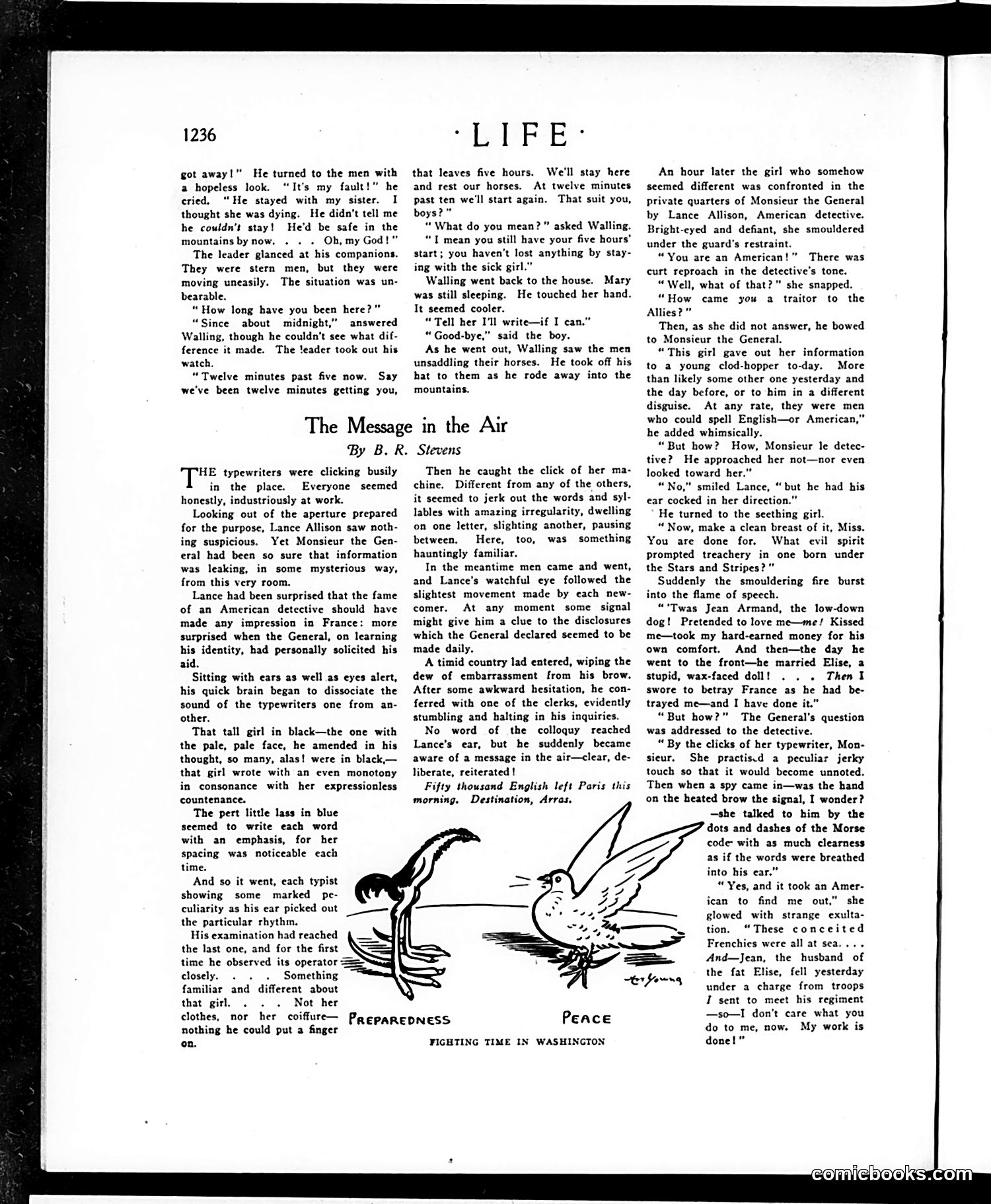
This page contains a short story by B.R. Stevens about an American detective (Lance Allison) working for a French general during what appears to be World War I. The detective is stationed in an office to identify who is leaking military information. The narrative demonstrates spy-craft through observation: Allison distinguishes typists by the unique rhythmic patterns of their machines—a clever metaphor for identifying individuals through distinctive characteristics. He eventually detects a coded message being transmitted through the typewriter's deliberate irregularities: "Fifty thousand English left Paris this morning. Destination, Arras." The illustrations labeled "Preparedness" and "Peace" (showing a dove) appear to reference wartime vigilance themes. The story exemplifies early-20th-century spy fiction popular during WWI, emphasizing technological detection and the danger of enemy agents embedded within Allied operations. The narrative suggests that even seemingly innocent office work could mask espionage activities.
📄 Transcribed text from this page (OCR, searchable)
Machine-transcribed from the original scan — historical spelling and the odd misread are preserved.
1236 got away!" He turned to the men with a hopeless look. “It's my fault!" he cried, “He stayed with my sister. I thought she was dying. He didn’t tell me he couldn't stay! He'd be safe in the mountains by now. . Oh, my God!” The leader glanced at his companions. They were stern men, but they were moving uneasily, The situation was un- bearable. “How long have you been here?” “Since about midnight,” answered Walling, though he couldn't see what dif- ference it made. The ‘eader took out his watch. “Twelve minutes past five now. Say we've been twelve minutes getting you, “ae We'll stay here At twelve minutes That suit you, that leaves five hours. and rest our horses. past ten we'll start again. boys?” What do you mean?” asked Walling. “T mean you still have your five hours’ start; you haven't lost anything by stay- ing with the sick girl.” Walling went back to the house. Mary was still sleeping. He touched her hand. It seemed cooler. “Tell her I'll write—if I can.” “Good-bye,” said the boy. As he went out, Walling saw the men unsaddling their horses. He took off his hat to them as he rode away into the mountains. The Message in the Air By B. R. Stevens HE typewriters were clicking busily in the place. Everyone seemed honestly, industriously at work. Looking out of the aperture prepared for the purpose, Lance Allison saw noth- ing suspicious. Yet Monsieur the Gen- eral had been so sure that information was leaking, in some mysterious way, from this very room. Lance had been surprised that the fame of an American detective should have made any impression in France: more surprised when the General, on learning his identity, had personally solicited his ai Sitting with ears as well as eyes alert, his quick brain began to dissociate the sound of the typewriters one from an- other. That tall girl in black—the one with the pale, pale face, he amended in his thought, so many, alas! were in black,— that girl wrote with an even monotony in consonance with her expressionless countenance. The pert little lass in blue seemed to write each word with an emphasis, for her spacing was noticeable each time. And so it went, each typist showing some marked pe- culiarity as his ear picked out the particular rhythm. His examination had reached the last one, and for the first time he observed its operator ==> closely. Something familiar and different about that girl, . . . Not her clothes, nor her coiffure— nothing he could put a finger on. Then he caught the click of her ma- chine. Different from any of the others, it seemed to jerk out the words and syl- lables with amazing irregularity, dwelling on one letter, slighting another, pausing between, Here, too, was something hauntingly familiar. In the meantime men came and went, and Lance’s watchful eye followed the slightest. movement made by each new- comer. At any moment some signal might give him a clue to the disclosures which the General declared seemed to be made daily. A timid country lad entered, wiping the dew of embarrassment from his brow. After some awkward hesitation, he con- ferred with one of the clerks, evidently stumbling and halting in his inquiries. No word of the colloquy reached Lance’s ear, but he suddenly became aware of a message in the air—clear, de- liberate, reiterated! Fifty thousand English left Paris this morning. Destination, Arras. PrepareDNess FIGHTING TIME IN WASHINGTON An hour later the girl who somehow seemed different was confronted in the private quarters of Monsieur the General by Lance Allison, American detective. Bright-eyed and defiant, she smouldered under the guard's restraint. “You are an American!” There was curt reproach in the detective’s tone. “Well, what of that?” she snapped. “How came you a traitor to the Allies?” Then, as she did not answer, he bowed to Monsieur the General. “This girl gave out her information to a young clod-hopper to-day. More than likely some other one yesterday and the day before, or to him in a different disguise. At any rate, they were men who could spell English—or American,” he added whimsically. “But how? How, Monsieur le detec- tive? He approached her not—nor even looked toward her.” “No,” smiled Lance, “but he had his ear cocked in her direction.” He turned to the seething girl. “Now, make a clean breast of it, Miss. You are done for. What evil spirit Prompted treachery in one born under the Stars and Stripes?" Suddenly the smouldering fire burst into the flame of speech. “'Twas Jean Armand, the low-down dog! Pretended to love me—me! Kissed me—took my hard-earned money for his own comfort. And then—the day he went to the front—he married Elise, a stupid, wax-faced doll! . . . Then I swore to betray France as he had be- trayed me—and I have done it.” “But how?" The General's question was addressed to the detective. “ By the clicks of her typewriter, Mon- sieur, She practis.d a peculiar jerky touch so that it would become unnoted. Then when a spy came in—was the hand on the heated brow the signal, I wonder? —she talked to him by the dots and dashes of the Norse code with as much clearness as if the words were breathed into his ear.” “Yes, and it took an Amer- ican to find me out,” she glowed with strange exulta- tion. “These conceited Frenchies were all at sea... . And—Jean, the husband of the fat Elise, fell yesterday under a charge from troops I sent to meet his regiment —so—I don't care what you do to me, now. My work is done!”