
A complete issue · 44 pages · 1914
Life — November 19, 1914
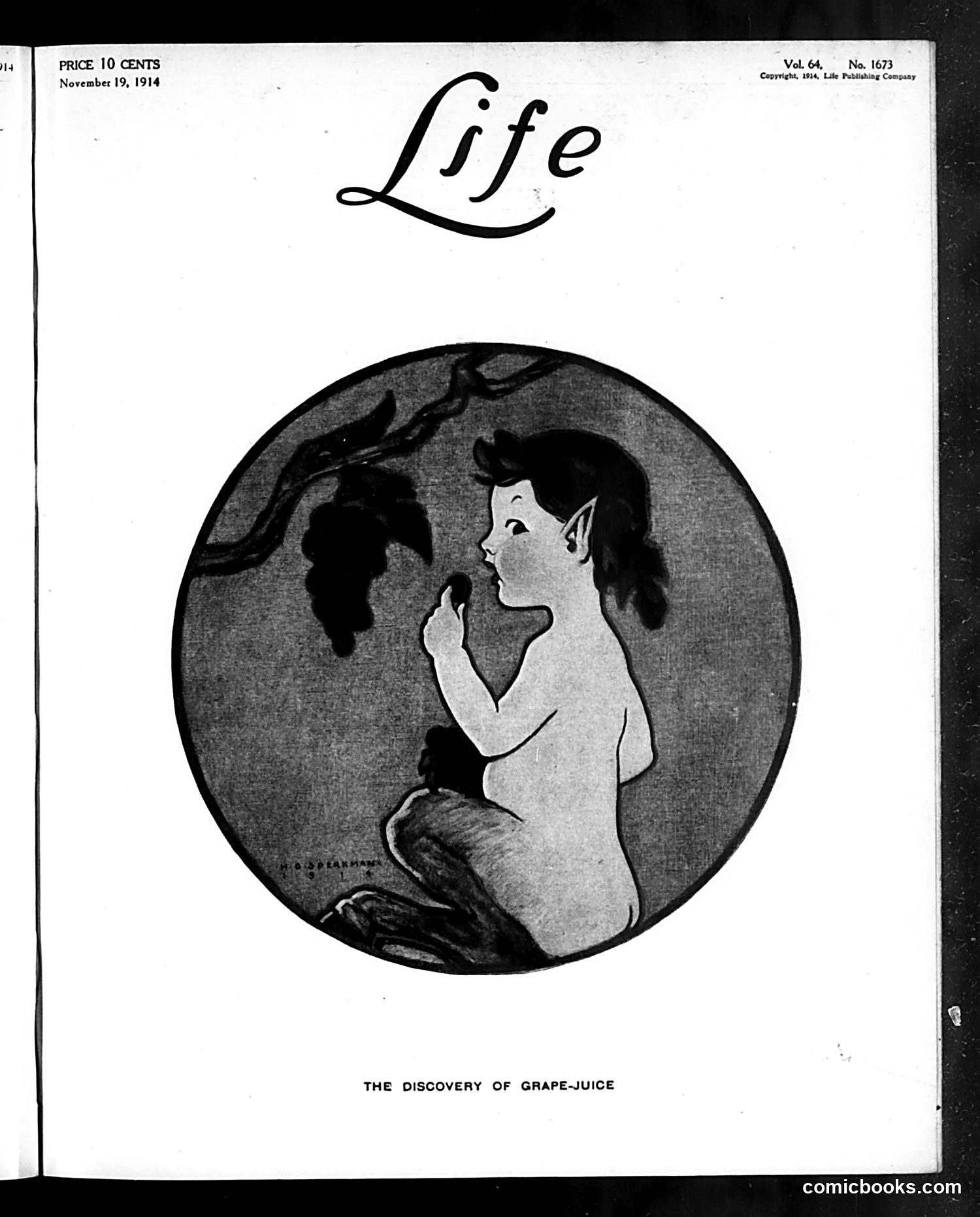
This November 1914 *Life* magazine cover presents a satirical image of a cherub or cupid-like figure discovering a grape vine with grapes. The caption "The Discovery of Grape-Juice" appears to be a humorous reference to Prohibition-era concerns in America. The satire likely mocks either the temperance movement's claims about grape juice as an alcohol-free alternative, or perhaps ridicules the absurdity of treating grape juice as a novel "discovery" when it's simply fermented grapes. Given the 1914 date—pre-Prohibition (which began in 1920)—this may satirize growing temperance advocacy that promoted grape juice as a substitute for wine. The cherubic figure's pose suggests innocence or naiveté, reinforcing the satirical tone about this supposedly wholesome alternative to alcohol.
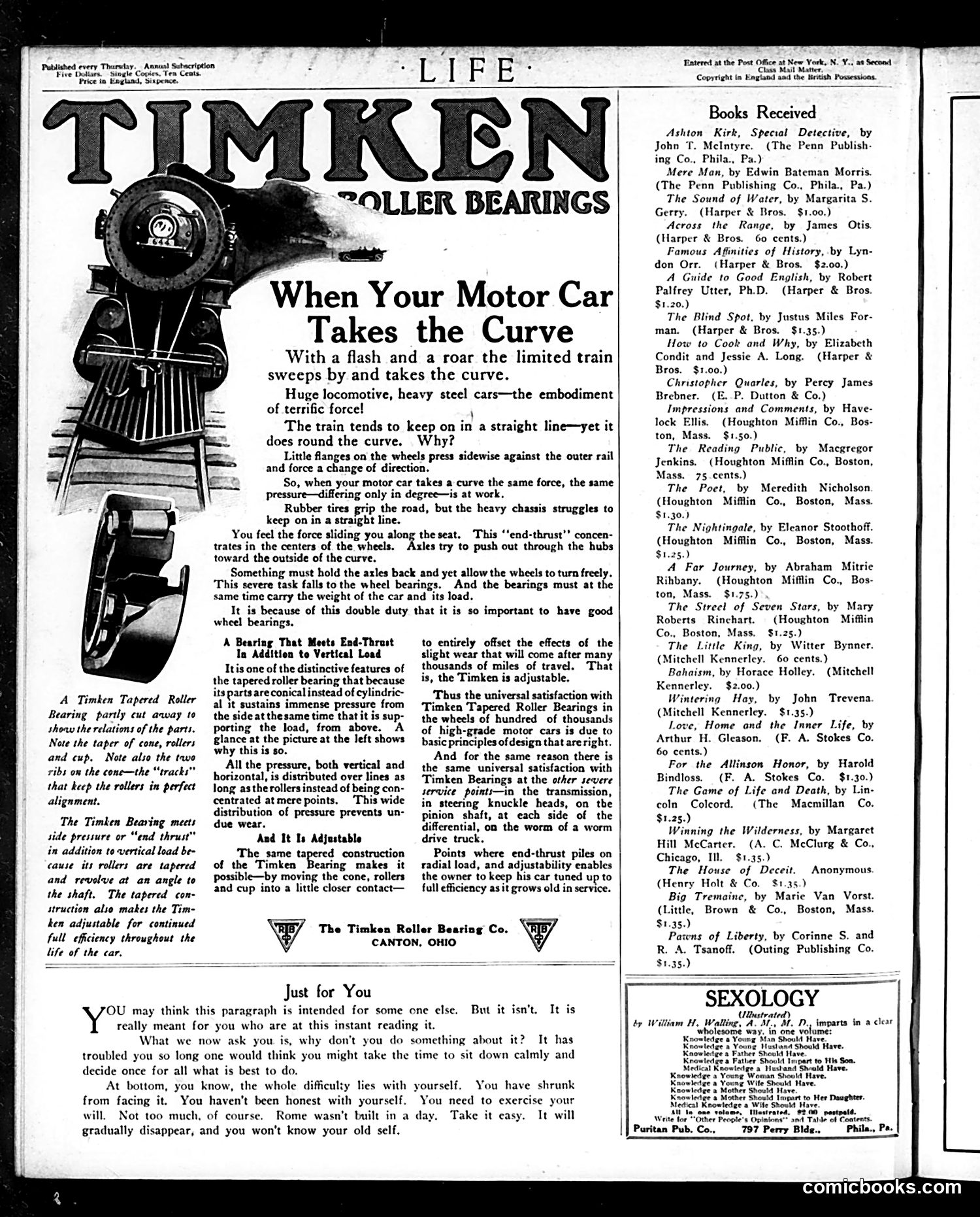
This page contains **no political cartoon or satire**. Instead, it's primarily a **Timken Roller Bearings advertisement** featuring a locomotive and motor car, explaining how railway wheel bearings function compared to automobile steering through curves. The ad uses a technical analogy: just as train wheels need reliable bearings to handle lateral forces on curves, car wheels require quality bearings for safe turning. It's pure industrial marketing, not commentary. Below is an unrelated section titled "Just for You"—a brief self-help essay encouraging readers to face personal difficulties honestly. The right column lists **"Books Received,"** a standard publishing notice, and advertises "Sexology," an illustrated reference book. This is a standard magazine page from approximately the 1920s mixing advertising, editorial content, and publishing notices—nothing satirical.
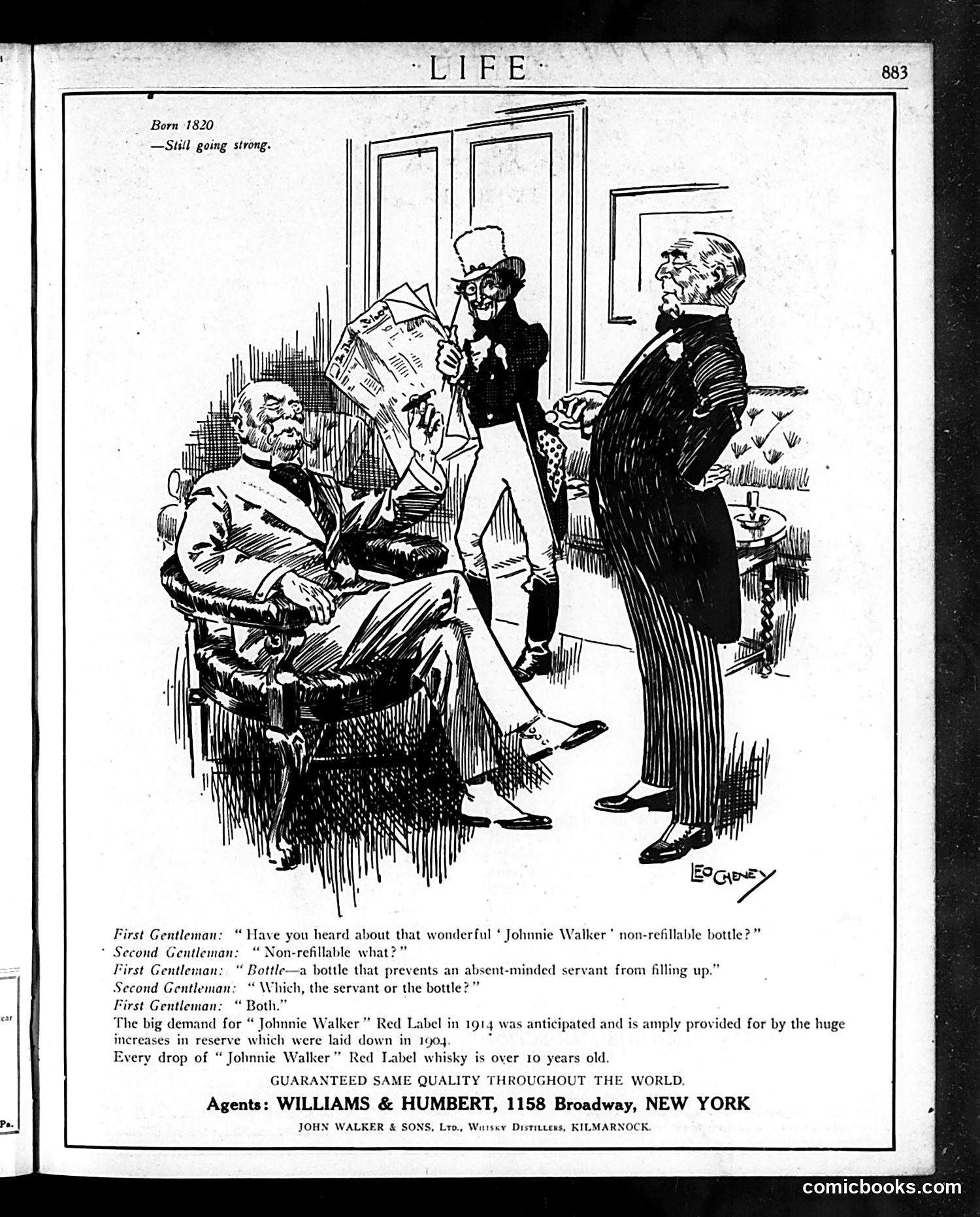
This is primarily a **Johnnie Walker whisky advertisement** disguised as editorial content in Life magazine (page 883). The cartoon shows three gentlemen discussing a "non-refillable bottle" — a marketing innovation where the bottle cannot be refilled by servants, ensuring consumers purchase genuine product rather than counterfeit or diluted whisky. The joke plays on class anxieties: wealthy men worry about dishonest servants adulterating expensive spirits. The header "Born 1820 — Still going strong" references Johnnie Walker's founding date and the whisky's longevity. The advertisement emphasizes that Johnnie Walker Red Label whisky, over 10 years old, maintains "guaranteed same quality throughout the world." This represents early 20th-century advertising using humor and social satire to sell premium spirits to affluent readers.
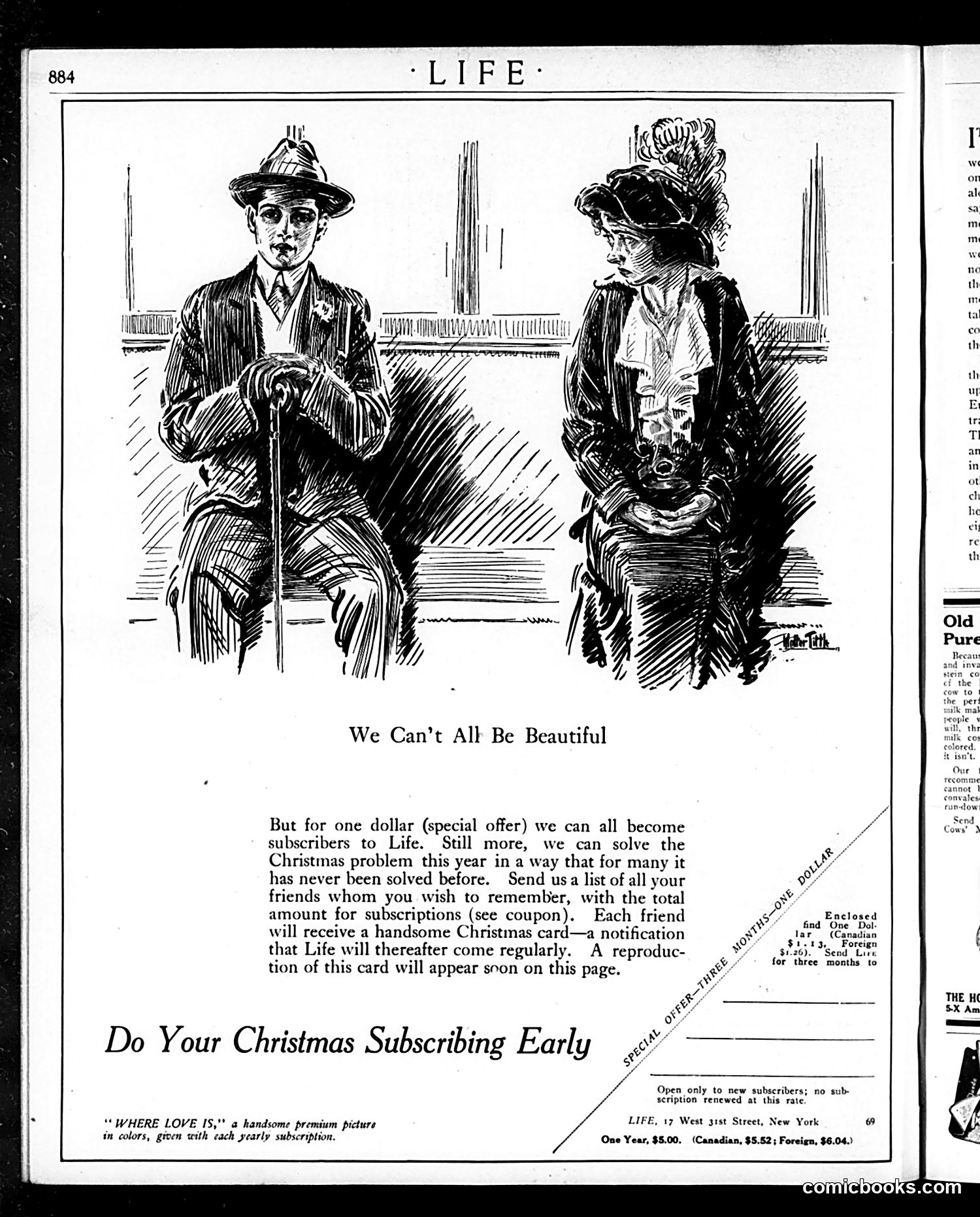
This page is primarily a **subscription advertisement** for Life magazine rather than political satire. It features an illustration of a man and woman sitting on a bench, with the caption "We Can't All Be Beautiful." The ad promotes a **Christmas gift subscription offer**: for one dollar, subscribers could purchase Life magazine subscriptions for friends, who would receive a decorative Christmas card and ongoing issues. The satire here is light and self-aware—Life acknowledges that not everyone possesses conventional beauty, but magazine subscriptions are an accessible luxury "gift" anyone can afford to give. The humor relies on the gentle, pragmatic message that magazine reading is a consolation prize for those lacking physical attractiveness. It's typical early-20th-century satirical advertising.
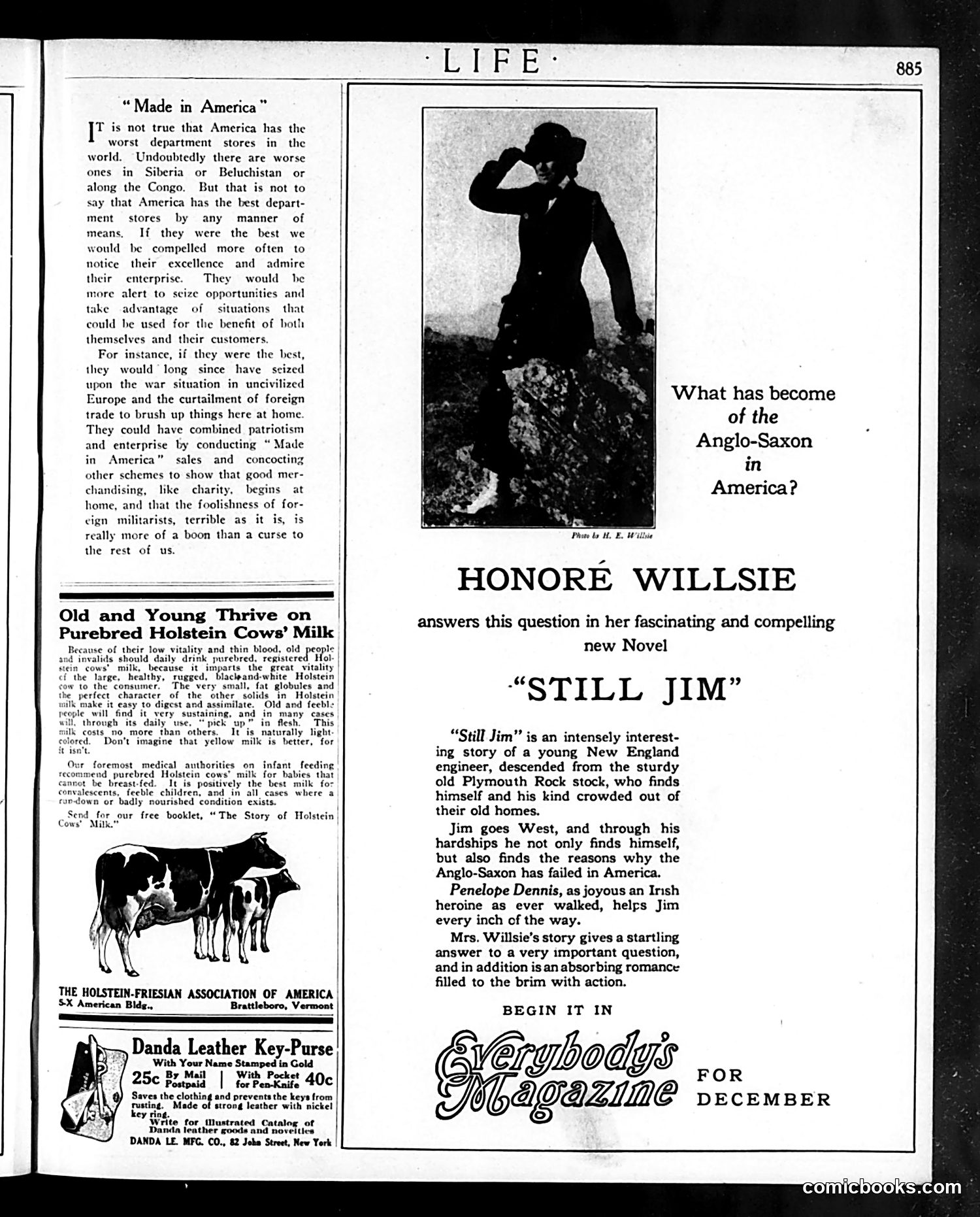
This page is primarily **advertising and literary promotion** rather than political satire. The main content advertises novelist **Honoré Willsie's** new novel "*Still Jim*," which tells the story of a New England engineer descended from Plymouth Rock colonists who moves West. The narrative apparently explores why "the Anglo-Saxon has failed in America"—suggesting the book addresses concerns about the decline of Anglo-Saxon dominance, a common theme in early 20th-century American literature reflecting anxieties about immigration and cultural change. Other advertisements include Holstein dairy cow milk promotion and a leather key-purse. The "Made in America" essay critiques American department stores, not depicting specific political figures. No clear political cartoons appear on this page.
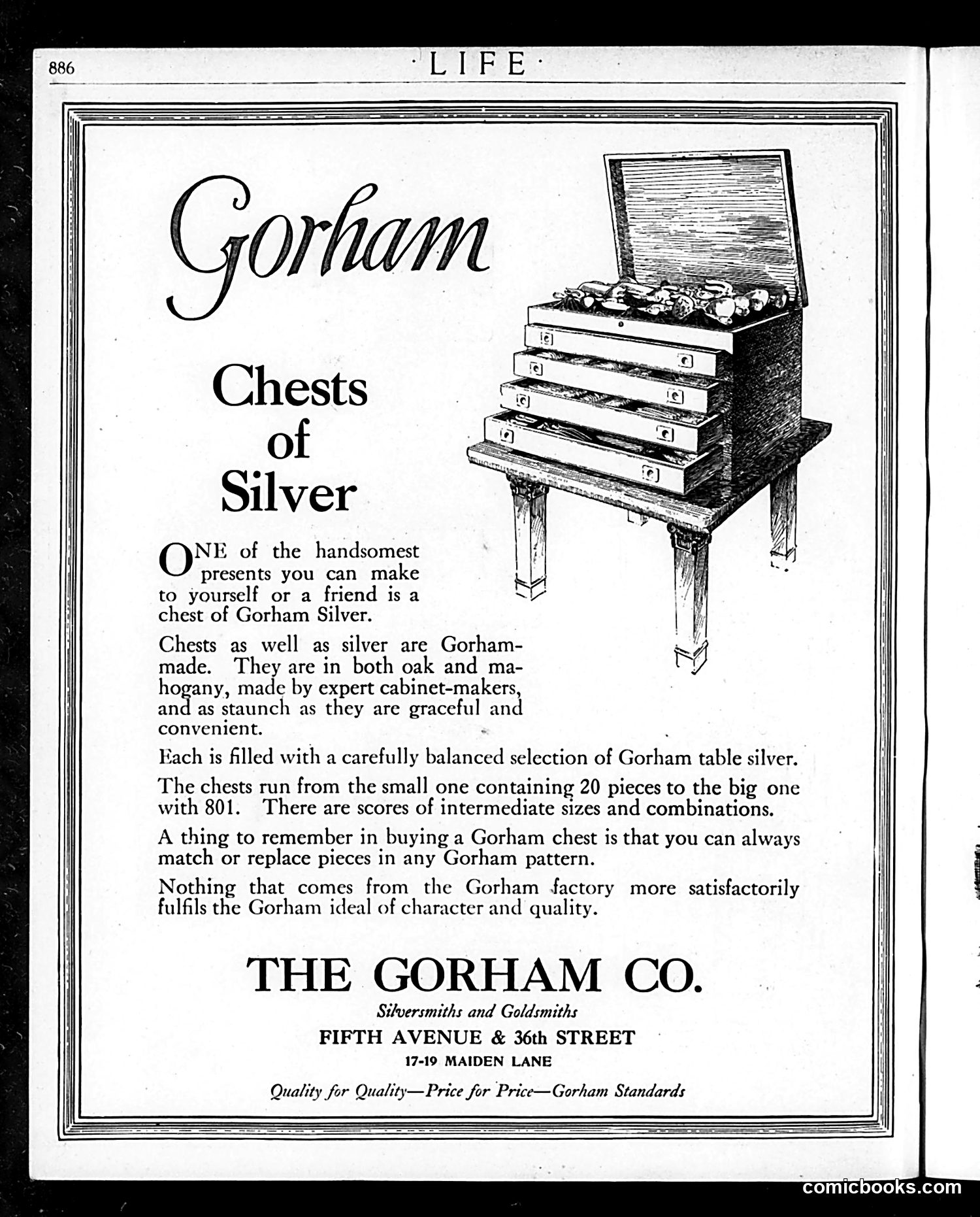
This is **not a cartoon or satirical content**—it's a straightforward advertisement for The Gorham Company, silversmiths and goldsmiths located in New York City. The page promotes Gorham's "Chests of Silver," luxury gift items containing matched sets of table silver. The illustration shows a tiered wooden chest on a stand, open to display silverware inside. The ad emphasizes quality craftsmanship, variety of sizes (20 to 801 pieces), and the practical advantage that replacement pieces can always be matched to existing Gorham patterns. This represents early 20th-century luxury marketing targeting affluent consumers seeking prestigious houseware gifts. There is no satire, political commentary, or hidden meaning—simply period advertising in a magazine known primarily for humor.
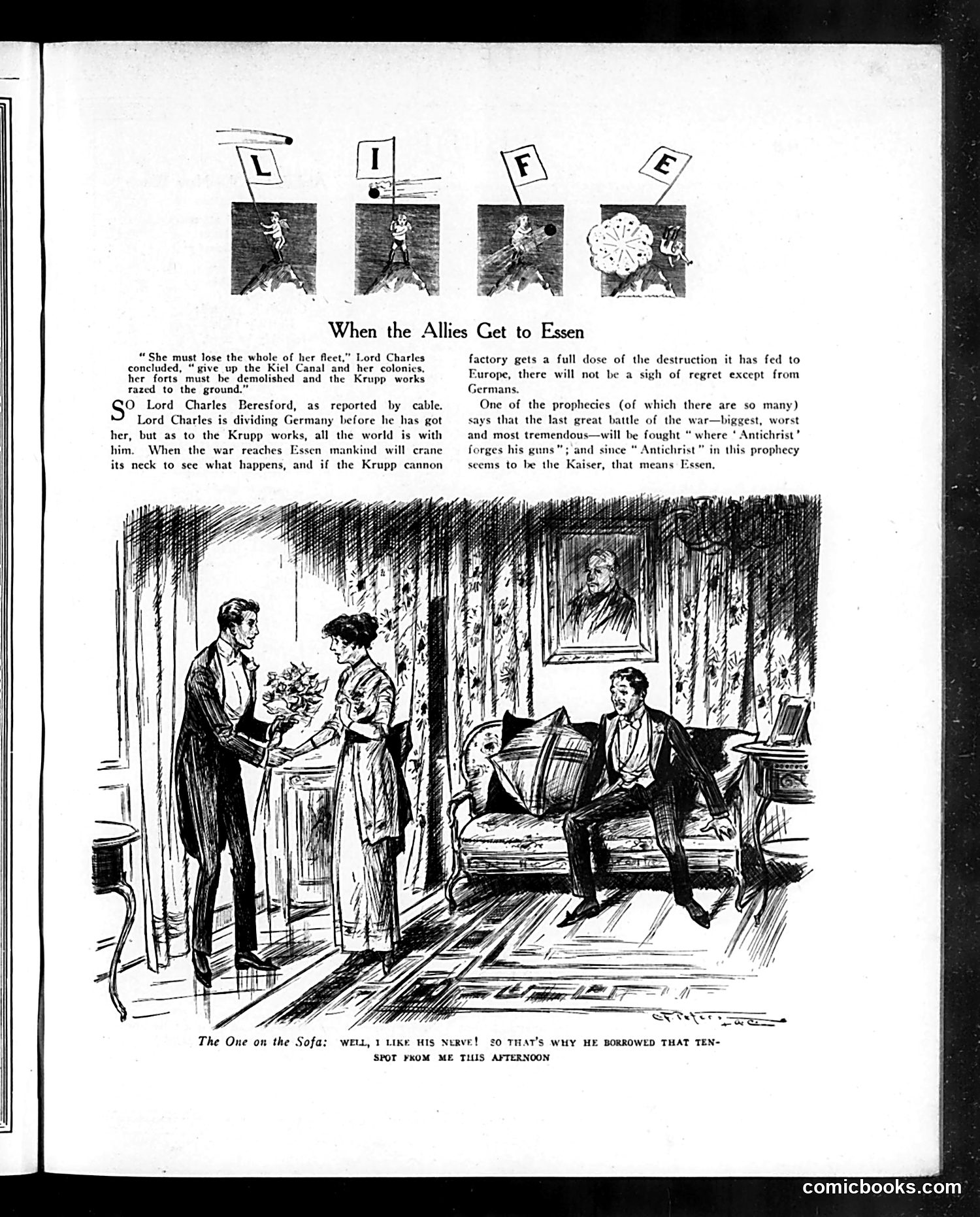
This page satirizes World War I Allied strategy. The top section shows letters L-I-F-E spelling out military positions or outcomes, likely referring to the Krupp armaments factory at Essen, Germany—a crucial war target. The text quotes Lord Charles predicting Germany's defeat: she must surrender the Kiel Canal, colonies, and fortifications. It references prophecies about a final "Antichrist" battle at Essen, seemingly mocking grandiose war predictions. The bottom cartoon depicts a domestic scene where a man tells a woman he borrowed her servant for the afternoon—a humorous non-sequitur seemingly unrelated to the war discussion above, possibly satirizing how ordinary life continues amid grand military strategizing. The connection between sections remains unclear from the visible content.
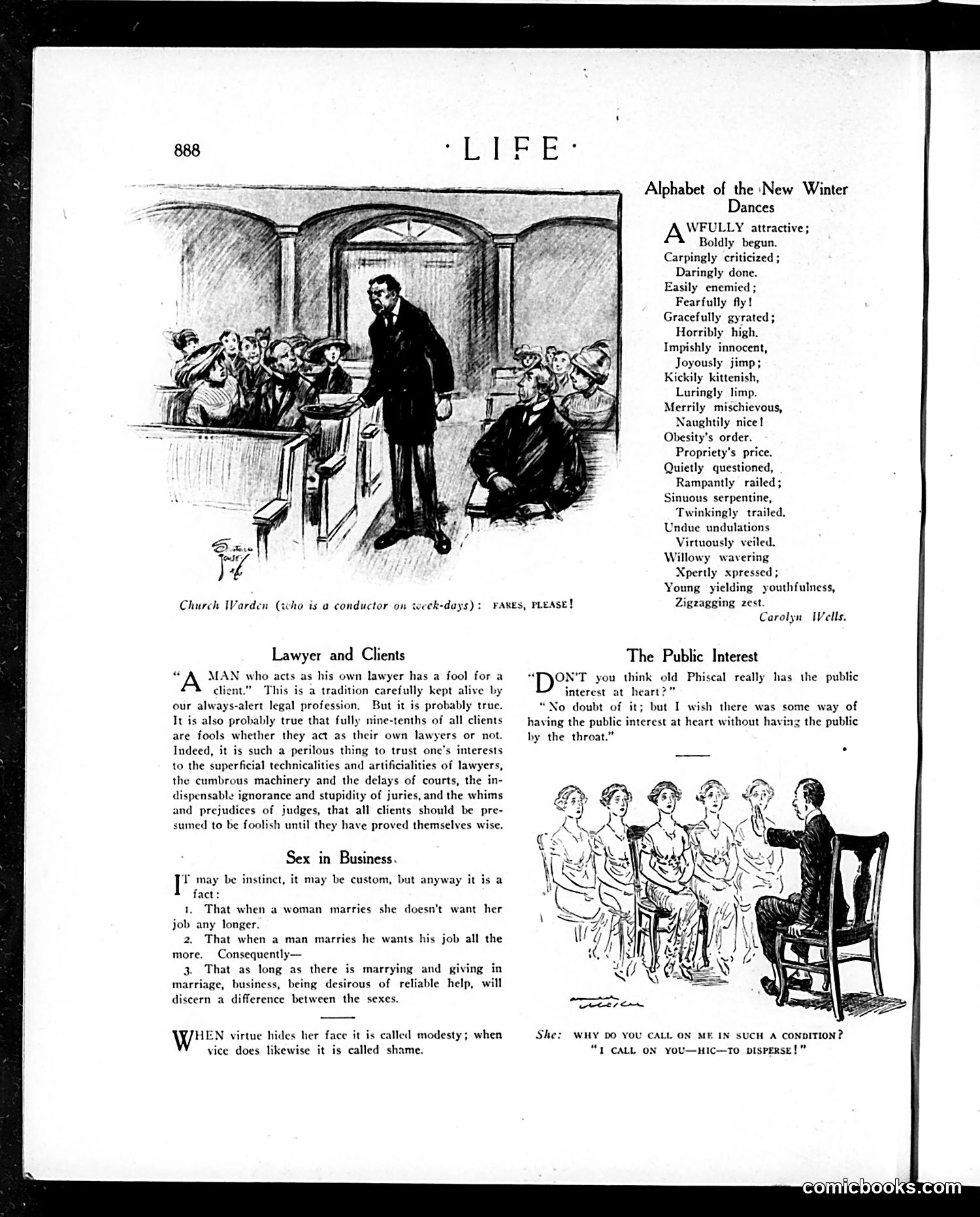
**"Church Warden" Cartoon**: A church official (labeled as a "conductor on week-days") stands before a bench of seated parishioners. The joke plays on the hypocrisy of someone who behaves one way at work and another at church—the caption "FARES, PLEASE!" suggests he's a bus conductor during weekdays but adopts religious authority on Sundays. **"Lawyer and Clients"**: Satirizes the legal profession's complexity and potential for fooling clients through technicalities and court delays, suggesting lawyers profit from clients' ignorance. **"Sex in Business"**: A straightforward social commentary that married women leave employment while married men seek advancement—highlighting early 20th-century gender discrimination in the workplace. The page reflects Progressive-era American satire targeting institutional hypocrisy and professional exploitation.
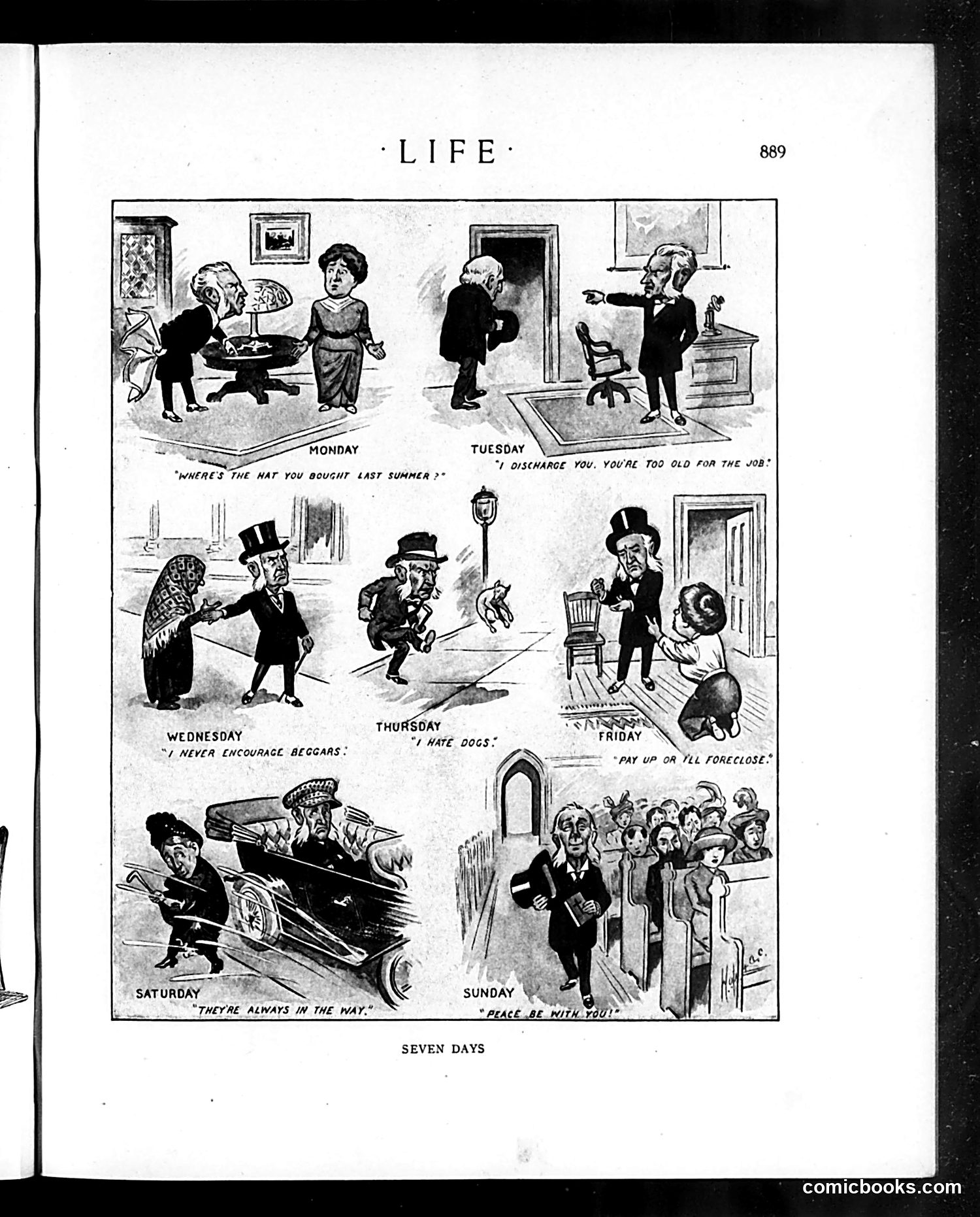
This comic strip satirizes the misfortunes of an older man throughout the week. Each day presents a different domestic or social hardship: **Monday-Friday** show him encountering various embarrassments: a wife questioning a missing hat, an employer firing him for age, a woman rejecting beggars, dogs chasing him, and creditors demanding payment on a foreclosure. **Saturday-Sunday** depict escalating chaos—being literally run over by a vehicle, then seeking solace at church where a congregation welcomes him with "Peace be with you." The satire suggests life's relentless disappointments, particularly for aging men facing unemployment, poverty, and social rejection. The religious conclusion offers ironic commentary: only the church provides acceptance when the wider world offers none. It reflects early 20th-century anxieties about economic instability and aging.
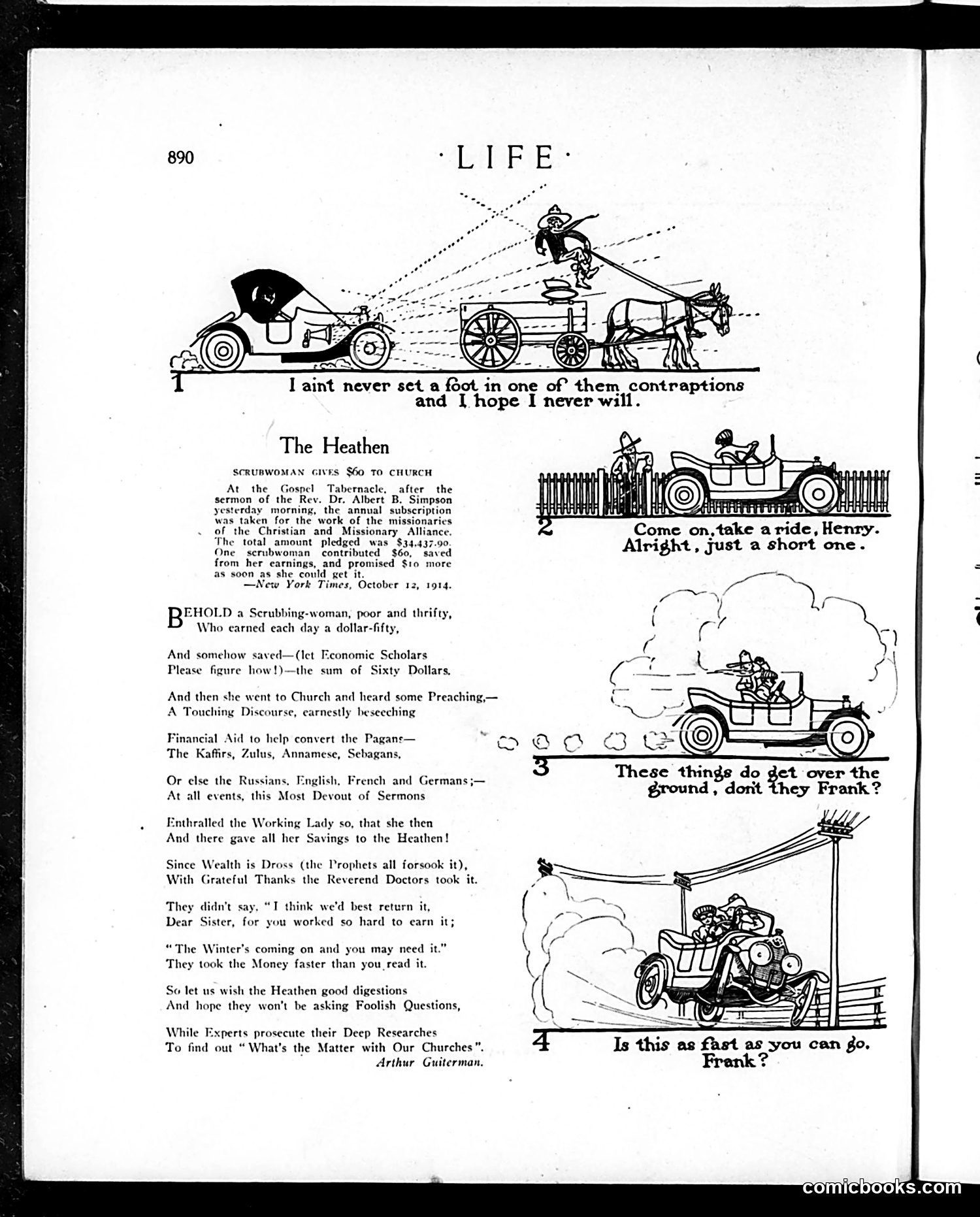
This page contains a satirical poem titled "The Heathen" by Arthur Guiterman, accompanied by four cartoons about automobiles. The text mocks Christian missionary efforts, suggesting hypocrisy: a working woman donates her savings to convert "heathens" (non-Christians in foreign lands—Kafirs, Zulus, Annamese, Sebagangs), yet Christian institutions don't reciprocate financially helping her. The four car cartoons appear to joke about automotive dangers and speed, with captions like "Come on, take a ride, Henry" and "These things do get over the ground, don't they Frank?" The final panel asks "Is this as fast as you can go, Frank?"—likely satirizing early automobile speeds and safety concerns. The overall message critiques misplaced charity priorities and industrial-age risks.
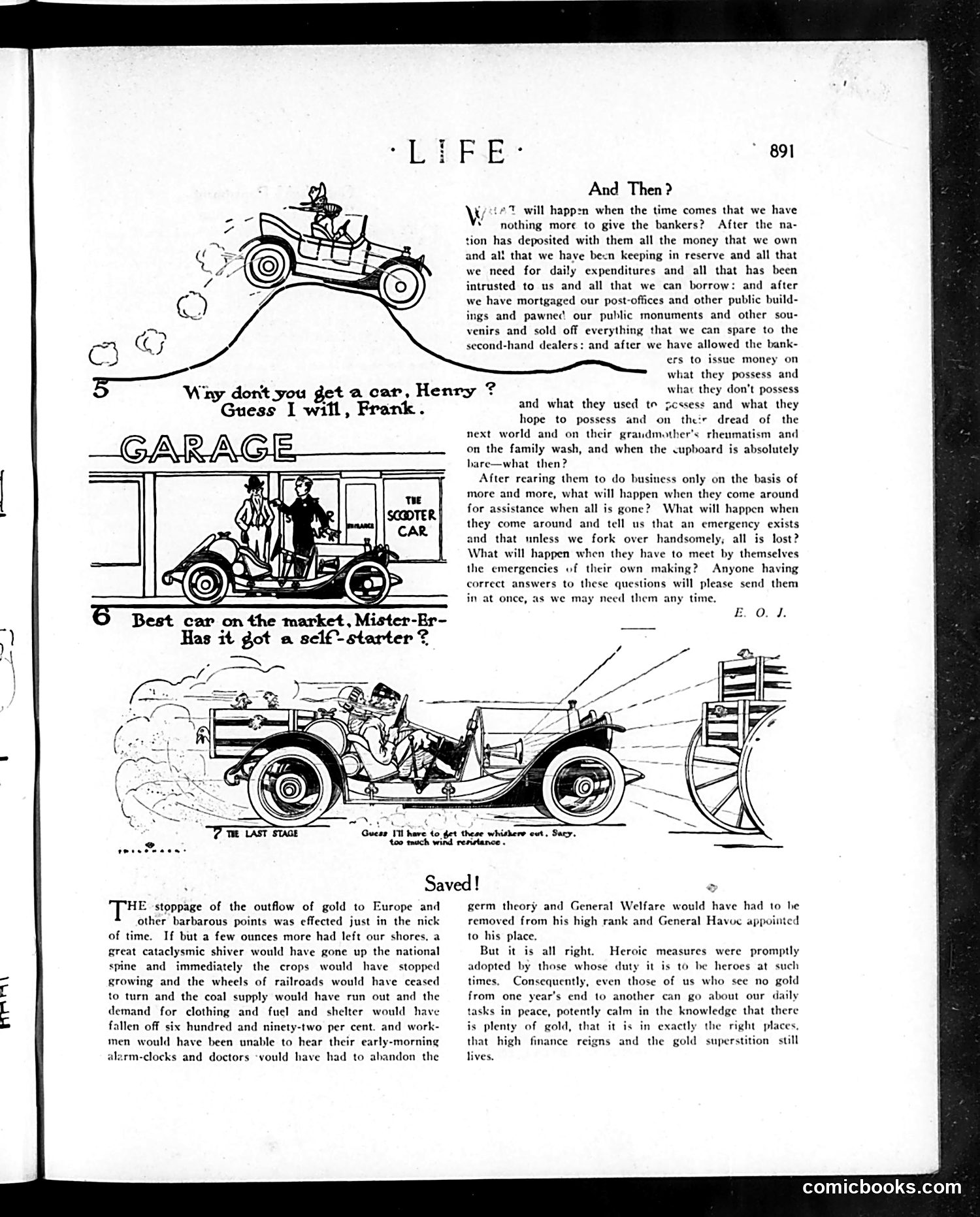
This page satirizes post-World War I financial anxiety. The main text warns of catastrophic consequences if banks exhaust their gold reserves—predicting economic collapse, job losses, and social breakdown. The cartoon vignettes humorously illustrate this dread scenario: - **Panel 5**: A man asks for a car, suggesting consumer demand when finances are stable - **Panel 6**: A garage advertises a "self-starter" car—a novelty feature - **Panel 7**: "The Last Stage" shows deteriorating conditions as wealth disappears The satire critiques both banking institutions and public anxiety about financial stability. The piece, signed "E.O.I.," appears published when post-war economic concerns dominated American discourse, mocking the cycle of prosperity-dependent confidence and fear-driven pessimism.
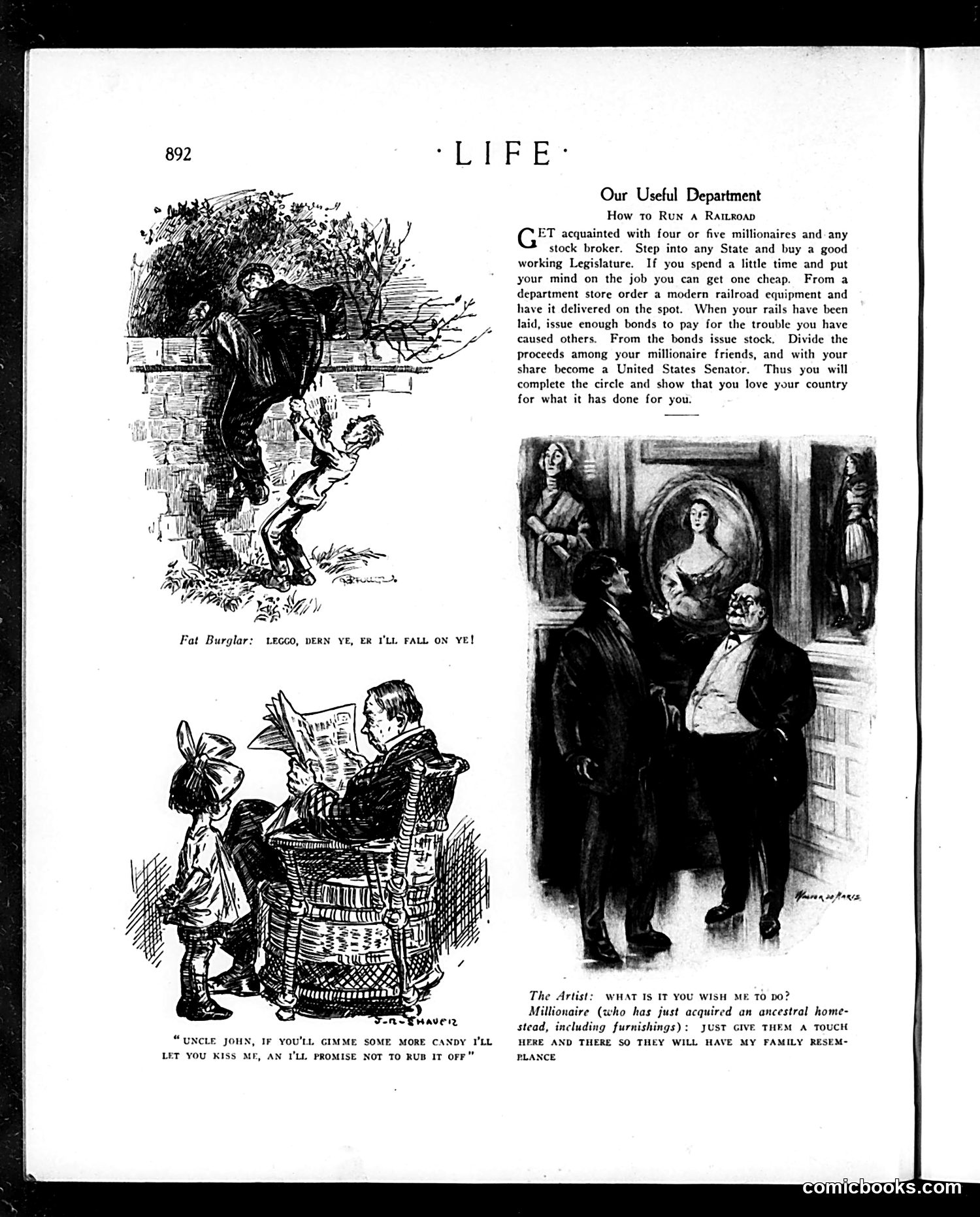
This *Life* magazine page contains two satirical cartoons mocking wealthy industrialists and political corruption. The top cartoon titled "Fat Burglar" depicts a grotesque figure emerging from a tree, satirizing corrupt business dealings. The accompanying article "How to Run a Railroad" sarcastically advises acquiring millionaires and stock brokers to manipulate legislation and profit from railroad bonds—describing a system of bribery and insider dealing. The bottom cartoon shows "Uncle John" offering candy to a child, with text joking about bribery ("gimme some more candy I'll let you kiss me"). The right illustration depicts a wealthy man commissioning an artist to paint his portrait, with the caption mocking how the newly rich acquire "ancestral" artwork and furnishings to appear cultured—satirizing nouveau riche pretension and the corruption of Gilded Age industrialists.
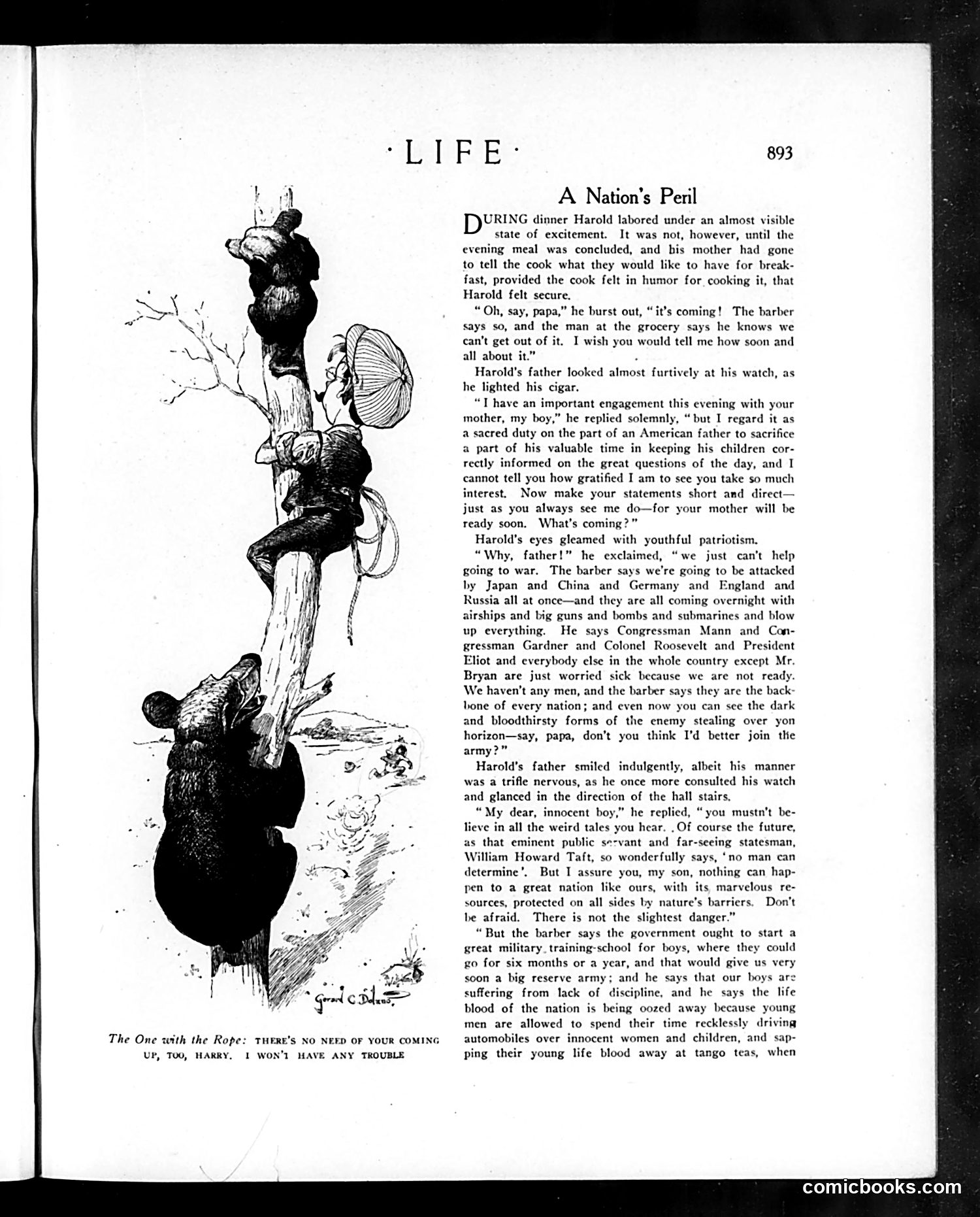
This satirical piece depicts a father dismissing his son Harold's war concerns. The illustration shows a figure climbing a rope toward what appears to be a noose—a visual metaphor for national danger. Harold reports alarming rumors: Japan, China, Germany, England, and Russia supposedly plan simultaneous attacks with airships, guns, bombs, and submarines. He urges his father to support military preparedness and training schools. The father, however, dismisses these fears as baseless panic, confidently asserting America's natural geographic protection makes war impossible. He explicitly tells Harold not to join the army. The satire critiques both blind complacency about genuine threats and the spread of alarming (possibly exaggerated) war rumors. The rope imagery suggests the nation faces real peril despite willful denial.
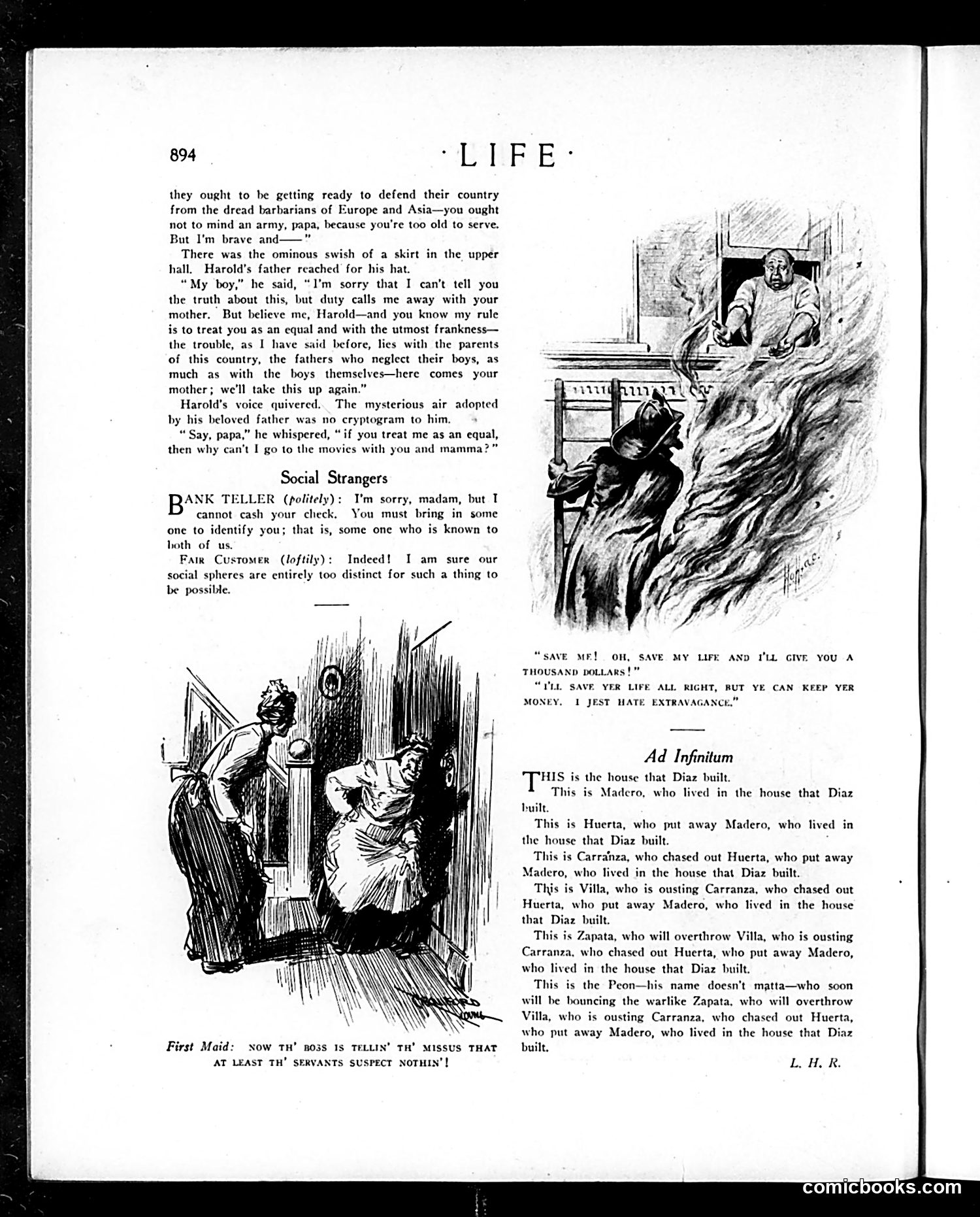
This page contains two distinct pieces of satire: **"Social Strangers"** (top section): A dialogue satirizing banking rules. A Bank Teller refuses to cash a check for a Fair Customer without proper identification—someone "known to both of us." The joke critiques rigid bureaucratic procedures that inconvenience ordinary customers, even when transactions seem straightforward. **"Ad Infinitum"** (bottom section): A cumulative verse poem satirizing corruption and political instability, likely Latin American. It describes a chain of leaders successively overthrowing each other ("This is the house that Diaz built"), referencing the cyclical nature of coups and regime changes. The format mimics "This Is the House That Jack Built," making the serious subject darkly comic through repetitive escalation. Both pieces mock institutional absurdity—one commercial, one political.
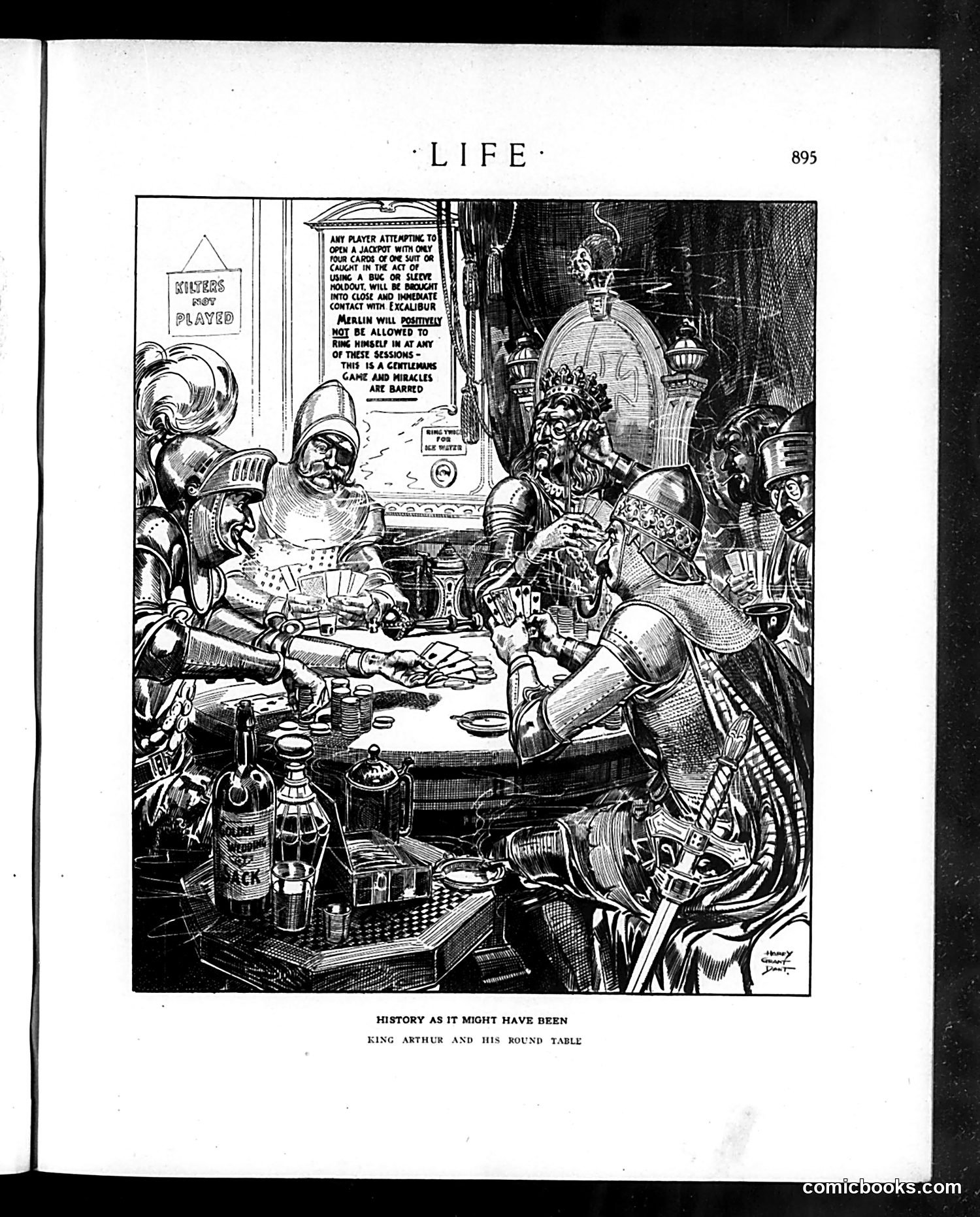
This satirical cartoon depicts King Arthur's legendary Round Table as a poker game among armored medieval knights. A sign posted at the table establishes absurd "house rules" for what appears to be a gentlemen's game, parodying how historical legends get reinterpreted through modern cultural lenses. The satire mocks the romanticization of medieval chivalry by showing these noble knights engaged in gambling—a mundane, vice-laden activity. By juxtaposing Arthurian legend (representing idealized history and nobility) with card-playing and its associated cheating rules, the cartoon suggests that "history as it might have been" is often just projection of contemporary concerns and behaviors onto the past, rather than accurate representation. The title invites readers to imagine alternative histories while the image undercuts such imaginative exercises.
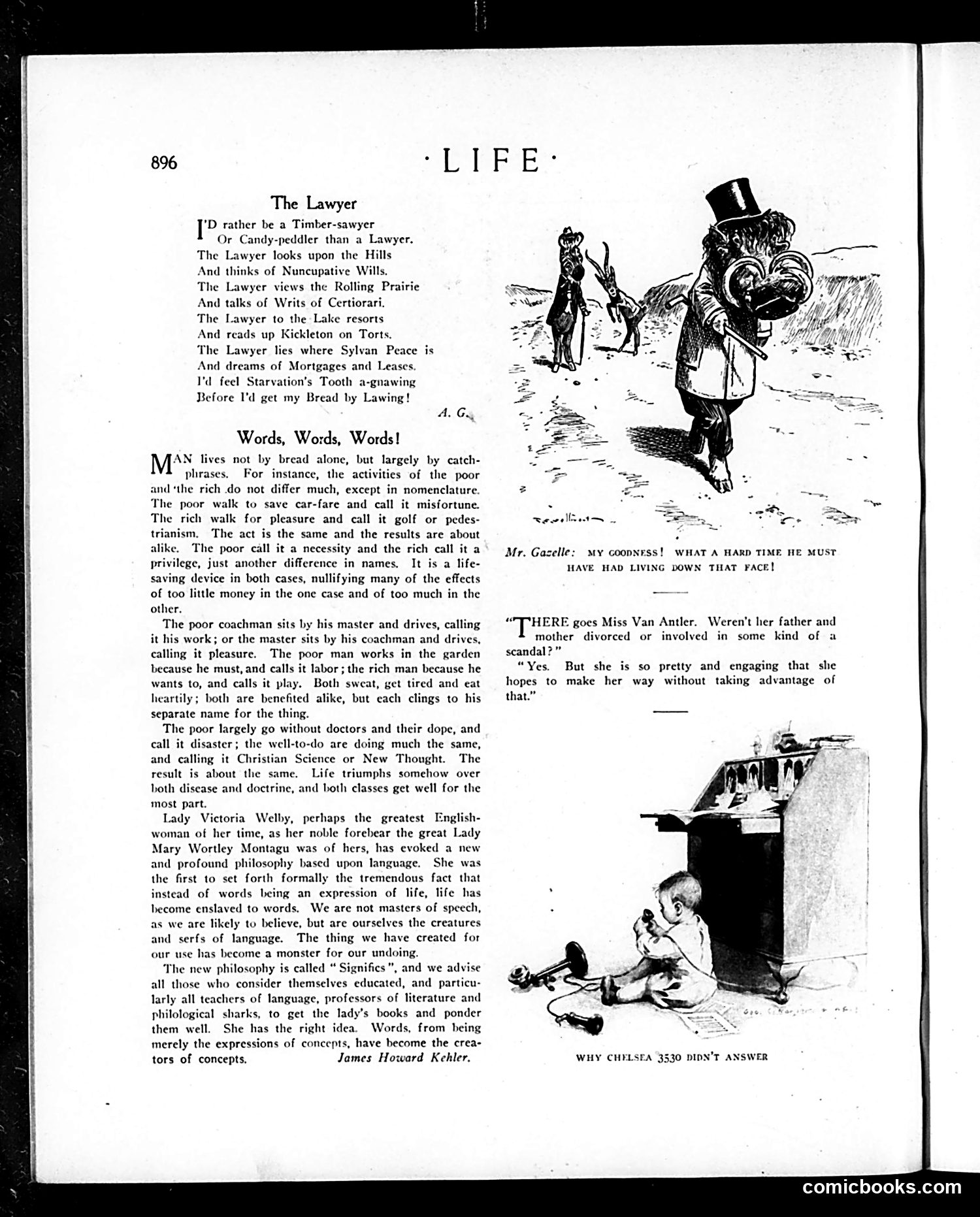
This page contains three distinct satirical pieces mocking American social hypocrisy: **"The Lawyer"** (top left): A humorous poem ridiculing lawyers as unable to enjoy nature—they obsess over legal concepts (wills, writs, torts) even during leisure. The joke: lawyers cannot escape their professional jargon even when relaxing. **"Words, Words, Words!"** (center): A philosophical essay arguing that society uses different language to describe identical activities based on class. The poor "save car-fare" while the rich enjoy "pedestrianism"; both are walking. It cites Lady Victoria Welby's philosophy of "Signifies," suggesting language controls thought rather than expressing it—a genuinely serious intellectual point wrapped in satire about class pretension. **Two cartoon vignettes** (right): - Top: A caricatured figure (unclear identity) with exaggerated features and top hat - Bottom: A social commentary dialogue about Miss Van Antler, whose parents divorced but whose beauty allows her social acceptance anyway—mocking society's shallow standards. The overarching theme: language masks reality and class differences.
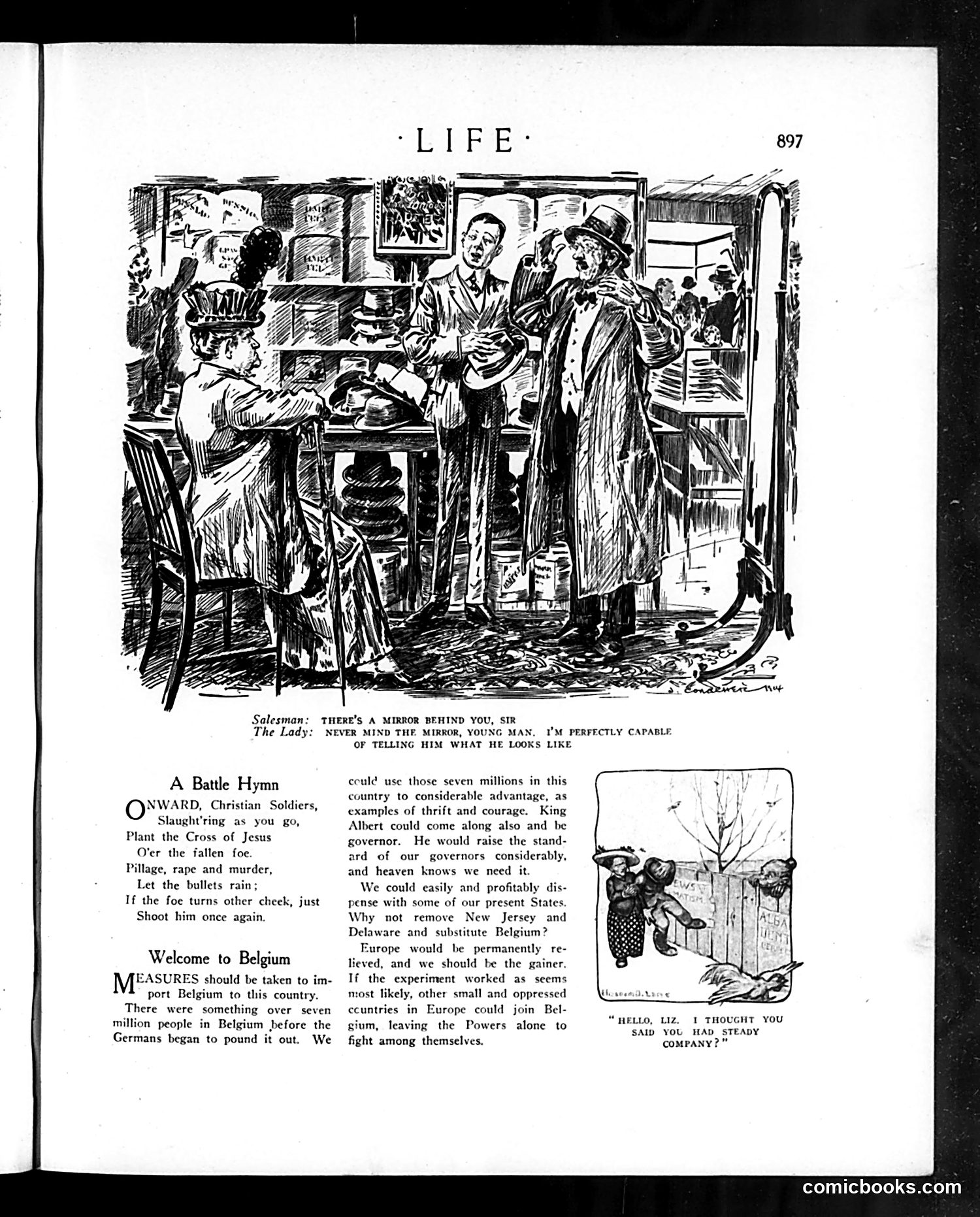
This page contains anti-war satire from World War I era (pre-1918, given references to Belgium's invasion by Germany). **Top Cartoon:** A salesman shows a mirror to a customer, but the lady refuses to look, saying she can tell him what he looks like without it. The satire suggests willful blindness—people refusing to acknowledge uncomfortable truths about themselves or their society. **"A Battle Hymn":** A darkly ironic parody of the hymn "Onward, Christian Soldiers," replacing religious language with brutal warfare ("Slaught'ring," "Pillage, rape and murder"). It mocks the disconnect between Christian values and wartime atrocities. **"Welcome to Belgium":** Satirizes American attitudes toward Belgian refugees. The author sarcastically proposes importing Belgium's entire population and government as superior to American states, then suggests replacing inferior U.S. states (New Jersey, Delaware) with Belgium. It's commentary on American indifference to Belgian suffering and immigrant attitudes. **Bottom Cartoon:** A woman questions her boyfriend's faithfulness, finding him with another woman ("Liz"). A light domestic humor piece contrasting with the page's weightier content.
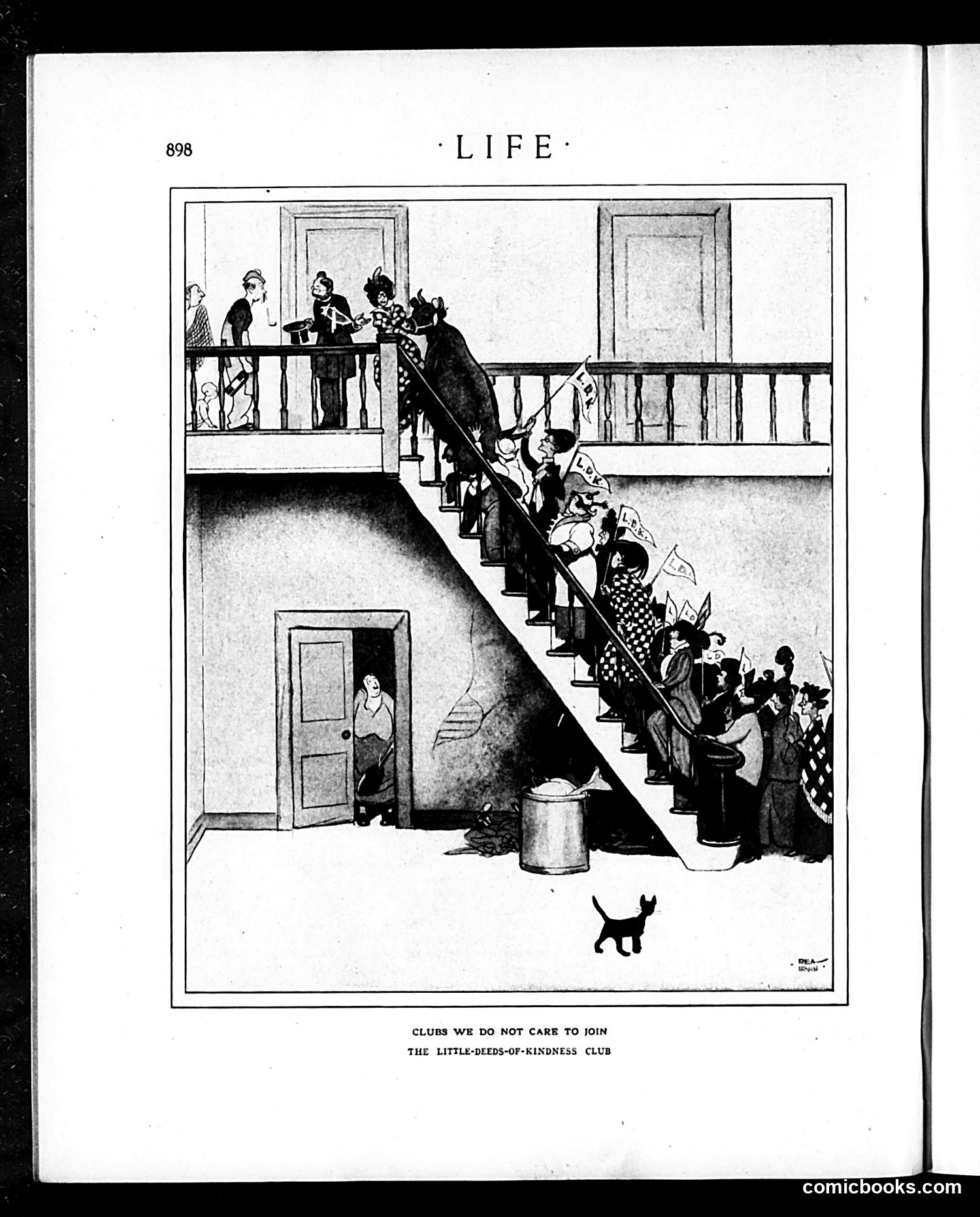
This satirical cartoon depicts a social club meeting where members are climbing stairs in an orderly queue. The title sarcastically claims these are clubs "we do not care to join"—the "Little-Deeds-of-Kindness Club." The joke mocks exclusive social clubs and their pretentious membership hierarchies. The cartoon suggests that clubs claiming to promote kindness are actually exclusionary organizations with rigid structure and gatekeeping (note the people monitoring entry at the top). The dog at the bottom appears to undercut the club's dignity. The satire criticizes the hypocrisy of organizations that claim moral virtue while functioning as status-conscious, members-only establishments. It's a commentary on American club culture and the gap between stated noble ideals and actual exclusionary practice.
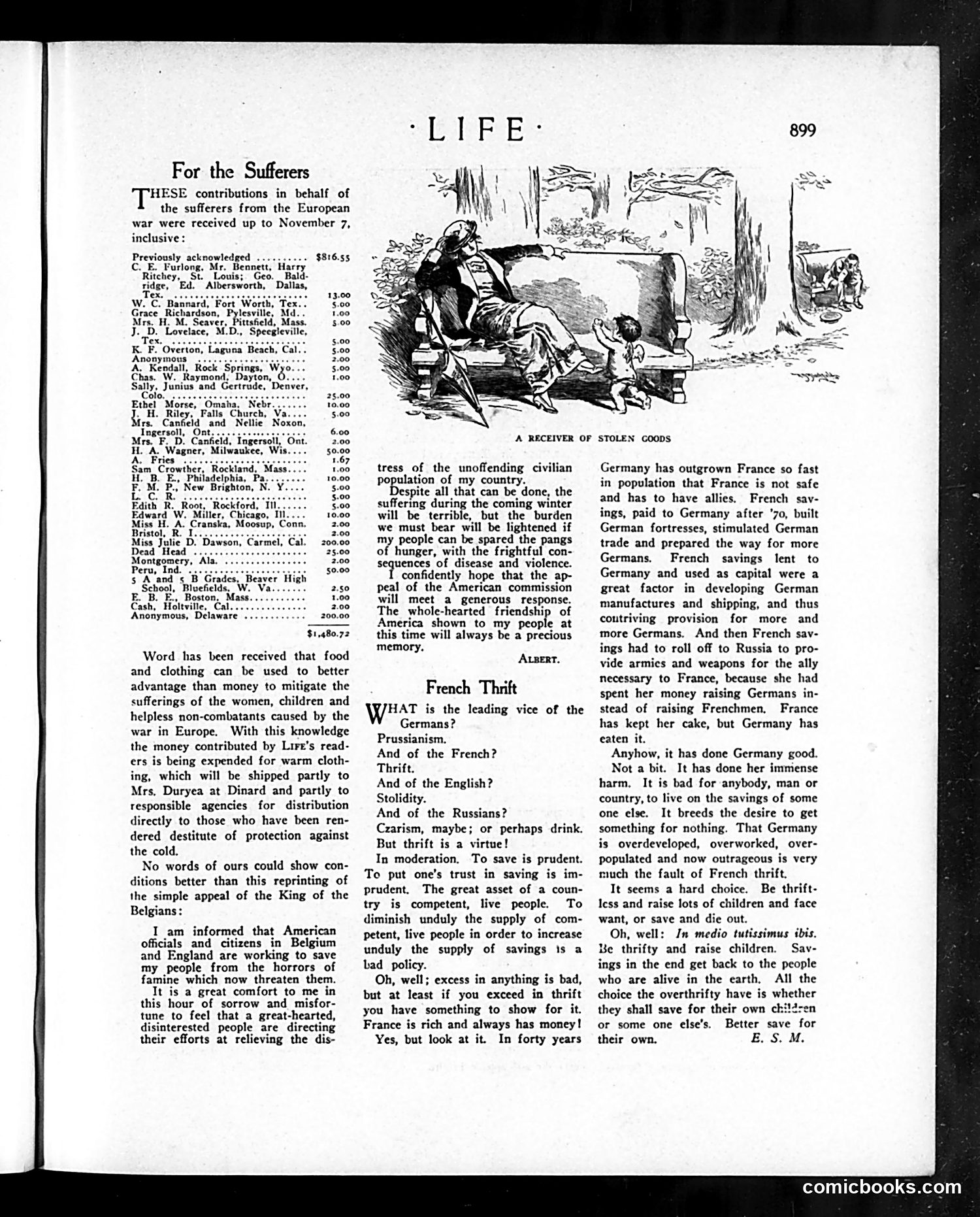
This page documents **charitable contributions for European War relief** (likely WWI, circa 1914-1915). The main cartoon, "A Receiver of Stolen Goods," depicts a figure (appearing to be France or a French citizen) receiving goods that are visibly marked as stolen—a satirical commentary on France's financial relationship with Germany. The accompanying text explains the bitter irony: French savings and investments, intended to build French wealth, were instead lent to Germany after the 1870 Franco-Prussian War. This German capital development funded German industry, military fortifications, and population growth—making Germany so powerful that France now requires Russian military alliance for protection against the very nation it inadvertently strengthened. The "French Thrift" dialogue reinforces this critique: excessive frugality, while virtuous in theory, backfired strategically when France's accumulated wealth financed German military capability rather than French population and defense. The satire targets France's self-defeating financial policies and the geopolitical consequences of capital flowing to potential enemies.
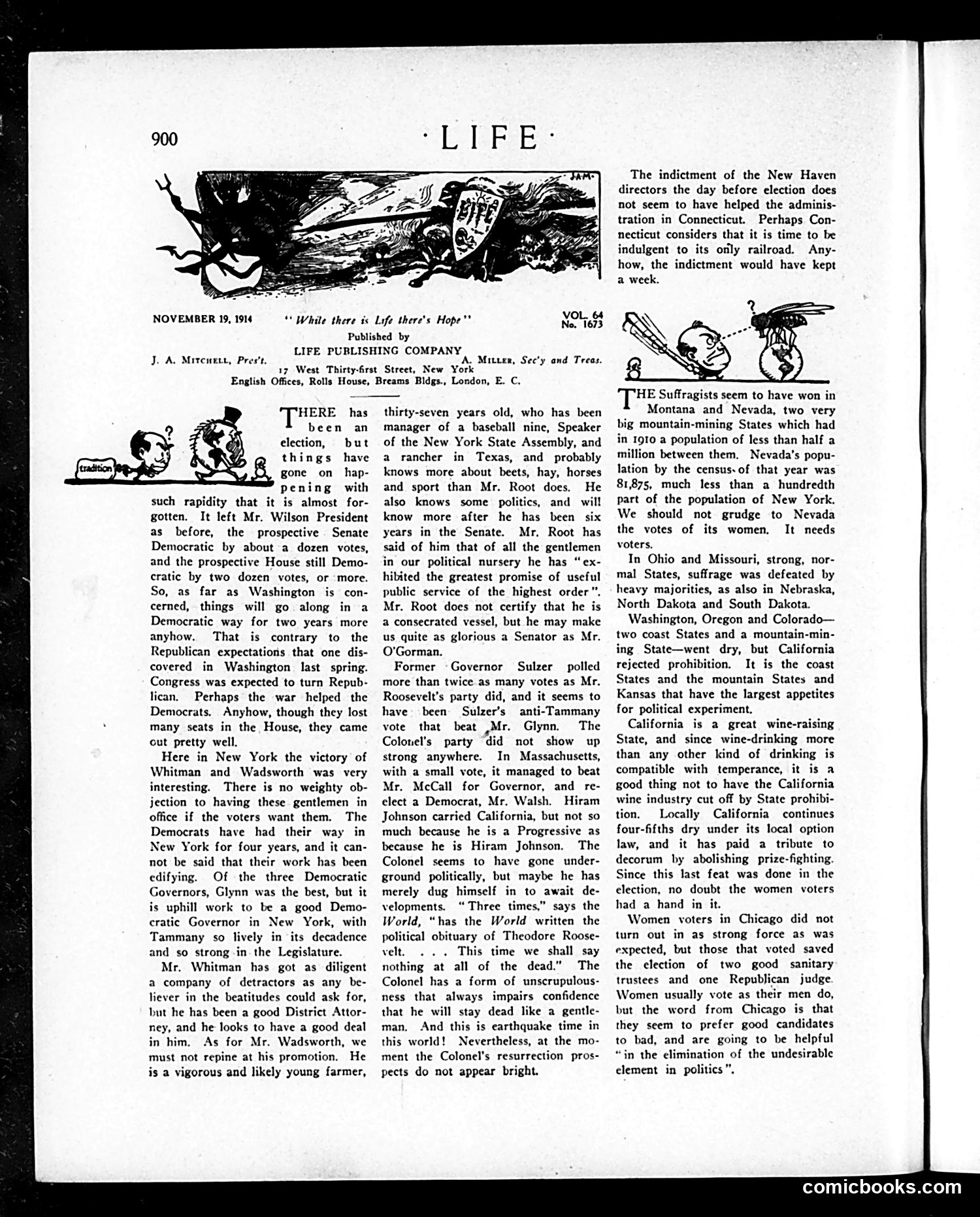
This page analyzes the 1914 U.S. midterm elections. The text discusses President Wilson's reelection and Democratic congressional performance, noting the party retained control despite Republican expectations. The article praises New York's newly elected Governor Whitman and Senator Wadsworth (described as a "vigorous and likely young farmer" and former baseball manager), suggesting they're improvements over Democratic governance plagued by Tammany Hall corruption. Notably, the piece addresses Theodore Roosevelt's failed Progressive Party bid, sarcastically noting the *World* newspaper has repeatedly written Roosevelt's "political obituary" but he may resurface—comparing him to an unreliable corpse that won't "stay dead like a gentleman." The cartoons (unclear in detail here) appear to be satirical illustrations accompanying this political analysis, typical of Life's visual commentary on contemporary politics and elections.
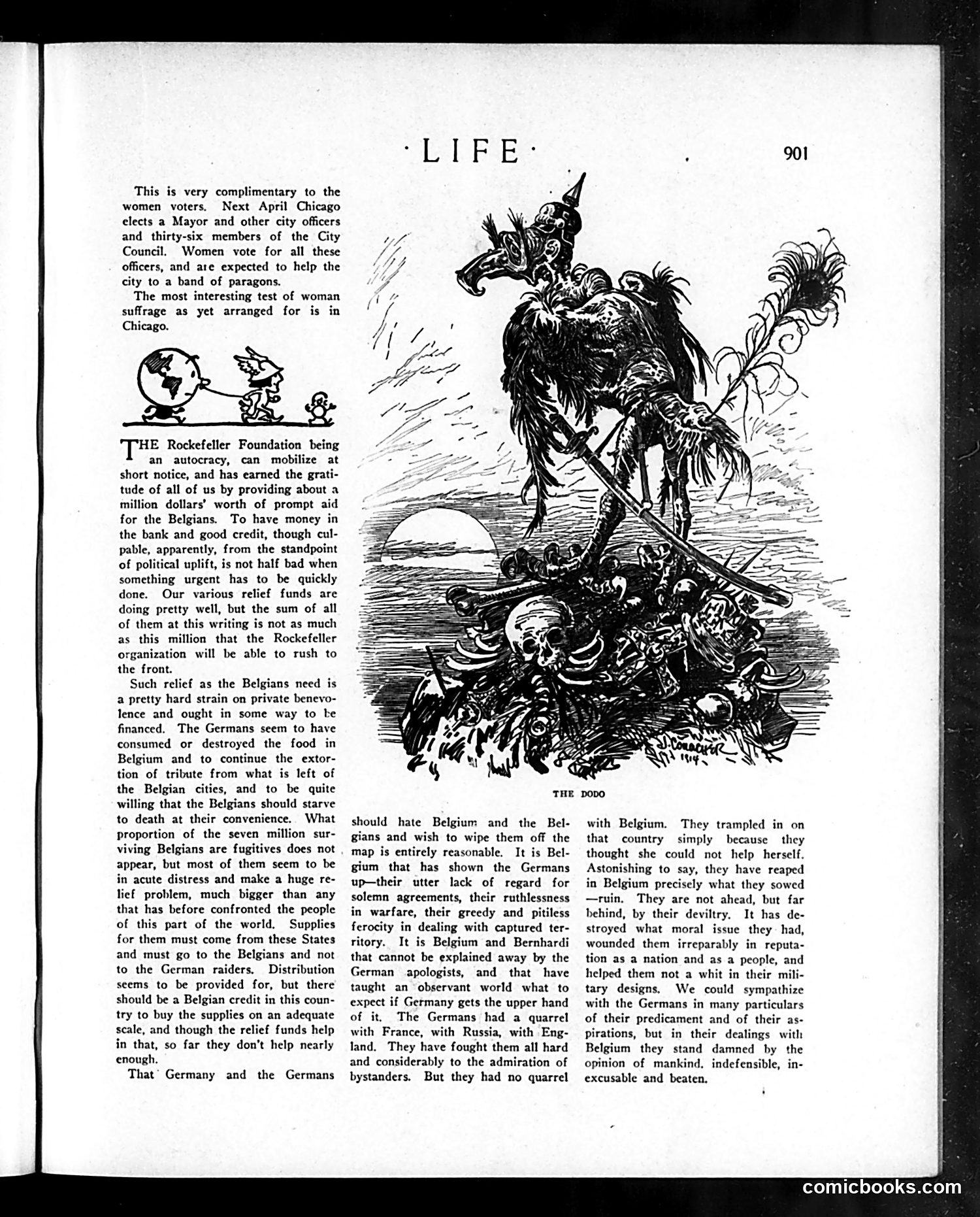
**The Cartoon ("The Pogo"):** The large illustration depicts a demonic or grotesque figure (representing Germany) astride destruction and ruin in Belgium—bodies, weapons, and devastation beneath its feet. The figure appears triumphant but is actually surrounded by the wreckage of its own conquest. **Historical Context:** This page discusses World War I, specifically Germany's invasion and occupation of neutral Belgium (1914). The text criticizes Germany's unprovoked attack, which violated international agreements and caused massive civilian suffering and starvation. **The Satire:** The cartoon's irony is that Germany, believing it was winning militarily by crushing Belgium, actually defeated itself morally and politically. The "Pogo" stands victorious yet ruined—illustrating the article's point that Germany's brutality destroyed its international reputation and ultimately harmed its own strategic position. **Modern Context:** Readers today need to know this refers to WWI Belgium's invasion and the resulting humanitarian crisis that shocked international opinion and turned global sentiment against Germany.
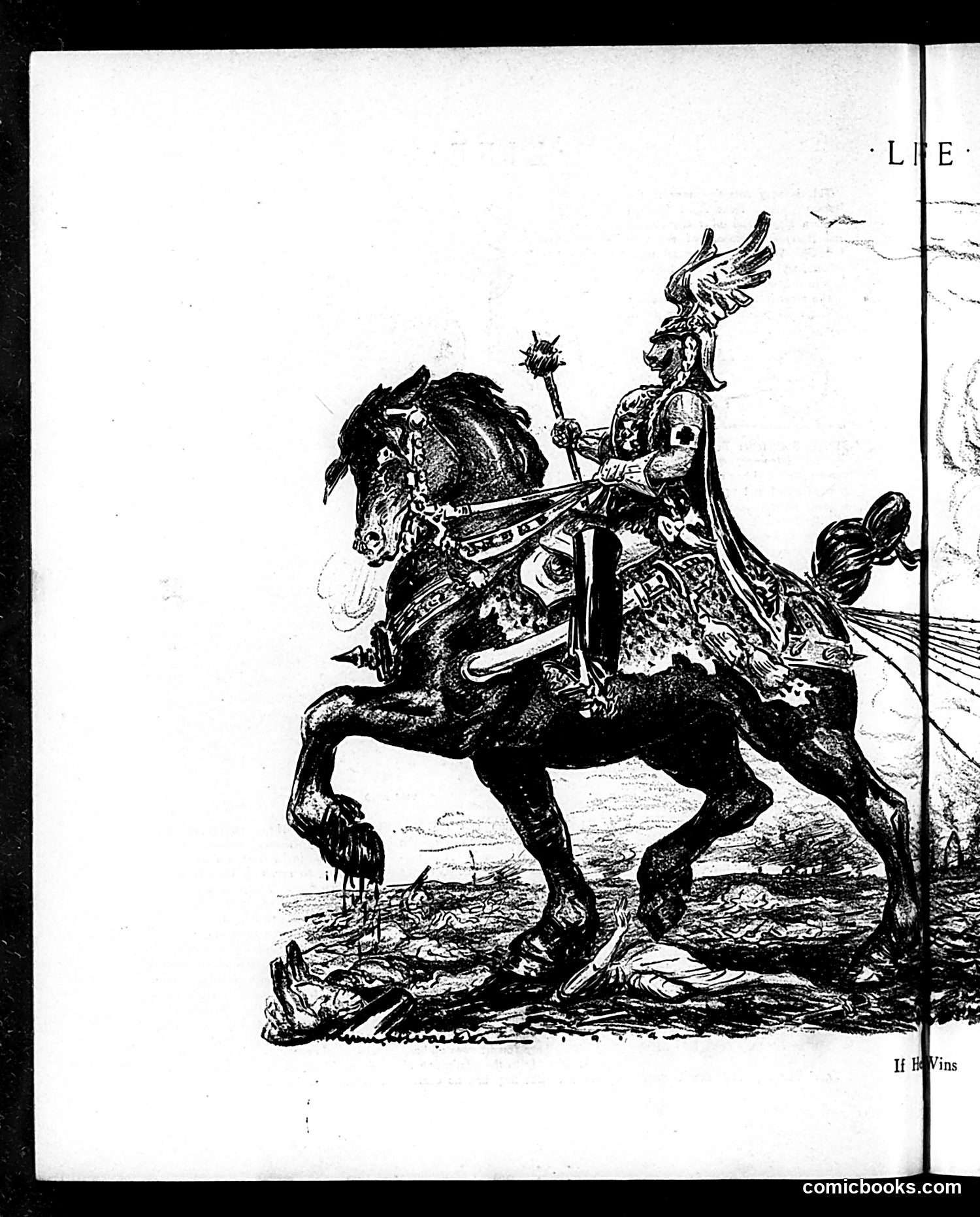
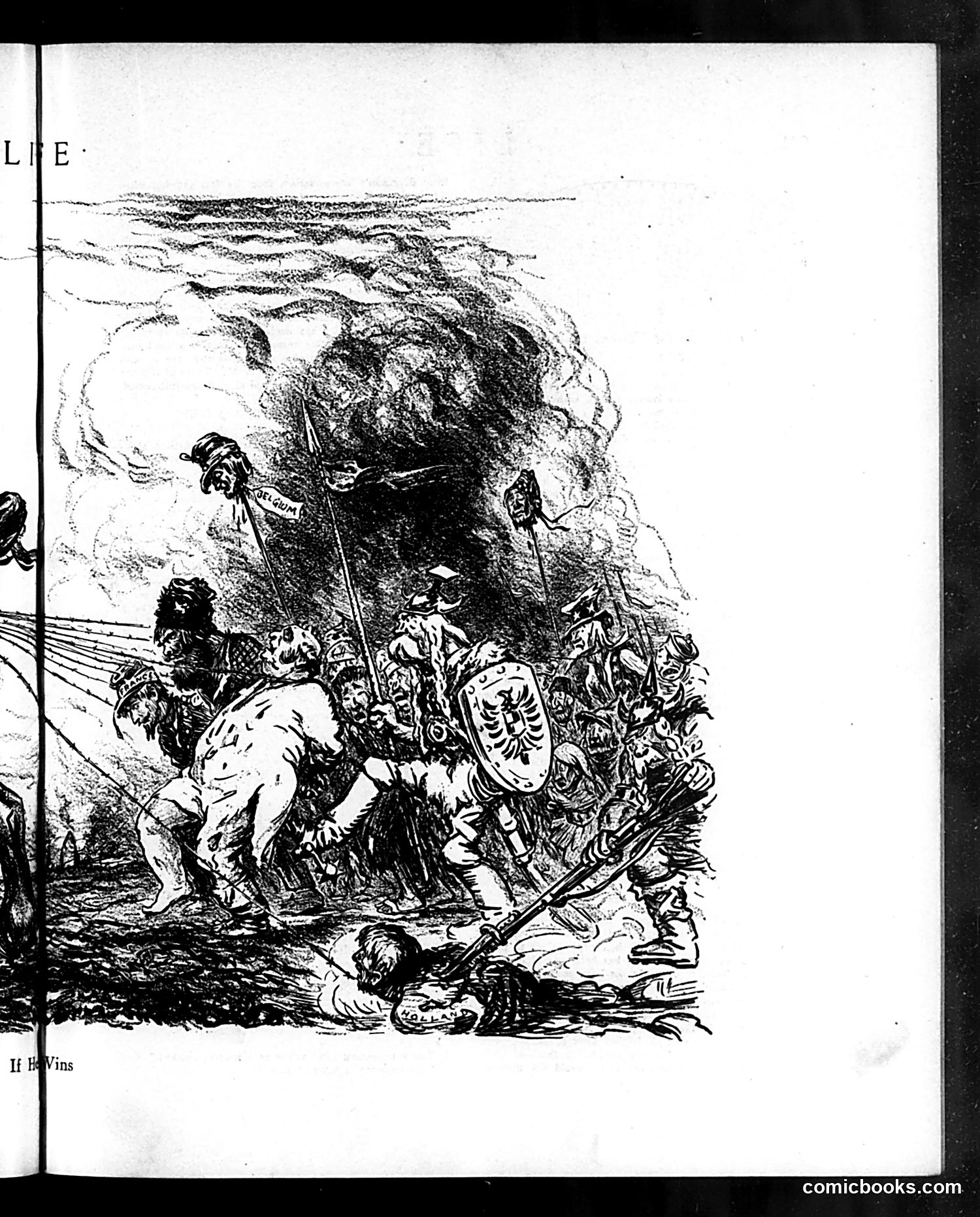
This page contains a single illustration signed "H. B. Vins" (likely cartoonist initials). It depicts an ornately armored, winged figure mounted on a prancing horse, wielding a scepter topped with a star. The figure wears elaborate Renaissance-style armor and a plumed helmet. The heavily detailed, allegorical style suggests this represents a political or royal figure—likely a European monarch or military leader. The winged imagery and regal regalia indicate themes of power, ambition, or authority. Without clear OCR text or a visible title, the specific political reference remains unclear, though the ornamental style suggests Late 19th or early 20th-century *Life* magazine satirizing European militarism or aristocratic authority. The meaning requires additional context from surrounding page content or dated publication information.
This page appears to be from Life magazine and contains a classical engraving or etching-style illustration depicting a mythological or allegorical scene. The image shows cherubs or putti (baby figures) gathered around what appears to be a cave or rocky outcropping, with armed soldiers or warriors visible in the background among elaborate decorative elements and heraldry. The OCR text provided contains only formatting characters and numbers—no readable content—making it impossible to determine the specific satirical message, intended targets, or political/social commentary this illustration meant to convey. Without legible accompanying text or caption, the exact meaning and historical context remain unclear. The classical artistic style suggests this may reference historical or mythological events rather than contemporary 19th or early 20th-century politics.
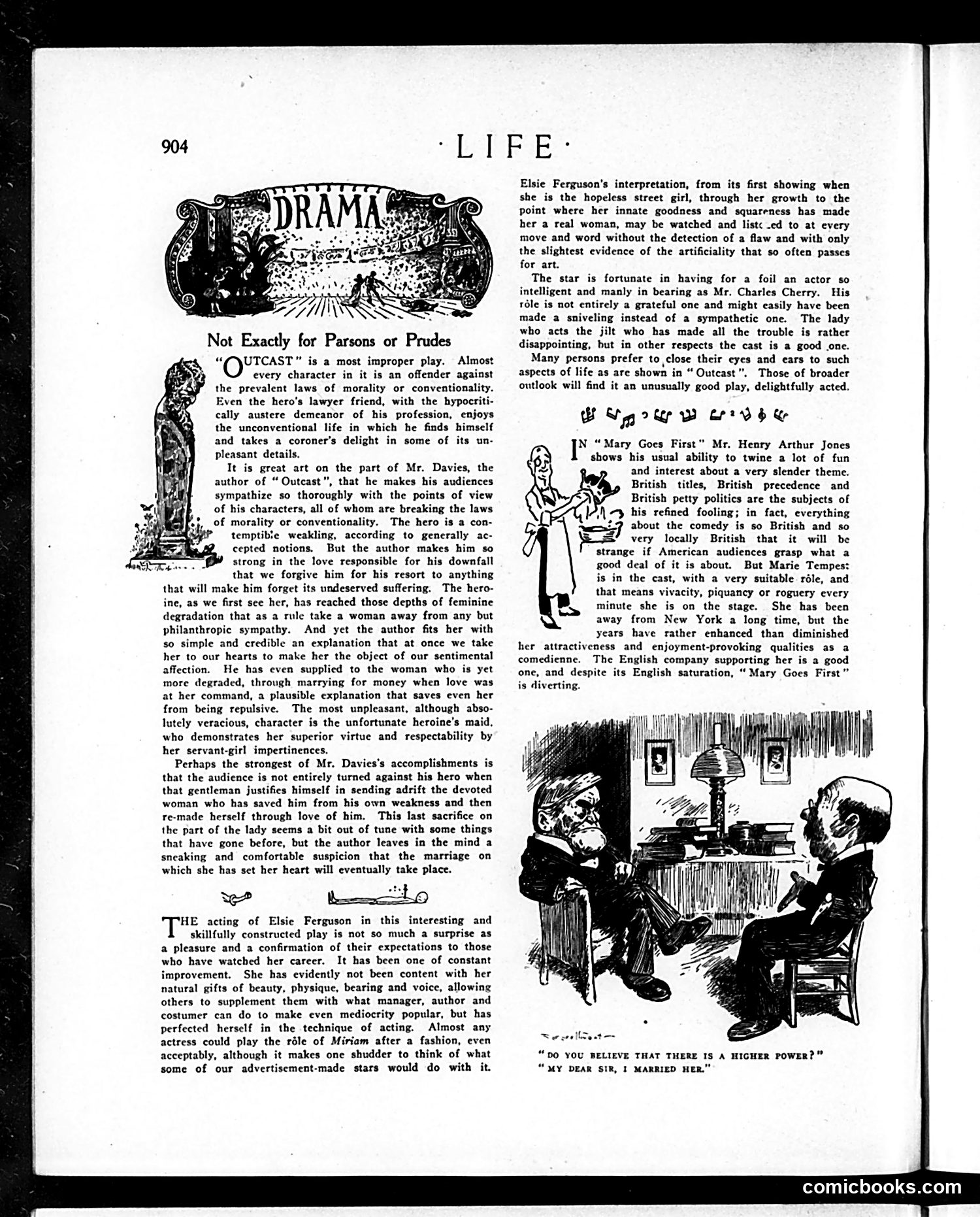
This page reviews a stage play called "Outcast" by Mr. Davies, starring actress Elsie Ferguson. The critic defends the work against presumed moral objections ("Not Exactly for Parsons or Prudes"). The play's innovation is that it portrays morally compromised characters—including a prostitute heroine and a weak hero—with such sympathy and credible motivation that audiences empathize with them despite their transgressions. The critic praises Davies for making audiences forgive characters who violate conventional morality. Ferguson's performance is praised as technically skilled and naturalistic. The supporting actor Charles Cherry is noted for bringing dignity to an ungrateful role. The cartoon at bottom (showing what appears to be a domestic scene) likely illustrates the play's central romantic tension—possibly the scene where the hero abandons his devoted woman, which the critic finds somewhat incongruous with the overall narrative.
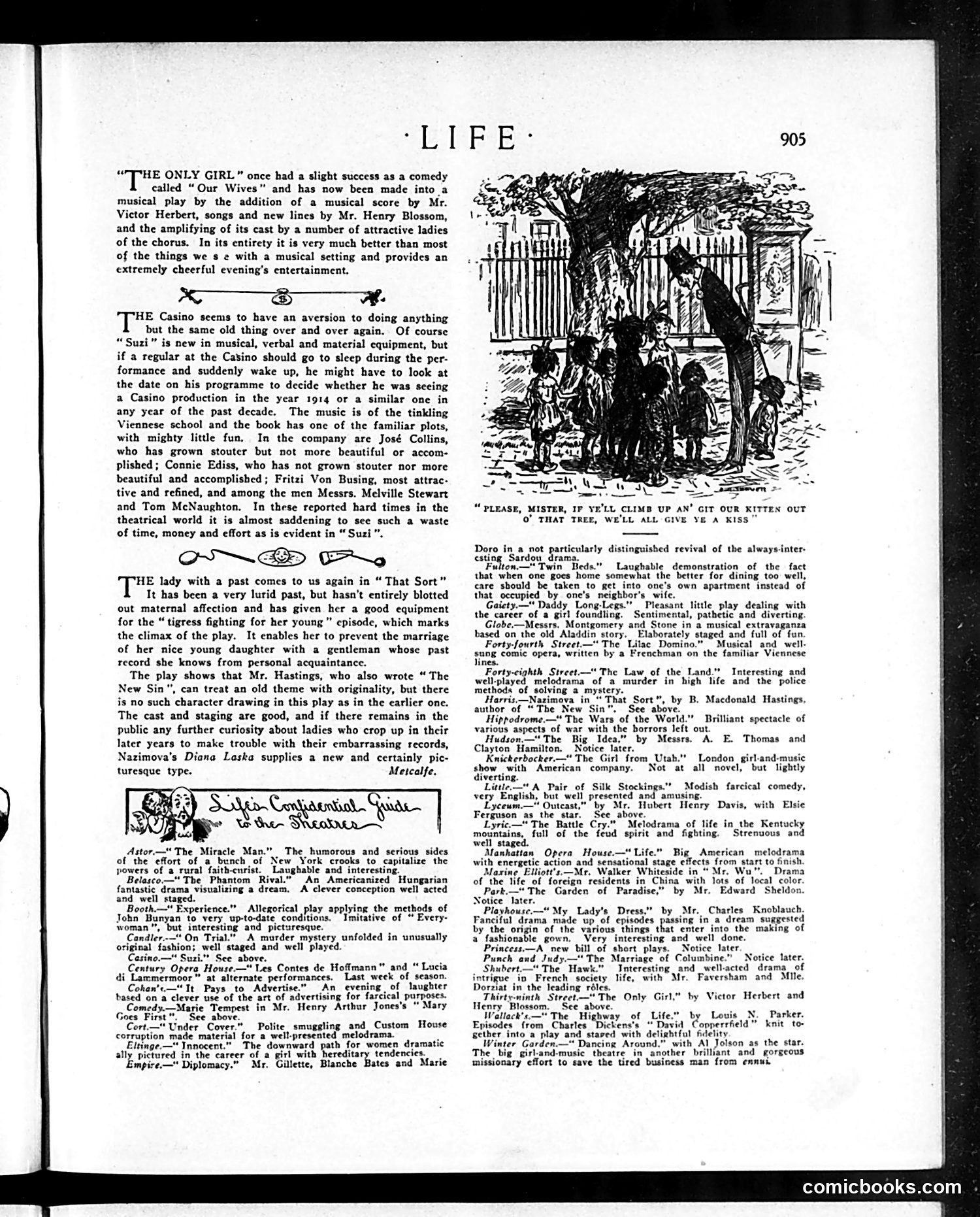
This page contains theater reviews from Life magazine, likely from 1914 based on internal references. The cartoon depicts a domestic scene—a man and woman with a child near a tree—illustrating the caption "Please, mister, if ye'll climb up an' git our kitten out o' that tree, we'll give ye a kiss." The satire appears to target sentimentality in theatrical plots. The reviews mock the predictability of Broadway productions: "The Only Girl" and "Suzi" are criticized for recycling tired formulas despite expensive productions; "That Sort" reprises the worn "woman with a scandalous past" plot device. The cartoon exemplifies this critique—it presents an overly sentimental domestic vignette, the kind of saccharine scenario these theatrical pieces apparently trafficked in. The reviews' tone is world-weary about theater's reliance on familiar narratives and "tinkling Viennese school" music rather than innovation, even during economically difficult times ("reported hard times in the theatrical world").
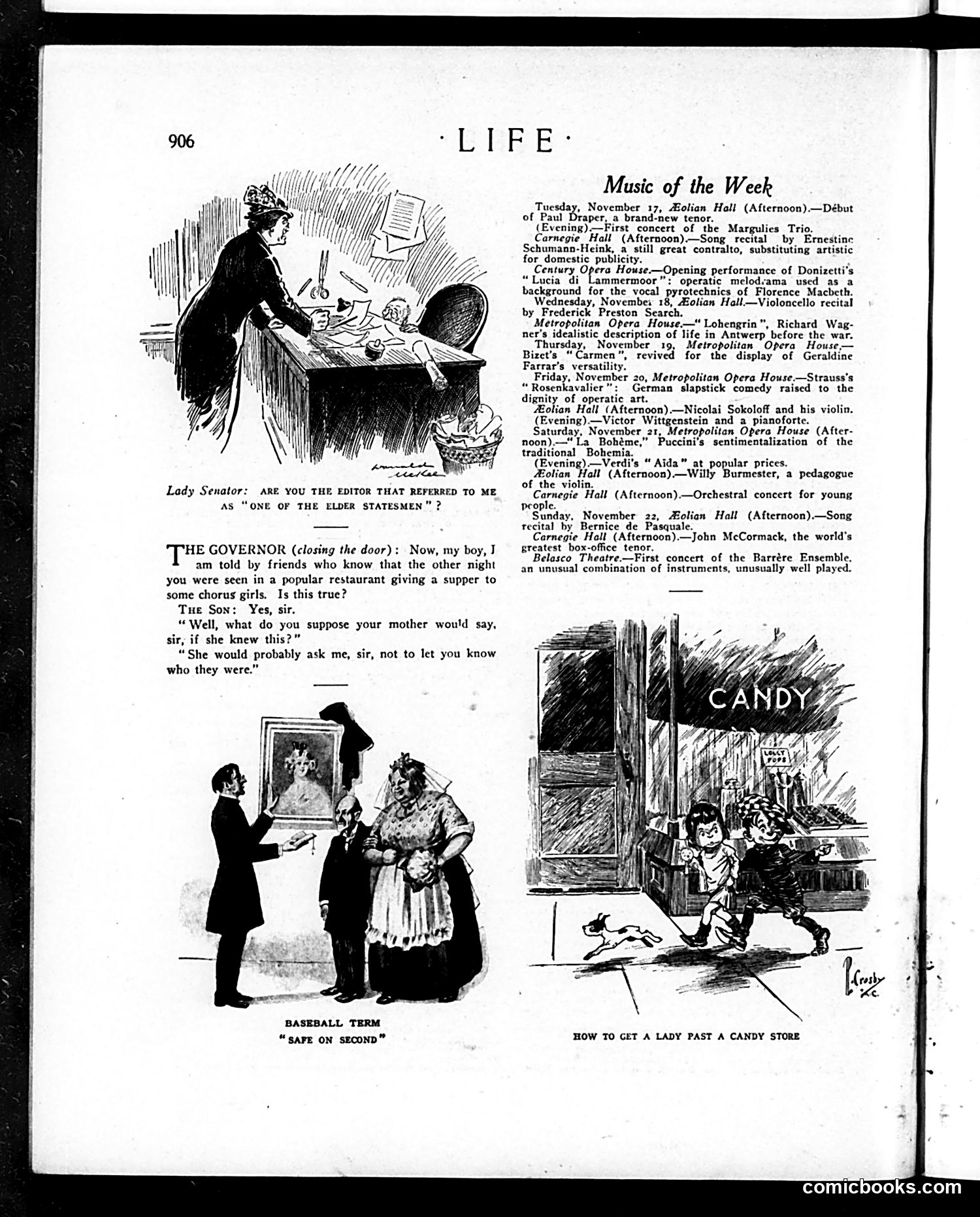
This page contains two satirical cartoons reflecting early 20th-century social attitudes: **"Safe on Second"** depicts a governor confronting his son about dining with chorus girls. The joke plays on Victorian propriety—the governor assumes impropriety, but the son's witty retort suggests the real scandal would be the governor's own involvement. "Safe on second" is a baseball metaphor implying the son has avoided getting caught. **"How to Get a Lady Past a Candy Store"** shows a woman being literally dragged past a shop window, sarcastically suggesting women lack self-control around sweets. This reflects period stereotypes about feminine weakness and consumption. The page also features weekly classical music listings, indicating Life's educated, cultured readership. Together, these elements showcase Life's satirical humor targeting gender roles, generational hypocrisy, and social conventions of the Jazz Age era.
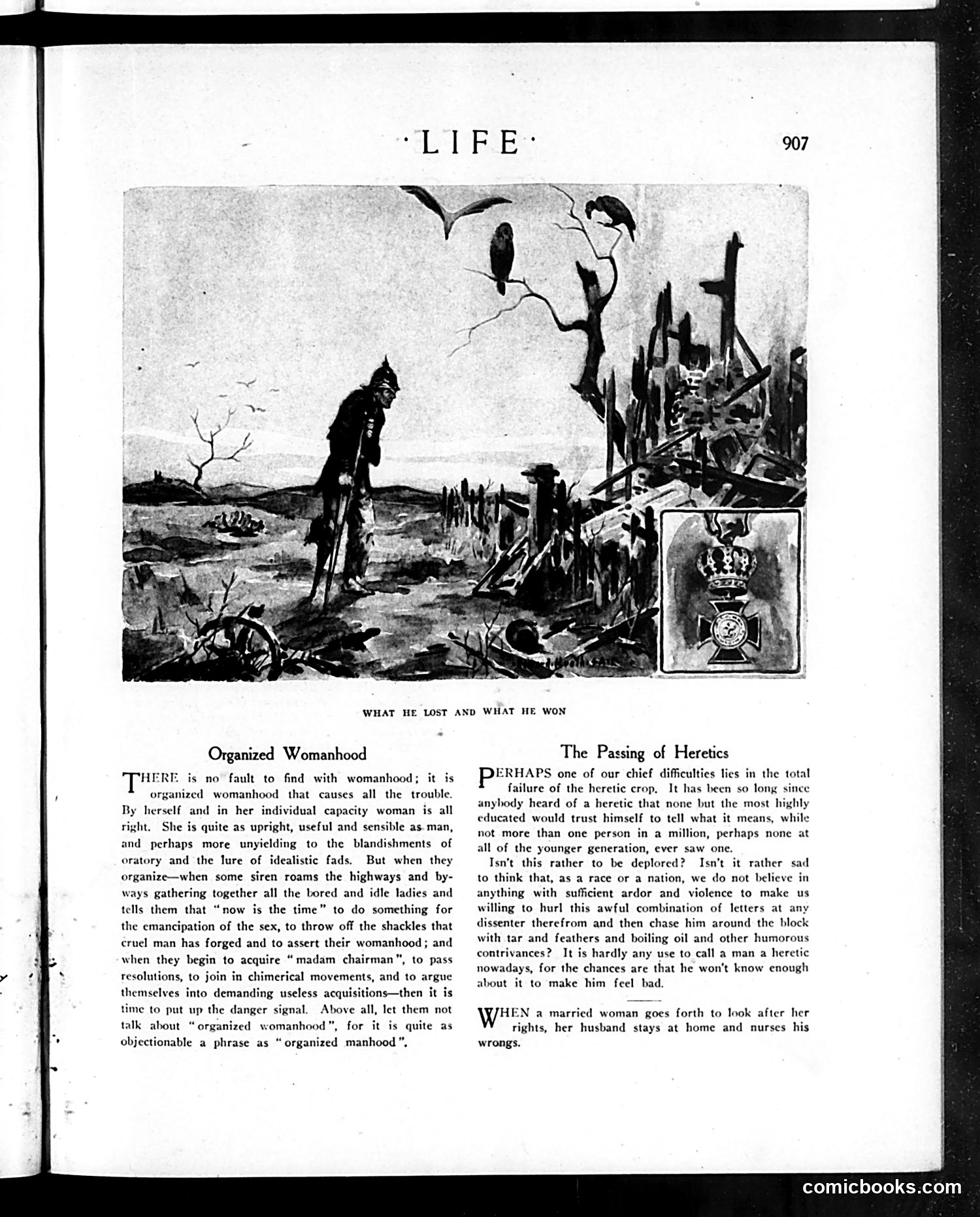
This page contains two satirical essays attacking early 20th-century social movements, likely from the 1910s-1920s era. **"Organized Womanhood"** mocks the women's suffrage and rights movement. The author argues that individual women are perfectly fine, but "organized womanhood"—women's groups demanding emancipation and "asserting their womanhood"—causes problems. The piece dismisses their activism as the work of "sirens" manipulating "bored and idle ladies" into "chimerical movements" and "useless acquisitions." This reflects anti-suffragist rhetoric that portrayed women's rights advocates as manipulated, frivolous troublemakers. **"The Passing of Heretics"** laments that modern society no longer violently persecutes dissenters, treating the absence of heretic-hunts as a cultural loss. It's darkly ironic commentary on social conformity. The accompanying illustration (captioned "What He Lost and What He Won") appears to show a desolate, war-ravaged landscape with a figure amid destruction, likely commenting on masculine sacrifice versus feminine gains from social change—reinforcing the first essay's anti-women's-rights stance. The page represents conservative opposition to women's equality movements of the era.
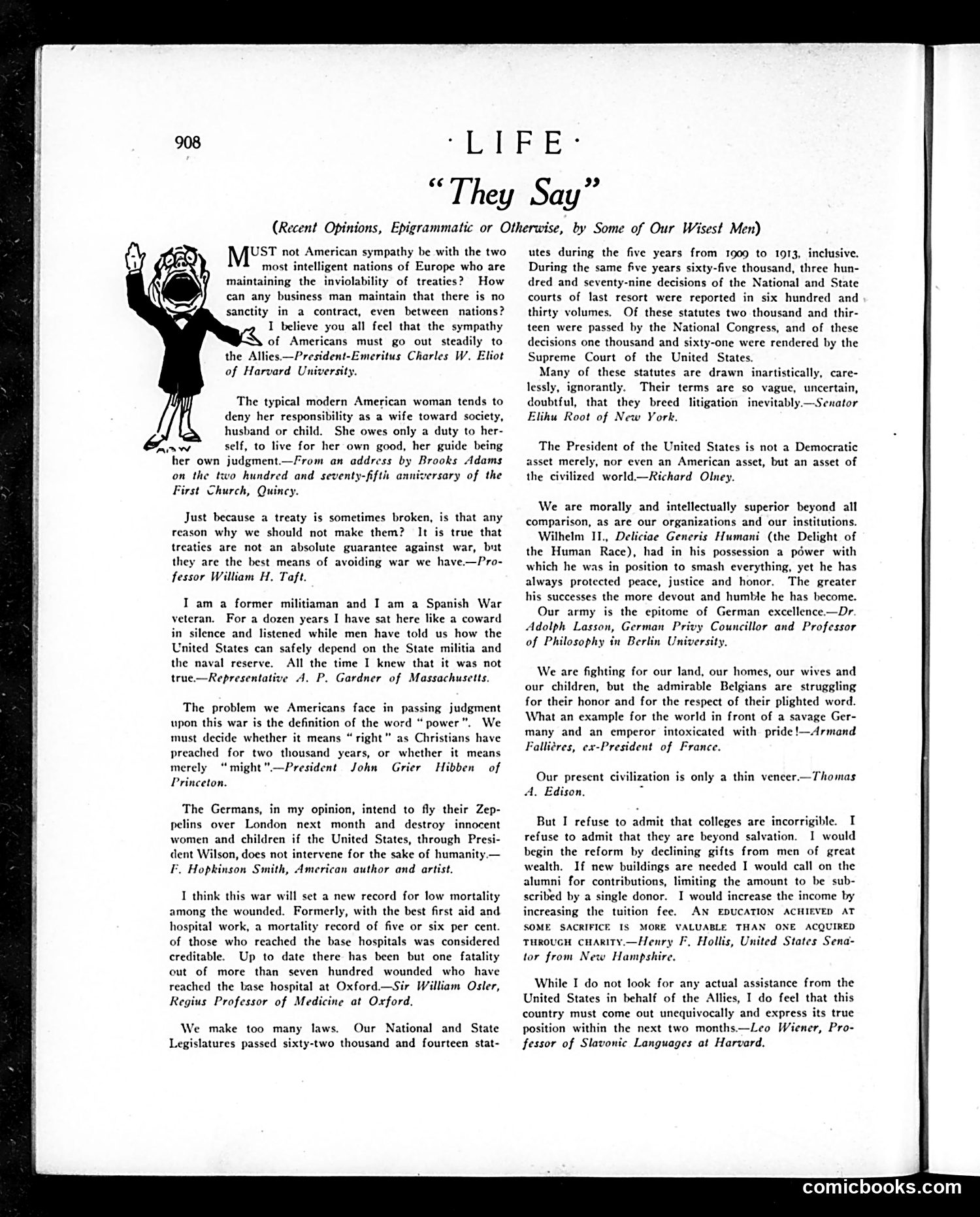
This is a satirical compilation of quotations from prominent American figures on World War I, presented as *Life* magazine's commentary on contemporary debate. The cartoon figure (a caricatured face) likely represents public opinion or the magazine itself observing these competing voices. The satire works through juxtaposition: statements by Harvard's Charles W. Eliot and others advocating for Allied sympathy are paired with contradictory quotes—such as Kaiser Wilhelm II's claim of moral superiority—to expose hypocrisy and absurdity on all sides. The page captures American division circa 1914-1917: should the U.S. support the Allies? Trust treaties? Reform domestic institutions? By presenting these "wise men" without editorial comment, *Life* sardonically lets their contradictions speak for themselves, suggesting that expert opinion is unreliable guidance for policy.
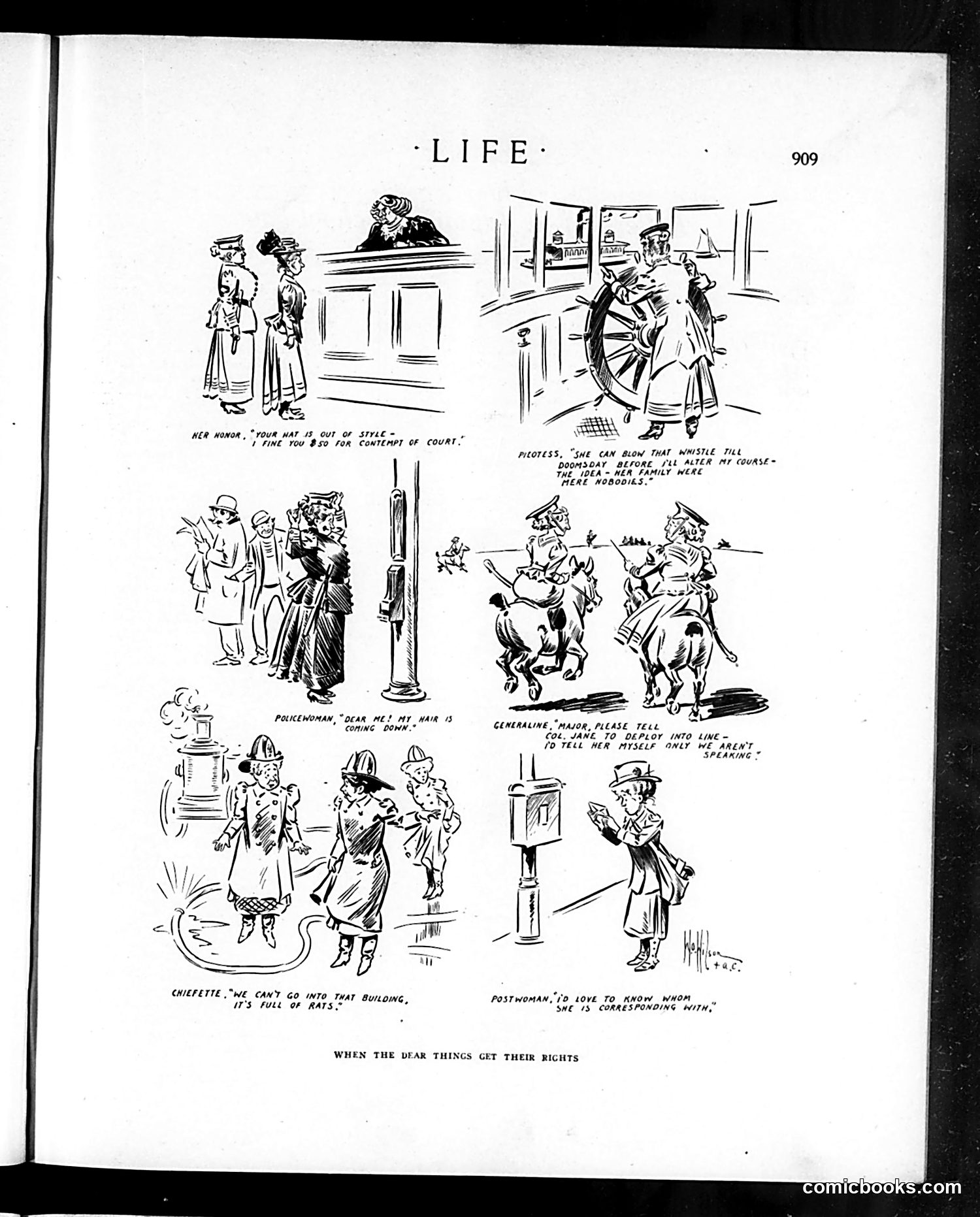
This satirical page mocks women gaining political and professional rights. The title suggests sarcasm—presenting women's equality as absurd. The sketches depict women in traditionally male-dominated roles (judge, general, police officer, postwoman) behaving incompetently or absurdly: a judge fining a woman for contempt over fashion; a general unable to communicate directly with subordinates; a policewoman refusing to enter a building; a postwoman obsessing over others' correspondence. The humor relies on stereotypes: women are portrayed as vain, incompetent, gossipy, and unsuited for authority. Each cartoon implies that granting women professional equality produces chaos and comic failure. This reflects early-20th-century anti-suffrage sentiment, using ridicule to argue women shouldn't hold public positions. The repeated phrase "dear things" drips with condescension, suggesting women seeking rights are foolish or childlike.
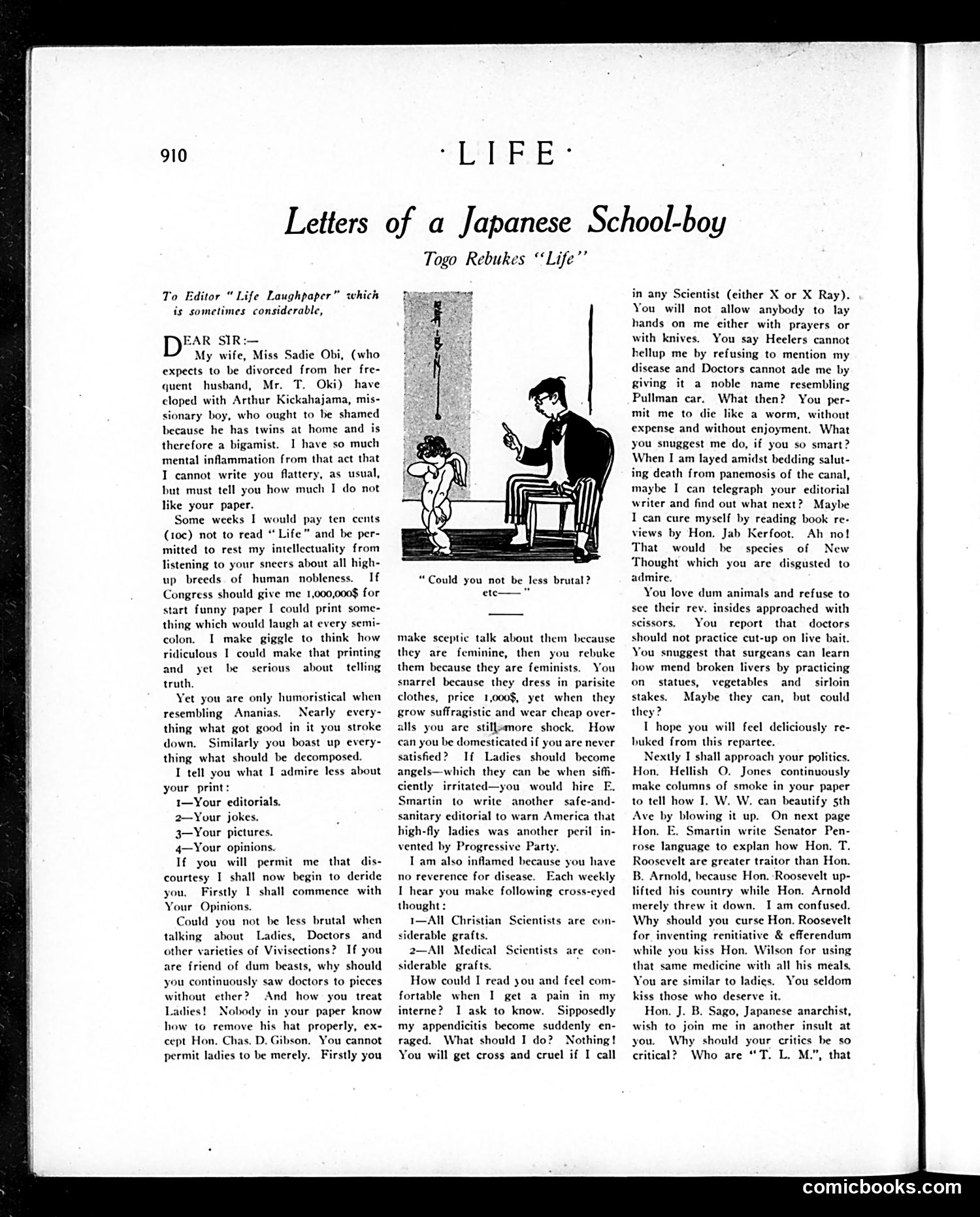
This satirical letter is written as if from a Japanese gentleman named "Togo Rebukes" (likely referencing Japanese Admiral Togo, famous from the Russo-Japanese War). The writer uses broken English and absurd logic to mock *Life* magazine itself through exaggerated complaints. The satire works by having the Japanese character attack *Life's* editorial positions on women, doctors, and disease with contradictory, illogical arguments—thereby defending the very targets *Life* criticizes. For instance, he accuses *Life* of being simultaneously cruel to women for mocking their femininity AND for supporting women's suffrage. The illustration shows a young boy speaking to an adult, captioned "Could you not be less brutal?"—suggesting *Life's* humor is needlessly harsh. The piece is essentially *Life* defending its own satirical approach by creating a ridiculous foreign critic whose complaints prove the magazine's points rather than refuting them. It's self-referential humor about magazine criticism itself.
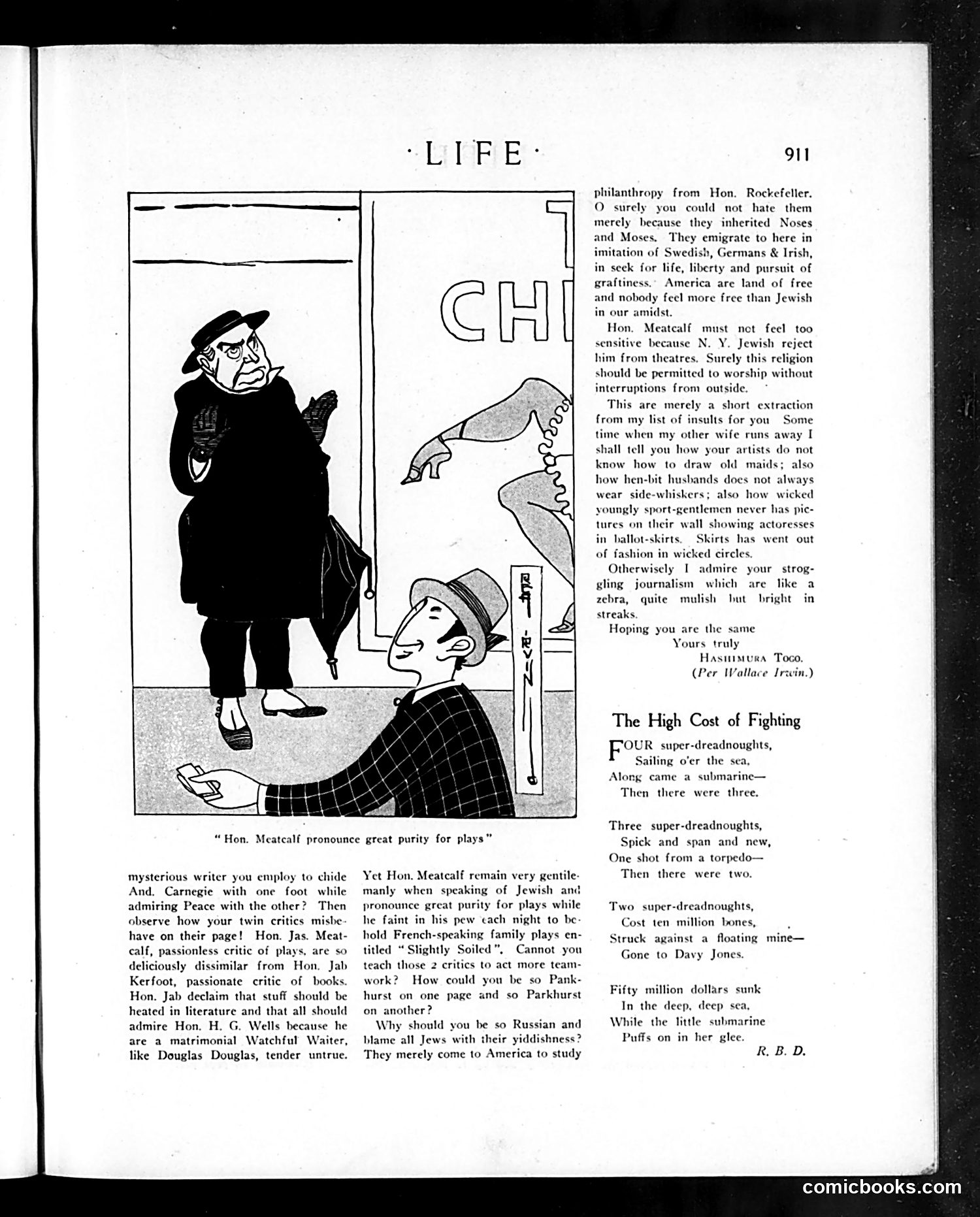
The main cartoon depicts "Hon. Meatcalf," a critic of theatrical productions, caricatured with exaggerated Jewish features (prominent nose). The accompanying letter satirizes his hypocrisy: Meatcalf publicly champions "purity" in plays while privately attending risqué French productions and harboring prejudice against Jewish immigrants and performers. The satire attacks anti-Semitic gatekeeping in early 20th-century American theater. The letter—written in deliberately fractured English to mock immigrant speech—defends Jewish newcomers as legitimate Americans seeking "life, liberty and pursuit of graftiness," while exposing Meatcalf's contradictory standards. Below, "The High Cost of Fighting" is a grim poem about naval warfare, showing expensive warships destroyed by cheaper submarine weaponry—likely commentary on pre-WWI armament escalation and military inefficiency. Both pieces employ satire to critique social hypocrisy and institutional prejudice.
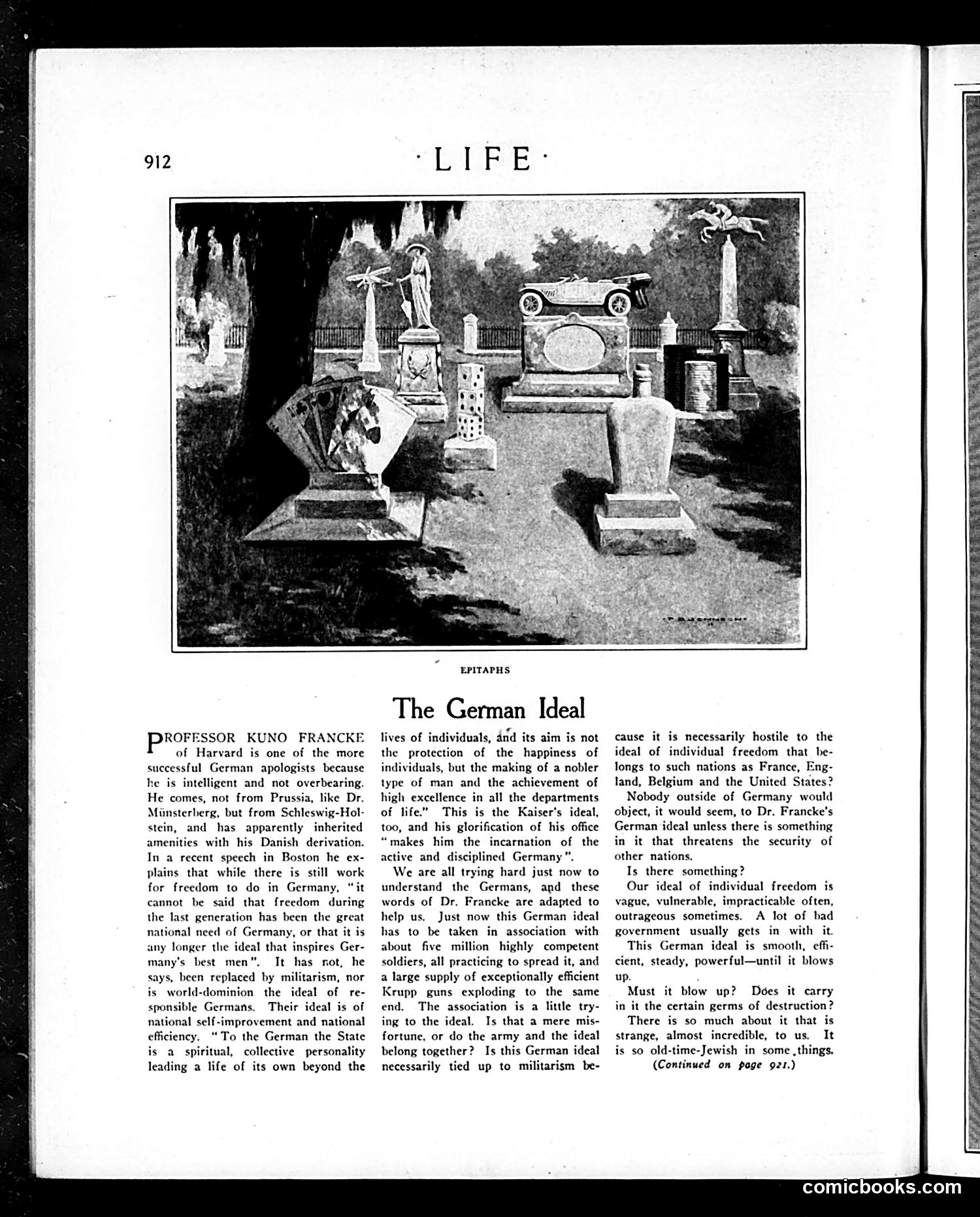
This is a satirical essay (not a cartoon) critiquing German ideology during World War I. The text analyzes a speech by Professor Kuno Francke of Harvard, a German apologist who argued that German national ideals prioritize state efficiency and collective excellence over individual freedom—unlike Western democracies. Life's satire is sharp: while acknowledging Francke's eloquence, the writer highlights the contradiction between this "spiritual" German ideal and its actual implementation through militarism and the Krupp munitions industry. The rhetorical questions—"Must it blow up? Does it carry the certain germs of destruction?"—mock the ideology's instability when paired with military aggression. The accompanying image shows an ornate cemetery with statues, a car as monument, and cypress trees, sarcastically visualizing Germany's glorification of its state and martial power as monuments to the dead. The essay questions whether German idealism is inherently incompatible with individual liberty and democratic values—a central American concern during WWI.
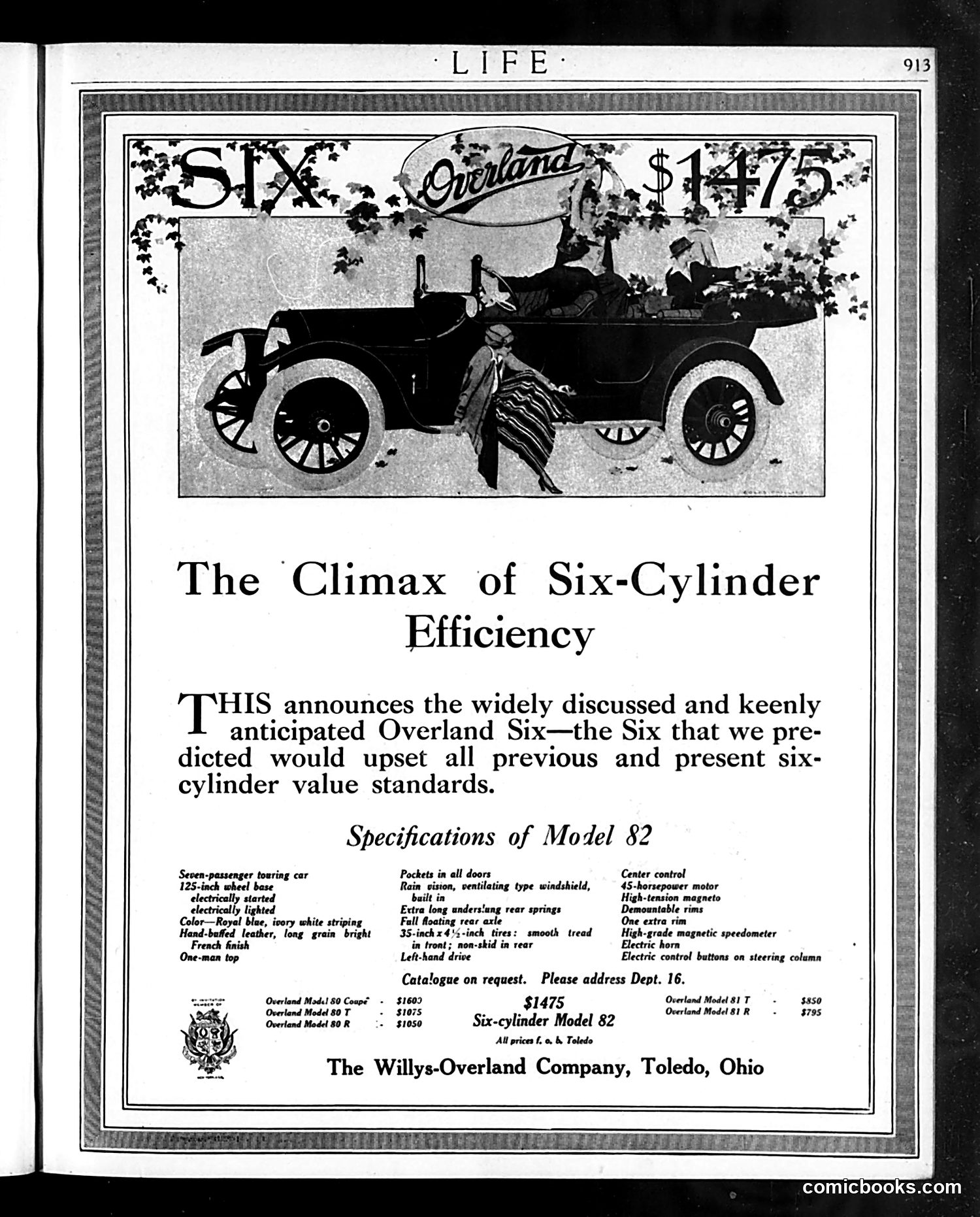
This is primarily a **car advertisement**, not political satire. The page announces the Overland Six Model 82 automobile, priced at $1,475. The illustration shows a stylized touring car with passengers, accompanied by decorative ivy and a fashionably dressed woman in 1920s attire—typical advertising imagery of the era meant to convey luxury and modernity. The "satire" angle, if present, is subtle: the ad boasts the car will "upset all previous and present six-cylinder value standards," suggesting competitors' six-cylinder vehicles are inferior. This is standard competitive advertising language rather than sharp satire. The detailed specifications (45-horsepower motor, electric start, hand-buffed leather seats, magnetic speedometer) emphasize technological advancement—key selling points for automobiles in this era. The manufacturer, Willys-Overland Company of Toledo, Ohio, was a legitimate major automaker of the 1920s. **Conclusion**: This is largely commercial advertising rather than satirical content.
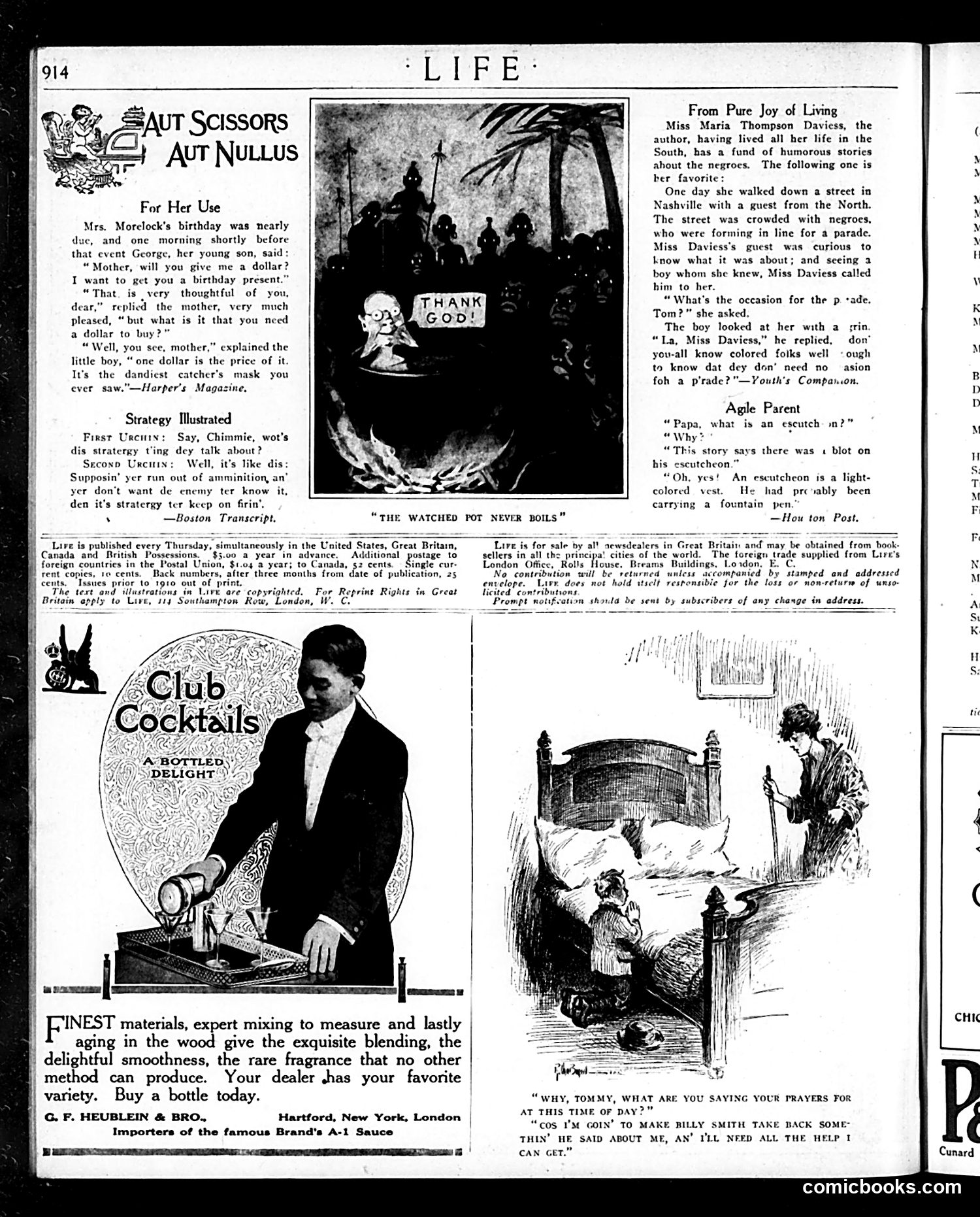
This page from *Life* magazine (early 20th century) contains several humor pieces: **"Aut Scissors Aut Nullus"** presents a joke about a boy wanting a dollar for his mother's birthday gift—a baseball catcher's mask he plans to use himself. The humor lies in the child's transparent selfishness masked as generosity. **"Strategy Illustrated"** is a brief immigrant dialect joke where two working-class characters discuss military strategy. One explains it as continuing to fire even when out of ammunition to deceive the enemy—satirizing the gap between military theory and common sense. The page also features racist humor typical of the era: a story by Maria Thompson Daviess depicting a Black boy in Nashville using dialect ("dey don' need no asion") to make a joke about parades. Additional content includes advertisements for Club Cocktails and a domestic humor cartoon about a child preparing prayers before a fight. The page reflects *Life*'s character as a satirical magazine mixing social commentary with period-appropriate (though now offensive) ethnic stereotyping.
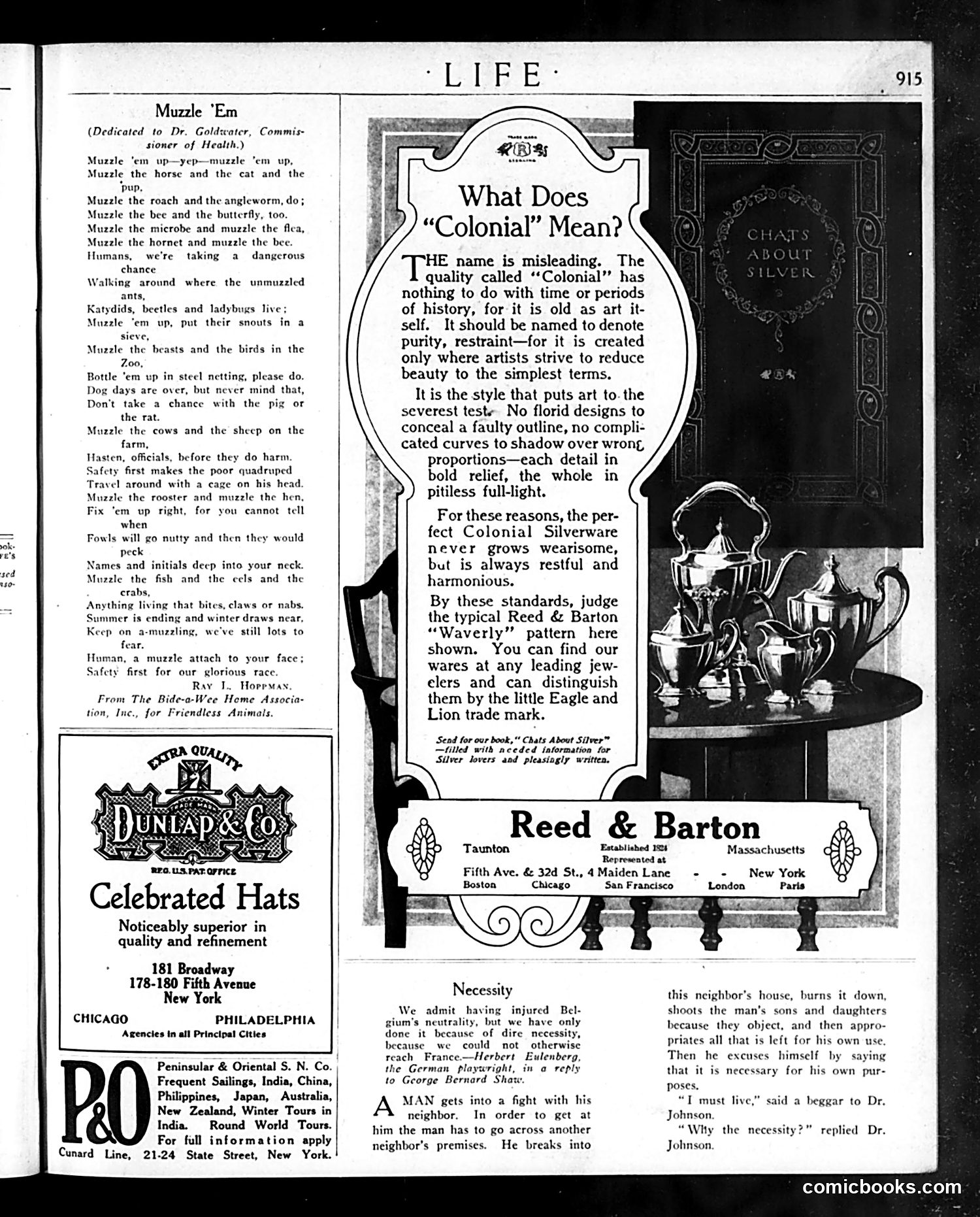
This poem satirizes excessive public-health regulation, specifically targeting Dr. Goldwater, NYC's Health Commissioner. The joke escalates absurdly: starting with reasonable disease-prevention measures (muzzling animals to prevent bites), it spirals into muzzling everything—insects, fish, even humans—reducing the concept of "safety first" to ridiculous extremes. The satire critiques over-regulation and the logic that any risk justifies any intervention. By the poem's end, humans themselves must be muzzled "for our glorious race," exposing how safety-obsessed bureaucracy becomes totalitarian nonsense. Below the poem, a separate section titled "Necessity" uses an analogy: a man justifying invading his neighbor's house (burning it, killing residents) because he "needs" to reach France. This appears to reference Germany's August 1914 invasion of neutral Belgium—defending it as necessary military strategy, a contemporary political controversy Life's readers would recognize.
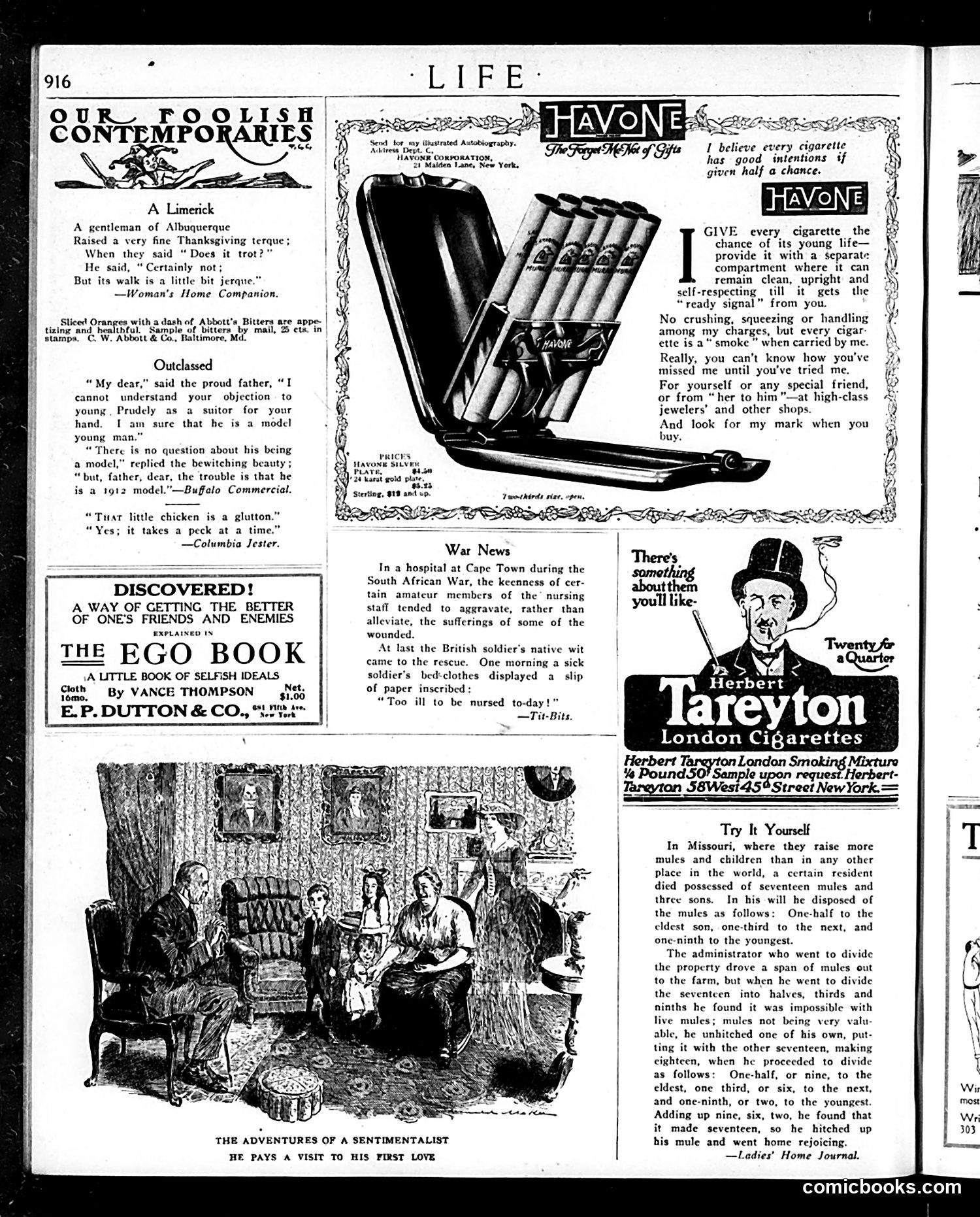
This page mixes humor pieces typical of early-20th-century American magazines with period advertisements. **The Humor Content:** The page features several short jokes and anecdotes—a limerick about a man from Albuquerque with a peculiar turkey, a father-daughter dialogue where she rejects a suitor because he's a "1912 model" (satirizing rapid industrial change and obsolescence), and a war anecdote from South Africa about an overeager nurse. These are lighthearted social commentary rather than political satire. **The Advertisements:** Notably, the page is dominated by cigarette ads (Havone and Herbert Tareyton), promoting cigarettes with imagery suggesting sophistication and gentlemanliness. A separate ad promotes "The Ego Book," a guide to selfish ideals—itself satirical. **Key Context:** This predates knowledge of smoking's health dangers. The page reflects turn-of-the-century America's embrace of modern consumer culture, industrial progress, and advertising-driven magazine publishing. The humor gently mocks social pretension and inefficiency rather than engaging in sharp political critique.
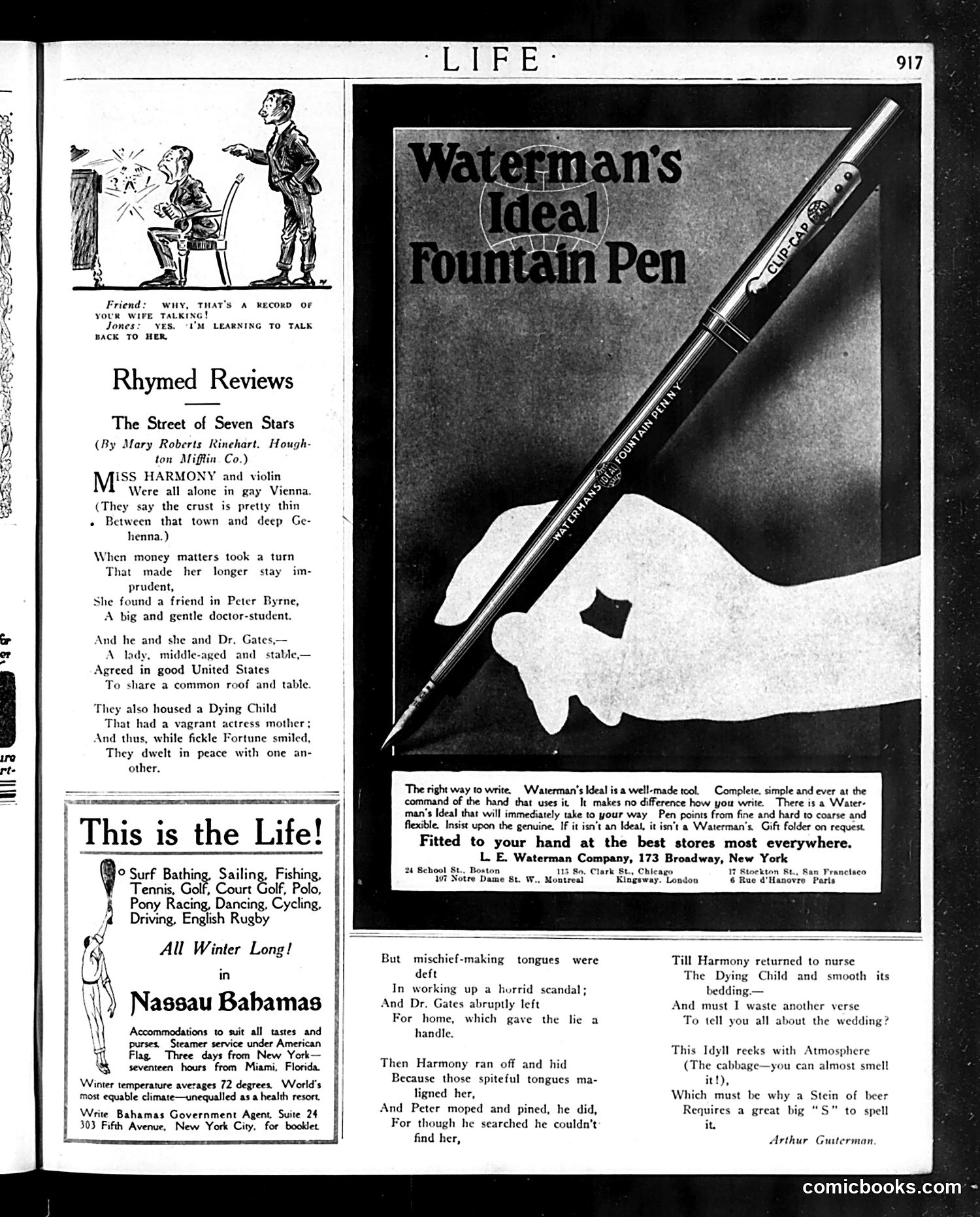
**The Cartoon (top left):** A man sits while a woman talks at him; he stands and says he's "learning to talk back to her." This is a domestic satire about marital communication—the joke is that the husband is finally standing up to his wife's constant talking, a common trope of early 20th-century humor mocking nagging spouses. **The Content:** This page is primarily a book review of *The Street of Seven Stars* by Mary Roberts Rinehart (a popular novelist), written in rhyming verse about a melodramatic plot involving Vienna, a woman named Harmony, a doctor, and scandal. The reviewer's final quip mocks the book's heavy "atmosphere"—particularly its use of cabbage as a local detail—joking that only a beer with a large "S" could spell it. **The Advertisements:** A Waterman's fountain pen ad and a Nassau Bahamas tourism ad occupy substantial space—typical content for *Life* magazine of this era. The page reflects early 1900s humor sensibilities: domestic comedy, literary satire, and consumer advertising.
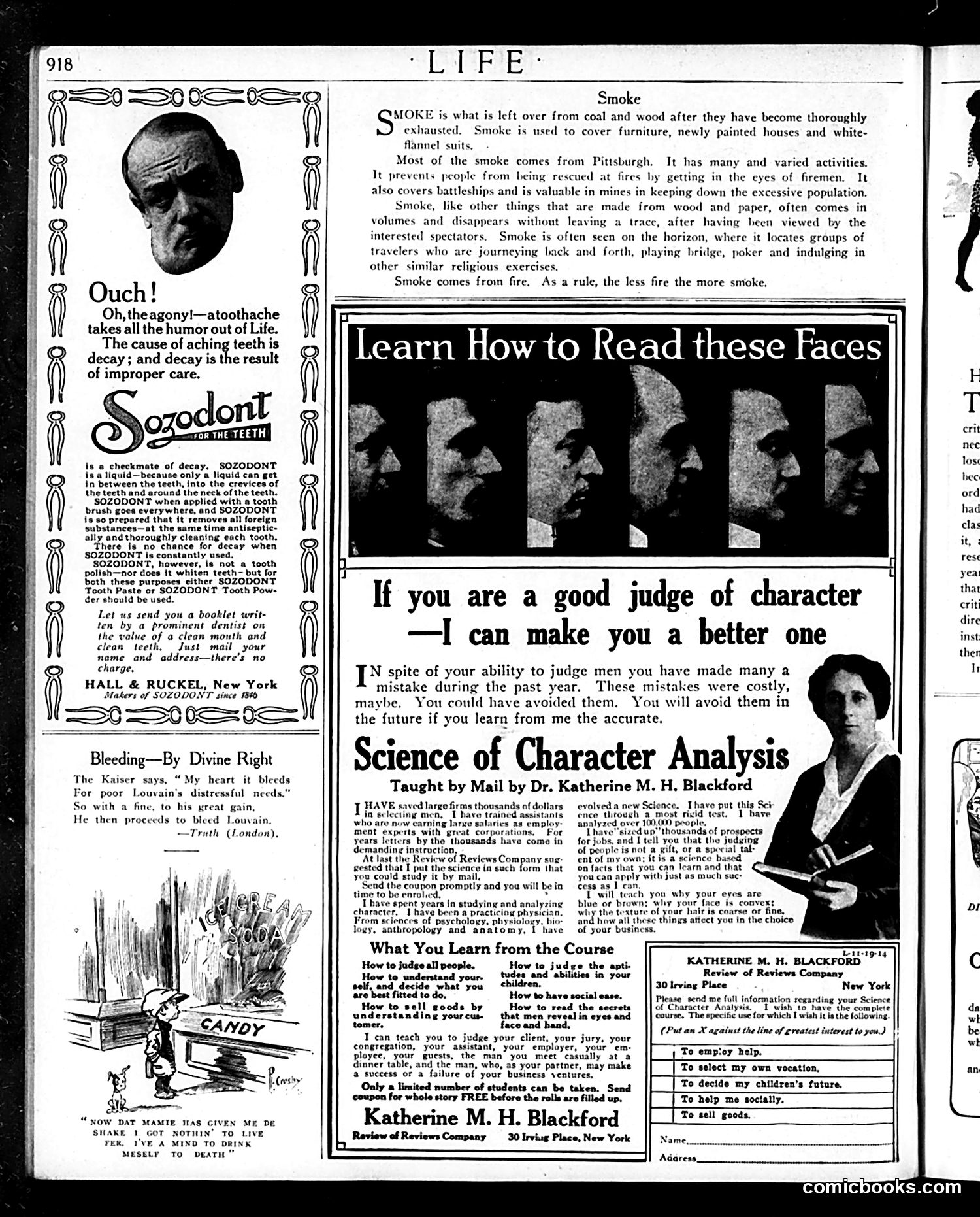
This page contains several distinct elements: **"Smoke" Satire**: A humorous essay mocking Pittsburgh's industrial pollution. It characterizes smoke as useful for covering furniture and "keeping down the excessive population" in mines—dark satire about industrial hazards and the city's notorious smog problem. **"Ouch!" Advertisement**: A dental product ad for Sozodont toothpaste, using a pained face to promote tooth care. **"Learn How to Read These Faces"**: The main feature advertises Dr. Katherine M. H. Blackford's mail-order "Science of Character Analysis" course. This references the early-20th-century pseudoscience of physiognomy—the belief that facial features reveal character. The course promises to teach readers to judge people's suitability for employment and relationships based on facial characteristics. **"Bleeding—By Divine Right"**: A brief satirical verse mocking Kaiser Wilhelm II's proclaimed humanitarian concerns while actually exploiting Louvain (Belgium), which suffered German atrocities in WWI. The page reflects period obsessions with scientism, industrial excess, and wartime propaganda.
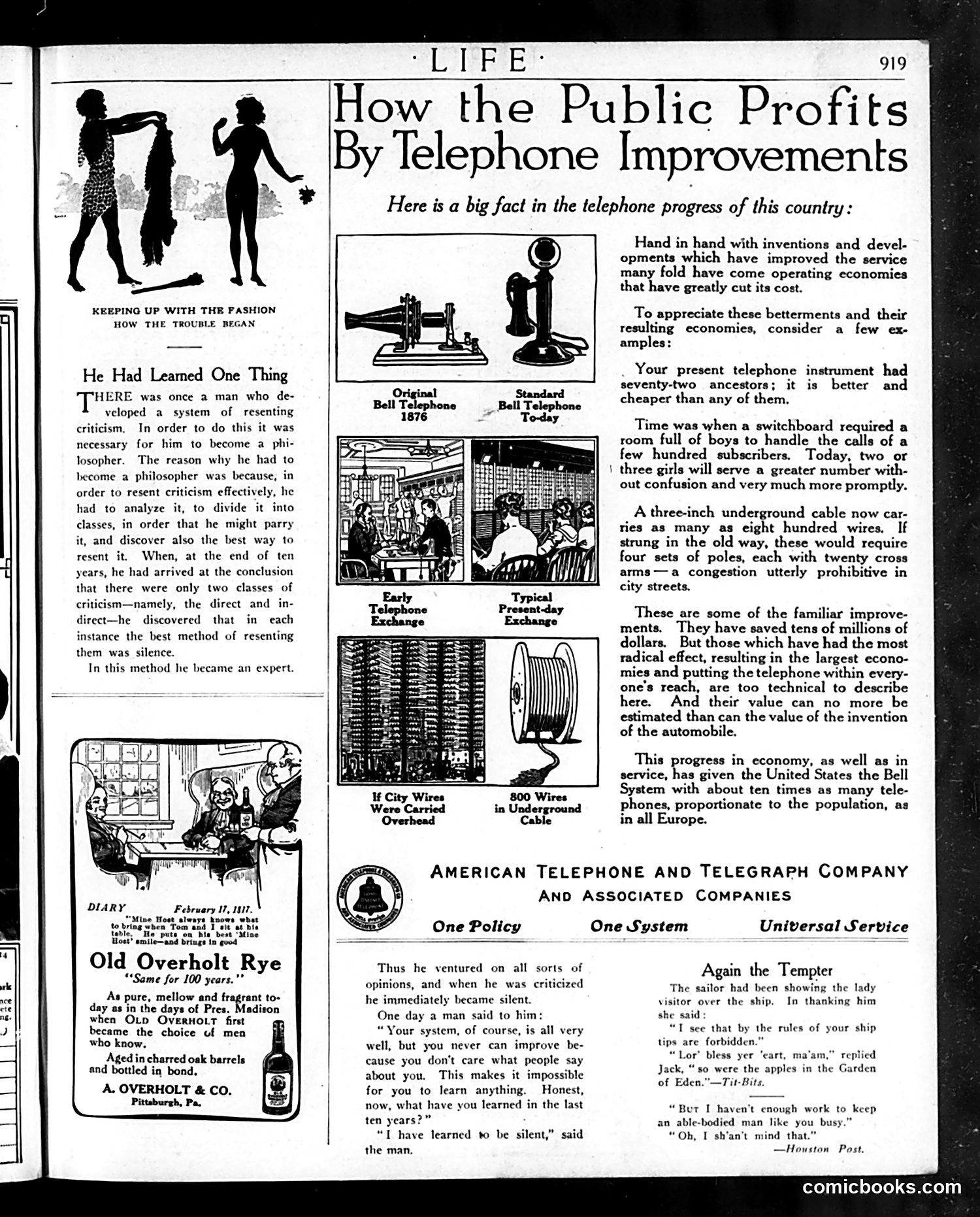
This page contains a mix of editorial content and advertising typical of early 20th-century Life magazine. **Main Editorial Content:** The right side features a corporate advertisement from American Telephone and Telegraph (AT&T) promoting telephone service improvements and cost efficiencies. It uses before-and-after comparisons—original 1876 telephone versus modern models, early switchboards versus contemporary ones—to argue that technological progress has made phones cheaper and more accessible to the public. This appears designed to justify AT&T's market dominance and service charges. **Left Side Humor/Satire:** A short story titled "He Had Learned One Thing" satirizes a man who responds to all criticism with silence, discovering this as his only "philosophy." The joke critiques obstinate people who dismiss feedback rather than improve. Below this is an advertisement for "Old Overholt Rye" whiskey, claiming 100 years of consistent quality. At the bottom are two brief humorous anecdotes about social etiquette (tips on ships, work expectations). The page blends corporate messaging with light satirical commentary—typical Life magazine content of the era.
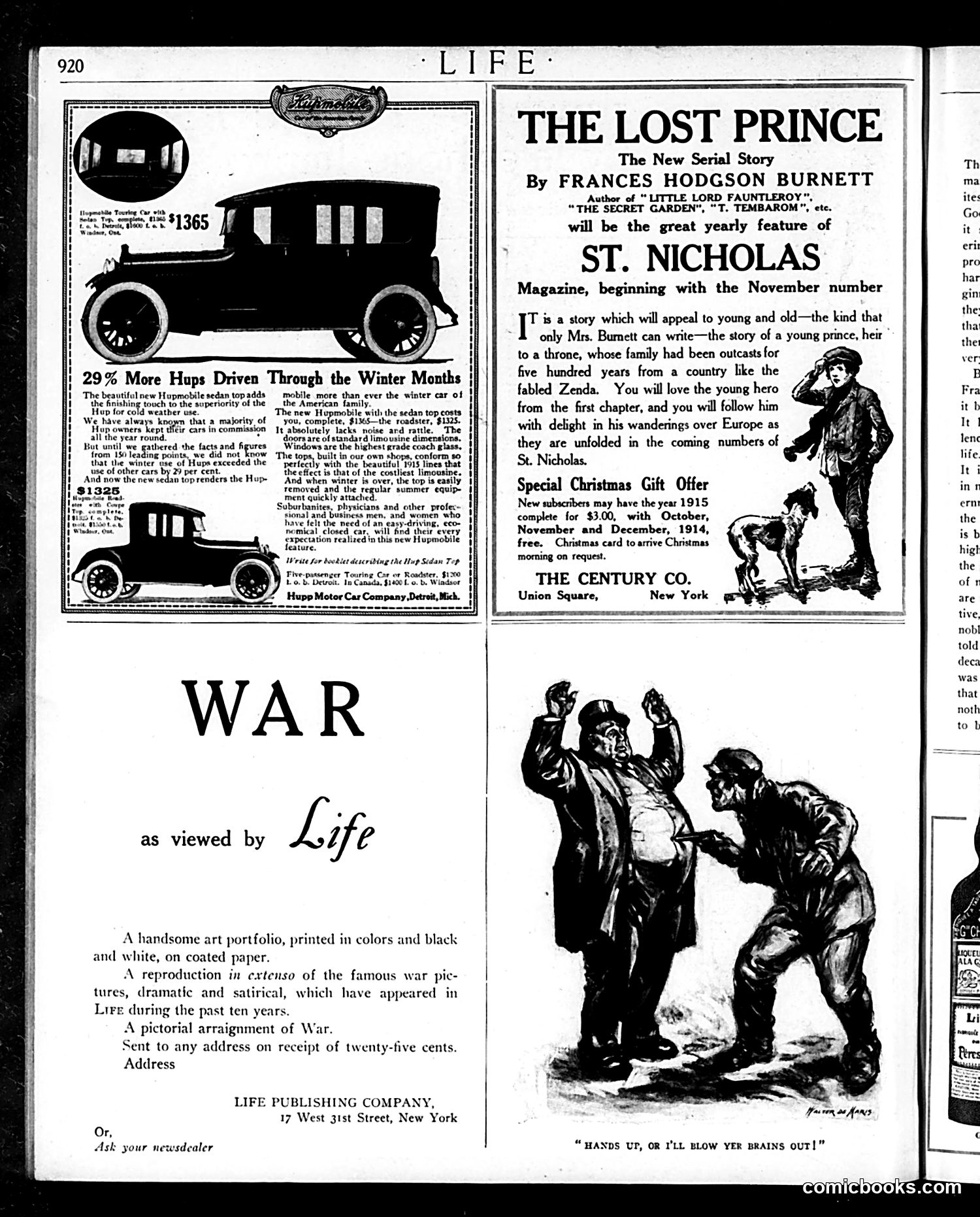
This page combines advertisements with editorial content typical of Life's satirical approach circa 1914-1915. **Top Left:** A Hupmobile automobile ad emphasizes winter driving capability—practical messaging for early automotive markets. **Top Right:** Announcement for Frances Hodgson Burnett's serial "The Lost Prince" in *St. Nicholas* magazine, targeting family audiences with a fairy-tale narrative about an exiled young prince. **Center:** Life advertises its own "War as viewed by Life"—a portfolio of satirical war cartoons accumulated over the previous decade, priced at 25 cents. This reflects Life's established role as a humor magazine offering political and social commentary. **Bottom:** A stark political cartoon (uncredited artist, signature unclear) depicts what appears to be a militaristic or revolutionary figure threatening another with "Hands up, or I'll blow yer brains out!" The crude dialect and violent imagery suggest satire of either wartime aggression or political extremism—likely commentary on contemporary European conflicts or domestic political tensions circa 1914-1915.
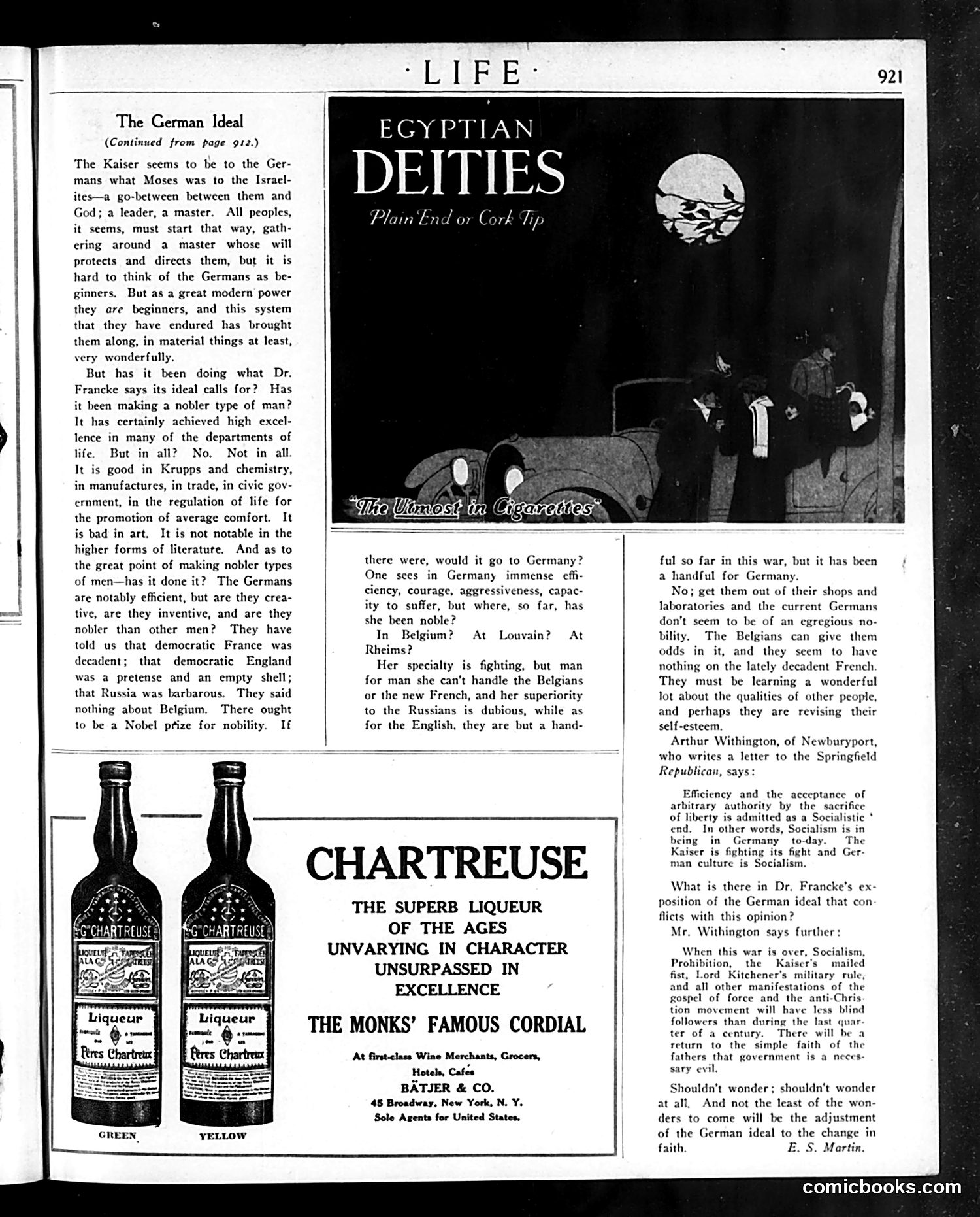
This page from *Life* magazine critiques German militarism during World War I. The main article, "The German Ideal," argues that while Germany achieved industrial and material efficiency under authoritarian leadership (comparing the Kaiser to Moses), it failed to produce moral nobility or creative culture. The author questions whether Germans truly excel at anything beyond manufacturing and fighting—pointedly referencing atrocities at Belgium, Louvain, and Rheims. A reader's letter from Arthur Withington then equates German authoritarianism with socialism, suggesting both sacrifice individual liberty for state control. The response predicts post-war disillusionment with "force" and a return to democratic values. The Egyptian deities advertisement and Chartreuse liqueur ad are unrelated commercial content typical of the era. **Context**: This reflects American intellectual skepticism toward German militarism circa 1914-1917, before U.S. entry into WWI.
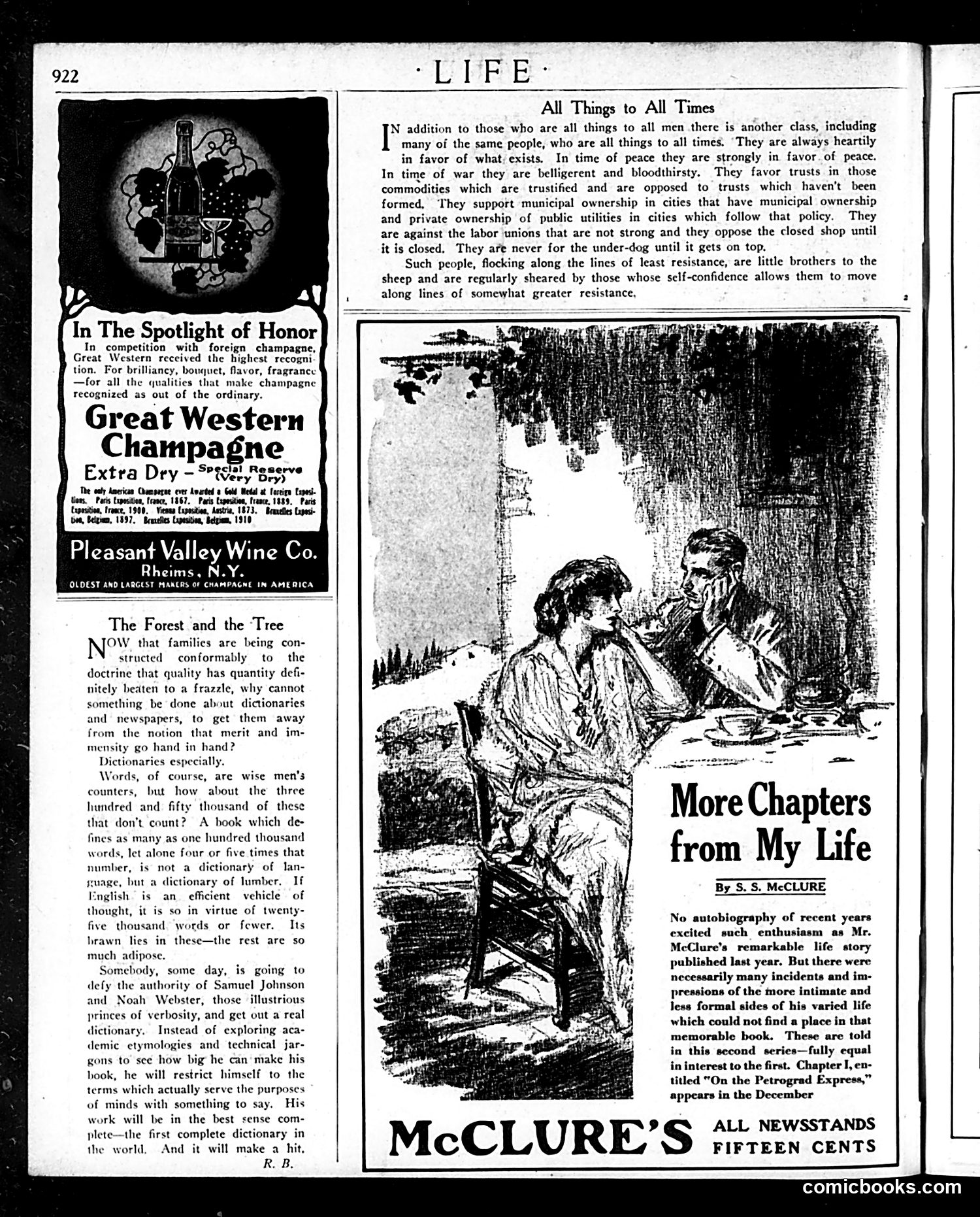
This page contains **three distinct pieces**: a champagne advertisement, and two opinion essays with accompanying illustration. **The Champagne Ad** promotes Great Western Champagne from Pleasant Valley Wine Co. (New York), claiming it won international gold medals competing against French champagne. **"The Forest and the Tree"** (by R.B.) critiques oversized dictionaries. The author argues that English efficiently uses only ~25,000 words, so comprehensive dictionaries including 100,000+ words are "lumber"—advocating for a slim, practical dictionary restricted to words that actually serve communication. **"All Things to All Times"** satirizes political and social opportunists who simply align with whatever currently exists or prevails. These "sheep-like" people support peace during peace, war during war, monopolies when formed, labor unions only when strong—always taking the path of least resistance rather than principled stands. The accompanying sketch shows two figures in conversation, illustrating this conformist mentality. All three pieces reflect Life's satirical mission critiquing American society's pretensions, wastefulness, and lack of independent thinking.
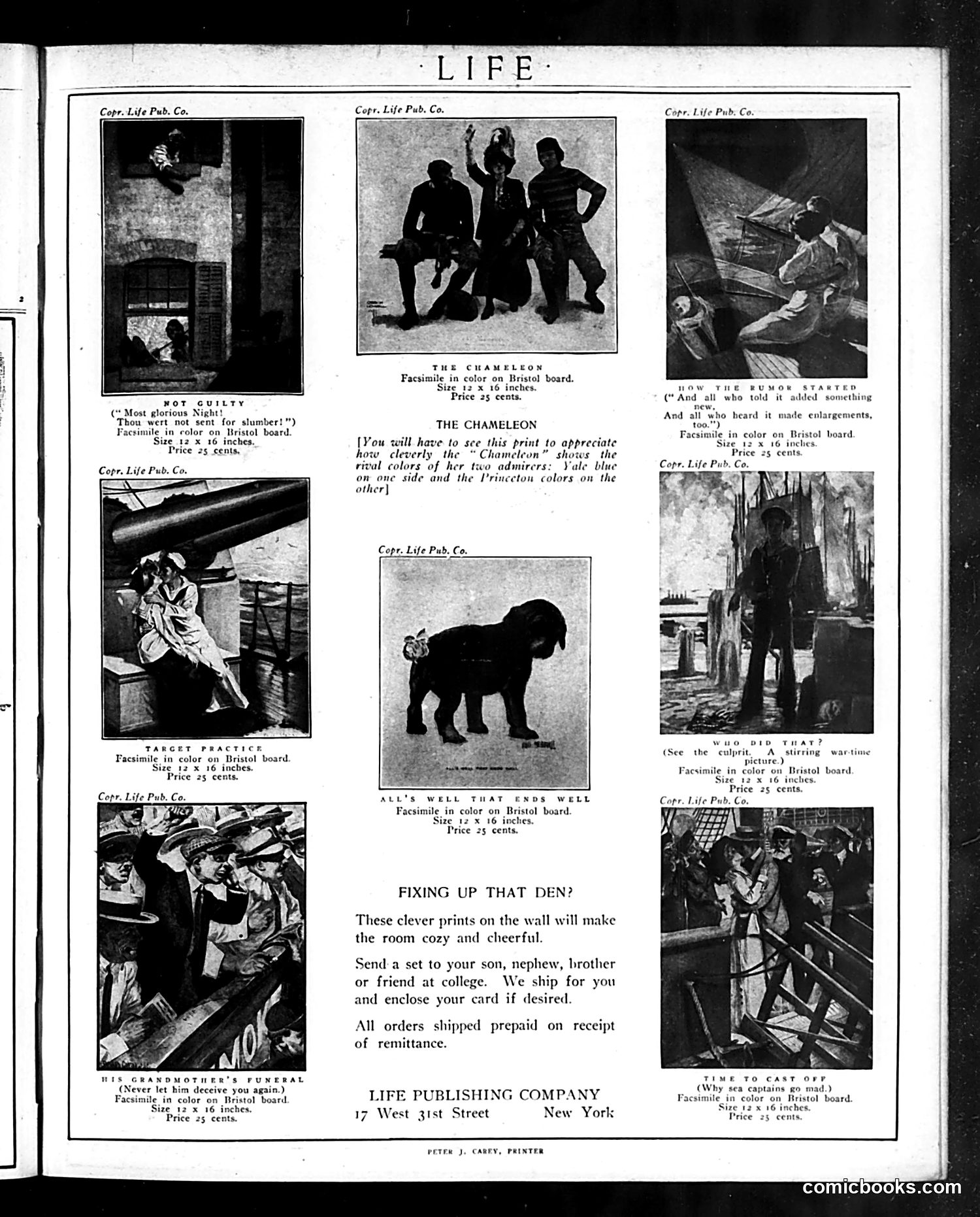
This page advertises satirical prints sold by Life Publishing Company for college dorm decoration. The captions indicate social humor of the era: **"The Chameleon"** jokes about a woman with two suitors—one from Yale, one from Princeton—showing rival university colors, playing on college rivalry and romantic fickleness. **"Not Guilty"** and **"Target Practice"** appear to reference romantic or domestic situations (exact meaning unclear from visible text). **"His Grandmother's Funeral"** likely satirizes insincere mourning or deception. **"The Rumor"** depicts how gossip spreads and grows with each retelling—a timeless joke about exaggeration. **"Time to Cast Off"** jokes about sailors going mad, suggesting nautical life's psychological toll. These were marketed as affordable ($0.25 each) wall decorations for college students, reflecting early 20th-century Life magazine's focus on genteel satire about university culture, romance, and social manners.
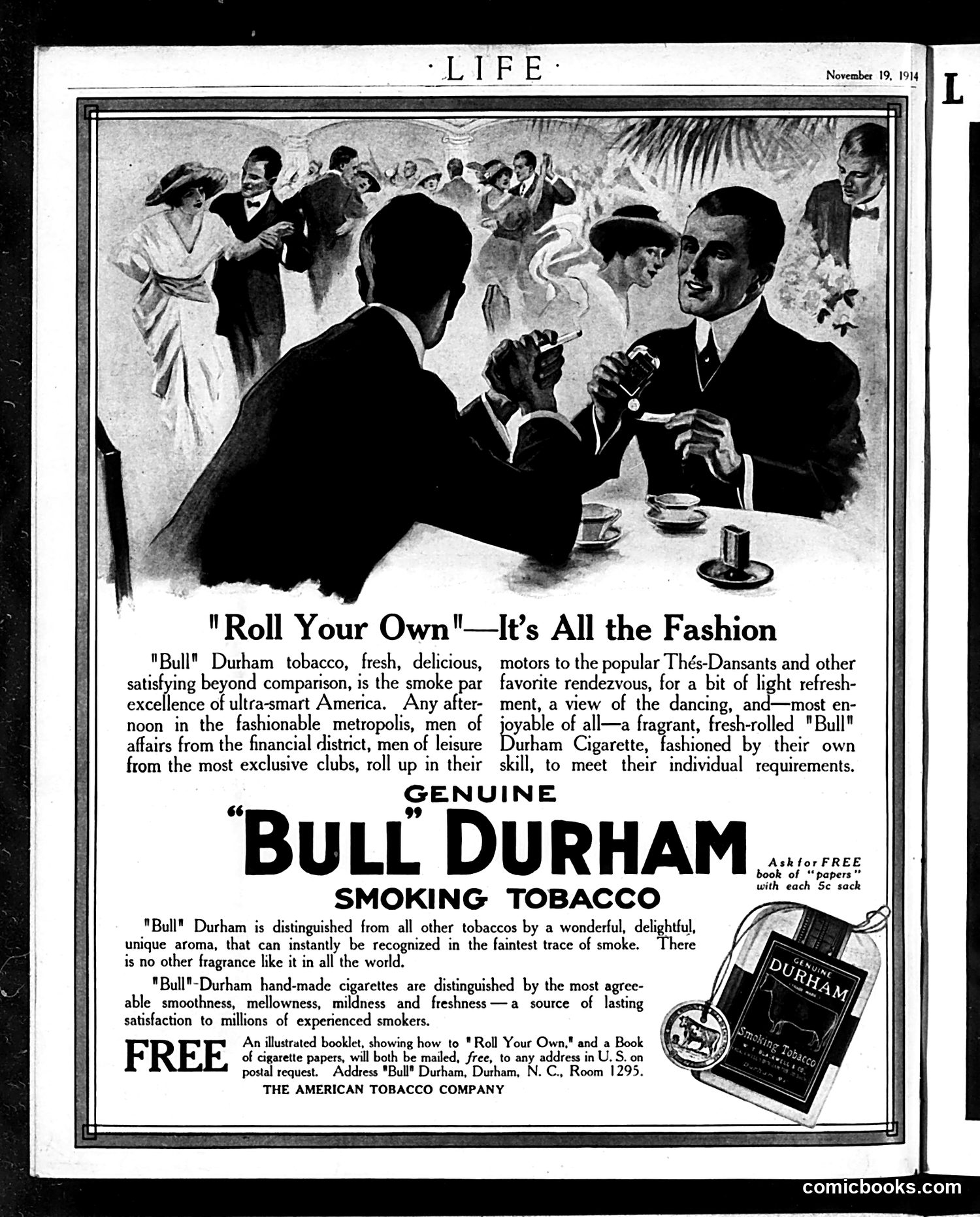
This is primarily a **tobacco advertisement**, not satire. The illustration depicts wealthy, fashionable men at an upscale afternoon tea dance ("Thés-Dansants")—a popular social venue of the era—rolling their own cigarettes from Bull Durham tobacco. The ad's appeal centers on a **paradox**: wealthy men of leisure and financial prominence are hand-rolling cheap cigarettes rather than purchasing pre-made ones. The advertisement frames this as sophisticated, fashionable behavior—suggesting that self-rolling demonstrates individual taste and skill, even among the elite. The text emphasizes the tobacco's "unique aroma" and the prestige of hand-crafting one's cigarettes. A free booklet on "how to roll your own" is offered. By 1914, this reflects genuine early-20th-century practice before mass-manufactured cigarettes fully dominated the market. The ad's humor lies in its implicit endorsement of humble self-rolling as a mark of refined taste among the wealthy.