
Life, 1914-11-19 · page 25 of 44
Life — November 19, 1914 — page 25: what you’re looking at
What you’re looking at
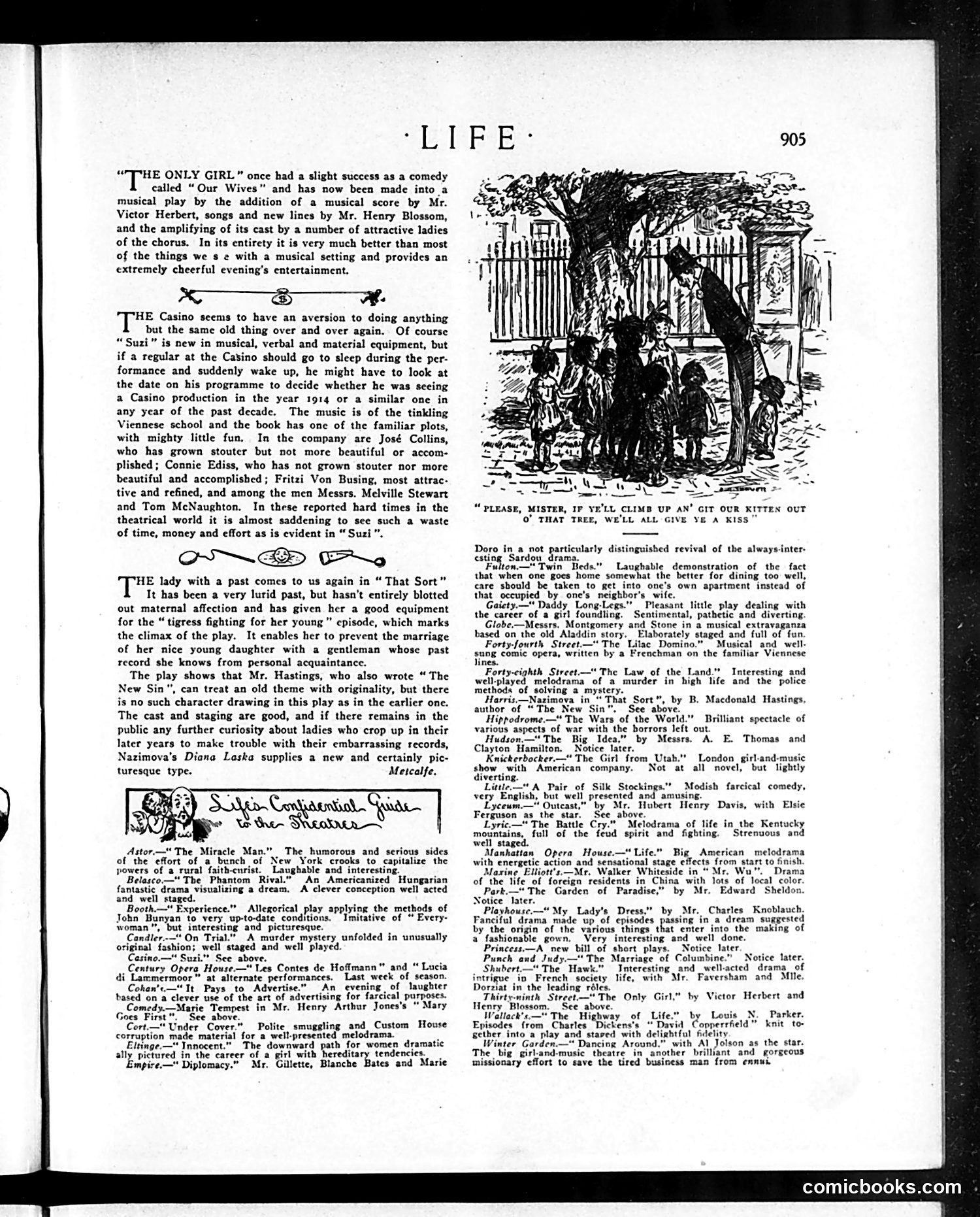
This page contains theater reviews from Life magazine, likely from 1914 based on internal references. The cartoon depicts a domestic scene—a man and woman with a child near a tree—illustrating the caption "Please, mister, if ye'll climb up an' git our kitten out o' that tree, we'll give ye a kiss." The satire appears to target sentimentality in theatrical plots. The reviews mock the predictability of Broadway productions: "The Only Girl" and "Suzi" are criticized for recycling tired formulas despite expensive productions; "That Sort" reprises the worn "woman with a scandalous past" plot device. The cartoon exemplifies this critique—it presents an overly sentimental domestic vignette, the kind of saccharine scenario these theatrical pieces apparently trafficked in. The reviews' tone is world-weary about theater's reliance on familiar narratives and "tinkling Viennese school" music rather than innovation, even during economically difficult times ("reported hard times in the theatrical world").
📄 Transcribed text from this page (OCR, searchable)
Machine-transcribed from the original scan — historical spelling and the odd misread are preserved.
Abate) 8p¢ bs 'HE ONLY GIRL" once had a slight success as a comedy called “Our Wives” and has now been made into a musical play by the addition of a musical score by Mr. Victor Herbert, songs and new lines by Mr. Henry Blossom, and the amplifying of its cast by a number of attractive ladies of the chorus. In its entirety it is very much better than most of the things we s ¢ with a musical setting and provides an extremely cheerful evening’s entertainment. Ts Casino seems to have an aversion to doing anything but the same old thing over and over again. Of course “Suzi” is new in musical, verbal and material equipment, but if a regular at the Casino should go to sleep during the per- formance and suddenly wake up, he might have to look at the date on his programme to decide whether he was sceing a Casino production in the year 1914 or a similar one in any year of the past decade. The music is of the tinkling iennese school and the book has one of the familiar plots, with mighty little fun. In the company are José Collins, who has grown stouter but not more beautiful or accom- plished; Connie Ediss, who has not grown stouter nor more beautiful and accomplished; Fritzi Von Busing, most attrac- tive and refined, and among the men Messrs. Melville Stewart and Tom McNaughton. In these reported hard times in the theatrical world it is almost saddening to see such a waste of time, money and effort as is evident in “Suzi”. ON ~&D © ~ HE lady with a past comes to us again in “ That Sort” It has been a very lurid past, but hasn't entirely blotted out maternal affection and has given her a good equipment for the “ tigress fighting for her young” episode, which marks the climax of the play. It enables her to prevent the marriage of her nice young daughter with a gentleman whose past record she knows from personal acquaintance. The play shows that Mr. Hastings, who also wrote “ The New Sin", can treat an old theme with originality, but there is no such character drawing in this play as in the earlier one. The cast and staging are good, and if there remains in the public any further curiosity about ladies who crop up in their later years to make trouble with their embarrassing records, Nazimova’s Diana Laska supplies a new and certainly pic- turesque type. Metcalfe. Astor —" The Miracle Man." The humorous and serious sides of the effort of a bunch of New York crooks to capitalize the powers of a rural faith-curist. Laughable and interesting. Belasco—" The Phantom Rival.” An Americanized Hungarian fantastic drama visualizing a dream. A clever conception well acted and well staged. Booth.—" Experience. nyan to very up-to-date conditions. but interesting and picturesque. On Trial.” A murder mystery unfolded in unusually original fashion; well staged and well played. Casino.—" Suzi. See above. * Century Opera House—" Les Contes de Hoffmann” and “ Lucia di Lammermoor” at alternate performances. Last week of season. Cokan’.—“ It Pays to Advertise.” An evening of laughter based on a clever use of the art of advertising for farcical purposes. Comedy.—Marie Tempest in Mr. Henry Arthur Jones's “ Mary Goes Fi ‘See above. ‘ Cort.—" Under Cover.” Polite smuggling and Custom House corruption made material for a well-presented melodrama. 5 i Innocent.” The downward path for women dramatic 1 of a girl with hereditary tendencies Mr. Gillette, Blanche Bates and Marie Allegorical play applying the methods of Imitative of “ Every- “ PLEASE, MISTER, IP YE'LL CLIMB UP AN’ GIT OUR KITTEN OUT 0’ THAT TREE, WE'LL ALL GIVE YE A KISS” Doro in a not particularly distinguished revival of the always-inter- esting Sardou_ drama. Fulton.—" Twin Beds" Laughable demonstration of the fact that when one goes home somewhat the better for dining too well, care should be taken to get into one’s own apartment instead of that occupied by one’s neighbor's wife. Gaiety.—" Daddy Long-Legs.” Pleasant little play dealing with the career of a girl foundling. Sentimental, pathetic and diverting. Globe.—Messrs. Montgomery and Stone in a musical extravaganza based on the old Aladdin story. Elaborately staged and full of fun. Forty-fourth Street—" The Lilac Domino.” Musical and well: red comic opera, written by a Frenchman on the familiar Viennese ines. Forty-cighth Street-—" The Law, of the Land." Interesting and well-played melodrama of a murder in high life and the police methods of solving a mystery. Harris.—Nazimova in“ That Sort”, by B. Macdonald Hastings, author of “The New Sin", See above. Hippodrome.—" The Wars of the World.” Brilliant spectacle of various aspects of war with the horrors left out. Hudson. —" The Big Idea,” by Messrs. A. E. Thomas and Clayton Hamilton. | Notice later. . Knickerbocker—“ The Girl from Utah.” London gitland-music show with American company. Not at ali novel, but lightly diverting. Little.—" A Pair of Silk Stockings.” Modish farcical comedy, very English, but well presented and amusing. _ Outcast," by Mr. Hubert Henry Davis, with Elsie See above. Lyric.—" The Battle Cry.” Melodrama of life in_the Kentucky mountains, full of the feud spirit and fighting. Strenuous and well staged. Manhattan Opera House. Life.” Big American melodrama with energetic action and sensational stage effects from start to finish EMiott's.—Mr. Walker Whiteside in “ Mr. Wu of foreign residents in China with lots of local color. The Garden of Paradise,” by Mr. Edward Sheldon. Playhouse.—" My Lady's. Dress.” by Mr. Charles Knoblauch, Fanciful drama made up of episodes passing in a dream suggested by the origin of the various things that enter into the making of a fashionable gown. Very interesting and well done. Princess.—A_new bill of short plays. Notice later. Punch and Judy.—" The Marriage of Columbine.” Notice later. Shubert.—" The Hawk.” Interesting and _well-acted drama’ of intrigue in French society life, with Mr. Faversham and Mille. Dorziat in the leading réles. Thirty-ninth Street-— The Only Girl," by Victor Herbert and Henry Blossom. See above. Wallack’s.—" The Highway of Life." by Louis N. Parker. Episodes from Charles Dickens's “David Copperrfield” knit to- gether into a play and staved with delightful fidelity Winter Garden.— Dancing Around.” with Al Jolson as the star. The big girl-and-music theatre in another brilliant and gorgeous missionary effort to save the tired business man from ennui comicbooks.com