
Life, 1914-11-19 · page 24 of 44
Life — November 19, 1914 — page 24: what you’re looking at
What you’re looking at
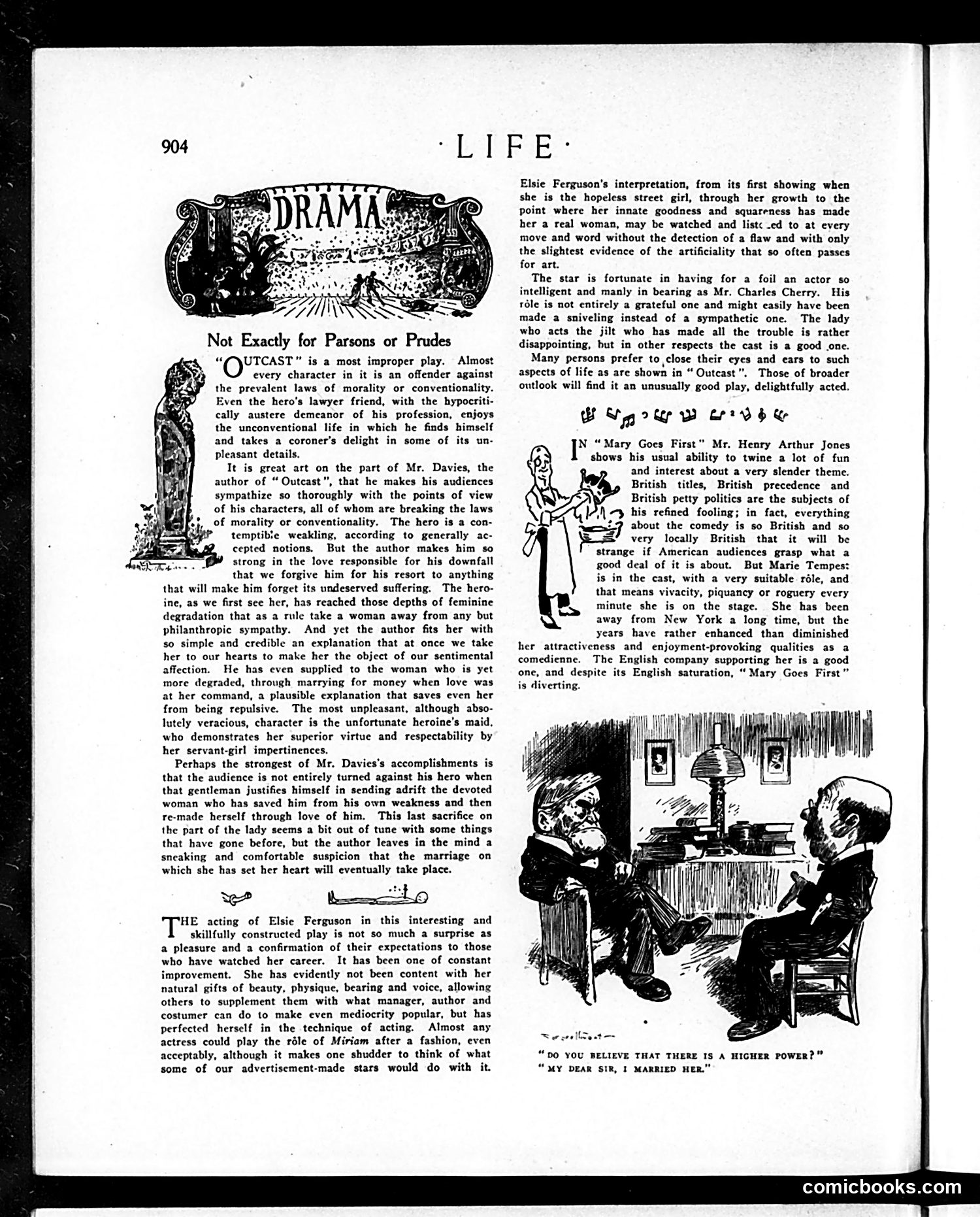
This page reviews a stage play called "Outcast" by Mr. Davies, starring actress Elsie Ferguson. The critic defends the work against presumed moral objections ("Not Exactly for Parsons or Prudes"). The play's innovation is that it portrays morally compromised characters—including a prostitute heroine and a weak hero—with such sympathy and credible motivation that audiences empathize with them despite their transgressions. The critic praises Davies for making audiences forgive characters who violate conventional morality. Ferguson's performance is praised as technically skilled and naturalistic. The supporting actor Charles Cherry is noted for bringing dignity to an ungrateful role. The cartoon at bottom (showing what appears to be a domestic scene) likely illustrates the play's central romantic tension—possibly the scene where the hero abandons his devoted woman, which the critic finds somewhat incongruous with the overall narrative.
📄 Transcribed text from this page (OCR, searchable)
Machine-transcribed from the original scan — historical spelling and the odd misread are preserved.
“LRRSE:: SS Not Exactly for Parsons or Prudes “(YUTCAST” is a most improper play. Almost every character in it is an offender against the prevalent laws of morality or conventionality. Even the hero's lawyer friend, with the hypocriti- cally austere demeanor of his profession, enjoys the unconventional life in which he finds himself and takes a coroner’s delight in some of its un- pleasant details. It is great art on the part of Mr. Davies, the author of “Outcast”, that he makes his audiences sympathize so thoroughly with the points of view of his characters, all of whom are breaking the laws of morality or conventionality. The hero is a con- temptibie weakling, according to generally ac- cepted notions, But the author makes him so strong in the love responsible for his downfall that we forgive him for his resort to anything that will make him forget its undeserved suffering. The hero- ine, as we first see her, has reached those depths of feminine degradation that as a rule take a woman away from any but philanthropic sympathy. And yet the author fits her with so simple and credible an explanation that at once we take her to our hearts to make her the object of our sentimental affection. He has even supplied to the woman who is yet more degraded, through marrying for money when love was at her command, a plausible explanation that saves even her from being repulsive. The most unpleasant, although abso- lutely veracious, character is the unfortunate heroine's maid. who demonstrates her superior virtue and respectability by her servant-girl impertinences. Perhaps the strongest of Mr. Davies's accomplishments is that the audience is not entirely turned against his hero when that gentleman justifies himself in sending adrift the devoted woman who has saved him from his own weakness and then re-made herself through love of him. This last sacrifice on the part of the lady seems a bit out of tune with some things that have gone before, but the author leaves in the mind a sneaking and comfortable suspicion that the marriage on which she has set her heart will eventually take place. HE acting of Elsie Ferguson in this interesting and skillfully constructed play is not so much a surprise as a pleasure and a confirmation of their expectations to those who have watched her career. It has been one of constant improvement. She has evidently not been content with her natural gifts of beauty, physique, bearing and voice, allowing others to supplement them with what manager, author and costumer can do to make even mediocrity popular, but has perfected herself in the technique of acting. Almost any actress could play the réle of Miriam after a fashion, even acceptably, although it makes one shudder to think of what some of our advertisement-made stars would do with it. Elsie Ferguson's interpretation, from its first showing when she is the hopeless street girl, through her growth to the point where her innate goodness and squareness has made her a real woman, may be watched and listc .ed to at every move and word without the detection of a flaw and with only the slightest evidence of the artificiality that so often passes for art. The star is fortunate in having for a foil an actor so intelligent and manly in bearing as Mr. Charles Cherry. His réle is not entirely a grateful one and might easily have been made a sniveling instead of a sympathetic one. The lady who acts the jilt who has made all the trouble is rather disappointing, but in other respects the cast is a good one. Many persons prefer to close their eyes and ears to such aspects of life as are shown in “ Outcast”. Those of broader outlook will find it an unusually good play, delightfully acted. OV g rer w ovew N “Mary Goes First” Mr. Henry Arthur Jones shows his usual ability to twine a lot of fun and interest about a very slender theme. British titles, British precedence and British petty politics are the subjects of > his refined fooling; in fact, everything WeahF about the comedy is so British and so very locally British that it will be strange if American audiences grasp what a good deal of it is about. But Marie Tempes: is in the cast, with a very suitable réle, and that means vivacity, piquancy or roguery every ca Minute she is on the stage. She has been away from New York a long time, but the years have rather enhanced than diminished her attractiveness and enjoyment-provoking qualities as a comedienne. The English company supporting her is a good one, and despite its English saturation, “Mary Goes First” is diverting. st “DO YOU BELIEVE THAT THERE IS A HIGHER POWER?” “MY DEAR SIR, 1 MARRIED HER.” comicbooks.com