
Life, 1914-11-19 · page 20 of 44
Life — November 19, 1914 — page 20: what you’re looking at
What you’re looking at
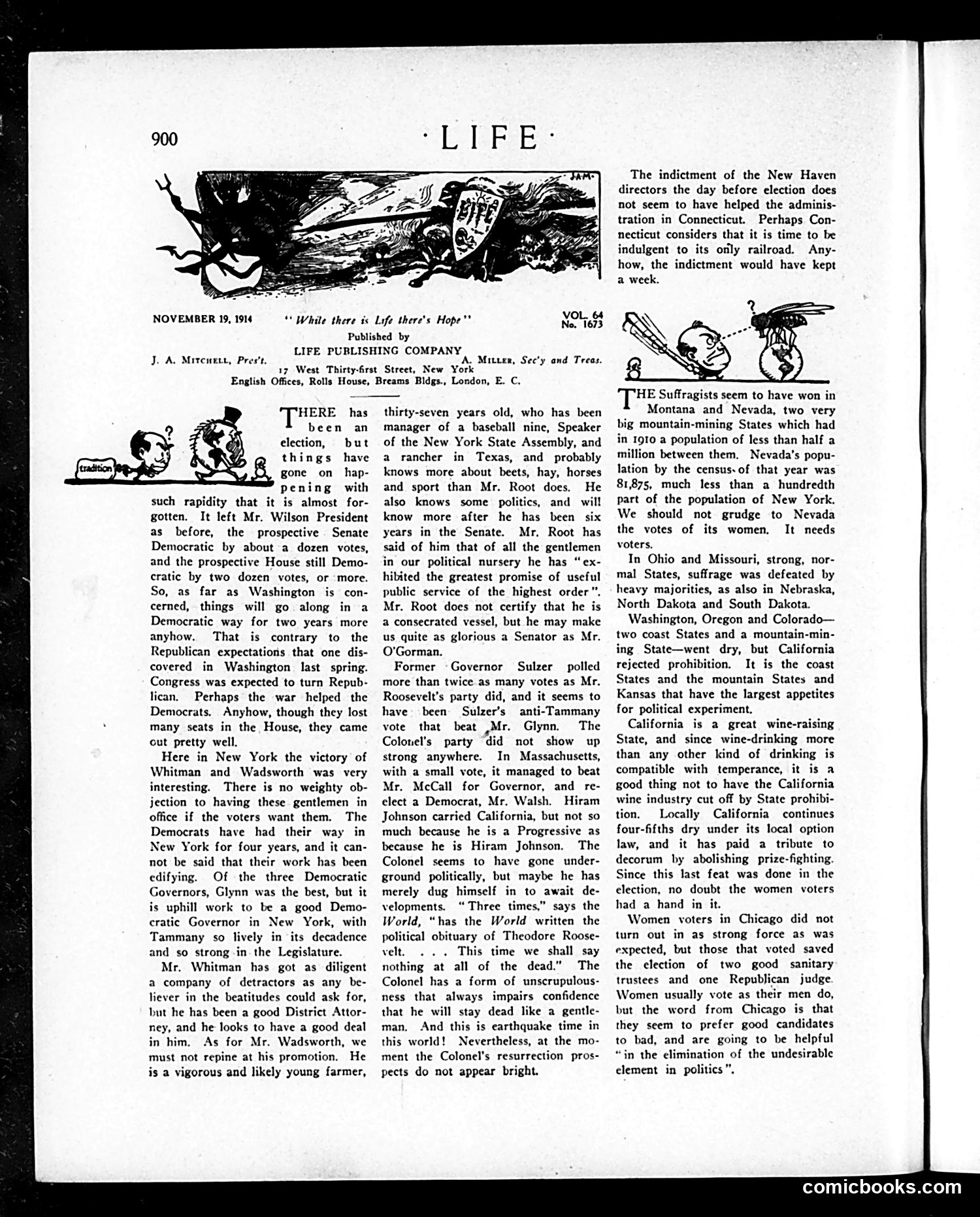
This page analyzes the 1914 U.S. midterm elections. The text discusses President Wilson's reelection and Democratic congressional performance, noting the party retained control despite Republican expectations. The article praises New York's newly elected Governor Whitman and Senator Wadsworth (described as a "vigorous and likely young farmer" and former baseball manager), suggesting they're improvements over Democratic governance plagued by Tammany Hall corruption. Notably, the piece addresses Theodore Roosevelt's failed Progressive Party bid, sarcastically noting the *World* newspaper has repeatedly written Roosevelt's "political obituary" but he may resurface—comparing him to an unreliable corpse that won't "stay dead like a gentleman." The cartoons (unclear in detail here) appear to be satirical illustrations accompanying this political analysis, typical of Life's visual commentary on contemporary politics and elections.
📄 Transcribed text from this page (OCR, searchable)
Machine-transcribed from the original scan — historical spelling and the odd misread are preserved.
NOVEMBER 19, 1914 “While there is Life there's Hope" No, 1673 Published by LIFE PUBLISHING COMPANY J. A. Mitenent, Pres't, 17 West Thirty-first Street, New Yor! A Miture, Sec'y and Treas. English Offices, Rolls House, Breams Bldgs, London, E. C, HERE has been an election, but things have gone on_ hap- pening with such rapidity that it is almost for- gotten. It left Mr. Wilson President as before, the prospective Senate Democratic by about a dozen votes, and the prospective House still Demo- cratic by two dozen votes, or more. So, as far as Washington is con- cerned, things will go along in a Democratic way for two years more anyhow. That is contrary to the Republican expectations that one dis- covered in Washington last spring. Congress was expected to turn Repub- lican, Perhaps the war helped the Democrats. Anyhow, though they lost many seats in the House, they came out pretty well. Here in New York the victory of Whitman and Wadsworth was very interesting. There is no weighty ob- jection to having these gentlemen in office if the voters want them. The Democrats have had their way in New York for four years, and it can- not be said that their work has been edifying. Of the three Democratic Governors, Glynn was the best, but it is uphill work to be a good Demo- cratic Governor in New York, with Tammany so lively in its decadence and so strong.in the Legislature. Mr. Whitman has got as diligent a company of detractors as any be- liever in the beatitudes could ask for, but he has been a good District Attor- ney, and he looks to have a good deal in him, As for Mr. Wadsworth, we must not repine at his promotion. He is a vigorous and likely young farmer, thirty-seven years old, who has been manager of a baseball nine, Speaker of the New York State Assembly, and a rancher in Texas, and probably knows more about beets, hay, horses and sport than Mr. Root does. He also knows some politics, and will know more after he has been six years in the Senate. Mr. Root has said of him that of all the gentlemen in our political nursery he has “ex- hibited the greatest promise of useful public service of the highest order”. Mr. Root does not certify that he is a consecrated vessel, but he may make us quite as glorious a Senator as Mr. O'Gorman. Former -Governor Sulzer polled more than twice as many votes as Mr. Roosevelt’s party did, and it seems to have been Sulzer’s anti-Tammany vote that beat ,Mr. Glynn. The Colonel's party did not show up strong anywhere. In Massachusetts, with a small vote, it managed to beat Mr. McCall for Governor, and re- elect a Democrat, Mr. Walsh. Hiram Johnson carried California, but not so much because he is a Progressive as because he is Hiram Johnson. The Colonel seems to have gone under- ground politically, but maybe he has merely dug himself in to await de- velopments. “Three times,” says the World, “has the World written the political obituary of Theodore Roose- velt. .. . This time we shall say nothing at all of the dead.” The Colonel has a form of unscrupulous- ness that always impairs confidence that he will stay dead like a gentle- man, And this is earthquake time in this world! Nevertheless, at the mo- ment the Colonel's resurrection pros- pects do not appear bright. The indictment of the New Haven directors the day before election does not seem to have helped the adminis- tration in Connecticut. Perhaps Con- necticut considers that it is time to be indulgent to its only railroad. Any- how, the indictment would have kept a week. HE Suffragists seem to have won in Montana and Nevada, two very big mountain-mining States which had in 1910 a population of less than half a million between them. Nevada's popu- lation by the census. of that year was 81,875, much less than a hundredth part of the population of New York. We should not grudge to Nevada the votes of its women, It needs voters. In Ohio and Missouri, strong, nor- mal States, suffrage was defeated by heavy majorities, as also in Nebraska, North Dakota and South Dakota. Washington, Oregon and Colorado— two coast States and a mountain-min- ing State—went dry, but California rejected prohibition. It is the coast States and the mountain States and Kansas that have the largest appetites for political experiment. California is a great wine-raising State, and since wine-drinking more than any other kind of drinking is compatible with temperance, it is a good thing not to have the California wine industry cut off by State prohibi- tion. Locally California continues four-fifths dry under its local option law, and it has paid a tribute to decorum by abolishing prize-fighting. Since this last feat was done in the election, no doubt the women voters had a hand in it. Women voters in Chicago did not turn out in as strong force as was expected, but those that voted saved the election of two good sanitary trustees and one Republican judge. Women usually vote as their men do, but the word from Chicago is that they seem to prefer good candidates to bad, and are going to be helpful “in the elimination of the undesirable element in politics”. comicbooks.com