
Life, 1914-11-19 · page 41 of 44
Life — November 19, 1914 — page 41: what you’re looking at
What you’re looking at
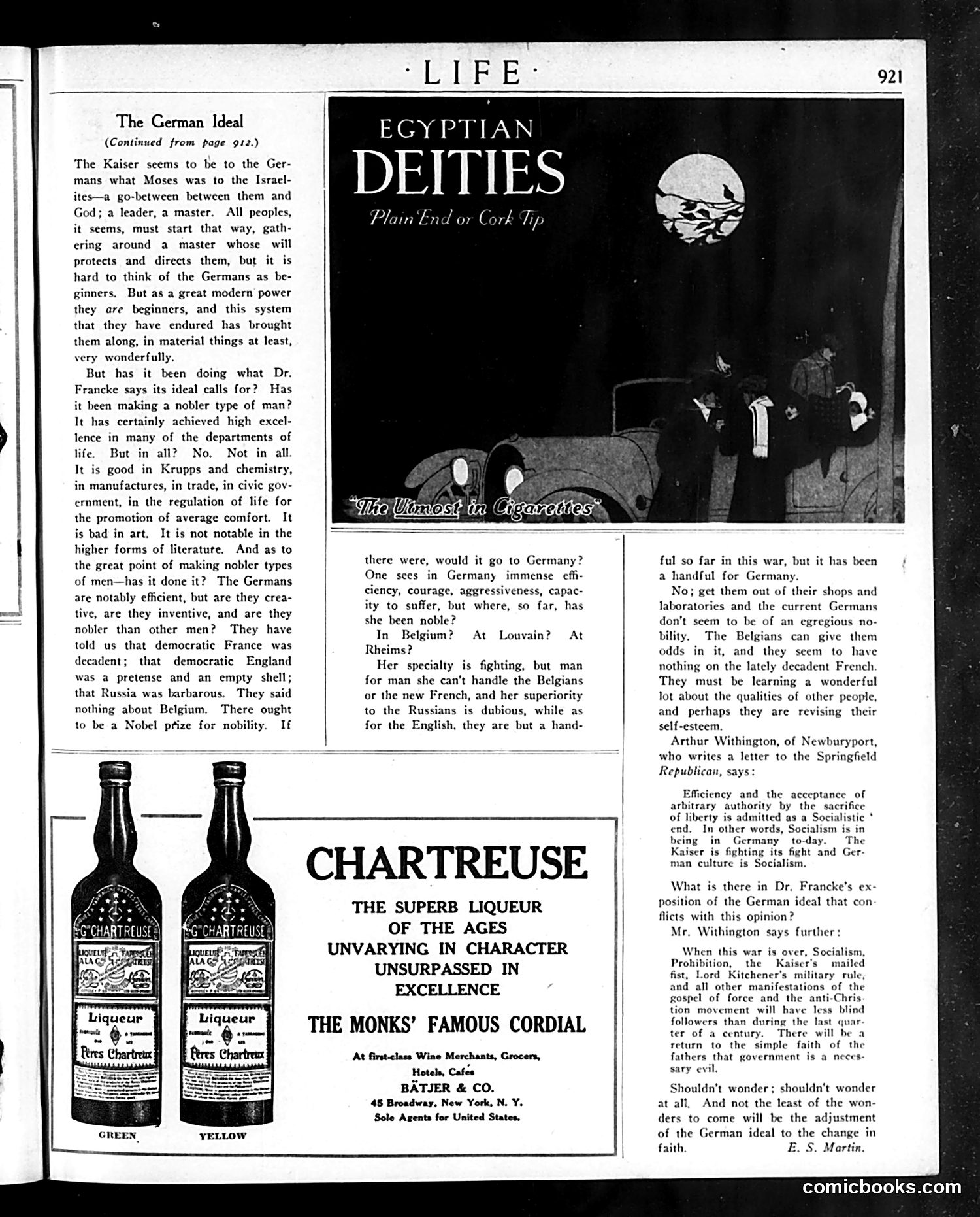
This page from *Life* magazine critiques German militarism during World War I. The main article, "The German Ideal," argues that while Germany achieved industrial and material efficiency under authoritarian leadership (comparing the Kaiser to Moses), it failed to produce moral nobility or creative culture. The author questions whether Germans truly excel at anything beyond manufacturing and fighting—pointedly referencing atrocities at Belgium, Louvain, and Rheims. A reader's letter from Arthur Withington then equates German authoritarianism with socialism, suggesting both sacrifice individual liberty for state control. The response predicts post-war disillusionment with "force" and a return to democratic values. The Egyptian deities advertisement and Chartreuse liqueur ad are unrelated commercial content typical of the era. **Context**: This reflects American intellectual skepticism toward German militarism circa 1914-1917, before U.S. entry into WWI.
📄 Transcribed text from this page (OCR, searchable)
Machine-transcribed from the original scan — historical spelling and the odd misread are preserved.
The German Ideal (Continued from page 912.) The Kaiser seems to be to the Ger- mans what Moses was to the Israel- ites—a go-between between them and God; a leader, a master. All peoples, it seems, must start that way, gath- ering around a master whose will protects and directs them, but it is hard to think of the Germans as be- ginners, But as a great modern power they are beginners, and this system that they have endured has brought them along, in material things at least, very wonderfully. But has it been doing what Dr. Francke says its ideal calls for? Has it been making a nobler type of man? It has certainly achieved high excel- lence in many of the departments of life. But in all? No, Not in all. It is good in Krupps and chemistry, in manufactures, in trade, in civic gov- ernment, in the regulation of life for the promotion of average comfort. It is bad in art. It is not notable in the higher forms of literature. And as to the great point of making nobler types of men—has it done it? The Germans are notably efficient, but are they crea- tive, are they inventive, and are they nobler than other men? They have told us that democratic France was decadent; that democratic England was a pretense and an empty shell; that Russia was barbarous. They said nothing about Belgium. There ought to be a Nobel prize for nobility. If EGYPTIAN DEITIES Plain En lor Cork Tip there were, would it go to Germany? One sees in Germany immense effi- ciency, courage, aggre: ness, capac- ity to suffer, but where, so far, has she been noble? In Belgium? At Louvain? At Rheims? Her specialty is fighting, but man for man she can’t handle the Belgians or the new French, and her superiority to the Russians is dubious, while as for the English, they are but a hand- “6° CHARTREUSE = GREEN YELLOW CHARTREUSE THE SUPERB LIQUEUR OF THE AGES UNVARYING IN CHARACTER UNSURPASSED IN EXCELLENCE THE MONKS’ FAMOUS CORDIAL At first-class Wine Merchants, Grocers, Hotels, Cafes BATJER & CO. 45 Broadway, New York, N. Y. Sole Agents for United States. ful so far in this war, but it has been a handful for Germany. No; get them out of their shops and laboratories and the current Germans don’t seem to be of an egregious no- bility. The Belgians can give them odds in it, and they seem to have nothing on the lately decadent French They must be learning a wonderful lot about the qualities of other people, and perhaps they are revising their self-esteem. Arthur Withington, of Newburyport, who writes a letter to the Springfield Republican, says: Efficiency and the acceptance of arbitrary authority by the sacrifice of liberty is admitted as a Socialistic * end. In other words, Socialism is in being in Germany’ to-day. The Kaiser is fighting its fight and Ger man culture is Socialism. What is there in Dr. Francke’s ex- position of the German ideal that con flicts with this opinion? Mr. Withington says further: When this war is over, Socialism, Prohibition, the Kaiser's mailed fist, Lord Kitchener's military rule, and all other manifestations of the gospel of force and the anti-Chris tion movement will have less blind followers than during the last quar ter of a century. There will be a return to the simple faith of the fathers that government is a neces- sary evil. Shouldn't wonder; shouldn't wonder at all, And not the least of the won- ders to come will be the adjustment of the German ideal to the change in faith, E. S. Martin. comicbooks.com