
Life, 1914-11-19 · page 28 of 44
Life — November 19, 1914 — page 28: what you’re looking at
What you’re looking at
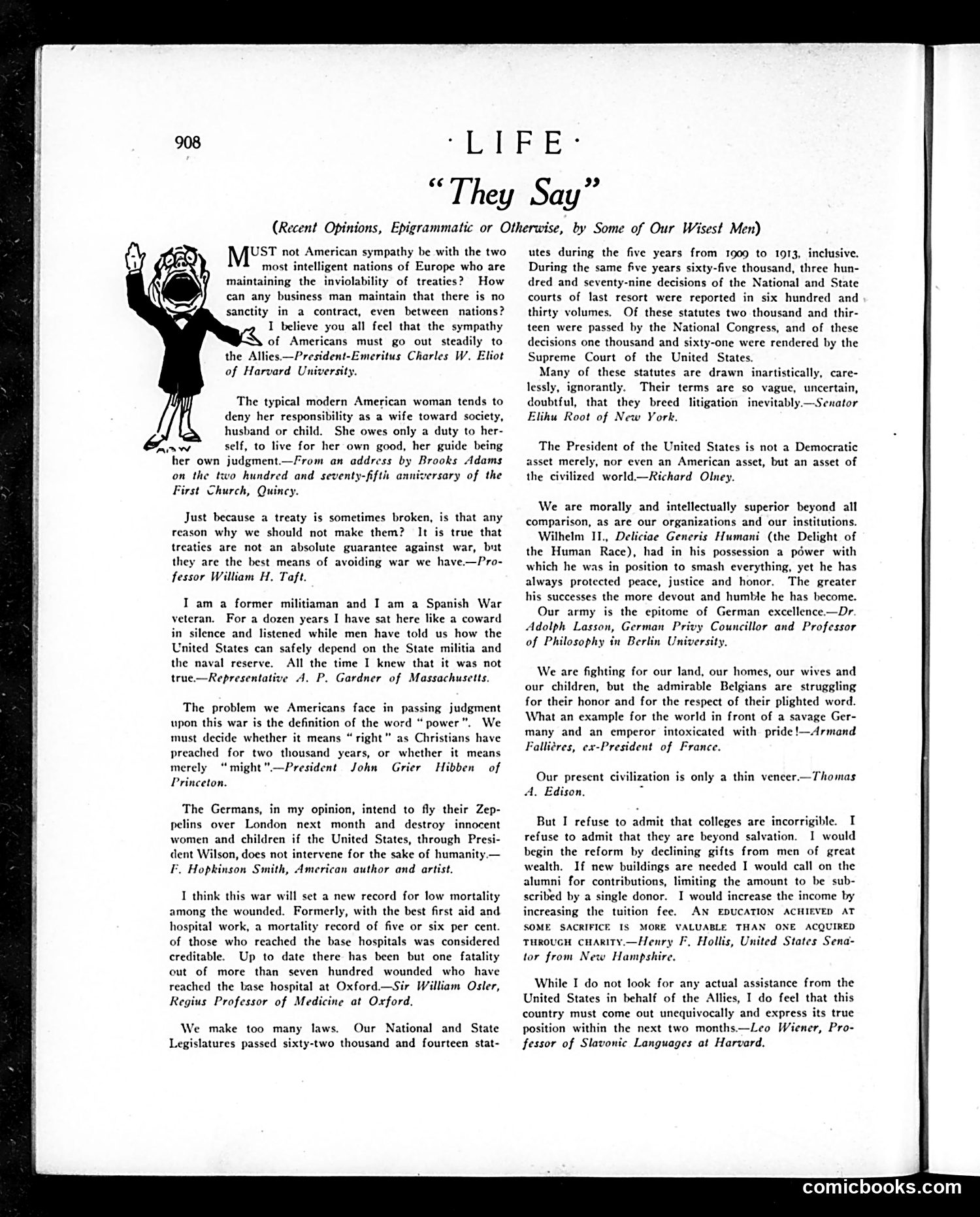
This is a satirical compilation of quotations from prominent American figures on World War I, presented as *Life* magazine's commentary on contemporary debate. The cartoon figure (a caricatured face) likely represents public opinion or the magazine itself observing these competing voices. The satire works through juxtaposition: statements by Harvard's Charles W. Eliot and others advocating for Allied sympathy are paired with contradictory quotes—such as Kaiser Wilhelm II's claim of moral superiority—to expose hypocrisy and absurdity on all sides. The page captures American division circa 1914-1917: should the U.S. support the Allies? Trust treaties? Reform domestic institutions? By presenting these "wise men" without editorial comment, *Life* sardonically lets their contradictions speak for themselves, suggesting that expert opinion is unreliable guidance for policy.
📄 Transcribed text from this page (OCR, searchable)
Machine-transcribed from the original scan — historical spelling and the odd misread are preserved.
—EalGRtE “They Say” (Recent Opinions, Epigrammatic or Otherwise, by Some of Our Wisest Men) UST not American sympathy be with the two most intelligent nations of Europe who are maintaining the inviolability of treaties? How can any business man maintain that there is no sanctity in a contract, even between nations? I believe you all feel that the sympathy of Americans must go out steadily to the Allies—President-Emeritus Charles W. Eliot of Harvard University The typical modern American woman tends to deny her responsibility as a wife toward society, husband or child. She owes only a duty to her- self, to live for her own good, her guide being her own judgment—From an address by Brooks Adams on the two hundred and seventy-fiftis anniversary of the First Church, Quincy. Just because a treaty is sometimes broken, is that any reason why we should not make them? It is true that treaties are not an absolute guarantee against war, but they are the best means of avoiding war we have—Pro- fessor William H, Taft. I am a former militiaman and I am a Spanish War veteran. For a dozen years I have sat here like a coward in silence and listened while men have told us how the United States can safely depend on the State militia and the naval reserve. All the time I knew that it was not true—Representative A. P. Gardner of Massachusetts. The problem we Americans face in passing judgment upon this war is the definition of the word “ power”. We must decide whether it means “right” as Christians have preached for two thousand years, or whether it means merely “might".—President John Grier Hibben of Princeton. The Germans, in my opinion, intend to fly their Zep- pelins over London next month and destroy innocent women and children if the United States, through Presi dent Wilson, does not intervene for the sake of humanity.— F, Hopkinson Smith, American author and artist. I think this war will set a new record for low mortality among the wounded. Formerly, with the best first aid and hospital work, a mortality record of five or six per cent. of those who reached the base hospitals was considered creditable. Up to date there has been but one fatality out of more than seven hundred wounded who have reached the base hospital at Oxford.—Sir William Osler, Regius Professor of Medicine at Oxford. We make too many laws. Our National and State Legislatures passed sixty-two thousand and fourteen stat- utes during the five years from 1909 to 1913, inclusive. During the same five years sixty-five thousand, three hun- dred and seventy-nine decisions of the National and State courts of last resort were reported in six hundred and thirty volumes, Of these statutes two thousand and thir- teen were passed by the National Congress, and of these decisions one thousand and sixty-one were rendered by the Supreme Court of the United States. Many of these statutes are drawn inartistically, care- lessly, ignorantly. Their terms are so vague, uncertain, doubtful, that they breed litigation inevitably—Senator Elihu Root of New York. The President of the United States is not a Democratic asset merely, nor even an American asset, but an asset of the civilized world.—Richard Olney. We are morally and intellectually superior beyond all comparison, as are our organizations and our institutions. Wilhelm II., Deliciae Generis Humani (the Delight of the Human Race), had in his possession a power with which he was in position to smash everything, yet he has always protected peace, justice and honor. The greater his successes the more devout and humble he has become. Our army is the epitome of German excellence.—Dr. Adolph Lasson, German Privy Councillor and Professor of Philosophy in Berlin University, We are fighting for our land, our homes, our wives and our children, but the admirable Belgians are struggling for their honor and for the respect of their plighted word. What an example for the world in front of a savage Ger- many and an emperor intoxicated with pride !—Armand Falliéres, ex-President of France. Our present civilization is only a thin vencer.—Thomas A. Edison. - But I refuse to admit that colleges are incorrigible. I refuse to admit that they are beyond salvation. 1 would begin the reform by declining gifts from men of great wealth. If new buildings are needed I would call on the alumni for contributions, limiting the amount to be sub- scribed by a single donor. I would increase the income by increasing the tuition fee. AN EDUCATION ACHIEVED AT SOME SACRIFICE MORE VALUABLE THAN ONE ACQUIRED TuroucH cHarity.—Henry F, Hollis, United States Sena- tor from New Hampshire. While I do not look for any actual assistance from the United States in behalf of the Allies, I do feel that this country must come out unequivocally and express its true position within the next two months.—Leo Wiener, Pro- fessor of Slavonic Languages at Harvard. comicbooks.com