
Life, 1914-11-19 · page 27 of 44
Life — November 19, 1914 — page 27: what you’re looking at
What you’re looking at
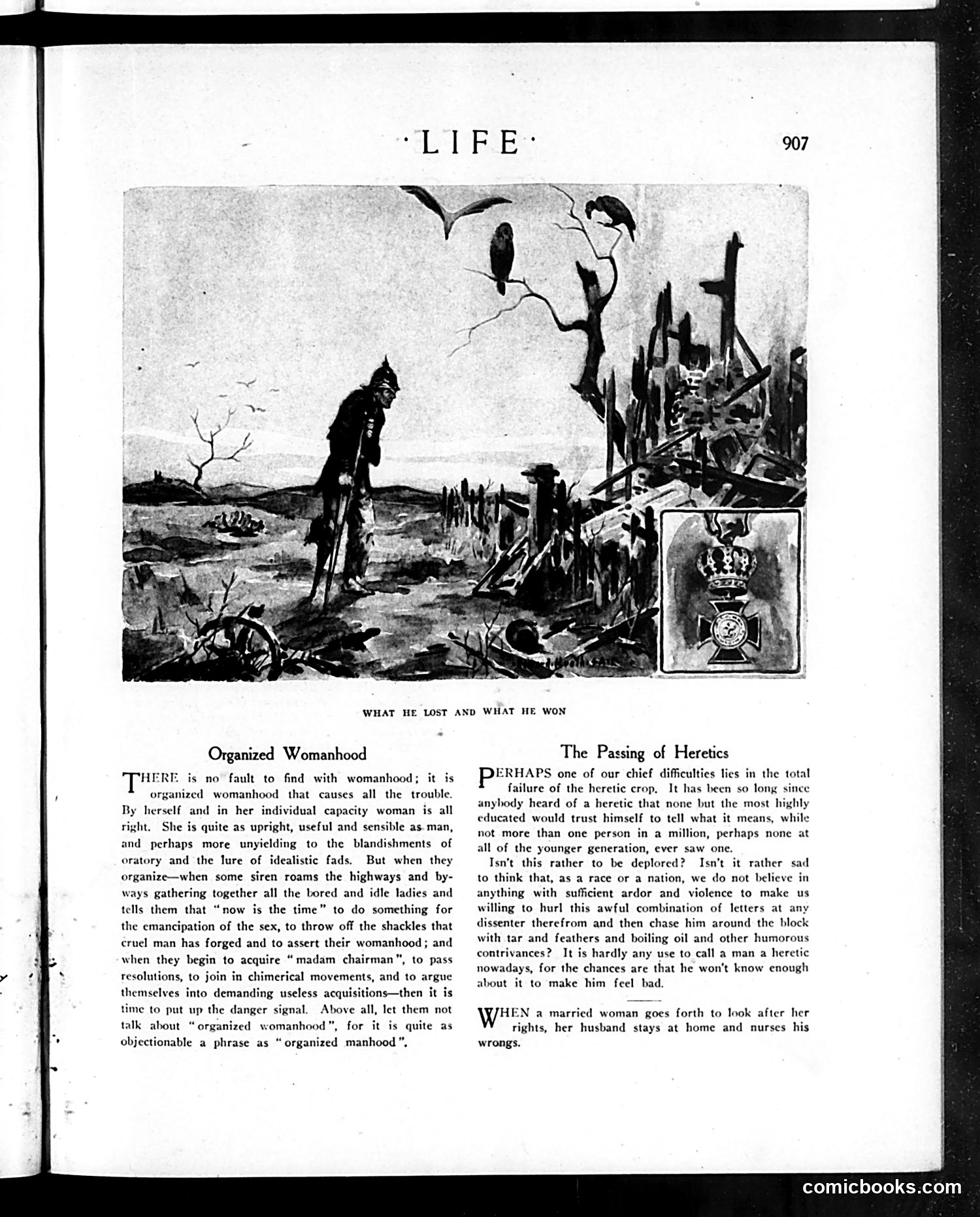
This page contains two satirical essays attacking early 20th-century social movements, likely from the 1910s-1920s era. **"Organized Womanhood"** mocks the women's suffrage and rights movement. The author argues that individual women are perfectly fine, but "organized womanhood"—women's groups demanding emancipation and "asserting their womanhood"—causes problems. The piece dismisses their activism as the work of "sirens" manipulating "bored and idle ladies" into "chimerical movements" and "useless acquisitions." This reflects anti-suffragist rhetoric that portrayed women's rights advocates as manipulated, frivolous troublemakers. **"The Passing of Heretics"** laments that modern society no longer violently persecutes dissenters, treating the absence of heretic-hunts as a cultural loss. It's darkly ironic commentary on social conformity. The accompanying illustration (captioned "What He Lost and What He Won") appears to show a desolate, war-ravaged landscape with a figure amid destruction, likely commenting on masculine sacrifice versus feminine gains from social change—reinforcing the first essay's anti-women's-rights stance. The page represents conservative opposition to women's equality movements of the era.
📄 Transcribed text from this page (OCR, searchable)
Machine-transcribed from the original scan — historical spelling and the odd misread are preserved.
WHAT HE LOST AND WHAT HE WON Organized Womanhood HERE is no fault to find with womanhood; it is organized womanhood that causes all the trouble. By herself and in her individual capacity woman is all right. and perhaps more unyielding to the blandishments of But when they She is quite as upright, useful and sensible as. man, oratory and the lure of idealistic fads. organize—when some siren roams the highways and by- ways gathering together all the bored and idle ladies and tells them that “now is the time” to do something for the emancipation of the sex, to throw off the shackles that cruel man has forged and to assert their womanhood ; and when they begin to acquire “madam chairman”, to pass resolutions, to join in chimerical movements, and to argue themselves into demanding useless acquisitions—then it is Above all, let them not for it is quite as time to put up the danger signal. talk about “organized womanhoo¢ objectionable a phrase as “organized manhood”, The Pas ing of Heretics ERHAPS one of our chief difficulties lies in the total failure of the heretic crop, It has been so long since anybody heard of a heretic that none but the most highly educated would trust himself to tell what it means, while not more than one person in a million, perhaps none at all of the younger generation, ever saw one. Isn't this rather to be deplored? Isn't it rather sad to think that, as a race or a nation, we do not believe in anything with sufficient ardor and violence to make us willing to hurl this awful combination of letters at any dissenter therefrom and then chase him around the block with tar and feathers and boiling oil and other humorous contrivances? It is hardly any use to call a man a heretic nowadays, for the chances are that he won't know enough about it to make him feel bad. Wi a married woman goes forth to look after her rights, her husband stays at home and nurses his wrongs. comicbooks.com