
Life, 1914-11-19 · page 32 of 44
Life — November 19, 1914 — page 32: what you’re looking at
What you’re looking at
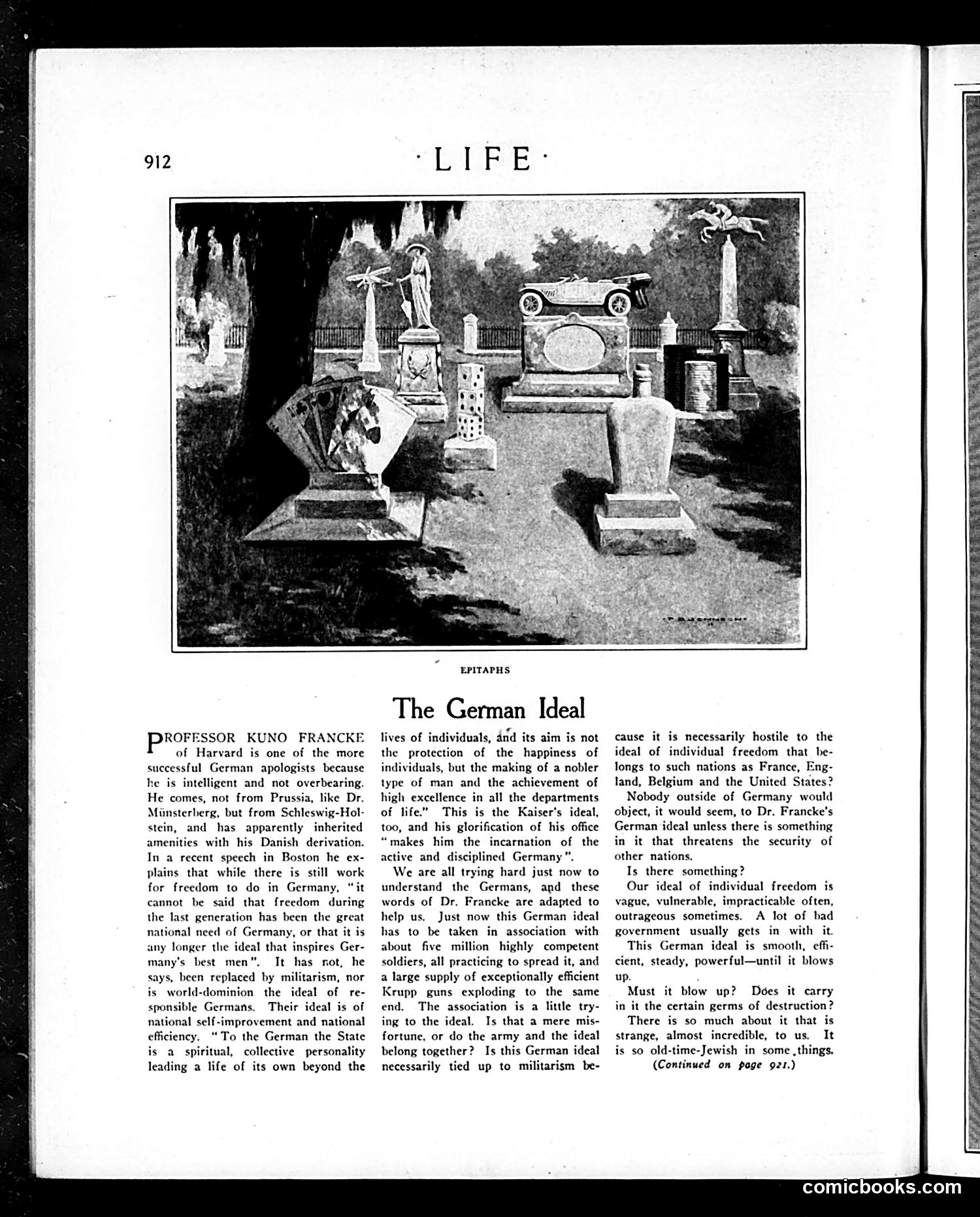
This is a satirical essay (not a cartoon) critiquing German ideology during World War I. The text analyzes a speech by Professor Kuno Francke of Harvard, a German apologist who argued that German national ideals prioritize state efficiency and collective excellence over individual freedom—unlike Western democracies. Life's satire is sharp: while acknowledging Francke's eloquence, the writer highlights the contradiction between this "spiritual" German ideal and its actual implementation through militarism and the Krupp munitions industry. The rhetorical questions—"Must it blow up? Does it carry the certain germs of destruction?"—mock the ideology's instability when paired with military aggression. The accompanying image shows an ornate cemetery with statues, a car as monument, and cypress trees, sarcastically visualizing Germany's glorification of its state and martial power as monuments to the dead. The essay questions whether German idealism is inherently incompatible with individual liberty and democratic values—a central American concern during WWI.
📄 Transcribed text from this page (OCR, searchable)
Machine-transcribed from the original scan — historical spelling and the odd misread are preserved.
ROFESSOR KUNO FRANCKE of Harvard is one of the more successful German apologists because he is intelligent and not overbearing. He comes, not from Prussia, like Dr. Miinsterberg, but from Schleswig-Hol- stein, and has apparently inherited amenities with his Danish derivation. In a recent speech in Boston he ex- plains that while there is still work for freedom to do in Germany, cannot be said that freedom during the last generation has been the great national need of Germany, or that it is any longer the ideal that inspires Ger- many’s best men”. It has not, he says, been replaced by militarism, nor is world-dominion the ideal of re- sponsible Germans. Their ideal is of national self-improvement and national efficiency. “To the German the State is a spiritual, collective personality leading a life of its own beyond the EPITAPHS The German Ideal lives of individuals, dnd its aim is not the protection of the happiness of individuals, but the making of a nobler type of man and the achievement of high excellence in all the departments of life.” This is the Kaiser's ideal, too, and his glorification of his office “makes him the incarnation of the active and disciplined Germany”. We are all trying hard just now to understand the Germans, apd these words of Dr. Francke are adapted to help us, Just now this German ideal has to be taken in association with about five million highly competent soldiers, all practicing to spread it, and a large supply of exceptionally efficient Krupp guns exploding to the same end. The association is a little try- ing to the ideal. Is that a mere mis- fortune, or do the army and the ideal belong together? Is this German ideal necessarily tied up to militarism be- cause it is necessarily hostile to the ideal of individual freedom that be- longs to such nations as France, Eng- land, Belgium and the United States? Nobody outside of Germany would object, it would seem, to Dr. Francke's German ideal unless there is something in it that threatens the security of other nations. Is there something? Our ideal of individual freedom is vague, vulnerable, impracticable often, outrageous sometimes. A lot of bad government usually gets in with it This German ideal is smooth, effi- cient, steady, powerful—until it blows up. Must it blow up? Does it carry it the certain germs of destruction? There is so much about it that is strange, almost incredible, to us. It is so old-time-Jewish in some ,things. (Continued on page 921.) comicbooks.com